REVIEW 5 major objections 6 minor 84 references
LaVin-DiT: Large Vision Diffusion Transformer
T0 review · 5 major / 6 minor · reviewed 2026-08-12 · deepseek-v4-flash
Pith's one-line read The paper claims that a single diffusion transformer, LaVin-DiT, can unify more than 20 image and video tasks and outperform the strongest autoregressive large vision model baseline.
desk verdict A genuinely interesting unified vision diffusion transformer whose headline claims are undercut by missing video numbers, an 'unseen tasks' contradiction, and unresolved pseudo-label provenance. read the letter →
The pith
A machine-rendered reading of the paper's core claim, the machinery that carries it, and where it could break.
The reading
What carries the argument
The load-bearing machinery is the combination of a spatial-temporal variational autoencoder (ST-VAE) and a joint diffusion transformer (J-DiT). ST-VAE compresses both images and videos into a continuous $4\times 8\times 8$ latent representation using causal 3D convolutions, with two stages of spatial-temporal downsampling followed by spatial-only downsampling, which keeps diffusion computation tractable. J-DiT extends MM-DiT by giving the clean condition latents and the noisy target latents separate patch embeddings and separate adaptive RMS normalization, then lets them interact through full-sequence joint attention with 3D rotary position embeddings so the model knows where each token sits in space and time. Training uses the conditional flow-matching loss to regress the velocity field, and inference integrates the learned ODE backward with Euler steps, so the same network can denoise any task's target given the right context.
What would settle it
Check the training-data documentation of Depth-Anything V2 and Stable-Normal (turbo) for NYUv2; if either model was trained on NYUv2 or its derivatives, the Table 2 depth and normal evaluations measure label inheritance rather than in-context generalization. A cleaner experiment is to retrain LaVin-DiT with pseudo labels from a teacher provably never exposed to NYUv2 and re-measure AbsRel and MAE on the same test set.
Extended reading notes
Core claim
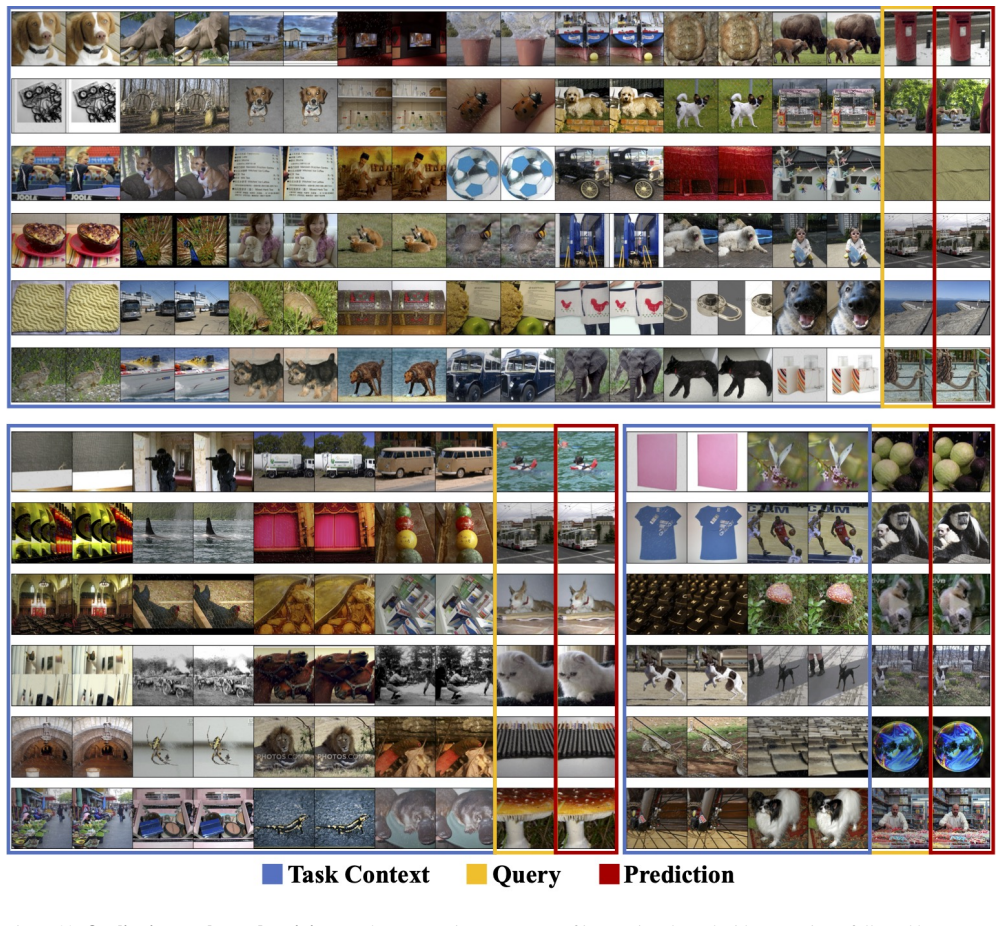
The paper's central claim is that the conditional distribution $p(y|x,s)$ of a vision output $y$ given a query $x$ and a task context $s$ can be modeled as a flow-matching denoising problem in a shared latent space. The task context is a set of input-target pairs that define the task, the query is encoded with the same spatial-temporal variational autoencoder, and the joint diffusion transformer denoises the target latent in parallel across the full sequence. The paper reports that at 3.4B parameters LaVin-DiT outperforms LVM on foreground segmentation (mIoU 67.87–75.80 versus 47.66–51.29 across splits), single-object detection (mIoU 67.85–69.32 versus 48.25–50.08), NYU-v2 depth (AbsRel 6.2 versus 30.2), surface normals (MAE 15.901 versus 23.433), and ImageNet inpainting (FID 1.65 versus 4.05), while running 1.7–2.3× faster at inference. These numbers are the concrete evidence for the thesis that diffusion modeling is a better fit than sequential token prediction for unified vision.
Load-bearing premise
The load-bearing premise is that the pseudo depth and surface-normal labels generated by Depth-Anything V2 and Stable-Normal (turbo) are accurate and have not already been exposed to the NYUv2 evaluation distribution, since those labels supervise training and the paper's headline geometric numbers are measured on NYUv2.
Editorial extensions
If this is right
- Diffusion-based vision foundation models can match or beat autoregressive models on dense prediction while being faster, so future large vision models need not borrow LLM-style token-by-token decoding.
- Longer task-context sets monotonically improve downstream accuracy, making the selection of good input-target pairs a practical lever for performance.
- Scaling LaVin-DiT from 0.1B to 3.4B parameters produces monotone gains in both training loss and downstream metrics, supporting further scaling efforts.
- A single checkpoint can serve both image and video tasks without task-specific heads or fine-tuning, simplifying deployment of generalist vision models.
Reading between the lines
- Because the depth and normal training labels come from teacher models, LaVin-DiT's NYU-v2 results likely inherit the teachers' biases; a direct test would be to compare the student's errors on out-of-distribution images with the teachers' errors, and the paper does not report such a comparison.
- If pseudo-label contamination is ruled out, the strong depth and normal numbers would suggest that in-context conditioning can transfer metric knowledge from a teacher to a student; a clean way to check this is to hold out a teacher's label set and see whether the student still reproduces the teacher's distinctive failure modes.
- A natural extension is automatic context selection: since longer contexts help, picking the most informative input-target pairs could deliver large gains without any architectural change, a direction the paper names as future work.
- The limitation stated in the paper implies that in-context generalization should be read as generalization within the neighborhood of the training task distribution; tasks far outside that neighborhood would require either more data or a different mechanism.
Editorial analysis
A structured set of objections, weighed in public.
Referee Report
Summary. The paper proposes LaVin-DiT, a unified diffusion-transformer foundation model that handles over 20 image and video tasks via a spatial-temporal VAE (ST-VAE), a joint diffusion transformer (J-DiT) with full-sequence joint attention and 3D RoPE, and in-context conditioning through input-target pairs. Training data combines about 3.2M images and 0.6M videos, with pseudo-labels for depth and normals from Depth-Anything V2 and Stable-Normal (turbo). Quantitative results are reported for foreground segmentation, single object detection, colorization, NYUv2 depth/normal estimation, and ImageNet inpainting, plus qualitative results for many tasks and a latency comparison against LVM. The paper claims state-of-the-art performance and 1.7–2.3× faster inference relative to LVM.
Significance. If the reported results are reproducible and the issues below are resolved, this is a potentially influential contribution: it shows that a diffusion-based generative framework can unify diverse vision tasks and outperform the autoregressive LVM baseline on several benchmarks. The paper provides useful implementation details, including algorithm pseudocode, architecture configuration tables, and a plan to release code and models, which supports reproducibility. The strongest quantitative gains are on foreground segmentation (e.g., 67.87 mIoU vs. 48.94 for LVM on Split 1), single object detection, colorization, and inpainting (FID 1.65 vs. 4.05). However, several load-bearing claims currently lack sufficient evidence, particularly the depth/normal results, the 'unseen task' claim, and all video-task claims.
major comments (5)
- [§4.2, Table 1, Table 4] The claim that foreground segmentation and single object detection are 'unseen tasks during our training' (Table 1 note and main text) is contradicted by Table 4, which lists single object detection on COCO/Object365 and instance segmentation on COCO/ADE20K/Cityscapes as training tasks. Even if the Pascal-5i classes are held out, the task families are trained; this overstates the generalization claim and should be reworded with a precise statement of what is unseen (e.g., dataset splits or classes).
- [§4.1, Table 4, Table 2] The NYUv2 depth and surface normal results in Table 2 may be inherited from the pseudo-label teachers. Training depth labels are generated with Depth-Anything V2 and normal labels with Stable-Normal (turbo) on ImageNet-1K/COCO/ADE20K/Cityscapes. The paper does not report whether these teachers or their training data include NYUv2 or NYUv2-derived benchmarks, nor does it provide depth/normal evaluation on a dataset outside the teachers' likely training corpora. Without this provenance, the AbsRel 6.2 and MAE 15.901 gains over LVM could reflect teacher-to-student distillation rather than in-context generalization, so the comparison in Table 2 is not decisive.
- [§4.2, §4.3, Table 1, Figure 5] The colorization results are internally inconsistent: Table 1 and the text in §4.2 report MSE 0.24 for LaVin-DiT (3.4B), while §4.3 and Figure 5 report MSE 0.273 for the same model. The evaluation subsample sizes also differ from the protocol in §B.2 (1,000 images vs. possibly different for Figure 5). The authors should state one protocol and report all numbers from it, or explain the discrepancy.
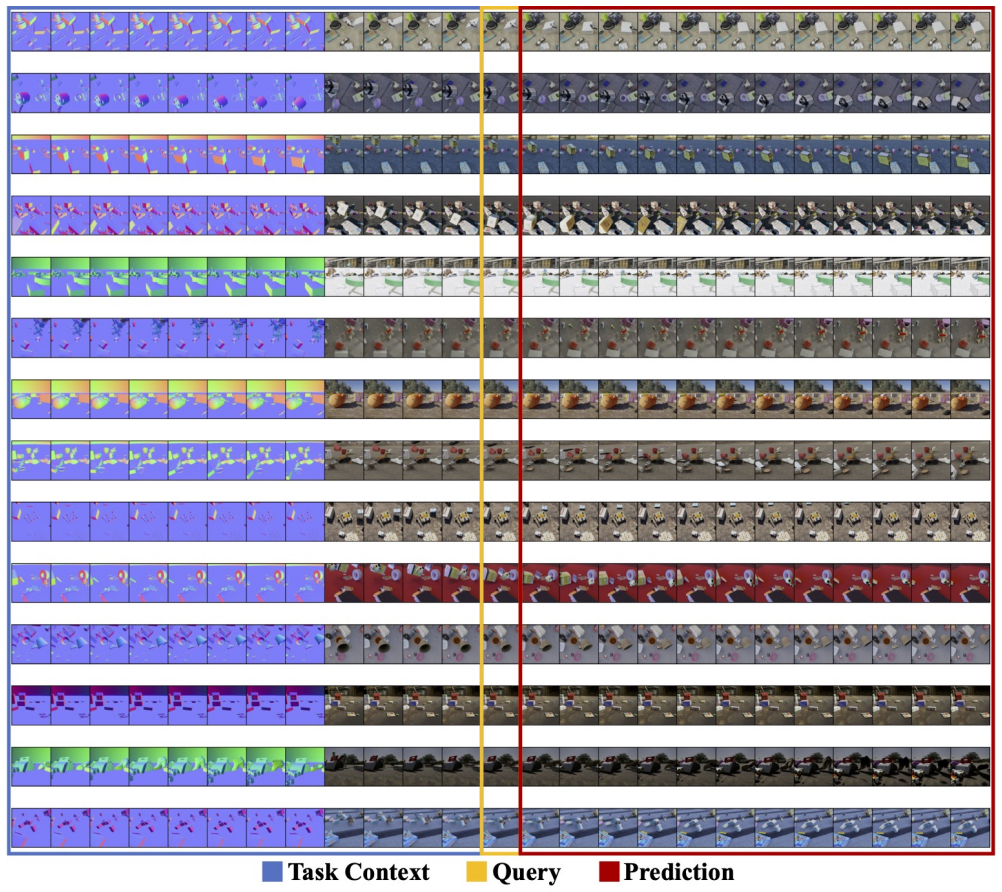
- [§4.2, §B.1, Figures 3, 23-29] No quantitative results are reported for any video task, despite the abstract and introduction claiming state-of-the-art performance across 'diverse vision tasks' including video. Frame prediction, video depth/normal/optical flow/instance segmentation, and depth/normal-to-video are shown only qualitatively. Since the spatial-temporal VAE and video evaluation are a core part of the claimed contribution, the paper should either provide quantitative video evaluations or explicitly limit the SOTA claim to the evaluated image tasks.
- [§4.4, Figure 6] The latency comparison in §4.4 states that LaVin-DiT and LVM are 'both 7B models', but LaVin-DiT is 3.4B by default (Table 3). Comparing a 3.4B diffusion model to a 7B autoregressive model confounds architecture with capacity. A matched-capacity or per-parameter latency/quality comparison is needed to support the inference-efficiency claim.
minor comments (6)
- [§4.2, first paragraph] 'LaVin-Dit' should be 'LaVin-DiT'.
- [§2, Related Work] The phrase 'from the respective of image-resembling generation' should be 'from the perspective'; there are several other grammatical issues throughout the text that should be corrected.
- [Algorithm 2, line 9] The final line 'Decode sample: ˆy ← Dec(z0)' is ambiguous; it should refer to the integrated latent z(0) at t=0, not the initial latent z0 defined in Algorithm 1.
- [Table 3] The column header 'K.V . groups' has a formatting issue; also clarify that grouped-query attention is only used for the 3.4B model (the 0.1B and 1.0B rows have no KV groups), and what value is used for the 3.4B model.
- [§B.2, Depth Estimation] The depth evaluation protocol mentions least-squares alignment but does not define the threshold accuracy δ1; please specify the standard thresholds (e.g., δ1 < 1.25) and whether the metrics are computed after alignment.
- [Figure 7] The caption of Figure 7 does not define the plotted metric or the ten tasks included; add a description so the figure is self-contained.
Circularity Check
No significant circularity: the model's benchmark results are not derived from its training inputs by construction, and the pseudo-label teacher provenance issue is a contamination risk, not a demonstrated circular loop.
full rationale
LaVin-DiT is an empirical systems paper whose contributions are architectural (ST-VAE, J-DiT, 3D-RoPE, in-context conditioning) and evaluated by benchmarks; it contains no first-principles derivation whose conclusion could be equivalent to its premises. The flow-matching objective in Eq. (1) regresses a velocity field v_theta(z_t,t) against the interpolation target z_0 - z_1, and neither the latent encoder/decoder nor the joint attention mechanism presupposes any of the reported benchmark outcomes. The paper cites previous work by the same authors (e.g., [34, 41, 66, 68, 70, 78]) only in related-work and in-context-learning context; no load-bearing claim rests on these self-citations, and no uniqueness theorem or earlier ansatz is imported to force the model choice. The strongest possible circularity candidate is the use of Depth-Anything V2 and Stable-Normal (turbo) to generate pseudo depth/normal labels on ImageNet-1K (Sec. 4.1, Table 4) followed by evaluation on NYUv2 (Table 2). The paper does not, however, fit any parameter to NYUv2 or define its outputs in terms of NYUv2 ground truth; the teachers are external models, and whether their training corpora included NYUv2 is a benchmark-contamination/provenance question, not a demonstrated reduction of LaVin-DiT's prediction to its training input. The internal inconsistencies noted by readers, such as the colorization MSE of 0.24 in Table 1 versus 0.273 in Figure 5 and the labeling of single-object detection as 'unseen' despite detection training data in Table 4, are correctness/reporting issues and do not establish circularity. The Limitations section further concedes that the model struggles when task definitions deviate from the training distribution, which is consistent with an empirical, non-circular claim.
Assumptions & free parameters
free parameters (4)
- Architecture hyperparameters (latent channels, hidden dim, layers, heads, KV groups, patch size) =
Table 3: 16 latent channels, 2304 hidden, 22 layers, 32 heads, 4 KV groups, 2x2 patch
- Number of inference timesteps N =
20
- Task context length (number of input-target pairs) =
8 in latency comparison
- Training hyperparameters (learning rate, batch size, steps, EMA) =
LR 1e-4 then 5e-5, batch 640, 100k plus 20k steps, EMA 0.9999
assumptions (6)
- domain assumption ST-VAE latent space preserves enough spatial-temporal detail for all dense prediction tasks.
- domain assumption Small sets of input-target pairs fully define the task in latent space.
- domain assumption Flow matching with 20 Euler steps produces converged samples.
- domain assumption Pseudo depth and normal labels from Depth-Anything V2 and Stable-Normal are accurate and do not leak evaluation-set knowledge.
- domain assumption The assembled multi-task dataset is diverse enough for in-context generalization across tasks.
- domain assumption Synthetic targets (Canny edges, crops, grayscale, Albumentations degradations) are valid supervision for the corresponding restoration tasks.
Cite this review
Pith. "Pith review of LaVin-DiT: Large Vision Diffusion Transformer." pith.science (2026). https://pith.science/paper/PLWW3LKE
@misc{pith2026241111505,
  author       = {Pith},
  title        = {Pith review of: LaVin-DiT: Large Vision Diffusion Transformer},
  year         = {2026},
  howpublished = {\url{https://pith.science/paper/PLWW3LKE}},
  note         = {Machine review of arXiv:2411.11505}
}
read the original abstract
This paper presents the Large Vision Diffusion Transformer (LaVin-DiT), a scalable and unified foundation model designed to tackle over 20 computer vision tasks in a generative framework. Unlike existing large vision models directly adapted from natural language processing architectures, which rely on less efficient autoregressive techniques and disrupt spatial relationships essential for vision data, LaVin-DiT introduces key innovations to optimize generative performance for vision tasks. First, to address the high dimensionality of visual data, we incorporate a spatial-temporal variational autoencoder that encodes data into a continuous latent space. Second, for generative modeling, we develop a joint diffusion transformer that progressively produces vision outputs. Third, for unified multi-task training, in-context learning is implemented. Input-target pairs serve as task context, which guides the diffusion transformer to align outputs with specific tasks within the latent space. During inference, a task-specific context set and test data as queries allow LaVin-DiT to generalize across tasks without fine-tuning. Trained on extensive vision datasets, the model is scaled from 0.1B to 3.4B parameters, demonstrating substantial scalability and state-of-the-art performance across diverse vision tasks. This work introduces a novel pathway for large vision foundation models, underscoring the promising potential of diffusion transformers. The code and models are available.
Figures


Figures from the paper (25 more)






Reference graph
Works this paper leans on
-
[1]
Josh Achiam, Steven Adler, Sandhini Agarwal, Lama Ah- mad, Ilge Akkaya, Florencia Leoni Aleman, Diogo Almeida, Janko Altenschmidt, Sam Altman, Shyamal Anadkat, et al. Gpt-4 technical report. arXiv preprint arXiv:2303.08774 ,
-
[2]
Gqa: Training generalized multi-query transformer models from multi-head checkpoints
Joshua Ainslie, James Lee-Thorp, Michiel de Jong, Yury Zemlyanskiy, Federico Lebron, and Sumit Sanghai. Gqa: Training generalized multi-query transformer models from multi-head checkpoints. In EMNLP, 2023. 4
2023
-
[3]
Flamingo: a visual language model for few-shot learning
Jean-Baptiste Alayrac, Jeff Donahue, Pauline Luc, Antoine Miech, Iain Barr, Yana Hasson, Karel Lenc, Arthur Mensch, Katherine Millican, Malcolm Reynolds, et al. Flamingo: a visual language model for few-shot learning. In NeurIPS, pages 23716–23736, 2022. 3
2022
-
[4]
Rethinking inductive biases for surface normal estimation
Gwangbin Bae and Andrew J Davison. Rethinking inductive biases for surface normal estimation. In CVPR, pages 9535– 9545, 2024. 14
2024
-
[5]
Sequential modeling enables scalable learn- ing for large vision models
Yutong Bai, Xinyang Geng, Karttikeya Mangalam, Amir Bar, Alan L Yuille, Trevor Darrell, Jitendra Malik, and Alexei A Efros. Sequential modeling enables scalable learn- ing for large vision models. In CVPR, pages 22861–22872,
-
[6]
All are worth words: A vit backbone for diffusion models
Fan Bao, Shen Nie, Kaiwen Xue, Yue Cao, Chongxuan Li, Hang Su, and Jun Zhu. All are worth words: A vit backbone for diffusion models. In CVPR, pages 22669–22679, 2023. 3
work page 2023
-
[7]
One transformer fits all distributions in multi-modal diffu- sion at scale
Fan Bao, Shen Nie, Kaiwen Xue, Chongxuan Li, Shi Pu, Yaole Wang, Gang Yue, Yue Cao, Hang Su, and Jun Zhu. One transformer fits all distributions in multi-modal diffu- sion at scale. In ICML, pages 1692–1717, 2023. 3
work page 2023
-
[8]
Visual prompting via image inpaint- ing
Amir Bar, Yossi Gandelsman, Trevor Darrell, Amir Glober- son, and Alexei Efros. Visual prompting via image inpaint- ing. In NeurIPS, pages 25005–25017, 2022. 2, 3, 6, 7, 14
work page 2022
Show all 84 references
-
[9]
Video generation models as world simulators
Tim Brooks, Bill Peebles, Connor Holmes, Will DePue, Yufei Guo, Li Jing, David Schnurr, Joe Taylor, Troy Luh- man, Eric Luhman, Clarence Ng, Ricky Wang, and Aditya Ramesh. Video generation models as world simulators
-
[10]
Language models are few-shot learners
Tom B Brown. Language models are few-shot learners. arXiv preprint arXiv:2005.14165, 2020. 1, 2, 3
2005 arXiv
-
[11]
End- to-end object detection with transformers
Nicolas Carion, Francisco Massa, Gabriel Synnaeve, Nicolas Usunier, Alexander Kirillov, and Sergey Zagoruyko. End- to-end object detection with transformers. In ECCV, pages 213–229, 2020. 3
2020
-
[12]
Pixart-alpha: Fast training of diffusion transformer for photorealistic text-to-image synthesis
Junsong Chen, Jincheng Yu, Chongjian Ge, Lewei Yao, Enze Xie, Yue Wu, Zhongdao Wang, James Kwok, Ping Luo, Huchuan Lu, et al. Pixart-alpha: Fast training of diffusion transformer for photorealistic text-to-image synthesis. arXiv preprint arXiv:2310.00426, 2023. 3
-
[13]
Gentron: Diffusion transformers for image and video generation
Shoufa Chen, Mengmeng Xu, Jiawei Ren, Yuren Cong, Sen He, Yanping Xie, Animesh Sinha, Ping Luo, Tao Xiang, and Juan-Manuel Perez-Rua. Gentron: Diffusion transformers for image and video generation. InCVPR, pages 6441–6451,
-
[14]
Pix2seq: A language modeling framework for object detection
Ting Chen, Saurabh Saxena, Lala Li, David J Fleet, and Ge- offrey Hinton. Pix2seq: A language modeling framework for object detection. arXiv preprint arXiv:2109.10852, 2021. 2
2021 arXiv
-
[15]
Panoptic-deeplab: A simple, strong, and fast baseline for bottom-up panoptic segmentation
Bowen Cheng, Maxwell D Collins, Yukun Zhu, Ting Liu, Thomas S Huang, Hartwig Adam, and Liang-Chieh Chen. Panoptic-deeplab: A simple, strong, and fast baseline for bottom-up panoptic segmentation. In CVPR, pages 12475– 12485, 2020. 3
2020
-
[16]
The cityscapes dataset for semantic urban scene understanding
Marius Cordts, Mohamed Omran, Sebastian Ramos, Timo Rehfeld, Markus Enzweiler, Rodrigo Benenson, Uwe Franke, Stefan Roth, and Bernt Schiele. The cityscapes dataset for semantic urban scene understanding. In CVPR, pages 3213–3223, 2016. 5, 15
2016
-
[17]
Scalable high-resolution pixel-space image syn- thesis with hourglass diffusion transformers
Katherine Crowson, Stefan Andreas Baumann, Alex Birch, Tanishq Mathew Abraham, Daniel Z Kaplan, and Enrico Shippole. Scalable high-resolution pixel-space image syn- thesis with hourglass diffusion transformers. In ICML, 2024. 3
2024
-
[18]
Imagenet: A large-scale hierarchical image database
Jia Deng, Wei Dong, Richard Socher, Li-Jia Li, Kai Li, and Li Fei-Fei. Imagenet: A large-scale hierarchical image database. In CVPR, pages 248–255, 2009. 5, 8, 14, 15
2009
-
[19]
A survey on in-context learning
Qingxiu Dong, Lei Li, Damai Dai, Ce Zheng, Jingyuan Ma, Rui Li, Heming Xia, Jingjing Xu, Zhiyong Wu, Tianyu Liu, et al. A survey on in-context learning. arXiv preprint arXiv:2301.00234, 2022. 2
2022 arXiv
-
[20]
Scaling recti- fied flow transformers for high-resolution image synthesis
Patrick Esser, Sumith Kulal, Andreas Blattmann, Rahim Entezari, Jonas M ¨uller, Harry Saini, Yam Levi, Dominik Lorenz, Axel Sauer, Frederic Boesel, et al. Scaling recti- fied flow transformers for high-resolution image synthesis. In ICML, 2024. 3, 4
2024
-
[21]
Multiscale vision transformers
Haoqi Fan, Bo Xiong, Karttikeya Mangalam, Yanghao Li, Zhicheng Yan, Jitendra Malik, and Christoph Feichtenhofer. Multiscale vision transformers. In ICCV, pages 6824–6835,
-
[22]
Geometry- consistent generative adversarial networks for one-sided un- supervised domain mapping
Huan Fu, Mingming Gong, Chaohui Wang, Kayhan Bat- manghelich, Kun Zhang, and Dacheng Tao. Geometry- consistent generative adversarial networks for one-sided un- supervised domain mapping. In CVPR, pages 2427–2436,
-
[23]
Masked diffusion transformer is a strong image synthesizer
Shanghua Gao, Pan Zhou, Ming-Ming Cheng, and Shuicheng Yan. Masked diffusion transformer is a strong image synthesizer. In ICCV, pages 23164–23173, 2023. 3
2023
-
[24]
Instructdiffusion: A generalist modeling inter- face for vision tasks
Zigang Geng, Binxin Yang, Tiankai Hang, Chen Li, Shuyang Gu, Ting Zhang, Jianmin Bao, Zheng Zhang, Houqiang Li, Han Hu, et al. Instructdiffusion: A generalist modeling inter- face for vision tasks. In CVPR, pages 12709–12720, 2024. 2
2024
-
[25]
Kubric: A scalable dataset generator
Klaus Greff, Francois Belletti, Lucas Beyer, Carl Doersch, Yilun Du, Daniel Duckworth, David J Fleet, Dan Gnanapra- gasam, Florian Golemo, Charles Herrmann, et al. Kubric: A scalable dataset generator. In CVPR, pages 3749–3761,
-
[26]
Photorealistic video generation with diffusion models
Agrim Gupta, Lijun Yu, Kihyuk Sohn, Xiuye Gu, Meera Hahn, Li Fei-Fei, Irfan Essa, Lu Jiang, and Jos ´e Lezama. Photorealistic video generation with diffusion models. arXiv preprint arXiv:2312.06662, 2023. 3
2023 arXiv
-
[27]
Masked autoencoders are scalable vision learners
Kaiming He, Xinlei Chen, Saining Xie, Yanghao Li, Piotr Doll´ar, and Ross Girshick. Masked autoencoders are scalable vision learners. In CVPR, pages 16000–16009, 2022. 3
2022
-
[28]
The kinetics hu- man action video dataset
Will Kay, Joao Carreira, Karen Simonyan, Brian Zhang, Chloe Hillier, Sudheendra Vijayanarasimhan, Fabio Viola, Tim Green, Trevor Back, Paul Natsev, et al. The kinetics hu- man action video dataset. arXiv preprint arXiv:1705.06950,
-
[29]
Repurpos- ing diffusion-based image generators for monocular depth estimation
Bingxin Ke, Anton Obukhov, Shengyu Huang, Nando Met- zger, Rodrigo Caye Daudt, and Konrad Schindler. Repurpos- ing diffusion-based image generators for monocular depth estimation. In CVPR, pages 9492–9502, 2024. 6, 8
2024
-
[30]
Auto-encoding variational bayes
Diederik P Kingma. Auto-encoding variational bayes. arXiv preprint arXiv:1312.6114, 2013. 2
2013 arXiv
-
[31]
Panoptic segmentation
Alexander Kirillov, Kaiming He, Ross Girshick, Carsten Rother, and Piotr Doll ´ar. Panoptic segmentation. In CVPR, pages 9404–9413, 2019. 2, 3
2019
-
[32]
An im- age is worth 16x16 words: Transformers for image recogni- tion at scale
Alexander Kolesnikov, Alexey Dosovitskiy, Dirk Weis- senborn, Georg Heigold, Jakob Uszkoreit, Lucas Beyer, Matthias Minderer, Mostafa Dehghani, Neil Houlsby, Syl- vain Gelly, Thomas Unterthiner, and Xiaohua Zhai. An im- age is worth 16x16 words: Transformers for image recogni-...
2021
-
[33]
Uvim: A unified modeling approach for vision with learned guiding codes
Alexander Kolesnikov, Andr ´e Susano Pinto, Lucas Beyer, Xiaohua Zhai, Jeremiah Harmsen, and Neil Houlsby. Uvim: A unified modeling approach for vision with learned guiding codes. In NeurIPS, pages 26295–26308, 2022. 2
2022
-
[34]
Un- derstanding and enhancing the transferability of jailbreak- ing attacks
Runqi Lin, Bo Han, Fengwang Li, and Tongliang Liu. Un- derstanding and enhancing the transferability of jailbreak- ing attacks. In The Thirteenth International Conference on Learning Representations, 2025. 2
2025
-
[35]
Microsoft coco: Common objects in context
Tsung-Yi Lin, Michael Maire, Serge Belongie, James Hays, Pietro Perona, Deva Ramanan, Piotr Doll´ar, and C Lawrence Zitnick. Microsoft coco: Common objects in context. In ECCV, pages 740–755, 2014. 5, 15
2014
-
[36]
Feature pyramid networks for object detection
Tsung-Yi Lin, Piotr Doll ´ar, Ross Girshick, Kaiming He, Bharath Hariharan, and Serge Belongie. Feature pyramid networks for object detection. In CVPR, pages 2117–2125,
-
[37]
Flow matching for generative modeling
Yaron Lipman, Ricky TQ Chen, Heli Ben-Hamu, Maximil- ian Nickel, and Matthew Le. Flow matching for generative modeling. In ICLR, 2023. 5, 13
2023
-
[38]
Swin transformer: Hierarchical vision transformer using shifted windows
Ze Liu, Yutong Lin, Yue Cao, Han Hu, Yixuan Wei, Zheng Zhang, Stephen Lin, and Baining Guo. Swin transformer: Hierarchical vision transformer using shifted windows. In ICCV, pages 10012–10022, 2021. 3
2021
-
[39]
Decoupled weight decay regularization
I Loshchilov. Decoupled weight decay regularization. arXiv preprint arXiv:1711.05101, 2017. 5
2017 arXiv
-
[40]
Unified-io: A unified model for vision, language, and multi-modal tasks
Jiasen Lu, Christopher Clark, Rowan Zellers, Roozbeh Mot- taghi, and Aniruddha Kembhavi. Unified-io: A unified model for vision, language, and multi-modal tasks. In ICLR,
-
[41]
Deem: Diffusion models serve as the eyes of large language models for image perception
Run Luo, Yunshui Li, Longze Chen, Wanwei He, Ting- En Lin, Ziqiang Liu, Lei Zhang, Zikai Song, Xiaobo Xia, Tongliang Liu, et al. Deem: Diffusion models serve as the eyes of large language models for image perception. arXiv preprint arXiv:2405.15232, 2024. 2
2024 arXiv
-
[42]
Latte: Latent diffusion transformer for video generation
Xin Ma, Yaohui Wang, Gengyun Jia, Xinyuan Chen, Zi- wei Liu, Yuan-Fang Li, Cunjian Chen, and Yu Qiao. Latte: Latent diffusion transformer for video generation. arXiv preprint arXiv:2401.03048, 2024. 3
2024 arXiv
-
[43]
Scalable diffusion models with transformers
William Peebles and Saining Xie. Scalable diffusion models with transformers. In ICCV, pages 4195–4205, 2023. 3, 4
2023
-
[44]
Movie gen: A cast of media foundation models
Adam Polyak, Amit Zohar, Andrew Brown, Andros Tjandra, Animesh Sinha, Ann Lee, Apoorv Vyas, Bowen Shi, Chih- Yao Ma, Ching-Yao Chuang, et al. Movie gen: A cast of media foundation models. arXiv preprint arXiv:2410.13720,
-
[45]
Unicontrol: A unified diffu- sion model for controllable visual generation in the wild
Can Qin, Shu Zhang, Ning Yu, Yihao Feng, Xinyi Yang, Yingbo Zhou, Huan Wang, Juan Carlos Niebles, Caiming Xiong, Silvio Savarese, et al. Unicontrol: A unified diffu- sion model for controllable visual generation in the wild. In NeurIPS, 2024. 2
2024
-
[46]
Zero: Memory optimizations toward train- ing trillion parameter models
Samyam Rajbhandari, Jeff Rasley, Olatunji Ruwase, and Yuxiong He. Zero: Memory optimizations toward train- ing trillion parameter models. In International Conference for High Performance Computing, Networking, Storage and Analysis, pages 1–16, 2020. 5
2020
-
[47]
Hierarchical text-conditional image gen- eration with clip latents
Aditya Ramesh, Prafulla Dhariwal, Alex Nichol, Casey Chu, and Mark Chen. Hierarchical text-conditional image gen- eration with clip latents. arXiv preprint arXiv:2204.06125,
-
[48]
Towards robust monocular depth estimation: Mixing datasets for zero-shot cross-dataset transfer
Ren ´e Ranftl, Katrin Lasinger, David Hafner, Konrad Schindler, and Vladlen Koltun. Towards robust monocular depth estimation: Mixing datasets for zero-shot cross-dataset transfer. IEEE transactions on pattern analysis and machine intelligence, 44(3):1623–1637, 2020. 14
2020
-
[49]
Vi- sion transformers for dense prediction
Ren ´e Ranftl, Alexey Bochkovskiy, and Vladlen Koltun. Vi- sion transformers for dense prediction. In ICCV, pages 12179–12188, 2021. 6, 8
2021
-
[50]
Faster r-cnn: Towards real-time object detection with region proposal networks
Shaoqing Ren, Kaiming He, Ross Girshick, and Jian Sun. Faster r-cnn: Towards real-time object detection with region proposal networks. IEEE Transactions on Pattern Analysis and Machine Intelligence, 39(6):1137–1149, 2016. 2, 3
2016
-
[51]
High-resolution image syn- thesis with latent diffusion models
Robin Rombach, Andreas Blattmann, Dominik Lorenz, Patrick Esser, and Bj¨orn Ommer. High-resolution image syn- thesis with latent diffusion models. In CVPR, pages 10684– 10695, 2022. 2, 3, 4
2022
-
[52]
One-shot learning for semantic segmentation
Amirreza Shaban, Shray Bansal, Zhen Liu, Irfan Essa, and Byron Boots. One-shot learning for semantic segmentation. arXiv preprint arXiv:1709.03410, 2017. 14
2017 arXiv
-
[53]
Objects365: A large-scale, high-quality dataset for object detection
Shuai Shao, Zeming Li, Tianyuan Zhang, Chao Peng, Gang Yu, Xiangyu Zhang, Jing Li, and Jian Sun. Objects365: A large-scale, high-quality dataset for object detection. In ICCV, pages 8430–8439, 2019. 5, 15
2019
-
[54]
Indoor segmentation and support inference from rgbd images
Nathan Silberman, Derek Hoiem, Pushmeet Kohli, and Rob Fergus. Indoor segmentation and support inference from rgbd images. In ECCV, pages 746–760, 2012. 2, 6, 8, 14
2012
-
[55]
Ucf101: A dataset of 101 human actions classes from videos in the wild
K Soomro. Ucf101: A dataset of 101 human actions classes from videos in the wild. arXiv preprint arXiv:1212.0402 ,
-
[56]
Roformer: Enhanced transformer with rotary position embedding
Jianlin Su, Murtadha Ahmed, Yu Lu, Shengfeng Pan, Wen Bo, and Yunfeng Liu. Roformer: Enhanced transformer with rotary position embedding. Neurocomputing, 568:127063,
-
[57]
Sequence to sequence learning with neural net- works
I Sutskever. Sequence to sequence learning with neural net- works. arXiv preprint arXiv:1409.3215, 2014. 2
2014 arXiv
-
[58]
Gemma: Open models based on gemini research and tech- nology
Gemma Team, Thomas Mesnard, Cassidy Hardin, Robert Dadashi, Surya Bhupatiraju, Shreya Pathak, Laurent Sifre, Morgane Rivi `ere, Mihir Sanjay Kale, Juliette Love, et al. Gemma: Open models based on gemini research and tech- nology. arXiv preprint arXiv:2403.08295, 2024. 4
2024 arXiv
-
[59]
U-dits: Downsample tokens in u-shaped diffusion transformers
Yuchuan Tian, Zhijun Tu, Hanting Chen, Jie Hu, Chao Xu, and Yunhe Wang. U-dits: Downsample tokens in u-shaped diffusion transformers. arXiv preprint arXiv:2405.02730 ,
-
[60]
Llama: Open and efficient foundation language models
Hugo Touvron, Thibaut Lavril, Gautier Izacard, Xavier Martinet, Marie-Anne Lachaux, Timoth´ee Lacroix, Baptiste Rozi`ere, Naman Goyal, Eric Hambro, Faisal Azhar, et al. Llama: Open and efficient foundation language models. arXiv preprint arXiv:2302.13971, 2023. 1, 2
2023 arXiv
-
[61]
Neural discrete representation learning
Aaron Van Den Oord, Oriol Vinyals, et al. Neural discrete representation learning. In NeurIPS, 2017. 2
2017
-
[62]
A simple la- tent diffusion approach for panoptic segmentation and mask inpainting
Wouter Van Gansbeke and Bert De Brabandere. A simple la- tent diffusion approach for panoptic segmentation and mask inpainting. arXiv preprint arXiv:2401.10227, 2024. 2
2024 arXiv
-
[63]
Multi-task learning for dense prediction tasks: A survey
Simon Vandenhende, Stamatios Georgoulis, Wouter Van Gansbeke, Marc Proesmans, Dengxin Dai, and Luc Van Gool. Multi-task learning for dense prediction tasks: A survey. IEEE transactions on pattern analysis and machine intelligence, 44(7):3614–3633, 2021. 2
2021
-
[64]
Omnitokenizer: A joint image-video tokenizer for visual generation
Junke Wang, Yi Jiang, Zehuan Yuan, Binyue Peng, Zux- uan Wu, and Yu-Gang Jiang. Omnitokenizer: A joint image-video tokenizer for visual generation. arXiv preprint arXiv:2406.09399, 2024. 3
2024 arXiv
-
[65]
Images speak in images: A generalist painter for in-context visual learning
Xinlong Wang, Wen Wang, Yue Cao, Chunhua Shen, and Tiejun Huang. Images speak in images: A generalist painter for in-context visual learning. In CVPR, pages 6830–6839,
-
[66]
Cris: Clip-driven referring image segmentation
Zhaoqing Wang, Yu Lu, Qiang Li, Xunqiang Tao, Yandong Guo, Mingming Gong, and Tongliang Liu. Cris: Clip-driven referring image segmentation. In CVPR, pages 11686– 11695, 2022. 2
2022
-
[67]
In- context learning unlocked for diffusion models
Zhendong Wang, Yifan Jiang, Yadong Lu, Pengcheng He, Weizhu Chen, Zhangyang Wang, Mingyuan Zhou, et al. In- context learning unlocked for diffusion models. In NeurIPS, pages 8542–8562, 2023. 2
2023
-
[68]
Open-vocabulary segmentation with unpaired mask-text supervision
Zhaoqing Wang, Xiaobo Xia, Ziye Chen, Xiao He, Yandong Guo, Mingming Gong, and Tongliang Liu. Open-vocabulary segmentation with unpaired mask-text supervision. arXiv preprint arXiv:2402.08960, 2024. 2
2024 arXiv
-
[69]
Finetuned language models are zero-shot learn- ers
Jason Wei, Maarten Bosma, Vincent Zhao, Kelvin Guu, Adams Wei Yu, Brian Lester, Nan Du, Andrew M Dai, and Quoc V Le. Finetuned language models are zero-shot learn- ers. In ICLR, 2022. 2
2022
-
[70]
Training-free ro- bust interactive video object segmentation
Xiaoli Wei, Zhaoqing Wang, Yandong Guo, Chunxia Zhang, Tongliang Liu, and Mingming Gong. Training-free ro- bust interactive video object segmentation. arXiv preprint arXiv:2406.05485, 2024. 2
2024 arXiv
-
[71]
Upsnet: A unified panoptic segmentation network
Yuwen Xiong, Renjie Liao, Hengshuang Zhao, Rui Hu, Min Bai, Ersin Yumer, and Raquel Urtasun. Upsnet: A unified panoptic segmentation network. InCVPR, pages 8818–8826,
-
[72]
Depth any- thing v2
Lihe Yang, Bingyi Kang, Zilong Huang, Zhen Zhao, Xiao- gang Xu, Jiashi Feng, and Hengshuang Zhao. Depth any- thing v2. arXiv preprint arXiv:2406.09414, 2024. 5
2024 arXiv
-
[73]
Cogvideox: Text-to-video diffusion models with an expert transformer
Zhuoyi Yang, Jiayan Teng, Wendi Zheng, Ming Ding, Shiyu Huang, Jiazheng Xu, Yuanming Yang, Wenyi Hong, Xiao- han Zhang, Guanyu Feng, et al. Cogvideox: Text-to-video diffusion models with an expert transformer. arXiv preprint arXiv:2408.06072, 2024. 3
2024 arXiv
-
[74]
Stablenormal: Reducing diffusion variance for stable and sharp normal
Chongjie Ye, Lingteng Qiu, Xiaodong Gu, Qi Zuo, Yushuang Wu, Zilong Dong, Liefeng Bo, Yuliang Xiu, and Xiaoguang Han. Stablenormal: Reducing diffusion variance for stable and sharp normal. arXiv preprint arXiv:2406.16864, 2024. 5, 6, 8
2024 arXiv
-
[75]
Colorful image colorization
Richard Zhang, Phillip Isola, and Alexei A Efros. Colorful image colorization. In ECCV, pages 649–666, 2016. 2
2016
-
[76]
The unreasonable effectiveness of deep features as a perceptual metric
Richard Zhang, Phillip Isola, Alexei A Efros, Eli Shechtman, and Oliver Wang. The unreasonable effectiveness of deep features as a perceptual metric. In CVPR, 2018. 4, 7, 14
2018
-
[77]
Trained transformers learn linear models in-context
Ruiqi Zhang, Spencer Frei, and Peter L Bartlett. Trained transformers learn linear models in-context. Journal of Ma- chine Learning Research, 25(49):1–55, 2024. 3
2024
-
[78]
Ideal: Influence-driven selective annotations empower in-context learners in large language models
Shaokun Zhang, Xiaobo Xia, Zhaoqing Wang, Ling-Hao Chen, Jiale Liu, Qingyun Wu, and Tongliang Liu. Ideal: Influence-driven selective annotations empower in-context learners in large language models. In ICLR, 2024. 2
2024
-
[79]
Di- ception: A generalist diffusion model for visual perceptual tasks
Canyu Zhao, Mingyu Liu, Huanyi Zheng, Muzhi Zhu, Zhiyue Zhao, Hao Chen, Tong He, and Chunhua Shen. Di- ception: A generalist diffusion model for visual perceptual tasks. arXiv preprint arXiv:2502.17157, 2025. 2
2025
-
[80]
Cv-vae: A compatible video vae for latent generative video models
Sijie Zhao, Yong Zhang, Xiaodong Cun, Shaoshu Yang, Muyao Niu, Xiaoyu Li, Wenbo Hu, and Ying Shan. Cv-vae: A compatible video vae for latent generative video models. arXiv preprint arXiv:2405.20279, 2024. 3
2024 arXiv
-
[81]
Fast training of diffusion models with masked transformers
Hongkai Zheng, Weili Nie, Arash Vahdat, and Anima Anandkumar. Fast training of diffusion models with masked transformers. arXiv preprint arXiv:2306.09305, 2023. 3
2023 arXiv
-
[82]
Scene parsing through ade20k dataset
Bolei Zhou, Hang Zhao, Xavier Puig, Sanja Fidler, Adela Barriuso, and Antonio Torralba. Scene parsing through ade20k dataset. In CVPR, pages 633–641, 2017. 5, 15
2017
-
[83]
Lumina-next: Making lumina-t2x stronger and faster with next-dit
Le Zhuo, Ruoyi Du, Han Xiao, Yangguang Li, Dongyang Liu, Rongjie Huang, Wenze Liu, Lirui Zhao, Fu-Yun Wang, Zhanyu Ma, et al. Lumina-next: Making lumina-t2x stronger and faster with next-dit. arXiv preprint arXiv:2406.18583 ,
-
[2024]
More Technical Details of LaVin-DiT A.1
2, 3 LaVin-DiT: Large Vision Diffusion Transformer Supplementary Material A. More Technical Details of LaVin-DiT A.1. Details of 3D RoPE Recall that we represent task context and query as a unified sequence of frames, which is a 3D representation. After- ward, we extend RoPE f...
2017
Reviewed August 12, 2026 · model on record in the stance chip above.
Discussion (0). Continue with ORCID to comment.