REVIEW 3 major objections 4 minor 42 references
Topology-aware Preemptive Scheduling for Co-located LLM Workloads
T0 review · 3 major / 4 minor · reviewed 2026-08-12 · deepseek-v4-flash
Pith's one-line read This paper claims that preempting co-located LLM jobs with the victim's hardware topology in view — freeing GPUs near the same NUMA node or socket the high-priority service needs — raises topology-affinity hit rate from 44.5% to 100% in a…
desk verdict A sensible, well-built scheduling system that overclaims its 55% performance number, since the evaluation only measures the same topology score the scheduler already optimizes. read the letter →
The pith
A machine-rendered reading of the paper's core claim, the machinery that carries it, and where it could break.
The reading
What carries the argument
The load-bearing objects are three. (1) FlexTopo, a graph-based, server-generic representation of hardware topology and live allocation: sockets, NUMA nodes, CPU core groups, and GPU devices are nodes; host, contain, localized, and nearby edges encode hierarchy and proximity; status and used-by attributes link components to running instances. (2) A scoring function for preemption candidates, $S(C) = \alpha \times \frac{1}{\text{sum of priority}(C)} + (1-\alpha)\, T(C_{\mathrm{flextopo}})$, where $T$ is a piecewise affinity score: high for same-NUMA victim resources, medium for same-socket but different-NUMA, low for cross-socket; $\alpha \in [0,1]$ trades victim priority against topology fitness. (3) Incremental Minimal Preemption (IMP), a greedy search that tests victim subsets from size 1 upward and stops at the first feasible size, keeping the average-case cost close to polynomial while preserving minimal victim sets. An in-cluster FlexTopo agent keeps the representation fresh with periodic hardware checks and event-driven allocation updates, and a two-stage pipeline applies guaranteed filtering and best-effort sorting according to the preemptor's QoS.
What would settle it
A controlled latency experiment on one of the paper's own server types (for example, an 8-GPU 4090 or A100 node): place the same LLM inference workload in three conditions — same-NUMA, same-socket different-NUMA, and cross-socket — and measure end-to-end throughput and tail latency. If the cross-socket placement performs within noise of the same-NUMA placement for the workloads the scheduler targets, the scoring function's ordering is miscalibrated and the claimed 55% scheduled-performance improvement would not appear; conversely, a direct before/after comparison of tail latency for a scaled-up service, with and without FlexTopo preemption, would settle whether the hit-rate gain translates into the claimed performance gain.
Extended reading notes
Core claim
On the paper's own terms, the discovery is that preemption quality is a topology problem, not just a priority problem. A scheduler that knows, at victim-selection time, which sockets, NUMA nodes, CPU core groups, and GPU devices each candidate victim occupies can free resources that line up with the preemptor's requirements, and it can do so without an exponential search. The paper demonstrates this with FlexTopo — a unified graph whose nodes are sockets, NUMA nodes, CPU core groups, and GPUs, with edges for hosting, containment, and proximity — and a piecewise scoring of candidates that rates same-NUMA allocation highest, same-socket allocation medium, and cross-socket allocation lowest, balanced against victim priority by a weight $\alpha$. The reported outcome is that in 100 simulation cycles with 50 preemptions each on a 100-node simulated 4090 cluster, the standard scheduler met topology requirements in 2225 of 5000 preemptions (44.5%), while FlexTopo-based preemption met them in all 5000 (100%); the paper reads the gap as a 55% reduction in scheduling failures for guaranteed QoS and a 55% improvement in scheduled performance for best-effort QoS. A greedy Incremental Minimal Preemption procedure keeps the victim search near-polynomial in the average case, cutting candidate-sourcing latency by 7.3% to 76.5% relative to exhaustive evaluation.
Load-bearing premise
The load-bearing premise is that a hand-assigned scoring rule — same NUMA node is best, same socket is second, cross-socket is worst — captures how much LLM inference performance actually depends on hardware topology, so that optimizing this score genuinely improves real scheduled performance.
Editorial extensions
If this is right
- Preemption can be made topology-reliable: in the paper's simulation, all 5000 preemptions met the preemptor's affinity requirements, versus 2225 (44.5%) for the standard scheduler.
- The Kubernetes TopologyAffinityError failure mode is reduced by 55% for guaranteed-QoS preemptors, and scheduled performance improves by 55% for best-effort preemptors.
- Saturation allocation becomes practical: clusters can run fully packed with mixed LLM workloads and still reclaim resources that satisfy latency-sensitive services when auto-scaling fires.
- The overhead of topology-aware victim selection is manageable: IMP cuts candidate-sourcing latency by 7.3% to 76.5% versus exhaustive FlexTopo evaluation, with the smallest overhead for small GPU requests.
- Because FlexTopo abstracts away server-specific layouts, the same policy transfers across hardware generations (for example, 4090 and A100 servers) without per-server adaptation.
Reading between the lines
- A direct calibration test is missing from the paper: the score assumes same-NUMA beats same-socket beats cross-socket, but the paper itself reports communication penalties of 1.2× within a socket and 3.2× across sockets on 4090 servers (2× on A100 servers); plugging those measured ratios into the topology score would be a natural, testable tightening.
- The 55% scheduled-performance gain is inferred from the affinity-hit-rate gap rather than measured end-to-end; a direct before/after measurement of tail inference latency for the scaled-up service would confirm whether the hit-rate improvement actually buys the latency win the paper claims.
- The FlexTopo representation and scoring could serve normal placement and defragmentation, not only preemption; the paper leaves those applications implicit.
- The benefit is bounded by how topology-sensitive the workload actually is: for inference engines or quantization schemes that tolerate memory-bandwidth imbalance, the same scoring may over-rank or under-rank candidates, so the win would vary by engine.
Signed reviews
Editorial analysis
A structured set of objections, weighed in public.
Referee Report
Summary. The paper proposes FlexTopo, a graph-based representation of per-node hardware topology and allocation state, and integrates it into the Gödel scheduler as a preemption plugin. The scheduler uses a weighted scoring function combining victim priority and topology affinity, plus an incremental minimal preemption algorithm to limit search cost. The evaluation, conducted in a 100-node KWOK simulation and a near-production cluster, reports an increase in topology-affinity hit rate from 44.5% to 100% and claims a 55% improvement in scheduled performance for LLM workloads.
Significance. If the claimed performance improvement were supported by end-to-end measurements, the work would be a useful practical addition to topology-aware scheduling: victim selection during preemption is a genuine gap in existing Kubernetes/Gödel schedulers, and the open-source implementation is a concrete artifact. The proposed unified graph representation and the incremental search heuristic are reasonable engineering contributions. However, the current evidence does not substantiate the headline performance claim, because the evaluation metric is essentially the same topology score that the scheduler optimizes.
major comments (3)
- [Section 5, Table 4] The only quantitative success metric, topology-affinity hit rate, is defined by same-NUMA/same-socket placement, which is exactly the objective T(C_flextopo) in Eq. (1). A scheduler that maximizes this score will naturally achieve a high hit rate, so the 100%-vs-44.5% result demonstrates self-consistency rather than an improvement in LLM scheduled performance. The paper contains no measurement of end-to-end latency, throughput, TTFT, or goodput for any LLM workload, and the phrase "55% improvement in Scheduled Performance" in Section 5 is therefore unsupported. Re-run the comparison with actual serving metrics (e.g., p50/p99 token-generation latency, throughput, or the number of placement failures observed by the kubelet) or restrict the claims to hit-rate improvement.
- [Section 3.4, Eq. (1)] The scoring function uses α, whose value is never reported, and a piecewise T(C_flextopo) whose high/medium/low numeric values are never specified. This underdetermines the reported comparison: depending on α and the numeric mapping, the tie-breaking between priority and topology can change the selected victims, so the 100% hit rate cannot be reproduced by a reader. Please report the exact values, justify them, and include a sensitivity analysis over α and the topology-score values.
- [Section 5, Simulation Configuration and Table 3] The simulation uses one fixed workload mix, one GPU server type (8×RTX 4090), and one saturation state, and no replication or confidence interval is reported for the 5000-preemption hit-rate numbers. The "100%" result especially needs to be tested across load levels, workload mixes, and hardware topologies (e.g., A100-style 2-socket/2-NUMA servers) before claiming that cross-socket allocations are eliminated. At minimum, report run-to-run variation or worst-case outcomes over multiple seeds and configurations.
minor comments (4)
- [Section 2.2 and Section 3.4] There are typos in the prose: "Readers are refereed" should be "Readers are referred," and "as detailed in the bellow" should be "as detailed below."
- [Section 5, Figure 8] The authors acknowledge that the before/after production snapshots may not be strictly comparable; please label this figure as illustrative, since it is not a controlled comparison and should not be cited as quantitative evidence.
- [Section 5, text after Table 4] The sentence claiming that the scheduling failure rate is "reduced by 55%" conflates a 55.5-percentage-point absolute increase in hit rate with a relative reduction or a performance improvement; please state the arithmetic precisely.
- [Abstract and Section 5] The title and abstract emphasize LLM workloads, but no LLM inference engine is exercised in the evaluation; clarify that the results currently concern topology-based victim selection in a simulated Kubernetes cluster, with LLM relevance argued from hardware topology rather than measured inference performance.
Circularity Check
The 55% Scheduled Performance claim is the optimizer's own topology score counted as a hit rate, making the headline result self-referential.
-
self definitional
[Section 3.4, Eq. (1); Section 5, 'Topology Affinity Hit Rate']
"T (Cflextopo) = high, if vN ∈ the same aligned NUMA of N; medium, if vN ∈ the same aligned socket but different NUMA of N; low, if vN is located across sockets ... While for workloads with best-effort QoS, FlexTopo-based preemption provides a 55% improvement in Scheduled Performance."
The scheduler maximizes S(C) = α × 1/sum of priority(C) + (1−α) × T(C_flextopo), where T assigns high/medium/low to same-NUMA, same-socket, and cross-socket victim placements. Section 5's 'topology affinity hit rate' counts preemptions that 'satisfied topology requirements' — the same same-NUMA/same-socket/cross-socket categories that define T. A scheduler that maximizes T therefore achieves a 100% hit rate on T by construction; the claimed '55% improvement in Scheduled Performance' is the 100%-versus-45% hit-rate gap relabeled as performance, not an independent LLM performance measurement. No end-to-end latency, throughput, or goodput result is reported.
full rationale
The underlying system pieces — FlexTopo as a graph representation, the event-driven agent, and the IMP greedy search with its overhead measurements — are self-contained and not circular. The circularity is confined to the headline performance claim: the evaluation metric (topology affinity hit rate) is identical to the scoring function in Eq. (1) that the scheduler optimizes. Because the central '55% Scheduled Performance' claim reduces to self-consistency with Eq. (1), the score is 6. The overhead and production snapshot analyses are independent, but they do not validate the headline performance number.
Assumptions & free parameters
free parameters (3)
- Alpha (alpha) in scoring function =
not reported
- CoreGroup size =
not reported (configurable)
- Topology score thresholds =
high/medium/low not quantified
assumptions (4)
- domain assumption Topology affinity significantly determines LLM inference performance
- domain assumption Saturation allocation with preemption is the right operational model
- domain assumption Draining all victims hypothetically and then scoring is sufficient to find a feasible placement
- domain assumption Graph edges omit PCIe and NVSwitch details without affecting decisions
Cite this review
Pith. "Pith review of Topology-aware Preemptive Scheduling for Co-located LLM Workloads." pith.science (2026). https://pith.science/paper/JOXOJ3SD
@misc{pith2026241111560,
  author       = {Pith},
  title        = {Pith review of: Topology-aware Preemptive Scheduling for Co-located LLM Workloads},
  year         = {2026},
  howpublished = {\url{https://pith.science/paper/JOXOJ3SD}},
  note         = {Machine review of arXiv:2411.11560}
}
abstract
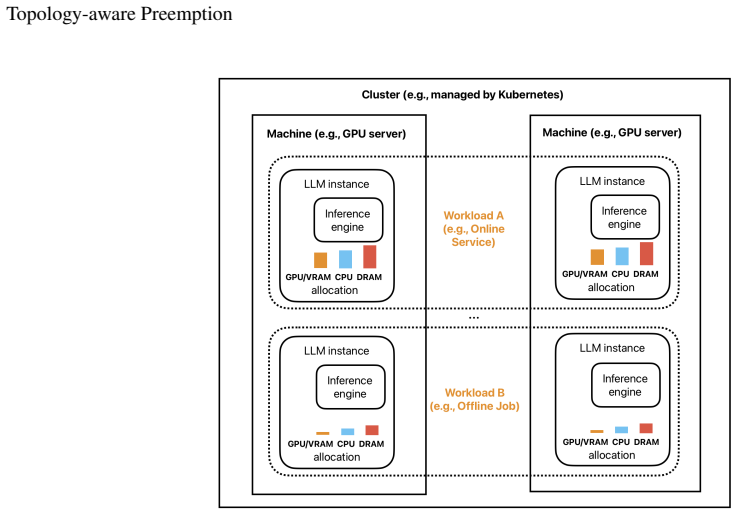
Hosting diverse large language model workloads in a unified resource pool through co-location is cost-effective. For example, long-running chat services generally follow diurnal traffic patterns, which inspire co-location of batch jobs to fulfill resource valleys between successive peaks, and thus to saturate resource allocation in cluster-wide scope. These heterogeneous workloads often have different business priorities, and therefore preemption can be leveraged for resource elasticity. However, workloads often have distinct topology preferences as well. The resources released by lower-priority instances may fail to meet the requirements of high-priority online services which are usually latency-sensitive. The root cause behind such mis-match is a lack of topology awareness of resource scheduler, especially during preemption. To bridge this gap, we develop a fine-grained topology-aware method for preemptive scheduling of hybrid workloads. The method ensures that the resources freed by preempted tasks adhere to the topological affinity needs of high-priority preemptors in a guaranteed or best-effort manner. This dynamic alignment significantly increases the efficiency of preemption and improves overall scheduled performance for LLM workloads by $55\%$.
Figures


Figures from the paper (8 more)


Reference graph
Works this paper leans on
-
[1]
A survey on large language models: Applications, challenges, limitations, and practical usage
Muhammad Usman Hadi, Rizwan Qureshi, Abbas Shah, Muhammad Irfan, Anas Zafar, Muhammad Bilal Shaikh, Naveed Akhtar, Jia Wu, Seyedali Mirjalili, et al. A survey on large language models: Applications, challenges, limitations, and practical usage. Authorea Preprints, 2023
2023
-
[2]
Efficient training of large language models on distributed infrastructures: A survey
Jiangfei Duan, Shuo Zhang, Zerui Wang, Lijuan Jiang, Wenwen Qu, Qinghao Hu, Guoteng Wang, Qizhen Weng, Hang Yan, Xingcheng Zhang, et al. Efficient training of large language models on distributed infrastructures: A survey. arXiv preprint arXiv:2407.20018, 2024
arXiv 2024
-
[3]
Towards efficient and reliable llm serving: A real-world workload study
Yuxin Wang, Yuhan Chen, Zeyu Li, Zhenheng Tang, Rui Guo, Xin Wang, Qiang Wang, Amelie Chi Zhou, and Xiaowen Chu. Towards efficient and reliable llm serving: A real-world workload study. arXiv preprint arXiv:2401.17644, 2024
arXiv 2024
-
[4]
Gödel: Unified large-scale resource management and scheduling at bytedance
Wu Xiang, Yakun Li, Yuquan Ren, Fan Jiang, Chaohui Xin, Varun Gupta, Chao Xiang, Xinyi Song, Meng Liu, Bing Li, et al. Gödel: Unified large-scale resource management and scheduling at bytedance. In Proceedings of the 2023 ACM Symposium on Cloud Computing, pages 308–323, 2023. 15 Topology-aware Preemption
work page 2023
-
[5]
Topology-aware gpu scheduling for learning workloads in cloud environments
Marcelo Amaral, Jordà Polo, David Carrera, Seetharami Seelam, and Malgorzata Steinder. Topology-aware gpu scheduling for learning workloads in cloud environments. In Proceedings of the International Conference for High Performance Computing, Networking, Storage and Analysis, pages 1–12, 2017
work page 2017
-
[6]
Christoph Lameter. Numa (non-uniform memory access): An overview: Numa becomes more common because memory controllers get close to execution units on microprocessors. Queue, 11(7):40–51, 2013
work page 2013
-
[7]
M\’elange: Cost efficient large language model serving by exploiting gpu heterogeneity
Tyler Griggs, Xiaoxuan Liu, Jiaxiang Yu, Doyoung Kim, Wei-Lin Chiang, Alvin Cheung, and Ion Stoica. M\’elange: Cost efficient large language model serving by exploiting gpu heterogeneity. arXiv preprint arXiv:2404.14527, 2024
arXiv 2024
-
[8]
NVIDIA. Fastertransformer. https://github.com/NVIDIA/FasterTransformer, 2021. Commit: df4a753, Accessed on: 2023-11-25
work page 2021
Show all 42 references
-
[9]
Efficient memory management for large language model serving with pagedattention
Woosuk Kwon, Zhuohan Li, Siyuan Zhuang, Ying Sheng, Lianmin Zheng, Cody Hao Yu, Joseph Gonzalez, Hao Zhang, and Ion Stoica. Efficient memory management for large language model serving with pagedattention. In Proceedings of the 29th Symposium on Operating Systems Principles, p...
2023
-
[10]
FMInference. Flexgen. https://github.com/FMInference/FlexGen, 2023. Commit: d34f7b4, Accessed on: 2023-11-25
2023
-
[11]
Huggingface text generation inference
Huggingface. Huggingface text generation inference. https://github.com/huggingface/ text-generation-inference, 2023. Commit: 3c02262, Accessed on: 2023-11-25
2023
-
[12]
Deepspeed inference
Microsoft. Deepspeed inference. https://github.com/microsoft/DeepSpeed, 2022. Commit: 2afa1c7, Accessed on: 2023-11-25
2022
-
[13]
Tensorrt-llm
NVIDIA. Tensorrt-llm. https://github.com/NVIDIA/TensorRT-LLM, 2023. Commit: 6837c81, Accessed on: 2023-11-25
2023
-
[14]
To- wards efficient generative large language model serving: A survey from algorithms to systems
Xupeng Miao, Gabriele Oliaro, Zhihao Zhang, Xinhao Cheng, Hongyi Jin, Tianqi Chen, and Zhihao Jia. To- wards efficient generative large language model serving: A survey from algorithms to systems. arXiv preprint arXiv:2312.15234, 2023
2023 arXiv
-
[15]
Kubernetes topology manager moves to beta
Kubernetes.io. Kubernetes topology manager moves to beta. https://kubernetes.io/blog/2020/04/01/ kubernetes-1-18-feature-topoloy-manager-beta/ , 2023. Published on: 2020-04-01
2020
-
[16]
Pod priority and preemption
Kubernetes.io. Pod priority and preemption. https://kubernetes.io/docs/concepts/ scheduling-eviction/pod-priority-preemption , 2024. Accessed on: 2024-11-04
2024
-
[17]
Godel scheduler: a unified scheduler for online and offline tasks
Kubewharf. Godel scheduler: a unified scheduler for online and offline tasks. https://github.com/ kubewharf/godel-scheduler, 2023
2023
-
[18]
Daemonset
Kubernetes.io. Daemonset. https://kubernetes.io/docs/concepts/workloads/controllers/ daemonset/, 2024. Accessed on: 2024-11-14
2024
-
[19]
Kubernetes without kubelet
Kwok.sigs.k8s.io. Kubernetes without kubelet. https://kwok.sigs.k8s.io/, 2024. Accessed on: 2024-11-13
2024
-
[20]
Control topology management policies on a node
Kubernetes.io. Control topology management policies on a node. https://kubernetes.io/docs/tasks/ administer-cluster/topology-manager/policy-restricted , 2024. Accessed on: 2024-11-14
2024
-
[21]
Towards {GPU} utilization prediction for cloud deep learning
Gingfung Yeung, Damian Borowiec, Adrian Friday, Richard Harper, and Peter Garraghan. Towards {GPU} utilization prediction for cloud deep learning. In 12th USENIX Workshop on Hot Topics in Cloud Computing (HotCloud 20), 2020
2020
-
[22]
Horus: Interference-aware and prediction-based scheduling in deep learning systems
Gingfung Yeung, Damian Borowiec, Renyu Yang, Adrian Friday, Richard Harper, and Peter Garraghan. Horus: Interference-aware and prediction-based scheduling in deep learning systems. IEEE Transactions on Parallel and Distributed Systems, 33(1):88–100, 2021
2021
-
[23]
Beware of fragmentation: Scheduling {GPU-Sharing} workloads with fragmentation gradient descent
Qizhen Weng, Lingyun Yang, Yinghao Yu, Wei Wang, Xiaochuan Tang, Guodong Yang, and Liping Zhang. Beware of fragmentation: Scheduling {GPU-Sharing} workloads with fragmentation gradient descent. In 2023 USENIX Annual Technical Conference (USENIX ATC 23), pages 995–1008, 2023
2023
-
[24]
{HiveD}: Sharing a {GPU} cluster for deep learning with guarantees
Hanyu Zhao, Zhenhua Han, Zhi Yang, Quanlu Zhang, Fan Yang, Lidong Zhou, Mao Yang, Francis CM Lau, Yuqi Wang, Yifan Xiong, et al. {HiveD}: Sharing a {GPU} cluster for deep learning with guarantees. In 14th USENIX symposium on operating systems design and implementation (OSDI 20...
2020
-
[25]
Supporting gpu sharing in cloud environments with a transparent runtime consolidation framework
Vignesh T Ravi, Michela Becchi, Gagan Agrawal, and Srimat Chakradhar. Supporting gpu sharing in cloud environments with a transparent runtime consolidation framework. In Proceedings of the 20th international symposium on High performance distributed computing, pages 217–228, 2011
2011
-
[26]
Fine-grained gpu sharing primitives for deep learning applications
Peifeng Yu and Mosharaf Chowdhury. Fine-grained gpu sharing primitives for deep learning applications. Proceedings of Machine Learning and Systems, 2:98–111, 2020. 16 Topology-aware Preemption
2020
-
[27]
Gpushare: Fair-sharing middleware for gpu clouds
Anshuman Goswami, Jeffrey Young, Karsten Schwan, Naila Farooqui, Ada Gavrilovska, Matthew Wolf, and Greg Eisenhauer. Gpushare: Fair-sharing middleware for gpu clouds. In 2016 IEEE International Parallel and Distributed Processing Symposium Workshops (IPDPSW), pages 1769–1776. ...
2016
-
[28]
Nvidia cloud native technologies: Gpu sharing
NVIDIA. Nvidia cloud native technologies: Gpu sharing. https://docs.nvidia.com/datacenter/ cloud-native/gpu-operator/latest/gpu-sharing.html , 2024. Accessed on: 2024-11-04
2024
-
[29]
Advanced features in ibm power8 systems
Balaram Sinharoy, Randy Swanberg, Naresh Nayar, B Mealey, Jeff Stuecheli, Berni Schiefer, Jens Leenstra, Joefon Jann, Philipp Oehler, David Levitan, et al. Advanced features in ibm power8 systems. IBM Journal of Research and Development, 59(1):1–1, 2015
2015
-
[30]
Performance evaluation of the nvidia tesla p100: Our directive-based partitioning and pipelining vs
Xuewen Cui, Thomas RW Scogland, Bronis R de Supinski, and Wu-chun Feng. Performance evaluation of the nvidia tesla p100: Our directive-based partitioning and pipelining vs. nvidia’s unified memory. Matrix, 40:50, 2017
2017
-
[31]
Topology-aware scheduling framework for microservice applications in cloud
Xin Li, Junsong Zhou, Xin Wei, Dawei Li, Zhuzhong Qian, Jie Wu, Xiaolin Qin, and Sanglu Lu. Topology-aware scheduling framework for microservice applications in cloud. IEEE Transactions on Parallel and Distributed Systems, 34(5):1635–1649, 2023
2023
-
[32]
Katalyst core
Kubewharf. Katalyst core. https://github.com/kubewharf/katalyst-core, 2023. Accessed on: 2024-11- 04
2023
-
[33]
Topology-aware resource allocation for data-intensive workloads
Gunho Lee, Niraj Tolia, Parthasarathy Ranganathan, and Randy H Katz. Topology-aware resource allocation for data-intensive workloads. In Proceedings of the first ACM asia-pacific workshop on Workshop on systems, pages 1–6, 2010
2010
-
[34]
Towards topology aware pre-emptive job scheduling with deep reinforcement learning
Bon Ryu, Aijun An, Zana Rashidi, Junfeng Liu, and Yonggang Hu. Towards topology aware pre-emptive job scheduling with deep reinforcement learning. In Proceedings of the 30th Annual International Conference on Computer Science and Software Engineering, pages 83–92, 2020
2020
-
[35]
Microsecond-scale preemption for concurrent {GPU- accelerated}{DNN} inferences
Mingcong Han, Hanze Zhang, Rong Chen, and Haibo Chen. Microsecond-scale preemption for concurrent {GPU- accelerated}{DNN} inferences. In 16th USENIX Symposium on Operating Systems Design and Implementation (OSDI 22), pages 539–558, 2022
2022
-
[36]
Efficiently programming large language models using sglang
Lianmin Zheng, Liangsheng Yin, Zhiqiang Xie, Jeff Huang, Chuyue Sun, Cody Hao Yu, Shiyi Cao, Christos Kozyrakis, Ion Stoica, Joseph E Gonzalez, et al. Efficiently programming large language models using sglang. arXiv e-prints, pages arXiv–2312, 2023
2023
-
[37]
Orca: A distributed serving system for {Transformer-Based} generative models
Gyeong-In Yu, Joo Seong Jeong, Geon-Woo Kim, Soojeong Kim, and Byung-Gon Chun. Orca: A distributed serving system for {Transformer-Based} generative models. In 16th USENIX Symposium on Operating Systems Design and Implementation (OSDI 22), pages 521–538, 2022
2022
-
[38]
Fast distributed inference serving for large language models
Bingyang Wu, Yinmin Zhong, Zili Zhang, Gang Huang, Xuanzhe Liu, and Xin Jin. Fast distributed inference serving for large language models. arXiv preprint arXiv:2305.05920, 2023
2023 arXiv
-
[39]
Bert loses patience: Fast and robust inference with early exit
Wangchunshu Zhou, Canwen Xu, Tao Ge, Julian McAuley, Ke Xu, and Furu Wei. Bert loses patience: Fast and robust inference with early exit. Advances in Neural Information Processing Systems, 33:18330–18341, 2020
2020
-
[40]
Flashattention: Fast and memory-efficient exact attention with io-awareness
Tri Dao, Dan Fu, Stefano Ermon, Atri Rudra, and Christopher Ré. Flashattention: Fast and memory-efficient exact attention with io-awareness. Advances in Neural Information Processing Systems, 35:16344–16359, 2022
2022
-
[41]
Sparsegpt: Massive language models can be accurately pruned in one-shot
Elias Frantar and Dan Alistarh. Sparsegpt: Massive language models can be accurately pruned in one-shot. In International Conference on Machine Learning, pages 10323–10337. PMLR, 2023
2023
-
[42]
Awq: Activation-aware weight quantization for on-device llm compression and acceleration
Ji Lin, Jiaming Tang, Haotian Tang, Shang Yang, Wei-Ming Chen, Wei-Chen Wang, Guangxuan Xiao, Xingyu Dang, Chuang Gan, and Song Han. Awq: Activation-aware weight quantization for on-device llm compression and acceleration. Proceedings of Machine Learning and Systems, 6:87–100,...
2024
Reviewed August 12, 2026 · model on record in the stance chip above.
Discussion (0). Continue with ORCID to comment.