REVIEW 4 major objections 3 minor 66 references
MSSIDD: A Benchmark for Multi-Sensor Denoising
T0 review · 4 major / 3 minor · reviewed 2026-08-12 · deepseek-v4-flash
Pith's one-line read Denoising models can be trained to transfer across camera sensors using multi-sensor consistency supervision and a new six-sensor raw benchmark, MSSIDD.
desk verdict A genuinely new public benchmark for raw-domain sensor transferability with a plausible consistency-training plug-in, but the synthetic proxy and the under-documented real-sensor table mean the real-world claims outrun the evidence. read the letter →
The pith
A machine-rendered reading of the paper's core claim, the machinery that carries it, and where it could break.
The reading
What carries the argument
The central object is the multi-scale, multi-sensor consistency loss $L_{MS} = \lambda_1 L_{inter} + \lambda_2 L_{intra} + \lambda_3 L_{adv}$. $L_{intra}$ constrains, for each image and each scale of a designated sub-network, the difference between feature maps of different sensors to match the difference between their noisy inputs; $L_{inter}$ applies the same relation-based constraint across different images in a batch; and $L_{adv}$ trains a sensor classifier on the sub-network features with a gradient reversal layer so the features become sensor-invariant. The loss is a plug-in that can be added to any encoder-decoder denoising architecture, and the paper's data-generation pipeline (inverse ISP starting from SIDD sRGB) provides the six-sensor paired raw data needed to compute it.
What would settle it
Collect raw noise/clean pairs from a new real camera with its own calibration, train a model on MSSIDD's five synthetic sensors, and evaluate on that real camera without any inverse-transformed data; if the synthetic-trained model does not outperform a model trained only on a single unrelated sensor (or if the performance gap reverses), the inverse-ISP synthesis assumption fails.
Extended reading notes
Core claim
The core claim is that a denoising network can learn to ignore which sensor produced an image, so that a model trained on a handful of known sensors works on a new, unseen sensor without fine-tuning. The authors argue this with the MSSIDD dataset, where the only differences between the six sensor domains are the calibrated ISP parameters (white balance, color correction, digital gain, black level) and the shot/read noise model. They then show that enforcing consistency between features extracted from different sensors of the same image, and between different images, while adversarially confusing a sensor classifier, yields quantitative gains on every held-out sensor under both raw-domain and sRGB-domain supervision. The same supervision transfers to Sony and Canon real-camera data, which supports the claim that the learned features are sensor-invariant rather than just tuned to synthetic noise levels.
Load-bearing premise
The load-bearing premise is that taking a clean sRGB image and running it backward through an inverse ISP pipeline faithfully produces raw images that behave like real camera raw data for the purpose of training and testing denoising transfer.
Editorial extensions
If this is right
- On the MSSIDD benchmark, MS-NAFNet and MS-Restormer outperform all baselines on all six transfer-to-sensor tasks in both Raw2Raw and Raw2RGB settings, with gains over the base models reaching about 0.2 dB.
- The consistency supervision can be added to existing denoising architectures with negligible computational overhead, making it a lightweight way to improve sensor portability in mobile terminals.
- A model trained on five of the six MSSIDD sensors transfers to the sixth without seeing its training data, establishing a reproducible evaluation protocol for sensor transferability research.
- The real-sensor experiments with Sony and Canon cameras show that the same supervision improves performance on genuinely captured raw data, not only on the synthetic dataset.
Reading between the lines
- Because the real-sensor validation in Section 5.4 generates the sensor6 domain by the same inverse transformation used to build the benchmark, that validation may not be fully independent of the synthetic-data assumption; a cleaner test would evaluate only on raw data captured natively by an entirely unseen camera.
- The relation-based consistency losses resemble contrastive and relative-learning constraints, suggesting the recipe could extend to other sensor-dependent restoration tasks such as demosaicing, color correction, or super-resolution, and perhaps to domain generalization beyond cameras.
- The dataset's noise statistics and ISP parameters are sampled rather than calibrated per image, so transferability scores may depend on the chosen ranges (for instance ISO 2400-12800 and the inverse-gain Gaussian); ablating these ranges would reveal how sensitive the benchmark is to the synthesis choices.
Signed reviews
Editorial analysis
A structured set of objections, weighed in public.
Referee Report
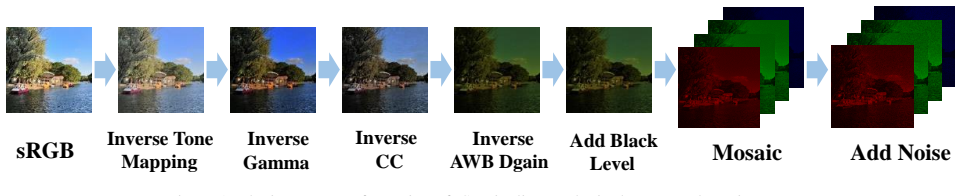
Summary. This paper introduces MSSIDD, a synthetic raw-domain benchmark for evaluating the sensor transferability of denoising models. Starting from clean sRGB ground-truth images from SIDD, the authors apply an inverse ISP pipeline (inverse tone mapping, inverse gamma, inverse color correction, inverse white balance, and mosaicing) to generate clean raw images for six simulated sensors, then add shot and read noise using calibration parameters from each sensor. The resulting 60,000 training and 6,000 validation paired noisy/clean raw images are used to benchmark several existing denoisers under leave-one-sensor-out transfer. The paper also proposes a multi-sensor consistency training framework that combines intra-image and inter-image relation-based feature consistency losses with adversarial sensor classification, and shows consistent improvements over base models on the synthetic benchmark and on a small real-sensor evaluation. The dataset and code are released publicly.
Significance. MSSIDD addresses a real gap: there is no widely used raw-domain benchmark specifically designed to measure cross-sensor generalization of denoising models. The dataset itself, if its synthetic generation is trustworthy, would be a useful resource, and the proposed consistency losses are simple, model-agnostic, and show consistent gains of roughly 0.1–0.2 dB across all held-out sensors in Tables 1–2. The authors also provide code, a datasheet, and a public release, which is commendable. However, the benchmark's central validity rests on the assumption that the inverse-ISP synthesis produces raw images whose sensor-to-sensor differences faithfully mimic real cameras. The real-sensor validation in Section 5.4 is not documented sufficiently, and the evaluation protocol in the Raw2Raw setting is not fully described in the main text. These are load-bearing issues that must be resolved before the dataset and the transferability claims can be accepted.
major comments (4)
- [Section 5.4, Table 3] The real-sensor validation is not documented. The text says that Sony and Canon raw images were captured and that "we subsequently use Sony sRGB image to perform inverse transformation according to the camera parameters of sensor6, resulting in three domains, namely sensor6, Sony, and Canon." It is never explained how the clean reference images for the Sony and Canon raw domains were obtained. If the references are also produced by the same inverse-ISP transformation, then the evaluation is circular and only tests within the synthetic pipeline. If genuine clean raw references exist (e.g., from multi-frame averaging), the acquisition and alignment procedure, the ISP parameters, and the way the references were validated must be described. As written, Table 3 cannot support the claim that the proposed supervision improves generalization to real sensors.
- [Section 3.1–3.2, Eq. (1)] The benchmark's validity rests on the assumption that the inverse-ISP pipeline yields clean raw images whose sensor-to-sensor differences (color, noise, black level) match real cameras. The paper provides no validation of this assumption. It relies on the general unprocessing idea of [11] but introduces modifications (random digital gain drawn from a Gaussian, random convex combinations of AWB and CCM parameters) and uses sensor parameters from a public webpage without any comparison to real raw captures. The authors should provide evidence, for example, by comparing the statistics of the synthesized raw images against real raw data from the same sensors, or by demonstrating that models trained on MSSIDD transfer to real raw data in a protocol with clearly documented ground-truth references.
- [Section 5.1 and Supplemental Section 7.2] The Raw2Raw evaluation protocol is not described accurately in the main text. Section 5.1 says PSNR and SSIM are reported on raw and sRGB outputs, but the supplement states that "under the RAW2RAW setting, we will conduct the digital gain and gamma correction on the predicted clean raw images output by the network" with a gain of 2.0 and gamma of 1/2.2 before computing metrics. This post-processing is part of the protocol and must be stated in the main text, otherwise the benchmark results are not reproducible from the paper alone. The authors should also analyze sensitivity to the chosen gain and gamma values, since the ranking of methods could depend on these choices.
- [Section 4.1, Eqs. (5)–(7)] The proposed intra- and inter-image consistency losses assume that the same scene is available across sensors with pixel-perfect alignment. This assumption holds trivially in the MSSIDD benchmark because all six sensor images are generated from the same sRGB image via the inverse pipeline. For real multi-sensor data, capturing the same scene with different cameras introduces parallax, registration errors, and different lens/ISP characteristics, which would break the assumption. The paper should clarify how the proposed supervision is intended to be applied to real sensor data, or state explicitly that the method is designed for synthetic multi-sensor training data where such alignment is available.
minor comments (3)
- [Abstract and Section 3.3] The abstract states the dataset consists of "60,000 raw images of six distinct sensors," but Section 3.3 and Table 4 describe 60,000 training pairs plus 6,000 validation pairs, totaling 66,000. Please correct the abstract or clarify that the number refers only to training pairs.
- [Datasheet, Section 8 vs. Section 3.2] The datasheet says "All raw images are 4 channels with RGGB bayer pattern," while Section 3.2 says the raw images follow the BGGR Bayer pattern. One of these is inconsistent and should be fixed.
- [Section 4.1, Eqs. (5)–(7)] The normalization constants in Eqs. (5)–(7) are written with ambiguous notation (e.g., "N (N − 1)/2|D|"). Use explicit fractions such as \frac{N(N-1)}{2|D|L} to avoid confusion about the placement of the dataset-size and scale factors.
Circularity Check
No circularity: held-out sensor transfer tasks use unseen sensor parameters, the consistency losses are training regularizers, and self-citations are background; the underdocumented real-sensor validation is a validity risk, not an exhibited circular reduction.
full rationale
None of the circularity failure modes is realized in the paper's derivation chain. The MSSIDD benchmark is a data-generation contribution: SIDD sRGB content is passed through an inverse-ISP pipeline (Section 3.1) using externally calibrated sensor parameters and noise models, and the '→ sensor m' transfer tasks in Tables 1-2 exclude sensor m from training. The measured PSNR/SSIM therefore quantify generalization to sensor parameters not seen during optimization, rather than being constructed from the same fitted values. The proposed losses (Eqs. 5-9) are training regularizers; they are not fit to the reported evaluation numbers and do not define the metrics. The inverse-ISP pipeline is adopted from external prior work [11], not from the authors' own prior claims. The self-citations [38,39] are cited only as inspiration for relation-based consistency and adversarial training, so they are not load-bearing evidence for the dataset's validity or for the observed gains. A legitimate validity concern remains: the inverse-ISP synthesis in Section 3.1 is a proxy for real sensor behavior, and Section 5.4 does not document how clean references for the real Sony and Canon raw images were obtained, so the real-sensor validation is incomplete as written. But missing documentation is not, by itself, an exhibited circular reduction: the paper never states that the same inverse-ISP outputs are reused as the Sony/Canon references, and no equation shows the evaluation target being defined by the training pipeline. Under the rule that circularity must be quoted and specifically reduced, this is a correctness/validation risk rather than a circularity finding. Score 1 reflects the minor, non-load-bearing self-citations and the background validation gap, not a circular derivation chain.
Assumptions & free parameters
free parameters (4)
- Inverse digital gain distribution =
mean 0.65, std 0.2
- Balance weights lambda1, lambda2, lambda3 =
0.1, 0.1, 1.0
- Adversarial ramp alpha =
0 to 1
- Raw2Raw metric gain and gamma =
digital gain 2.0, gamma 1/2.2
assumptions (4)
- domain assumption Inverse ISP pipeline (unprocessing) of [11] produces physically plausible raw images from sRGB images.
- domain assumption The noise model I ~ N(x, sigma_shot^2 x + sigma_read^2) with sigma_shot^2 = K0*ISO + K1 and sigma_read^2 = B0*ISO^2 + B1*ISO + B2 from [27] describes real camera noise.
- domain assumption Six sensor profiles from the Sony semiconductor page [1] (plus CCMs and light sources) represent realistic diversity of mobile sensors.
- domain assumption Encouraging relation-consistency of features across sensors (Eqs. 5-7) and sensor confusion (Eq. 8) improves generalization to unseen sensors.
Cite this review
Pith. "Pith review of MSSIDD: A Benchmark for Multi-Sensor Denoising." pith.science (2026). https://pith.science/paper/WHXFD3TF
@misc{pith2026241111562,
  author       = {Pith},
  title        = {Pith review of: MSSIDD: A Benchmark for Multi-Sensor Denoising},
  year         = {2026},
  howpublished = {\url{https://pith.science/paper/WHXFD3TF}},
  note         = {Machine review of arXiv:2411.11562}
}
read the original abstract
The cameras equipped on mobile terminals employ different sensors in different photograph modes, and the transferability of raw domain denoising models between these sensors is significant but remains sufficient exploration. Industrial solutions either develop distinct training strategies and models for different sensors or ignore the differences between sensors and simply extend existing models to new sensors, which leads to tedious training or unsatisfactory performance. In this paper, we introduce a new benchmark, the Multi-Sensor SIDD (MSSIDD) dataset, which is the first raw-domain dataset designed to evaluate the sensor transferability of denoising models. The MSSIDD dataset consists of 60,000 raw images of six distinct sensors, derived through the degeneration of sRGB images via different camera sensor parameters. Furthermore, we propose a sensor consistency training framework that enables denoising models to learn the sensor-invariant features, thereby facilitating the generalization of the consistent model to unseen sensors. We evaluate previous arts on the newly proposed MSSIDD dataset, and the experimental results validate the effectiveness of our proposed method. Our dataset is available at https://www.kaggle.com/datasets/sjtuwh/mssidd.
Figures


Figures from the paper (3 more)


Reference graph
Works this paper leans on
-
[11]
Unpro- cessing images for learned raw denoising
Tim Brooks, Ben Mildenhall, Tianfan Xue, Jiawen Chen, Dillon Sharlet, and Jonathan T Barron. Unpro- cessing images for learned raw denoising. In IEEE Conference on Computer Vision and Pattern Recogni- tion, pages 11036–11045, 2019. 1, 2, 3, 4, 6
work page 2019
-
[1]
https:// www.sony-semicon.com/en/products/is/ camera/index.html
Image sensor for consumer cameras. https:// www.sony-semicon.com/en/products/is/ camera/index.html. 4
-
[2]
Standard illuminant. https://en.wikipedia. org/wiki/Standard_illuminant. 3
-
[3]
A high-quality denoising dataset for smartphone cameras
Abdelrahman Abdelhamed, Stephen Lin, and Michael S Brown. A high-quality denoising dataset for smartphone cameras. In IEEE Conference on Computer Vision and Pattern Recognition , pages 1692–1700, 2018. 2, 3, 6
work page 2018
-
[4]
Cross-camera con- volutional color constancy
Mahmoud Afifi, Jonathan T Barron, Chloe LeGendre, Yun-Ta Tsai, and Francois Bleibel. Cross-camera con- volutional color constancy. InInternational Conference on Computer Vision, pages 1981–1990, 2021. 3
work page 1981
-
[5]
Real image denoising with feature attention
Saeed Anwar and Nick Barnes. Real image denoising with feature attention. In International Conference on Computer Vision, pages 3155–3164, 2019. 2, 6, 7, 8
work page 2019
-
[6]
Martin Arjovsky, L´eon Bottou, Ishaan Gulrajani, and David Lopez-Paz. Invariant risk minimization. arXiv preprint arXiv:1907.02893, 2019. 6
arXiv 1907
-
[7]
Jonathan T Barron. Convolutional color constancy. In International Conference on Computer Vision, pages 379–387, 2015. 3
work page 2015
Show all 66 references
-
[8]
Photon shot noise
CWJ Beenakker and M Patra. Photon shot noise. Mod- ern physics letters B, 13(11):337–347, 1999. 3
1999
-
[9]
Automatic exposure algorithms for digital photography
Jarosław Bernacki. Automatic exposure algorithms for digital photography. Multimedia Tools and Applica- tions, 79(19):12751–12776, 2020. 3
2020
-
[10]
Boie and Ingemar J
Robert A. Boie and Ingemar J. Cox. An analysis of camera noise. IEEE Transactions on Pattern Analysis and Machine Intelligence, 14(06):671–674, 1992. 3
1992
-
[12]
A non-local algorithm for image denoising
Antoni Buades, Bartomeu Coll, and J-M Morel. A non-local algorithm for image denoising. In IEEE Con- ference on Computer Vision and Pattern Recognition, pages 60–65. Ieee, 2005. 2
2005
-
[13]
Self-similarity driven color demo- saicking
Antoni Buades, Bartomeu Coll, Jean-Michel Morel, and Catalina Sbert. Self-similarity driven color demo- saicking. IEEE Transactions on Image Processing, 18 (6):1192–1202, 2009. 3
2009
-
[14]
Learning camera-aware noise models
Ke-Chi Chang, Ren Wang, Hung-Jin Lin, Yu-Lun Liu, Chia-Ping Chen, Yu-Lin Chang, and Hwann-Tzong Chen. Learning camera-aware noise models. In Euro- pean Conference on Computer Vision, pages 343–358,
-
[15]
Hinet: Half instance normalization network for image restoration
Liangyu Chen, Xin Lu, Jie Zhang, Xiaojie Chu, and Chengpeng Chen. Hinet: Half instance normalization network for image restoration. In IEEE Conference on Computer Vision and Pattern Recognition , pages 182–192, 2021. 6, 7, 8
2021
-
[16]
Simple baselines for image restoration
Liangyu Chen, Xiaojie Chu, Xiangyu Zhang, and Jian Sun. Simple baselines for image restoration. In Eu- ropean Conference on Computer Vision, pages 17–33,
-
[17]
A simple framework for contrastive learning of visual representations
Ting Chen, Simon Kornblith, Mohammad Norouzi, and Geoffrey Hinton. A simple framework for contrastive learning of visual representations. In International conference on machine learning , pages 1597–1607. PMLR, 2020. 5
2020
-
[18]
Intrinsic phase-preserving networks for depth super resolution
Xuanhong Chen, Hang Wang, Jialiang Chen, Kairui Feng, Jinfan Liu, Xiaohang Wang, Weimin Zhang, and Bingbing Ni. Intrinsic phase-preserving networks for depth super resolution. In Proceedings of the AAAI Conference on Artificial Intelligence, pages 1210–1218,
-
[19]
Focal network for image restoration
Yuning Cui, Wenqi Ren, Xiaochun Cao, and Alois Knoll. Focal network for image restoration. In Interna- tional Conference on Computer Vision, pages 13001– 13011, 2023. 2
2023
-
[20]
Image denoising by sparse 3-d transform-domain collaborative filtering
Kostadin Dabov, Alessandro Foi, Vladimir Katkovnik, and Karen Egiazarian. Image denoising by sparse 3-d transform-domain collaborative filtering. IEEE Trans- actions on Image Processing, 16(8):2080–2095, 2007. 1, 2, 7, 8
2007
-
[21]
Unsupervised domain adaptation by backpropagation
Yaroslav Ganin and Victor Lempitsky. Unsupervised domain adaptation by backpropagation. In Interna- tional Conference on Machine Learning, pages 1180–
-
[22]
Malvar-he-cutler linear image demo- saicking
Pascal Getreuer. Malvar-he-cutler linear image demo- saicking. Image Processing on Line, 1:83–89, 2011. 3
2011
-
[23]
Deep joint demosaicking and denoising
Micha¨el Gharbi, Gaurav Chaurasia, Sylvain Paris, and Fr´edo Durand. Deep joint demosaicking and denoising. ACM Transactions on Graphics, 35(6):1–12, 2016. 2
2016
-
[24]
Weighted nuclear norm minimization with application to image denoising
Shuhang Gu, Lei Zhang, Wangmeng Zuo, and Xi- angchu Feng. Weighted nuclear norm minimization with application to image denoising. In IEEE Con- ference on Computer Vision and Pattern Recognition, pages 2862–2869, 2014. 2
2014
-
[25]
Gamma correction for digital fringe projection profilometry
Hongwei Guo, Haitao He, and Mingyi Chen. Gamma correction for digital fringe projection profilometry. Applied optics, 43(14):2906–2914, 2004. 3
2004
-
[26]
Toward convolutional blind denoising of 9 real photographs
Shi Guo, Zifei Yan, Kai Zhang, Wangmeng Zuo, and Lei Zhang. Toward convolutional blind denoising of 9 real photographs. In IEEE Conference on Computer Vi- sion and Pattern Recognition, pages 1712–1722, 2019. 2
2019
-
[27]
Radiometric ccd camera calibration and noise estimation
Glenn E Healey and Raghava Kondepudy. Radiometric ccd camera calibration and noise estimation. IEEE Transactions on Pattern Analysis and Machine Intelli- gence, 16(3):267–276, 1994. 3
1994
-
[28]
The human condition as seen from the cross: Luther and disability
Stefan Heuser. The human condition as seen from the cross: Luther and disability. Disability in the Christian tradition: A reader, pages 184–215, 2012. 3
2012
-
[29]
Adaptive homogeneity-directed demosaicing algorithm
Keigo Hirakawa and Thomas W Parks. Adaptive homogeneity-directed demosaicing algorithm. IEEE Transactions on Image Processing , 14(3):360–369,
-
[30]
Focnet: A fractional optimal control network for image denoising
Xixi Jia, Sanyang Liu, Xiangchu Feng, and Lei Zhang. Focnet: A fractional optimal control network for image denoising. In IEEE Conference on Computer Vision and Pattern Recognition, pages 6054–6063, 2019. 2
2019
-
[31]
Lighting every darkness in two pairs: A calibration-free pipeline for raw denoising
Xin Jin, Jia-Wen Xiao, Ling-Hao Han, Chunle Guo, Ruixun Zhang, Xialei Liu, and Chongyi Li. Lighting every darkness in two pairs: A calibration-free pipeline for raw denoising. In International Conference on Computer Vision, pages 13275–13284, 2023. 1, 2
2023
-
[32]
Transfer learning from synthetic to real- noise denoising with adaptive instance normalization
Yoonsik Kim, Jae Woong Soh, Gu Yong Park, and Nam Ik Cho. Transfer learning from synthetic to real- noise denoising with adaptive instance normalization. In IEEE Conference on Computer Vision and Pattern Recognition, pages 3482–3492, 2020. 7, 8
2020
-
[33]
Efficient visual computing with camera raw snapshots
Zhihao Li, Ming Lu, Xu Zhang, Xin Feng, M Salman Asif, and Zhan Ma. Efficient visual computing with camera raw snapshots. IEEE Transactions on Pattern Analysis and Machine Intelligence, 2024. 2, 3
2024
-
[34]
Swinir: Image restoration using swin transformer
Jingyun Liang, Jiezhang Cao, Guolei Sun, Kai Zhang, Luc Van Gool, and Radu Timofte. Swinir: Image restoration using swin transformer. In International Conference on Computer Vision , pages 1833–1844,
-
[35]
Non-local recurrent network for image restoration
Ding Liu, Bihan Wen, Yuchen Fan, Chen Change Loy, and Thomas S Huang. Non-local recurrent network for image restoration. Advances in Neural Information Processing Systems, 31, 2018. 2
2018
-
[36]
Decoupled weight decay regularization
Ilya Loshchilov and Frank Hutter. Decoupled weight decay regularization. In International Conference on Learning Representations, 2019. 6
2019
-
[37]
Visu- alizing data using t-sne
Laurens Van Der Maaten and Geoffrey Hinton. Visu- alizing data using t-sne. Journal of Machine Learning Research, 9(2605):2579–2605, 2008
2008
-
[38]
Towards bridging sample complexity and model capacity
Shibin Mei, Chenglong Zhao, Shengchao Yuan, and Bingbing Ni. Towards bridging sample complexity and model capacity. InProceedings of the AAAI Conference on Artificial Intelligence, pages 1972–1980, 2022. 5
1972
-
[39]
Exploring and utilizing pattern imbal- ance
Shibin Mei, Chenglong Zhao, Shengchao Yuan, and Bingbing Ni. Exploring and utilizing pattern imbal- ance. In Proceedings of the IEEE/CVF Conference on Computer Vision and Pattern Recognition , pages 7569–7578, 2023. 6
2023
-
[40]
Graphical modeling for multi-source domain adaptation
Minghao Xu, Hang Wang, and Bingbing Ni. Graphical modeling for multi-source domain adaptation. IEEE Transactions on Pattern Analysis and Machine Intelli- gence, 46(3):1727–1741, 2022
2022
-
[41]
Reducing domain gap via style-agnostic networks
Hyeonseob Nam, HyunJae Lee, Jongchan Park, Won- jun Yoon, and Donggeun Yoo. Reducing domain gap via style-agnostic networks. arXiv preprint arXiv:1910.11645, 2(7):8, 2019. 6
1910 arXiv
-
[42]
An iterative regularization method for total variation-based image restoration
Stanley Osher, Martin Burger, Donald Goldfarb, Jinjun Xu, and Wotao Yin. An iterative regularization method for total variation-based image restoration. Multiscale Modeling & Simulation, 4(2):460–489, 2005. 2
2005
-
[43]
Gradient based threshold free color filter array interpolation
Ibrahim Pekkucuksen and Yucel Altunbasak. Gradient based threshold free color filter array interpolation. In IEEE International Conference on Image Processing, pages 137–140. IEEE, 2010. 3
2010
-
[44]
Benchmarking denoising algorithms with real photographs
Tobias Plotz and Stefan Roth. Benchmarking denoising algorithms with real photographs. In IEEE Conference on Computer Vision and Pattern Recognition , pages 1586–1595, 2017. 2, 6
2017
-
[45]
Demosaicking methods for bayer color arrays
Rajeev Ramanath, Wesley E Snyder, Griff L Bilbro, and William A Sander III. Demosaicking methods for bayer color arrays. Journal of Electronic imaging, 11 (3):306–315, 2002. 3
2002
-
[46]
U-net: Convolutional networks for biomedical im- age segmentation
Olaf Ronneberger, Philipp Fischer, and Thomas Brox. U-net: Convolutional networks for biomedical im- age segmentation. In Medical Image Computing and Computer-assisted Intervention, pages 234–241, 2015. 5
2015
-
[47]
Distributionally robust neural net- works for group shifts: On the importance of regular- ization for worst-case generalization
Shiori Sagawa, Pang Wei Koh, Tatsunori B Hashimoto, and Percy Liang. Distributionally robust neural net- works for group shifts: On the importance of regular- ization for worst-case generalization. arXiv preprint arXiv:1911.08731, 2019. 5
1911 arXiv
-
[48]
Ntire 2017 challenge on single image super-resolution: Methods and results
Radu Timofte, Eirikur Agustsson, Luc Van Gool, Ming- Hsuan Yang, and Lei Zhang. Ntire 2017 challenge on single image super-resolution: Methods and results. In IEEE Conference on Computer Vision and Pattern Recognition Workshops, 2017. 6
2017
-
[49]
Attention is all you need
Ashish Vaswani, Noam Shazeer, Niki Parmar, Jakob Uszkoreit, Llion Jones, Aidan N Gomez, Łukasz Kaiser, and Illia Polosukhin. Attention is all you need. Advances in Neural Information Processing Systems, 30, 2017. 2
2017
-
[50]
Omni aggregation networks for lightweight image super-resolution
Hang Wang, Xuanhong Chen, Bingbing Ni, Yutian Liu, and Jinfan Liu. Omni aggregation networks for lightweight image super-resolution. In Proceedings of the IEEE/CVF Conference on Computer Vision and Pattern Recognition, pages 22378–22387, 2023. 2 10
2023
-
[51]
Practical deep raw image denoising on mobile devices
Yuzhi Wang, Haibin Huang, Qin Xu, Jiaming Liu, Yiqun Liu, and Jue Wang. Practical deep raw image denoising on mobile devices. In European Conference on Computer Vision, pages 1–16, 2020. 3
2020
-
[52]
Bovik, H.R
Zhou Wang, A.C. Bovik, H.R. Sheikh, and E.P. Simon- celli. Image quality assessment: from error visibility to structural similarity. IEEE Transactions on Image Processing, 13(4):600–612, 2004. 6
2004
-
[53]
Uformer: A general u-shaped transformer for image restoration
Zhendong Wang, Xiaodong Cun, Jianmin Bao, Wen- gang Zhou, Jianzhuang Liu, and Houqiang Li. Uformer: A general u-shaped transformer for image restoration. In IEEE Conference on Computer Vision and Pattern Recognition, pages 17683–17693, 2022. 2, 6, 7, 8
2022
-
[54]
Learning enriched features for real image restoration and enhancement
Syed Waqas Zamir, Aditya Arora, Salman Khan, Mu- nawar Hayat, Fahad Shahbaz Khan, Ming-Hsuan Yang, and Ling Shao. Learning enriched features for real image restoration and enhancement. In European Con- ference on Computer Vision, 2020. 7, 8
2020
-
[55]
Cycleisp: Real image restoration via improved data synthesis
Syed Waqas Zamir, Aditya Arora, Salman Khan, Mu- nawar Hayat, Fahad Shahbaz Khan, Ming-Hsuan Yang, and Ling Shao. Cycleisp: Real image restoration via improved data synthesis. In IEEE Conference on Computer Vision and Pattern Recognition, pages 2696– 2705, 2020. 2, 6, 7, 8
2020
-
[56]
Learning enriched features for real image restoration and enhancement
Syed Waqas Zamir, Aditya Arora, Salman Khan, Mu- nawar Hayat, Fahad Shahbaz Khan, Ming-Hsuan Yang, and Ling Shao. Learning enriched features for real image restoration and enhancement. In European Con- ference on Computer Vision, pages 492–511, 2020. 1, 2
2020
-
[57]
Multi-stage progressive image restora- tion
Syed Waqas Zamir, Aditya Arora, Salman Khan, Mu- nawar Hayat, Fahad Shahbaz Khan, Ming-Hsuan Yang, and Ling Shao. Multi-stage progressive image restora- tion. In IEEE Conference on Computer Vision and Pattern Recognition, pages 14821–14831, 2021. 2, 7, 8
2021
-
[58]
Restormer: Efficient transformer for high- resolution image restoration
Syed Waqas Zamir, Aditya Arora, Salman Khan, Mu- nawar Hayat, Fahad Shahbaz Khan, and Ming-Hsuan Yang. Restormer: Efficient transformer for high- resolution image restoration. In IEEE Conference on Computer Vision and Pattern Recognition, pages 5728– 5739, 2022. 1, 2, 6, 7, 8
2022
-
[59]
Ingredient-oriented multi-degradation learning for image restoration
Jinghao Zhang, Jie Huang, Mingde Yao, Zizheng Yang, Hu Yu, Man Zhou, and Feng Zhao. Ingredient-oriented multi-degradation learning for image restoration. In IEEE Conference on Computer Vision and Pattern Recognition, pages 5825–5835, 2023. 2
2023
-
[60]
Beyond a gaussian denoiser: Residual learning of deep cnn for image denoising
Kai Zhang, Wangmeng Zuo, Yunjin Chen, Deyu Meng, and Lei Zhang. Beyond a gaussian denoiser: Residual learning of deep cnn for image denoising. IEEE Trans- actions on Image Processing, 26(7):3142–3155, 2017. 1, 2, 6, 7, 8
2017
-
[61]
Learning deep cnn denoiser prior for image restoration
Kai Zhang, Wangmeng Zuo, Shuhang Gu, and Lei Zhang. Learning deep cnn denoiser prior for image restoration. In IEEE Conference on Computer Vision and Pattern Recognition, pages 3929–3938, 2017
2017
-
[62]
Ffdnet: Toward a fast and flexible solution for cnn-based image denoising
Kai Zhang, Wangmeng Zuo, and Lei Zhang. Ffdnet: Toward a fast and flexible solution for cnn-based image denoising. IEEE Transactions on Image Processing, 27(9):4608–4622, 2018. 2, 6, 7, 8
2018
-
[63]
Plug-and-play image restoration with deep denoiser prior
Kai Zhang, Yawei Li, Wangmeng Zuo, Lei Zhang, Luc Van Gool, and Radu Timofte. Plug-and-play image restoration with deep denoiser prior. IEEE Transac- tions on Pattern Analysis and Machine Intelligence, 44 (10):6360–6376, 2021. 2
2021
-
[64]
Variational adversar- ial defense: A bayes perspective for adversarial train- ing
Chenglong Zhao, Shibin Mei, Bingbing Ni, Shengchao Yuan, Zhenbo Yu, and Jun Wang. Variational adversar- ial defense: A bayes perspective for adversarial train- ing. IEEE Transactions on Pattern Analysis and Ma- chine Intelligence, 2023. 6 11
2023
-
[65]
Supplemental Materials 7.1. Datasheet We apply datasheets for datasets for dataset documentation and intended uses, where we illustrate the motivation for developing the MSSIDD benchmark, dataset composition, collection process, preprocessing, dataset usage, distribution, and ...
-
[66]
meta data.pkl
Datasheet for the MSSIDD Benchmark Motivation For what purpose was the dataset created? Was there a specific task in mind? Was there a specific gap that needed to be filled? Please provide a description. MSSIDD is created to be the first publicly available multi- sensor denois...
2024
Reviewed August 12, 2026 · model on record in the stance chip above.
Discussion (0). Continue with ORCID to comment.