REVIEW 2 major objections 4 minor 1 cited by
Mean first-passage time at the origin of a run-and-tumble particle with periodic forces
T0 review · 2 major / 4 minor · reviewed 2026-08-12 · deepseek-v4-flash
Pith's one-line read One integral J(a) of the periodic force decides whether a run-and-tumble particle reaches the origin almost surely; if J(a) > 0, exit probability decays exponentially and the conditional mean first-passage time grows linearly with distance.
desk verdict Strong physics, weak proof: the J(a) criterion is likely right and worth publishing, but Proposition 1 as written is not a valid proof and the remark has a typo. read the letter →
The pith
A machine-rendered reading of the paper's core claim, the machinery that carries it, and where it could break.
The reading
What carries the argument
The argument rests on the backward Fokker–Planck equation for the survival probability, whose Laplace transform yields a coupled first-order system for the exit probability E(x,±) and the mean exit time T(x,±). The paper trades E and T for symmetric and antisymmetric combinations E, e and T, t, which satisfy scalar first-order ODEs solved by an integrating factor $e^{{J(x)}}$. Periodicity gives closed forms for J and the auxiliary integrals Ξ_± on the whole half-line, and the two integration constants are fixed by a Markov-chain argument: the embedded chain on the lattice {ka} has transition probabilities taken from the exit probabilities on a segment, and its ergodic theory shows that for J(a)>0 the chain drifts away from the origin, implying e(0)<0. A renewal argument based on periodicity — a particle starting at x+Na must pass through Na before reaching 0 — yields the affine dependence of the conditional mean first-passage time on N.
What would settle it
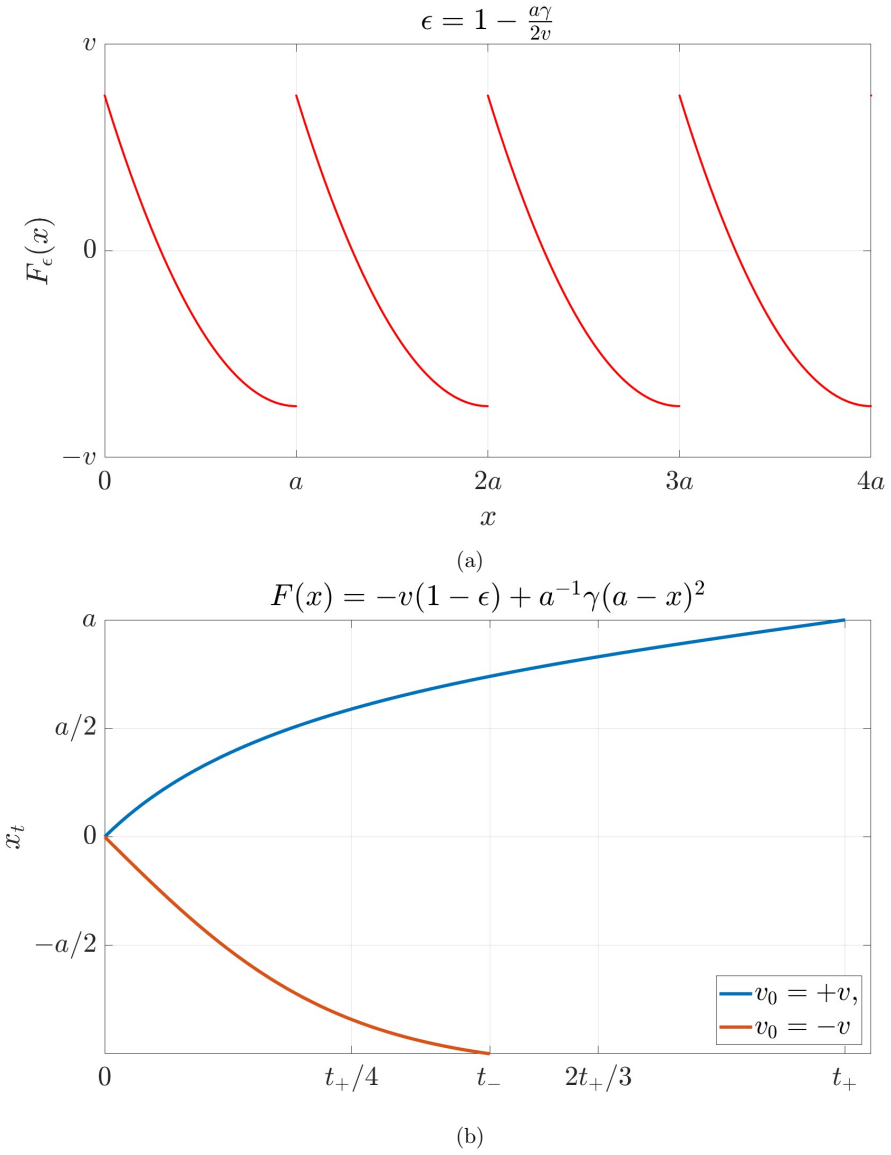
Take the periodic extension of F(x) = −v + $a^{{−1}}$γ(a−x)^2 on [0,a), which satisfies |F|<v but violates condition (i) because a particle starting at 0 approaches a only asymptotically. This field gives J(a) ≤ 0, yet the particle never reaches a, so the Markov chain on {ka} cannot be defined; a simulation would show a finite probability of never hitting the origin, demonstrating that the accessibility assumptions are essential to the theorem.
Extended reading notes
Core claim
The central claim is that the sign of J(a) = ∫_0^a 2F(y)/(1−F(y)^2) dy completely separates the two dynamical regimes. If J(a) ≤ 0, the particle hits the origin in finite time with probability one, and the mean first-passage time given the initial velocity state is an affine function of N, the number of periods separating the starting point from the origin. If J(a) > 0, the exit probability E(x+Na, ±) is not identically 1; it equals a prefactor times $e^{{−N J(a)}}$, and the conditional average ⟨T(x+Na)⟩_{c,±} is again affine in N with a slope that is independent of the phase x and the initial velocity state. The formulas (Eqs. 21–23) reproduce the known constant-drift results in the appropriate limits, and in the limit of a short period a→0 the conditional mean first-return time coincides with 1/|μ_eff| for an effective drift μ_eff = J(a)/(2Ξ_−(a)).
Load-bearing premise
The entire argument hinges on the assumption that starting from 0, the deterministic flows with total velocity F+1 and F−1 reach the next period boundary ±a in finite time; if this fails, the Markov chain on multiples of a is not well-defined and the boundary conditions and renewal step no longer apply.
Editorial extensions
If this is right
- For any periodic force field satisfying the accessibility conditions, the sign of J(a) tells directly whether particles are captured at the origin or escape to infinity.
- The conditional mean first-passage time grows linearly with the number of periods, with a slope independent of the starting phase and the initial velocity state, generalizing the constant-drift result.
- In the short-period limit the system behaves like a constant effective drift μ_eff = J(a)/(2Ξ_−(a)), so the mean first-return time from the origin becomes 1/|μ_eff|.
- The formulas reduce to the previously known constant-drift expressions when F is constant, which the paper verifies explicitly in an appendix.
Reading between the lines
- Because J(a) equals the drop of the active external potential W over one period, the condition J(a) ≤ 0 can be read as a potential-difference criterion: the active potential drives the particle toward the origin exactly when its value at the origin exceeds its value one period away.
- The Markov-chain method used here could be pushed to higher moments of the first-passage time by expanding the Laplace transform to higher order in s, yielding a hierarchy of affine-in-N expressions.
- A testable extension would be to include a finite tumble duration or a space-dependent tumbling rate; the periodic structure suggests the same J(a)-type integral should still govern the large-distance decay, though the constants will change.
- The short-period effective drift μ_eff = J(a)/(2Ξ_−(a)) is a clean quantity that could be measured experimentally with bacteria moving through periodic arrays of chemical gradients.
Editorial analysis
A structured set of objections, weighed in public.
Referee Report
Summary. The paper studies a one-dimensional run-and-tumble particle on the positive half-line with an absorbing target at the origin and a spatially periodic force field, in units where the tumbling rate and self-propulsion speed are one. The central results are an integral criterion J(a)≤0 for almost-sure exit, closed-form expressions for the exit probability E(x,±) in both regimes (Eqs. 20-21), and affine-in-N formulas for the conditional mean first-passage time (Eqs. 22-23). The dichotomous behavior is traced to the sign of the active external potential difference J(a)=W(0)-W(a). As an application, the authors treat a piecewise-constant force alternating between opposite drifts and show that in the short-period limit the conditional mean first-return time matches that of an effective constant drift. The derivations are based on the backward Fokker-Planck equation, boundary conditions obtained from renewal arguments, and a Markov-chain construction in Proposition 1; consistency with the constant-drift results of [36] is checked in Appendix D, and the alternating-drift results are compared with numerical simulations.
Significance. If the results are correct, they constitute a significant exact generalization of the constant-drift first-passage theory for run-and-tumble particles to arbitrary periodic forces, and they identify the active external potential of [35] as the quantity that controls the almost-sure-exit dichotomy. The paper is strong in several respects: it derives the main formulas from first principles rather than heuristics, it includes explicit consistency checks against the known constant-drift limits in Appendix D, it provides numerical simulations for the alternating-drift example, and it carefully introduces accessibility conditions (i) and (ii) with a concrete counterexample showing that |F|<1 alone is insufficient. The renewal argument in Section 5 for the affine spatial dependence is elegant and reduces the problem to one period interval. A notable internal strength is the Remark after Proposition 1, which contains a correct-looking alternative derivation of e(0) via the large-b limit of the segment exit probability; this remark provides a route to repair the flawed Markov-chain proof in the main text.
major comments (2)
- [§3.2, Eq. (58)] The transition probabilities p_{i,j} stated in Eq. (58) do not follow from the segment exit formula of [29] that the proof invokes. With A defined as 2∫_0^a Ξ_-(x)dx, the expression p_{1,1}=2/(A+e^{-J(a)}+1) contradicts Eq. (59), which gives E_a(0,+)=2/(2Ξ_-(a)+e^{-J(a)}+1); replacing A by 2Ξ_-(a) would be consistent with the cited formula, but then the stated p_{-1,1} still appears incompatible with the x→a^- limit of Eq. (59). Because this transition matrix is the basis for selecting the negative root e(0) in Proposition 1, the proof as written does not establish the dichotomy. The Remark following Proposition 1 gives a different derivation of e(0) by taking b→∞ in Eq. (59) and yields Eq. (54); that argument appears sound and should be promoted to the main proof, with the Markov-chain calculation either corrected or removed.
- [§3.2, Proposition 1, Eq. (56)] The inference 'the ergodic theorem gives π1−π2>0, therefore S_k=0 can occur only finitely often, hence P(S_k>0 for all k)>0' is a non-sequitur. A stochastic process can have a positive Cesàro average while returning to 0 infinitely often (e.g., long positive excursions interspersed with isolated returns to 0), so the ergodic theorem alone does not imply Eq. (56). To establish that the particle stays in the positive half-line with positive probability one needs a harmonic-function or supermartingale argument for the embedded walk, or the large-b limit of the segment formula given in the Remark. Since Proposition 1 is the only place in the main text where the 'only if' direction of the J(a)≤0 criterion is justified, this gap must be repaired.
minor comments (4)
- [§3.2, Proposition 1 proof] There is a duplicated phrase in the construction of the Markov chain: 'as if the particle the particle lived on the points {ka}'. The sentence should read 'as if the particle lived on the points {ka}'.
- [Author affiliation, first page] The affiliation contains a typo: 'Duke A venue' should be 'Duke Avenue'.
- [§3.2, Proposition 1 proof] The assertion that p_{i,j}>0 'thanks to Eqs (3), (4) and (5)' should explicitly refer to the accessibility conditions (i) and (ii) of Section 1, since |F|<1 alone is not sufficient to guarantee finite-time reachability of ±a, as the counterexample in Section 1 demonstrates.
- [§7, Discussion] The statement 'This condition has been established by a Markov-chain argument' should be updated to reflect the corrected proof, in particular the large-b limit of the segment formula in the Remark, since the Markov-chain transition probabilities in Eq. (58) are not reliable as written.
Circularity Check
No significant circularity: the derivation is self-contained, with external exact results used only as building blocks and consistency checks.
full rationale
The paper's central claims are derived from the backward Fokker-Planck equations (Eqs. 14, 16) by direct integration. The functions J and Xi_± are defined as integrals of the force F (Eqs. 42, 45), and the exit probability is obtained by solving the ODE system with boundary condition E(0,-)=1 and a renewal/periodicity boundary condition; no parameter is fitted to the paper's own outputs. The dichotomy J(a)<=0 vs J(a)>0 is established as follows: for J(a)<0 and J(a)=0, boundedness of e(x) forces e(0)=0 and then E(x)=1 (Section 3.2); for J(a)>0, Proposition 1 selects the negative root for e(0). Although the Markov-chain proof of Proposition 1 contains a logical gap (positive drift of the empirical average does not by itself imply a positive probability of avoiding level 0 forever), the appended Remark derives the same value of e(0) directly from the large-b limit of the segment exit probability quoted from [29], so the final value is not assumed from the claim being proved. The Markov-chain transition probabilities are taken from the independent external result [29], not from the present paper's conclusions. The short-period effective-drift limit is derived by asymptotic expansion of the exact formulas for T(0,+) and E(0,+), and the 'self-consistent argument' in Section 6.3 independently reproduces the same µ_eff from typical run lengths; it is a cross-check, not the source of the result. The connection to the active external potential W of [35] is interpretive (J(a)=W(0)-W(a)) and does not provide the first-passage formulas. The constant-drift checks in Appendix D and the numerical simulations are external benchmarks, not inputs. There are no self-citations by the authors, no fitted parameters renamed as predictions, and no ansatz smuggled in via citation. The flagged defect in Proposition 1 is a correctness risk, not a circularity, and per the hard rules I do not convert a proof gap into a circularity score.
Assumptions & free parameters
assumptions (5)
- domain assumption RTP model: dx/dt = F(x)+vσ(t), σ flips at rate γ; backward Fokker-Planck equation (27) for survival probability.
- domain assumption Subcritical force: |F(x)|<v, hence |F(x)|<1 in units where v=1 (Eq. 3).
- ad hoc to paper Accessibility conditions (i) and (ii): flows with velocities F+1 and F−1 starting at 0 reach +a and −a in finite time (Eqs 4,5).
- domain assumption Segment exit probabilities E_b(x,±) quoted from [29] (Eq. 59).
- standard math Ergodic theorem for finite-state irreducible Markov chains [38].
Cite this review
Pith. "Pith review of Mean first-passage time at the origin of a run-and-tumble particle with periodic forces." pith.science (2026). https://pith.science/paper/H36C66BP
@misc{pith2026241111601,
  author       = {Pith},
  title        = {Pith review of: Mean first-passage time at the origin of a run-and-tumble particle with periodic forces},
  year         = {2026},
  howpublished = {\url{https://pith.science/paper/H36C66BP}},
  note         = {Machine review of arXiv:2411.11601}
}
read the original abstract
We consider a run-and-tumble particle on a half-line with an absorbing target at the origin. The particle has an internal velocity state that switches between two opposite values at Poisson-distributed times. The position of the particle evolves according to an overdamped Langevin dynamics with a spatially-periodic force field such that every point in a given period interval is accessible to the particle. The survival probability of the particle satisfies a backward Fokker--Planck equation, whose Laplace transform yields systems of equations for the moments of the first-passage time of the particle at the origin. The mean first-passage time has already been calculated assuming that the particle exits the system almost surely. We calculate the probability that the particle reaches the origin in a finite time, given its initial position and velocity. We obtain an integral condition on the force, under which the particle has a non-zero survival probability. The conditional average of the first-passage time at the origin (over the trajectories that reach the origin) is obtained in closed form. As an application, we consider a piecewise-constant force field that alternates periodically between two opposite values. In the limit where the period is short compared to the mean free path of the particle, the mean first-return time to the origin coincides with the value obtained in the case of an effective constant drift, which we calculate explicitly.
Figures


Figures from the paper (4 more)


Forward citations
Cited by 1 Pith paper
-
Exact Stationary State of a $d$-dimensional Run-and-Tumble Particle in a Harmonic Potential
The stationary position distribution of a run-and-tumble particle in a harmonic trap is solved exactly in 1D, 2D, and 3D; the 3D radial law is new and is not a beta distribution.
Reference graph
Works this paper leans on
-
[36]
Survival probability of a run-and-tumble particle in the presence of a drift,
B. De Bruyne, S. N. Majumdar, and G. Schehr, “Survival probability of a run-and-tumble particle in the presence of a drift,”Journal of Statistical Mechanics: Theory and Experiment, vol. 2021, no. 4, p. 043211, 2021. 55
work page 2021
-
[29]
Relating absorbing and hard wall boundary conditions for a one- dimensional run-and-tumble particle,
M. Guéneau and L. Touzo, “Relating absorbing and hard wall boundary conditions for a one- dimensional run-and-tumble particle,”Journal of Physics A: Mathematical and Theoretical, vol. 57, no. 22, p. 225005, 2024
work page 2024
-
[35]
Velocity and diffusion constant of an active particle in a one-dimensional force field,
P. Le Doussal, S. N. Majumdar, and G. Schehr, “Velocity and diffusion constant of an active particle in a one-dimensional force field,”Europhysics Letters, vol. 130, no. 4, p. 40002, 2020
work page 2020
-
[1]
Patie,On some first passage time problems motivated by financial applications
P. Patie,On some first passage time problems motivated by financial applications. PhD thesis, Universität Zürich, 2004
work page 2004
-
[2]
A. E. Kyprianou,Introductory lectures on fluctuations of Lévy processes with applications. Springer Science & Business Media, 2006
work page 2006
-
[3]
On the hitting times of continuous-state branching processes with immigration,
X. Duhalde, C. Foucart, and C. Ma, “On the hitting times of continuous-state branching processes with immigration,”Stochastic Processes and their Applications, vol. 124, no. 12, pp. 4182–4201, 2014
work page 2014
-
[4]
Continuous-state branching processes with collisions: first passage times and duality,
C. Foucart and M. Vidmar, “Continuous-state branching processes with collisions: first passage times and duality,”Stochastic Processes and their Applications, vol. 167, p. 104230, 2024
work page 2024
-
[5]
Redner,A guide to first-passage processes
S. Redner,A guide to first-passage processes. Cambridge university press, 2001
2001
Show all 41 references
-
[6]
Chemotaxis in escherichia coli analysed by three-dimensional tracking,
H. C. Berg and D. A. Brown, “Chemotaxis in escherichia coli analysed by three-dimensional tracking,”Nature, vol. 239, no. 5374, pp. 500–504, 1972
1972
-
[7]
H. C. Berg,E. coli in Motion. Springer Science & Business Media, 2008
2008
-
[8]
The mechanics and statistics of active matter,
S. Ramaswamy, “The mechanics and statistics of active matter,” 2010
2010
-
[9]
Motility-induced phase separation,
M. E. Cates and J. Tailleur, “Motility-induced phase separation,”Annu. Rev. Condens. Matter Phys., vol. 6, no. 1, pp. 219–244, 2015. 53
2015
-
[10]
Stochastic calculus of run-and-tumble motion: an applied perspective,
P. C. Bressloff, “Stochastic calculus of run-and-tumble motion: an applied perspective,”arXiv preprint arXiv:2411.15544, 2024
2024 arXiv
-
[11]
Run-and-tumble particle in inhomogeneous media in one dimension,
P. Singh, S. Sabhapandit, and A. Kundu, “Run-and-tumble particle in inhomogeneous media in one dimension,”Journal of Statistical Mechanics: Theory and Experiment, vol. 2020, no. 8, p. 083207, 2020
2020
-
[12]
Models of dispersal in biological systems,
H. G. Othmer, S. R. Dunbar, and W. Alt, “Models of dispersal in biological systems,”Journal of mathematical biology, vol. 26, no. 3, pp. 263–298, 1988
1988
-
[13]
Probability distributions for the run-and-tumble bacterial dynamics: An analogy to the Lorentz model,
K. Martens, L. Angelani, R. Di Leonardo, and L. Bocquet, “Probability distributions for the run-and-tumble bacterial dynamics: An analogy to the Lorentz model,”The European Physical Journal E, vol. 35, pp. 1–6, 2012
2012
-
[14]
Some applications of persistent random walks and the telegrapher’s equation,
G. H. Weiss, “Some applications of persistent random walks and the telegrapher’s equation,” Physica A: Statistical Mechanics and its Applications, vol. 311, no. 3-4, pp. 381–410, 2002
2002
-
[15]
Universal survival probability for a d-dimensional run-and-tumble particle,
F. Mori, P. Le Doussal, S. N. Majumdar, and G. Schehr, “Universal survival probability for a d-dimensional run-and-tumble particle,”Physical review letters, vol. 124, no. 9, p. 090603, 2020
2020
-
[16]
Run-and-tumbleparticlesintwodimensions: Marginal position distributions,
I.Santra, U.Basu, andS.Sabhapandit, “Run-and-tumbleparticlesintwodimensions: Marginal position distributions,”Phys. Rev. E, vol. 101, p. 062120, Jun 2020
2020
-
[17]
Exact position distribution of a harmonically confined run-and-tumble particle in two dimensions,
N. R. Smith, P. Le Doussal, S. N. Majumdar, and G. Schehr, “Exact position distribution of a harmonically confined run-and-tumble particle in two dimensions,”Physical Review E, vol. 106, no. 5, p. 054133, 2022
2022
-
[18]
Steady state, relaxation and first-passage properties of a run-and-tumble particle in one-dimension,
K. Malakar, V. Jemseena, A. Kundu, K. V. Kumar, S. Sabhapandit, S. N. Majumdar, S. Red- ner, and A. Dhar, “Steady state, relaxation and first-passage properties of a run-and-tumble particle in one-dimension,”Journal of Statistical Mechanics: Theory and Experiment, vol. 2018, n...
2018
-
[19]
Run and tumble particle under resetting: a renewal ap- proach,
M. R. Evans and S. N. Majumdar, “Run and tumble particle under resetting: a renewal ap- proach,”Journal of Physics A: Mathematical and Theoretical, vol. 51, no. 47, p. 475003, 2018
2018
-
[20]
Run-and-tumble particles in two dimensions under stochastic resetting conditions,
I. Santra, U. Basu, and S. Sabhapandit, “Run-and-tumble particles in two dimensions under stochastic resetting conditions,”Journal of Statistical Mechanics: Theory and Experiment, vol. 2020, p. 113206, nov 2020
2020
-
[21]
Noncrossing run-and-tumble particles on a line,
P. Le Doussal, S. N. Majumdar, and G. Schehr, “Noncrossing run-and-tumble particles on a line,”Physical Review E, vol. 100, no. 1, p. 012113, 2019
2019
-
[22]
Stationary nonequilibrium bound state of a pair of run and tumble particles,
P. Le Doussal, S. N. Majumdar, and G. Schehr, “Stationary nonequilibrium bound state of a pair of run and tumble particles,”Physical Review E, vol. 104, no. 4, p. 044103, 2021
2021
-
[23]
Extremal statistics of a one-dimensional run and tumble particle with an absorbing wall,
P. Singh, S. Santra, and A. Kundu, “Extremal statistics of a one-dimensional run and tumble particle with an absorbing wall,”Journal of Physics A: Mathematical and Theoretical, vol. 55, no. 46, p. 465004, 2022. 54
2022
-
[24]
Run-and-tumble particles, telegrapher’s equation and absorption problems with partially reflecting boundaries,
L. Angelani, “Run-and-tumble particles, telegrapher’s equation and absorption problems with partially reflecting boundaries,”Journal of Physics A: Mathematical and Theoretical, vol. 48, no. 49, p. 495003, 2015
2015
-
[25]
Confined run-and-tumble swimmers in one dimension,
L. Angelani, “Confined run-and-tumble swimmers in one dimension,”Journal of Physics A: Mathematical and Theoretical, vol. 50, no. 32, p. 325601, 2017
2017
-
[26]
One-dimensional run-and-tumble motions with generic boundary conditions,
L. Angelani, “One-dimensional run-and-tumble motions with generic boundary conditions,” Journal of Physics A: Mathematical and Theoretical, vol. 56, no. 45, p. 455003, 2023
2023
-
[27]
Encounter-based model of a run-and-tumble particle,
P. C. Bressloff, “Encounter-based model of a run-and-tumble particle,”Journal of Statistical Mechanics: Theory and Experiment, vol. 2022, no. 11, p. 113206, 2022
2022
-
[28]
Encounter-based model of a run-and-tumble particle II: absorption at sticky boundaries,
P. C. Bressloff, “Encounter-based model of a run-and-tumble particle II: absorption at sticky boundaries,”Journal of Statistical Mechanics: Theory and Experiment, vol. 2023, no. 4, p. 043208, 2023
2023
-
[30]
Run-and-tumble particle in one-dimensional confining potentials: Steady-state, relaxation, and first-passage properties,
A. Dhar, A. Kundu, S. N. Majumdar, S. Sabhapandit, and G. Schehr, “Run-and-tumble particle in one-dimensional confining potentials: Steady-state, relaxation, and first-passage properties,” Physical Review E, vol. 99, no. 3, p. 032132, 2019
2019
-
[31]
Survival probability and position distribution of a run and tumble particle inu(x) =α|x|potential with an absorbing boundary,
S. K. Nath and S. Sabhapandit, “Survival probability and position distribution of a run and tumble particle inu(x) =α|x|potential with an absorbing boundary,”arXiv preprint arXiv:2405.18988, 2024
2024 arXiv
-
[32]
Optimal mean first-passage time of a run- and-tumble particle in a class of one-dimensional confining potentials,
M. Guéneau, S. N. Majumdar, and G. Schehr, “Optimal mean first-passage time of a run- and-tumble particle in a class of one-dimensional confining potentials,”Europhysics Letters, vol. 145, no. 6, p. 61002, 2024
2024
-
[33]
Run-and-tumble particle in one-dimensional potentials: mean first-passage time and applications,
M. Guéneau, S. N. Majumdar, and G. Schehr, “Run-and-tumble particle in one-dimensional potentials: mean first-passage time and applications,”arXiv preprint arXiv:2409.16951, 2024
2024 arXiv
-
[34]
Run-and-tumble motion in a linear ratchet potential: Analytic solution, power extraction, and first-passage properties,
C. Roberts and Z. Zhen, “Run-and-tumble motion in a linear ratchet potential: Analytic solution, power extraction, and first-passage properties,”Physical Review E, vol. 108, no. 1, p. 014139, 2023
2023
-
[37]
Persistenceandfirst-passagepropertiesinnonequi- librium systems,
A.J.Bray, S.N.Majumdar, andG.Schehr, “Persistenceandfirst-passagepropertiesinnonequi- librium systems,”Advances in Physics, vol. 62, no. 3, pp. 225–361, 2013
2013
-
[38]
J. R. Norris,Markov chains. No. 2, Cambridge university press, 1998
1998
-
[39]
H. C. Berg,E. coli in Motion. Springer, 2004
2004
-
[40]
Harmonically trapped inertial run-and- tumble particle in one dimension,
D. Dutta, A. Kundu, S. Sabhapandit, and U. Basu, “Harmonically trapped inertial run-and- tumble particle in one dimension,”Physical Review E, vol. 110, no. 4, p. 044107, 2024
2024
-
[41]
Inertial dynamics of run-and-tumble particle,
D. Dutta, A. Kundu, and U. Basu, “Inertial dynamics of run-and-tumble particle,”arXiv preprint arXiv:2411.19186, 2024. 56
2024 arXiv
Reviewed August 12, 2026 · model on record in the stance chip above.
Discussion (0). Continue with ORCID to comment.