REVIEW 4 major objections 6 minor 29 references
Advacheck at GenAI Detection Task 1: AI Detection Powered by Domain-Aware Multi-Tasking
T0 review · 4 major / 6 minor · reviewed 2026-08-12 · deepseek-v4-flash
Pith's one-line read This paper claims that adding two auxiliary domain-classification heads to a shared Transformer encoder improves binary human-versus-machine text detection, winning its competition track with 83.07% macro F1.
desk verdict Winning shared-task system with real engineering value, but the headline numbers come from test-set-tuned thresholds and head counts. read the letter →
The pith
A machine-rendered reading of the paper's core claim, the machinery that carries it, and where it could break.
The reading
What carries the argument
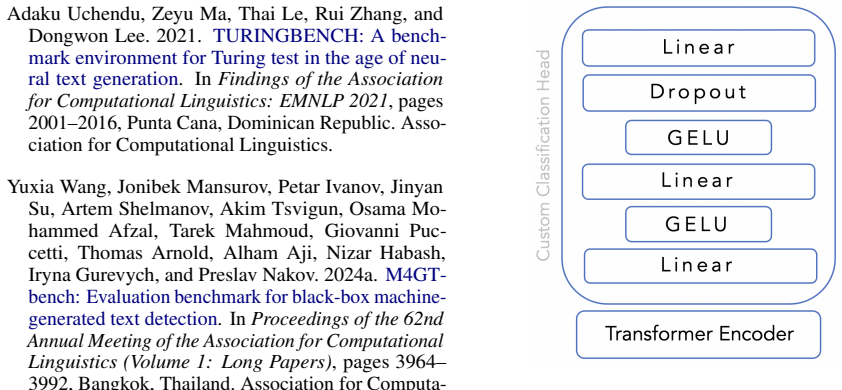
The central object is the multi-task Transformer with hard parameter sharing: a shared deberta-v3-base encoder and three custom classification heads, one binary head for the main task and two multi-class heads with five classes for HC3 sub-sources and six for M4GT sub-sources. Each custom head replaces the default linear classifier with a multi-layer GELU-activated head with dropout. Training runs in two stages: first the classifiers are trained with the encoder frozen, then the whole model is fine-tuned together; at inference only the binary head's predictions are used, optionally with a 0.92 threshold. The auxiliary heads carry the claimed benefit by forcing the shared representations to encode domain structure.
What would settle it
Hold out a fresh test sample from the same domains and generators, fix the multi-task architecture, the 0.92 threshold, and the two auxiliary heads using only the development set, then compare macro F1 against the single-task model selected the same way. If the multi-task model does not beat single-task within its confidence interval, the paper's central claim is not reproduced.
Extended reading notes
Core claim
The paper's central claim is that a hard-parameter-sharing multi-task architecture — one shared DeBERTa-v3 encoder feeding a binary human-versus-machine head plus two auxiliary multi-class heads that predict sub-sources inside the HC3 and M4GT corpora — detects machine-generated text better than the same encoder fine-tuned on the binary task alone. On the competition's test set the multi-task model reaches 83.07% macro F1 and first place, surpassing its single-task counterpart by about 3 points, and the authors assert that simultaneous training induces a domain-wise cluster structure in the shared embedding space.
Load-bearing premise
The claimed 3-point advantage of multi-task over single-task training assumes the final test scores were not used to choose the auxiliary-head configuration and the 0.92 threshold; if those choices were made by looking at test-set curves, the reported gap is a selected maximum rather than an unbiased estimate.
Editorial extensions
If this is right
- Multi-task training with domain-aware auxiliary heads is a drop-in replacement for plain fine-tuning when labelled sub-sources are available, giving a consistent gain on the binary detection task.
- The two-stage schedule of frozen-encoder training followed by full fine-tuning, plus a confidence threshold on the binary head, is enough to lift the winning configuration; single-stage multi-task training does not outperform single-task on the test set.
- The reported cluster structure implies that the shared encoder organizes texts by domain rather than purely by authorship, which may make the detection head's decisions more interpretable.
- Adding a third auxiliary head or using only one auxiliary head both lower test performance, so the benefit is not monotonic in the number of auxiliary tasks.
Reading between the lines
- A testable extension: replace the fixed HC3 and M4GT sub-source labels with automatically induced clusters, such as k-means on embeddings, and train the auxiliary heads on those; if the gain persists, the method does not need hand-curated domain labels.
- If the gain comes from domain structure rather than from having more classification parameters, the same improvement should appear when the auxiliary heads are trained on domain labels unrelated to generator identity, such as topic categories.
Signed reviews
Editorial analysis
A structured set of objections, weighed in public.
Referee Report
Summary. The paper describes the Advacheck entry for the monolingual subtask of GenAI Content Detection Task 1. The system uses a DeBERTa-v3 encoder shared across three classification heads: one binary head for human-vs-machine classification and two auxiliary multiclass heads predicting sub-sources within the HC3 and M4GT corpora. The model is trained in two stages (classifier heads with frozen encoder, then full fine-tuning). The authors report first place with 83.07% macro F1 on the official test set, outperforming the baseline by 10%. They claim that multi-task learning outperforms single-task fine-tuning and that the auxiliary tasks induce a domain-wise cluster structure in the embedding space, supported by ablations, error analysis, and PCA visualizations; code and model are released.
Significance. If the comparison were rigorous, the result would be a useful positive example of hard-parameter-sharing multi-task learning with auxiliary domain-labeling tasks improving generalization of AI-text detectors, in addition to being a winning shared-task system. The release of code and model, and the inclusion of ablations and error analysis, are strengths. However, the methodological issues described below mean the paper currently supports the scientific claims only weakly; the headline 83.07% score is likely a post-hoc maximum over test-set-selected hyperparameters rather than an unbiased estimate of a pre-specified system.
major comments (4)
- [§4.1, §6.2, Table 3, Figure 3] The paper explicitly states that a threshold "allowed us to achieve a winning result on the test set" (§4.1) and that Figure 3 "reaffirm[s] the choice of the final system and threshold for it" (§6.2). Table 3 and Figure 3 are both based on test-set macro F1. This indicates that both the head configuration (two auxiliary CCHs) and the 0.92 threshold were selected using test labels. Consequently, the reported 83.07% is a post-hoc selected maximum over the evaluated thresholds and configurations, not an unbiased estimate of a pre-specified system. Because the paper's central claim is that multi-task learning outperforms single-task learning, the authors should re-run the selection protocol using only the development set (e.g., choosing threshold and head count on the dev split) and report the test score of that pre-specified system, or otherwise provide an unbiased evaluation.
- [Table 1] The threshold-free comparison between MTL (81.55) and single-task DeBERTaV3 (78.52) appears to favor multi-task learning, but the single-task baseline was not given the same opportunity for threshold optimization. Applying a threshold to the MTL output improves its test macro F1 from 81.55 to 83.07, so the reported 3-point advantage may partly reflect unequal hyperparameter optimization rather than the multi-task architecture itself. The authors should apply an identical threshold-selection procedure to the single-task model and report the corresponding test score.
- [All experimental sections] All results are single runs without error bars, confidence intervals, or significance tests. The differences at stake are small (e.g., 81.55 vs 78.52 in Table 1; 82.70 vs 81.07 in Table 3), so run-to-run variance could change the conclusions. The authors should report results over multiple seeds (at least 3–5) with means and standard deviations, or provide bootstrap confidence intervals on the official test set, to establish that the reported gaps are not noise.
- [§6.2, Table 3] Table 3 shows that the one- and three-head configurations achieve higher development performance (92.27, 91.70, and 91.43) than the selected two-head system (87.96), while the two-head system is best on the test set. This directly confirms that the choice of two auxiliary heads was made using test-set performance, not development-set performance. The claim in §6.2 and the Conclusion that configurations with one or three heads "perform worse than our final system" is only true on the test set; on the dev set, the final system performs worst. This should be stated transparently, and the implications for leaderboard overfitting should be discussed.
minor comments (6)
- [§6.1, Figure 2] The claim that multi-task learning forms a "cluster structure" in the embedding space is supported only by qualitative PCA plots; a quantitative measure (e.g., silhouette score, cluster purity, or separation between domain centroids) would make this claim testable.
- [Figure 3 caption] The caption says "different configuration of the systems"; this should be "different configurations of the systems."
- [§6.2] The word "Additionaly" should be "Additionally."
- [§3] The sentence "After several variations of set of parallel heads" is vague; the authors should specify which variations were tried and why the two-head configuration was chosen other than by test performance.
- [Appendix B, Table 4] The hyperparameter table mentions "possibility of early exit" but does not describe what triggers the early exit; this should be clarified.
- [§2, Results] The task definition states that Micro F1 is an additional metric, but the paper does not report Micro F1 anywhere; reporting it would be useful for comparability with other systems.
Circularity Check
No circularity: the MTL-vs-single-task comparison is an external empirical evaluation; the test-set threshold tuning is a selection-bias concern but not a circular reduction.
full rationale
The paper's claimed derivation chain is empirical rather than definitional. The system is a hard-parameter-sharing multi-task architecture whose auxiliary heads are trained on the provided sub-source labels, and the central claim that MTL outperforms single-task is supported by direct macro-F1 comparisons on both the development set (87.33 vs 82.56) and the test set without the test-tuned threshold (81.55 vs 78.52). No equation defines the target result in terms of its own fitted values, and no prediction is renamed from a fitted parameter. Self-citations to prior team work (e.g., Gritsay et al. 2022, 2023b) serve only as contextual motivation for fine-tuning and MTL and are not load-bearing for the outcome. The paper does reveal that the 0.92 threshold and final head configuration were chosen with test-set feedback, which is a legitimate evaluation-integrity concern, but it does not make the derivation circular: the core comparison is an external benchmark evaluation and remains non-circular.
Assumptions & free parameters
free parameters (1)
- classifier threshold =
0.92
assumptions (2)
- domain assumption Auxiliary sub-source labels in HC3 and M4GT are informative for learning general text representations.
- domain assumption The development and test splits are representative of each other and of deployment conditions.
Cite this review
Pith. "Pith review of Advacheck at GenAI Detection Task 1: AI Detection Powered by Domain-Aware Multi-Tasking." pith.science (2026). https://pith.science/paper/HDVLXYC7
@misc{pith2026241111736,
  author       = {Pith},
  title        = {Pith review of: Advacheck at GenAI Detection Task 1: AI Detection Powered by Domain-Aware Multi-Tasking},
  year         = {2026},
  howpublished = {\url{https://pith.science/paper/HDVLXYC7}},
  note         = {Machine review of arXiv:2411.11736}
}
read the original abstract
The paper describes a system designed by Advacheck team to recognise machine-generated and human-written texts in the monolingual subtask of GenAI Detection Task 1 competition. Our developed system is a multi-task architecture with shared Transformer Encoder between several classification heads. One head is responsible for binary classification between human-written and machine-generated texts, while the other heads are auxiliary multiclass classifiers for texts of different domains from particular datasets. As multiclass heads were trained to distinguish the domains presented in the data, they provide a better understanding of the samples. This approach led us to achieve the first place in the official ranking with 83.07% macro F1-score on the test set and bypass the baseline by 10%. We further study obtained system through ablation, error and representation analyses, finding that multi-task learning outperforms single-task mode and simultaneous tasks form a cluster structure in embeddings space.
Figures


Figures from the paper (3 more)


Reference graph
Works this paper leans on
-
[1]
online" 'onlinestring :=
ENTRY address archivePrefix author booktitle chapter edition editor eid eprint eprinttype howpublished institution journal key month note number organization pages publisher school series title type volume year doi pubmed url lastchecked label extra.label sort.label short.list INTEGERS output.state before.all mid.sentence after.sentence after.block STRING...
-
[2]
write newline
" write newline "" before.all 'output.state := FUNCTION n.dashify 't := "" t empty not t #1 #1 substring "-" = t #1 #2 substring "--" = not "--" * t #2 global.max substring 't := t #1 #1 substring "-" = "-" * t #2 global.max substring 't := while if t #1 #1 substring * t #2 global.max substring 't := if while FUNCTION word.in bbl.in capitalize " " * FUNCT...
-
[3]
K. Avetisyan, G. Gritsay, and A. Grabovoy. 2023. https://doi.org/10.1134/S0361768823040138 Cross-lingual plagiarism detection: Two are better than one . Program. Comput. Softw., 49(4):346–354
-
[4]
Kuk Lida Lee Chao-Ying Joanne Peng and Gary M. Ingersoll. 2002. https://doi.org/10.1080/00220670209598786 An introduction to logistic regression analysis and reporting . The Journal of Educational Research, 96(1):3--14
-
[5]
Michael Crawshaw. 2020. https://arxiv.org/abs/2009.09796 Multi-task learning with deep neural networks: A survey . Preprint, arXiv:2009.09796
arXiv 2020
-
[6]
Liam Dugan, Alyssa Hwang, Filip Trhlik, Josh Magnus Ludan, Andrew Zhu, Hainiu Xu, Daphne Ippolito, and Chris Callison-Burch. 2024. https://arxiv.org/abs/2405.07940 Raid: A shared benchmark for robust evaluation of machine-generated text detectors . Preprint, arXiv:2405.07940
arXiv 2024
-
[7]
German Gritsai, Anastasia Voznyuk, Andrey Grabovoy, and Yury Chekhovich. 2024. https://arxiv.org/abs/2410.14677 Are ai detectors good enough? a survey on quality of datasets with machine-generated texts . Preprint, arXiv:2410.14677
arXiv 2024
- [8]
Show all 29 references
-
[9]
German Gritsay, Andrey Grabovoy, Aleksandr Kildyakov, and Yury Chekhovich. 2023 a . Artificially generated text fragments search in academic documents. In Doklady Mathematics, volume 108, pages S434--S442. Springer
2023
-
[10]
German Gritsay, Andrey Grabovoy, Aleksandr Kildyakov, and Yury Chekhovich. 2023 b . Automated text identification: Multilingual transformer-based models approach. In IberLEF@ SEPLN
2023
-
[11]
Zikang Guo, Kaijie Jiao, Xingyu Yao, Yuning Wan, Haoran Li, Benfeng Xu, Licheng Zhang, Quan Wang, Yongdong Zhang, and Zhendong Mao. 2024. https://doi.org/10.18653/v1/2024.semeval-1.217 USTC - BUPT at S em E val-2024 task 8: Enhancing machine-generated text detection via domain...
2024 doi
-
[12]
Abhimanyu Hans, Avi Schwarzschild, Valeriia Cherepanova, Hamid Kazemi, Aniruddha Saha, Micah Goldblum, Jonas Geiping, and Tom Goldstein. 2024. https://arxiv.org/abs/2401.12070 Spotting llms with binoculars: Zero-shot detection of machine-generated text . Preprint, arXiv:2401.12070
2024 arXiv
-
[13]
Dan Hendrycks and Kevin Gimpel. 2023. https://arxiv.org/abs/1606.08415 Gaussian error linear units (gelus) . Preprint, arXiv:1606.08415
2023 arXiv
-
[14]
Ganesh Jawahar, Muhammad Abdul-Mageed, and Laks Lakshmanan, V.S. 2020. https://doi.org/10.18653/v1/2020.coling-main.208 Automatic detection of machine generated text: A critical survey . In Proceedings of the 28th International Conference on Computational Linguistics, pages 22...
2020 doi
-
[15]
Ryuto Koike, Masahiro Kaneko, and Naoaki Okazaki. 2023. https://api.semanticscholar.org/CorpusID:260091573 Outfox: Llm-generated essay detection through in-context learning with adversarially generated examples . In AAAI Conference on Artificial Intelligence
2023
-
[16]
Kristian Kuznetsov, Eduard Tulchinskii, Laida Kushnareva, German Magai, Serguei Barannikov, Sergey Nikolenko, and Irina Piontkovskaya. 2024. https://arxiv.org/abs/2410.08113 Robust ai-generated text detection by restricted embeddings . Preprint, arXiv:2410.08113
2024 arXiv
-
[17]
Maxime Labonne and Sean Moran. 2023. https://arxiv.org/abs/2304.01238 Spam-t5: Benchmarking large language models for few-shot email spam detection . Preprint, arXiv:2304.01238
2023 arXiv
-
[18]
Yongqiang Ma, Jiawei Liu, Fan Yi, Qikai Cheng, Yong Huang, Wei Lu, and Xiaozhong Liu. 2023. https://arxiv.org/abs/2301.10416 Ai vs. human -- differentiation analysis of scientific content generation . Preprint, arXiv:2301.10416
2023 arXiv
-
[19]
Dominik Macko, Robert Moro, Adaku Uchendu, Jason Lucas, Michiharu Yamashita, Matúš Pikuliak, Ivan Srba, Thai Le, Dongwon Lee, Jakub Simko, and Maria Bielikova. 2023. https://doi.org/10.18653/v1/2023.emnlp-main.616 Multitude: Large-scale multilingual machine-generated text dete...
2023 doi
-
[20]
Manning, and Chelsea Finn
Eric Mitchell, Yoonho Lee, Alexander Khazatsky, Christopher D. Manning, and Chelsea Finn. 2023. https://arxiv.org/abs/2301.11305 Detectgpt: Zero-shot machine-generated text detection using probability curvature . Preprint, arXiv:2301.11305
2023 arXiv
-
[21]
Zhenpeng Su, Xing Wu, Wei Zhou, Guangyuan Ma, and Songlin Hu. 2024. https://arxiv.org/abs/2309.02731 Hc3 plus: A semantic-invariant human chatgpt comparison corpus . Preprint, arXiv:2309.02731
2024 arXiv
-
[22]
Zhen Tao, Yanfang Chen, Dinghao Xi, Zhiyu Li, and Wei Xu. 2024. https://arxiv.org/abs/2406.09056 Cudrt: Benchmarking the detection models of human vs. large language models generated texts . Preprint, arXiv:2406.09056
2024 arXiv
-
[23]
Eduard Tulchinskii, Kristian Kuznetsov, Laida Kushnareva, Daniil Cherniavskii, Sergey Nikolenko, Evgeny Burnaev, Serguei Barannikov, and Irina Piontkovskaya. 2023. Intrinsic dimension estimation for robust detection of ai-generated texts. In Proceedings of the 37th Internation...
2023
-
[24]
Adaku Uchendu, Zeyu Ma, Thai Le, Rui Zhang, and Dongwon Lee. 2021. https://doi.org/10.18653/v1/2021.findings-emnlp.172 TURINGBENCH : A benchmark environment for T uring test in the age of neural text generation . In Findings of the Association for Computational Linguistics: EM...
2021 doi
-
[25]
Yuxia Wang, Jonibek Mansurov, Petar Ivanov, Jinyan Su, Artem Shelmanov, Akim Tsvigun, Osama Mohammed Afzal, Tarek Mahmoud, Giovanni Puccetti, Thomas Arnold, Alham Aji, Nizar Habash, Iryna Gurevych, and Preslav Nakov. 2024 a . https://doi.org/10.18653/v1/2024.acl-long.218 M 4 G...
2024 doi
-
[26]
Yuxia Wang, Jonibek Mansurov, Petar Ivanov, Jinyan Su, Artem Shelmanov, Akim Tsvigun, Chenxi Whitehouse, Osama Mohammed Afzal, Tarek Mahmoud, Giovanni Puccetti, Thomas Arnold, Alham Fikri Aji, Nizar Habash, Iryna Gurevych, and Preslav Nakov. 2024 b . Semeval-2024 task 8: Multi...
2024
-
[27]
Yuxia Wang, Artem Shelmanov, Jonibek Mansurov, Akim Tsvigun, Vladislav Mikhailov, Rui Xing, Zhuohan Xie, Jiahui Geng, Giovanni Puccetti, Ekaterina Artemova, Jinyan Su, Minh Ngoc Ta, Mervat Abassy, Kareem Elozeiri, Saad El Dine Ahmed, Maiya Goloburda, Tarek Mahmoud, Raj Vardhan...
2025
-
[28]
Zijie Zeng, Lele Sha, Yuheng Li, Kaixun Yang, Dragan Gašević, and Guanliang Chen. 2023. https://arxiv.org/abs/2307.12267 Towards automatic boundary detection for human-ai collaborative hybrid essay in education . Preprint, arXiv:2307.12267
2023 arXiv
-
[29]
Qihui Zhang, Chujie Gao, Dongping Chen, Yue Huang, Yixin Huang, Zhenyang Sun, Shilin Zhang, Weiye Li, Zhengyan Fu, Yao Wan, and Lichao Sun. 2024. https://arxiv.org/abs/2401.05952 Llm-as-a-coauthor: Can mixed human-written and machine-generated text be detected? Preprint, arXiv...
2024 arXiv
Reviewed August 12, 2026 · model on record in the stance chip above.
Discussion (0). Continue with ORCID to comment.