REVIEW 3 major objections 5 minor 141 references
Let there be neutrons! Hadronic photoproduction from a large flux of high-energy photons
T0 review · 3 major / 5 minor · reviewed 2026-08-12 · deepseek-v4-flash
Pith's one-line read Long gamma-ray bursts can manufacture neutrons from photons at the jet head, converting proton-only stellar gas into fuel for heavy-element nucleosynthesis.
desk verdict A genuinely new r-process mechanism for long GRBs, but the one-zone network violates photon number conservation and the neutron yields are likely overestimated by orders of magnitude. read the letter →
The pith
A machine-rendered reading of the paper's core claim, the machinery that carries it, and where it could break.
The reading
What carries the argument
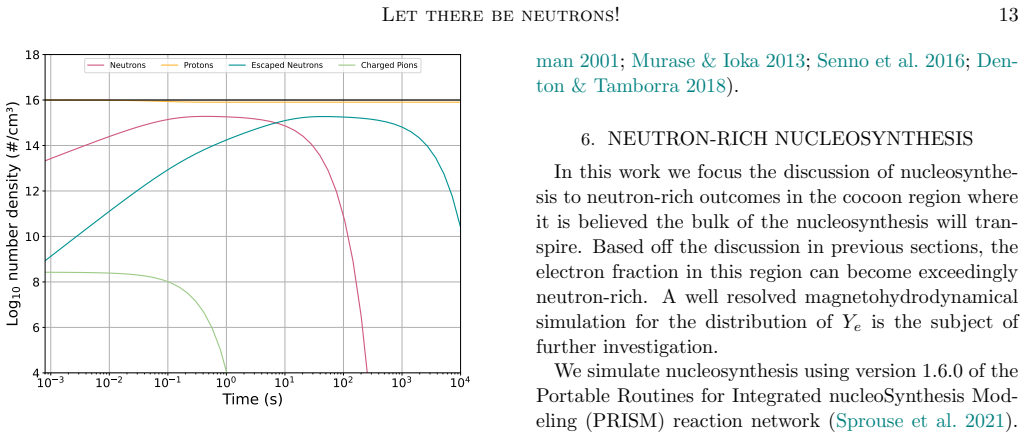
The load-bearing mechanism is the photo-pion transmutation reaction gamma + p -> pi+ + n, balanced against gamma + n -> pi- + p, with cross sections taken from the paper's coupled-channel photon-nucleon reaction model, a unified fit to world photoproduction data. The photon flux is modeled as a piecewise power law of the observed GRB spectral form, normalized to A = $10^{37}$ ph/$cm^{2}$/s/keV at the pivot energy and scaled to the jet head. A single-zone reaction network tracks protons, neutrons, escaped neutrons, and charged pions, competing the neutron-production rate against neutron decay, pion decay, and the ~$10^{-4}$ s neutron escape timescale while protons and pions remain magnetically confined. This interplay sets the electron fraction of the cocoon, the parameter that ultimately controls whether the outflow produces an r-process, an i-process-like pattern, or proton-rich nucleosynthesis.
What would settle it
Compute the actual photon flux at the jet-head interaction radius with a self-consistent sub-photospheric dissipation model; if the flux at $10^{6}$ keV falls below ~$10^{25}$ ph/$cm^{2}$/s/keV, neutron production is slower than the ~$10^{-4}$ s escape timescale and the claimed mechanism fails.
Extended reading notes
Core claim
This paper's central claim is that hadronic photoproduction can manufacture neutrons in situ in collapsar gamma-ray bursts. Using a coupled-channel photon-nucleon model to compute cross sections and a single-zone reaction network at the jet head, it finds that with the estimated photon flux Phi_gamma ~ $10^{33}$ ph/$cm^{2}$/s/keV at ~$10^{6}$ keV, neutrons and pions are produced nearly instantaneously from a starting composition of pure protons. The charged products stay confined by the jet's magnetic field, while neutrons escape on ~$10^{-4}$ s timescales into the cocoon; the resulting electron fractions can be extremely low, down to Ye ~ 0.0035 in one simulated case. Nucleosynthesis calculations then yield weak and robust r-process patterns, fission recycling with actinide production, and an i-process-like cold pattern, whose summed abundance curve reproduces the full range of solar r-process residuals. The conclusion is that collapsar long GRBs are a viable new site for neutron-capture nucleosynthesis.
Load-bearing premise
The argument stands on the assumed photon flux at the jet head, estimated by scaling an observed GRB spectrum from cosmological distance back to r ~ $10^{10}$ cm; if that flux is even a few orders of magnitude lower than ~$10^{33}$ ph/$cm^{2}$/s/keV at 1 MeV, neutron production cannot keep pace with neutron escape.
Editorial extensions
If this is right
- Collapsar long GRBs become candidate r-process sites that do not require pre-existing neutrons or a neutron-star merger; even a helium or carbon envelope works because photodissociation first frees nucleons.
- The cocoon can reach electron fractions far below those of disk outflows, down to Ye ~ 0.03 for Gamma ~ 10 and even lower in the paper's longer-lived scenario, which is the regime that produces actinides and fission recycling.
- The combined abundance patterns from the paper's three density and temperature evolutions can reproduce the solar r-process residuals across the first, second, third, and lead peaks, giving a specific elemental fingerprint to search for in GRB-associated ejecta.
- Observable signatures follow from the same reactions: red kilonova light from lanthanide and actinide production, the 2.6 MeV 208Tl decay line, a possible neutron precursor, and high-energy neutrinos from pion decay.
Reading between the lines
- If this is right, the standard division of r-process labor between short GRBs and compact-object mergers is incomplete; galactic chemical evolution models would need a long-GRB channel whose yield is sensitive to jet Lorentz factor and envelope density.
- Because the same photons that create neutrons also create pions that decay into neutrinos, a stacking search for high-energy neutrinos from long GRBs could independently confirm the jet-head photon flux before any nucleosynthesis signature is observed.
- The bottleneck is the sub-photospheric non-thermal tail; the mechanism could be tested by radiative-transfer simulations of jet-head dissipation that compute the actual 1 MeV photon flux in the envelope frame, or by measuring the prompt spectrum's high-energy extension across many bursts.
Editorial analysis
A structured set of objections, weighed in public.
Referee Report
Summary. The paper proposes that the intense photon flux at the head of a long-GRB jet can drive hadronic photoproduction, notably gamma + p -> pi+ + n, converting initially proton-only stellar material into neutron-rich material in situ. The authors estimate the jet-head photon spectrum by rescaling observed GRB spectra to the source, compute photohadronic rates using ANL-Osaka cross sections, model the proton/neutron/pion populations with a one-zone reaction network, estimate escape and injection timescales, and then run PRISM nucleosynthesis for three assumed density/temperature/electron-fraction trajectories. They conclude that collapsar long GRBs could be a new site for r-process and i-process nucleosynthesis and discuss several observational signatures.
Significance. If the central mechanism operates as claimed, this paper would add collapsar long GRBs to the list of candidate r-process sites and connect jet physics directly to heavy-element nucleosynthesis. The use of the documented ANL-Osaka partial-wave amplitudes for the photoproduction cross sections and the use of a standard reaction network (PRISM) are strengths, as is the concrete enumeration of observable tests such as a neutron precursor, kilonova signatures, gamma-ray lines, and associated neutrinos. The main reservations concern not the cross-section physics but whether the assumed photon field can actually process the claimed baryon mass, and whether the nucleosynthesis calculations are connected to the photoproduction network by a forward model.
major comments (3)
- [Sec. 4.7, Eq. (10); Sec. 5.4] The homogeneous reaction network implicitly neglects photon depletion, and this is load-bearing for the central claim. With the fiducial values n_b = 10^24 cm^-3 and L ~ 5 x 10^7 cm, the optical depth across the jet head for a ~300 MeV photon is tau ~ n_b sigma L ~ 1.5 x 10^4 for sigma ~ 3 x 10^-28 cm^2. Integrating Eq. (10) over the whole zone therefore asks each incident photon to convert ~10^4 protons, which violates photon number conservation. In reality the photon flux attenuates on a scale lambda ~ 1/(n_b sigma_tot) ~ 10^2-10^3 cm, with Compton and pair-production opacity comparable or larger, so only a thin skin of the jet-head material is processed. The cone-mass estimate M ~ 0.1-1 M_sun in Secs. 5.5-5.6 and the very low initial electron fractions used in Sec. 6 therefore do not follow from the stated jet-head conditions. Please provide an attenuation-corrected estimate of the processed baryon mass and neutron yield, or explicitly reframe the claim as applying to a thin surface layer rather than to the full jet-head cone.
- [Sec. 3.2] The estimate Phi_gamma ~ 10^33 ph/cm^2/s/keV at 10^6 keV is an order-of-magnitude extrapolation from Figure 2 of Ahlgren et al. (2019), scaled by (d_l/r_jh)^2 under the assumptions that the sub-photospheric non-thermal tail originates at r_jh ~ 10^10 cm, is isotropic, and is not absorbed before reaching the baryons. Because the proposed mechanism fails for flux below Phi_gamma ~ 10^25 ph/cm^2/s/keV at 10^6 keV (Sec. 4.7), the nominal margin of several orders of magnitude does not remove the need for a sensitivity analysis; the true flux at the interaction region could be much lower if the high-energy tail is produced at larger radii, is beamed, or is attenuated by pair production and scattering. Please state the plausible uncertainty range on Phi_gamma and show explicitly at which flux values the neutron-rich outcome is lost.
- [Sec. 6 and Sec. 5.5] The nucleosynthesis simulations are not yet connected to the photoproduction network. The initial electron fractions Ye = 0.334, 0.034, and 0.0035 are imposed from the extreme-conversion formulas in Sec. 5.5, which assume that all baryons in the jet head are converted to neutrons and then mix with envelope protons. Once the photon-attenuation issue of Sec. 4.7 is taken into account, the fraction of converted baryons is far smaller, so the actually attainable Ye will be higher and closer to the quasi-equilibrium range Ye ~ 0.52-0.66 quoted in Sec. 4.8. The statement that the integration of simulations (a)-(c) 'closely aligns with the full range of solar r-process residuals' should be presented as an illustration of possible outcomes for chosen parameters, not as a prediction of the proposed mechanism, unless a forward model linking the jet-head conditions to Ye and the density trajectory is supplied.
minor comments (5)
- [Throughout] There are several typographical errors: 'photodisentigration' in Sec. 1, 'copius' in Sec. 3.2, and 'Relativitiy' in Sec. 8; these should be corrected.
- [Fig. 3 caption] The caption reads 'Cross section ( -barns)', which appears to have a missing mu symbol; please confirm that the units are microbarns.
- [Secs. 4.6-4.7] The adopted neutron escape time tau_esc = 5 x 10^-4 s and the injection time tau_inj = 10^-4 s are not clearly derived from the stated geometry: Sec. 4.6 estimates tau_esc ~ L/v with L = r tan(theta), while Sec. 5.4 gives L ~ 5 x 10^7 cm, for which L/c ~ 0.17 s. Please define a single length scale and velocity and provide corresponding timescales, or present these values explicitly as free parameters in a sensitivity scan.
- [Sec. 4.7] The claim that the conclusions are independent of starting composition is not demonstrated, because the network in Eqs. (20)-(23) tracks only protons, neutrons, and charged pions and does not include photodisintegration of 4He or 12C. Please either add the relevant photodisintegration channels or soften the statement.
- [Sec. 5.6] Equation (48) treats tau1, tau2, and xi as adjustable parameters; for a work proposing a new mechanism, a brief justification of the adopted values, or a footnote indicating which physical regimes they represent, would improve clarity.
Circularity Check
No significant circularity: the derivation chain rests on external data and standard rate equations; the nucleosynthesis section is exploratory rather than a fitted prediction.
full rationale
I followed the derivation chain from the photon flux (Sec. 3.2) through the hadronic reaction network (Sec. 4) to the nucleosynthesis initial conditions (Secs. 5.5 and 6). The photon flux normalization A = 10^37 ph/cm^2/s/keV is obtained by scaling an observed GRB spectrum (Ahlgren et al. 2019) with (d_l/r_jh)^2, an external input rather than a quantity fitted to the paper's own neutron-rich outcome. The cross sections for processes (2)-(5) come from the ANL-Osaka coupled-channel model, which is independently constrained by roughly 50,000 data points and by Jefferson Lab photoproduction measurements; the fact that one author is a developer of that model does not make the cross-section input circular, since the model is not defined in terms of the target neutron-production claim. Equations (10)-(13) and (20)-(23) are standard rate equations whose output (Fig. 4) is a calculation from stated fluxes and cross sections, not a restatement of the conclusion. The low electron fractions used in Sec. 6 are explicitly labeled as extreme cases ('In the most extreme case, all baryons in the jet head are converted to neutrons') and the density timescales are explicitly called 'adjustable parameters'; the resulting r-process-like patterns are therefore conditional demonstrations, not fitted predictions disguised as output. The possible violation of photon number conservation or attenuation of the photon flux in a dense medium is a physical-consistency/correctness concern about the input assumptions, not a circularity of the derivation. The few self-citations (e.g., Lloyd-Ronning et al. 2019 for BZ background; Sprouse et al. 2021 for the PRISM solver) are not load-bearing: removing them does not alter the derivation. No equation in the paper is equivalent by construction to the claimed result.
Assumptions & free parameters
free parameters (7)
- Photon flux normalization A =
10^37 ph/cm^2/s/keV at 10 keV
- Photon spectral indices alpha, beta, break E0 =
alpha = -0.1, beta = -1.5, E0 = 300 keV
- Neutron escape timescale tau_esc =
5 x 10^-4 s
- Photon injection timescale tau_inj =
10^-4 s in the jet head run; 0.1 s for shell interaction
- Mixing efficiency epsilon =
2.0 (scenario a), 28.3 (scenario b), 282.8 (scenario c)
- Density evolution parameters tau1, tau2, xi =
tau1 = tau2 = 3.5e-2 s, xi = 2 (a,b); tau1 = 1e-4 s, tau2 = 1e-1 s, xi = 3.5 (c)
- Initial temperature, density, and electron fraction for nucleosynthesis =
T0 = 2 GK, Ye = 0.334 (a); T0 = 2 GK, Ye = 0.034 (b); T0 = 0.1 GK, Ye = 0.0035 (c)
assumptions (6)
- domain assumption Cross sections from the ANL-Osaka model are reliable for gamma N -> pion N processes in the 200-1500 MeV range.
- domain assumption The gamma-ray spectrum observed at Earth, scaled back by (d_l / r_jh)^2, equals the flux at the jet head; the jet is effectively transparent to these photons at r ~ 10^10 cm.
- domain assumption Magnetic fields confine protons and charged pions on timescales much longer than neutron escape, allowing neutrons to leave the jet head selectively.
- domain assumption The hadronic population can be described by a homogeneous single-zone network with only protons, neutrons, and charged pions.
- domain assumption Photoproduced neutrons thermalize rapidly (before neutron capture) so Maxwellian-averaged cross sections apply.
- domain assumption The cocoon material is eventually ejected into the interstellar medium rather than falling back onto the black hole.
Cite this review
Pith. "Pith review of Let there be neutrons! Hadronic photoproduction from a large flux of high-energy photons." pith.science (2026). https://pith.science/paper/UISD25NE
@misc{pith2026241111831,
  author       = {Pith},
  title        = {Pith review of: Let there be neutrons! Hadronic photoproduction from a large flux of high-energy photons},
  year         = {2026},
  howpublished = {\url{https://pith.science/paper/UISD25NE}},
  note         = {Machine review of arXiv:2411.11831}
}
read the original abstract
We propose that neutrons may be generated in high-energy, high-flux photon environments via photo-induced reactions on pre-existing baryons. These photohadronic interactions are expected to occur in astrophysical jets and surrounding material. Historically, these reactions have been attributed to the production of high-energy cosmic rays and neutrinos. We estimate the photoproduction off of protons in the context of gamma-ray bursts, where it is expected there will be sufficient baryonic material that may be encompassing or entrained in the jet. We show that typical stellar baryonic material, even material completely devoid of neutrons, can become inundated with neutrons in situ via hadronic photoproduction. Consequently, this mechanism provides a means for collapsars and other astrophysical sites containing substantial flux of high-energy photons to be favorable for neutron-capture nucleosynthesis.
Figures


Figures from the paper (4 more)



Reference graph
Works this paper leans on
-
[1]
Abbott , B. P., Abbott , R., Abbott , T. D., et al. 2017, Physical Review Letters, 119, 161101, 10.1103/PhysRevLett.119.161101
-
[2]
2019, , 880, 76, 10.3847/1538-4357/ab271b
Ahlgren , B., Larsson , J., Valan , V., et al. 2019, , 880, 76, 10.3847/1538-4357/ab271b
-
[3]
2024, , 962, 68, 10.3847/1538-4357/ad11df
Anand , S., Barnes , J., Yang , S., et al. 2024, , 962, 68, 10.3847/1538-4357/ad11df
-
[4]
2013, Journal of Cosmology and Astroparticle Physics, 2013, 008–008, 10.1088/1475-7516/2013/09/008
Asano, K., & Mészáros, P. 2013, Journal of Cosmology and Astroparticle Physics, 2013, 008–008, 10.1088/1475-7516/2013/09/008
-
[5]
1993, The Astrophysical Journal, 413, 281, 10.1086/172995
Band, D., Matteson, J., Ford, L., et al. 1993, The Astrophysical Journal, 413, 281, 10.1086/172995
doi:10.1086/172995 1993
-
[6]
Barnes , J., Zhu , Y. L., Lund , K. A., et al. 2021, , 918, 44, 10.3847/1538-4357/ac0aec
-
[7]
2019, Monthly Notices of the Royal Astronomical Society, 489, 1082, 10.1093/mnras/stz2158
Battino, U., Tattersall, A., Lederer-Woods, C., et al. 2019, Monthly Notices of the Royal Astronomical Society, 489, 1082, 10.1093/mnras/stz2158
-
[8]
Beloborodov , A. M. 2010, , 407, 1033, 10.1111/j.1365-2966.2010.16770.x
arXiv 2010
Show all 141 references
-
[9]
S., & Smirnov , A
Berezinskii , V. S., & Smirnov , A. I. 1975, , 32, 461, 10.1007/BF00643157
1975 doi
-
[10]
A., & Brown, G
Bethe, H. A., & Brown, G. E. 1995, Reviews of Modern Physics, 67, 545, 10.1103/RevModPhys.67.545
1995 doi
-
[11]
K., Villar , V
Blanchard , P. K., Villar , V. A., Chornock , R., et al. 2024, Nature Astronomy, 8, 774, 10.1038/s41550-024-02237-4
2024 doi
-
[12]
1987, , 154, 1, 10.1016/0370-1573(87)90134-7
Blandford , R., & Eichler , D. 1987, , 154, 1, 10.1016/0370-1573(87)90134-7
1987 doi
-
[13]
2019, , 57, 467, 10.1146/annurev-astro-081817-051948
Blandford , R., Meier , D., & Readhead , A. 2019, , 57, 467, 10.1146/annurev-astro-081817-051948
2019 doi
-
[14]
D., & McKee, C
Blandford, R. D., & McKee, C. F. 1976, The Physics of Fluids, 19, 1130, 10.1063/1.861619
1976 doi
-
[15]
D., & Znajek , R
Blandford , R. D., & Znajek , R. L. 1977, , 179, 433, 10.1093/mnras/179.3.433
1977 doi
-
[16]
1949, The Characteristics of Electrical Discharges in Magnetic Fields, ed
Bohm, D. 1949, The Characteristics of Electrical Discharges in Magnetic Fields, ed. A. Guthrie (McGraw-Hill)
1949
-
[17]
2011, , 733, 85, 10.1088/0004-637X/733/2/85
Bromberg , O., Mikolitzky , Z., & Levinson , A. 2011, , 733, 85, 10.1088/0004-637X/733/2/85
2011 doi
-
[18]
2015, Monthly Notices of the Royal Astronomical Society, 456, 1739, 10.1093/mnras/stv2591
Bromberg, O., & Tchekhovskoy, A. 2015, Monthly Notices of the Royal Astronomical Society, 456, 1739, 10.1093/mnras/stv2591
2015 doi
-
[19]
M., Burbidge, G
Burbidge, E. M., Burbidge, G. R., Fowler, W. A., & Hoyle, F. 1957, Rev. Mod. Phys., 29, 547, 10.1103/RevModPhys.29.547
1957 doi
- [20]
-
[21]
2021, , 648, A119, 10.1051/0004-6361/202040170
Choplin , A., Siess , L., & Goriely , S. 2021, , 648, A119, 10.1051/0004-6361/202040170
2021 doi
-
[22]
A., & Petschek , A
Colgate , S. A., & Petschek , A. G. 1980, in Texas Workshop on Type I Supernovae, ed. J. C. Wheeler , 42--52
1980
-
[23]
2018, , 854, 105, 10.3847/1538-4357/aaaae8
C \^o t \'e , B., Denissenkov , P., Herwig , F., et al. 2018, , 854, 105, 10.3847/1538-4357/aaaae8
2018 doi
-
[24]
J., Pfeiffer, B., Kratz, K., et al
Cowan, J. J., Pfeiffer, B., Kratz, K., et al. 1999, The Astrophysical Journal, 521, 194–205, 10.1086/307512
1999 doi
-
[25]
M., Fr \"o hlich , C., et al
Curtis , S., Miller , J. M., Fr \"o hlich , C., et al. 2023, , 945, L13, 10.3847/2041-8213/acba16
2023 doi
-
[26]
2022, Monthly Notices of the Royal Astronomical Society, 512, 3627, 10.1093/mnras/stac742
De Colle, F., Kumar, P., & Hoeflich, P. 2022, Monthly Notices of the Royal Astronomical Society, 512, 3627, 10.1093/mnras/stac742
2022 doi
-
[27]
2018, , 478, 4553, 10.1093/mnras/sty1282
De Colle , F., Lu , W., Kumar , P., Ramirez-Ruiz , E., & Smoot , G. 2018, , 478, 4553, 10.1093/mnras/sty1282
2018 doi
-
[28]
B., & Tamborra, I
Denton, P. B., & Tamborra, I. 2018, The Astrophysical Journal, 855, 37, 10.3847/1538-4357/aaab4a
2018 doi
- [29]
-
[30]
, Thielemann, F.-K
Farouqi, K. , Thielemann, F.-K. , Rosswog, S. , & Kratz, K.-L. 2022, A&A, 663, A70, 10.1051/0004-6361/202141038
2022 doi
-
[31]
P., Belloni , T
Fender , R. P., Belloni , T. M., & Gallo , E. 2004, , 355, 1105, 10.1111/j.1365-2966.2004.08384.x
2004
-
[32]
Freiburghaus , C., Rosswog , S., & Thielemann , F. K. 1999, , 525, L121, 10.1086/312343
1999 doi
-
[33]
2007, , 656, 382, 10.1086/509908
Fujimoto , S.-i., Hashimoto , M.-a., Kotake , K., & Yamada , S. 2007, , 656, 382, 10.1086/509908
2007 doi
-
[34]
2018, , 476, 1853, 10.1093/mnras/sty369
Fuller , J., & Ro , S. 2018, , 476, 1853, 10.1093/mnras/sty369
2018 doi
-
[35]
Gehrels , N., Ramirez-Ruiz , E., & Fox , D. B. 2009, , 47, 567, 10.1146/annurev.astro.46.060407.145147
2009
-
[37]
2007 b , , 469, 1, 10.1051/0004-6361:20066739
---. 2007 b , , 469, 1, 10.1051/0004-6361:20066739
2007 doi
-
[38]
L., & Syrovatskii , S
Ginzburg , V. L., & Syrovatskii , S. I. 1964, The Origin of Cosmic Rays
1964
-
[39]
2022, , 510, 4962, 10.1093/mnras/stab3784
Gottlieb , O., Lalakos , A., Bromberg , O., Liska , M., & Tchekhovskoy , A. 2022, , 510, 4962, 10.1093/mnras/stab3784
2022 doi
-
[40]
2020, Monthly Notices of the Royal Astronomical Society, 500, 3511–3526, 10.1093/mnras/staa3501
Gottlieb, O., Nakar, E., & Bromberg, O. 2020, Monthly Notices of the Royal Astronomical Society, 500, 3511–3526, 10.1093/mnras/staa3501
2020 doi
-
[41]
2004, Astroparticle Physics, 20, 429–455, 10.1016/s0927-6505(03)00211-1
Guetta, D., Hooper, D., Alvarez-Muñiz, J., Halzen, F., & Reuveni, E. 2004, Astroparticle Physics, 20, 429–455, 10.1016/s0927-6505(03)00211-1
2004 doi
-
[42]
2023, The Astrophysical Journal Letters, 944, L38, 10.3847/2041-8213/acb702
Halevi, G., Wu, B., Mösta, P., et al. 2023, The Astrophysical Journal Letters, 944, L38, 10.3847/2041-8213/acb702
2023 doi
-
[43]
2013, , 772, 101, 10.1088/0004-637X/772/2/101
Harrison , R., & Kobayashi , S. 2013, , 772, 101, 10.1088/0004-637X/772/2/101
2013 doi
-
[44]
R., Lin , P.-H., Knox , M., & Fryer , C
Herwig , F., Woodward , P. R., Lin , P.-H., Knox , M., & Fryer , C. 2014, , 792, L3, 10.1088/2041-8205/792/1/L3
2014 doi
-
[45]
2008, Nucleosynthesis simulations for a wide range of nuclear production sites from NuGrid
Herwig, F., Bennett, M., Diehl, S., et al. 2008, Nucleosynthesis simulations for a wide range of nuclear production sites from NuGrid. 0811.4653
2008 arXiv
-
[46]
Hillas , A. M. 1984, , 22, 425, 10.1146/annurev.aa.22.090184.002233
1984
-
[47]
2018, International Journal of Modern Physics D, 27, 1842005, 10.1142/S0218271818420051
Hotokezaka , K., Beniamini , P., & Piran , T. 2018, International Journal of Modern Physics D, 27, 1842005, 10.1142/S0218271818420051
2018 doi
-
[48]
2012, Physical Review Letters, 108, 10.1103/physrevlett.108.231101
Hümmer, S., Baerwald, P., & Winter, W. 2012, Physical Review Letters, 108, 10.1103/physrevlett.108.231101
2012 doi
-
[49]
2019, , 565, 324, 10.1038/s41586-018-0826-3
Izzo , L., de Ugarte Postigo , A., Maeda , K., et al. 2019, , 565, 324, 10.1038/s41586-018-0826-3
2019 doi
-
[50]
2023, Galaxies, 11, 105, 10.3390/galaxies11050105
Jiang , Y.-F. 2023, Galaxies, 11, 105, 10.3390/galaxies11050105
2023 doi
-
[51]
H., Matsuyama, A., & Sato, T
Juliá-Díaz, B., Lee, T.-S. H., Matsuyama, A., & Sato, T. 2007, Physical Review C, 76, 10.1103/physrevc.76.065201
2007 doi
-
[52]
A., Obergaulinger , M., & Nagataki , S
Just , O., Aloy , M. A., Obergaulinger , M., & Nagataki , S. 2022, , 934, L30, 10.3847/2041-8213/ac83a1
2022 doi
-
[53]
Kamano, H. 2017, in Proceedings of the 14th International Conference on Meson-Nucleon Physics and the Structure of the Nucleon (MENU2016) (Journal of the Physical Society of Japan), 10.7566/jpscp.13.010012
2017 doi
-
[54]
Kamano, H., Lee, T. S. H., Nakamura, S. X., & Sato, T. 2019, The ANL-Osaka Partial-Wave Amplitudes of N and N Reactions. 1909.11935
2019 arXiv
-
[55]
X., Lee, T.-S
Kamano, H., Nakamura, S. X., Lee, T.-S. H., & Sato, T. 2010, Phys. Rev. C, 81, 065207, 10.1103/PhysRevC.81.065207
2010 doi
- [56]
-
[57]
2015, , 191, 391, 10.1007/s11214-015-0171-x
Kargaltsev , O., Cerutti , B., Lyubarsky , Y., & Striani , E. 2015, , 191, 391, 10.1007/s11214-015-0171-x
2015 doi
-
[58]
2012, Stellar Structure and Evolution, 2nd edn
Kippenhahn, R., Weigert, A., & Weiss, A. 2012, Stellar Structure and Evolution, 2nd edn. (Berlin Heidelberg: Springer-Verlag)
2012
-
[59]
2018, , 620, A182, 10.1051/0004-6361/201833686
K \"o lligan , A., & Kuiper , R. 2018, , 620, A182, 10.1051/0004-6361/201833686
2018 doi
-
[60]
M., Fryer , C
Korobkin , O., Hungerford , A. M., Fryer , C. L., et al. 2020, , 889, 168, 10.3847/1538-4357/ab64d8
2020 doi
-
[61]
2015, , 561, 1, 10.1016/j.physrep.2014.09.008
Kumar , P., & Zhang , B. 2015, , 561, 1, 10.1016/j.physrep.2014.09.008
2015 doi
- [62]
-
[63]
J., & L \'o pez-C \'a mara , D
Lazzati , D., Morsony , B. J., & L \'o pez-C \'a mara , D. 2015, Journal of High Energy Astrophysics, 7, 17, 10.1016/j.jheap.2015.04.001
2015 doi
-
[64]
P., & Levan , A
Lazzati , D., Perna , R., Gompertz , B. P., & Levan , A. J. 2023, , 950, L20, 10.3847/2041-8213/acd18c
2023 doi
-
[65]
Lee, T.-S. H. 2019. https://www.phy.anl.gov/theory/research/anl-osaka-pwa
2019
-
[66]
2016, , 202, 33, 10.1007/s11214-016-0312-x
Levan , A., Crowther , P., de Grijs , R., et al. 2016, , 202, 33, 10.1007/s11214-016-0312-x
2016 doi
-
[67]
2010, Compact Stellar X-ray Sources
Lewin , W., & van der Klis , M. 2010, Compact Stellar X-ray Sources
2010
-
[68]
Lippuner, J., & Roberts, L. F. 2017, The Astrophysical Journal Supplement Series, 233, 18, 10.3847/1538-4365/aa94cb
2017 doi
-
[69]
2001, , 555, 540, 10.1086/321455
Lithwick , Y., & Sari , R. 2001, , 555, 540, 10.1086/321455
2001 doi
-
[70]
M., Fryer , C., Miller , J
Lloyd-Ronning , N. M., Fryer , C., Miller , J. M., et al. 2019, , 485, 203, 10.1093/mnras/stz390
2019 doi
-
[71]
J., & Moyer, B
Longo, M. J., & Moyer, B. J. 1962, Phys. Rev., 125, 701, 10.1103/PhysRev.125.701
1962 doi
-
[72]
MacDonald , D., & Thorne , K. S. 1982, , 198, 345, 10.1093/mnras/198.2.345
1982 doi
- [73]
-
[74]
1995, Astroparticle Physics, 3, 295, https://doi.org/10.1016/0927-6505(94)00044-4
Mannheim, K. 1995, Astroparticle Physics, 3, 295, https://doi.org/10.1016/0927-6505(94)00044-4
1995 doi
-
[75]
2016, Journal of Physics: Conference Series, 703, 012003, 10.1088/1742-6596/703/1/012003
Maria, L. 2016, Journal of Physics: Conference Series, 703, 012003, 10.1088/1742-6596/703/1/012003
2016 doi
-
[76]
2021, The Astrophysical Journal, 906, 131, 10.3847/1538-4357/abc952
Mastichiadis, A., & Petropoulou, M. 2021, The Astrophysical Journal, 906, 131, 10.3847/1538-4357/abc952
2021 doi
-
[77]
2007, Physics Reports, 439, 193–253, 10.1016/j.physrep.2006.12.003
Matsuyama, A., Sato, T., & Lee, T.-S. 2007, Physics Reports, 439, 193–253, 10.1016/j.physrep.2006.12.003
2007 doi
-
[78]
C., Filippenko , A
Mauerhan , J. C., Filippenko , A. V., Zheng , W., et al. 2018, , 478, 5050, 10.1093/mnras/sty1307
2018 doi
-
[79]
A., Whalen , D
Mesler , R. A., Whalen , D. J., Lloyd-Ronning , N. M., Fryer , C. L., & Pihlstr \"o m , Y. M. 2012, , 757, 117, 10.1088/0004-637X/757/2/117
2012 doi
-
[80]
2006, Reports on Progress in Physics, 69, 2259, 10.1088/0034-4885/69/8/R01
M \'e sz \'a ros , P. 2006, Reports on Progress in Physics, 69, 2259, 10.1088/0034-4885/69/8/R01
2006 doi
-
[81]
Metzger, B. D. 2019, Living Reviews in Relativity, 23, 10.1007/s41114-019-0024-0
2019 doi
-
[82]
D., Bauswein, A., Goriely, S., & Kasen, D
Metzger, B. D., Bauswein, A., Goriely, S., & Kasen, D. 2014, Monthly Notices of the Royal Astronomical Society, 446, 1115–1120, 10.1093/mnras/stu2225
2014 doi
-
[83]
S., Krishnan , T
Meyer , B. S., Krishnan , T. D., & Clayton , D. D. 1998, , 498, 808, 10.1086/305562
1998 doi
-
[84]
M., Sprouse , T
Miller , J. M., Sprouse , T. M., Fryer , C. L., et al. 2020, , 902, 66, 10.3847/1538-4357/abb4e3
2020 doi
-
[85]
J., Yoon , S.-C., Gr \"a fener , G., & Blinnikov , S
Moriya , T. J., Yoon , S.-C., Gr \"a fener , G., & Blinnikov , S. I. 2017, , 469, L108, 10.1093/mnrasl/slx056
2017 doi
-
[86]
L., & Valenti , S
Morozova , V., Piro , A. L., & Valenti , S. 2018, , 858, 15, 10.3847/1538-4357/aab9a6
2018 doi
-
[87]
J., Lazzati , D., & Begelman , M
Morsony , B. J., Lazzati , D., & Begelman , M. C. 2010, , 723, 267, 10.1088/0004-637X/723/1/267
2010 doi
-
[88]
P., Engel , R., Protheroe , R
M \"u cke , A., Rachen , J. P., Engel , R., Protheroe , R. J., & Stanev , T. 1999, , 16, 160, 10.1071/AS99160
1999 doi
-
[89]
2016, Progress in Particle and Nuclear Physics, 86, 86–126, 10.1016/j.ppnp.2015.09.001
Mumpower, M., Surman, R., McLaughlin, G., & Aprahamian, A. 2016, Progress in Particle and Nuclear Physics, 86, 86–126, 10.1016/j.ppnp.2015.09.001
2016 doi
-
[90]
R., Sprouse , T
Mumpower , M. R., Sprouse , T. M., Miller , J. M., et al. 2024, , 970, 173, 10.3847/1538-4357/ad5afc
2024 doi
-
[91]
2013, Physical Review Letters, 111, 10.1103/physrevlett.111.121102
Murase, K., & Ioka, K. 2013, Physical Review Letters, 111, 10.1103/physrevlett.111.121102
2013 doi
-
[92]
2013, Physical Review Letters, 111, 10.1103/physrevlett.111.131102
Murase, K., Kashiyama, K., & Mészáros, P. 2013, Physical Review Letters, 111, 10.1103/physrevlett.111.131102
2013 doi
-
[93]
2001, Physical Review Letters, 87, 10.1103/physrevlett.87.171102
Mészáros, P., & Waxman, E. 2001, Physical Review Letters, 87, 10.1103/physrevlett.87.171102
2001 doi
-
[94]
X., Kamano, H., Lee, T
Nakamura, S. X., Kamano, H., Lee, T. S. H., & Sato, T. 2018, Nuclear applications of ANL-Osaka amplitudes: pion photo-productions on deuteron. 1804.04757
2018 arXiv
-
[95]
2017, , 834, 28, 10.3847/1538-4357/834/1/28
Nakar , E., & Piran , T. 2017, , 834, 28, 10.3847/1538-4357/834/1/28
2017 doi
-
[96]
2024, Maximum Energy of Particles in Plasmas
Oka, M., Makishima, K., & Terasawa, T. 2024, Maximum Energy of Particles in Plasmas. 2412.00564
2024 arXiv
-
[97]
R., & Volkoff, G
Oppenheimer, J. R., & Volkoff, G. M. 1939, Physical Review, 55, 374, 10.1103/PhysRev.55.374
1939 doi
-
[98]
L., Burkert, V
Particle Data Group , Workman, R. L., Burkert, V. D., et al. 2022, Progress of Theoretical and Experimental Physics, 2022, 083C01, 10.1093/ptep/ptac097
2022 doi
-
[99]
Pe'er , A., M \'e sz \'a ros , P., & Rees , M. J. 2006, , 642, 995, 10.1086/501424
2006 doi
-
[100]
1999, Physics Reports, 314, 575, https://doi.org/10.1016/S0370-1573(98)00127-6
Piran, T. 1999, Physics Reports, 314, 575, https://doi.org/10.1016/S0370-1573(98)00127-6
1999 doi
-
[101]
2004, Reviews of Modern Physics, 76, 1143, 10.1103/RevModPhys.76.1143
Piran , T. 2004, Reviews of Modern Physics, 76, 1143, 10.1103/RevModPhys.76.1143
2004 doi
-
[102]
2005, in American Institute of Physics Conference Series, Vol
Piran , T. 2005, in American Institute of Physics Conference Series, Vol. 784, Magnetic Fields in the Universe: From Laboratory and Stars to Primordial Structures., ed. E. M. de Gouveia dal Pino , G. Lugones , & A. Lazarian (AIP), 164--174, 10.1063/1.2077181
2005 doi
-
[103]
Ramirez-Ruiz , E., Celotti , A., & Rees , M. J. 2002, , 337, 1349, 10.1046/j.1365-8711.2002.05995.x
2002
-
[104]
C., Gompertz , B
Rastinejad , J. C., Gompertz , B. P., Levan , A. J., et al. 2022, , 612, 223, 10.1038/s41586-022-05390-w
2022 doi
-
[105]
P., & Ferreira , J
Ray , T. P., & Ferreira , J. 2021, , 93, 101615, 10.1016/j.newar.2021.101615
2021
-
[106]
2004, The Astrophysical Journal, 613, 1072–1078, 10.1086/423166
Razzaque, S., Meszaros, P., & Zhang, B. 2004, The Astrophysical Journal, 613, 1072–1078, 10.1086/423166
2004 doi
-
[107]
U., Vassh , N., Holmbeck , E
Roederer , I. U., Vassh , N., Holmbeck , E. M., et al. 2023, Science, 382, 1177, 10.1126/science.adf1341
2023 doi
-
[108]
2018, , 615, A132, 10.1051/0004-6361/201732117
Rosswog , S., Sollerman , J., Feindt , U., et al. 2018, , 615, A132, 10.1051/0004-6361/201732117
2018 doi
-
[109]
M., Placco , V
Sakari , C. M., Placco , V. M., Farrell , E. M., et al. 2018, , 868, 110, 10.3847/1538-4357/aae9df
2018 doi
-
[110]
S., Barbieri , C., Ascenzi , S., & Toffano , M
Salafia , O. S., Barbieri , C., Ascenzi , S., & Toffano , M. 2020, , 636, A105, 10.1051/0004-6361/201936335
2020 doi
-
[111]
Sato, T., & Lee, T.-S. H. 1996, Phys. Rev. C, 54, 2660, 10.1103/PhysRevC.54.2660
1996 doi
-
[112]
2001, Phys
Schatz, H., Aprahamian, A., Barnard, V., et al. 2001, Phys. Rev. Lett., 86, 3471, 10.1103/PhysRevLett.86.3471
2001 doi
-
[113]
2016, Physical Review D, 93, 10.1103/physrevd.93.083003
Senno, N., Murase, K., & Mészáros, P. 2016, Physical Review D, 93, 10.1103/physrevd.93.083003
2016 doi
-
[114]
2011, Physics Procedia, 17, 199, https://doi.org/10.1016/j.phpro.2011.06.037
Serebrov, A., & Fomin, A. 2011, Physics Procedia, 17, 199, https://doi.org/10.1016/j.phpro.2011.06.037
2011 doi
-
[115]
M., Barnes , J., & Metzger , B
Siegel , D. M., Barnes , J., & Metzger , B. D. 2019, , 569, 241, 10.1038/s41586-019-1136-0
2019 doi
-
[116]
Smith , N., & Owocki , S. P. 2006, , 645, L45, 10.1086/506523
2006 doi
-
[117]
1960, The Physics of Fluids, 3, 659, 10.1063/1.1706104
Spitzer, Lyman, J. 1960, The Physics of Fluids, 3, 659, 10.1063/1.1706104
1960 doi
-
[118]
M., Mumpower , M
Sprouse , T. M., Mumpower , M. R., & Surman , R. 2020, in European Physical Journal Web of Conferences, Vol. 242, European Physical Journal Web of Conferences, 04001, 10.1051/epjconf/202024204001
2020
-
[119]
M., Mumpower , M
Sprouse , T. M., Mumpower , M. R., & Surman , R. 2021, , 104, 015803, 10.1103/PhysRevC.104.015803
2021 doi
-
[120]
2022, , 925, 148, 10.3847/1538-4357/ac3d8d
Suzuki , A., & Maeda , K. 2022, , 925, 148, 10.3847/1538-4357/ac3d8d
2022 doi
-
[121]
Suzuki, N., Sato, T., & Lee, T.-S. H. 2010, Phys. Rev. C, 82, 045206, 10.1103/PhysRevC.82.045206
2010 doi
-
[122]
Taub, A. H. 1948, Phys. Rev., 74, 328, 10.1103/PhysRev.74.328
1948 doi
-
[123]
Usov , V. V. 1992, , 357, 472, 10.1038/357472a0
1992 doi
-
[124]
B., Bustamante, M., & Glaser, C
Valera, V. B., Bustamante, M., & Glaser, C. 2022, Journal of High Energy Physics, 2022, 10.1007/jhep06(2022)105
2022 doi
-
[125]
2024, , 132, 052701, 10.1103/PhysRevLett.132.052701
Vassh , N., Wang , X., Larivi \`e re , M., et al. 2024, , 132, 052701, 10.1103/PhysRevLett.132.052701
2024 doi
-
[126]
M., & Poutanen , J
Vurm , I., Beloborodov , A. M., & Poutanen , J. 2011, , 738, 77, 10.1088/0004-637X/738/1/77
2011 doi
-
[127]
2003, Progress in Particle and Nuclear Physics, 50, 615, https://doi.org/10.1016/S0146-6410(03)00057-7
Wambach, J. 2003, Progress in Particle and Nuclear Physics, 50, 615, https://doi.org/10.1016/S0146-6410(03)00057-7
2003 doi
-
[128]
2007, The Astrophysical Journal, 666, L77–L80, 10.1086/521724
Wanajo, S. 2007, The Astrophysical Journal, 666, L77–L80, 10.1086/521724
2007 doi
-
[129]
2020, , 903, L3, 10.3847/2041-8213/abbe18
Wang , X., N3AS Collaboration , Vassh , N., et al. 2020, , 903, L3, 10.3847/2041-8213/abbe18
2020 doi
-
[130]
1997, Phys
Waxman, E., & Bahcall, J. 1997, Phys. Rev. Lett., 78, 2292, 10.1103/PhysRevLett.78.2292
1997 doi
-
[131]
1998, Physical Review D, 59, 10.1103/physrevd.59.023002
---. 1998, Physical Review D, 59, 10.1103/physrevd.59.023002
1998 doi
-
[132]
J., G \"o rres , J., Gula , A., & Liu , Q
Wiescher , M., deBoer , R. J., G \"o rres , J., Gula , A., & Liu , Q. 2020, Acta Physica Polonica B, 51, 631, 10.5506/APhysPolB.51.631
2020 doi
-
[133]
E., & Greene, G
Wietfeldt, F. E., & Greene, G. L. 2011, Rev. Mod. Phys., 83, 1173, 10.1103/RevModPhys.83.1173
2011 doi
-
[134]
Woosley , S. E. 1993, , 405, 273, 10.1086/172359
1993 doi
- [135]
-
[136]
E., Heger, A., & Weaver, T
Woosley, S. E., Heger, A., & Weaver, T. A. 2002, Rev. Mod. Phys., 74, 1015, 10.1103/RevModPhys.74.1015
2002 doi
-
[137]
2018, , 615, A108, 10.1051/0004-6361/201730908
Yang , R.-z., Kafexhiu , E., & Aharonian , F. 2018, , 615, A108, 10.1051/0004-6361/201730908
2018 doi
-
[138]
2024, , 626, 742, 10.1038/s41586-023-06979-5
Yang , Y.-H., Troja , E., O'Connor , B., et al. 2024, , 626, 742, 10.1038/s41586-023-06979-5
2024 doi
-
[139]
2004, International Journal of Modern Physics A, 19, 2385, 10.1142/S0217751X0401746X
Zhang , B., & M \'e sz \'a ros , P. 2004, International Journal of Modern Physics A, 19, 2385, 10.1142/S0217751X0401746X
2004 doi
-
[140]
2011, , 726, 90, 10.1088/0004-637X/726/2/90
Zhang , B., & Yan , H. 2011, , 726, 90, 10.1088/0004-637X/726/2/90
2011 doi
-
[141]
T., Vassh , N., et al
Zhu , Y., Wollaeger , R. T., Vassh , N., et al. 2018, , 863, L23, 10.3847/2041-8213/aad5de
2018 doi
-
[142]
L., Lund , K
Zhu , Y. L., Lund , K. A., Barnes , J., et al. 2021, , 906, 94, 10.3847/1538-4357/abc69e
2021 doi
Reviewed August 12, 2026 · model on record in the stance chip above.
Discussion (0). Continue with ORCID to comment.