REVIEW 3 major objections 6 minor 36 references
Traversable Wormholes Sourced by Dark Matter in Loop Quantum Cosmology
T0 review · 3 major / 6 minor · reviewed 2026-08-12 · deepseek-v4-flash
Pith's one-line read The paper claims that cold dark matter density profiles, combined with loop-quantum-cosmology effective corrections, produce regular traversable wormhole spacetimes that satisfy the Morris-Thorne conditions, and that the NFW-model shadow…
desk verdict Useful explicit LQC wormhole solutions for three dark matter profiles, but the M87 shadow fit rests on an unjustified photon-sphere assumption and the asymptotic-flatness claim is self-contradictory. read the letter →
The pith
A machine-rendered reading of the paper's core claim, the machinery that carries it, and where it could break.
The reading
What carries the argument
The load-bearing machinery is the LQC effective-fluid mapping: $\rho_e(r)=\rho(r)(1-\rho(r)/\rho_c)$ and $p_e(r)=p(r)-\rho(r)(2p(r)+\rho(r))/\rho_c$, with $\rho_c$ the LQC critical density. This maps a normal dark-matter fluid with $p=\omega\rho$ into an effective stress-energy tensor whose radial pressure can go negative near the throat, providing the null-energy-condition violation that Morris-Thorne wormholes need. Feeding $\rho_e$ and $p_e$ into the Einstein equations for the Morris-Thorne metric and imposing the conservation equation, both the shape function $b(r)$ and the redshift function $\Phi(r)$ follow from the chosen density profile. The combination is what turns each dark-matter profile into a complete wormhole solution rather than just a rescaled general-relativistic source.
What would settle it
A direct calculation of the effective Hamiltonian constraint for a static, spherically symmetric spacetime in loop quantum cosmology—checking whether it reproduces Eqs. (8)-(9)—would settle whether these geometries are genuinely LQC wormholes, and a precise M87 shadow measurement that excludes $0<\omega\lesssim0.025$ would rule out the NFW shadow prediction.
Extended reading notes
Core claim
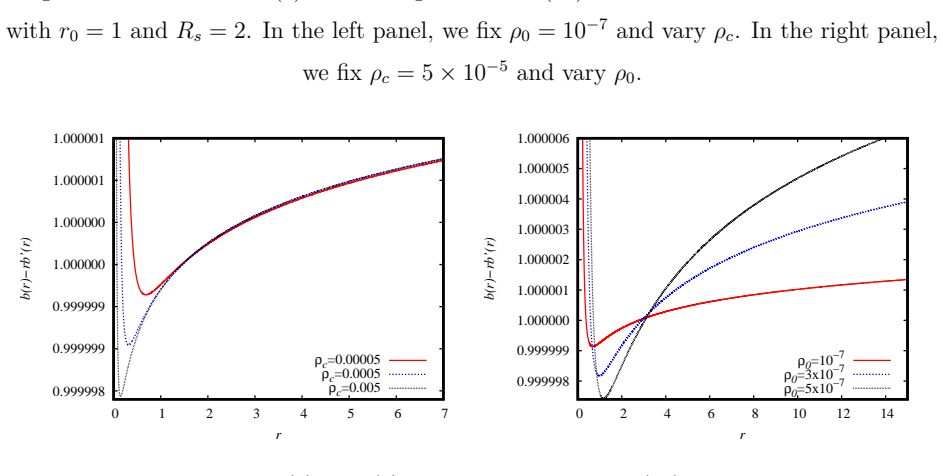
The paper's central claim is that isotropic dark matter described by the NFW, pseudo-isothermal and perfect-fluid profiles can serve as the source of traversable Morris-Thorne wormholes when LQC quantum-geometry corrections are encoded in effective fluid quantities $\rho_e = \rho(1-\rho/\rho_c)$ and $p_e = p-\rho(2p+\rho)/\rho_c$. Solving the LQC-modified Einstein equations together with the conservation equation, the authors obtain explicit shape functions $b(r)$ and redshift functions $\Phi(r)$ for each profile. Each solution obeys $b(r_0)=r_0$, $b(r)/r<1$, $b'(r_0)<1$, and the flaring-out condition $b-rb'>0$; Kretschmann scalars are finite provided $\rho_0$ stays below a model-dependent bound. Energy-condition analysis shows the effective source can violate the null energy condition in the throat region (identically satisfied at $\omega=-1$), and the volume integral quantifier decreases as $\rho_c$ decreases. Under the NFW profile, the photon-sphere approximation gives a shadow radius consistent with the M87 observation for $0<\omega\lesssim0.025$.
Load-bearing premise
The construction assumes, without derivation, that the LQC modified Friedmann equation can be translated locally and statically into the effective stress-energy formulas $\rho_e=\rho(1-\rho/\rho_c)$ and $p_e=p-\rho(2p+\rho)/\rho_c$; if that mapping is not what loop quantum gravity says around a compact object, the geometries are ordinary general-relativistic wormholes with a rescaled source rather than LQC wormholes.
Editorial extensions
If this is right
- If the central claim holds, no bespoke exotic fluid is needed: standard cold-dark-matter profiles, with LQC corrections, can satisfy all Morris-Thorne traversability conditions.
- Each profile comes with a quantitative regularity bound on the central density $\rho_0$; exceeding it produces singularities, so observations of central dark-matter densities can in principle test the construction.
- Lowering the LQC critical density $\rho_c$ reduces the amount of exotic matter required, most strongly for the perfect-fluid model, while near the throat the perfect-fluid model demands the most exotic matter and the NFW model the least.
- At $\omega\approx0.025$ the NFW-model shadow matches the M87 shadow observation, so shadow size alone cannot distinguish this wormhole from a black hole.
Reading between the lines
- A testable extension the paper leaves implicit: adding rotation or a surrounding plasma to the NFW wormhole would shift the shadow and could break the degeneracy with a black hole that holds in the vacuum, static case.
- The same effective-fluid recipe could be applied to other smooth dark-matter halo profiles whose densities appear as rational functions; the paper's mechanism suggests they would yield wormhole solutions with analogous regularity bounds.
- If the LQC effective mapping is later found not to follow from full loop-quantum dynamics in static spherical symmetry, the conservative reading is that these are regular general-relativistic wormholes with rescaled sources—still a geometric result, but not a quantum-gravity one.
Editorial analysis
A structured set of objections, weighed in public.
Referee Report
Summary. The paper constructs static, spherically symmetric Morris-Thorne wormhole spacetimes sourced by three dark matter density profiles (NFW, pseudo-isothermal, and perfect fluid) within an LQC-inspired effective stress-energy framework. The authors solve the modified Einstein equations for the shape function b(r) and the conservation equation for the redshift function Phi(r), verify the standard geometric wormhole conditions, compute the Kretschmann scalar to argue regularity, study energy conditions and the volume integral quantifier, and finally compare the shadow of the NFW model with EHT observations of M87. The central construction is algebraic and the paper contains many closed-form results, but the asymptotic structure and the shadow/photon-sphere analysis contain load-bearing problems.
Significance. If correct, the paper would provide explicit traversable wormhole solutions supported by ordinary dark matter with LQC-type corrections, with a surprising observational match to the M87 shadow. The strengths are the closed-form expressions for b(r) and Phi(r), the explicit verification of flare-out and throat conditions, the Kretschmann regularity check, and the quantitative VIQ comparison across three profiles. However, the claimed M87 shadow compatibility is currently an artifact of an unjustified identification of the photon sphere with the throat, and the spacetimes are not asymptotically flat for the fitted value of omega. These issues undermine the paper's most striking observational claim, though the underlying construction machinery may still be salvageable after revision.
major comments (3)
- [Section VIII, Eqs. (58)-(59)] The photon-sphere radius is not derived; the paper simply sets rph = r0. For the metric (10), the condition d(gamma^2)/dr = 0 at r is equivalent to Phi'(r)=1/r. Substituting the NFW Phi'(r) from Eq. (19) with the M87 parameters of Fig. 20 (where rho0 Rs^3/(rho_c r0^3) ~ 1.8e-8) gives Phi'(r0) ~ omega/[(1+omega) r0], which equals 1/r0 only for omega very large, not for omega ~ 0.025. Therefore Eq. (59) is not the physical shadow radius of this spacetime, and the claimed EHT compatibility is not a consequence of the model.
- [Section III.B, Eq. (16) (and Eqs. (25), (29))] The redshift function is not asymptotically flat for omega != 0: for the NFW profile e^{2Phi} ~ r^{6 omega/(1+omega)} as r -> infinity, with analogous power-law behavior for the PI and PF profiles. The text acknowledges the undesirable asymptotic behavior but then claims that the vanishing of curvature scalars (Fig. 4 and the discussion after Eq. (19)) establishes asymptotic flatness. This is incorrect: a vanishing Kretschmann scalar is necessary but not sufficient for asymptotic flatness; the metric coefficients must approach Minkowski values. Since the shadow calculation in Eq. (59) uses the bare metric at a distant observer coordinate Ro, and the wormhole interpretation normally requires asymptotic flatness or an explicit exterior matching, this issue is load-bearing.
- [Section II, Eqs. (8)-(9)] The effective density and pressure are obtained by transplanting the LQC modified Friedmann equation into a local, static, spherically symmetric setting, citing Refs. [10,11]. No derivation or justification is given for why these homogeneous cosmological corrections apply locally around a compact object. Because the shape functions, energy conditions, and shadow results all depend on this mapping, the claim that these are LQC wormholes requires either a derivation or an explicit statement that this is a phenomenological ansatz. As written, the model is 'LQC-inspired' rather than a derivation from loop quantum gravity.
minor comments (6)
- [Abstract and throughout] There are numerous typographical errors (e.g., 'with in', 'ana lyze', 'comp are', 'state parameter') and grammatical slips that should be corrected in a revised manuscript.
- [Section III.B] The phrase 'except when omega -> 0' should be 'except when omega = 0', since it is the value, not the limit, that makes the asymptotic exponent vanish.
- [Section VIII] The sentence 'Here we will consider rph = r0, since the calculation will be made in the approximation of a vacuum medium' is not physically meaningful: a vacuum exterior does not place the photon sphere at the throat. This justification should be removed or replaced with a proper photon-sphere calculation.
- [Section VII, Eqs. (44), (49), (54)] The volume integral quantifier diverges logarithmically for the NFW and PF models and linearly for the PI model as r -> infinity. The comparison in Fig. 19 is therefore cutoff-dependent; please state the integration cutoff and discuss the physical interpretation of an infinite amount of exotic matter.
- [Figure 20] The EHT observational constraint on the M87 shadow is quoted without error bars or a confidence interval; the compatibility claim should be stated relative to the reported 1-sigma range.
- [Figure 20 and Section II] The parameters in Fig. 20 are given in SI units (kg/m^3, m), while the field equations are written in natural units with 8 pi G = c = 1. Please state the conversion explicitly or confirm that the dimensionless ratios such as rho0/rho_c and rho0 Rs^3/(rho_c r0^3) are computed consistently in geometric units.
Circularity Check
No significant circularity: the wormhole geometries are constructed from chosen dark-matter profiles and LQC effective relations supported by an independent prior reference; the M87 shadow statement is a parameter-compatibility claim, not a forced prediction.
full rationale
The paper's derivation chain is constructive rather than predictive. The dark-matter density profiles are inputs fixed by Eq. (1) from known models, and the LQC effective density and pressure in Eqs. (8)-(9) are taken from Refs. [10,11], where Ref. [10] has no author overlap with the present paper. Thus the main input is not a self-citation chain and is not derived from the wormhole solutions themselves. The shape and redshift functions are genuine outputs of integrating the field equation (11) with b(r0)=r0 and the conservation equation (14), and the Morris-Thorne checks, Kretschmann regularity bounds, and VIQ values are consequences of those solved functions rather than restatements of the inputs. The shadow section is also not circular: Fig. 20 scans the free equation-of-state parameter omega and reports the interval (0.00, 0.025) for which the shadow size is compatible with EHT; this is a postdiction or compatibility statement, not a parameter-free prediction. The explicit assumption rph=r0 in Sec. VIII is an extra geometric identification that is not derived from Eq. (58), so the shadow result is conditional on that assumption; this is a model-validity or correctness concern, not a circular reduction. No equation in the paper is equivalent by construction to the claim it is used to support. The only mild self-citation issue is that Ref. [11] shares two authors and is cited for Eqs. (8)-(9), but the independent Ref. [10] is cited for the same expressions, so no load-bearing circularity results.
Assumptions & free parameters
free parameters (5)
- rho_c (LQC critical density) =
chosen per plot (e.g., 1e-5 in Figs. 1-3; 1e10 kg/m^3 in Sec. VIII)
- rho_0 (central dark matter density) =
chosen per plot (e.g., 1e-6; 4.4e-21 kg/m^3 in Sec. VIII)
- R_s (scale radius) =
2 in plots; 6.17e20 m in Sec. VIII
- r_0 (throat radius) =
1 in plots; 1.8e13 m in Sec. VIII
- omega (equation of state parameter) =
1 in Kretschmann plots, -1/2 in VIQ plot, 0.025 in M87 shadow fit
assumptions (5)
- domain assumption Effective density and pressure are given by rho_e = rho(1 - rho/rho_c) and p_e = p - rho(2p+rho)/rho_c (Eqs. 8-9).
- domain assumption The wormhole geometry is described by the Morris-Thorne metric Eq. (10).
- ad hoc to paper Dark matter obeys a linear equation of state p = omega*rho.
- domain assumption The three density profiles in Eqs. (1)-(4) describe dark matter in galaxies.
- standard math The Einstein tensor is divergence-free, so the conservation equation Eq. (14) is automatic.
Cite this review
Pith. "Pith review of Traversable Wormholes Sourced by Dark Matter in Loop Quantum Cosmology." pith.science (2026). https://pith.science/paper/ABA3VY52
@misc{pith2026241112063,
  author       = {Pith},
  title        = {Pith review of: Traversable Wormholes Sourced by Dark Matter in Loop Quantum Cosmology},
  year         = {2026},
  howpublished = {\url{https://pith.science/paper/ABA3VY52}},
  note         = {Machine review of arXiv:2411.12063}
}
read the original abstract
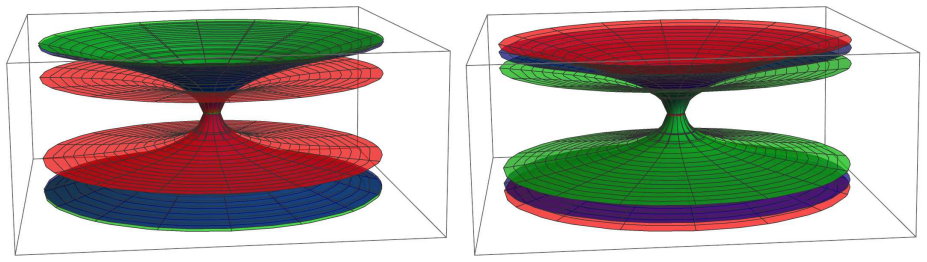
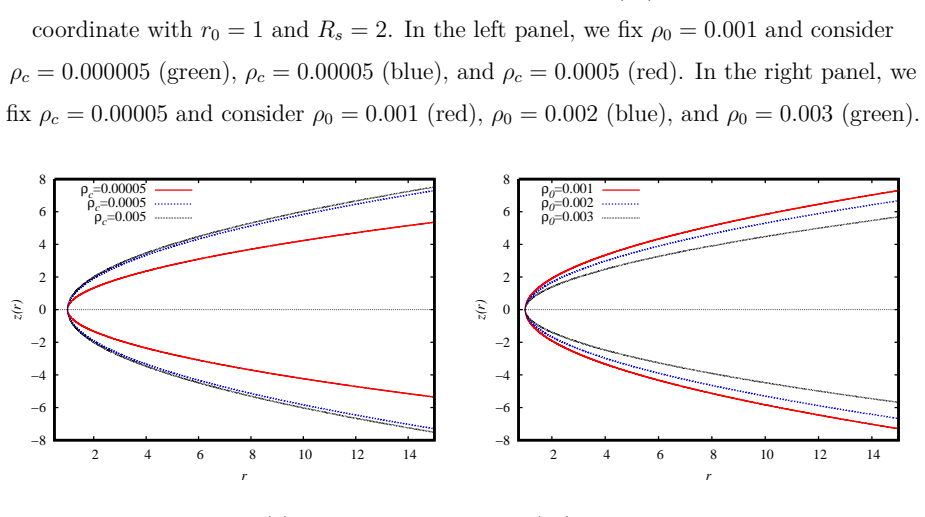
In this work, we investigate the existence of wormholes within the framework of Loop Quantum Cosmology, using isotropic dark matter as the source. We analyze three distinct density profiles and solve the modified gravity field equations alongside the stress-energy tensor conservation, applying appropriate boundary conditions to obtain traversable wormhole solutions. Each solution is shown to satisfy the geometric criteria for wormholes, and their regularity is verified by computing the Kretschmann scalar to ensure the absence of singularities under determined conditions. Additionally, we examine the stress-energy tensor to identify scenarios in which energy conditions are violated within this model. The wormhole geometry is further explored through embedding diagrams, and the amount of exotic matter required to sustain these structures is computed using the Volume Integral Quantifier. Finally, we study the shadow produced by our wormhole solution, considering one of the dark matter density profiles, and compare it with observations of the M87 galaxy.
Figures


Figures from the paper (17 more)






Reference graph
Works this paper leans on
-
[1]
B. P. Abbott et al. (LIGO Scientific, Virgo), Phys. Rev. Le tt. 116, 061102 (2016), 1602.03837
arXiv 2016
-
[2]
and ( 4) always violate the null energy condition in the innermost regions of the wormhole, e quations (40) and ( 50). For the second model, if ρ c ≥ 2ρ 0, the null condition will always be satisfied, while for ρ c < 2ρ 0, the null condition will be violated in more central regions, equ ation ( 45). In models ( 2) and ( 4), the energy densities will always...
work page 2021
-
[3]
Einstein and N
A. Einstein and N. Rosen, Phys. Rev. 48, 73 (1935)
1935
-
[4]
M. S. Morris and K. S. Thorne, Am. J. Phys. 56, 395 (1988)
1988
-
[5]
S. W. Hawking, Phys. Rev. D 37, 904 (1988). 27
work page 1988
-
[6]
Visser, Lorentzian wormholes: From Einstein to Hawking (1995), ISBN 978-1-56396-653-8
M. Visser, Lorentzian wormholes: From Einstein to Hawking (1995), ISBN 978-1-56396-653-8
1995
-
[7]
K. K. Nandi, Y.-Z. Zhang, and K. B. Vijaya Kumar, Phys. Rev . D 70, 127503 (2004), gr- qc/0407079
arXiv 2004
-
[8]
M. S. Churilova, R. A. Konoplya, Z. Stuchlik, and A. Zhide nko, JCAP 10, 010 (2021), 2107.05977
arXiv 2021
Show all 36 references
-
[9]
R. A. Konoplya and A. Zhidenko, Phys. Rev. Lett. 128, 091104 (2022), 2106.05034
2022 arXiv
- [10]
-
[11]
Sengupta, S
R. Sengupta, S. Ghosh, and M. Kalam, Eur. Phys. J. C 83, 830 (2023), 2309.12527
2023 arXiv
-
[12]
C. R. Muniz, T. Tangphati, R. M. P. Neves, and M. B. Cruz, P hys. Dark Univ. 46, 101673 (2024), 2406.08250
2024 arXiv
-
[13]
Aghanim et al
N. Aghanim et al. (Planck), Astron. Astrophys. 641, A6 (2020), [Erratum: Astron.Astrophys. 652, C4 (2021)], 1807.06209
2020 arXiv
-
[14]
Zwicky, Helv
F. Zwicky, Helv. Phys. Acta 6, 110 (1933)
1933
-
[15]
V. C. Rubin and W. K. Ford, Jr., Astrophys. J. 159, 379 (1970)
1970
-
[16]
Persic, P
M. Persic, P. Salucci, and F. Stel, Mon. Not. Roy. Astron . Soc. 281, 27 (1996), astro- ph/9506004
1996
- [17]
-
[18]
Randall, Nature 557, 2 (2018)
L. Randall, Nature 557, 2 (2018)
2018
-
[19]
C. A. Argüelles, A. Diaz, A. Kheirandish, A. Olivares-D el-Campo, I. Safa, and A. C. Vincent, Rev. Mod. Phys. 93, 035007 (2021), 1912.09486
2021 arXiv
-
[20]
D. J. E. Marsh, D. Ellis, and V. M. Mehta, Dark Matter: Evidence, Theory, and Constraints , Princeton Series in Astrophysics (Princeton University Pr ess, 2024), ISBN 978-0-691-24971-1, 978-0-691-24952-0
2024
-
[21]
Y.-D. Tsai, J. Eby, and M. S. Safronova, Nature Astron. 7, 113 (2023), 2112.07674
2023 arXiv
-
[22]
A. D. S. Souza, C. R. Muniz, R. M. P. Neves, and M. B. Cruz, A nnals Phys. 472, 169859 (2025), 2403.04992
2025 arXiv
-
[23]
Z. Xu, M. Tang, G. Cao, and S.-N. Zhang, Eur. Phys. J. C 80, 70 (2020)
2020
-
[24]
C. R. Muniz and R. V. Maluf, Annals Phys. 446, 169129 (2022)
2022
-
[25]
Mustafa, S
G. Mustafa, S. K. Maurya, and S. Ray, Fortsch. Phys. 71, 2200129 (2023)
2023
-
[26]
Radhakrishnan, P
R. Radhakrishnan, P. Brown, J. Mutulevich, E. Davis, D. Mirfendereski, and G. Cleaver, Symmetry 16, 1007 (2024), 2405.05476. 28
2024 arXiv
-
[27]
Errehymy, A
A. Errehymy, A. Banerjee, S. Hansraj, O. Donmez, K. S. Ni sar, and A.-H. Abdel-Aty, Eur. Phys. J. C 84, 573 (2024)
2024
-
[28]
S. K. Maurya, J. Kumar, S. Kiroriwal, and A. Errehymy, Ph ys. Dark Univ. 46, 101564 (2024)
2024
- [29]
-
[30]
J. F. Navarro, C. S. Frenk, and S. D. M. White, Astrophys. J. 462, 563 (1996), astro- ph/9508025
1996
-
[31]
K. G. Begeman, A. H. Broeils, and R. H. Sanders, Mon. Not. Roy. Astron. Soc. 249, 523 (1991)
1991
- [32]
-
[33]
Ashraf, F
A. Ashraf, F. Javed, W.-X. Ma, and A. Waseem, Eur. Phys. J . Plus 139, 857 (2024)
2024
-
[34]
Swain, G
S. Swain, G. Sahoo, and B. Nayak, Sci. Rep. 14, 16928 (2024)
2024
-
[35]
Alloqulov, F
M. Alloqulov, F. Atamurotov, A. Abdujabbarov, B. Ahmed ov, and V. Khamidov, Chin. Phys. C 48, 025104 (2024)
2024
-
[36]
Akiyama et al
K. Akiyama et al. (Event Horizon Telescope), Astrophys . J. Lett. 875, L1 (2019), 1906.11238. 29
2019 arXiv
Reviewed August 12, 2026 · model on record in the stance chip above.
Discussion (0). Continue with ORCID to comment.