REVIEW 3 major objections 6 minor 39 references
Diffusion Product Quantization
T0 review · 3 major / 6 minor · reviewed 2026-08-12 · deepseek-v4-flash
Pith's one-line read Product quantization lets 1-bit diffusion models generate sharp images while cutting model size over 24 times.
desk verdict A useful, mostly sound adaptation of product quantization to DiT at extreme low bit-widths; the internal VQ comparison is convincing, but the external baselines are not size-matched and one derivation is stashed in a missing appendix. read the letter →
The pith
A machine-rendered reading of the paper's core claim, the machinery that carries it, and where it could break.
The reading
What carries the argument
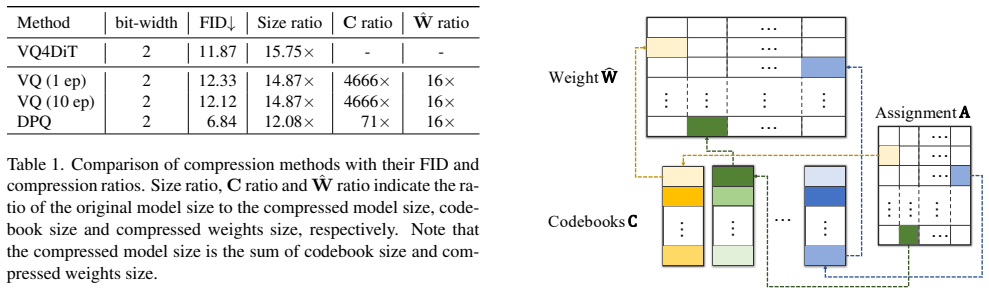
The load-bearing object is the product-quantization decomposition: the weight matrix is split into sub-vectors of dimension $d$, and for each subspace position there is a separate codebook $C \in \mathbb{R}^{N \times k \times d}$, so the effective number of representable vectors is $k^N$ while the codebook memory grows only linearly. Around that core sit two mechanisms the paper adds: a codebook pool (Eqs. 4-5) that ranks centroids by assignment frequency, merges any centroid within L2 distance $\tau_c = 0.05$ of a more important one, and stores the result in FP16 so the compressed codebook stays within the designed size budget; and a two-part calibration (Eqs. 7-8) that reassigns codewords in the forward pass using the activation-weighted error $\|Wx - W'x\|^2$ and updates codewords in the backward pass through the DDPM loss $L_{\mathrm{DDPM}}$.
What would settle it
Reproduce the 1-bit DiT-XL/2 experiment on ImageNet with two variants: the published DPQ pipeline, and the same pipeline with $\tau_c = 0$ (no centroid merging, with the bit budget held constant by reducing the subspace dimension $d$). If the unmerged variant's FID is substantially better than DPQ's reported 14.03, the codebook-pool merging step, not product quantization itself, is where generative quality is lost. Also verify the projection-storage calculation promised in the appendix, since the claimed size ratio depends on it.
Extended reading notes
Core claim
The central claim is that existing vector-quantization compression fails for diffusion models at low bit-widths not because quantization is wrong, but because a single shared codebook cannot represent high-dimensional sub-vectors precisely, and because errors compound over the iterative denoising steps. DPQ replaces the shared codebook with product quantization: each weight row is split into subspaces, each subspace has its own codebook, and the effective number of codewords grows exponentially while codebook storage grows only linearly. To stop the codebooks from canceling the compression gain, DPQ stores centroids in FP16 and merges similar, rarely used centroids into a codebook pool according to a distance threshold, keeping the codebook no more than a quarter of the assignment size. Finally, calibration updates the assignments in the forward pass by minimizing the activation-weighted reconstruction error $\|Wx - W'x\|^2$ and fine-tunes the codebooks in the backward pass with the DDPM noise-prediction loss. On DiT-XL/2 at 256x256, the method reports FID 6.84 at 2 bits and 14.03 at 1 bit, with size ratios of 12.08x and 24.57x respectively, consistently beating the vector-quantization and post-training-quantization baselines compared in the paper.
Load-bearing premise
The claimed 24x compression at 1 bit assumes that merging similar, rarely used codebook centroids with a fixed threshold $\tau_c = 0.05$ preserves generative quality, a heuristic the paper does not analyze for sensitivity.
Editorial extensions
If this is right
- At 1 bit, the DPQ-compressed DiT-XL/2 retains usable generation (FID 14.03, IS 110.23, precision 0.6863), where ordinary VQ collapses to FID 91.71.
- At 2 bits, DPQ gives FID 6.84 and a 12.08x size reduction, beating GPTQ, Q-DiT, and VQ4DiT at 250, 100, and 50 sampling steps.
- The method transfers to U-Net diffusion models: on DDIM/CIFAR-10 it reaches FID 5.19 at 4 bits and 7.01 at 2 bits.
- Compressing the codebook itself is mandatory for PQ in this setting; keeping the codebook within one quarter of the assignment size is what preserves the overall size ratio.
- Calibrating with the DDPM loss outperforms block-wise distillation, and forward-pass codeword reassignment adds a further gain in the reported ablation.
Reading between the lines
- If the reported 1-bit result reproduces, product quantization should be tried on larger text-to-image DiTs, where per-subspace codebooks could absorb higher weight dimensionality without the exponential codebook blow-up that defeats ordinary VQ.
- The error-accumulation analysis suggests a testable extension: calibrating against a subset of denoising timesteps might cut the roughly 5-hour calibration cost while preserving the FID gains, since the paper shows saturation after 5 epochs.
- Because DPQ does not accelerate inference, a natural next step is combining DPQ with activation quantization or pruning; the codebook structure may also enable lookup-table-based fast inference.
- The codebook-pool merging rule is an importance-based pruning inside the codebook; a principled alternative would select centroids to merge by their contribution to reconstruction error on real activations rather than usage frequency alone.
Editorial analysis
A structured set of objections, weighed in public.
Referee Report
Summary. The paper proposes Diffusion Product Quantization (DPQ), a post-training compression method for diffusion transformers. It replaces a single vector quantizer with product quantization over weight rows, compresses the resulting PQ codebooks via a usage-weighted 'codebook pool' with a similarity threshold tau_c, and calibrates the assignments and codebooks using activation-weighted reassignment and the DDPM loss. Experiments on DiT-XL/2 at ImageNet 256x256 report FID 14.03 at 1-bit with a 24.57x model-size reduction, versus FID 91.71 for a VQ baseline at 28.65x, and favorable comparisons against GPTQ, Q-DiT, and VQ4DiT; an additional DDIM/CIFAR-10 experiment shows applicability to a U-Net diffusion model.
Significance. If the size-accounting and comparisons hold, DPQ is a useful step for extreme low-bit diffusion-model compression: it demonstrates that PQ's larger effective codebook capacity translates into much better generative quality than VQ at 1-2 bits, while the codebook pool keeps storage overhead under control. The paper is transparent about limitations (no inference speedup, costly calibration), and the VQ-versus-DPQ comparison under the same calibration pipeline is a clean internal control. The main caveats are the deferred projection-storage derivation and the need for size-matched external comparisons.
major comments (3)
- [§3.2, Tables 1-3] The headline size ratios are not verifiable as written. The derivation of the projection storage is explicitly deferred to a missing appendix ('see appendix'), and the text does not state whether the projection table is included in the 'Size ratio', 'C ratio', or 'codebook size' columns. Please provide the full per-layer calculation, including the number of projection entries ((n/d)*k), their integer width, and a comparison with the pool size for the actual DiT-XL/2 layer shapes, and state unambiguously whether all compressed components are counted in the reported size ratios. Without this, the 24.57x claim is not derivable from the equations in §3.2.
- [Table 3] The comparison against VQ4DiT and the other external baselines is confounded by effective model size. At 2-bit/250 steps, DPQ has a size ratio of 12.08x, whereas VQ4DiT reports 15.75x; at 3-bit, DPQ has 9.92x versus VQ4DiT 10.59x. In both cases DPQ is less compressed, so part of the FID gain may be attributable to a larger model rather than to the quantization method. The paper should either match baselines at equal compressed size, plot FID/sFID versus size ratio for all methods, or explicitly discuss this trade-off when claiming to 'consistently outperform' other PTQ methods.
- [§3.2, Eq. (4)-(5)] The codebook-compression heuristic is load-bearing, but no sensitivity analysis is reported. The threshold tau_c is fixed at 0.05 with no ablation, and the paper does not report how many centroids are merged per layer or how the pool size N' relates to the number of surviving centroids. Since the size/quality trade-off of the whole method depends on this heuristic, an ablation over tau_c (or over N') is needed to support the claim that redundancy can be removed without significant quality loss.
minor comments (6)
- [§4.2] The sentence 'While DPQ has a slightly larger size ratio due to the additional codebook size' contradicts Table 2, which shows DPQ with smaller size ratios (i.e., larger compressed models) at every bit-width; please correct the wording.
- [Table 5] The ablation table is under-specified: the three rows do not make clear which combination of PQ, DDPM loss, blockwise distillation, and codeword adjustment is being compared, and the text's claim that blockwise distillation is suboptimal is not backed by a displayed row.
- [Eq. (7)] The expression c_{j,p} x_j is ambiguous because c_{j,p} is a d-dimensional row vector and x_j is a matrix or vector; please specify the shapes and the dimension over which the norm is taken.
- [§4.1] The text says the listed bit-width does not represent actual bits per value, yet Tables 2 and 3 still label rows '1 bit', '2 bit', etc.; please add an effective-bits-per-value column or otherwise define the bit-width convention precisely.
- [Figures 2 and 4] Several annotations in Figures 2 and 4 are too small or undefined; in particular, the right panel of Figure 2 should define the x-axis (diffusion step?) and clarify which blocks are selected for the MSE comparison.
- [§4.1] The paper credits code from [21] and [25] but provides no repository URLs or version identifiers; please add reproducibility details for the quantization and calibration pipelines.
Circularity Check
No significant circularity: the reported compression ratios and FID values are measured against FP32 and external baselines, so the central claims are not equivalent to their inputs.
full rationale
The paper's load-bearing result (Table 2) compares the measured FID of the actually quantized DiT-XL/2 model against the FP32 model and external baselines such as VQ4DiT, GPTQ, and Q-DiT; none of these reported numbers is defined in terms of DPQ's own fitted parameters. The codebook-pool target N' = mn/(16d^2) in Section 3.2 is a storage-accounting design target: the paper first requires the codebook to be at most one-quarter the size of the assignments, and then halves that target to leave room for the projection mapping, whose size bound is deferred to an appendix. This is arithmetic and design choice, not a prediction that reduces to its own input. The merging threshold tau_c = 0.05 and the calibration epoch count are ordinary hyperparameters, and the paper provides an ablation for epochs while the lack of a tau_c sensitivity study is a completeness risk rather than circularity. The code reused from references [21] and [25] is acknowledged, and those citations are not used to justify the central empirical claim; the baselines are external. The missing appendix and the absent sensitivity analysis for tau_c should be weighed as correctness and completeness concerns, but they do not make the derivation circular.
Assumptions & free parameters
free parameters (2)
- tau_c (codebook merge threshold) =
0.05
- Calibration epochs =
5
assumptions (4)
- standard math Product quantization with N subspaces and k codewords per subspace yields k^N effective codewords at linear codebook cost.
- domain assumption Quantization error accumulates over diffusion timesteps and is the dominant cause of quality degradation.
- domain assumption The DDPM loss is a valid objective for fine-tuning compressed codebooks and restores generation quality.
- domain assumption The activations x_j used in assignment reassignment (Eq. 7) are representative of the quantized model's forward pass across timesteps.
Cite this review
Pith. "Pith review of Diffusion Product Quantization." pith.science (2026). https://pith.science/paper/SYDHQI43
@misc{pith2026241112306,
  author       = {Pith},
  title        = {Pith review of: Diffusion Product Quantization},
  year         = {2026},
  howpublished = {\url{https://pith.science/paper/SYDHQI43}},
  note         = {Machine review of arXiv:2411.12306}
}
read the original abstract
In this work, we explore the quantization of diffusion models in extreme compression regimes to reduce model size while maintaining performance. We begin by investigating classical vector quantization but find that diffusion models are particularly susceptible to quantization error, with the codebook size limiting generation quality. To address this, we introduce product quantization, which offers improved reconstruction precision and larger capacity -- crucial for preserving the generative capabilities of diffusion models. Furthermore, we propose a method to compress the codebook by evaluating the importance of each vector and removing redundancy, ensuring the model size remaining within the desired range. We also introduce an end-to-end calibration approach that adjusts assignments during the forward pass and optimizes the codebook using the DDPM loss. By compressing the model to as low as 1 bit (resulting in over 24 times reduction in model size), we achieve a balance between compression and quality. We apply our compression method to the DiT model on ImageNet and consistently outperform other quantization approaches, demonstrating competitive generative performance.
Figures


Figures from the paper (2 more)


Reference graph
Works this paper leans on
-
[21]
Permute, quantize, and fine-tune: Efficient compression of neural networks
Julieta Martinez, Jashan Shewakramani, Ting Wei Liu, Ioan Andrei B ˆarsan, Wenyuan Zeng, and Raquel Urtasun. Permute, quantize, and fine-tune: Efficient compression of neural networks. In Proceedings of the IEEE/CVF con- ference on computer vision and pattern recognition , pages 15699–15708, 2021. 6, 7
work page 2021
-
[25]
Scalable diffusion models with transformers
William Peebles and Saining Xie. Scalable diffusion models with transformers. In Proceedings of the IEEE/CVF Inter- national Conference on Computer Vision, pages 4195–4205,
-
[1]
Shane Barratt and Rishi Sharma. A note on the inception score. arXiv preprint arXiv:1801.01973, 2018. 6
arXiv 2018
-
[2]
Language models are few-shot learners
Tom B Brown. Language models are few-shot learners. arXiv preprint arXiv:2005.14165, 2020. 1
arXiv 2005
-
[3]
Q-dit: Ac- curate post-training quantization for diffusion transformers
Lei Chen, Yuan Meng, Chen Tang, Xinzhu Ma, Jingyan Jiang, Xin Wang, Zhi Wang, and Wenwu Zhu. Q-dit: Ac- curate post-training quantization for diffusion transformers. arXiv preprint arXiv:2406.17343, 2024. 1, 7
arXiv 2024
-
[4]
Diffusion models in vision: A survey
Florinel-Alin Croitoru, Vlad Hondru, Radu Tudor Ionescu, and Mubarak Shah. Diffusion models in vision: A survey. IEEE Transactions on Pattern Analysis and Machine Intelli- gence, 45(9):10850–10869, 2023. 2
2023
-
[5]
Vq4dit: Efficient post-training vec- tor quantization for diffusion transformers
Juncan Deng, Shuaiting Li, Zeyu Wang, Hong Gu, Kedong Xu, and Kejie Huang. Vq4dit: Efficient post-training vec- tor quantization for diffusion transformers. arXiv preprint arXiv:2408.17131, 2024. 1, 3, 4, 6, 7
arXiv 2024
-
[6]
Diffusion models beat gans on image synthesis
Prafulla Dhariwal and Alexander Nichol. Diffusion models beat gans on image synthesis. Advances in neural informa- tion processing systems, 34:8780–8794, 2021. 1
2021
Show all 39 references
-
[7]
Extreme com- pression of large language models via additive quantization
Vage Egiazarian, Andrei Panferov, Denis Kuznedelev, Elias Frantar, Artem Babenko, and Dan Alistarh. Extreme com- pression of large language models via additive quantization. arXiv preprint arXiv:2401.06118, 2024. 3, 4
2024 arXiv
-
[8]
GPTQ: Accurate post-training quantization for gener- ative pre-trained transformers
Elias Frantar, Saleh Ashkboos, Torsten Hoefler, and Dan Al- istarh. GPTQ: Accurate post-training quantization for gener- ative pre-trained transformers. In The Eleventh International Conference on Learning Representations, 2023. 2, 7
2023
-
[9]
Opti- mized product quantization for approximate nearest neigh- bor search
Tiezheng Ge, Kaiming He, Qifa Ke, and Jian Sun. Opti- mized product quantization for approximate nearest neigh- bor search. In Proceedings of the IEEE conference on computer vision and pattern recognition, pages 2946–2953,
-
[10]
Allen Gersho and Robert M. Gray. Vector quantization and signal compression . Kluwer Academic Publishers, USA,
-
[11]
Generative adversarial nets
Ian Goodfellow, Jean Pouget-Abadie, Mehdi Mirza, Bing Xu, David Warde-Farley, Sherjil Ozair, Aaron Courville, and Yoshua Bengio. Generative adversarial nets. Advances in neural information processing systems, 27, 2014. 2, 6
2014
-
[12]
Deep residual learning for image recognition
Kaiming He, Xiangyu Zhang, Shaoqing Ren, and Jian Sun. Deep residual learning for image recognition. In Proceed- ings of the IEEE conference on computer vision and pattern recognition, pages 770–778, 2016. 1
2016
-
[13]
Ptqd: Accurate post-training quantization for diffusion models
Yefei He, Luping Liu, Jing Liu, Weijia Wu, Hong Zhou, and Bohan Zhuang. Ptqd: Accurate post-training quantization for diffusion models. Advances in Neural Information Pro- cessing Systems, 36, 2024. 1
2024
-
[14]
Denoising dif- fusion probabilistic models
Jonathan Ho, Ajay Jain, and Pieter Abbeel. Denoising dif- fusion probabilistic models. Advances in neural information processing systems, 33:6840–6851, 2020. 1, 2
2020
-
[15]
Cascaded diffu- sion models for high fidelity image generation
Jonathan Ho, Chitwan Saharia, William Chan, David J Fleet, Mohammad Norouzi, and Tim Salimans. Cascaded diffu- sion models for high fidelity image generation. Journal of Machine Learning Research, 23(47):1–33, 2022. 6
2022
-
[16]
Estimation of non- normalized statistical models by score matching
Aapo Hyv ¨arinen and Peter Dayan. Estimation of non- normalized statistical models by score matching. Journal of Machine Learning Research, 6(4), 2005. 2
2005
-
[17]
Prod- uct quantization for nearest neighbor search
Herve Jegou, Matthijs Douze, and Cordelia Schmid. Prod- uct quantization for nearest neighbor search. IEEE trans- actions on pattern analysis and machine intelligence, 33(1): 117–128, 2010. 1, 2, 3
2010
-
[18]
Large memory layers with product keys
Guillaume Lample, Alexandre Sablayrolles, Marc’Aurelio Ranzato, Ludovic Denoyer, and Herv´e J´egou. Large memory layers with product keys. Advances in Neural Information Processing Systems, 32, 2019. 3
2019
-
[19]
Q-diffusion: Quantizing diffusion models
Xiuyu Li, Yijiang Liu, Long Lian, Huanrui Yang, Zhen Dong, Daniel Kang, Shanghang Zhang, and Kurt Keutzer. Q-diffusion: Quantizing diffusion models. In Proceedings of the IEEE/CVF International Conference on Computer Vi- sion, pages 17535–17545, 2023. 7
2023
-
[20]
Awq: Activation-aware weight quantization for on-device llm compression and acceleration
Ji Lin, Jiaming Tang, Haotian Tang, Shang Yang, Wei-Ming Chen, Wei-Chen Wang, Guangxuan Xiao, Xingyu Dang, Chuang Gan, and Song Han. Awq: Activation-aware weight quantization for on-device llm compression and acceleration. Proceedings of Machine Learning and Systems , 6:87–100,
-
[22]
Dit-3d: Exploring plain diffusion transformers for 3d shape generation
Shentong Mo, Enze Xie, Ruihang Chu, Lanqing Hong, Matthias Niessner, and Zhenguo Li. Dit-3d: Exploring plain diffusion transformers for 3d shape generation. Advances in neural information processing systems, 36:67960–67971,
-
[23]
GLIDE: towards photorealis- tic image generation and editing with text-guided diffusion models
Alexander Quinn Nichol, Prafulla Dhariwal, Aditya Ramesh, Pranav Shyam, Pamela Mishkin, Bob McGrew, Ilya Sutskever, and Mark Chen. GLIDE: towards photorealis- tic image generation and editing with text-guided diffusion models. In International Conference on Machine Learning,
-
[24]
Cartesian k-means
Mohammad Norouzi and David J Fleet. Cartesian k-means. In Proceedings of the IEEE Conference on computer Vision and Pattern Recognition, pages 3017–3024, 2013. 3
2013
-
[26]
Learning transferable visual models from natural language supervi- sion
Alec Radford, Jong Wook Kim, Chris Hallacy, Aditya Ramesh, Gabriel Goh, Sandhini Agarwal, Girish Sastry, Amanda Askell, Pamela Mishkin, Jack Clark, et al. Learning transferable visual models from natural language supervi- sion. In International conference on machine learning, ...
2021
-
[27]
Hierarchical text-conditional image gener- ation with clip latents
Aditya Ramesh, Prafulla Dhariwal, Alex Nichol, Casey Chu, and Mark Chen. Hierarchical text-conditional image gener- ation with clip latents. arXiv preprint arXiv:2204.06125, 1 (2):3, 2022. 2
2022 arXiv
-
[28]
High-resolution image synthesis with latent diffusion models
Robin Rombach, Andreas Blattmann, Dominik Lorenz, Patrick Esser, and Bj ¨orn Ommer. High-resolution image synthesis with latent diffusion models. In Proceedings of the IEEE/CVF conference on computer vision and pattern recognition, pages 10684–10695, 2022. 2
2022
-
[29]
Efficient content-based sparse attention with rout- ing transformers
Aurko Roy, Mohammad Saffar, Ashish Vaswani, and David Grangier. Efficient content-based sparse attention with rout- ing transformers. Transactions of the Association for Com- putational Linguistics, 9:53–68, 2021. 3
2021
-
[30]
Improved techniques for training gans
Tim Salimans, Ian Goodfellow, Wojciech Zaremba, Vicki Cheung, Alec Radford, and Xi Chen. Improved techniques for training gans. Advances in neural information processing systems, 29, 2016. 6
2016
-
[31]
Post-training quantization on diffusion models
Yuzhang Shang, Zhihang Yuan, Bin Xie, Bingzhe Wu, and Yan Yan. Post-training quantization on diffusion models. In Proceedings of the IEEE/CVF conference on computer vi- sion and pattern recognition, pages 1972–1981, 2023. 1
1972
-
[32]
Deep unsupervised learning using nonequilibrium thermodynamics
Jascha Sohl-Dickstein, Eric Weiss, Niru Maheswaranathan, and Surya Ganguli. Deep unsupervised learning using nonequilibrium thermodynamics. In International confer- ence on machine learning, pages 2256–2265. PMLR, 2015. 2
2015
-
[33]
Denoising diffusion implicit models
Jiaming Song, Chenlin Meng, and Stefano Ermon. Denoising diffusion implicit models. arXiv preprint arXiv:2010.02502, 2020. 7
2010 arXiv
-
[34]
Generative modeling by esti- mating gradients of the data distribution
Yang Song and Stefano Ermon. Generative modeling by esti- mating gradients of the data distribution. Advances in neural information processing systems, 32, 2019. 2
2019
-
[35]
Score-based generative modeling through stochastic differential equa- tions
Yang Song, Jascha Sohl-Dickstein, Diederik P Kingma, Ab- hishek Kumar, Stefano Ermon, and Ben Poole. Score-based generative modeling through stochastic differential equa- tions. arXiv preprint arXiv:2011.13456, 2020. 1
2011 arXiv
-
[36]
And the bit goes down: Revis- iting the quantization of neural networks
Pierre Stock, Armand Joulin, R ´emi Gribonval, Benjamin Graham, and Herv ´e J ´egou. And the bit goes down: Revis- iting the quantization of neural networks. In International Conference on Learning Representations, 2020. 1, 3
2020
-
[37]
Quip#: Even better llm quantization with hadamard incoherence and lattice code- books
Albert Tseng, Jerry Chee, Qingyao Sun, V olodymyr Kuleshov, and Christopher De Sa. Quip#: Even better llm quantization with hadamard incoherence and lattice code- books. arXiv preprint arXiv:2402.04396, 2024. 3, 4, 6
2024 arXiv
-
[38]
Gptvq: The bless- ing of dimensionality for llm quantization
Mart van Baalen, Andrey Kuzmin, Markus Nagel, Pe- ter Couperus, Cedric Bastoul, Eric Mahurin, Tijmen Blankevoort, and Paul Whatmough. Gptvq: The bless- ing of dimensionality for llm quantization. arXiv preprint arXiv:2402.15319, 2024. 1, 3, 4
2024 arXiv
-
[39]
Open-sora: Democratizing efficient video production for all, 2024
Zangwei Zheng, Xiangyu Peng, Tianji Yang, Chenhui Shen, Shenggui Li, Hongxin Liu, Yukun Zhou, Tianyi Li, and Yang You. Open-sora: Democratizing efficient video production for all, 2024. 2
2024
Reviewed August 12, 2026 · model on record in the stance chip above.
Discussion (0). Continue with ORCID to comment.