REVIEW 4 major objections 6 minor 84 references
The impact of stochastic resetting on resource allocation: The case of Reallocating geometric Brownian motion
T0 review · 4 major / 6 minor · reviewed 2026-08-12 · deepseek-v4-flash
Pith's one-line read Stochastic resetting tames the mean-repulsive regime of the Reallocating Geometric Brownian Motion, making both first and second moments stationary above a critical rate.
desk verdict A useful extension with a correct-looking moment classification, but the advertised infinite-self-averaging-time result rests on cross-moment equations with a factor-of-two resetting error. read the letter →
The pith
A machine-rendered reading of the paper's core claim, the machinery that carries it, and where it could break.
The reading
What carries the argument
The key object is the jump-diffusion representation of RGBM with resetting, where a Poisson process with intensity $r$ sends the process back to $x_0$ while the remaining time the dynamics follow RGBM (Eq. 4). Itô's formula applied with $f(x)=x$ and $f(x)=x_ix_j$ yields coupled moment equations for $v(t)=E[x_i^2]$ and $q(t)=E[x_ix_j]$, which close under the self-averaging ansatz $E[x]=\langle x\rangle_N$. The relative variance $R_N(t)=\mathrm{var}(\langle x\rangle_N)/E[\langle x\rangle_N]^2$ then serves as the self-averaging criterion: the critical resetting rate is the one that makes $R_N(t)$ vanish in the long-time limit. Requiring the second-moment exponent to be negative gives $r_c=2(\mu-\tau)+\sigma^2$, and the same condition makes the Fokker--Planck equation (19) well defined with a stationary mean field.
What would settle it
Simulate $N$ agents with $\tau<0$ and $r>2(\mu-\tau)+\sigma^2$, compute the relative variance of the population mean $R_N(t)$ at long times, and compare the measured stationary mean and MSD with Eqs. (23)--(24); if $R_N(t)$ does not decay to zero or the moments do not match, the claimed infinite self-averaging time and stationary moments are false.
Extended reading notes
Core claim
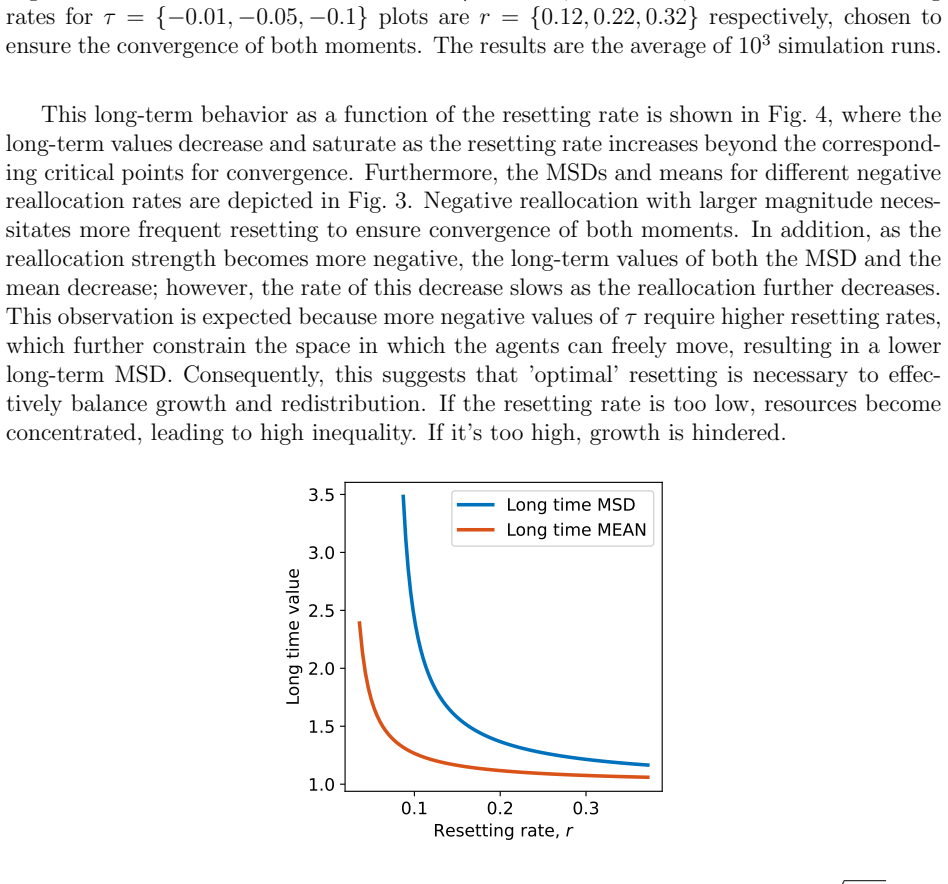
The central claim is that in RGBM with resetting and negative reallocation, the long-time behavior is fully classified by two thresholds. For $r<\mu-\tau$, the process keeps the non-ergodic, diverging character of standard RGBM. For $\mu-\tau<r<2(\mu-\tau)+\sigma^2$, the mean reaches a stationary value but the variance still diverges, so no stationary distribution exists. For $r>2(\mu-\tau)+\sigma^2$, both the first and second moments converge to the closed-form stationary values in Eqs. (23)--(24), the Fokker--Planck density stabilizes, and the self-averaging time becomes effectively infinite, meaning the population average equals the ensemble average for all practical purposes. The paper backs this with numerical simulations and with mobility statistics: rank correlation and earnings elasticity fall as resetting increases, and the probability of top-1% states decreases and stabilizes.
Load-bearing premise
The calculation leans on the assumption that the population average equals the ensemble average, $E[x]=\langle x\rangle_N$, including after replacing the time-dependent mean field by its stationary value in the Fokker--Planck equation; if this equality fails in the stabilized regime, the derived moments and thresholds do not follow.
Editorial extensions
If this is right
- Above $r_c$, the stationary mean and mean-square displacement are given by the explicit formulas in Eqs. (23)--(24), so one can compute long-run resource levels and dispersion without simulation.
- For resetting rates between $\mu-\tau$ and $r_c$, the mean is stationary but the variance diverges, so interventions that stabilize only the average still leave the distribution itself unstable.
- In the stabilized regime, the equality between population average and ensemble average holds indefinitely, which makes the non-ergodic RGBM behave like an ergodic system for practical measurements.
- In wealth-redistribution applications, increasing the resetting rate above $r_c$ lowers wealth concentration (fewer top-1% states) and increases mobility, at the cost of a smaller total pool.
Reading between the lines
- The same threshold logic applied to the $n$th moment would predict convergence for $r>n(\mu-\tau)+n(n-1)\sigma^2/2$; checking this numerically would reveal whether the stabilized distribution is fully captured by its first two moments or retains heavy tails.
- The paper's trade-off between equality and growth suggests an optimal resetting rate for a social-welfare objective that weights both concentration and total wealth; the authors flag this balance but do not solve the optimization.
- One could test the stabilization mechanism on other non-ergodic multiplicative processes, such as resetting to a distribution rather than a point, to see whether the threshold structure survives.
Signed reviews
Editorial analysis
A structured set of objections, weighed in public.
Referee Report
Summary. This paper analyzes the Reallocating Geometric Brownian Motion (RGBM) model subject to stochastic resetting, focusing on the negative reallocation regime (τ<0) where the standard model is non-stationary and non-ergodic. The authors derive moment equations, identify three long-time regimes for the first and second moments as functions of the resetting rate r, and compute a relative variance R_N(t) to argue that beyond a critical resetting rate the self-averaging time becomes effectively infinite. They complement the analysis with numerical simulations and apply the results to wealth mobility and inequality measures.
Significance. If the central claims were fully substantiated, the paper would be a useful contribution to the stochastic resetting literature: it generalizes srGBM results to a mean-field reallocation model, provides a simple regime diagram (Table 1), and connects the theory to economic mobility measures. The numerical simulations, the explicit GitHub code, and the recovery of the τ=0 srGBM limit are strengths. However, the analytical derivation of the self-averaging time rests on cross-moment equations that contain resetting terms inconsistent with the model's dynamics, and the ensemble mean is given by two incompatible expressions; these issues must be resolved before the regime classification and the 'infinite self-averaging time' claim can be accepted.
major comments (4)
- [Sec. 3.1, Eqs. (14)-(16)] The resetting contributions in the cross-moment equations are inconsistent with Eq. (8). For f = x_i^2, Eq. (8) yields a reset term r(x_0^2 - v), so dv/dt should contain -r v, not -2r v as in Eq. (15). For f = x_i x_j with independent per-agent resetting, the jump contribution is 2r x_0 E[x] - 2r q (and r(x_0^2 - q) for common resetting), whereas Eq. (15) uses r x_0^2 - 2r q, matching neither mechanism. As a result, the relative variance R_N(t) in Eq. (16) and the associated critical resetting rate for t_c → ∞ are not reliably derived. A direct witness is the τ = 0 limit, where Eq. (15) gives v_st = r x_0^2/[2(r-μ)-σ^2] instead of the standard srGBM result r x_0^2/(r-2μ-σ^2), a discrepancy of more than a factor of 3 for the parameters used in the paper (μ=0.021, σ^2=0.01, r=0.1). This leaves the analytical support for the 'effectively infinite self-averaging time' claim in Sec. 3.1 and Table 1 currently unsupported.
- [Sec. 3 and Sec. 4.1, Eqs. (10) and (21)] The paper gives two different expressions for the ensemble mean that are not equivalent for τ≠0. Eq. (10) follows from Eq. (8) under the self-averaging closure E[⟨x⟩_N]=E[x] and yields dE[x]/dt = (μ-r)E[x] + r x_0, with no τ in the transient rate. Eq. (21), derived from the Fokker-Planck equation (19) with ⟨x⟩_N replaced by its stationary value, has transient rate r - μ + τ. The exact finite-N moment equation for m(t)=E[x_i] from Eq. (4) gives the Eq. (10) form because the τ terms cancel when E[⟨x⟩_N]=E[x]. Consequently, the first row of Table 1 (convergence for r > μ-τ) appears incorrect; the mean converges for r > μ. This changes the boundary between the first and second regimes, although the stationary value (Eq. (23)) is unaffected.
- [Sec. 4.1, Eq. (19)] The Fokker-Planck equation (19) substitutes the stationary mean-field value ⟨x⟩_N = r/(r-μ) x_0 (Eq. (20)) into the time-dependent drift. This is only justified in the long-time stationary limit, not for the transient dynamics. Using Eq. (19) to derive the time-dependent moments (21)-(22) and to compare with simulations (Fig. 3) is therefore not valid in the transient; this is the source of the spurious τ dependence in the mean that leads to the incorrect threshold in Table 1.
- [Sec. 3.1] The derivation of the critical resetting rate mixes exact finite-N moment equations with the self-averaging assumption (Eq. (11)) in a way that is not transparent. Equations (14)-(15) for v(t) and q(t) close exactly for finite N without invoking Eq. (11), whereas the denominator E[x_i(t)] in Eq. (16) is taken from Eq. (10), which does assume E[⟨x⟩_N]=E[x]. The paper should separate these ingredients and state which results are exact and which are self-consistent approximations; as written, the logic is difficult to verify and the 'infinite self-averaging time' conclusion relies on a closure that is itself under test.
minor comments (6)
- [Eq. (11)] There is a stray equals sign in the displayed relation; it should read E[f(x)] = lim_{N→∞} ⟨f(x)⟩_N.
- [Eq. (14)] In the second line of Eq. (14), the second sum should be over k≠j E[x_k x_j] rather than over k≠j E[x_k x_i].
- [Sec. 3.1] The condition for t_c = ∞ should be stated precisely, e.g., R_N(t) < 1 for all t, and an explicit formula or numerical value for the critical rate r_c should be provided rather than only plots.
- [Sec. 2] The notation ⟨x⟩_N is described as both 'ensemble or population average' and later as the empirical average; please clarify the distinction between ⟨x⟩_N and E[x] throughout.
- [Fig. 5] The x-axis label in the left panel appears truncated ('0 10'); please check the axis range and labels.
- [Sec. 4.2] The text states that the critical point for variance convergence occurs at r_c = 2(μ-τ)+σ^2, but this is not derived from the corrected moment equations; please ensure consistency with the corrected R_N(t) analysis.
Circularity Check
Moderate partial circularity: the resetting rate rc that makes self-averaging 'infinite' is computed from moment equations that were closed with the self-averaging ansatz (Eq. 11) meant to be validated; no fitted predictions or uniquely load-bearing self-citation chain found.
-
self definitional
[Section 3, Eq. (11) and Section 3.1, Eqs. (12)-(16)]
"where we utilized E[f (x)] = lim N →∞ = ⟨f (x)⟩N (11) However, due to the non-ergodic nature of the negative reallocation regime of RGBM, Eq. 11 will be valid until some critical self-averaging time, tc, but with the introduction of stochastic resetting, for some value of the resetting rate rc, the assumption will be applicable always (tc → ∞). The calculation of rc is the focus of the next section which will play a key role in calculating the moments."
The rate rc is defined as the value at which Eq. 11 (E[f(x)] = ⟨f(x)⟩_N) becomes permanently valid. The relative variance RN(t) used to locate rc is constructed from v(t) and q(t), whose equations (Eq. 15) are obtained by inserting f = x_i^2 and f = x_i x_j into Eq. 8 and closing the mean-field terms τE[⟨x⟩_N ∂f/∂x_i] with Eq. 11. Therefore the criterion 'RN(t)→0, so self-averaging holds' is evaluated inside a model that already assumed self-averaging. rc is the stability boundary of the assumed mean-field closure, not an independent first-principles prediction. The paper is transparent about this, which makes it a self-consistency analysis rather than a hidden fit.
-
self definitional
[Section 4.1, Eqs. (19)-(20) and Table 1]
"In the self-averaging regime, when Eq. 18 is true, the Fokker-Planck equation (2) has the following form: ... where we have substituted ⟨x(t)⟩N = r/(r − µ) x0. (20) ... To ensure the long-time limit of the mean and MSD converge, the conditions r > µ−τ and r > 2(µ−τ )+ σ^2, respectively, must be met. This gives rise to three regimes ... summarized in Table 1."
The stationary mean field Eq. 20 is substituted into the Fokker-Planck equation before deriving the second moment and the Table 1 convergence threshold. Eq. 20 is itself the first moment obtained under the self-averaging assumption (Eq. 11, restated as Eq. 18). Hence the condition r > 2(µ−τ)+σ² for a finite stationary second moment is the stability condition of a solution constructed under the assumption whose validity it is supposed to establish. The 'infinite self-averaging time' and 'stabilized distribution' claims therefore inherit the ansatz rather than being independently derived.
full rationale
The paper contains no fitted parameters, no data-fitting disguised as prediction, and no uniqueness theorem imported from the authors. The moment and regime calculations are analytically explicit and are checked against simulations for the mean, MSD, and PDFs (Figs. 3-5). The main circularity concern is the self-averaging ansatz Eq. 11: it is used to close the first- and second-moment equations, and the same closed equations are then used to calculate the resetting rate rc at which the ansatz supposedly becomes permanently valid. This is a legitimate self-consistency analysis, but it means the headline result — effectively infinite self-averaging time in the stable regime — is equivalent to stability of the mean-field-closed moment equations, not an independent consequence of the resetting dynamics. The paper is explicit about the assumption, and the moment thresholds are nontrivial, so the partial circularity is moderate (score 4). A separate mathematical concern, not scored as circularity: Eq. 15 appears inconsistent with Eq. 8 under the paper's own common-resetting prescription (the resetting coefficients in the v and q equations differ from those obtained by applying Eq. 8 to f=x_i² and f=x_i x_j), which would undermine the quantitative RN(t) claim; this is a correctness risk rather than a circularity because the issue is an erroneous or mis-cited intermediate step, not a conclusion that reduces to its premise.
Assumptions & free parameters
assumptions (4)
- domain assumption Mean-field replacement <x>_N = E[x] (self-averaging) in the stochastic differential equation (Eq. 4 and Eq. 11).
- domain assumption The Fokker-Planck equation for the resetting process (Eq. 19) uses the stationary mean value r/(r-mu) x0 for the time-dependent mean field.
- standard math Standard Itô calculus for jump-diffusion processes and the Poisson resetting representation (Eq. 3), following [69] and [77].
- domain assumption The large population limit N -> infinity is taken for the analytical moments; finite-size effects are only addressed through the relative variance RN(t).
Cite this review
Pith. "Pith review of The impact of stochastic resetting on resource allocation: The case of Reallocating geometric Brownian motion." pith.science (2026). https://pith.science/paper/DL26PLBL
@misc{pith2026241112390,
  author       = {Pith},
  title        = {Pith review of: The impact of stochastic resetting on resource allocation: The case of Reallocating geometric Brownian motion},
  year         = {2026},
  howpublished = {\url{https://pith.science/paper/DL26PLBL}},
  note         = {Machine review of arXiv:2411.12390}
}
read the original abstract
We study the effects of stochastic resetting on the Reallocating geometric Brownian motion (RGBM), an established model for resource redistribution relevant to systems such as population dynamics, evolutionary processes, economic activity, and even cosmology. The RGBM model is inherently non-stationary and non-ergodic, leading to complex resource redistribution dynamics. By introducing stochastic resetting, which periodically returns the system to a predetermined state, we examine how this mechanism modifies RGBM behavior. Our analysis uncovers distinct long-term regimes determined by the interplay between the resetting rate, the strength of resource redistribution, and standard geometric Brownian motion parameters: the drift and the noise amplitude. Notably, we identify a critical resetting rate beyond which the self-averaging time becomes effectively infinite. In this regime, the first two moments are stationary, indicating a stabilized distribution of an initially unstable, mean-repulsive process. We demonstrate that optimal resetting can effectively balance growth and redistribution, reducing inequality in the resource distribution. These findings help us understand better the management of resource dynamics in uncertain environments.
Figures


Figures from the paper (5 more)


Reference graph
Works this paper leans on
-
[67]
Geometric brownian motion under stochastic resetting: A stationary yet nonergodic process
Viktor Stojkoski, Trifce Sandev, Ljupco Kocarev, and Arnab Pal. Geometric brownian motion under stochastic resetting: A stationary yet nonergodic process. Physical Review E, 104(1):014121, 2021
work page 2021
-
[1]
Wealth inequality and the er- godic hypothesis: Evidence from the united states
Yonatan Berman, Ole Peters, and Alexander Adamou. Wealth inequality and the er- godic hypothesis: Evidence from the united states. Forthcoming in Journal of Income Distribution, 2020
2020
-
[2]
Wealth condensation in a simple model of economy
Jean-Philippe Bouchaud and Marc M´ ezard. Wealth condensation in a simple model of economy. Physica A: Statistical Mechanics and its Applications, 282(3-4):536–545, 2000
2000
-
[3]
Correlation and relaxation times for a stochastic process with a fat-tailed steady-state distribution
Z Liu and Rostislav A Serota. Correlation and relaxation times for a stochastic process with a fat-tailed steady-state distribution. Physica A: Statistical Mechanics and its Applications, 474:301–311, 2017
2017
-
[4]
Dynamical optimization theory of a diversified portfolio
Matteo Marsili, Sergei Maslov, and Yi-Cheng Zhang. Dynamical optimization theory of a diversified portfolio. Physica A: Statistical Mechanics and its Applications, 253(1- 4):403–418, 1998
1998
-
[5]
Fokker–planck equations in the modeling of socio-economic phenomena
Giulia Furioli, Ada Pulvirenti, Elide Terraneo, and Giuseppe Toscani. Fokker–planck equations in the modeling of socio-economic phenomena. Mathematical Models and Methods in Applied Sciences, 27(01):115–158, 2017
work page 2017
-
[6]
ROBERT H. MACARTHUR and EDW ARD O. WILSON. The Theory of Island Biogeography. Princeton University Press, rev - revised edition, 1967. 19
work page 1967
-
[7]
Biodiversity as spatial insur- ance in heterogeneous landscapes
Michel Loreau, Nicolas Mouquet, and Andrew Gonzalez. Biodiversity as spatial insur- ance in heterogeneous landscapes. Proceedings of the National Academy of Sciences, 100(22):12765–12770, 2003
work page 2003
Show all 84 references
-
[8]
Simon A. Levin. Dispersion and population interactions. The American Naturalist, 108(960):207–228, 1974
1974
-
[9]
Mechanisms of maintenance of species diversity
Peter Chesson. Mechanisms of maintenance of species diversity. Annual Review of Ecology, Evolution, and Systematics, 31(Volume 31, 2000):343–366, 2000
2000
-
[10]
Robert D. Holt. Population dynamics in two-patch environments: Some anomalous con- sequences of an optimal habitat distribution.Theoretical Population Biology, 28(2):181– 208, 1985
1985
-
[11]
Evolutionary rate at the molecular level
Motoo Kimura. Evolutionary rate at the molecular level. Nature, 217:624–626, 1968
1968
-
[12]
Evolution in mendelian populations
Sewall Wright. Evolution in mendelian populations. Genetics, 16(2):97–159, 03 1931
1931
-
[13]
The causes of molecular evolution, volume 2
John H Gillespie. The causes of molecular evolution, volume 2. Oxford University Press, USA, 1991
1991
-
[14]
Crow and M
J.F. Crow and M. Kimura. An introduction to population genetics theory. New York etc, Harper and Row, 1970
1970
-
[15]
W.J. Ewens. Mathematical population genetics. Springer, 2004
2004
-
[16]
Explore or exploit? a generic model and an exactly solvable case
Thomas Gueudr´ e, Alexander Dobrinevski, and Jean-Philippe Bouchaud. Explore or exploit? a generic model and an exactly solvable case. Physical review letters, 112(5):050602, 2014
2014
-
[17]
New trends in turbulence turbulence: Nouveaux aspects
U Frisch and J Bec. New trends in turbulence turbulence: Nouveaux aspects. Les Houches-´Ecole d’´Et´ ede Physique Th´ eorique,edited by M. Lesieur, A. Yaglom, F. David (Springer, Berlin, 2002), 74, 2001
2002
-
[18]
Burgers turbulence.Physics reports, 447(1-2):1– 66, 2007
J´ er´ emie Bec and Konstantin Khanin. Burgers turbulence.Physics reports, 447(1-2):1– 66, 2007
2007
-
[19]
Kinetic roughening of growing surfaces
Joachim Krug and Herbert Spohn. Kinetic roughening of growing surfaces. Solids far from equilibrium, 1, 1991
1991
-
[20]
Cambridge university press, 1995
A-L Barab´ asi and Harry Eugene Stanley.Fractal concepts in surface growth. Cambridge university press, 1995
1995
-
[21]
Kinetic roughening phenomena, stochastic growth, directed polymers and all that
Timothy Halpin-Healy and Yi-Cheng Zhang. Kinetic roughening phenomena, stochastic growth, directed polymers and all that. aspects of multidisciplinary statistical mechan- ics. Physics reports, 254(4-6):215–414, 1995
1995
-
[22]
Van Kampen
N.G. Van Kampen. Stochastic Processes in Physics and Chemistry. North-Holland Personal Library. Elsevier Science, 2011. 20
2011
-
[23]
Birkhoff
George D. Birkhoff. Proof of the ergodic theorem. Proceedings of the National Academy of Sciences, 17(12):656–660, 1931
1931
-
[24]
E. G. D. Cohen and G. Gallavotti. Journal of Statistical Physics, 96(5/6):1343–1349, 1999
1999
-
[25]
Peters and W
O. Peters and W. Klein. Ergodicity breaking in geometric brownian motion. Phys. Rev. Lett., 110:100603, Mar 2013
2013
-
[26]
Small random perturbations of dynamical systems and the definition of attractors
David Ruelle. Small random perturbations of dynamical systems and the definition of attractors. Communications in Mathematical Physics, 82:137–151, 1981
1981
-
[27]
Strange kinetics of single molecules in living cells
Eli Barkai, Yuval Garini, and Ralf Metzler. Strange kinetics of single molecules in living cells. Physics Today, 65(8):29–35, 08 2012
2012
-
[28]
Weak ergodicity breaking and aging in disordered-systems
Jean-Philippe Bouchaud. Weak ergodicity breaking and aging in disordered-systems. Journal de physique I, 2, 09 1992
1992
-
[29]
Aging continuous time random walks
Eli Barkai and Yuan-Chung Cheng. Aging continuous time random walks. The Journal of Chemical Physics, 118(14):6167–6178, 04 2003
2003
-
[30]
Ergodicity breaking in wealth dynamics: The case of reallocating geometric brownian motion
Viktor Stojkoski and Marko Karbevski. Ergodicity breaking in wealth dynamics: The case of reallocating geometric brownian motion. Physical Review E, 105(2):024107, 2022
2022
-
[31]
Theory of financial risk and derivative pricing: from statistical physics to risk management
Jean-Philippe Bouchaud and Marc Potters. Theory of financial risk and derivative pricing: from statistical physics to risk management. Cambridge university press, 2003
2003
-
[32]
Evans and Satya N
Martin R. Evans and Satya N. Majumdar. Diffusion with stochastic resetting. Phys. Rev. Lett., 106:160601, Apr 2011
2011
-
[33]
Diffusion with optimal resetting
Martin R Evans and Satya N Majumdar. Diffusion with optimal resetting. Journal of Physics A: Mathematical and Theoretical, 44(43):435001, oct 2011
2011
-
[34]
Stochastic resetting and applications
Martin R Evans, Satya N Majumdar, and Gr´ egory Schehr. Stochastic resetting and applications. Journal of Physics A: Mathematical and Theoretical, 53(19):193001, April 2020
2020
-
[35]
Diffusion in a potential landscape with stochastic resetting
Arnab Pal. Diffusion in a potential landscape with stochastic resetting. Physical Review E, 91(1):012113, 2015
2015
-
[36]
Optimal search behavior and classic foraging theory
F Bartumeus and J Catalan. Optimal search behavior and classic foraging theory. Journal of Physics A: Mathematical and Theoretical, 42(43):434002, oct 2009
2009
-
[37]
Search with home returns provides advantage under high uncertainty
Arnab Pal, Lukasz Ku´ smierz, and Shlomi Reuveni. Search with home returns provides advantage under high uncertainty. Phys. Rev. Res., 2:043174, Nov 2020
2020
-
[38]
Role of substrate unbinding in michaelis–menten enzymatic reactions
Shlomi Reuveni, Michael Urbakh, and Joseph Klafter. Role of substrate unbinding in michaelis–menten enzymatic reactions. Proceedings of the National Academy of Sciences, 111(12):4391–4396, 2014. 21
2014
-
[39]
First passage under restart
Arnab Pal and Shlomi Reuveni. First passage under restart. Physical review letters, 118(3):030603, 2017
2017
-
[40]
W.J. Bell. Searching Behaviour: The behavioural ecology of finding resources. Chapman & Hall Animal Behaviour Series. Springer Netherlands, 2012
2012
-
[41]
Diffusion under time-dependent resetting
Arnab Pal, Anupam Kundu, and Martin R Evans. Diffusion under time-dependent resetting. Journal of Physics A: Mathematical and Theoretical, 49(22):225001, apr 2016
2016
-
[42]
Subdiffusive continuous-time random walks with stochastic resetting
Lukasz Ku´ smierz and Ewa Gudowska-Nowak. Subdiffusive continuous-time random walks with stochastic resetting. Phys. Rev. E, 99:052116, May 2019
2019
-
[43]
Controlling particle currents with evaporation and resetting from an interval
Gennaro Tucci, Andrea Gambassi, Shamik Gupta, and ´Edgar Rold´ an. Controlling particle currents with evaporation and resetting from an interval. Phys. Rev. Res., 2:043138, Oct 2020
2020
-
[44]
Autocorrelation functions and ergodicity in diffusion with stochastic resetting
Viktor Stojkoski, Trifce Sandev, Ljupco Kocarev, and Arnab Pal. Autocorrelation functions and ergodicity in diffusion with stochastic resetting. Journal of Physics A: Mathematical and Theoretical, 55(10):104003, feb 2022
2022
-
[45]
Cherstvy, Wei Wang, Ralf Metzler, and Igor M
Deepak Vinod, Andrey G. Cherstvy, Wei Wang, Ralf Metzler, and Igor M. Sokolov. Nonergodicity of reset geometric brownian motion. Phys. Rev. E, 105:L012106, Jan 2022
2022
-
[46]
Income inequality and mobility in geometric brownian motion with stochastic resetting: theoretical results and empirical evidence of non-ergodicity
Viktor Stojkoski, Petar Jolakoski, Arnab Pal, Trifce Sandev, Ljupco Kocarev, and Ralf Metzler. Income inequality and mobility in geometric brownian motion with stochastic resetting: theoretical results and empirical evidence of non-ergodicity. Philosophical Transactions of the...
2022
-
[47]
Resetting random walks in one-dimensional lattices with sinks
L N Christophorov. Resetting random walks in one-dimensional lattices with sinks. Journal of Physics A: Mathematical and Theoretical, 55(15):155006, mar 2022
2022
-
[48]
First passage under restart for discrete space and time: Application to one-dimensional confined lattice random walks
Ofek Lauber Bonomo and Arnab Pal. First passage under restart for discrete space and time: Application to one-dimensional confined lattice random walks. Phys. Rev. E, 103:052129, May 2021
2021
-
[49]
Riascos, Denis Boyer, Paul Herringer, and Jos´ e L
Alejandro P. Riascos, Denis Boyer, Paul Herringer, and Jos´ e L. Mateos. Random walks on networks with stochastic resetting. Phys. Rev. E, 101:062147, Jun 2020
2020
-
[50]
A first passage under resetting approach to income dynamics
Petar Jolakoski, Arnab Pal, Trifce Sandev, Ljupco Kocarev, Ralf Metzler, and Viktor Stojkoski. A first passage under resetting approach to income dynamics. Chaos, Solitons & Fractals, 175:113921, 2023
2023
-
[51]
Random walks on complex networks with first- passage resetting
Feng Huang and Hanshuang Chen. Random walks on complex networks with first- passage resetting. Phys. Rev. E, 103:062132, Jun 2021. 22
2021
-
[52]
Rose, Hugo Touchette, Igor Lesanovsky, and Juan P
Dominic C. Rose, Hugo Touchette, Igor Lesanovsky, and Juan P. Garrahan. Spectral properties of simple classical and quantum reset processes. Phys. Rev. E, 98:022129, Aug 2018
2018
-
[53]
Instability in the quantum restart problem
Ruoyu Yin, Qingyuan Wang, and Eli Barkai. Instability in the quantum restart problem. Phys. Rev. E, 109:064150, Jun 2024
2024
-
[54]
Experimental realization of diffusion with stochastic resetting
Ofir Tal-Friedman, Arnab Pal, Amandeep Sekhon, Shlomi Reuveni, and Yael Roichman. Experimental realization of diffusion with stochastic resetting. The Journal of Physical Chemistry Letters, 11(17):7350–7355, 2020. PMID: 32787296
2020
-
[55]
Majumdar, and Sergio Ciliberto
Benjamin Besga, Alfred Bovon, Artyom Petrosyan, Satya N. Majumdar, and Sergio Ciliberto. Optimal mean first-passage time for a brownian searcher subjected to reset- ting: Experimental and theoretical results. Phys. Rev. Res., 2:032029, Jul 2020
2020
-
[56]
Ornstein-uhlenbeck process and generalizations: Particle dynamics under comb constraints and stochastic resetting
Pece Trajanovski, Petar Jolakoski, Kiril Zelenkovski, Alexander Iomin, Ljupco Kocarev, and Trifce Sandev. Ornstein-uhlenbeck process and generalizations: Particle dynamics under comb constraints and stochastic resetting. Phys. Rev. E, 107:054129, May 2023
2023
-
[57]
Steady-state moments under resetting to a distribution
Kristian Stølevik Olsen. Steady-state moments under resetting to a distribution. Physical Review E, 108(4):044120, 2023
2023
-
[58]
Orn- stein–uhlenbeck process on three-dimensional comb under stochastic resetting
Pece Trajanovski, Petar Jolakoski, Ljupco Kocarev, and Trifce Sandev. Orn- stein–uhlenbeck process on three-dimensional comb under stochastic resetting. Mathematics, 11(16), 2023
2023
-
[59]
Universal framework for record ages under restart
Aanjaneya Kumar and Arnab Pal. Universal framework for record ages under restart. Physical Review Letters, 130(15):157101, 2023
2023
-
[60]
Anomalous diffusion in random-walks with memory-induced relocations
Axel Mas´ o-Puigdellosas, Daniel Campos, and Vicen¸ c M´ endez. Anomalous diffusion in random-walks with memory-induced relocations. Frontiers in Physics, 7:112, 2019
2019
-
[61]
Mitigating long queues and waiting times with service resetting
Ofek Lauber Bonomo, Arnab Pal, and Shlomi Reuveni. Mitigating long queues and waiting times with service resetting. PNAS nexus, 1(3):pgac070, 2022
2022
-
[62]
Queues with resetting: a perspective.Journal of Physics: Complexity, 5(2):021001, 2024
Reshmi Roy, Arup Biswas, and Arnab Pal. Queues with resetting: a perspective.Journal of Physics: Complexity, 5(2):021001, 2024
2024
-
[63]
Resetting dynamics in a confining potential
RK Singh, R Metzler, and T Sandev. Resetting dynamics in a confining potential. Journal of Physics A: Mathematical and Theoretical, 53(50):505003, 2020
2020
-
[64]
Random resetting in search problems
Arnab Pal, Viktor Stojkoski, and Trifce Sandev. Random resetting in search problems. arXiv preprint arXiv:2310.12057, 2023
2023 arXiv
-
[65]
Stochastic resetting: A (very) brief review
Shamik Gupta and Arun M Jayannavar. Stochastic resetting: A (very) brief review. Frontiers in Physics, 10:789097, 2022
2022
-
[66]
Measures of physical mixing evaluate the economic mobility of the typical individual
Viktor Stojkoski. Measures of physical mixing evaluate the economic mobility of the typical individual. Chaos, Solitons & Fractals, 180:114567, 2024. 23
2024
-
[68]
The fokker-planck equation, 1996
H Risken. The fokker-planck equation, 1996
1996
-
[69]
Stochastic representation of processes with resetting
Marcin Magdziarz and Kacper Ta´ zbierski. Stochastic representation of processes with resetting. Phys. Rev. E, 106:014147, Jul 2022
2022
-
[70]
S. Ken-Iti. L´ evyProcesses and Infinitely Divisible Distributions. Cambridge studies in advanced mathematics. Cambridge University Press, 1999
1999
-
[71]
On the electrodynamics of moving bodies
Albert Einstein. On the electrodynamics of moving bodies. j-ANN-PHYS-1900-4, 322(10):891–921, 1905
1900
-
[72]
Smoluchowski
M. Smoluchowski. Zur kinetischen theorie der brownschen molekularbewegung und der suspensionen. Annalen der Physik, 326:756 – 780, 03 2006
2006
-
[73]
Bachelier
L. Bachelier. Th´ eorie de la sp´ eculation. Annales scientifiques de l’´Ecole Normale Sup´ erieure, 3e s´ erie, 17:21–86, 1900
1900
-
[74]
Robert C. Merton. Option pricing when underlying stock returns are discontinuous. Journal of Financial Economics, 3(1):125–144, 1976
1976
-
[75]
The pricing of options and corporate liabilities
Fishcer Black and Myron Scholes. The pricing of options and corporate liabilities. Journal of political economy, 81(3):637, 1973
1973
-
[76]
Barndorff-Nielsen, T
O.E. Barndorff-Nielsen, T. Mikosch, and S.I. Resnick. L´ evyProcesses: Theory and Applications. Birkh¨ auser Boston, 2001
2001
-
[77]
Applied stochastic processes and control for jump-diffusions: modeling, analysis and computation
Floyd B Hanson. Applied stochastic processes and control for jump-diffusions: modeling, analysis and computation. SIAM, 2007
2007
-
[78]
Stochastic integral, volume 20
Kiyosi Ito. Stochastic integral, volume 20. Procedings of the Imperial Academy, 1944
1944
-
[79]
On a Stochastic Integral Equation,” Proceedings of the Japan Academy, volume 22
Kiyosi Ito. On a Stochastic Integral Equation,” Proceedings of the Japan Academy, volume 22. Procedings of the Japan Academy, 1944
1944
-
[80]
Stochastic differential equations: an introduction with applications
Bernt Oksendal. Stochastic differential equations: an introduction with applications. Springer Science & Business Media, 2013
2013
-
[81]
Self-averaging of random quantum dynamics
Marcin Lobejko, Jerzy Dajka, and Jerzy Luczka. Self-averaging of random quantum dynamics. Physical Review A, 98(2):022111, 2018
2018
-
[82]
Ergodicity economics
Ole Peters and Alexander Adamou. Ergodicity economics. London Mathematical Laboratory, 2018
2018
-
[83]
Bouchaud-m´ ezard model on a random network
Takashi Ichinomiya. Bouchaud-m´ ezard model on a random network. Physical Review E—Statistical, Nonlinear, and Soft Matter Physics, 86(3):036111, 2012
2012
-
[84]
Measuring Inequality
Frank Cowell. Measuring Inequality. Oxford University Press, 01 2011. 24
2011
Reviewed August 12, 2026 · model on record in the stance chip above.
Discussion (0). Continue with ORCID to comment.