REVIEW 4 major objections 5 minor 93 references
Probe-Me-Not: Protecting Pre-trained Encoders from Malicious Probing
T0 review · 4 major / 5 minor · reviewed 2026-08-12 · deepseek-v4-flash
Pith's one-line read Forbidden-task probing accuracy falls to near-random levels.
desk verdict A useful new problem framing for encoder probing protection, with a solid supervised/unsupervised core, but the zero-shot variant and the universal 'effectively limit' claim outrun the evidence. read the letter →
The pith
A machine-rendered reading of the paper's core claim, the machinery that carries it, and where it could break.
The reading
What carries the argument
The load-bearing object is the domain-aware weight selection score, which ranks each weight $i$ in layer $l$ by the magnitude ratio of the target-domain gradient to the source-domain gradient, $|\nabla L_T^{l,i} / \nabla L_S^{l,i}|$, and selects the top $N$ weights per round; a weight whose influence is large for the prohibited domain but small for the authorized one can be adjusted without erasing the encoder's main competence. The selected weights are updated by minimizing the log-ratio regularizer $R_T = \log(1 + \alpha\, L_S / L_T)$ under the constraint $\lVert \phi^* - \phi \rVert_0 \le M$, which penalizes the ratio between source loss and target loss so the target loss rises without dragging the source down. Around this core sit the three data-dependence branches: a self-challenging minimax loop that retrains the target head from scratch each round (supervised), a contrastive loss that blurs class structure in the target domain's feature space (unsupervised), and an AI-agent plus text-to-image pipeline with prompt refinement that fabricates a synthetic target dataset from a theme (zero-shot).
What would settle it
Probe an EncoderLock-protected encoder with a downstream classifier trained on prohibited-domain data that the defender's proxy never covered—for example military-vehicle photos in new environments, viewpoints, or resolutions absent from the synthetic set used for the zero-shot variant, or a differently composed domain with the same theme. If the classifier's accuracy rebounds toward the unprotected level observed in the paper (around 60% on the military-vehicle domain) instead of staying in the reported 18–29% range, the central transferability assumption of the weight-selection score is wrong.
Extended reading notes
Core claim
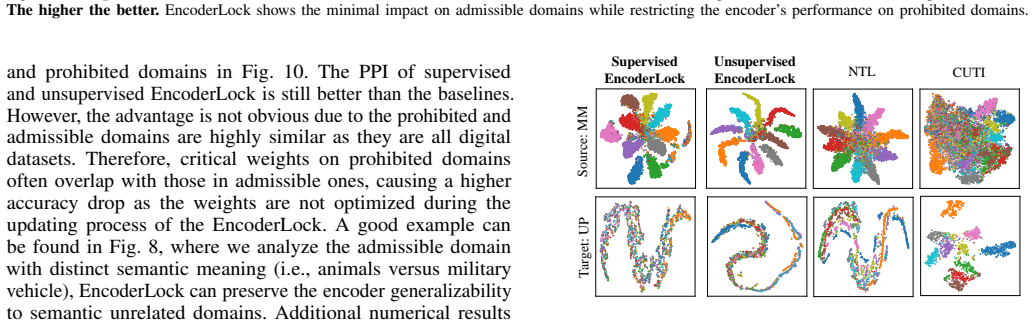
At the weight level, the paper argues, applicability authorization is enforceable: after EncoderLock, a downstream classifier trained on the encoder's embeddings for a prohibited domain reaches accuracy near random guess in several settings (for example 8.47% on a ten-class digit target and 1.19% on a 100-class target), while accuracy on the authorized source domain stays above 92%. In the real-encoder study on a public self-supervised Vision Transformer, military-vehicle classification accuracy drops from an unprotected 60.55% (measured on the paired ResNet-18 setup) to 21.56%, 18.15%, and 29.26% under the supervised, unsupervised, and zero-shot variants. The enabling observation is that domain-relevant knowledge is local: each domain engages a distinct small set of critical weights, ranked by the ratio of target-domain to source-domain gradient magnitudes $|\nabla L_T^{l,i} / \nabla L_S^{l,i}|$, and updating only those weights within a small $\ell_0$ budget confines the lock's damage to the prohibited domain. Over that selection sits a minimax 'self-challenging' loop that re-initializes and retrains the attacker's downstream head each round, forcing the encoder to keep losing target-domain utility no matter which classifier the attacker tries; the label-free and data-free variants drive the same selection with a contrastive loss or with synthetic images generated from a text theme through an AI-agent prompt-refinement pipeline. The paper's experiments show the lock surviving progressive probing epochs, deeper and wider heads, and access to the full prohibited dataset, and outperforming earlier non-transferable learning baselines that regain target accuracy after a few fine-tuning steps.
Load-bearing premise
The load-bearing assumption is that the defender's stand-in for the prohibited domain—labeled samples, unlabeled samples, or synthetic images generated from a text theme—matches the data an attacker will actually probe, because the critical-weight ranking is computed on that stand-in; if the distributions diverge, the altered weights may not suppress the attacker's accuracy.
Editorial extensions
If this is right
- A provider can ship one frozen encoder whose embeddings are unhelpful for a stated forbidden task: supervised and unsupervised EncoderLock leave target accuracy at roughly 8–20% on the digit-domain pairs while source accuracy stays above 92%.
- The defense works on a large, self-supervised Vision Transformer, not only on small supervised convolutional encoders, and it changes only a tiny fraction of the weights (reported average below 0.08%), leaving performance on unrelated admissible domains mostly intact.
- Attacker adaptation within the probing threat model does not restore target accuracy: classifiers from one to four layers with widths up to 4096 achieve at most 17.89% on the target, and probing with up to the entire prohibited dataset leaves target accuracy low.
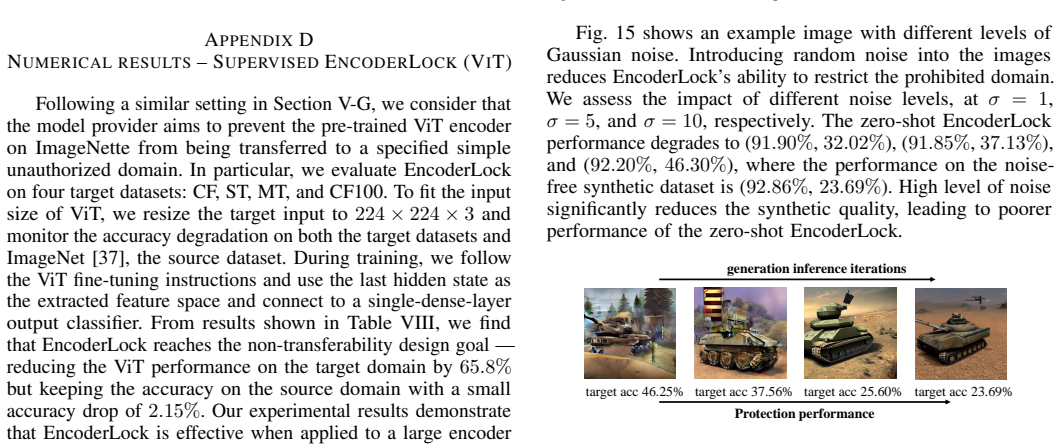
- Protection is available across the whole spectrum of prior knowledge: with labeled prohibited data, unlabeled prohibited data, or none at all—the zero-shot variant, using only a text theme refined through an AI agent and a text-to-image model, reduces military-vehicle target accuracy from 60.55% to 23.69% in the ResNet-18 case study.
Reading between the lines
- The paper leaves untested whether the lock survives a proxy gap, where the attacker's prohibited-domain data differs from the defender's stand-in (labeled samples, unlabeled samples, or synthetic images); a natural next experiment is to lock with one military-vehicle proxy and probe with a deliberately disjoint military dataset, and to compare locking a union of critical weights from several proxi
- The target-to-source gradient ratio is a general-purpose instrument the paper does not pursue: the same score could be used to prune away domain-specific capacity, to place watermarks in domain-sensitive weights, or to audit which domains a released model was tuned on.
- Because the threat model only covers attackers who freeze the encoder and train a head, the 'locked' guarantee has an untested boundary: an attacker who partially fine-tunes the encoder itself, or uses adapters that modify features rather than classify them, might bypass the lock—checking that boundary is the immediate sequel the paper implicitly invites.
Editorial analysis
A structured set of objections, weighed in public.
Referee Report
Summary. This paper proposes EncoderLock, a method for restricting malicious linear probing of a pre-trained encoder on a specified prohibited domain. EncoderLock iteratively selects a small set of encoder weights whose target-gradient to source-gradient ratio is large (Function 1) and updates those weights with a regularized loss (Eq. 4-5) under a self-challenging scheme (Algorithm 1). Three variants address labeled, unlabeled, and no-access prohibited-domain data: supervised, unsupervised contrastive, and zero-shot with synthetic Stable-Diffusion data. Experiments on digit-transfer pairs (Tables II-III), cross-task transfers (Fig. 6), a military-vehicle case study with ResNet-18 (Fig. 8), a real Facebook ViT encoder (Fig. 13), and comparisons with NTL and CUTI (Figs. 9-11) are reported.
Significance. If the central claims held at face value, this would be a practically useful applicability-authorization tool: it operates on the encoder rather than the full model, targets the probing setting, includes a genuinely label-free variant, and is evaluated on a real ViT with a concrete military-use case. The paper ships a large set of experiments, compares against two prior transforms, reports weight-change budgets, and includes failure-oriented ablations. However, the significance is limited by the universal wording of the main claim and by the untested proxy-to-probe distribution transfer, which the zero-shot results already show to be the weakest link. With claim refinement and additional transfer experiments, the contribution would be solid.
major comments (4)
- [Section V-G / Table III] The abstract and Section V-G state that all three variants of EncoderLock effectively limit the encoder's performance on prohibited domains, and the abstract promises 'poor performance on specified prohibited domains.' Table III (VGG-11, unsupervised EncoderLock) reports post-protection target accuracies of 76.68% for SD-to-MT, 86.75% for SD-to-UP, and 75.31% for SD-to-SN. These values correspond to relative target drops of only about 21%, 7%, and 17%, respectively, and are far above the 'poor performance' level claimed. The central claim is therefore stated more broadly than the evidence supports; it should be restricted to the tested regimes, and the failure cases should be analyzed explicitly.
- [Sections IV-B / IV-E / V-D] The domain-aware selection in Function 1 computes the importance ranking on batches B_T from the defender's target set D_T, and the zero-shot variant constructs D_T from 10 Stable-Diffusion prompts. The paper never tests the transfer assumption that this proxy is representative of the distribution an attacker actually probes: no experiment partitions a prohibited domain into defender-visible and attacker-held portions, and the real-Military zero-shot numbers in Fig. 8 and Section V-G are the weakest of the three variants (23.69% versus 11.48% on ResNet-18, and 29.26% versus 21.56% and 18.15% on ViT). This is a load-bearing gap because if an attacker probes a subpopulation whose critical weights are not ranked highly under the proxy, the locked encoder can leave the prohibited-domain accuracy high. I ask for an explicit distribution-shift evaluation (for example, train on a subset of military classes or on synthetic data, then evaluate on held-out classes or a second prohibited dataset) and a corresponding revision of the universal claim.
- [Algorithm 1 / Table V] Algorithm 1 takes a 'Desired target accuracy αgoal' as an input and uses it for early stopping, but αgoal is never specified in the main text, Appendix A, or Table V. Section VI-B describes a generic accuracy threshold accth but does not report the values used in the experiments. Since the reported 'after' accuracies depend on when training stops, this missing hyperparameter prevents reproduction and leaves open the possibility that the target accuracies were determined by threshold choice. Please report αgoal or the actual stopping rounds for every configuration.
- [Function 1 / Eq. (6)] The weight-importance score in Function 1 is defined as |∇L_T^{l,i} / ∇L_S^{l,i}|. For weights where the source batch gradient is zero or very small, the score is undefined or dominated by the denominator rather than by target importance. The paper does not specify a stabilizer, a floor on |∇L_S|, or a masking rule for such weights. Because this ranking determines which M weights are updated, a precise definition is required for the algorithm to be reproducible and for the reported selection behavior to be interpretable.
minor comments (5)
- [Abstract / Table I] The abstract says the experiments span 'fifteen domains,' but Table I lists twelve datasets and Section I also says twelve domains; the number should be reconciled.
- [Section V-D] The text says 'We evaluate one-shot EncoderLock's performance' in the zero-shot evaluation section; this should read 'zero-shot EncoderLock.'
- [Section IV-C / Eq. (6)] The method is described as a minimax optimization, but Algorithm 1 performs alternating updates: the encoder weights are updated first, then the auxiliary head is retrained from scratch. The paper should clarify that this is an alternating scheme rather than a joint solution to Eq. (6).
- [Eq. (5)-(6)] The constraint ∥ϕ*−ϕ∥_0 ≤ M is stated but no mechanism for enforcing it is described; please clarify whether the update is restricted by masking only the selected weights or by some projected update.
- [Eq. (8)] The PPI formula divides by accT_m, so the index diverges when the protected target accuracy is zero; please state how zero or near-zero denominators are handled in the reported plots.
Circularity Check
No significant circularity: EncoderLock's reported target-domain suppression is a measured post-training outcome on held-out and external datasets, not a replay of its training objective.
full rationale
EncoderLock's claimed protection is an empirically trained defense, not a derivation of its conclusion from its inputs. The supervised variant optimizes Eqs. (4)-(6) against source and target batches and is then probed by a freshly fine-tuned downstream head on held-out target test data, with Algorithm 1's early-stopping on target validation accuracy serving as standard model selection rather than as a fitted value renamed as a prediction. The unsupervised variant is evaluated under the same held-out protocol in Tables III and IX, and the zero-shot variant is the decisive non-circular case: the encoder is trained only on synthetic images generated from text prompts (Section IV-E) and then evaluated on the real Military Vehicles dataset (Fig. 8 and Section V-G), an external target never used in training. Baseline comparisons use external methods NTL [79] and CUTI [78]. The only self-citations ([20] and [91]) appear in the related-work enumeration of applicability authorization and are not load-bearing for any equation or result. The practical caveat that zero-shot protection could weaken if the synthetic proxy distribution does not match the attacker's actual probe distribution is a robustness limitation, not a circularity.
Assumptions & free parameters
free parameters (4)
- N (critical weights selected per round) =
100 (supervised), 200 (unsupervised)
- R (number of rounds) =
100
- alpha (regularization weight) =
1000 (supervised), 10 (unsupervised)
- learning rate for encoder update =
0.01
assumptions (4)
- domain assumption The gradient-magnitude ratio |∇L_T / ∇L_S| isolates weights that are critical for the prohibited domain but not for the source domain.
- domain assumption The owner's prohibited-domain data (labeled, unlabeled, or LLM-generated synthetic images) is representative of the attacker's probing distribution.
- domain assumption The self-challenging auxiliary classifiers in Eq. (6) span the space of downstream heads a real attacker will use.
- ad hoc to paper The log-ratio regularizer RT = log(1 + alpha * LS / LT) is an adequate balance between source retention and target suppression.
Cite this review
Pith. "Pith review of Probe-Me-Not: Protecting Pre-trained Encoders from Malicious Probing." pith.science (2026). https://pith.science/paper/OZTQNU2W
@misc{pith2026241112508,
  author       = {Pith},
  title        = {Pith review of: Probe-Me-Not: Protecting Pre-trained Encoders from Malicious Probing},
  year         = {2026},
  howpublished = {\url{https://pith.science/paper/OZTQNU2W}},
  note         = {Machine review of arXiv:2411.12508}
}
read the original abstract
Adapting pre-trained deep learning models to customized tasks has become a popular choice for developers to cope with limited computational resources and data volume. More specifically, probing--training a downstream head on a pre-trained encoder--has been widely adopted in transfer learning, which helps to prevent overfitting and catastrophic forgetting. However, such generalizability of pre-trained encoders raises concerns about the potential misuse of probing for harmful intentions, such as discriminatory speculation and warfare applications. In this work, we introduce EncoderLock, a novel applicability authorization method designed to protect pre-trained encoders from malicious probing, i.e., yielding poor performance on specified prohibited domains while maintaining their utility in authorized ones. Achieving this balance is challenging because of the opposite optimization objectives and the variety of downstream heads that adversaries can utilize adaptively. To address these challenges, EncoderLock employs two techniques: domain-aware weight selection and updating to restrict applications on prohibited domains/tasks, and self-challenging training scheme that iteratively strengthens resistance against any potential downstream classifiers that adversaries may apply. Moreover, recognizing the potential lack of data from prohibited domains in practical scenarios, we introduce three EncoderLock variants with different levels of data accessibility: supervised (prohibited domain data with labels), unsupervised (prohibited domain data without labels), and zero-shot (no data or labels available). We verify EncoderLock's effectiveness and practicality with a real-world pre-trained Vision Transformer (ViT) encoder from Facebook. These results underscore the valuable contributions EncoderLock brings to the development of responsible AI.
Figures


Figures from the paper (19 more)






Reference graph
Works this paper leans on
-
[1]
J. Achiam et al. , “Gpt-4 technical report,” arXiv preprint arXiv:2303.08774, 2023
arXiv 2023
-
[2]
Deep-Lock: Secure Authorization for Deep Neural Networks
M. Alam et al. , “Deep-lock: Secure authorization for deep neural networks,” arXiv preprint arXiv:2008.05966 , 2020
work page Pith review arXiv 2008
-
[3]
Exploring visual prompts for adapting large-scale models,
H. Bahng et al. , “Exploring visual prompts for adapting large-scale models,” arXiv preprint arXiv:2203.17274 , 2022. TABLE IV . PERFORMANCE OF THE SUPERVISED ENCODER LOCK ON VARIOUS CLASSIFIER CONFIGURATIONS —SOURCE (MT) TO TARGET (UP). # Layers 1 2 3 4 Hidden dim. / 256 512 1024 2048 4096 256 512 1024 2048 4096 256 512 1024 2048 4096 size (M) 0.25 6.42 ...
arXiv 2022
-
[4]
Probing classifiers: Promises, shortcomings, and advances,
Y . Belinkov, “Probing classifiers: Promises, shortcomings, and advances,” Computational Linguistics, 2022
2022
-
[5]
Representation learning: A review and new perspec- tives,
Y . Bengioet al., “Representation learning: A review and new perspec- tives,” IEEE transactions on pattern analysis and machine intelligence , vol. 35, no. 8, pp. 1798–1828, 2013
2013
-
[6]
Military vehicles dataset,
A. Bose, “Military vehicles dataset,” https://www.kaggle.com/datasets/ amanrajbose/millitary-vechiles, n.d., accessed: 2023-04-23
2023
-
[7]
Putting representations to use,
R. Cao, “Putting representations to use,” Synthese, p. 151, 2022
2022
-
[8]
Emerging properties in self-supervised vision trans- formers,
M. Caron et al., “Emerging properties in self-supervised vision trans- formers,” in ICCV, 2021, pp. 9650–9660
2021
Show all 93 references
-
[9]
Hardware-assisted intellectual property protection of deep learning models,
A. Chakraborty, A. Mondai, and A. Srivastava, “Hardware-assisted intellectual property protection of deep learning models,” in DAC, 2020
2020
-
[10]
Confronting the risks of artificial intelligence,
B. Cheatham, K. Javanmardian, and H. Samandari, “Confronting the risks of artificial intelligence,” McKinsey Quarterly, pp. 1–9, 2019
2019
-
[11]
A simple framework for contrastive learning of visual representations,
T. Chen, S. Kornblith, M. Norouzi, and G. Hinton, “A simple framework for contrastive learning of visual representations,” in ICML, 2020
2020
-
[12]
Catastrophic forgetting meets negative transfer: Batch spectral shrinkage for safe transfer learning,
X. Chen, S. Wang et al., “Catastrophic forgetting meets negative transfer: Batch spectral shrinkage for safe transfer learning,” NeurIPS, 2019
2019
-
[13]
An embarrassingly simple approach for transfer learning from pretrained language models,
A. Chronopoulou, C. Baziotis, and A. Potamianos, “An embarrassingly simple approach for transfer learning from pretrained language models,” arXiv preprint arXiv:1902.10547 , 2019
1902 arXiv
-
[14]
general-image-embedding3,
Clarifai, “general-image-embedding3,” 2020. [Online]. Available: https://clarifai.com/clarifai/main/models/general-image-embedding
2020
-
[15]
An analysis of single-layer networks in unsupervised feature learning,
A. Coates, A. Ng, and H. Lee, “An analysis of single-layer networks in unsupervised feature learning,” in AISTATS, 2011, pp. 215–223
2011
-
[16]
Emnist: Extending mnist to handwritten letters,
G. Cohen, S. Afshar et al., “Emnist: Extending mnist to handwritten letters,” in IJCNN. IEEE, 2017, pp. 2921–2926
2017
-
[17]
On the relationship between self-attention and convolutional layers,
J.-B. Cordonnier, A. Loukas, and M. Jaggi, “On the relationship between self-attention and convolutional layers,” arXiv:1911.03584, 2019
1911 arXiv
-
[18]
Supervised learning,
P. Cunningham, M. Cord, and S. J. Delany, “Supervised learning,” in Machine learning techniques for multimedia . Springer, 2008, pp. 21–49
2008
-
[19]
Imagenet: A large-scale hierarchical image database,
J. Deng, W. Dong et al., “Imagenet: A large-scale hierarchical image database,” in CVPR. IEEE, 2009, pp. 248–255
2009
-
[20]
Non-transferable pruning,
R. Ding, L. Su, A. A. Ding, and Y . Fei, “Non-transferable pruning,” in European Conference on Computer Vision . Springer, 2025, pp. 375–393
2025
-
[21]
Puma: Secure inference of llama-7b in five minutes,
Y . Dong, W.-j. Lu et al., “Puma: Secure inference of llama-7b in five minutes,” arXiv preprint arXiv:2307.12533 , 2023
2023
-
[22]
The lottery ticket hypothesis: Finding sparse, trainable neural networks,
J. Frankle and M. Carbin, “The lottery ticket hypothesis: Finding sparse, trainable neural networks,” arXiv preprint arXiv:1803.03635 , 2018
2018 arXiv
-
[23]
Decorate the newcomers: Visual domain prompt for continual test time adaptation,
Y . Gan, Y . Baiet al., “Decorate the newcomers: Visual domain prompt for continual test time adaptation,” in AAAI, 2023
2023
-
[24]
Unsupervised domain adaptation by backpropagation,
Y . Ganin and V . Lempitsky, “Unsupervised domain adaptation by backpropagation,” in ICML. PMLR, 2015, pp. 1180–1189
2015
-
[25]
Domain-adversarial training of neural networks,
Y . Ganin, E. Ustinova et al. , “Domain-adversarial training of neural networks,” The journal of machine learning research , 2016
2016
-
[26]
Tuning pre-trained model via moment probing,
M. Gao, Q. Wang et al., “Tuning pre-trained model via moment probing,” in ICCV, 2023, pp. 11 803–11 813
2023
-
[27]
Generative adversarial networks,
I. Goodfellow, J. Pouget-Abadie et al., “Generative adversarial networks,” Communications of the ACM , vol. 63, no. 11, pp. 139–144, 2020
2020
-
[28]
Self-supervised relationship probing,
J. Gu, J. Kuen et al., “Self-supervised relationship probing,” NeurIPS, vol. 33, pp. 1841–1853, 2020
2020
-
[29]
Sigma: secure gpt inference with function secret sharing,
K. Gupta, N. Jawalkar et al., “Sigma: secure gpt inference with function secret sharing,” Cryptology ePrint Archive , 2023
2023
-
[30]
A survey on vision transformer,
K. Han, Y . Wang et al. , “A survey on vision transformer,” IEEE transactions on pattern analysis and machine intelligence , vol. 45, no. 1, pp. 87–110, 2022
2022
-
[31]
Pre-trained models: Past, present and future,
X. Han, Z. Zhang et al., “Pre-trained models: Past, present and future,” AI Open, vol. 2, pp. 225–250, 2021
2021
-
[32]
Masked autoencoders are scalable vision learners,
K. He, X. Chen et al., “Masked autoencoders are scalable vision learners,” in PCVPR, 2022, pp. 16 000–16 009
2022
-
[33]
Momentum contrast for unsupervised visual representation learning,
K. He, H. Fan et al. , “Momentum contrast for unsupervised visual representation learning,” in CVPR, 2020, pp. 9729–9738
2020
-
[34]
Deep residual learning for image recognition,
K. He, X. Zhang et al., “Deep residual learning for image recognition,” in CVPR, 2016, pp. 770–778
2016
-
[35]
Using self-supervised learning can improve model robustness and uncertainty,
D. Hendrycks et al., “Using self-supervised learning can improve model robustness and uncertainty,” NeurIPS, vol. 32, 2019
2019
-
[36]
imagenette
J. Howard, “imagenette.” [Online]. Available: https://github.com/fastai/ imagenette/
-
[37]
Fastai: A layered api for deep learning,
J. Howard and S. Gugger, “Fastai: A layered api for deep learning,” Information, vol. 11, no. 2, p. 108, 2020
2020
-
[38]
A database for handwritten text recognition research,
J. J. Hull, “A database for handwritten text recognition research,” IEEE Transactions on pattern analysis and machine intelligence , vol. 16, no. 5, pp. 550–554, 1994
1994
-
[39]
A review of deep transfer learning and recent advancements,
M. Iman, H. R. Arabnia, and K. Rasheed, “A review of deep transfer learning and recent advancements,” Technologies, 2023
2023
-
[40]
Gender and ai: Addressing bias in artifi- cial intelligence,
International Women’s Day, “Gender and ai: Addressing bias in artifi- cial intelligence,” https://www.internationalwomensday.com/Missions/ 14458/Gender-and-AI-Addressing-bias-in-artificial-intelligence, 2024, accessed: 2024-06-22
2024
-
[41]
A survey on contrastive self-supervised learning,
A. Jaiswal, A. R. Babu, M. Z. Zadeh, D. Banerjee, and F. Makedon, “A survey on contrastive self-supervised learning,” Technologies, vol. 9, no. 1, p. 2, 2020
2020
-
[42]
Entangled watermarks as a defense against model extraction,
H. Jia, C. A. Choquette-Choo, V . Chandrasekaran, and N. Papernot, “Entangled watermarks as a defense against model extraction,” inUSENIX Security 21, 2021, pp. 1937–1954
2021
-
[43]
Visual prompt tuning,
M. Jia, L. Tang et al. , “Visual prompt tuning,” in ECCV. Springer, 2022, pp. 709–727
2022
-
[44]
Adam: A method for stochastic optimization,
D. P. Kingma and J. Ba, “Adam: A method for stochastic optimization,” ICLR, 2015
2015
-
[45]
Auto-encoding variational bayes,
D. P. Kingma and M. Welling, “Auto-encoding variational bayes,” arXiv preprint arXiv:1312.6114, 2013
2013 arXiv
-
[46]
Learning multiple layers of features from tiny images,
A. Krizhevsky, G. Hinton et al., “Learning multiple layers of features from tiny images,” 2009
2009
-
[47]
Contrastive representation learning: A framework and review,
P. H. Le-Khac, G. Healy, and A. F. Smeaton, “Contrastive representation learning: A framework and review,” Ieee Access, vol. 8, pp. 193 907– 193 934, 2020
2020
-
[48]
Gradient-based learning applied to document recognition,
Y . LeCun, L. Bottouet al., “Gradient-based learning applied to document recognition,” Proceedings of the IEEE , vol. 86, no. 11, 1998
1998
-
[49]
Modeldiff: Testing-based dnn similarity comparison for model reuse detection,
Y . Li, Z. Zhang et al. , “Modeldiff: Testing-based dnn similarity comparison for model reuse detection,” in ISSTA, 2021, pp. 139–151
2021
-
[50]
Transtailor: Pruning the pre-trained model for improved transfer learning,
B. Liu et al., “Transtailor: Pruning the pre-trained model for improved transfer learning,” in AAAI, vol. 35, no. 10, 2021
2021
-
[51]
Secdeep: Secure and performant on-device deep learning inference framework for mobile and iot devices,
R. Liu et al., “Secdeep: Secure and performant on-device deep learning inference framework for mobile and iot devices,” in IoTDI, 2021
2021
-
[52]
Fault injection attack on deep neural network,
Y . Liu, L. Wei, B. Luo, and Q. Xu, “Fault injection attack on deep neural network,” in ICCAD. IEEE, 2017, pp. 131–138
2017
-
[53]
Rethinking the value of network pruning,
Z. Liu, M. Sun et al., “Rethinking the value of network pruning,” arXiv preprint arXiv:1810.05270, 2018
2018 arXiv
-
[54]
Transfer learning from pre-trained models,
P. Marcelino, “Transfer learning from pre-trained models,” Towards data science, vol. 10, no. 330, p. 23, 2018
2018
-
[55]
Is artificial intelligence dangerous? 6 ai risks everyone should know about,
B. Marr, “Is artificial intelligence dangerous? 6 ai risks everyone should know about,” Forbes. Retrieved May, vol. 13, p. 2022, 2018
2022
-
[56]
Data augmentation for improving deep learning in image classification problem,
A. Mikołajczyk et al., “Data augmentation for improving deep learning in image classification problem,” in IIPhDW. IEEE, 2018, pp. 117–122
2018
-
[57]
Reading digits in natural images with unsupervised feature learning,
Y . Netzer, T. Wang et al. , “Reading digits in natural images with unsupervised feature learning,” in NIPS workshop on deep learning and unsupervised feature learning , vol. 2011, no. 2. Granada, 2011
2011
-
[58]
Openai’s embeddings api,
OpenAI, “Openai’s embeddings api,” 2020, accessed: 4 October 2024. [Online]. Available: https://platform.openai.com/docs/guides/embeddings
2020
-
[59]
The unsurprising effectiveness of pre-trained vision models for control,
S. Parisi et al. , “The unsurprising effectiveness of pre-trained vision models for control,” in ICML. PMLR, 2022, pp. 17 359–17 371
2022
-
[60]
Llm self defense: By self examination, llms know they are being tricked,
M. Phute, A. Helbling et al., “Llm self defense: By self examination, llms know they are being tricked,” in ICLR, 2023
2023
-
[61]
Early stopping-but when?
L. Prechelt, “Early stopping-but when?” in Neural Networks: Tricks of the trade. Springer, 2002, pp. 55–69
2002
-
[62]
Pre-trained models for natural language processing: A survey,
X. Qiu, T. Sun et al., “Pre-trained models for natural language processing: A survey,” Science China technological sciences , 2020
2020
-
[63]
Reaas: Enabling adversarially robust downstream classifiers via robust encoder as a service,
W. Qu, J. Jia, and N. Z. Gong, “Reaas: Enabling adversarially robust downstream classifiers via robust encoder as a service,” in NDSS, 2023
2023
-
[64]
Learning transferable visual models from natural language supervision,
A. Radford, J. W. Kim et al., “Learning transferable visual models from natural language supervision,” in ICML. PMLR, 2021, pp. 8748–8763
2021
-
[65]
Bit-flip attack: Crushing neural network with progressive bit search,
A. S. Rakin, Z. He, and D. Fan, “Bit-flip attack: Crushing neural network with progressive bit search,” in ICCV, 2019, pp. 1211–1220
2019
-
[66]
Probing the probing paradigm: Does probing accuracy entail task relevance?
A. Ravichander, Y . Belinkov, and E. Hovy, “Probing the probing paradigm: Does probing accuracy entail task relevance?” arXiv preprint arXiv:2005.00719, 2020
2005 arXiv
-
[67]
Gaussian mixture models
D. A. Reynolds et al. , “Gaussian mixture models.” Encyclopedia of biometrics, vol. 741, no. 659-663, 2009
2009
-
[68]
High-resolution image synthesis with latent diffusion models,
R. Rombach, A. Blattmann et al., “High-resolution image synthesis with latent diffusion models,” 2021
2021
-
[69]
Grad-cam: Visual explanations from deep networks via gradient-based localization,
R. R. Selvaraju, M. Cogswell et al., “Grad-cam: Visual explanations from deep networks via gradient-based localization,” in ICCV, 2017
2017
-
[70]
Financial feature embedding with knowledge representation learning for financial statement fraud detection,
Y . Shen, C. Guo et al., “Financial feature embedding with knowledge representation learning for financial statement fraud detection,” Procedia Computer Science, vol. 187, pp. 420–425, 2021
2021
-
[71]
A survey on image data augmen- tation for deep learning,
C. Shorten and T. M. Khoshgoftaar, “A survey on image data augmen- tation for deep learning,” Journal of big data , 2019
2019
-
[72]
Very deep convolutional networks for large-scale image recognition,
K. Simonyan and A. Zisserman, “Very deep convolutional networks for large-scale image recognition,” in ICLR, 2019
2019
-
[73]
Convolutional neural networks for medical image analysis: Full training or fine tuning?
N. Tajbakhsh, J. Y . Shin et al. , “Convolutional neural networks for medical image analysis: Full training or fine tuning?” IEEE transactions on medical imaging , vol. 35, no. 5, pp. 1299–1312, 2016
2016
-
[74]
Federated learning from pre-trained models: A contrastive learning approach,
Y . Tan, G. Long et al., “Federated learning from pre-trained models: A contrastive learning approach,” NeurIPS, vol. 35, 2022
2022
-
[75]
Ai bill of rights: Algorithmic discrimination protections,
The White House Office of Science and Technology Policy, “Ai bill of rights: Algorithmic discrimination protections,” https://www.whitehouse. gov/ostp/ai-bill-of-rights/algorithmic-discrimination-protections-2/, 2024, accessed: 2024-06-22
2024
-
[76]
Visualizing data using t-sne
L. Van der Maaten and G. Hinton, “Visualizing data using t-sne.” Journal of machine learning research , vol. 9, no. 11, 2008
2008
-
[77]
Pre-trained language models and their applications,
H. Wang, J. Liet al., “Pre-trained language models and their applications,” Engineering, 2022
2022
-
[78]
Model barrier: A compact un- transferable isolation domain for model intellectual property protection,
L. Wang, M. Wang, D. Zhang, and H. Fu, “Model barrier: A compact un- transferable isolation domain for model intellectual property protection,” in CVPR, 2023, pp. 20 475–20 484
2023
-
[79]
Non-transferable learning: A new approach for model ownership verification and applicability authorization,
L. Wang et al., “Non-transferable learning: A new approach for model ownership verification and applicability authorization,” in ICLR, 2022
2022
-
[80]
Toxicity detection with generative prompt- based inference,
Y .-S. Wang and Y . Chang, “Toxicity detection with generative prompt- based inference,” arXiv preprint arXiv:2205.12390 , 2022
2022 arXiv
-
[81]
A non-linear structural probe,
J. C. White, T. Pimentel, N. Saphra, and R. Cotterell, “A non-linear structural probe,” arXiv preprint arXiv:2105.10185 , 2021
2021 arXiv
-
[82]
Structured model probing: Empowering efficient transfer learning by structured regularization,
Z.-F. Wu, C. Maoet al., “Structured model probing: Empowering efficient transfer learning by structured regularization,” in CVPR, 2024
2024
-
[83]
Fine-grained visual prompting,
L. Yang, Y . Wang et al. , “Fine-grained visual prompting,” NeurIPS, vol. 36, 2024
2024
-
[84]
Robust watermarking for deep neural networks via bi-level optimization,
P. Yang, Y . Lao, and P. Li, “Robust watermarking for deep neural networks via bi-level optimization,” in ICCV, 2021, pp. 14 841–14 850
2021
-
[85]
Graph representation learning in bioinformatics: trends, methods and applications,
H.-C. Yi et al., “Graph representation learning in bioinformatics: trends, methods and applications,” Briefings in Bioinformatics , 2022
2022
-
[86]
Florence: A new foundation model for computer vision,
L. Yuan, D. Chen et al., “Florence: A new foundation model for computer vision,” arXiv preprint arXiv:2111.11432 , 2021
2021 arXiv
-
[87]
Adadelta: an adaptive learning rate method,
M. D. Zeiler, “Adadelta: an adaptive learning rate method,”arXiv preprint arXiv:1212.5701, 2012
2012 arXiv
-
[88]
Protecting intellectual property of deep neural networks with watermarking,
J. Zhang, Z. Gu et al., “Protecting intellectual property of deep neural networks with watermarking,” in ASIACCS, 2018, pp. 159–172
2018
-
[89]
Fault sneaking attack: A stealthy framework for misleading deep neural networks,
P. Zhao, S. Wang, C. Gongye, Y . Wang, Y . Fei, and X. Lin, “Fault sneaking attack: A stealthy framework for misleading deep neural networks,” in DAC, 2019, pp. 1–6
2019
-
[90]
An overview on data representation learning: From traditional feature learning to recent deep learning,
G. Zhong, L.-N. Wang, X. Ling, and J. Dong, “An overview on data representation learning: From traditional feature learning to recent deep learning,” The Journal of Finance and Data Science , 2016
2016
-
[91]
Archlock: Locking dnn transferability at the architecture level with a zero-cost binary predictor,
T. Zhou, S. Ren, and X. Xu, “Archlock: Locking dnn transferability at the architecture level with a zero-cost binary predictor,” in The Twelfth International Conference on Learning Representations , 2024
2024
-
[92]
To prune, or not to prune: exploring the efficacy of pruning for model compression,
M. Zhu and S. Gupta, “To prune, or not to prune: exploring the efficacy of pruning for model compression,” arXiv preprint arXiv:1710.01878 , 2017. APPENDIX A HYPERPARAMETER CONFIGURATION OF ENCODER LOCK TABLE V . H YPERPARAMETERS USED IN THE EXPERIMENT Hyperparameters N R α LR...
2017 arXiv
-
[93]
train- from-scratch
Their accuracy drops on the authorized domain are 0.07%, 0.25%, and 0.17%, respectively, all below the accuracy drop constraint ( ϵ = 2%). Fig. 18 shows the probing performance of the EncoderLock-protected and unprotected encoders on the prohibited domain, compared to the accu...
Reviewed August 12, 2026 · model on record in the stance chip above.
Discussion (0). Continue with ORCID to comment.