REVIEW 4 major objections 5 minor 43 references
Universal programmable waveguide arrays
T0 review · 4 major / 5 minor · reviewed 2026-08-12 · deepseek-v4-flash
Pith's one-line read Cascaded programmable waveguide arrays can implement any unitary transformation, with error vanishing as the number of sections grows.
desk verdict First constructive universality proof for cascaded PWAs with strictly positive couplings, sound on existence but the practical-constraints claim is unsupported because the LLL recurrence length is never bounded. read the letter →
The pith
A machine-rendered reading of the paper's core claim, the machinery that carries it, and where it could break.
The reading
What carries the argument
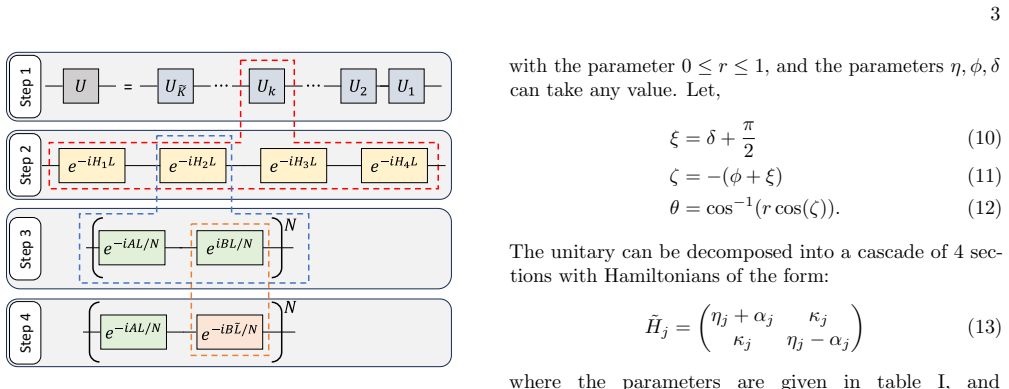
The load-bearing object is the cascaded programmable waveguide array with Hamiltonian $H=\sum_m\beta_m|m\rangle\langle m|+\sum_m C_{m,m+1}(|m\rangle\langle m+1|+|m+1\rangle\langle m|)$, $\beta_m>0$, $C_{m,m+1}>0$. The argument runs on three tools: the Reck-type decomposition of any $\mathrm{SU}(d)$ matrix into adjacent two-level unitaries; an exact four-section synthesis of each $\mathrm{SU}(2)$ block; and the Lie-Trotter formula $e^{A+B}=\lim_{N\to\infty}(e^{A/N}e^{B/N})^N$, which lets the cascade emulate a block-diagonal Hamiltonian even though the physical waveguides are continuously coupled. The final ingredient is the quantum recurrence theorem, applied through the LLL algorithm, which finds an integer $q$ such that evolution under the fixed uniform Hamiltonian $B_k$ for length $\tilde{L}=q-L/N$ reproduces $e^{iB_kL/N}$, effectively turning backward time into forward time. This last step is what makes the whole construction compatible with strictly positive couplings.
What would settle it
A concrete check: for one fixed dimension and one fixed Trotter number, run the LLL algorithm on the eigenvalues $\lambda_j=-2\cos(j\pi/(d+1))$ of the uniform section to find the integer $q$ and the resulting length $\tilde{L}=q-L/N$. If that length exceeds any reasonable chip scale while the error is still above the Trotter bound, the proof's practical-constraints claim fails.
Extended reading notes
Core claim
The authors' central claim is Theorem 1: for $d>2$, an arbitrary $U\in\mathrm{SU}(d)$ can be decomposed into $K=4\tilde{K}N$ cascaded sections, where $\tilde{K}=\frac{1}{6}(2d^3-3d^2+d)$, each section described by a tridiagonal Hamiltonian with strictly positive matrix elements, and the approximation error satisfies $\|U-V\|=O(\tilde{K}/N)$. For $d=2$, the decomposition is exact with at most four sections. The construction is a four-step algorithm: decompose $U$ into adjacent two-mode unitaries (with permutations making them adjacent); implement each two-mode unitary exactly as a product of four constrained sections; approximate the required block-diagonal $d\times d$ Hamiltonian by Trotterizing alternating sections $A_k$ and $B_k$; and replace the implicit backward-time evolution of $B_k$ by forward-time evolution over a length $\tilde{L}=q-L/N$ chosen by the LLL algorithm so that $e^{-iB_k\tilde{L}}\approx e^{iB_kL/N}$. The physical parameters of the $B_k$ sections are independent of the target unitary and can be fixed at design time.
Load-bearing premise
The proof requires that one fixed section of the chip, run for a suitably long length, can mimic the inverse-time evolution of another short section, and it does not bound how long that length must be.
Editorial extensions
If this is right
- Any $d$-dimensional unitary, including the discrete Fourier transform, clock, and shift gates, can be implemented with error $O(d^3/N)$, so arbitrary precision is reachable by increasing the Trotter number $N$.
- For qubits ($d=2$), every $\mathrm{SU}(2)$ gate is realized exactly with at most four sections, and any phase-shift gate with at most three.
- A single-section PWA is intrinsically limited: to first order its unitary is tridiagonal, so no material or geometry change can lift the performance ceiling.
- The $B_k$ sections of the cascade can be designed once, independent of the target unitary, leaving only the $A_k$ sections to be compiled per gate.
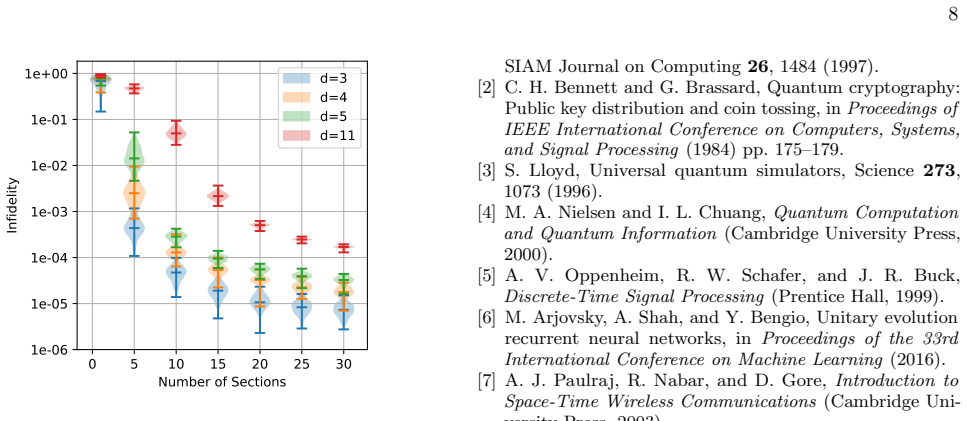
- The numerical experiments show infidelities around $10^{-5}$ with far fewer sections than the theorem's $O(d^3N)$ bound, suggesting practical implementations need only a modest cascade.
Reading between the lines
- The proof's unquantified recurrence length $\tilde{L}$ is the main resource cost; if a tighter analysis shows $\tilde{L}$ grows steeply with $d$ or $1/\epsilon$, the architecture remains universal but may lose its practical advantage over Mach-Zehnder meshes.
- The same Trotter-plus-recurrence trick could be adapted to other platforms with always-on nearest-neighbor couplings and positivity constraints, such as coupled superconducting qubits or trapped-ion chains, as a way to decouple subspaces without physically switching off interactions.
- The numerical observation that a handful of sections (e.g., 5 for $d=5$) already reaches infidelity $\sim10^{-5}$ suggests the true worst-case section count may scale much more gently than $\tilde{K}N$, which would be a testable conjecture.
- Because the $B_k$ design is unitary-independent, one could pre-characterize and calibrate those sections once per chip, turning the remaining compile problem into a smaller search over $A_k$ parameters.
Signed reviews
Editorial analysis
A structured set of objections, weighed in public.
Referee Report
Summary. The paper proposes a constructive framework for implementing arbitrary unitary transformations with cascaded programmable waveguide arrays (PWAs), whose Hamiltonians are tridiagonal with strictly positive propagation constants and couplings. The central result is Theorem 1: for d>2, any U in SU(d) can be approximated by K=4 Ktilde N cascaded sections with error O(Ktilde/N), where Ktilde ~ d^3, and for d=2 exactly with at most 4 sections. The proof combines a Reck-type decomposition into adjacent-mode two-level unitaries, an exact 4-section decomposition of each 2x2 unitary, a Lie-Trotter step that decouples the two active modes using alternating A and B sections, and an LLL-based quantum recurrence step that replaces backward evolution under B by a long forward section. The paper also introduces a numerical voltage-optimization method for a lithium-niobate PWA model and reports infidelities for DFT, clock, shift, and Haar-random unitaries using far fewer sections than the theorem requires.
Significance. If the theorem and its resource claims are correct, the paper would establish PWAs as a universal platform for arbitrary unitary transformations despite the physical constraints of positive, nearest-neighbor-only couplings. The constructive proof is a strength: it is explicit, builds on standard results (Reck, Lie-Trotter, LLL, quantum recurrence), and provides Hamiltonian parameters in Table I. The numerical section is also a useful design tool and demonstrates that optimized cascades can outperform single-section devices in practice. However, the practical-constraints claim in the abstract is not supported by the proof because the recurrence length is left unbounded, and several smaller technical errors affect the statement and proof of Theorem 1.
major comments (4)
- [Step 4, Eqs. (19)-(25), and Supplementary Note 4] The LLL/recurrence step proves the existence of q but never bounds q or the resulting section length \tilde L = q - L/N. Standard simultaneous Diophantine approximation gives q = O(epsilon^{-d}), and with the paper's choice epsilon = O(L^2/(d N^2)) this implies \tilde L = O(N^{2d}) up to constants. Since the B section is repeated N times per two-mode stage and there are O(d^3) stages, the constructive total device length scales as O(d^3 N^{2d+1}), i.e. O((1/delta)^{2d+1}) for error delta ~ 1/N. This does not support the abstract's claim of implementation 'within practical constraints' or the Discussion's scalability claim. Please either provide a quantitative bound on \tilde L and compare it with realistic device lengths, or substantially weaken the practical-constraints claim to a pure existence statement.
- [Theorem 1 and Step 3] Theorem 1 states K = 4\tilde K N sections, but each Trotter factor in Eq. (14) uses two physical sections, A_k and B_k, with B_k implemented by the long recurrence section in Step 4. The construction therefore uses 8\tilde K N physical sections, not 4\tilde K N. The asymptotic error O(\tilde K/N) is unaffected, but the exact section count in the theorem and the sentence 'K = 4\tilde K N cascaded sections' must be corrected.
- [Step 2 and Supplementary Note 3] The phase-shift exception is misstated. In the parameterization of Eq. (9), r=1 gives the diagonal phase-shift gate, whereas r=0 gives the symmetric beamsplitter with zero diagonal entries. The main text says a phase-shift R_z(xi) corresponds to r=0 and uses three sections, but Supplementary Note 3 correctly identifies it as r=1. Please reconcile the main text with the supplementary derivation.
- [Supplementary Note 4, Eqs. (71)-(78)] The diagonal error matrix used to convert the LLL approximation error into a Hamiltonian perturbation is dimensionally inconsistent. To obtain the stated bound ||E|| <= 2 pi j_1 d N epsilon / L and the final choice epsilon <= L^2/(2 pi j_1 d N^2), the matrix in Eq. (71) should be Delta = sum_j (2 pi j_1 Delta_j N/L)|j><j|, not sum_j (2 pi j_1 Delta_j/N) L |j><j|. As written, Eq. (84) does not follow from Eq. (83). This is a fixable typo, but it appears in the load-bearing error estimate and should be corrected.
minor comments (5)
- [Step 3, main text] The text 'can be chose arbitrarily' should read 'can be chosen arbitrarily', and 'the the 2x2 parameters' has a duplicated article.
- [Supplementary Note 1] The Hamiltonian in Eq. (1) uses N-1 as the upper sum limit even though the array dimension is d; this clashes with the use of N as the Trotter number in the main text.
- [Figure 3 caption] The phrase 'black color in the the phase shift plots' contains a typo and should be 'black color in the phase-shift plots'.
- [After Eq. (25)] The statement that all parameters are independent of the unitary being decomposed should explicitly note that q is independent of the target unitary but depends on d and N; as written, it could be misread as independence from d and N as well.
- [Discussion] The comparison with Refs. [20] and [21] would be clearer with one sentence explaining the specific mathematical gap that the present proof fills relative to those constructions.
Circularity Check
No significant circularity: the universality proof is a constructive chain built from external Reck decomposition, Trotter–Suzuki bounds, and LLL Diophantine approximation; the numerical results are an independent optimization, not a prediction forced by the theorem.
full rationale
The derivation chain is self-contained and does not assume its target. Step 1 invokes the external Reck et al. decomposition to reduce SU(d) to adjacent two-mode unitaries. Step 2 gives an explicit four-section construction for each SU(2) block and verifies the Hamiltonian parameters from the unitary parameters; this is a direct construction, not a fit. Step 3 uses the standard Lie–Trotter formula, cited to Hatano–Suzuki and Suzuki, to approximate A−B by alternating sections with error O(L^2/N). Step 4 uses the LLL algorithm and the exact eigenvalues of the uniform Toeplitz Hamiltonian to choose a recurrence length Ltilde = q − L/N; the approximation e^{-iB Ltilde} ≈ e^{iB L/N} is justified by eigenvalue arithmetic, not assumed. No parameter is fitted to a subset of data and then renamed a prediction: the numerical section optimizes voltages directly against the target unitary and is presented as a design method rather than as a test of Theorem 1. Self-citations (e.g., refs. 17–19 and 22) provide platform parameters and prior experimental context, but none is load-bearing in the proof. The manuscript itself flags that engineering a device from Theorem 1's specifications can be challenging, and the proof leaves Ltilde unbounded; this is an unquantified resource-cost or correctness gap, not circularity. The central claim therefore does not reduce to its inputs.
Assumptions & free parameters
free parameters (4)
- Free integers k1..k4, l2 (Table I)
- Recurrence integers j1, j2 and precision epsilon (Step 4)
- Base values betatilde0, Ctilde0 (B_k section)
- Trotter number N
assumptions (7)
- standard math Lie-Trotter formula and its error bound O(L^2/N)
- standard math Reck-Zeilinger-Bernstein-Bertani decomposition of any unitary into 2-level unitaries
- standard math LLL algorithm for simultaneous Diophantine approximation
- domain assumption Quantum recurrence theorem for finite-dimensional unitary evolution
- domain assumption PWA Hamiltonian model with independently programmable beta_m and C_{m,m+1} via electrodes
- domain assumption Lossless coherent propagation described by unitary evolution e^{-iHL}
- standard math Eigenvalues of the uniform tridiagonal Toeplitz Hamiltonian B_k are lambda_j = -2 cos(j*pi/(d+1))
Cite this review
Pith. "Pith review of Universal programmable waveguide arrays." pith.science (2026). https://pith.science/paper/XBRBRDI2
@misc{pith2026241112610,
  author       = {Pith},
  title        = {Pith review of: Universal programmable waveguide arrays},
  year         = {2026},
  howpublished = {\url{https://pith.science/paper/XBRBRDI2}},
  note         = {Machine review of arXiv:2411.12610}
}
read the original abstract
Implementing arbitrary unitary transformations is crucial for applications in quantum computing, signal processing, and machine learning. Unitaries govern quantum state evolution, enabling reversible transformations critical in quantum tasks like cryptography and simulation and playing key roles in classical domains such as dimensionality reduction and signal compression. Integrated optical waveguide arrays have emerged as a promising platform for these transformations, offering scalability for both quantum and classical systems. However, scalable and efficient methods for implementing arbitrary unitaries remain challenging. Here, we present a theoretical framework for realizing arbitrary unitary matrices through programmable waveguide arrays (PWAs). We provide a mathematical proof demonstrating that cascaded PWAs can implement any unitary matrix within practical constraints, along with a numerical optimization method for customized PWA designs. Our results establish PWAs as a universal and scalable architecture for quantum photonic computing, effectively bridging quantum and classical applications, and positioning PWAs as an enabling technology for advancements in quantum simulation, machine learning, secure communication, and signal processing.
Figures


Figures from the paper (2 more)

Reference graph
Works this paper leans on
-
[1]
P. W. Shor, Polynomial-time algorithms for prime factor- ization and discrete logarithms on a quantum computer, SIAM Journal on Computing 26, 1484 (1997)
work page 1997
-
[2]
C. H. Bennett and G. Brassard, Quantum cryptography: Public key distribution and coin tossing, in Proceedings of IEEE International Conference on Computers, Systems, and Signal Processing (1984) pp. 175–179
work page 1984
-
[3]
Lloyd, Universal quantum simulators, Science 273, 1073 (1996)
S. Lloyd, Universal quantum simulators, Science 273, 1073 (1996)
1996
-
[4]
M. A. Nielsen and I. L. Chuang, Quantum Computation and Quantum Information (Cambridge University Press, 2000)
2000
-
[5]
A. V. Oppenheim, R. W. Schafer, and J. R. Buck, Discrete-Time Signal Processing (Prentice Hall, 1999)
work page 1999
-
[6]
M. Arjovsky, A. Shah, and Y. Bengio, Unitary evolution recurrent neural networks, in Proceedings of the 33rd International Conference on Machine Learning (2016)
work page 2016
-
[7]
A. J. Paulraj, R. Nabar, and D. Gore, Introduction to Space-Time Wireless Communications (Cambridge Uni- versity Press, 2003)
work page 2003
-
[8]
W. Bogaerts, D. P´ erez, J. Capmany, D. A. Miller, J. Poon, D. Englund, F. Morichetti, and A. Melloni, Programmable photonic circuits, Nature 586, 207 (2020)
work page 2020
Show all 43 references
-
[10]
Carolan, C
J. Carolan, C. Harrold, C. Sparrow, E. Mart´ ın-L´ opez, N. J. Russell, J. W. Silverstone, P. J. Shadbolt, N. Matsuda, M. Oguma, M. Itoh, G. D. Marshall, D. J. Thomson, J. L. O’Brien, J. C. F. Matthews, and A. Laing, Universal linear optics, Science 349, 711 (2015)
2015
-
[11]
Aaronson and A
S. Aaronson and A. Arkhipov, The computational com- plexity of linear optics, in Proceedings of the forty-third annual ACM symposium on Theory of computing (2011) pp. 333–342
2011
-
[12]
Peruzzo, M
A. Peruzzo, M. Lobino, J. C. F. Matthews, N. Matsuda, A. Politi, K. Poulios, X. Zhou, Y. Lahini, N. Ismail, K. W¨ orhoff,et al. , Quantum walks of correlated photons, Science 329, 1500 (2010)
2010
-
[13]
Lahini, G
Y. Lahini, G. R. Steinbrecher, A. D. Bookatz, and D. Englund, Quantum logic using correlated one- dimensional quantum walks, npj Quantum Information 4, 10.1038/s41534-017-0050-2 (2018)
2018 doi
-
[14]
R. J. Chapman, S. H¨ ausler, G. Finco, F. Kaufmann, and R. Grange, Quantum logical controlled-not gate in a lithium niobate-on-insulator photonic quantum walk, Quantum Sci. Technol. 9, 10.1088/2058-9565/ad0a48 (2023)
2023 doi
-
[15]
Weimann, R
S. Weimann, R. Keil, M. C. Tichy, M. Gr¨ afe, R. Heilmann, S. Nolte, and A. Szameit, Implementation of quantum and classical discrete fractional fourier transforms, Nature Communications 7, 11027 (2016)
2016
-
[16]
Ozawa, H
T. Ozawa, H. M. Price, A. Amo, N. Goldman, M. Hafezi, L. Lu, M. C. Rechtsman, D. Schuster, J. Simon, O. Zilber- berg, and I. Carusotto, Topological photonics, Reviews of Modern Physics 91, 015006 (2019)
2019
-
[17]
Youssry, Y
A. Youssry, Y. Yang, R. J. Chapman, B. Haylock, F. Lenzini, M. Lobino, and A. Peruzzo, Experimental graybox quantum system identification and control, npj Quantum Information 10, 10.1038/s41534-023-00795-5 (2024)
2024 doi
-
[18]
Y. Yang, R. J. Chapman, B. Haylock, F. Lenzini, Y. N. Joglekar, M. Lobino, and A. Peruzzo, Programmable high- dimensional hamiltonian in a photonic waveguide array, Nature Communications 15, 50 (2024)
2024
-
[19]
Youssry, R
A. Youssry, R. J. Chapman, A. Peruzzo, C. Ferrie, and 9 M. Tomamichel, Modeling and control of a reconfigurable photonic circuit using deep learning, Quantum Science and Technology 5, 025001 (2020)
2020
-
[20]
Saygin, I
M. Saygin, I. Kondratyev, I. Dyakonov, S. Mironov, S. Straupe, and S. Kulik, Robust architecture for pro- grammable universal unitaries, Physical Review Letters 124, 10.1103/physrevlett.124.010501 (2020)
2020 doi
-
[21]
N. N. Skryabin, I. V. Dyakonov, M. Y. Saygin, and S. P. Kulik, Waveguide-lattice-based architecture for multichan- nel optical transformations, Optics Express 29, 26058 (2021), 2103.02664
2021 arXiv
- [22]
-
[23]
Lifante, Coupled mode theory: Waveguide gratings, in Integrated Photonics: Fundamentals (John Wiley & Sons, Ltd, 2003) Chap
G. Lifante, Coupled mode theory: Waveguide gratings, in Integrated Photonics: Fundamentals (John Wiley & Sons, Ltd, 2003) Chap. 4, pp. 98–135
2003
-
[24]
Krantz, M
P. Krantz, M. Kjaergaard, F. Yan, T. P. Orlando, S. Gus- tavsson, and W. D. Oliver, A quantum engineer’s guide to superconducting qubits, Applied Physics Reviews 6, 10.1063/1.5089550 (2019)
2019 doi
-
[25]
Hatano and M
N. Hatano and M. Suzuki, Finding exponential prod- uct formulas of higher orders, in Quantum Annealing and Other Optimization Methods , edited by A. Das and B. K. Chakrabarti (Springer Berlin Heidelberg, Berlin, Heidelberg, 2005) pp. 37–68
2005
-
[26]
M. Suzuki, Generalized trotter’s formula and systematic approximants of exponential operators and inner deriva- tions with applications to many-body problems, Commu- nications in Mathematical Physics 51, 183–190 (1976)
1976
-
[27]
A. K. Lenstra, H. W. Lenstra, and L. Lov´ asz, Factoring polynomials with rational coefficients, Mathematische Annalen 261, 515–534 (1982)
1982
- [28]
-
[29]
Youssry, G
A. Youssry, G. A. Paz-Silva, and C. Ferrie, Character- ization and control of open quantum systems beyond quantum noise spectroscopy, npj Quantum Information 6, 1 (2020)
2020
-
[30]
Youssry, G
A. Youssry, G. A. Paz-Silva, and C. Ferrie, Noise detection with spectator qubits and quantum feature engineering, New Journal of Physics 25, 073004 (2023)
2023
-
[31]
Youssry and H
A. Youssry and H. I. Nurdin, Multi-axis control of a qubit in the presence of unknown non-Markovian quantum noise, Quantum Science and Technology 8, 015018 (2023), 2208.03058
2023 arXiv
-
[32]
A. F. Fouad, A. Youssry, A. El-Rafei, and S. Hammad, Model-free distortion canceling and control of quantum devices, Quantum Science and Technology 10, 015002 (2024)
2024
-
[33]
Perrier, D
E. Perrier, D. Tao, and C. Ferrie, Quantum geometric machine learning for quantum circuits and control, New Journal of Physics 22, 103056 (2020)
2020
-
[34]
C. M. Dawson and M. A. Nielsen, The solovay-kitaev algorithm, Quantum Information & Computation 6, 81 (2006)
2006
- [35]
- [36]
-
[37]
Sawicki and K
A. Sawicki and K. Karnas, Universality of single-qudit gates, Annales Henri Poincar´ e18, 3515–3552 (2017)
2017
-
[38]
Mattioli and A
L. Mattioli and A. Sawicki, On the universality and mem- bership problems for quantum gates, Journal of Mathe- matical Physics 64, 10.1063/5.0106615 (2023)
2023 doi
-
[39]
Banchi, D
L. Banchi, D. Burgarth, and M. J. Kastoryano, Driven quantum dynamics: Will it blend?, Physical Review X 7, 10.1103/physrevx.7.041015 (2017)
2017 doi
-
[40]
J. Lee, C. Arenz, H. Rabitz, and B. Russell, Dependence of the quantum speed limit on system size and control complexity, New Journal of Physics 20, 063002 (2018)
2018
-
[41]
Burgarth, J
D. Burgarth, J. Borggaard, and Z. Zimbor´ as, Quantum distance to uncontrollability and quantum speed limits, Physical Review A 105, 10.1103/physreva.105.042402 (2022). SUPPLEMENTARY MATERIALS for Universal programmable waveguide arrays Akram Youssry 1 and Alberto Peruzzo 1, 2...
2022 arXiv
-
[42]
R. A. Bertlmann and P. Krammer, Bloch vectors for qudits, Journal of Physics A: Mathematical and Theoretical 41, 235303 (2008)
2008
-
[43]
M. Reck, A. Zeilinger, H. J. Bernstein, and P. Bertani, Experimental realization of any discrete unitary operator, Physical Review Letters 73, 58–61 (1994)
1994
-
[44]
Hatano and M
N. Hatano and M. Suzuki, Finding exponential product formulas of higher orders, in Quantum Annealing and Other Optimization Methods , edited by A. Das and B. K. Chakrabarti (Springer Berlin Heidelberg, Berlin, Heidelberg, 2005) pp. 37–68
2005
Reviewed August 12, 2026 · model on record in the stance chip above.
Discussion (0). Continue with ORCID to comment.