REVIEW 5 major objections 6 minor 24 references
Superpixel Cost Volume Excitation for Stereo Matching
T0 review · 5 major / 6 minor · reviewed 2026-08-12 · deepseek-v4-flash
Pith's one-line read Superpixel-level supervision of the disparity probability volume improves boundary accuracy in cost-volume stereo networks at zero inference overhead.
desk verdict Nice idea, but the headline EPE drops are confounded by an unablated switch to top-k soft-argmin; the superpixel head's contribution is not yet established. read the letter →
The pith
A machine-rendered reading of the paper's core claim, the machinery that carries it, and where it could break.
The reading
What carries the argument
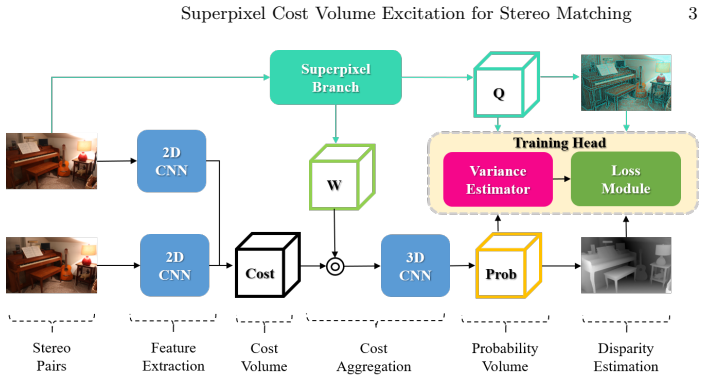
The load-bearing object is the superpixel probability volume $P_s$: for each superpixel $s$, the per-pixel disparity probabilities $C_{\mathrm{prob}}(p)$ are pooled by geometric mean in log space, $\ln(P_s) = \frac{1}{n}\sum_{p \in \tilde{m}_s} \ln(C_{\mathrm{prob}}(p))$, giving a single disparity distribution per region. This pooled distribution is compared, via cross-entropy, with a superpixel-level ground truth obtained by pooling an adaptive Laplace target $P^{\mathrm{gt}}(d) = \operatorname{softmax}(-|d - d_{\mathrm{gt}}|/v)$, where $v$ is read from the model's own aggregated volume. Two supporting mechanisms carry the claim: the superpixel guided channel excitation (SGCE) module, which multiplies the 4D cost volume by sigmoid-transformed multi-scale superpixel features along the channel dimension before each aggregation stage, and the disparity reconstruction loss $L_{\mathrm{recon}}$ that keeps the segmentation branch aligned with disparity. The entire superpixel machinery is dropped at inference, leaving the base stereo network unchanged.
What would settle it
Train the same cost-volume network with the superpixel cross-entropy loss but with a fixed, non-adaptive variance in the Laplace ground truth; if the boundary-error reductions on Scene Flow vanish, the adaptive variance computed from the model's own volume is the essential component, and if they persist, the superpixel pooling itself is what matters.
Extended reading notes
Core claim
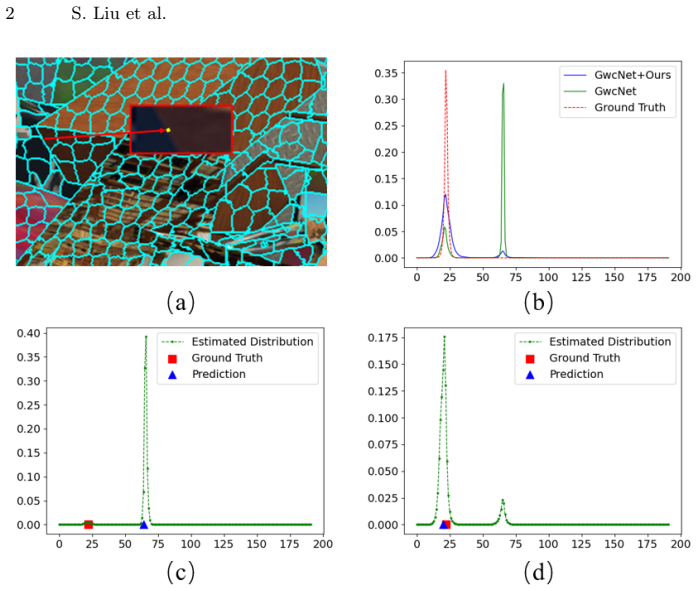
On its own terms, the paper's central discovery is that a superpixel-level training signal can excite the latent local consistency already present in a cost volume's probability distribution. The method defines a superpixel probability volume by geometric mean pooling the per-pixel disparity probabilities inside each superpixel, and trains it to match a unimodal superpixel ground truth built from a Laplace distribution whose variance is estimated from the network's own aggregated cost volume. This superpixel cross-entropy loss, combined with a channel-excitation module that injects multi-scale superpixel features into the cost volume and a disparity-reconstruction loss that keeps superpixels disparity-aware, removes spurious modes and sharpens boundary predictions. The authors report that the auxiliary superpixel branch is needed only in training, so the resulting accuracy improvement is cost-free at inference.
Load-bearing premise
The load-bearing premise is that superpixels formed from color and spatial similarity coincide with regions of constant disparity, and that the variance read from the model's own cost volume is a reliable guide to how sharp the training target should be.
Editorial extensions
If this is right
- If correct, the method gives a drop-in training-only upgrade for cost-volume stereo networks: any model that regresses disparity from a probability volume can be supervised with superpixel cross-entropy without altering deployment code.
- Boundary errors, which dominate end-point error and edge metrics on Scene Flow, Middlebury, and KITTI, should shrink whenever color-consistent superpixels overlap disparity-consistent regions.
- Because the loss weights in Eq. 9 are set heuristically, the approach implies a stable training regime where the same weights work across at least four different base networks.
- The reported transfer to PSMNet, MobileStereo, and PCWNet indicates the benefit is not an artifact of one particular cost-volume design.
- The method is explicitly not validated on iterative refinement architectures, so its scope as stated is limited to networks that regress disparity from a probabilistic cost volume.
Reading between the lines
- Editorial extension: the same superpixel pooling mechanism could apply to any stereo pipeline that exposes a probability volume before regression, including iterative refinement models; the authors explicitly do not validate that setting, so this is an open prediction, not a result of the paper.
- Editorial extension: a clean test would replace the color-derived superpixel association map with one derived from disparity or semantic labels; if boundary gains persist, the operative ingredient is regional disparity consistency rather than color affinity.
- Editorial extension: the adaptive variance $v$ in Eq. 2 makes the training target depend on the network's own aggregated volume, so a controlled experiment with a fixed variance would separate the superpixel-pooling effect from the adaptive-target effect.
Editorial analysis
A structured set of objections, weighed in public.
Referee Report
Summary. The paper proposes a training-time superpixel module for cost-volume-based stereo matching networks. A superpixel segmentation branch (with a Superpixel Guided Channel Excitation, SGCE) modulates the cost volume, and a training head adds a superpixel cross-entropy loss (Lsce, Eq. 8) with an adaptive Laplace target (Eq. 2) plus a disparity reconstruction loss (Lrecon, Eq. 7). The claimed benefit is improved boundary accuracy and lower EPE without additional inference cost. Experiments are reported on Scene Flow, KITTI 2012/2015, and Middlebury, using GwcNet as the main baseline and integrating the training head into PSMNet, MobileStereo, and PCWNet.
Significance. The core idea—using superpixel-consistent probability distributions as a soft training constraint while keeping inference unchanged—is practical and potentially useful for cost-volume stereo networks. The training-time-only property is a genuine strength, and the authors are explicit about the limitation that the approach is designed for probabilistic cost volumes rather than iterative refinement architectures. However, the current evidence is undermined by a missing control on the disparity readout and by reporting issues. If the isolated contribution of each component can be established with a properly controlled ablation, the method would be a credible, low-cost improvement. The paper does not provide machine-checked proofs or released code; its contribution is empirical.
major comments (5)
- [§3.3, Eq. (5), Table 1] The reported improvements are confounded by the unablated switch to the top-k soft-argmin readout. Eq. (5) replaces the standard full-domain soft-argmin, and §4.1 sets k=6. The manuscript never states that the GwcNet baseline or the reproduced baselines in Tables 2 and 3 use this top-k readout, and no ablation varies k. Since top-k truncates low-probability tails, it can reduce EPE independently of the proposed SGCE/Lsce/Lrecon components. Thus the ablation in Table 1 changes two variables at once and cannot attribute the gains to the superpixel mechanism. The authors should retrain the baseline with the same top-k readout and provide a k-ablation to establish the isolated contribution.
- [Table 1] Table 1 is too poorly formatted to support the ablation claims. The row labeled '+ SGCE' contains no metrics, and the checkmark pattern is ambiguous: the combination '- ✓ - ✓' appears both as the second row and as the last row. It is impossible to tell which rows include SGCE and which correspond to the 'GwcNet + Ours' configuration. The table should be reformatted so each row is a uniquely named configuration with all four loss flags and the metric values, e.g., 'GwcNet', 'GwcNet + Lsce + LreconD', 'GwcNet + SGCE', etc.
- [§3.2, Eq. (2)] The variance v in the Laplace target P_gt(d) is computed from the model's own aggregated cost volume (§3.2, Figure 4). This makes the sharpness of the training target depend on the model's prediction, so overconfident errors could be reinforced. This is a correctness-risk concern rather than a formal circularity, since the mode is still at the ground-truth disparity d_gt, but it deserves a direct test: compare Lsce with a detached variance (e.g., stop-gradient on v) or with a fixed v to demonstrate that the adaptive variance is necessary and does not harm.
- [§4.2, Tables 1–5] No error bars, standard deviations, or repeated-run results are reported. Several ablations differ by only 0.03–0.05 EPE (e.g., 0.626 vs 0.622), and it is unclear whether these differences are significant under typical training noise. The central claim of consistent improvement would be strengthened by reporting statistics over at least three seeds.
- [§4.3, Table 2] The universality study inherits the same top-k confound. The text does not state whether the reproduced baselines PSMNet, MobileStereo, and PCWNet use the top-k soft-argmin (Eq. 5) or the original full soft-argmin. Since the proposed training head includes the top-k readout, the gains in Table 2 may again reflect the readout change rather than the superpixel losses. The authors should specify the readout used in all baselines and, ideally, provide a version where the baseline is trained with the same readout.
minor comments (6)
- [§4.2, Table 1] The column headers LreconC and LreconD are not defined in the text; the authors should state that one is the color-based and the other the depth-based disparity reconstruction loss, and which is which.
- [§3.3, Eq. (7)] The notation for the superpixel reconstruction is unclear: define Q̃ and Q̂, and spell out how d′ and p′ are obtained; currently the sentence 'obtained by left multiplying association map Q̃ Q̂^T' is ambiguous.
- [§4.3] The text refers to 'Table III' but the table is numbered Table 2; the cross-reference should be corrected.
- [§4.1] The choice k=6 is justified only by 'superior performance observed in our prior work'; since k is a free parameter of the readout, an ablation over k is needed, at least in the revision.
- [Eq. (3)] The geometric-mean pooling in Eq. (3) is unusual; a brief justification of why the geometric mean (rather than the arithmetic mean) is used for superpixel probability pooling would help the reader.
- [§4.4] The KITTI tables (Tables 4 and 5) do not identify which GwcNet variant is used as the direct baseline ('GwcNet-gc' vs 'GwcNet-g'); the authors should align the baseline naming with the main comparison.
Circularity Check
The Lsce 'ground-truth' distribution is constructed from the model's own probability volume, making the superpixel cross-entropy term a self-comparison; the unablated top-k readout is an attribution confound but not a circular reduction.
-
self definitional
[Section 3.2 (Eqs. 2-4) and Section 3.3 (Eq. 8)]
"As depicted in Figure 4, the variance v is computed based on the aggregated cost volume (i.e. probability volume). ... Lsce = − 1 Ns D−1X d=0 P gt s (d) · log Ps(d)"
P_gt in Eq. 2 is a Laplace distribution centered at d_gt whose variance v is derived from the model's own aggregated probability volume Cprob. Ps in Eqs. 3-4 is the geometric-mean superpixel pooling of that same Cprob. Therefore Lsce (Eq. 8) is a cross-entropy between two functions of the current model output: the 'ground-truth' target is not an independent label but a variance-scaled, superpixel-pooled reshaped version of the prediction itself. A confidently wrong boundary mode can produce a small v and a sharp target that reinforces the error; minimizing Lsce can amount to sharpening existing beliefs rather than correcting them.
full rationale
One genuine circular step exists: the superpixel cross-entropy target is built from the model's own probability volume via the variance v, so Eq. 8 compares the prediction with a transformed version of itself. This is a self-referential training design rather than an independent ground truth. However, the central empirical claims are not purely circular: disparity regression (Eq. 6) still uses annotated disparities, and all reported EPE/D1 numbers come from external Scene Flow, KITTI, and Middlebury evaluations, so those measurements are independent of the training-target construction. The top-k soft-argmin introduced in Eq. 5 and fixed at k=6 in Section 4.1 is a serious unablated confound for the attribution of gains to SGCE/Lsce/Lrecon, since baselines are not described as using the same readout; but that is an experimental-design and attribution problem, not an equation-level circularity. No load-bearing self-citation chain or uniqueness import is present, and the 'prior work' justification for k is not itself a derivation. Thus the overall circularity is partial and localized to the training target, giving a score of 5.
Assumptions & free parameters
free parameters (4)
- lambda (weight for Lsce) =
1
- mu (weight for Lrecon) =
0.1
- w (compactness weight in Lrecon) =
5e-3
- k (top-k in soft-argmin) =
6
assumptions (4)
- domain assumption Depth transitions smoothly within homologous regions; discontinuities only occur between distinct regions
- domain assumption Superpixels derived from color images align with disparity-consistent regions
- ad hoc to paper The Laplace distribution with variance estimated from the cost volume models the true disparity distribution
- standard math Soft-argmin with top-k values effectively regresses disparity
Cite this review
Pith. "Pith review of Superpixel Cost Volume Excitation for Stereo Matching." pith.science (2026). https://pith.science/paper/Q62YJX42
@misc{pith2026241113105,
  author       = {Pith},
  title        = {Pith review of: Superpixel Cost Volume Excitation for Stereo Matching},
  year         = {2026},
  howpublished = {\url{https://pith.science/paper/Q62YJX42}},
  note         = {Machine review of arXiv:2411.13105}
}
read the original abstract
In this work, we concentrate on exciting the intrinsic local consistency of stereo matching through the incorporation of superpixel soft constraints, with the objective of mitigating inaccuracies at the boundaries of predicted disparity maps. Our approach capitalizes on the observation that neighboring pixels are predisposed to belong to the same object and exhibit closely similar intensities within the probability volume of superpixels. By incorporating this insight, our method encourages the network to generate consistent probability distributions of disparity within each superpixel, aiming to improve the overall accuracy and coherence of predicted disparity maps. Experimental evalua tions on widely-used datasets validate the efficacy of our proposed approach, demonstrating its ability to assist cost volume-based matching networks in restoring competitive performance.
Figures

Figures from the paper (4 more)


Reference graph
Works this paper leans on
-
[1]
IEEE Transactions on Pattern Analysis and Machine Intelligence, vol
Hirschmuller, H.: Stereo Processing by Semiglobal Matching and Mutual Informa- tion. IEEE Transactions on Pattern Analysis and Machine Intelligence, vol. 30, no. 2, pp. 328–341 (2008)
work page 2008
-
[2]
In: Proceedings of the AAAI Conference on Artificial Intelligence, vol
Zhang, Y., Chen, Y., Bai, X., Yu S., Yu K., Li Z., Yang K.: Adaptive Unimodal Cost Volume Filtering for Deep Stereo Matching. In: Proceedings of the AAAI Conference on Artificial Intelligence, vol. 34, no. 7, pp. 12926–12934 (2020). http: //dx.doi.org/10.1609/aaai.v34i07.6991
-
[3]
In: Proceedings of the IEEE/CVF conference on computer vision and pattern recognition, pp
Xu G., Cheng J., Guo P., Yang X.: Attention Concatenation Volume for Accurate and Efficient Stereo Matching. In: Proceedings of the IEEE/CVF conference on computer vision and pattern recognition, pp. 12981–12990 (2022)
work page 2022
-
[4]
In: Proceedings of the IEEE/CVF Conference on Computer Vision and Pattern Recognition, pp
Chen L., Wang W., Mordohai P.: Learning the Distribution of Errors in Stereo Matching for Joint Disparity and Uncertainty Estimation. In: Proceedings of the IEEE/CVF Conference on Computer Vision and Pattern Recognition, pp. 17235– 17244 (2023)
work page 2023
-
[5]
IEEE Transactions on Pattern Analysis and Machine Intelligence vol
Achanta, R., Shaji, A., Smith, K., Lucchi, A., Fua, P., S¨ usstrunk, S.: SLIC su- perpixels compared to state-of-the-art superpixel methods. IEEE Transactions on Pattern Analysis and Machine Intelligence vol. 34, no. 11, pp. 2274–2282 (2012). http://dx.doi.org/10.1109/tpami.2012.120
-
[6]
Song, X., Zhao, X., Hu, H., Fang, L.: Edgestereo: A context integrated residual pyramid network for stereo matching. In: Computer Vision–ACCV 2018: 14th Asian Conference on Computer Vision, Perth, Australia, December 2–6, 2018, Revised Selected Papers, Part V, pp. 20–35. Springer (2019)
work page 2019
-
[7]
In: Proceedings of the IEEE/CVF Conference on Computer Vision and Pattern Recognition, pp
Xu, G., Wang, X., Ding, X., Yang, X.: Iterative geometry encoding volume for stereo matching. In: Proceedings of the IEEE/CVF Conference on Computer Vision and Pattern Recognition, pp. 21919–21928 (2023)
work page 2023
-
[8]
In: Proceedings of the European Conference on Computer Vision (ECCV), pp
Jampani, V., Sun, D., Liu, M.-Y., Yang, M.-H., Kautz, J.: Superpixel sampling networks. In: Proceedings of the European Conference on Computer Vision (ECCV), pp. 352–368 (2018)
work page 2018
Show all 24 references
-
[9]
IEEE Transactions on Circuits and Systems for Video Technology vol
Li, L., Zhang, S., Yu, X., Zhang, L.: PMSC: PatchMatch-based superpixel cut for accurate stereo matching. IEEE Transactions on Circuits and Systems for Video Technology vol. 28, no. 3, pp. 679–692 (2016).http://dx.doi.org/10.1109/tcsvt. 2016.2628782
2016
-
[10]
In: European Conference on Computer Vision, pp
Shen, Z., Dai, Y., Song, X., Rao, Z., Zhou, D., Zhang, L.: PCW-Net: Pyramid combination and warping cost volume for stereo matching. In: European Conference on Computer Vision, pp. 280–297. Springer (2022)
2022
-
[11]
IEEE Transactions on Im- age Processing vol
Chen, J., Hou, J., Ni, Y., Chau, L.-P.: Accurate light field depth estimation with superpixel regularization over partially occluded regions. IEEE Transactions on Im- age Processing vol. 27, no. 10, pp. 4889–4900 (2018)
2018
-
[12]
In: Proceedings of the IEEE International Conference on Computer Vision, pp
Kendall, A., Martirosyan, H., Dasgupta, S., Henry, P., Kennedy, R., Bachrach, A., Bry, A.: End-to-end learning of geometry and context for deep stereo regression. In: Proceedings of the IEEE International Conference on Computer Vision, pp. 66–75 (2017). http://dx.doi.org/10.11...
2017 doi
-
[13]
In: Proceedings of the IEEE Conference on Computer Vision and Pattern Recognition, pp
Chang, J.-R., Chen, Y.-S.: Pyramid stereo matching network. In: Proceedings of the IEEE Conference on Computer Vision and Pattern Recognition, pp. 5410–5418 (2018). http://dx.doi.org/10.1109/cvpr.2018.00567 Superpixel Cost Volume Excitation for Stereo Matching 13
2018
-
[14]
In: Proceedings of the IEEE/CVF Conference on Computer Vision and Pat- tern Recognition, pp
Guo, X., Yang, K., Yang, W., Wang, X., Li, H.: Group-wise correlation stereo net- work. In: Proceedings of the IEEE/CVF Conference on Computer Vision and Pat- tern Recognition, pp. 3273–3282 (2019). http://dx.doi.org/10.1109/cvpr.2019. 00339
2019 doi
-
[15]
In: Proceedings of the IEEE/CVF International Conference on Computer Vision, pp
Duggal, S., Wang, S., Ma, W.-C., Hu, R., Urtasun, R.: Deeppruner: Learning efficient stereo matching via differentiable patchmatch. In: Proceedings of the IEEE/CVF International Conference on Computer Vision, pp. 4384–4393 (2019). http://dx.doi.org/10.1109/iccv.2019.00448
2019
-
[16]
In: Proceedings of the IEEE/CVF Conference on Computer Vision and Pat- tern Recognition, pp
Tosi, F., Liao, Y., Schmitt, C., Geiger, A.: Smd-nets: Stereo mixture density net- works. In: Proceedings of the IEEE/CVF Conference on Computer Vision and Pat- tern Recognition, pp. 8942–8952 (2021). http://dx.doi.org/10.1109/cvpr46437. 2021.00883
2021
-
[17]
In: Proceedings of the IEEE/CVF International Conference on Computer Vision, pp
Chen, C., Chen, X., Cheng, H.: On the over-smoothing problem of CNN based disparity estimation. In: Proceedings of the IEEE/CVF International Conference on Computer Vision, pp. 8997–9005 (2019). http://dx.doi.org/10.1109/iccv. 2019.00909
2019
-
[18]
In: Proceedings of the IEEE/CVF Conference on Computer Vision and Pattern Recognition, pp
Yang, F., Sun, Q., Jin, H., Zhou, Z.: Superpixel segmentation with fully convolu- tional networks. In: Proceedings of the IEEE/CVF Conference on Computer Vision and Pattern Recognition, pp. 13964–13973 (2020). http://dx.doi.org/10.1109/ cvpr42600.2020.01398
2020
-
[19]
In: 18th International Conference on Pattern Recognition (ICPR’06), vol
Klaus, A., Sormann, M., Karner, K.: Segment-based stereo matching using be- lief propagation and a self-adapting dissimilarity measure. In: 18th International Conference on Pattern Recognition (ICPR’06), vol. 3, pp. 15–18. IEEE (2006). http://dx.doi.org/10.1109/icpr.2006.1033
2006
-
[20]
In: Proceedings of the IEEE/CVF International Conference on Computer Vision, pp
Wu, Z., Wu, X., Zhang, X., Wang, S., Ju, L.: Semantic stereo matching with pyramid cost volumes. In: Proceedings of the IEEE/CVF International Conference on Computer Vision, pp. 7484–7493 (2019). http://dx.doi.org/10.1109/iccv. 2019.00758
2019
-
[21]
In: 2021 International Conference on 3D Vision (3DV), pp
Lipson, L., Teed, Z., Deng, J.: Raft-stereo: Multilevel recurrent field transforms for stereo matching. In: 2021 International Conference on 3D Vision (3DV), pp. 218–227. IEEE (2021). http://dx.doi.org/10.1109/3dv53792.2021.00032
2021
-
[22]
W., Lee, S., Kweon, I
Bangunharcana, A., Cho, J. W., Lee, S., Kweon, I. S., Kim, K.-S., Kim, S.: Correlate-and-excite: Real-time stereo matching via guided cost volume excitation. In: 2021 IEEE/RSJ International Conference on Intelligent Robots and Systems (IROS), pp. 3542–3548. IEEE (2021). http:/...
2021
-
[23]
In: Proceedings of the IEEE/CVF Winter Conference on Applications of Computer Vision, pp
Shamsafar, F., Woerz, S., Rahim, R., Zell, A.: Mobilestereonet: Towards lightweight deep networks for stereo matching. In: Proceedings of the IEEE/CVF Winter Conference on Applications of Computer Vision, pp. 2417–2426 (2022). http: //dx.doi.org/10.1109/wacv51458.2022.00075
2022
-
[24]
Journal of Visual Communication and Image Representation, vol
Ji, P., Li, J., Li, H., Liu, X.: Superpixel alpha-expansion and normal adjustment for stereo matching. Journal of Visual Communication and Image Representation, vol. 79, 103238 (2021)
2021
Reviewed August 12, 2026 · model on record in the stance chip above.
Discussion (0). Continue with ORCID to comment.