REVIEW 3 major objections 4 minor 21 references
Optimal investment problem in a renewal risk model with generalized Erlang distributed interarrival times
T0 review · 3 major / 4 minor · reviewed 2026-08-12 · deepseek-v4-flash
Pith's one-line read The paper derives explicit optimal investment strategies for an insurer in a renewal risk model with generalized Erlang interarrival times, under CEV asset dynamics and exponential utility, proving the value function is concave.
desk verdict Genuine Erlang(n) extension with a clean r=0 construction, but both verification theorems have a backwards inequality and the r≠0 strategy has a sign error — the advertised optimality results are not proved as written. read the letter →
The pith
A machine-rendered reading of the paper's core claim, the machinery that carries it, and where it could break.
The reading
What carries the argument
The key machinery is the phase-type representation of the Erlang(n) interarrival distribution as a Markov chain on phases $1,\ldots,n$ with exponential clocks $\lambda_i$, where a claim occurs when the phase jumps from $n$ to $1$. This converts the control problem into an $n$-dimensional coupled Hamilton-Jacobi-Bellman system. The solution uses an ansatz that is exponential in wealth with a factor depending on $s^{-2\beta}$ and time, reducing the HJB system to a linear ODE system for the phase functions $\psi_i$; for $r=0$ the solution is written as a matrix exponential of a constant matrix, whose non-negativity follows from interpreting it as a transition matrix of a Markov chain with killing, and for $r\neq 0$ the time-inhomogeneous system is solved by a decoupling argument combined with the Banach fixed-point theorem on small time subintervals.
What would settle it
Take an Erlang(2) interarrival model with exponentially distributed claims, choose parameters satisfying the verification conditions, and solve the HJB system (2.5) numerically with a finite-difference scheme; compare the numerical optimal control with formula (4.20) and the numerical value function with (4.4). Any deviation beyond discretization error, or a simulated terminal-utility mean below the candidate value, would falsify the paper's claim.
Extended reading notes
Core claim
The paper's central claim is that the HJB system for the renewal risk model with observable Erlang phases can be solved by an exponential-affine ansatz. For $r\neq 0$ the value function is $v(t,x,s,i)=-\frac{1}{m}\exp\{-mxe^{r(T-t)}-\frac{(\mu-r)^2}{4\sigma^2\beta r}[1-e^{2\beta r(t-T)}]s^{-2\beta}\}\psi_i(t)$, and for $r=0$ it is $v(t,x,s,i)=-\frac{1}{m}\exp\{-mx+\frac{\mu^2}{2\sigma^2}(t-T)s^{-2\beta}\}\psi_i(t)$. In both cases the phase functions $\psi_i$ satisfy a coupled linear ODE system. The optimal investment policy is explicit: $a_t^* = \frac{\mu + \mu^2\beta(T-t)}{\sigma^2 s^{2\beta} m}$ when $r=0$, and $a_t^* = \frac{(\mu-r) + (1-e^{2\beta r(T-t)})\frac{(\mu-r)^2}{2r}}{\sigma^2 s^{2\beta} m e^{r(T-t)}}$ when $r\neq 0$. The paper proves the value function is concave by showing the phase functions are non-negative, and supplies verification theorems giving conditions under which the candidate solution is indeed the optimal value function.
Load-bearing premise
The insurer can observe which phase of the Erlang claim clock it is currently in; if the phase is hidden, the HJB system with the phase as a state variable is no longer the correct formulation, and the explicit formulas collapse.
Editorial extensions
If this is right
- The optimal investment policy is independent of the current surplus and of the current Erlang phase, so an insurer can use the same dollar allocation regardless of which claim phase it is in.
- The policy is a buy-low, sell-high rule in the stock price: the amount invested decreases as the CEV stock price rises, because volatility grows with the price level.
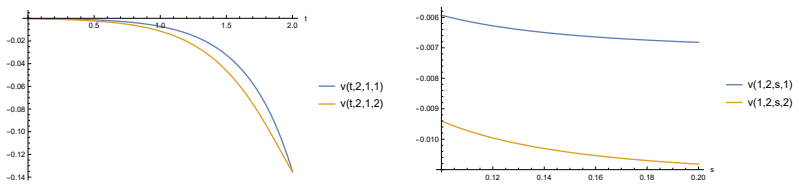
- As the terminal time approaches, the insurer invests more in the risky asset, while the value function decreases when the insurer is closer to a claim (phase $n$) compared with phase $1$.
- For $r=0$ the value function is fully explicit through a matrix exponential; for $r>0$ the paper provides a semi-explicit expression plus a constructive subinterval fixed-point scheme.
- The results extend the classical exponential-utility optimal investment problem for compound-Poisson claims to a renewal process with Erlang interarrival times, giving explicit formulas rather than only viscosity-solution characterizations.
Reading between the lines
- Beyond the paper: if the Erlang phase were only partially observable, the HJB system with phase as a state variable would need to be replaced by a filtering problem; the formulas here would then serve as the fully-observable benchmark against which the cost of partial information could be measured.
- Beyond the paper: the decoupling-and-contraction argument used for $r\neq 0$ suggests a provably convergent numerical scheme for the value function, and the same fixed-point structure may extend to other phase-type interarrival distributions such as Coxian or hypoexponential laws.
- Beyond the paper: since the optimal strategy is phase-independent, a natural testable extension is whether adding proportional reinsurance or dividend payments reintroduces phase-dependence into the optimal controls, as happens in related renewal dividend problems.
- Beyond the paper: the requirement $E(e^{mY e^{r(T-t)}})<\infty$ ties the admissible risk-aversion parameter to the tail of the claim-size distribution, so for heavy-tailed claims the model would need robust or truncated-utility variants to remain applicable.
Editorial analysis
A structured set of objections, weighed in public.
Referee Report
Summary. The paper studies an optimal investment problem for an insurer whose surplus is a renewal risk process with generalized Erlang(n) distributed interarrival times. The risky asset follows a CEV model and the insurer maximizes expected exponential utility of terminal wealth. The authors assume the phase of the Erlang process is observable, derive the associated HJB system, and propose explicit (for zero interest rate) and semi-explicit (for nonzero interest rate) value functions and optimal investment strategies. The proofs of concavity use a Markov-chain-with-killing argument in the r=0 case and a decoupling/Banach fixed-point argument in the r≠0 case, followed by verification theorems.
Significance. If correct, the results would extend the classical explicit optimal-investment literature from compound Poisson claims to renewal claims, and the explicit formulas would be directly implementable. The r=0 concavity proof via the Laplace transform of a Markov chain with killing is a nice idea, and the fixed-point construction for the nonnegativity of the ODE system is also an appealing technique. However, the verification arguments contain a reversed inequality that invalidates the claimed uniform-integrability step, and the stated optimal policy for r≠0 contains a sign error relative to the ansatz. These are load-bearing issues because the central contribution is the explicit optimal strategy and the proof that the candidate value function is the true value function.
major comments (3)
- [Theorem 4.3, Eq. (4.20)] The optimal policy stated in (4.20) is not the maximizer of the candidate value function constructed in (4.4). Substituting the derivatives (4.5) into the feedback formula (4.3) gives a_t^* = [(μ-r) + (1 - e^{-2βr(T-t)})(μ-r)^2/(2r)] / (σ^2 s^{2β} m e^{r(T-t)}), whereas (4.20) has (1 - e^{+2βr(T-t)}). As a consequence, the stated strategy does not reduce to the r=0 formula of Theorem 3.3 when r→0: the limit contains a term -μ^2β(T-t)/(σ^2 s^{2β} m) instead of +μ^2β(T-t)/(σ^2 s^{2β} m). Thus Theorem 4.3, as stated, does not provide the optimal policy for the value function it claims to verify.
- [Appendix B, Eq. (B.5); Appendix C, after Eq. (C.2)] The key inequality used to establish square-integrability of the candidate value function under the proposed strategy is reversed. In (B.5) (and similarly after (C.2)), the authors write X_t^* as (drift plus diffusion) minus the sum of claim jumps and then assert exp(-2m X_t^*) ≤ exp(-2m(drift plus diffusion)). Since subtracting a positive claim size makes X_t^* smaller and -2m X_t^* larger, the inequality should be ≥, and the exponential on the left is multiplied by the uncontrolled factor exp(2m Σ Y_i). The standing assumption E(e^{mY e^{rT}})<∞ does not imply E(e^{2mY e^{rT}})<∞, so the uniform-integrability step in both Theorems 3.3 and 4.3 is not established by the written argument.
- [Appendix C, definition of ι after Eq. (C.2)] The identity ι = sup_{u∈[0,T]} { -4(μ-r) ilde H_u + 8σ^2 ilde H_u^2 } = 4(μ-r)^2/σ^2 is false. With ilde H_u = [(μ-r) + (1-e^{2βr(T-u)})(μ-r)^2/(2r)]/σ^2 and B_u = (1-e^{2βr(T-u)})(μ-r)^2/(2r), the expression equals (1/σ^2)[4(μ-r)^2 + 12(μ-r)B_u + 8B_u^2], which depends on u unless B_u ≡ 0. Therefore the appeal to Theorem 5.1 of [19] for E(e^{2 ilde H_{1t}})<∞ is invalid, and the conditions (1)–(2) of Theorem 4.3 are not supported by the proof.
minor comments (4)
- [Section 2, definition of admissibility] The admissibility condition states E[∫_0^{+∞} a_t^2 S_t^{2β} dt]<∞, but the problem horizon is [0,T]; the integral should be over [0,T] or the condition should be stated for each t≤T.
- [Throughout] There are several typos, including 'anstaz' for 'ansatz' in Section 4, 'well-possedness' for 'well-posedness' in the Conclusion, 'crystall ball condition' for 'crystal ball condition' in Appendix B, and 'Poission' in the Introduction.
- [Section 2, HJB equation (2.5)] In the last line of (2.5), the term λ_n(E[v(t,x−Y,s,1)] − v(t,x,s,i)) is written for the case i=n; it would be clearer to write v(t,x,s,n) explicitly in the second argument of the subtraction, since the phase index is n.
- [Section 5, Example 5.2] The sentence 'This exponential distributed claim size may increase the risk of insurance company, and thus reduce its utility' is informal; since the mean is the same, the increase in risk should be attributed to the heavier tail, which is worth stating precisely.
Circularity Check
No significant circularity: the candidate value function and optimal strategy are derived from the HJB system by ansatz and verified with external moment estimates.
full rationale
The derivation chain is not circular. The paper posits an exponential ansatz for the value function, (3.2) for r=0 and (4.4) for r≠0, with undetermined deterministic coefficients ψ_i(t). Substituting that ansatz and the first-order condition for the maximizer (3.4)/(4.3) into the HJB system yields linear ODE systems (3.5)/(4.6) for ψ_i; those ODEs are solved directly (3.8) or via a fixed-point argument (Lemma 4.1, Theorem 4.2). The claimed optimal policies (Theorem 3.3 and Eq. (4.20)) are the explicit maximizers computed from the constructed candidate, not quantities fitted to the value function or assumed beforehand. The finiteness and integrability estimates needed in the verification are imported from Zeng-Taksar [19] (Theorems 5.1 and Lemma 4.3), an external source with no author overlap with the present paper; no load-bearing step reduces to a self-citation. The observability of the Erlang phase is a modeling assumption stated in Sections 1 and 2, not an input smuggled in as a conclusion. The reversal of the inequality in (B.5) and (C.2) when dropping claim jumps from exp(-2mX*) is a potential flaw in the verification argument, but it is a mathematical correctness issue, not a circularity: the claimed optimality is not true by construction or by definition. Accordingly no circular step can be exhibited, and the appropriate score is 0.
Assumptions & free parameters
assumptions (4)
- domain assumption Phases of the Erlang interarrival time are observable by the insurer.
- domain assumption Finite exponential moment z(t) = E[e^(mY e^(r(T-t)))] < infinity for all t in [0,T].
- standard math Theorems from Zeng-Taksar [19] apply (Theorem 5.1 on exponential integrability, Lemma 4.3 on martingality).
- standard math Itô's formula and the dynamic programming principle for the HJB derivation.
Cite this review
Pith. "Pith review of Optimal investment problem in a renewal risk model with generalized Erlang distributed interarrival times." pith.science (2026). https://pith.science/paper/DRUJNQLK
@misc{pith2026241113111,
  author       = {Pith},
  title        = {Pith review of: Optimal investment problem in a renewal risk model with generalized Erlang distributed interarrival times},
  year         = {2026},
  howpublished = {\url{https://pith.science/paper/DRUJNQLK}},
  note         = {Machine review of arXiv:2411.13111}
}
read the original abstract
This paper explores the optimal investment problem of a renewal risk model with generalized Erlang distributed interarrival times. The phases of the Erlang interarrival time is assumed to be observable. The price of the risky asset is driven by the constant elasticity of variance model (CEV) and the insurer aims to maximize the exponential utility of the terminal wealth by asset allocation. By solving the corresponding Hamilton-Jacobi-Bellman (HJB) equation, we establish the concavity of the value function and derive an explicit expression for the optimal investment policy when the interest rate is zero. When the interest rate is nonzero, we obtain an explicit form of the optimal investment strategy, along with a semi-explicit expression of the value function, whose concavity is also rigorously proven.
Figures


Reference graph
Works this paper leans on
-
[19]
Zeng, X.D, Taksar M. (2013). A stochastic volatility model and optimal portfolio selection. Quantative Finance, 13, 1547–1558
work page 2013
-
[1]
Albrecher, H., Claramunt, M.M., M´ armol, M. (2005). On the distribution of dividend pay- ments in a Sparre Andersen model with generalized Erlang ( n) interclaim times. Insurance: Mathematics and Economics, 37(2), 324–334
work page 2005
-
[2]
Albrecher, H., Hartinger, J. (2006). On the non-optimality of horizontal barrier strategies in the Sparre Andersen model. HERMES International Journal of Computer Mathematics and Its Applications, 7, 109–122. 22
work page 2006
-
[3]
Bai, L., Ma, J., Xing, X. (2017). Optimal Dividend and Investment Problems Under Sparre Andersen Model. The Annals of Applied Probability, 27(6), 3588–3632
work page 2017
-
[4]
Bai, L., Ma, J. (2021). Optimal Investment and Dividend Strategy under Renewal Risk Model. SIAM Journal on Control and Optimization, 59(6), 4590–4614
work page 2021
-
[5]
B¨ auerle, N., Leimcke, G. (2021). Robust optimal investment and reinsurance problems with learning. Scandinavian Actuarial Journal, 2021(2), 82–109
work page 2021
-
[6]
Bergel, A.I., Egidio dos Reis, A.D. (2015). Further developments in the Erlang ( n) risk process. Scandinavian Actuarial Journal, 2015(1), 32-48
work page 2015
-
[7]
Chiu, M. C., Wong, H.Y. (2013). Optimal investment for an insurer with cointegrated assets: CRRA utility. Insurance: Mathematics and Economics, 52(1), 52–64
work page 2013
Show all 21 references
-
[8]
Elliott, R.J., Siu, T.K. (2011). A stochastic differential game for optimal investment of an insurer with regime switching. Quantitative Finance, 11(3), 365–380
2011
-
[9]
Gu, A., Guo, X., Li, Z., Zeng, Y. (2012). Optimal control of excess-of-loss reinsurance and investment for insurers under a CEV model. Insurance: Mathematics and Economics, 51(3), 674–684
2012
-
[10]
Ji, L., Zhang, C. (2014). A duality result for the generalized erlang risk model. Risks, 2(4), 456–466
2014
-
[11]
Jiang, Z., Pistorius, M. (2012). Optimal dividend distribution under Markov regime switching. Finance and Stochastics, 16, 449–476
2012
-
[12]
Kim, J., Hastak, M. (2018). Social network analysis: Characteristics of online social networks after a disaster. International journal of information management, 38(1), 86–96
2018
-
[13]
Liu, J., Yiu, K.F.C., Siu, T.K. (2014). Optimal investment of an insurer with regime-switching and risk constraint. Scandinavian Actuarial Journal, 2014(7), 583–601
2014
-
[14]
Mishura, Y., Schmidli, H. (2012). Dividend barrier strategies in a renewal risk model with generalized Erlang interarrival times. North American Actuarial Journal, 16(4), 493–512
2012
-
[15]
Hipp, C., Plum, M. (2000). Optimal investment for insurers. Insurance: Mathematics and Economics 27, 215–228. 23
2000
-
[16]
Li, S., Dickson, D.C. (2006). The maximum surplus before ruin in an Erlang ( n) risk process and related problems. Insurance: Mathematics and Economics, 38(3), 529–539
2006
-
[17]
Wang, N. (2007). Optimal investment for an insurer with exponential utility preference. In- surance: Mathematics and Economics, 40(1), 77–84
2007
-
[18]
Optimal investment for insurer with jump-diffusion risk process
Yang, H.L., Zhang, L.H., (2005). Optimal investment for insurer with jump-diffusion risk process. Insurance: Mathematics and Economics, 37, 615–634
2005
-
[20]
Zheng, X., Zhou, J., Sun, Z. (2016). Robust optimal portfolio and proportional reinsurance for an insurer under a CEV model. Insurance: Mathematics and Economics, 67, 77–87
2016
-
[21]
Zou, B., Cadenillas, A. (2014). Explicit solutions of optimal consumption, investment and insurance problems with regime switching. Insurance: Mathematics and Economics, 58, 159– 167. 24
2014
Reviewed August 12, 2026 · model on record in the stance chip above.
Discussion (0). Continue with ORCID to comment.