REVIEW 4 major objections 6 minor 1 cited by
Identifying the Galactic Substructures in 5D Space Using All-sky RR Lyrae Stars in Gaia DR3
T0 review · 4 major / 6 minor · reviewed 2026-08-12 · deepseek-v4-flash
Pith's one-line read Using only 5D astrometry from Gaia, the paper identifies Milky Way halo substructures by assuming a Gaussian prior on missing radial velocities and clustering in integrals-of-motion space.
desk verdict A credible scale-up of 5D substructure finding, but the 18 unknown groups and GES/HAC/VOD overlap lack a false-positive control. read the letter →
The pith
A machine-rendered reading of the paper's core claim, the machinery that carries it, and where it could break.
The reading
What carries the argument
The load-bearing object is the five-parameter orbit descriptor $\hat{O} = (e, a, l_{\mathrm{orbit}}, b_{\mathrm{orbit}}, l_{\mathrm{apo}})$—eccentricity, semimajor axis, orbital-pole direction, and apocenter direction—computed from energy and angular momentum in an adopted Galactic potential. Because radial velocity is missing, each star's orbit is represented as a Monte Carlo probability distribution $p(\hat{O})$ built from $10^5$ draws, with the line-of-sight velocity drawn from a Gaussian prior with mean 0 km/s and dispersion 109 km/s. The orbit-likelihood distance $LD_{ij} = -\ln\left(\int p_i p_j / \sqrt{\int p_i^2 \int p_j^2}\right)$ measures orbital similarity, and friends-of-friends linking with a critical linking length chosen just before group mergers turns it into groups. A mock-data test supplies the key shortcut used for GES selection: stars with tangential velocity $V_\perp < 60$ km/s and Galactocentric radius $r > 15$ kpc are almost always on high-eccentricity ($e>0.7$) orbits regardless of radial velocity.
What would settle it
Take the 5,355 RR Lyrae stars with measured radial velocities used by Garcia et al. (2023), discard their radial velocities, run this pipeline, and compare the output groups to the 6D groups; if the recovered fraction of GES or Helmi-stream members falls well below the roughly four-fifths claimed for Sagittarius, or if known coherent streams disappear, the Gaussian-prior assumption is falsified for those populations.
Extended reading notes
Core claim
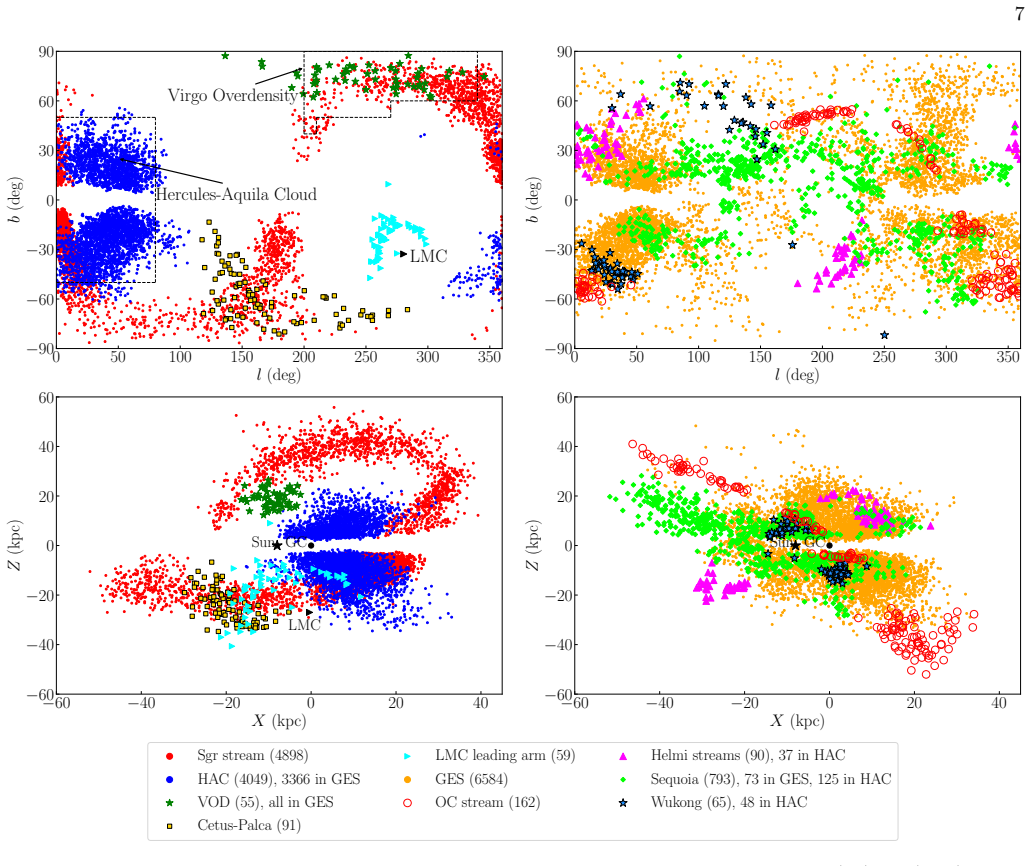
The central claim is that 5D kinematic data are enough to find coherent halo substructures, provided each star's orbit is represented as a probability distribution over five integrals of motion rather than a single point. Monte Carlo draws of the missing radial velocity—from a Gaussian prior estimated from halo RR Lyrae stars—turn each star into a spread of possible orbits, and friends-of-friends linking in that space groups stars that share an orbit. The method recovers the Sagittarius stream leading and trailing arms, Hercules–Aquila Cloud, Virgo Overdensity, Gaia-Enceladus-Sausage, Orphan-Chenab, Cetus-Palca, Helmi streams, Sequoia, Wukong, and an LMC leading-arm candidate. Most HAC and VOD members show high eccentricity and low tangential velocity like GES, so the paper argues these overdensities likely share GES's accretion origin. The 18 unknown groups each show consistent three-dimensional position and proper motion, and the paper leaves their confirmation to future spectroscopy.
Load-bearing premise
The entire orbit reconstruction assumes that every star's missing radial velocity is drawn from one Gaussian centered at zero with a 109 km/s spread; if real halo stars or a stream have a different line-of-sight velocity distribution, the orbit clouds and group assignments are systematically wrong.
Editorial extensions
If this is right
- Substructure searches can now use the full Gaia astrometric sample rather than the small fraction of stars with radial velocities, enlarging the census of halo debris by more than an order of magnitude.
- Future deep photometric surveys without spectroscopy, such as LSST and CSST, can map halo substructures to larger distances and full sky coverage.
- The recovered membership in GES, Sequoia, and the Sagittarius stream is more than ten times larger than earlier 6D samples, enabling stronger chemical and kinematic comparisons.
- If HAC and VOD are GES debris, the spatial extent of the ancient merger's debris is far wider than previously mapped.
- The 18 unknown groups become a concrete target list for spectroscopic follow-up.
Reading between the lines
- A testable extension the paper does not run: mask the measured radial velocities of RR Lyrae stars that have full 6D data and compare the recovered groups to the true ones; this would directly measure how much the Gaussian prior distorts coherent streams.
- The method's promise for LSST-era data depends on distances that are photometrically estimated; applying it to tracers without RR Lyrae's precise distance scale is an open step.
- The claim that HAC and VOD share GES's origin rests on the prior's shape; if the halo's true radial-velocity distribution is skewed or bimodal, the high-eccentricity inference weakens.
- The 18 unknown groups could be contamination from the prior; spectroscopy of a handful of members in each would settle whether they are real.
Editorial analysis
A structured set of objections, weighed in public.
Referee Report
Summary. The paper presents a method to identify Galactic halo substructures using 5D astrometric data (positions and proper motions) from Gaia DR3 for 46,575 RR Lyrae stars, without radial velocities. The method assumes a Gaussian prior for the missing radial velocity (mean 0, dispersion 109 km/s, from Wang et al. 2022), propagates uncertainties via Monte Carlo to build a probability distribution over five orbital parameters (semimajor axis, eccentricity, orbital pole, and apocenter direction), and clusters stars in this integrals-of-motion space with a friends-of-friends algorithm. Validation on the Sagittarius stream recovers about 76% of the members identified with 6D data (82% completeness and 86% purity against a literature candidate list). The method identifies known substructures (Sgr, HAC, VOD, GES, Helmi streams, Sequoia, Wukong, Cetus-Palca, Orphan-Chenab, LMC leading arm) and reports 18 previously unknown groups. The authors also argue that HAC and VOD are kinematically and chemically similar to GES and may share a common origin.
Significance. If the claimed performance holds, the method would allow substructure discovery in the much larger 5D-only sample, extending the reach of current 6D spectroscopic samples by an order of magnitude in size and distance. The Sgr validation is a useful sanity check, and the public data products (member lists) will be of value. However, the central claim's strength is currently limited by the absence of a false-positive control for the clustering and by the reliance on an ad-hoc prior for the eccentricity interpretation. The paper is a worthwhile contribution to the methodology of halo substructure identification, provided these concerns are addressed.
major comments (4)
- [Sec. 3.1 and Sec. 4.2] The FoF algorithm uses linking lengths tuned by visual inspection of 'sudden jumps' (Sec. 3.1) and a minimum group size of 15, yet no null test is reported. A permutation or shuffle test that randomizes proper motions (or distances) while preserving their error distributions would quantify the expected number of spurious groups of size > 15. Without this control, the 18 unknown groups in Sec. 4.2 and the 85 GES groups in Sec. 4.1.4 cannot be distinguished from artifacts of the clustering procedure under the broad 109 km/s prior. This is a load-bearing gap for the paper's central claim of discovering new substructures.
- [Sec. 4.1.4 and Appendix A] The GES membership is defined by the criterion V_perp < 60 km/s and r > 15 kpc, justified by a mock test in Appendix A. In Sec. 4.1.5 the same criterion is applied to HAC and VOD members, and the finding that ~57% of HAC and ~87% of VOD satisfy it is used to conclude that most HAC and VOD members have eccentricity as high as GES, suggesting a common origin. This reasoning is circular for the claimed similarity, since the GES sample was itself constructed from that criterion. Moreover, the mock test assumes an isotropic Gaussian velocity distribution N(0,100) for V_los, V_l, and V_b, which is not a realistic model of the stellar halo (no anisotropy, no rotational lag, no radial gradient). The conclusion that HAC and VOD share a common origin with GES would require either an external sample with measured radial velocities for HAC/VOD stars or a more realistic mock halo. The current statement is conditional on an ad-hoc assumption and should be softened or supported.
- [Sec. 3.1 and Sec. 3.2] The Gaussian radial velocity prior V_los ~ N(0, 109 km/s) is adopted from Wang et al. (2022) and applied uniformly to all stars regardless of location (Sec. 3.1). For a stream such as Sgr with coherent line-of-sight motion, this prior is incorrect by construction; the validation in Sec. 3.2 indeed shows a misidentification fraction of about 38% (110 of 177 recovered members in common with Wang et al. 2022). The paper does not assess how sensitive the final group catalog is to the prior's mean and dispersion, nor does it validate on a second, less prominent substructure (e.g., using members with measured radial velocities from the same sample). A sensitivity analysis that varies the prior and reports the stability of the 220 groups would make the central claim much more robust.
- [Sec. 3.2] The claim that 'our method could distinguish around four-fifths of the member stars in a substructure' is based solely on the Sgr stream, which is the most prominent and kinematically cold stream in the halo. The completeness and purity estimates against Ramos et al. (2020) are acknowledged to be upper limits because the reference sample is not complete or pure. Generalizing this single-stream recall to all substructure types, especially the diffuse populations that are the focus of the novel claims, is not justified without additional validation.
minor comments (6)
- [Sec. 2.1] In the sentence 'We further utilize the cut |Z| > 3 kpc to to eliminate the majority of the disk and bulge stars', 'to to' is a typo. Also, the following sentence 'We reserve the stars with |Z| < 3 kpc, R = sqrt(X^2+Y^2) > 20 kpc...' is ambiguous; clarify whether these stars are kept in addition to the |Z| > 3 kpc sample or are a separate selection.
- [Sec. 3.1] The definition of the orbital pole (l_orbit, b_orbit) and the angle lapo would benefit from a reference or an explicit formula; as written, the text depends on a forthcoming paper (Xue et al. 2024, in prep.) for full reproducibility.
- [Sec. 4.1.1] The internal metallicity gradient of the Sgr leading arm is reported as (1.4 ± 0.3) x 10^-3 dex/deg and called significant, but the photometric metallicity uncertainty is 0.24 dex. The paper should state the scatter around the fitted gradient and the associated p-value or equivalent significance test.
- [Sec. 4.1.4] The text says 'We select groups with more than 60% members satisfying the criteria... leading to the identification of 85 groups'. It would be informative to report the distribution of the member fraction across these groups, e.g., the median and range, to indicate how cleanly the selection threshold separates GES-like groups.
- [Sec. 4.2] For the unknown groups with only ~16 members (e.g., U11), the reported metallicity mean and standard deviation do not convey the uncertainty on the mean; consider adding the standard error or a bootstrap confidence interval.
- [Fig. 14] The caption of Figure 14 should explicitly define the color scale for the LMC number density and state how the LMC proper-motion bins were constructed, since the figure is used to support the LMC leading arm association.
Circularity Check
Core 5D pipeline is independent; only the GES/HAC/VOD eccentricity-similarity claim is partly by construction.
-
self definitional
[Section 4.1.4 (Eq. 2), Section 4.1.5, Table 3]
"We select groups with more than 60% members satisfying the criteria: (V⊥ < 60 km s−1); (r > 15 kpc), leading to the identification of 85 groups (6,584 RRLs) consistent with the GES. ... we find most of the stars ( ∼57% for HAC and ∼87% for VOD) in HAC and VOD satisfy these criteria, suggesting that most stars in HAC and VOD have high e."
GES membership is assigned using the same V⊥/r cut that is then cited as evidence that HAC and VOD have 'eccentricity as high as GES.' Because the GES sample is defined by Eq. (2), measuring that same proxy inside HAC and VOD reports the classifier rather than an independent kinematic resemblance. The mock test in Appendix A gives a separate model-based link from the proxy to e>0.7, so the high-eccentricity inference is not wholly forced, and the metallicity comparison is independent. The circularity is therefore partial and confined to the kinematic-similarity phrasing.
full rationale
The central 5D identification method is not circular: it combines Gaia astrometry and Li et al. (2023) distances with a Gaussian radial-velocity prior from Wang et al. (2022), then validates group finding against the known Sgr stream in Section 3.2. The RV prior is a self-citation by the same group, but it is a fixed empirical estimate measured from an independent 6D sample and is not fitted to the present data, so it does not make the pipeline circular. The FoF linking-length choices are subjectively tuned but not self-referential. The only notable circular element is the GES/HAC/VOD comparison: GES is defined by the V⊥<60 km/s and r>15 kpc proxy, and the same proxy is then used to claim that HAC and VOD have kinematic properties 'as high as GES.' That kinematic similarity is partly inherited from the selection rule, although the Appendix mock test and chemical abundances provide partial independent support. The absence of a null or permutation test is a correctness risk, not a circularity, and is not scored as circular here.
Assumptions & free parameters
free parameters (5)
- Radial velocity prior (mean, sigma) =
0 km/s, 109 km/s
- FoF linking lengths and critical linking length =
0.15-0.80 range; critical values per group
- Substructure association confidence threshold =
Not quoted numerically
- Minimum group size =
15 members
- Mock test velocity dispersion (isotropic) =
100 km/s
assumptions (6)
- domain assumption Integrals of motion are conserved and shared within substructures in a spherical potential with no dynamic friction.
- domain assumption Missing radial velocities follow a Gaussian distribution with mean 0 and dispersion 109 km/s.
- domain assumption Adopted Galactic potential (Hernquist bulge + exponential disk + NFW halo) with R0 = 8.0 kpc and LSR = 220 km/s.
- domain assumption Literature selection criteria for GES, Helmi streams, Sequoia, Wukong, HAC, and VOD are valid and transferable.
- ad hoc to paper Isotropic Gaussian mock velocity distribution represents halo kinematics for deriving the high-eccentricity criterion.
- domain assumption Photometric distances and metallicities from Li et al. (2023) are accurate to the quoted uncertainties.
invented entities (1)
-
18 unknown groups (U1-U18)
Cite this review
Pith. "Pith review of Identifying the Galactic Substructures in 5D Space Using All-sky RR Lyrae Stars in Gaia DR3." pith.science (2026). https://pith.science/paper/3HIVPUE7
@misc{pith2026241113122,
  author       = {Pith},
  title        = {Pith review of: Identifying the Galactic Substructures in 5D Space Using All-sky RR Lyrae Stars in Gaia DR3},
  year         = {2026},
  howpublished = {\url{https://pith.science/paper/3HIVPUE7}},
  note         = {Machine review of arXiv:2411.13122}
}
read the original abstract
Motivated by the vast gap between photometric and spectroscopic data volumes, there is great potential in using 5D kinematic information to identify and study substructures of the Milky Way. We identify substructures in the Galactic halo using 46,575 RR Lyrae stars (RRLs) from Gaia DR3 with the photometric metallicities and distances newly estimated by Li et al. (2023). Assuming a Gaussian prior distribution of radial velocity, we calculate the orbital distribution characterized by the integrals of motion for each RRL based on its 3D positions, proper motions and corresponding errors, and then apply the friends-of-friends algorithm to identify groups moving along similar orbits. We have identified several known substructures, including Sagittarius (Sgr) Stream, Hercules-Aquila Cloud (HAC), Virgo Overdensity (VOD), Gaia-Enceladus-Sausage (GES), Orphan-Chenab stream, Cetus-Palca, Helmi Streams, Sequoia, Wukong and Large Magellanic Cloud (LMC) leading arm, along with 18 unknown groups. Our findings indicate that HAC and VOD have kinematic and chemical properties remarkably similar to GES, with most HAC and VOD members exhibiting eccentricity as high as GES, suggesting that they may share a common origin with GES. The ability to identify the low mass and spatially dispersed substructures further demonstrates the potential of our method, which breaks the limit of spectroscopic survey and is competent to probe the substructures in the whole Galaxy. Finally, we have also identified 18 unknown groups with good spatial clustering and proper motion consistency, suggesting more excavation of Milky Way substructures in the future with only 5D data.
Figures


Figures from the paper (13 more)


Forward citations
Cited by 1 Pith paper
-
Unveiling Galactic substructures with M Giant stars: A kinematic and chemical study based on LAMOST DR9, Gaia DR3 and APOGEE DR17
Orbit-based clustering of LAMOST DR9 M giants recovers the Milky Way's known merger relics, finds two unclassified groups, and supports the scenario that the Gaia-Enceladus merger heated the primordial high-alpha disk...
Reference graph
Works this paper leans on
-
[1]
2021, A&A, 654, A15, doi: 10.1051/0004-6361/202141015
Balbinot, E., & Helmi, A. 2021, A&A, 654, A15, doi: 10.1051/0004-6361/202141015
-
[2]
Belokurov, V., Erkal, D., Deason, A. J., et al. 2017, MNRAS, 466, 4711, doi: 10.1093/mnras/stw3357
-
[3]
Deason, A. J. 2018, MNRAS, 478, 611, doi: 10.1093/mnras/sty982
-
[4]
Belokurov, V., Evans, N. W., Bell, E. F., et al. 2007a, ApJL, 657, L89, doi: 10.1086/513144
-
[5]
Belokurov, V., Evans, N. W., Irwin, M. J., et al. 2007b, ApJ, 658, 337, doi: 10.1086/511302
-
[6]
Belokurov, V., Koposov, S. E., Evans, N. W., et al. 2014, MNRAS, 437, 116, doi: 10.1093/mnras/stt1862
-
[7]
Blumenthal, G. R., Faber, S. M., Primack, J. R., & Rees, M. J. 1984, Nature, 311, 517, doi: 10.1038/311517a0
doi:10.1038/311517a0 1984
-
[8]
2012, AJ, 143, 105, doi: 10.1088/0004-6256/143/5/105
Bonaca, A., Juri´ c, M., Ivezi´ c,ˇZ., et al. 2012, AJ, 143, 105, doi: 10.1088/0004-6256/143/5/105
Show all 94 references
-
[9]
2015, ApJS, 216, 29, doi: 10.1088/0067-0049/216/2/29
Bovy, J. 2015, ApJS, 216, 29, doi: 10.1088/0067-0049/216/2/29
2015 doi
-
[10]
S., & Johnston, K
Bullock, J. S., & Johnston, K. V. 2005, ApJ, 635, 931, doi: 10.1086/497422
2005 doi
-
[11]
S., Kravtsov, A
Bullock, J. S., Kravtsov, A. V., & Weinberg, D. H. 2001, ApJ, 548, 33, doi: 10.1086/318681
2001 doi
-
[12]
2018, MNRAS, 480, 2178, doi: 10.1093/mnras/sty1980
Cao, Y., Gong, Y., Meng, X.-M., et al. 2018, MNRAS, 480, 2178, doi: 10.1093/mnras/sty1980
2018 doi
-
[13]
L., Sheffield, A
Carlin, J. L., Sheffield, A. A., Cunha, K., & Smith, V. V. 2018, ApJL, 859, L10, doi: 10.3847/2041-8213/aac3d8
2018 doi
-
[14]
2020, ApJ, 905, 100, doi: 10.3847/1538-4357/abc338
Chang, J., Yuan, Z., Xue, X.-X., et al. 2020, ApJ, 905, 100, doi: 10.3847/1538-4357/abc338
2020 doi
- [15]
-
[16]
2023, A&A, 674, A18, doi: 10.1051/0004-6361/202243964
Clementini, G., Ripepi, V., Garofalo, A., et al. 2023, A&A, 674, A18, doi: 10.1051/0004-6361/202243964
2023 doi
-
[17]
P., Cole, S., Frenk, C
Cooper, A. P., Cole, S., Frenk, C. S., et al. 2010, MNRAS, 406, 744, doi: 10.1111/j.1365-2966.2010.16740.x
2010
-
[18]
2012, Research in Astronomy and Astrophysics, 12, 1197, doi: 10.1088/1674-4527/12/9/003 de Grijs, R., & Bono, G
Cui, X.-Q., Zhao, Y.-H., Chu, Y.-Q., et al. 2012, Research in Astronomy and Astrophysics, 12, 1197, doi: 10.1088/1674-4527/12/9/003 de Grijs, R., & Bono, G. 2015, AJ, 149, 179, doi: 10.1088/0004-6256/149/6/179 de Grijs, R., Wicker, J. E., & Bono, G. 2014, AJ, 147, 122, doi: 10...
2012 doi
-
[19]
J., Liu, C., et al
Deng, L.-C., Newberg, H. J., Liu, C., et al. 2012, Research in Astronomy and Astrophysics, 12, 735, doi: 10.1088/1674-4527/12/7/003
2012 doi
-
[20]
Dierickx, M. I. P., & Loeb, A. 2017, ApJ, 836, 92, doi: 10.3847/1538-4357/836/1/92
2017 doi
-
[21]
2019, ApJ, 886, 76, doi: 10.3847/1538-4357/ab4f72
Thompson, J. 2019, ApJ, 886, 76, doi: 10.3847/1538-4357/ab4f72
2019 doi
-
[22]
J., Graham, M
Drake, A. J., Graham, M. J., Djorgovski, S. G., et al. 2014, ApJS, 213, 9, doi: 10.1088/0067-0049/213/1/9
2014 doi
-
[23]
K., Zinn, R., M´ endez, R
Duffau, S., Vivas, A. K., Zinn, R., M´ endez, R. A., & Ruiz, M. T. 2014, A&A, 566, A118, doi: 10.1051/0004-6361/201219654
2014 doi
-
[24]
Erkal, D., Belokurov, V., Laporte, C. F. P., et al. 2019, MNRAS, 487, 2685, doi: 10.1093/mnras/stz1371
2019 doi
-
[25]
S., & Strigari, L
Ferguson, P. S., & Strigari, L. E. 2020, MNRAS, 495, 4124, doi: 10.1093/mnras/staa1404
2020 doi
-
[26]
2002, ARA&A, 40, 487, doi: 10.1146/annurev.astro.40.060401.093840 Gaia Collaboration, Prusti, T., de Bruijne, J
Freeman, K., & Bland-Hawthorn, J. 2002, ARA&A, 40, 487, doi: 10.1146/annurev.astro.40.060401.093840 Gaia Collaboration, Prusti, T., de Bruijne, J. H. J., et al. 2016, A&A, 595, A1, doi: 10.1051/0004-6361/201629272 Gaia Collaboration, Brown, A. G. A., Vallenari, A., et al. 2018...
2002
-
[27]
C., Beers, T
Garcia, J. C., Beers, T. C., Huang, Y., et al. 2023, MNRAS, doi: 10.1093/mnras/stad3674
2023 doi
-
[28]
2019, ApJ, 883, 203, doi: 10.3847/1538-4357/ab391e
Gong, Y., Liu, X., Cao, Y., et al. 2019, ApJ, 883, 203, doi: 10.3847/1538-4357/ab391e
2019 doi
-
[29]
Grillmair, C. J. 2006, ApJL, 645, L37, doi: 10.1086/505863
2006 doi
- [30]
-
[31]
R., Majewski, S
Hayes, C. R., Majewski, S. R., Hasselquist, S., et al. 2020, ApJ, 889, 63, doi: 10.3847/1538-4357/ab62ad
2020 doi
-
[32]
2020, ARA&A, 58, 205, doi: 10.1146/annurev-astro-032620-021917
Helmi, A. 2020, ARA&A, 58, 205, doi: 10.1146/annurev-astro-032620-021917
2020 doi
-
[33]
H., et al
Helmi, A., Babusiaux, C., Koppelman, H. H., et al. 2018, Nature, 563, 85, doi: 10.1038/s41586-018-0625-x
2018 doi
-
[34]
Helmi, A., & White, S. D. M. 1999, MNRAS, 307, 495, doi: 10.1046/j.1365-8711.1999.02616.x
1999
-
[35]
Helmi, A., White, S. D. M., de Zeeuw, P. T., & Zhao, H. 1999, Nature, 402, 53, doi: 10.1038/46980
1999 doi
-
[36]
2017, ApJ, 850, 96, doi: 10.3847/1538-4357/aa960c
Hernitschek, N., Sesar, B., Rix, H.-W., et al. 2017, ApJ, 850, 96, doi: 10.3847/1538-4357/aa960c
2017 doi
-
[37]
1990, ApJ, 356, 359, doi: 10.1086/168845
Hernquist, L. 1990, ApJ, 356, 359, doi: 10.1086/168845
1990 doi
-
[38]
P., Mackereth, J
Horta, D., Schiavon, R. P., Mackereth, J. T., et al. 2023, MNRAS, 520, 5671, doi: 10.1093/mnras/stac3179
2023 doi
-
[39]
W., Yuan, H
Huang, Y., Liu, X. W., Yuan, H. B., et al. 2015, MNRAS, 449, 162, doi: 10.1093/mnras/stv204
2015 doi
-
[40]
F., Irwin, M., Totten, E., & Quinn, T
Ibata, R., Lewis, G. F., Irwin, M., Totten, E., & Quinn, T. 2001, ApJ, 551, 294, doi: 10.1086/320060 Ivezi´ c,ˇZ., Kahn, S. M., Tyson, J. A., et al. 2019, ApJ, 873, 111, doi: 10.3847/1538-4357/ab042c 19
2001 doi
-
[41]
V., Hernquist, L., & Bolte, M
Johnston, K. V., Hernquist, L., & Bolte, M. 1996, ApJ, 465, 278, doi: 10.1086/177418 Juri´ c, M., Ivezi´ c,ˇZ., Brooks, A., et al. 2008, ApJ, 673, 864, doi: 10.1086/523619
1996 doi
-
[42]
2008, ApJ, 678, 851, doi: 10.1086/526516
Schmidt, B. 2008, ApJ, 678, 851, doi: 10.1086/526516
2008 doi
-
[43]
J., & Lynden-Bell, D
Kerr, F. J., & Lynden-Bell, D. 1986, MNRAS, 221, 1023, doi: 10.1093/mnras/221.4.1023
1986 doi
-
[44]
E., Belokurov, V., Li, T
Koposov, S. E., Belokurov, V., Li, T. S., et al. 2019, MNRAS, 485, 4726, doi: 10.1093/mnras/stz457
2019 doi
-
[45]
H., Helmi, A., Massari, D., Price-Whelan, A
Koppelman, H. H., Helmi, A., Massari, D., Price-Whelan, A. M., & Starkenburg, T. K. 2019a, A&A, 631, L9, doi: 10.1051/0004-6361/201936738
-
[46]
2019b, A&A, 625, A5, doi: 10.1051/0004-6361/201834769
Bastian, U. 2019b, A&A, 625, A5, doi: 10.1051/0004-6361/201834769
-
[47]
R., & Majewski, S
Law, D. R., & Majewski, S. R. 2010, ApJ, 714, 229, doi: 10.1088/0004-637X/714/1/229
2010 doi
-
[48]
S., Balbinot, E., Mondrik, N., et al
Li, T. S., Balbinot, E., Mondrik, N., et al. 2016, ApJ, 817, 135, doi: 10.3847/0004-637X/817/2/135
2016 doi
-
[49]
C., & Zhang, H.-W
Li, X.-Y., Huang, Y., Liu, G.-C., Beers, T. C., & Zhang, H.-W. 2023, ApJ, 944, 88, doi: 10.3847/1538-4357/acadd5
2023 doi
- [50]
-
[51]
C., Huang, Y., Zhang, H
Liu, G. C., Huang, Y., Zhang, H. W., et al. 2020, ApJS, 247, 68, doi: 10.3847/1538-4365/ab72f8
2020 doi
-
[52]
Ostheimer, J. C. 2003, ApJ, 599, 1082, doi: 10.1086/379504
2003 doi
-
[53]
R., Schiavon, R
Majewski, S. R., Schiavon, R. P., Frinchaboy, P. M., et al. 2017, AJ, 154, 94, doi: 10.3847/1538-3881/aa784d
2017 doi
-
[54]
A., et al
Malhan, K., Yuan, Z., Ibata, R. A., et al. 2021, ApJ, 920, 51, doi: 10.3847/1538-4357/ac1675
2021 doi
-
[55]
A., Sharma, S., et al
Malhan, K., Ibata, R. A., Sharma, S., et al. 2022, ApJ, 926, 107, doi: 10.3847/1538-4357/ac4d2a
2022 doi
-
[56]
H., & Helmi, A
Massari, D., Koppelman, H. H., & Helmi, A. 2019, A&A, 630, L4, doi: 10.1051/0004-6361/201936135
2019 doi
-
[57]
2023, MNRAS, 520, 5225, doi: 10.1093/mnras/stad321
Mateu, C. 2023, MNRAS, 520, 5225, doi: 10.1093/mnras/stad321
2023 doi
-
[58]
2019, ApJL, 874, L35, doi: 10.3847/2041-8213/ab0ec0
Matsuno, T., Aoki, W., & Suda, T. 2019, ApJL, 874, L35, doi: 10.3847/2041-8213/ab0ec0
2019 doi
-
[59]
McMillan, P. J. 2017, MNRAS, 465, 76, doi: 10.1093/mnras/stw2759
2017 doi
-
[60]
C., Evans, N
Myeong, G. C., Evans, N. W., Belokurov, V., Sanders, J. L., & Koposov, S. E. 2018, MNRAS, 478, 5449, doi: 10.1093/mnras/sty1403
2018 doi
-
[61]
2019, MNRAS, 488, 1235, doi: 10.1093/mnras/stz1770
Belokurov, V. 2019, MNRAS, 488, 1235, doi: 10.1093/mnras/stz1770
2019 doi
-
[62]
P., Conroy, C., Bonaca, A., et al
Naidu, R. P., Conroy, C., Bonaca, A., et al. 2020, ApJ, 901, 48, doi: 10.3847/1538-4357/abaef4
2020 doi
-
[63]
F., Frenk, C
Navarro, J. F., Frenk, C. S., & White, S. D. M. 1996, ApJ, 462, 563, doi: 10.1086/177173
1996 doi
-
[64]
J., Yanny, B., Cole, N., et al
Newberg, H. J., Yanny, B., Cole, N., et al. 2007, ApJ, 668, 221, doi: 10.1086/521068
2007 doi
-
[65]
J., Yanny, B., Rockosi, C., et al
Newberg, H. J., Yanny, B., Rockosi, C., et al. 2002, ApJ, 569, 245, doi: 10.1086/338983
2002 doi
-
[66]
Peebles, P. J. E. 1974, ApJL, 189, L51, doi: 10.1086/181462
1974 doi
-
[67]
S., Pe˜ narrubia, J., & Jones, E
Petersen, M. S., Pe˜ narrubia, J., & Jones, E. 2022, MNRAS, 514, 1266, doi: 10.1093/mnras/stac1429
2022 doi
-
[68]
2020, A&A, 638, A104, doi: 10.1051/0004-6361/202037819
Ramos, P., Mateu, C., Antoja, T., et al. 2020, A&A, 638, A104, doi: 10.1051/0004-6361/202037819
2020 doi
-
[69]
Reid, M. J. 1993, ARA&A, 31, 345, doi: 10.1146/annurev.aa.31.090193.002021 Sch¨ onrich, R., Binney, J., & Dehnen, W. 2010, MNRAS, 403, 1829, doi: 10.1111/j.1365-2966.2010.16253.x
1993
-
[70]
1978, ApJ, 225, 357, doi: 10.1086/156499
Searle, L., & Zinn, R. 1978, ApJ, 225, 357, doi: 10.1086/156499
1978 doi
-
[71]
Sesar, B., Hernitschek, N., Dierickx, M. I. P., Fardal, M. A., & Rix, H.-W. 2017, ApJL, 844, L4, doi: 10.3847/2041-8213/aa7c61
2017 doi
-
[72]
H., et al
Sesar, B., Ivezi´ c,ˇZ., Grammer, S. H., et al. 2010, ApJ, 708, 717, doi: 10.1088/0004-637X/708/1/717
2010 doi
-
[73]
S., et al
Sesar, B., Ivezi´ c,ˇZ., Stuart, J. S., et al. 2013, AJ, 146, 21, doi: 10.1088/0004-6256/146/2/21
2013 doi
-
[74]
C., Placco, V
Shank, D., Beers, T. C., Placco, V. M., et al. 2022, ApJ, 926, 26, doi: 10.3847/1538-4357/ac409a
2022 doi
-
[75]
S., Pace, A
Shipp, N., Li, T. S., Pace, A. B., et al. 2019, ApJ, 885, 3, doi: 10.3847/1538-4357/ab44bf
2019 doi
-
[76]
T., Belokurov, V., Irwin, M., & Koposov, S
Simion, I. T., Belokurov, V., Irwin, M., & Koposov, S. E. 2014, MNRAS, 440, 161, doi: 10.1093/mnras/stu133
2014 doi
-
[77]
T., Belokurov, V., & Koposov, S
Simion, I. T., Belokurov, V., & Koposov, S. E. 2019, MNRAS, 482, 921, doi: 10.1093/mnras/sty2744
2019 doi
-
[78]
F., & Battaglia, G
Thomas, G. F., & Battaglia, G. 2022, A&A, 660, A29, doi: 10.1051/0004-6361/202142347 van der Marel, R. P. 2001, AJ, 122, 1827, doi: 10.1086/323100
2022 doi
-
[79]
2019, MNRAS, 482, 1525, doi: 10.1093/mnras/sty2672
Vasiliev, E. 2019, MNRAS, 482, 1525, doi: 10.1093/mnras/sty2672
2019 doi
-
[80]
2021, MNRAS, 501, 2279, doi: 10.1093/mnras/staa3673
Vasiliev, E., Belokurov, V., & Erkal, D. 2021, MNRAS, 501, 2279, doi: 10.1093/mnras/staa3673
2021 doi
-
[81]
W., Huang, Y., et al
Wang, F., Zhang, H. W., Huang, Y., et al. 2021, MNRAS, 504, 199, doi: 10.1093/mnras/stab848
2021 doi
-
[82]
W., Xue, X
Wang, F., Zhang, H. W., Xue, X. X., et al. 2022, MNRAS, 513, 1958, doi: 10.1093/mnras/stac874 20
2022 doi
-
[83]
L., Evans, N
Watkins, L. L., Evans, N. W., Belokurov, V., et al. 2009, MNRAS, 398, 1757, doi: 10.1111/j.1365-2966.2009.15242.x
2009
-
[84]
White, S. D. M., & Rees, M. J. 1978, MNRAS, 183, 341, doi: 10.1093/mnras/183.3.341
1978 doi
-
[85]
L., Eisenhardt, P
Wright, E. L., Eisenhardt, P. R. M., Mainzer, A. K., et al. 2010, AJ, 140, 1868, doi: 10.1088/0004-6256/140/6/1868
2010 doi
-
[86]
H., Shi, W
Yan, H. H., Shi, W. B., Chen, Y. Q., Zhao, J. K., & Zhao, G. 2023, A&A, 674, A78, doi: 10.1051/0004-6361/202346249
2023 doi
-
[87]
2019a, ApJ, 880, 65, doi: 10.3847/1538-4357/ab2462 —
Yang, C., Xue, X.-X., Li, J., et al. 2019a, ApJ, 880, 65, doi: 10.3847/1538-4357/ab2462 —. 2019b, ApJ, 886, 154, doi: 10.3847/1538-4357/ab48e2
-
[88]
J., et al
Yanny, B., Rockosi, C., Newberg, H. J., et al. 2009, AJ, 137, 4377, doi: 10.1088/0004-6256/137/5/4377
2009 doi
- [89]
-
[90]
G., Adelman, J., Anderson, John E., J., et al
York, D. G., Adelman, J., Anderson, John E., J., et al. 2000, AJ, 120, 1579, doi: 10.1086/301513
2000 doi
-
[91]
C., & Huang, Y
Yuan, Z., Chang, J., Beers, T. C., & Huang, Y. 2020, ApJL, 898, L37, doi: 10.3847/2041-8213/aba49f
2020 doi
-
[92]
2011, Scientia Sinica Physica, Mechanica & Astronomica, 41, 1441, doi: 10.1360/132011-961
Zhan, H. 2011, Scientia Sinica Physica, Mechanica & Astronomica, 41, 1441, doi: 10.1360/132011-961
2011 doi
-
[93]
2024, ApJ, 966, 174, doi: 10.3847/1538-4357/ad31a6
Zhang, R., Matsuno, T., Li, H., et al. 2024, ApJ, 966, 174, doi: 10.3847/1538-4357/ad31a6
2024 doi
-
[94]
Zhao, G., Zhao, Y.-H., Chu, Y.-Q., Jing, Y.-P., & Deng, L.-C. 2012, Research in Astronomy and Astrophysics, 12, 723, doi: 10.1088/1674-4527/12/7/002 21 0 50 100 150 200 250 300 350 400 V⊥ (km s−1) 0 10 20 30 40 50 60r (kpc) 0.0 0.2 0.4 0.6 0.8 1.0 Percentage Figure A1. The map...
2012 doi
Reviewed August 12, 2026 · model on record in the stance chip above.
Discussion (0). Continue with ORCID to comment.