REVIEW 4 major objections 6 minor 76 references
Long-term Detection System for Six Kinds of Abnormal Behavior of the Elderly Living Alone
T0 review · 4 major / 6 minor · reviewed 2026-08-12 · deepseek-v4-flash
Pith's one-line read This paper claims that a simulator-trained smart-home system, using one standardized preprocessing pipeline for binary ambient sensors, can detect six abnormal behaviors of elderly people living alone, with sensitivities above 0.9 for the…
desk verdict A clear, honestly scoped simulation study whose headline numbers are weaker than the abstract suggests because of small event counts and a lenient interval-overlap metric. read the letter →
The pith
A machine-rendered reading of the paper's core claim, the machinery that carries it, and where it could break.
The reading
What carries the argument
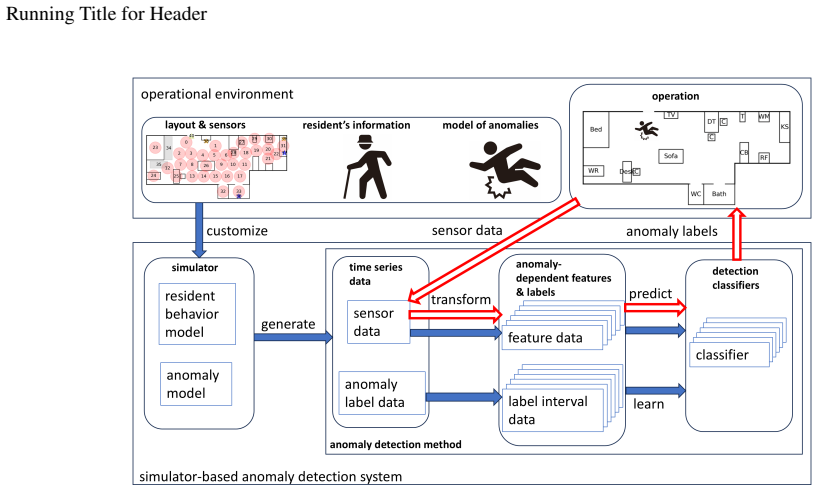
The load-bearing object is the sensor-data simulator that generates synchronized sensor firings and ground-truth anomaly labels from resident activity statistics, walking trajectories, an autoregressive MMSE score, and hand-coded anomaly models. Around it sits a unified preprocessing step that turns raw binary sensor events into a one-second binary matrix, then into anomaly-specific features and label intervals whose granularity matches the anomaly's duration: one second for falls and wandering, two hours for forgetting, and one day for housebound and semi-bedridden. The classifiers are deliberately simple—statistical threshold tests on estimated daily sleep duration and going-out frequency for semi-bedridden and housebound, a decision tree on appliance-on duration and the maximum distance to other active sensors for forgetting, random forests on nonresponse duration for fall while walking, and dynamic naive Bayes and hidden Markov models with post-hoc denoising for fall while standing and wandering.
What would settle it
Run the proposed classifiers on a modest real-world dataset of several months of ambient-sensor data from consenting elderly residents with caregiver- or diary-confirmed episodes of housebound, forgetting, and falls. If the interval-overlap sensitivity drops below about 0.5, or the false alarm rate rises above one per day, the simulator-fidelity premise is falsified; alternatively, compare real fall sensor traces to the simulator's 30-second immobility signature and see whether the signature appears in a majority of real falls.
Extended reading notes
Core claim
On the paper's own terms, the discovery is that a single set of binary ambient sensors—infrared motion, pressure, door, flow, and power sensors—can feed one standardized preprocessing pipeline whose outputs are then classified separately for six anomalies with very different time scales, and that this can be learned without any real sensor data. The authors model each anomaly inside the simulator: being semi-bedridden as added napping and reduced outings for about 30 days, being housebound as reduced going-out and phone use for about 14 days, forgetting as appliances left on until the resident returns, wandering as aimless walking whose frequency and duration grow as the simulated MMSE score declines, and falls as roughly 30 seconds of immobility. In nine years of simulated test data, the per-anomaly classifiers achieve sensitivity and interval-based false alarm rates of 1.0 and 0.0 for semi-bedridden, 1.0 and 0.004 per day for housebound, 1.0 and 0.01 for forgetting, 1.0 and 0.017 with HMM and denoising for wandering, 0.75 and 0.02 for fall while walking, and 0.92 and 0.0 for fall while standing. The authors explicitly frame the result as promising because it avoids collecting rare, ethically difficult real anomalies, while acknowledging that transfer to real homes still depends on simulator realism.
Load-bearing premise
The system's training and test labels all come from the simulator's hand-written anomaly models; if real elderly people's abnormal behavior produces different sensor patterns—for example, a real fall with movement after impact, or housebound episodes with different going-out statistics—the reported sensitivities and false alarm rates will not carry over to real homes.
Editorial extensions
If this is right
- If the simulated results transfer, a single privacy-preserving sensor set could monitor slow health decline (housebound, semi-bedridden) and urgent events (falls, forgetting) at the same time, with per-day and per-second alert granularity.
- The customization claim means the same pipeline could be re-trained for a new apartment by changing floor plan, sensor positions, and resident activity statistics in the simulator, avoiding new long-term data collection.
- The newly proposed detectors for forgetting, being housebound, and being semi-bedridden would be the first ambient-sensor methods for these anomalies with quantitative long-term evaluation, something prior work lacked.
- Fall while walking remains the weakest link at sensitivity 0.75; the paper suggests oversampling fall training data can raise it, as their earlier study reached 0.96 with about 200 times oversampling.
- Because the simulator gives exact anomaly intervals, the evaluation metric counts an anomaly as detected if predicted and true intervals overlap even slightly, which is a lenient but practical criterion for alerting.
Reading between the lines
- The principal risk is that real falls are not just 30 seconds of immobility: real post-fall behavior can include crawling, rolling, or sensor activations near furniture, so a detector tuned to the simulator's immobility signature could miss real falls or fire on ordinary naps.
- The MMSE-driven frequency models mean rare anomalies like semi-bedridden occur only 8 times in nine years of test data; sensitivity of 1.0 on such tiny counts is statistically fragile, and a single missed episode would drop it to 0.875.
- A cheap partial validation would be to replay real unlabeled sensor logs through the simulator's sensor model and compare activation statistics; if the simulated activity sequence already matches real data as claimed, the main remaining gap is anomaly-event fidelity, which could be checked with diary- or caregiver-confirmed episodes.
- The system's personalization to a resident is only as good as the fitted activity statistics; residents with atypical daily rhythms or non-sleep bed use (reading, watching TV) would break the sleep-duration estimate that the semi-bedridden detector relies on.
Editorial analysis
A structured set of objections, weighed in public.
Referee Report
Summary. The paper proposes a simulator-based system for detecting six abnormal behaviors of elderly people living alone (semi-bedridden, housebound, forgetting to turn off appliances, wandering, fall while walking, fall while standing). Sensor data from a studio apartment with 41 binary ambient sensors are generated by a simulator; per-anomaly feature sequences are fed to simple classifiers (statistical tests, decision tree, random forest, dynamic naive Bayes, hidden Markov models). Each classifier emits labels at an anomaly-appropriate granularity, from seconds (falls) to days (semi-bedridden). On a single nine-year simulated test sequence, the authors report interval-based sensitivities of 1.0 for semi-bedridden, housebound, forgetting, and wandering (HMM with denoising), 0.92 for fall while standing, and 0.75 for fall while walking, with false alarm rates below 0.02 per day for the headline results.
Significance. If the reported detection rates transferred to real deployment, the unified sensor preprocessing and multi-timescale labeling would be a practical contribution to ambient assisted living, and the public simulator code and explicit anomaly models support reproducibility and customization to new floor plans. The paper is also honest in Section 7.2 about the unresolved sim-to-real gap. However, the significance is heavily conditional: the headline numbers are point estimates from one simulation run, several are based on very small event counts, and the detectors use features that directly mirror the modeled symptoms, so the evidence base for the abstract's claims is substantially weaker than the text suggests.
major comments (4)
- [Section 6.3 and Table 5] The central claim of sensitivity over 0.9 is not statistically supported for the two long-duration anomalies. With only 8 semi-bedridden and 17 housebound test episodes, the exact binomial 95% lower confidence bound for an observed sensitivity of 1.0 is roughly 0.63 and 0.80 respectively, so the data cannot establish that true sensitivity exceeds 0.9. Moreover, the interval-overlap sensitivity metric counts an episode as detected if any predicted interval overlaps any part of the true interval; Table 5 shows raw per-day sensitivity of 0.80 for semi-bedridden even though interval sensitivity is 1.0, meaning 20% of true episode-days were missed. Report confidence intervals or multiple simulation runs, and present per-unit sensitivity alongside interval sensitivity.
- [Section 7.2] The paper itself states that 'the similarity of the simulated anomaly action sequence to real data has not been checked yet.' Since both training and test data are generated by the same simulator using the same anomaly models, the reported sensitivity and false-alarm rates are internal benchmark numbers with respect to those models, not validated performance on real anomalies. The abstract and conclusion nevertheless present them as achievable operational performance. This is a load-bearing limitation that must be fixed by either adding a real-data pilot (even with partial labels) or by explicitly reframing the contributions as a simulator-based internal benchmark with no claim of real-world transfer.
- [Section 5.5 and Table 1] There is a direct correspondence between the detection features and the modeled symptoms. The semi-bedridden detector uses daily sleep duration, and the anomaly model is defined as adding a 40-minute nap and increasing rest time by 30 minutes; the housebound detector uses going-out frequency, and the anomaly model is defined as a decrease in going-out frequency. High sensitivity is therefore partly built into the definition of the anomaly, which is appropriate for a demonstration but means the results cannot be read as evidence that the method detects the real-world clinical syndromes. Please state this explicitly and temper the external-validity language accordingly.
- [Section 6.4 and Table 5] The claim that the wandering and fall detection results are 'comparable to previous methods' is not supported because the evaluation metrics differ from those in Tables 2 and 3, as the text acknowledges, and because the raw precision values are very low (0.10 for wandering with HMM before denoising, and 0.20 for fall while walking). Without error bars or a common evaluation protocol, a numeric comparison to prior work is not meaningful. Either provide a rigorous comparison (e.g., reimplementing baselines on the same simulated data with the same metrics) or remove the comparability claim.
minor comments (6)
- [Introduction and Conclusion] There are several typos that should be corrected, including 'resindent' in the contributions list and 'simlator-ganerated' in the conclusion.
- [Table 1] The table header contains a typo ('F orgetting') and the use of an asterisk to define the MMSE-dependent parameters is unclear; a separate legend would improve readability.
- [Tables 2 and 3] The abbreviation list includes terms such as CDR and SF-12 that do not appear in those tables, and the sentence 'Abbreviations are; ...' is grammatically incomplete; please make the list self-contained.
- [Section 6.1] The notation '9 years (9 · 360 days)' is ambiguous; please write '9 years (9 × 360 days)' and explain why years are defined as 360 days.
- [Section 5.5] The rule-based sleep and going-out estimations depend on a one-minute threshold and on the assumption that the bed is used exclusively for sleep, but no sensitivity analysis is reported for these choices; a brief robustness check or an explicit justification would strengthen the method.
- [References] There are minor reference formatting issues, such as 'W. Hsuet al.' missing a space and inconsistent spelling of 'Gochoo' versus 'Goccho'; these should be cleaned up.
Circularity Check
No significant circularity: the internal simulator evaluation is self-consistent, and the paper explicitly flags the unvalidated sim-to-real gap; the main risks are statistical and external-validity concerns, not circular reasoning.
full rationale
The paper's numerical claims are derived entirely within its simulator: features, classifiers, training labels, and test labels all come from the same simulator (Sections 4, 5, and 6.1). This is an internal consistency check, not a circular reduction: the detection classifiers are fit on one 9-year simulation and evaluated on an independent 9-year simulation generated with the same fixed parameters but distinct random draws, and the label-generation mechanism (anomaly models in Table 1) is not the same function as the detector (sleep-duration thresholding, going-out frequency thresholding, decision trees, random forests, and hidden Markov models). The feature choice mirrors the modeled symptom, e.g., semi-bedridden is modeled as an added nap and increased rest time and is detected via daily sleep duration, but that is a designed detector aligned to a definitional symptom, not an equation-level equivalence. The closest concern is Section 7.2, which concedes that 'the similarity [of the simulated anomaly action sequence] to real data has not been checked yet'; this is an honest external-validity limitation, not circularity. The reliance on the authors' prior simulator paper [54] for activity-model realism is a self-citation, but it is code-reproduced and does not assume the six-anomaly detection result. Statistical fragility (e.g., sensitivity 1.0 for semi-bedridden rests on 8 test episodes, and the interval-overlap metric is lenient) is a genuine risk to the headline claim, but it is a correctness and statistical-power issue, not a circularity defect.
Assumptions & free parameters
free parameters (9)
- wandering frequency slope/intercept in MMSE =
frequency per month = -1.86M + 56; duration = -0.31M + 9.8 minutes
- forgetting frequency slope/intercept in MMSE =
-M + 30 per month
- fall frequency slope/intercept in MMSE =
-M/15 + 2 per month
- semi-bedridden occurrence parameters =
1/20 per month, 30 days average duration; +40 min nap, +30 min rest, outing once/week
- housebound occurrence parameters =
1/10 per month, 14 days average duration; phone once every 3 days, going out once per two weeks
- fall immobility duration =
average 30 seconds
- sleep threshold offset c_s =
0.10
- going-out threshold offset c_h =
1.80
- walking speed =
68.75 cm/s
assumptions (5)
- domain assumption Daily sleep duration and going-out frequency follow normal distributions with sample-estimated parameters.
- domain assumption The bed is used only for sleep.
- domain assumption Resident walks at constant speed along shortest paths.
- domain assumption The activity model from [54] generates realistic activity sequences.
- domain assumption Falls are characterized by 30-second immobility without crawling or movement.
Cite this review
Pith. "Pith review of Long-term Detection System for Six Kinds of Abnormal Behavior of the Elderly Living Alone." pith.science (2026). https://pith.science/paper/TRCFCTM7
@misc{pith2026241113153,
  author       = {Pith},
  title        = {Pith review of: Long-term Detection System for Six Kinds of Abnormal Behavior of the Elderly Living Alone},
  year         = {2026},
  howpublished = {\url{https://pith.science/paper/TRCFCTM7}},
  note         = {Machine review of arXiv:2411.13153}
}
read the original abstract
The proportion of elderly people is increasing worldwide, particularly those living alone in Japan. As elderly people get older, their risks of physical disabilities and health issues increase. To automatically discover these issues at a low cost in daily life, sensor-based detection in a smart home is promising. As part of the effort towards early detection of abnormal behaviors, we propose a simulator-based detection systems for six typical anomalies: being semi-bedridden, being housebound, forgetting, wandering, fall while walking and fall while standing. Our detection system can be customized for various room layout, sensor arrangement and resident's characteristics by training detection classifiers using the simulator with the parameters fitted to individual cases. Considering that the six anomalies that our system detects have various occurrence durations, such as being housebound for weeks or lying still for seconds after a fall, the detection classifiers of our system produce anomaly labels depending on each anomaly's occurrence duration, e.g., housebound per day and falls per second. We propose a method that standardizes the processing of sensor data, and uses a simple detection approach. Although the validity depends on the realism of the simulation, numerical evaluations using sensor data that includes a variety of resident behavior patterns over nine years as test data show that (1) the methods for detecting wandering and falls are comparable to previous methods, and (2) the methods for detecting being semi-bedridden, being housebound, and forgetting achieve a sensitivity of over 0.9 with fewer than one false alarm every 50 days.
Figures


Reference graph
Works this paper leans on
-
[1]
Fall detection by ambient sensors on years-long simulation data,
K. Tanaka, M. Kudo, and K. Kimura, “Fall detection by ambient sensors on years-long simulation data,” in6th International Conference on Activity and Behavior Computing (ABC 2024). Springer, 2024
work page 2024
-
[2]
World population ageing 2020 highlights: Living arrangements of older persons,
United Nations, “World population ageing 2020 highlights: Living arrangements of older persons,” United Nations Department of Economic and Social Affairs, Population Division, Highlights ST/ESA/SER.A/451, 11 2020
work page 2020
-
[3]
W. He, D. Goodkind, and P. Kowal, “An aging world: 2015,” United States Census Bureau, International Population Report P95-16-1, 03 2016
work page 2015
-
[4]
M. F. Folstein, S. E. Folstein, and P. R. McHugh, “"mini-mental state": a practical method for grading the cognitive state of patients for the clinician,” Journal of psychiatric research, vol. 12, no. 3, pp. 189–198, 1975
work page 1975
-
[5]
Population-based norms for the mini-mental state examination by age and educational level,
R. M. Crum, J. C. Anthony, S. S. Bassett, and M. F. Folstein, “Population-based norms for the mini-mental state examination by age and educational level,”Jama, vol. 269, no. 18, pp. 2386–2391, 1993
work page 1993
-
[6]
B. Reisberg, I. A. Jamil, S. Khan, I. Monteiro, C. Torossian, S. Ferris, M. Sabbagh, S. Gauthier, S. Auer, M. B. Shulman, A. Kluger, E. Franssen, and J. Wegiel,Staging Dementia. John Wiley & Sons, Ltd, 2010, ch. 31, pp. 162–169. [Online]. Available: https://onlinelibrary.wiley.com/doi/abs/10.1002/9780470669600.ch31
-
[7]
K. J. Anstey, C. V on Sanden, and M. A. Luszcz, “An 8-year prospective study of the relationship between cognitive performance and falling in very old adults,”Journal of the American Geriatrics Society, vol. 54, no. 8, pp. 1169–1176, 2006
work page 2006
-
[8]
Empirical derivation and validation of a wandering typology,
D. L. Algase, C. L. Antonakos, E. Beattie, C. A. Beel-Bates, and L. Yao, “Empirical derivation and validation of a wandering typology,”Journal of the American Geriatrics Society, vol. 57, 2009. 16 Running Title for Header
work page 2009
Show all 76 references
-
[9]
New parameters for daytime wandering,
D. Algase, C. Antonakos, E. Beattie, C. Beel-Bates, and L. Yao, “New parameters for daytime wandering,” Research in gerontological nursing, vol. 2, no. 1, pp. 58–68, 2009
2009
-
[10]
An international review of long-term care workforce: Policies and shortages,
S. Hussein and J. Manthorpe, “An international review of long-term care workforce: Policies and shortages,” Journal of aging & social policy, vol. 17, no. 4, pp. 75–94, 2005
2005
-
[11]
Impact of increased long-term care insurance payments on employment and wages in formal long-term care,
A. Kondo, “Impact of increased long-term care insurance payments on employment and wages in formal long-term care,” Journal of the Japanese and International Economies, vol. 53, p. 101034, 2019. [Online]. Available: https://www.sciencedirect.com/science/article/pii/S0889158319300255
2019
-
[12]
How smart is your home?
D. J. Cook, “How smart is your home?” Science, vol. 335, pp. 1579 – 1581, 2012
2012
-
[13]
Intelligent systems for assessing aging changes: home-based, unobtrusive, and continuous assessment of aging,
J. A. Kaye, S. A. Maxwell, N. Mattek, T. L. Hayes, H. Dodge, M. Pavel, H. B. Jimison, K. Wild, L. Boise, and T. A. Zitzelberger, “Intelligent systems for assessing aging changes: home-based, unobtrusive, and continuous assessment of aging,” Journals of Gerontology Series B: Ps...
2011
-
[14]
Testing classifiers for embedded health assessment,
M. Skubic, R. D. Guevara, and M. Rantz, “Testing classifiers for embedded health assessment,” inImpact Analysis of Solutions for Chronic Disease Prevention and Management: 10th International Conference on Smart Homes and Health Telematics, ICOST 2012, Artiminio, Italy, June 12...
2012
-
[15]
Casas: A smart home in a box,
D. J. Cook, A. S. Crandall, B. L. Thomas, and N. C. Krishnan, “Casas: A smart home in a box,”Computer, vol. 46, no. 7, pp. 62–69, 2013
2013
-
[16]
An integrated home-based self-management system to support the wellbeing of older adults,
J. Doyle, A. Kealy, J. Loane, L. Walsh, B. O’Mullane, C. Flynn, A. Macfarlane, B. Bortz, R. B. Knapp, and R. Bond, “An integrated home-based self-management system to support the wellbeing of older adults,”Journal of ambient intelligence and smart environments, vol. 6, no. 4, ...
2014
-
[17]
A survey on ambient-assisted living tools for older adults,
P. Rashidi and A. Mihailidis, “A survey on ambient-assisted living tools for older adults,” IEEE Journal of Biomedical and Health Informatics, vol. 17, no. 3, pp. 579–590, 2013
2013
-
[18]
A survey on anomalous behavior detection for elderly care using dense-sensing networks,
S. Deep, X. Zheng, C. Karmakar, D. Yu, L. G. Hamey, and J. Jin, “A survey on anomalous behavior detection for elderly care using dense-sensing networks,” IEEE Communications Surveys & Tutorials, vol. 22, no. 1, pp. 352–370, 2019
2019
-
[19]
Fall detection monitoring systems: a comprehensive review,
P. Vallabh and R. Malekian, “Fall detection monitoring systems: a comprehensive review,”Journal of Ambient Intelligence and Humanized Computing, vol. 9, pp. 1809–1833, 2018
2018
-
[20]
Unobtrusive assessment of activity patterns associated with mild cognitive impairment,
T. L. Hayes, F. Abendroth, A. Adami, M. Pavel, T. A. Zitzelberger, and J. A. Kaye, “Unobtrusive assessment of activity patterns associated with mild cognitive impairment,” Alzheimer’s & Dementia, vol. 4, no. 6, pp. 395–405, 2008
2008
-
[21]
Smart home-based prediction of multidomain symptoms related to alzheimer’s disease,
A. Alberdi, A. Weakley, M. Schmitter-Edgecombe, D. J. Cook, A. Aztiria, A. Basarab, and M. Barrenechea, “Smart home-based prediction of multidomain symptoms related to alzheimer’s disease,” IEEE Journal of Biomedical and Health Informatics, vol. 22, no. 6, pp. 1720–1731, 2018
2018
-
[22]
Detecting and exploring deviating behaviour of smart home residents,
J. Lundström, E. Järpe, and A. Verikas, “Detecting and exploring deviating behaviour of smart home residents,” Expert Systems with Applications, vol. 55, pp. 429–440, 2016. [Online]. Available: https://www.sciencedirect.com/science/article/pii/S0957417416300616
2016
-
[23]
Detection of abnormal living patterns for elderly living alone using support vector data description,
J. H. Shin, B. Lee, and K. S. Park, “Detection of abnormal living patterns for elderly living alone using support vector data description,” IEEE Transactions on Information Technology in Biomedicine, vol. 15, no. 3, pp. 438– 448, 2011
2011
-
[24]
A context-aware approach for long-term behavioural change detection and abnormality prediction in ambient assisted living,
A. R. M. Forkan, I. Khalil, Z. Tari, S. Foufou, and A. Bouras, “A context-aware approach for long-term behavioural change detection and abnormality prediction in ambient assisted living,” Pattern Recognition, vol. 48, no. 3, pp. 628–641, 2015
2015
-
[25]
Activity discovery and detection of behavioral deviations of an inhabitant from binary sensors,
J. Saives, C. Pianon, and G. Faraut, “Activity discovery and detection of behavioral deviations of an inhabitant from binary sensors,” IEEE Transactions on Automation Science and Engineering, vol. 12, no. 4, pp. 1211–1224, 2015
2015
-
[26]
Smart carpet using differential piezoresistive pres- sure sensors for elderly fall detection,
K. Chaccour, R. Darazi, A. H. el Hassans, and E. Andres, “Smart carpet using differential piezoresistive pres- sure sensors for elderly fall detection,” in 2015 IEEE 11th International Conference on Wireless and Mobile Computing, Networking and Communications (WiMob). IEEE, 20...
2015
-
[27]
Detection of falls among the elderly by a floor sensor using the electric near field,
H. Rimminen, J. Lindström, M. Linnavuo, and R. Sepponen, “Detection of falls among the elderly by a floor sensor using the electric near field,”IEEE Transactions on Information Technology in Biomedicine, vol. 14, no. 6, pp. 1475–1476, 2010. 17 Running Title for Header
2010
-
[28]
A smart and passive floor- vibration based fall detector for elderly,
M. Alwan, P. J. Rajendran, S. Kell, D. Mack, S. Dalal, M. Wolfe, and R. Felder, “A smart and passive floor- vibration based fall detector for elderly,” in2006 2nd International Conference on Information & Communication Technologies, vol. 1. IEEE, 2006, pp. 1003–1007
2006
-
[29]
Fall detection using single-tree complex wavelet transform,
A. Yazar, F. Keskin, B. U. Töreyin, and A. E. Çetin, “Fall detection using single-tree complex wavelet transform,” Pattern Recognition Letters, vol. 34, no. 15, pp. 1945–1952, 2013
1945
-
[30]
Vampir-an automatic fall detection system using a vertical pir sensor array,
M. Popescu, B. Hotrabhavananda, M. Moore, and M. Skubic, “Vampir-an automatic fall detection system using a vertical pir sensor array,” in 2012 6th International Conference on Pervasive Computing Technologies for Healthcare (PervasiveHealth) and Workshops. IEEE, 2012, pp. 163–166
2012
-
[31]
Privacy-preserved behavior analysis and fall detection by an infrared ceiling sensor network,
S. Tao, M. Kudo, and H. Nonaka, “Privacy-preserved behavior analysis and fall detection by an infrared ceiling sensor network,” Sensors, vol. 12, no. 12, pp. 16 920–16 936, 2012
2012
-
[32]
Cnn for elderly wandering prediction in indoor scenarios,
R. Oliveira, R. Feres, F. Barreto, and R. Abreu, “Cnn for elderly wandering prediction in indoor scenarios,”SN Computer Science, vol. 3, no. 3, p. 230, 2022
2022
-
[33]
Detecting dementia-related wandering locomotion of elders by leveraging active infrared sensors,
Q. Lin, W. Zhao, and W. Wang, “Detecting dementia-related wandering locomotion of elders by leveraging active infrared sensors,” Journal of Computer and Communications, vol. 6, no. 5, pp. 94–105, 2018
2018
-
[34]
Elderly-care motion sensor using uwb-ir,
K. Ota, Y . Ota, M. Otsu, and A. Kajiwara, “Elderly-care motion sensor using uwb-ir,” in 2011 IEEE Sensors Applications Symposium. IEEE, 2011, pp. 159–162
2011
-
[35]
A light-weight system for detecting indoor wandering of demented elders living alone,
W. Zhao, X. Zhou, H. Ni, and Q. Lin, “A light-weight system for detecting indoor wandering of demented elders living alone,” in 2014 International Conference on Orange Technologies. IEEE, 2014, pp. 53–56
2014
-
[36]
Device-free non-privacy invasive classification of elderly travel patterns in a smart house using pir sensors and dcnn,
M. Gochoo, T.-H. Tan, V . Velusamy, S.-H. Liu, D. Bayanduuren, and S.-C. Huang, “Device-free non-privacy invasive classification of elderly travel patterns in a smart house using pir sensors and dcnn,” IEEE Sensors Journal, vol. 18, no. 1, pp. 390–400, 2017
2017
-
[37]
Sensor signals-based early dementia detection system using travel pattern classification,
A. Chaudhary, H. P. Gupta, K. Shukla, and T. Dutta, “Sensor signals-based early dementia detection system using travel pattern classification,” IEEE Sensors Journal, vol. 20, no. 23, pp. 14 474–14 481, 2020
2020
-
[38]
Collaborative trajectory mining in smart-homes to support early diagnosis of cognitive decline,
E. Khodabandehloo and D. Riboni, “Collaborative trajectory mining in smart-homes to support early diagnosis of cognitive decline,” IEEE Transactions on Emerging Topics in Computing, vol. 9, no. 3, pp. 1194–1205, 2020
2020
-
[39]
Designing an iot based kitchen monitoring and automation system for gas and fire detection,
M. Logeshwaran and J. J. J. S. ME, “Designing an iot based kitchen monitoring and automation system for gas and fire detection,” in 2022 6th International Conference on Computing Methodologies and Communication (ICCMC). IEEE, 2022, pp. 346–353
2022
-
[40]
Application of internet of things in a kitchen fire prevention system,
W.-L. Hsu, J.-Y . Jhuang, C.-S. Huang, C.-K. Liang, and Y .-C. Shiau, “Application of internet of things in a kitchen fire prevention system,” Applied Sciences, vol. 9, no. 17, p. 3520, 2019
2019
-
[41]
Pervasive intelligence system to enable safety and assistance in kitchen for home-alone elderly,
A. A. P. Wai, S. Shanthini Devi, J. Biswas, and S. K. Panda, “Pervasive intelligence system to enable safety and assistance in kitchen for home-alone elderly,” inToward Useful Services for Elderly and People with Disabilities: 9th International Conference on Smart Homes and He...
2011
-
[42]
Recognizing long-term sleep behaviour change using clustering for elderly in smart homes,
Z. K. Shahid, S. Saguna, and C. Åhlund, “Recognizing long-term sleep behaviour change using clustering for elderly in smart homes,” in 2022 IEEE International Smart Cities Conference (ISC2). IEEE, 2022, pp. 1–7
2022
-
[43]
A unified framework for modeling and predicting going-out behavior,
S. Tominaga, M. Shimosaka, R. Fukui, and T. Sato, “A unified framework for modeling and predicting going-out behavior,” inPervasive Computing: 10th International Conference, Pervasive 2012, Newcastle, UK, June 18-22,
2012
-
[44]
A consensus novelty detection ensemble approach for anomaly detection in activities of daily living,
S. W. Yahaya, A. Lotfi, and M. Mahmud, “A consensus novelty detection ensemble approach for anomaly detection in activities of daily living,” Applied Soft Computing, vol. 83, p. 105613, 2019. [Online]. Available: https://www.sciencedirect.com/science/article/pii/S156849461930393X
2019
-
[45]
Toxicity and response criteria of the eastern cooperative oncology group,
M. M. Oken, R. H. Creech, D. C. Tormey, J. Horton, T. E. Davis, E. T. McFadden, and P. P. Carbone, “Toxicity and response criteria of the eastern cooperative oncology group,”American journal of clinical oncology, vol. 5, no. 6, pp. 649–656, 1982
1982
-
[46]
Bedridden elderly: Factors and risks,
R. Normala and Z. Lukman, “Bedridden elderly: Factors and risks,” International Journal of Research and Scientific Innovation, vol. 7, no. 8, pp. 46–49, 2020
2020
-
[47]
Factors related to frequency of engaging in outside activities among elderly persons living an independent life at home,
M. Ishikawa, K. Tamakoshi, H. Yatsuya, K. Suma, K. Wada, R. Otsuka, K. Matsushita, H. Zhang, C. Murata, T. Kondo et al., “Factors related to frequency of engaging in outside activities among elderly persons living an independent life at home,” Nagoya journal of medical science...
2006
-
[48]
Characteristics of rural homebound older adults: a community-based study,
M. Ganguli, A. Fox, J. Gilby, and S. Belle, “Characteristics of rural homebound older adults: a community-based study,”Journal of the American Geriatrics Society, vol. 44, no. 4, pp. 363–370, 1996. 18 Running Title for Header
1996
-
[49]
Housebound elderly people: Definition, prevalence and characteristics,
J. Lindesay and C. Thompson, “Housebound elderly people: Definition, prevalence and characteristics,” pp. 231–237, 1993
1993
-
[50]
Travel Behavior of Nursing Home Residents Perceived as Wanderers and Nonwanderers,
D. Martino-Saltzman, B. B. Blasch, R. D. Morris, and L. W. McNeal, “Travel Behavior of Nursing Home Residents Perceived as Wanderers and Nonwanderers,”The Gerontologist, vol. 31, no. 5, pp. 666–672, 10 1991. [Online]. Available: https://doi.org/10.1093/geront/31.5.666
1991 doi
-
[51]
Cardiorespiratory fitness, hippocampal volume, and frequency of forgetting in older adults
A. N. Szabo, E. McAuley, K. I. Erickson, M. V oss, R. S. Prakash, E. L. Mailey, T. R. Wójcicki, S. M. White, N. Gothe, E. A. Olson et al., “Cardiorespiratory fitness, hippocampal volume, and frequency of forgetting in older adults.” Neuropsychology, vol. 25, no. 5, p. 545, 2011
2011
-
[52]
From fall detection to fall prevention: A generic classification of fall-related systems,
K. Chaccour, R. Darazi, A. H. El Hassani, and E. Andres, “From fall detection to fall prevention: A generic classification of fall-related systems,” IEEE Sensors Journal, vol. 17, no. 3, pp. 812–822, 2016
2016
-
[53]
Patient falls in stroke rehabilitation: a challenge to rehabilitation strategies,
L. Nyberg and Y . Gustafson, “Patient falls in stroke rehabilitation: a challenge to rehabilitation strategies,”Stroke, vol. 26, no. 5, pp. 838–842, 1995
1995
-
[54]
Sensor data simulation for anomaly detection of the elderly living alone,
K. Tanaka, M. Kudo, and K. Kimura, “Sensor data simulation for anomaly detection of the elderly living alone,” IEEE Internet of Things Journal, vol. 11, no. 19, pp. 31 675–31 686, 2024
2024
-
[55]
Falls by elderly people at home: prevalence and associated factors,
A. Blake, K. Morgan, M. Bendall, H. Dallosso, S. Ebrahim, T. a. Arie, P. Fentem, and E. Bassey, “Falls by elderly people at home: prevalence and associated factors,” Age and ageing, vol. 17, no. 6, pp. 365–372, 1988
1988
-
[56]
Ambient technology to assist elderly people in indoor risks,
R. Yared and B. Abdulrazak, “Ambient technology to assist elderly people in indoor risks,”Computers, vol. 5, no. 4, p. 22, 2016
2016
-
[57]
Managing elders’ wandering behavior using sensors-based solutions: a survey,
Q. Lin, D. Zhang, L. Chen, H. Ni, and X. Zhou, “Managing elders’ wandering behavior using sensors-based solutions: a survey,” International Journal of Gerontology, vol. 8, no. 2, pp. 49–55, 2014
2014
-
[58]
Forecasting behavior in smart homes based on sleep and wake patterns,
J. A. Williams and D. J. Cook, “Forecasting behavior in smart homes based on sleep and wake patterns,” Technology and Health Care, vol. 25, no. 1, pp. 89–110, 2017
2017
-
[59]
Estimation of rest-activity patterns using motion sensors,
T. L. Hayes, T. Riley, M. Pavel, and J. A. Kaye, “Estimation of rest-activity patterns using motion sensors,” in 2010 Annual International Conference of the IEEE Engineering in Medicine and Biology. IEEE, 2010, pp. 2147–2150
2010
-
[60]
Autonomous unobtrusive detection of mild cognitive impairment in older adults,
A. Akl, B. Taati, and A. Mihailidis, “Autonomous unobtrusive detection of mild cognitive impairment in older adults,” IEEE transactions on biomedical engineering, vol. 62, no. 5, pp. 1383–1394, 2015
2015
-
[61]
Management of dementia and depression utilizing in-home passive sensor data,
C. Galambos, M. Skubic, S. Wang, and M. Rantz, “Management of dementia and depression utilizing in-home passive sensor data,” Gerontechnology: international journal on the fundamental aspects of technology to serve the ageing society, vol. 11, no. 3, p. 457, 2013
2013
-
[62]
Anomaly detection algorithm based on life pattern extraction from accumulated pyroelectric sensor data,
T. Mori, R. Urushibata, M. Shimosaka, H. Noguchi, and T. Sato, “Anomaly detection algorithm based on life pattern extraction from accumulated pyroelectric sensor data,” in 2008 IEEE/RSJ International Conference on Intelligent Robots and Systems. IEEE, 2008, pp. 2545–2552
2008
-
[63]
Automated detection of wandering patterns in people with dementia,
N. K. Vuong, S. Chan, and C. T. Lau, “Automated detection of wandering patterns in people with dementia,” Gerontechnology, vol. 12, no. 3, pp. 127–147, 2014
2014
-
[64]
A scalable semantic framework for iot healthcare applications,
R. Zgheib, S. Kristiansen, E. Conchon, T. Plageman, V . Goebel, and R. Bastide, “A scalable semantic framework for iot healthcare applications,” Journal of Ambient Intelligence and Humanized Computing, vol. 14, no. 5, pp. 4883–4901, 2023
2023
-
[65]
Activity recognition on streaming sensor data,
N. C. Krishnan and D. J. Cook, “Activity recognition on streaming sensor data,”Pervasive and mobile computing, vol. 10, pp. 138–154, 2014
2014
-
[66]
A method of assessing change in a single subject: An alteration of the rc index,
L. Christensen, “A method of assessing change in a single subject: An alteration of the rc index,” Behav Ther, vol. 17, pp. 305–308, 1986
1986
-
[67]
Human activity recognition from wireless sensor network data: Benchmark and software,
T. L. van Kasteren, G. Englebienne, and B. J. Kröse, “Human activity recognition from wireless sensor network data: Benchmark and software,” in Activity recognition in pervasive intelligent environments. Springer, 2011, pp. 165–186
2011
-
[68]
Random forests,
L. Breiman, “Random forests,” Machine learning, vol. 45, pp. 5–32, 2001
2001
-
[69]
A comparison of dynamic naive bayesian classifiers and hidden markov models for gesture recognition,
H. Avilés-Arriaga, L. Sucar-Succar, C. Mendoza-Durán, and L. Pineda-Cortés, “A comparison of dynamic naive bayesian classifiers and hidden markov models for gesture recognition,” Journal of applied research and technology, vol. 9, no. 1, pp. 81–102, 2011
2011
-
[70]
A tutorial on hidden markov models and selected applications in speech recognition,
L. R. Rabiner, “A tutorial on hidden markov models and selected applications in speech recognition,”Proceedings of the IEEE, vol. 77, no. 2, pp. 257–286, 1989. 19 Running Title for Header
1989
-
[71]
Classification and regression trees,
W.-Y . Loh, “Classification and regression trees,”Wiley interdisciplinary reviews: data mining and knowledge discovery, vol. 1, no. 1, pp. 14–23, 2011
2011
-
[72]
Sensitivity and false alarm rate of a fall sensor in long-term fall detection in the elderly,
M. Kangas, R. Korpelainen, I. Vikman, L. Nyberg, and T. Jämsä, “Sensitivity and false alarm rate of a fall sensor in long-term fall detection in the elderly,”Gerontology, vol. 61, no. 1, pp. 61–68, 2014
2014
-
[73]
Falls are unintentional: Studying simulations is a waste of faking time,
E. Stack, “Falls are unintentional: Studying simulations is a waste of faking time,” Journal of Rehabilitation and Assistive Technologies Engineering, vol. 4, p. 2055668317732945, 2017
2017
-
[74]
A federated learning approach to anomaly detection in smart buildings,
R. A. Sater and A. B. Hamza, “A federated learning approach to anomaly detection in smart buildings,” ACM Transactions on Internet of Things, vol. 2, no. 4, pp. 1–23, 2021
2021
-
[75]
Unsupervised statistical concept drift detection for behaviour abnormality detection,
B. Friedrich, T. Sawabe, and A. Hein, “Unsupervised statistical concept drift detection for behaviour abnormality detection,” Applied Intelligence, vol. 53, no. 3, pp. 2527–2537, 2023. 20
2023
-
[2012]
Springer, 2012, pp
Proceedings 10. Springer, 2012, pp. 73–90
2012
Reviewed August 12, 2026 · model on record in the stance chip above.
Discussion (0). Continue with ORCID to comment.