REVIEW 6 minor 18 references
On Minimal and Minimum Cylindrical Algebraic Decompositions
T0 review · 0 major / 6 minor · reviewed 2026-08-12 · deepseek-v4-flash
Pith's one-line read Every semi-algebraic set in the plane has a unique coarsest adapted cylindrical algebraic decomposition, while in dimensions three and above some sets do not.
desk verdict Solid structural results on minimal CADs: minima in dimensions 1 and 2, a sharp counterexample in dimension 3, and a confluence characterization; minor presentation gaps only. read the letter →
The pith
A machine-rendered reading of the paper's core claim, the machinery that carries it, and where it could break.
The reading
What carries the argument
The engine of the analysis is the poset $\mathrm{CAD}(S)$ of adapted CADs under the refinement order, together with a tree representation of a CAD whose leaves are labelled by whether the cell lies in $S$ or in its complement. A reduction rule merges a section with its two neighbouring sectors when the three cells are all inside $S$ or all inside the complement, and when such a rule lifts geometrically it yields a coarser adapted CAD. The key structural tool is Corollary 3.5, which forces the section functions of two minimal CADs to agree on overlapping base cells, making gluing possible in dimensions one and two. Confluence of the resulting rewriting system is then shown to be equivalent to the existence of a minimum CAD.
What would settle it
Find two distinct minimal adapted CADs for a single semi-algebraic set in the plane, or show for the three-dimensional 'trousers' set that there exists an adapted CAD coarser than both of the two minimal CADs described in the paper; either observation would refute the corresponding theorem.
Extended reading notes
Core claim
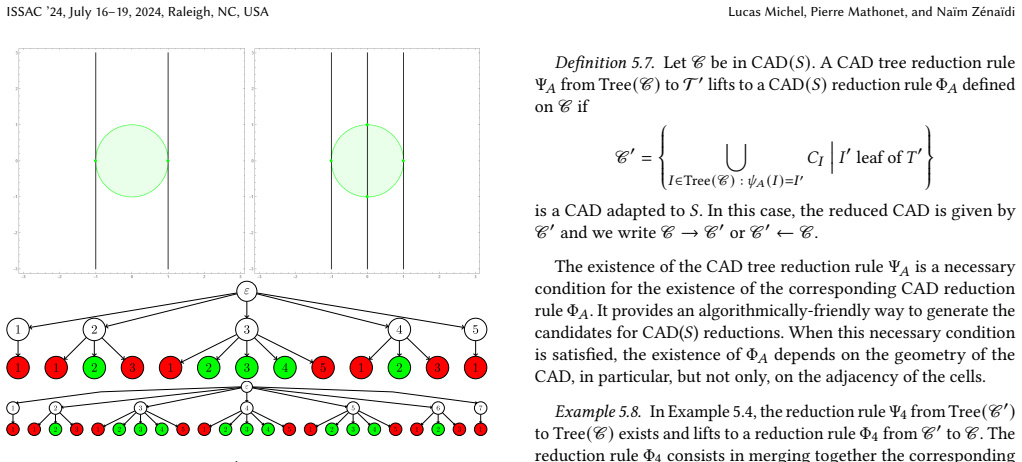
The central discovery is a sharp dimension cut-off for canonical CAD simplification. For every semi-algebraic set $S$ in $\mathbb{R}$ and $\mathbb{R}^2$, any two minimal CADs adapted to $S$ must coincide (Theorem 4.1), so their common refinement is a minimum; the proof glues sections above adjacent base cells using the fact that section functions agree on overlaps (Corollary 3.5). For $n \geq 3$, the set $T = \{(x,y,z)\in\mathbb{R}^3 : (x\leq 0 \lor y\leq 0) \land z=0\} \cup \{(x,y,z)\in\mathbb{R}^3 : x>0,\ y>0,\ z=-x/2\}$ has two distinct minimal adapted CADs and therefore no minimum (Proposition 4.4), with a direct extension to all higher dimensions (Corollary 4.6). The paper concludes with Theorem 5.15: the poset of adapted CADs for $S$ has a minimum if and only if the associated reduction system is confluent.
Load-bearing premise
The proof that planar minimal decompositions coincide assumes that the cutting points and cutting curves of two minimal decompositions match wherever their regions overlap, and that the three neighbouring pieces around a cutting point always meet the corresponding region of the other decomposition; if that matching or those overlaps fail, the coarser decomposition used to force uniqueness cannot be built.
Editorial extensions
If this is right
- In dimensions 1 and 2, any CAD algorithm's output can be post-processed to a unique coarsest adapted CAD, independent of the algorithm's choices.
- In dimension 3 and higher, no canonical simplification exists for some semi-algebraic sets, so any choice of minimal CAD is arbitrary without extra criteria.
- Minimal adapted CADs provide tight lower bounds on the number of cells needed to represent a given set, which can serve as benchmarks for CAD algorithms.
- The reduction system yields an algorithmic route to a minimal CAD by repeatedly applying liftable reduction rules, avoiding exhaustive search over all coarser partitions.
- The confluence criterion connects the existence of a minimum to a terminating rewriting system, placing the problem in the standard framework of abstract reduction systems.
Reading between the lines
- A practical implication the authors leave implicit is that for high-dimensional problems 'the' simplified CAD cannot be defined canonically, so CAD post-processing pipelines must either accept arbitrary minimal outputs or use additional user-chosen criteria to select among them.
- The trousers construction suggests that failure of a minimum arises when a cell is a section in one CAD and part of a sector in another, forcing the glued function to become discontinuous; this may be a general mechanism for non-uniqueness.
- One could test whether the confluence criterion is decidable for sets given by polynomial data, since the reduction system is terminating and admits only finitely many reduction rules at each stage.
- The result mirrors the role of confluence in Gröbner basis theory, raising the question of whether a completion procedure could be developed for adapted CADs.
Editorial analysis
A structured set of objections, weighed in public.
Referee Report
Summary. The paper studies the poset CAD(S) of cylindrical algebraic decompositions adapted to a semi-algebraic set S, ordered by refinement. It proves that every adapted CAD can be reduced to a minimal one (Proposition 3.1), that uniqueness of minimal elements is equivalent to existence of a minimum (Proposition 3.3), and that in a minimal CAD the last-level section functions over each base cell are exactly the boundary of the corresponding slice S_x (Proposition 3.4). The main structural result is Theorem 4.1: for n=1 and n=2 every semi-algebraic S admits a minimum adapted CAD, while for n≥3 there exist explicit semi-algebraic sets, such as the 'trousers' T and its higher-dimensional versions, whose poset has no minimum (Proposition 4.4 and Corollary 4.6). Section 5 introduces CAD-tree reductions, gives an algorithm for computing minimal CADs, and proves that CAD(S) has a minimum if and only if its reduction system is confluent (Theorem 5.15).
Significance. If correct, these are clean structural results about a natural combinatorial object attached to any semi-algebraic set. The dimension threshold 1,2 versus ≥3 is surprising and well illustrated by the explicit trousers example. The paper is purely deductive: it uses no fitted parameters, no data, and no reliance on the authors' prior results; the proofs rest on standard facts such as Collins' theorem and Newman's lemma, together with the authors' explicit constructions. The confluence characterization in Theorem 5.15 connects CADs to abstract reduction systems in an elegant way and gives a useful conceptual counterpart to the Gröbner-basis theory of confluence. The reduction-based algorithm also provides a plausible post-processing framework. I specifically checked the delicate gluing step in the proof of Theorem 4.1: Corollary 3.5, together with the fact that ξ_{2i} is an interior point of the sector C'_{2j-1}, supplies the needed equality of section counts and restrictions, so the uniqueness argument is valid.
minor comments (6)
- [§4, proof of Theorem 4.1] The defining display of e𝒞₂ lists merged unions only for l=1,...,2u'_{2j-1} and thereby omits the top-sector union corresponding to l=2u'_{2j-1}+1; taken literally, e𝒞₂ is not a partition. The surrounding text and the argument clearly intend the full range, so this is a typographical error, but it should be corrected.
- [Corollary 4.6] In the definition of T_n, the second line of the union is written as a subset of R^3; it should be a subset of R^n. This is a typo but could confuse readers.
- [Example 4.8] The claim that neither B nor U admits a minimum CAD is asserted without proof: for B the construction is explicitly omitted, and for U the authors only say that the trousers construction applies after replacing -x/2 by -x/y. Since the main n≥3 counterexample is already fully established by Proposition 4.4 and Corollary 4.6, this omission does not threaten the central claim, but the statements should be proved or the example should be removed.
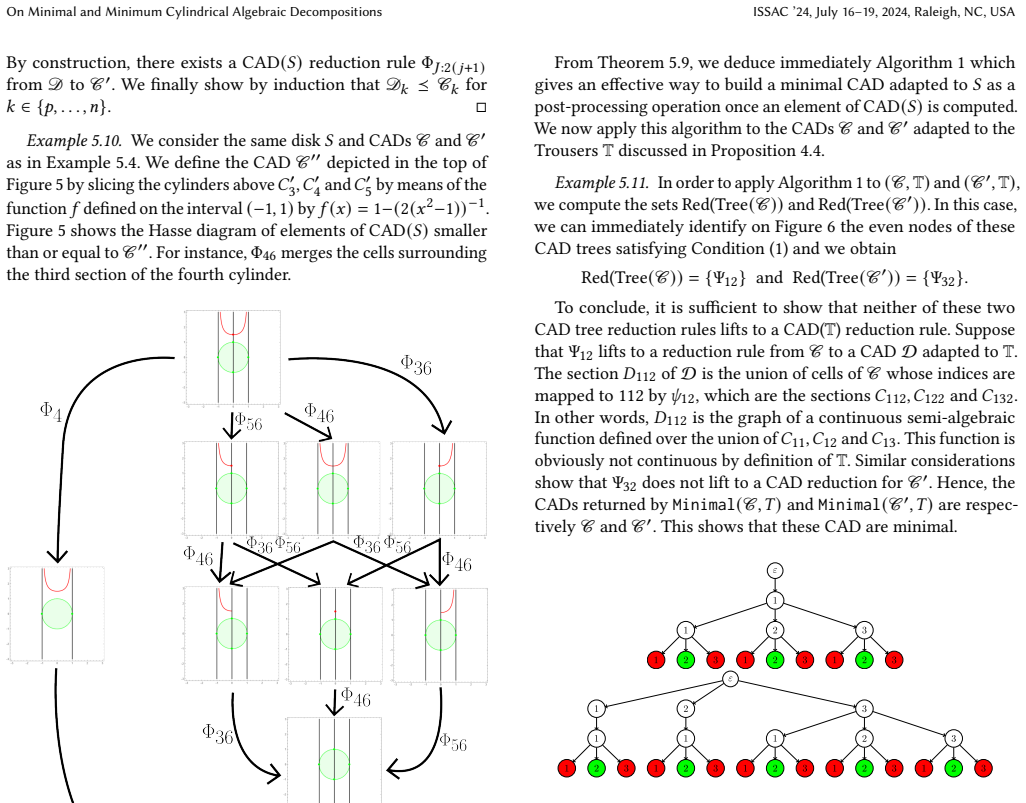
- [Example 5.11] The sentence 'Similar considerations show that Ψ₃₂ does not lift to a CAD reduction for 𝒞′' is very terse. The argument for the first reduction rule is spelled out; the second case should be expanded so that the minimality proof for the second trousers CAD is self-contained.
- [Proof of Proposition 4.4] The notation 'the function x ↦ -x/2 χ(x,y)' is formally incorrect, since the domain of the section is a cell in R^2 and the variable is (x,y); it should read (x,y) ↦ -x/2 χ(x,y). The same issue appears in Example 4.8.
- [Proof of Theorem 5.9] The final sentence says 'We finally show by induction that 𝒟ₖ ⪯ 𝒞ₖ for k∈{p,...,n}', but the induction is not written out. A few sentences explaining the inductive step would make the proof complete.
Circularity Check
No circularity found: the derivation is self-contained and deductive throughout.
full rationale
The paper's derivation chain is self-contained. The main results are proven directly from Collins's CAD theorem and the definition of the refinement poset: Proposition 3.1 is a finite descent argument, Proposition 3.4 and Corollary 3.5 derive equality of section data from minimality, and Theorem 4.1 glues those sections using nonempty overlaps, since the open interval C'_{2j-1} contains the section point xi_{2i}. The n >= 3 counterexamples rest on the explicitly defined trousers T, and the minimality of the two CADs C and C' is justified in Example 5.11 by showing, via Theorem 5.9, that the only tree reduction rules do not lift to CAD reductions. No fitted parameters, empirical data, or prior results of the present authors are used as load-bearing inputs; Theorem 5.15 follows from Theorem 5.9 and the standard Newman's lemma. The only caveats are presentational: Example 4.8 omits the analogous construction for B, and the displayed definition of eC_2 in Theorem 4.1 lists merged unions only up to l = 2u'_{2j-1} while the surrounding text intends the full range through l = 2u'_{2j-1} + 1. These do not affect the validity or circularity of the argument.
Assumptions & free parameters
assumptions (3)
- standard math Collins' theorem: for any finite list of semi-algebraic sets S_1,...,S_p in R^n, there exists a CAD adapted to all of them simultaneously (Remark 2.3).
- standard math Newman's lemma: a terminating and locally confluent abstract rewriting system is confluent (Lemma 5.14).
- domain assumption The fibers S_x = {y in R | (x,y) in S} of a semi-algebraic set are semi-algebraic subsets of R, and their boundaries are finite sets of algebraic points.
Cite this review
Pith. "Pith review of On Minimal and Minimum Cylindrical Algebraic Decompositions." pith.science (2026). https://pith.science/paper/L7C47TAS
@misc{pith2026241113218,
  author       = {Pith},
  title        = {Pith review of: On Minimal and Minimum Cylindrical Algebraic Decompositions},
  year         = {2026},
  howpublished = {\url{https://pith.science/paper/L7C47TAS}},
  note         = {Machine review of arXiv:2411.13218}
}
abstract
We consider cylindrical algebraic decompositions (CADs) as a tool for representing semi-algebraic subsets of $\mathbb{R}^n$. In this framework, a CAD $\mathscr{C}$ is adapted to a given set $S$ if $S$ is a union of cells of $\mathscr{C}$. Different algorithms computing an adapted CAD may produce different outputs, usually with redundant cell divisions. In this paper we analyse the possibility to remove the superfluous data. More precisely we consider the set CAD$(S)$ of CADs that are adapted to $S$, endowed with the refinement partial order and we study the existence of minimal and minimum elements in this poset. We show that for every semi-algebraic set $S$ of $\mathbb{R}^n$ and every CAD $\mathscr{C}$ adapted to $S$, there is a minimal CAD adapted to $S$ and smaller (i.e. coarser) than or equal to $\mathscr{C}$. Moreover, when $n=1$ or $n=2$, we strengthen this result by proving the existence of a minimum element in CAD$(S)$. Astonishingly for $n \geq 3$, there exist semi-algebraic sets whose associated poset of adapted CADs does not admit a minimum. We prove this result by providing explicit examples. We finally use a reduction relation on CAD$(S)$ to define an algorithm for the computation of minimal CADs. We conclude with a characterization of those semi-algebraic sets $S$ for which CAD$(S)$ has a minimum by means of confluence of the associated reduction system.
Figures


Figures from the paper (3 more)

Reference graph
Works this paper leans on
-
[1]
D. S. Arnon, G. E. Collins, and S. McCallum. 1998. Cylindrical Algebraic De- composition I: The Basic Algorithm. In Quantifier Elimination and Cylindrical Algebraic Decomposition, B. F. Caviness and J. R. Johnson (Eds.). Springer Vienna, Vienna, 136–151. https://doi.org/10.1007/978-3-7091-9459-1_6
-
[2]
F. Baader and T. Nipkow. 1998.Term rewriting and all that. Cambridge University Press, USA. https://doi.org/10.1017/CBO9781139172752
-
[3]
S. Basu, R. Pollack, and M.F. Coste-Roy. 2007. Algorithms in Real Algebraic Geometry. Springer Berlin Heidelberg. https://doi.org/10.1007/3-540-33099-2
-
[4]
J. Bochnak, M. Coste, and M-F. Roy. 1998. Real Algebraic Geometry . Springer. https://doi.org/10.1007/978-3-662-03718-8
- [5]
-
[6]
C. W. Brown. 2001. Simple CAD Construction and its Applications. Journal of Symbolic Computation 31, 5 (2001), 521–547. https://doi.org/10.1006/jsco.2000. 0394
-
[7]
C. W. Brown. 2017. Projection and Quantifier Elimination Using Non-Uniform Cylindrical Algebraic Decomposition. In Proceedings of the 2017 ACM on Inter- national Symposium on Symbolic and Algebraic Computation (Kaiserslautern, Germany) (ISSAC ’17). ACM, New York, NY, USA, 53–60. https://doi.org/10.1145/ 3087604.3087651
arXiv 2017
-
[8]
C. Chen and M. M. Maza. 2014. Quantifier Elimination by Cylindrical Algebraic Decomposition Based on Regular Chains. In Proceedings of the 39th International Symposium on Symbolic and Algebraic Computation (Kobe, Japan) (ISSAC ’14). ACM, New York, NY, USA, 91–98. https://doi.org/10.1145/2608628.2608666
arXiv 2014
Show all 18 references
-
[9]
G. E. Collins. 1975. Quantifier elimination for real closed fields by cylindrical algebraic decomposition. Lecture Notes in Computer Science (1975). https://doi. org/10.1007/3-540-07407-4_17
1975 doi
-
[10]
J. H. Davenport, A. S. Nair, G. K. Sankaran, and A. K. Uncu. 2023. Lazard- Style CAD and Equational Constraints. In Proceedings of the 2023 International Symposium on Symbolic and Algebraic Computation (ISSAC ’23) . Association for Computing Machinery, New York, NY, USA, 218–2...
2023
-
[11]
Huang, M
Z. Huang, M. England, D. Wilson, J. H. Davenport, L. C. Paulson, and J. Bridge
-
[12]
D. Lazard. 2010. CAD and Topology of Semi-Algebraic Sets. Math. Comput. Sci. 4, 1 (2010), 93–112. https://doi.org/10.1007/S11786-010-0047-0
2010 doi
-
[13]
Locatelli
A. Locatelli. 2016. On the regularity of cylindrical algebraic decompositions . PhD Thesis. University of Bath
2016
-
[14]
McCallum
S. McCallum. 1998. An Improved Projection Operation for Cylindrical Algebraic Decomposition. In Quantifier Elimination and Cylindrical Algebraic Decomposition, Bob F. Caviness and Jeremy R. Johnson (Eds.). Springer Vienna, Vienna, 242–268. https://doi.org/10.1007/978-3-7091-9459-1_12
1998 doi
-
[15]
piano movers
J. T. Schwartz and M. Sharir. 1983. On the “piano movers” problem. II. General techniques for computing topological properties of real algebraic manifolds. Advances in Applied Mathematics 4, 3 (1983), 298–351. https://doi.org/10.1016/ 0196-8858(83)90014-3
1983
-
[16]
D. Wilson. 2014. Advances in Cylindrical Algebraic Decomposition . PhD Thesis. University of Bath
2014
-
[107]
https://doi.org/10.1007/978-3-319-08434-3_8
-
[2014]
In Intelligent Computer Mathematics
Applying Machine Learning to the Problem of Choosing a Heuristic to Select the Variable Ordering for Cylindrical Algebraic Decomposition. In Intelligent Computer Mathematics. Springer International Publishing, Cham, 92–
Reviewed August 12, 2026 · model on record in the stance chip above.
Discussion (0). Continue with ORCID to comment.