REVIEW 3 major objections 5 minor 1 cited by
Extremum and Nash Equilibrium Seeking with Delays and PDEs: Designs & Applications
T0 review · 3 major / 5 minor · reviewed 2026-08-12 · deepseek-v4-flash
Pith's one-line read Boundary-control extremum seeking drives games whose players act through delays or heat PDEs to a small neighborhood of the Nash equilibrium.
desk verdict A useful consolidation of the authors' ES/NES results for PDE-constrained games, but the central stability claims rest on asserted small-gain verifications that the appendices do not actually carry out. read the letter →
The pith
A machine-rendered reading of the paper's core claim, the machinery that carries it, and where it could break.
The reading
What carries the argument
The load-bearing object is the averaged infinite-dimensional closed loop: a finite-dimensional ODE for the estimated gradient $\hat{G}$ coupled through its boundary condition to a transport or heat PDE that represents the compensated actuator error. A reduction-like transformation, the finite-spectrum assignment in equations (65) and (132)-(133), rewrites the loop so that the ODE sees the boundary control signal directly, and the boundary laws (58), (27), and (122) use only the player's own Hessian diagonal estimate plus an integral of the PDE state. Exponential stability of the average system is established by checking an input-to-state small-gain condition for the PDE-ODE interconnection, where the game coupling $\epsilon$ appears in the interconnection gains, and an averaging theorem for infinite-dimensional systems then converts that stability into convergence of the original periodic closed loop.
What would settle it
Compute the input-to-state gains $\gamma_0$ and $b_3$ for the averaged two-player heat-PDE loop (70)-(73) from the variation-of-constants formula and the integral bounds in Appendix A, for example with $D_1=1$, $D_2=2$, and diagonal-dominant Hessian entries, and test the small-gain inequalities (283) along a sequence $\epsilon\to 0$. If the gain product fails to stay below one, or if a direct simulation of the averaged loop for those parameters shows no exponential decay, the asserted verification is wrong and Theorem 1's conclusion is unsupported.
Extended reading notes
Core claim
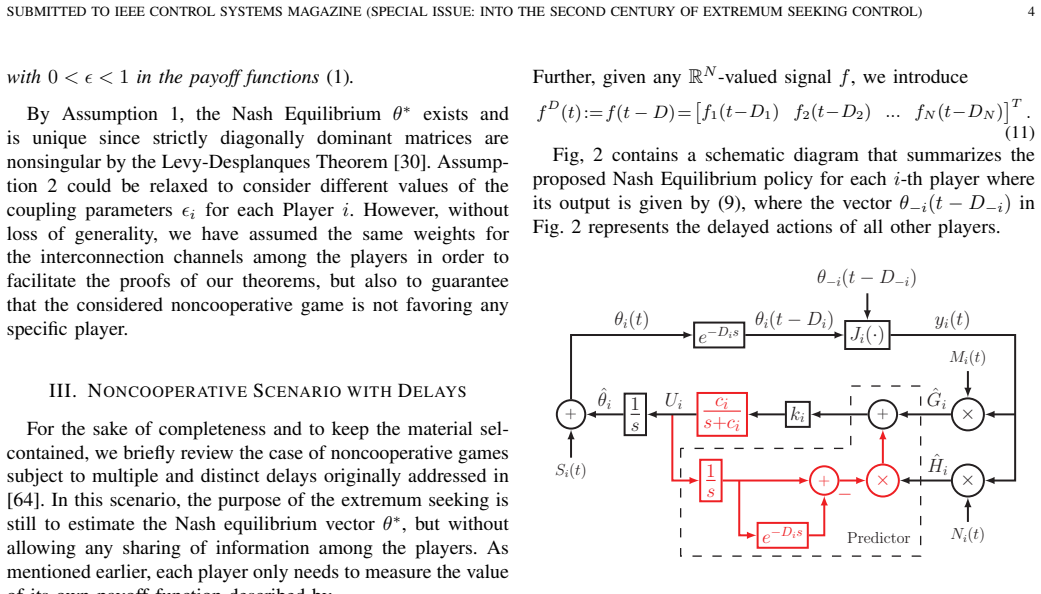
On the paper's own terms, the central discovery is a design-and-stability statement: in an $N$-player quadratic game where each player measures only its own payoff and knows only its own delay or diffusion domain, a boundary controller that compensates that player's actuation PDE lets all players collectively find the Nash equilibrium. Theorem 1 covers arbitrary distinct heat PDEs, Theorem 2 covers arbitrary distinct delays, and Theorem 3 covers a duopoly with one transport player and one heat player. In each case, the closed-loop error system has a unique locally exponentially stable periodic solution, and the propagated action vector satisfies $\limsup_{t\to\infty}|\Theta(t)-\Theta^*|=O(|a|+1/\omega)$, with the finer bounds $|\theta_1(t)-\theta_1^*|=O(a_1+1/\omega)$ and $|\theta_2(t)-\theta_2^*|=O(a_2e^{D_2\sqrt{\omega}/2}+1/\omega)$ in the heterogeneous duopoly. The paper also shows that scalar extremum seeking with PDE actuation is a corollary of the Nash results, and it catalogues a broad set of PDE types for which the same template, trajectory-generated probing signals plus boundary control, applies.
Load-bearing premise
The whole theorem rests on the claim, stated but not fully derived in the appendices, that the averaged PDE-ODE loop satisfies the small-gain condition needed for exponential stability for sufficiently small coupling $\epsilon$; if that verification fails, the convergence result collapses.
Editorial extensions
If this is right
- Theorem 1: in the heat-PDE game, $\limsup_{t\to\infty}|\Theta(t)-\Theta^*|=O(|a|+1/\omega)$ while the boundary inputs satisfy $\limsup_{t\to\infty}|\theta(t)-\theta^*|=O(|a|e^{\max_i D_i\sqrt{\omega}/2}+1/\omega)$, so the exponential probing amplification is confined to the input side.
- Theorem 2: with arbitrary distinct input delays, the predictor feedback (27) gives $\limsup_{t\to\infty}|\theta(t)-\theta^*|=O(|a|+1/\omega)$, the same residual order as a delay-free game.
- Theorem 3: in the transport-heat duopoly, the transport player converges to $O(a_1+1/\omega)$ and the heat player to $O(a_2e^{D_2\sqrt{\omega}/2}+1/\omega)$ of their Nash actions, despite each player compensating only its own PDE.
- Scalar extremum seeking with PDE actuation follows as a corollary (Remark 1), so every single-agent result in the paper's PDE catalogue inherits the same stability template.
- The boundary-control-plus-probing template is listed for reaction-advection-diffusion, wave, variable-delay, and distributed-delay actuation (Table I), indicating the design is not tied to heat or transport equations specifically.
Reading between the lines
- The numerical example uses $\epsilon=1$, outside the theorem's stated $0<\epsilon<1$ range, and still converges; I take this as evidence that the small-coupling assumption is conservative, though the paper does not promote this observation to a theorem.
- The residual bound for a heat-PDE player contains $e^{D\sqrt{\omega}/2}$, so a long diffusion domain forces a practical trade-off: to keep the Nash neighborhood tight one must shrink the probing amplitude, which in turn weakens the gradient estimate. I expect this trade-off to be the practical bottleneck in thermal and diffusion applications.
- The small-gain framework used for two PDE classes is generic enough that the same proof structure should cover games with more than two heterogeneous players, or mixtures involving wave and reaction-advection-diffusion dynamics, once the missing gain verifications are supplied.
- Since the payoffs are quadratic, a standard local-quadratic approximation argument suggests the theorems extend to smooth strictly concave payoffs in a neighborhood of the equilibrium; checking this explicitly would be a natural follow-up.
Editorial analysis
A structured set of objections, weighed in public.
Referee Report
Summary. The paper presents boundary-control extremum seeking (ES) and Nash equilibrium seeking (NES) algorithms for quadratic noncooperative games in which players' actions are filtered through delays, heat PDEs, or a heterogeneous transport-heat PDE pair. The main theoretical results, Theorems 1-3, assert that with sufficiently large filter gains and frequencies and sufficiently small coupling ε, the closed-loop system has a locally exponentially stable periodic solution and converges to an O(|a|+1/ω) neighborhood of the Nash equilibrium (with additional exponentially growing amplitude factors in the input-side bounds). The paper also reviews applications to traffic, drilling, source seeking, additive manufacturing, bioreactors, and neuromuscular stimulation, and includes a duopoly simulation.
Significance. If fully proven, the results would be a significant extension of model-free ES/NES to infinite-dimensional actuator dynamics, providing constructive boundary controllers and explicit residual bounds. The paper is well organized, connects to a large body of prior work, and the simulation illustrates the proposed laws. The main limitations are in the proof apparatus: the central stability theorems are reduced to small-gain verifications that are asserted rather than demonstrated, and at least one parameter mapping appears inconsistent with the plant boundary condition. The survey and application sections are informative, but the technical contribution is not yet fully supported.
major comments (3)
- [Appendix A (Theorem 1), Eqs. (278)-(281)] The verification of assumptions (A1)-(A7) of [34, Theorem 8.2] is not carried out. In particular, the plant's boundary at x=0 is the homogeneous Neumann condition ∂x u_i^av(0,t)=0 (Eq. (280)), while the parameter list assigns φ0(0,u_i^av,¯G_i^av)=b1 u_i^av(0,t) with b1<0. Since the small-gain condition (8.3.24) and the asserted O(ε) scaling of γ0 and b3 depend on the boundary operator at x=0, the current text does not establish the exponential stability of the averaged system (70)-(73). Please provide the correct parameter mapping for a Neumann boundary or show directly that the resulting ISS gains scale as claimed.
- [Appendices B and C (Theorems 2 and 3)] The proofs of Theorems 2 and 3 rely on the same pattern: the average closed-loop systems (286)-(288) and (292)-(296) are claimed to satisfy the hypotheses (H1)-(H2) or (A1)-(A7) of [34, Theorems 8.1 and 8.2], and the small-gain condition is asserted to hold for sufficiently small ε. No explicit verification of the gains (b3, γ0, γ1) or of the small-gain inequality is given; phrases such as 'can be readily verified' (after Eq. (297)) and 'it is not difficult to see' (Eqs. (66) and (134)) are not sufficient for a journal publication. Because local exponential stability of the average system is the load-bearing premise for the subsequent averaging argument and residual bounds, these steps must be supplied or replaced by precise pointers to the corresponding theorems in [60].
- [Theorems 1 and 3, Eqs. (76) and (148)] The residual bounds for the input-side estimates contain factors e^{max(D_i)√ω/2} and e^{D2√ω/2}, which grow with ω. The theorems state existence of sufficiently large ω while simultaneously using bounds that deteriorate as ω grows. Without an explicit scaling of the dither amplitudes a_i with ω (e.g., a_i = o(e^{-D_i√ω/2})), the assertion that θ(t) converges to a small neighborhood of θ* is not justified for the claimed parameter regime. Please state the admissible parameter scaling or reformulate the residual bound as a trade-off.
minor comments (5)
- [Section I] The word 'dealts' in the opening sentence should be 'deals'.
- [Section IV] The symbol D is overloaded: it denotes the delay matrix, the vector of domain lengths, the diffusion operator, and the spatial domain length. This causes confusion in equations such as (33) and (62); please use distinct notation or explicitly disambiguate.
- [Section X] In the sentence defining the low-pass filter, 'steads for convolution' should be 'stands for convolution'.
- [Appendix H] The heading 'THE BASIC IDEA OF NASH EQULIBRIUM SEEKING' contains a typo; it should be 'EQUILIBRIUM'.
- [Section VII] The simulation uses ε=1, which is outside the theorem's stated 0<ε<1. The text acknowledges that this suggests the analysis may be conservative, but the simulation should not be read as validation of the theorem's assumptions; this limitation should be stated more prominently.
Circularity Check
No significant circularity: the convergence theorems are not forced by construction; the main proof gaps are omitted small-gain verifications, not circular reductions.
full rationale
None of the load-bearing steps reduces to its own inputs by construction. Theorems 1–3 assert existence of design parameters (sufficiently large c and ω, sufficiently small ε) and derive exponential convergence of an averaged PDE–ODE loop to a residual set of size O(|a|+1/ω); the residual bounds are obtained via the general infinite-dimensional averaging theorem [25] after exponential stability of the average system is established, not by fitting parameters to the claimed Nash equilibrium. The stability verification in Appendices A–C relies on the Karafyllis–Krstić ISS small-gain theorems [34] and contains genuine omissions, e.g., the assertions that conditions “can be readily verified” (Appendix A, after Eq. (281)) and that “with some mathematical manipulations, it is not difficult to see” (Eq. (66) and Eq. (134)). There is also a possible correctness concern in Appendix A, where the listed mapping φ0(0,u_i,¯G_i)=b_1 u_i(0,t) is asserted while the plant boundary condition is the homogeneous Neumann condition ∂_x u_i(0,t)=0 (Eq. (280)); these are incomplete or mismatched verifications, but they are not circularity, because [34] is an external mathematical theorem and the paper does not define its target result into its assumptions. Self-citations to [18], [61], [62], [63], [65] supply design templates and conference versions of related games, but the central convergence claims are argued from the averaged closed loop and independent small-gain/averaging theorems rather than being justified solely by those citations. Therefore the paper is not circular, though its proof completeness is imperfect.
Assumptions & free parameters
assumptions (6)
- standard math Averaging theorem for infinite-dimensional systems (Hale and Lunel 1990) applies to the closed-loop parabolic/hyperbolic PDE-ODE systems.
- standard math Small-gain theorems for ODE-PDE loops (Karafyllis and Krstic 2018, Theorems 8.1, 8.2, 11.5) are applicable to the averaged closed-loop system.
- standard math Levy-Desplanques theorem: strictly diagonally dominant matrices are nonsingular.
- domain assumption Payoff functions are quadratic, strictly concave in each player's own action, with diagonal dominance of the Hessian and equal coupling weights (Assumptions 1-3).
- domain assumption Players only know their own payoff, their own constant delay or domain length D_i, and the parameters of their own probing signals; no information sharing.
- ad hoc to paper The averaged PDE-ODE closed-loop systems satisfy the assumptions (A1)-(A7) and (H1)-(H2) of the small-gain theorems with the specific gains stated in Appendices A-C.
Cite this review
Pith. "Pith review of Extremum and Nash Equilibrium Seeking with Delays and PDEs: Designs & Applications." pith.science (2026). https://pith.science/paper/WAZVDRYU
@misc{pith2026241113234,
  author       = {Pith},
  title        = {Pith review of: Extremum and Nash Equilibrium Seeking with Delays and PDEs: Designs & Applications},
  year         = {2026},
  howpublished = {\url{https://pith.science/paper/WAZVDRYU}},
  note         = {Machine review of arXiv:2411.13234}
}
read the original abstract
The development of extremum seeking (ES) has progressed, over the past hundred years, from static maps, to finite-dimensional dynamic systems, to networks of static and dynamic agents. Extensions from ODE dynamics to maps and agents that incorporate delays or even partial differential equations (PDEs) is the next natural step in that progression through ascending research challenges. This paper reviews results on algorithm design and theory of ES for such infinite-dimensional systems. Both hyperbolic and parabolic dynamics are presented: delays or transport equations, heat-dominated equation, wave equations, and reaction-advection-diffusion equations. Nash equilibrium seeking (NES) methods are introduced for noncooperative game scenarios of the model-free kind and then specialized to single-agent optimization. Even heterogeneous PDE games, such as a duopoly with one parabolic and one hyperbolic agent, are considered. Several engineering applications are touched upon for illustration, including flow-traffic control for urban mobility, oil-drilling systems, deep-sea cable-actuated source seeking, additive manufacturing modeled by the Stefan PDE, biological reactors, light-source seeking with flexible-beam structures, and neuromuscular electrical stimulation.
Figures


Figures from the paper (31 more)


Forward citations
Cited by 1 Pith paper
-
Lie-Bracket Nash Equilibrium Seeking with Bounded Update Rates for Noncooperative Games
A bounded-update-rate extremum seeking controller drives players in quadratic noncooperative games to a small neighborhood of the Nash equilibrium, with local exponential convergence shown via Lie-bracket averaging.
Reference graph
Works this paper leans on
-
[60]
T. R. Oliveira and M. Krsti ´c. Extremum Seeking through Delays and PDEs. SIAM, 2022
work page 2022
-
[1]
U. J. Aarsnes, O. M. Aamo, and M. Krsti ´c. Extremum seeking for real- time optimal drilling control. In IEEE American Control Conference , pages 5222–5227, Philadelphia, 2019
2019
-
[2]
Alibeji, N
N. Alibeji, N. Kirsch, S. Farrokhi, and N. Sharma. Further results on predictor-based control of neuromuscular electrical stimulation. IEEE Transactions on Neural Systems and Rehabilitation Engineering , 23:1095–1105, 2015
2015
-
[3]
Alibeji and N
N. Alibeji and N. Sharma. A PID-type robust input delay compensation method for uncertain euler–lagrange systems. IEEE Transactions on Control Systems Technology, 25:2235–2242, 2017
2017
-
[4]
Alpcan and T
T. Alpcan and T. Bas ¸ar. Network Security: A Decision and Game Theoretic Approach. Cambridge University Press, 2011
2011
-
[5]
S. Amin, G. A. Schwartz, and S. S. Sastry. Security of interdependent and identical networked control systems. Automatica, 49:186–192, 2013
2013
- [6]
-
[7]
A. Baccoli, A. Pisano, and Y . Orlov. Boundary control of coupled reaction–diffusion processes with constant parameters. Automatica, 54:80–90, 2015. SUBMITTED TO IEEE CONTROL SYSTEMS MAGAZINE (SPECIAL ISSUE: INTO THE SECOND CENTURY OF EXTREMUM SEEKING CONTROL) 37
work page 2015
Show all 85 references
-
[8]
Bas ¸ar and G
T. Bas ¸ar and G. J. Olsder. Dynamic Noncooperative Game Theory . SIAM, 1999
1999
-
[9]
Bekiaris-Liberis and M
N. Bekiaris-Liberis and M. Krsti ´c. Compensation of wave actuator dynamics for nonlinear systems. IEEE Transactions on Automatic Control, 59:1555–1570, 2014
2014
-
[10]
R. C. Carlson, I. Papamichail, M. Papageorgiou, and A. Messmer. Optimal motorway traffic flow control involving variable speed limits and ramp metering. Transportation Science, 44:238–253, 2010
2010
-
[11]
Carmona, J.-
R. Carmona, J.-. P. Fouque, S. M. Mousavi, and L.-H. Sun. Systemic risk and stochastic games with delay. Journal of Optimization Theory and Applications, 179:366–399, 2018
2018
-
[12]
M. D. Ciletti. Differential games with information time lag: Norm- invariant systems. Journal of Optimization Theory and Applications , 9:293–301, 1972
1972
-
[13]
Cougnon, D
P. Cougnon, D. Dochain, M. Guay, and M. Perrier. Real-time optimiza- tion of a tubular reactor with distributed feed. American Institute of Chemical Engineers Journal , 52:2120–2128, 2006
2006
-
[14]
Dervisoglu, G
G. Dervisoglu, G. Gomes, J. Kwon, R. Horowitz, and P. Varaiya. Auto- matic calibration of the fundamental diagram and empirical observations on capacity. In Transportation Research Board 88th Annual Meeting , pages 1–14, 2009
2009
-
[15]
W. B. Dunbar, N. Petit, P. Rouchon, and P. Martin. Motion planning for a nonlinear Stefan problem. ESAIM: Control, Optimisation and Calculus of Variations, 9:275–296, 2003
2003
-
[16]
Ehtamo and R
H. Ehtamo and R. P. H ¨am¨al¨ainen. Incentive strategies and equilibria for dynamic games with delayed information. Journal of Optimization Theory and Applications , 63:355–369, 1989
1989
-
[17]
Fan and B
S. Fan and B. Seibold. Data-fitted first-order traffic models and their second-order generalizations: Comparison by trajectory and sensor data. Transportation Research Record, 2391:32–43, 2013
2013
-
[18]
Feiling, S
J. Feiling, S. Koga, M. Krsti ´c, and T. R. Oliveira. Gradient extremum seeking for static maps with actuation dynamics governed by diffusion PDEs. Automatica, 95:197–206, 2018
2018
-
[19]
T. I. Fossen. Handbook of Marine Craft Hydrodynamics and Motion Control. Wiley, Chichester, 2011
2011
-
[20]
E. Fridman. Introduction to Time-Delay Systems - Analysis and Control. Birkh¨auser Basel, 2014
2014
-
[21]
Frihauf, M
P. Frihauf, M. Krstic, and T. Bas ¸ar. Nash equilibrium seeking in non- cooperative games. IEEE Transactions on Automatic Control, 57:1192– 1207, 2012
2012
-
[22]
M. L. Galvao, T. R. Oliveira, and M. Krstic. Extremum seeking for stefan problem with moving boundary and delays. In IFAC-PapersOnLine, volume 55, pages 222–227, 2022
2022
-
[23]
Ghaffari, M
A. Ghaffari, M. Krsti ´c, and D. Ne ˇsi´c. Multivariable Newton-based extremum seeking. Automatica, 48:1759–1767, 2012
2012
-
[24]
V . Y . Glizer and J. Shinar. Optimal evasion from a pursuer with delayed information. Journal of Optimization Theory and Applications , 111:7– 38, 2001
2001
-
[25]
J. K. Hale and S. M. V . Lunel. Averaging in infinite dimensions. Journal of Integral Equations and Applications , 2:463–494, 1990
1990
-
[26]
J. K. Hale and S. M. V . Lunel. Introduction to Functional Differential Equations. Springer, 1993
1993
-
[27]
Z. Han, D. Niyato, W. Saad, and T. Bas ¸ar. Game Theory for Next Generation Wireless and Communication Networks: Modeling, Analysis, and Design. Cambridge University Press, 2009
2009
-
[28]
Hegyi, B
A. Hegyi, B. D. Schutter, and H. Hellendoorn. Model predictive control for optimal coordination of ramp metering and variable speed limits. Transportation Research Part C: Emerging Technologies , 13:185–209, 2005
2005
-
[29]
C. D. Hill. Parabolic equations in one space variable and the non- characteristic Cauchy problem. Communications on Pure and Applied Mathematics, 20:619–633, 1967
1967
-
[30]
R. A. Horn and C. R. Johnson. Matrix Analysis. Cambridge University Press, 1985
1985
-
[31]
Hudon, M
N. Hudon, M. Guay, M. Perrier, and D. Dochain. Adaptive extremum- seeking control of convection-reaction distributed reactor with limited actuation. Computers and Chemical Engineering , 32:2994–3001, 2008
2008
-
[32]
O. C. Imer, S. Compans, T. Bas ¸ar, and R. Srikant. Abr congestion control in ATM networks. IEEE Control Systems Magazine , 21:38–56, 2001
2001
-
[33]
P. A. Ioannou and J. Sun. Robust Adaptive Control. PTR Prentice-Hall, 1996
1996
-
[34]
Karafyllis and M
I. Karafyllis and M. Krsti ´c. Input-to-State Stability for PDEs . Springer, 2018
2018
-
[35]
Karafyllis and M
I. Karafyllis and M. Papageorgiou. Feedback control of scalar conser- vation laws with application to density control in freeways by means of variable speed limits. Automatica, 105:228–236, 2019
2019
-
[36]
Kaskosz and T
B. Kaskosz and T. Tadumadze. A differential game of evasion with delays. Journal of Optimization Theory and Applications , 44:231–268, 1984
1984
-
[37]
H. K. Khalil. Nonlinear systems. Prentice Hall, 2002
2002
-
[38]
Killingsworth and M
N. Killingsworth and M. Krstic. Pid tuning using extremum seeking. IEEE Control Systems Magazine , 26:70–79, 2006
2006
-
[39]
S. Koga, M. Diagne, and M. Krsti ´c. Control and state estimation of the one-phase Stefan problem via backstepping design. IEEE Transactions on Automatic Control , 64:510–525, 2019
2019
-
[40]
Koga and M
S. Koga and M. Krsti ´c. Materials Phase Change PDE Control & Estimation: From Additive Manufacturing to Polar Ice . Birkha ¨user, 2020
2020
-
[41]
Koga and M
S. Koga and M. Krsti ´c. Control of stefan system and applications: a tutorial review. Annual Reviews in Control, Robotics, and Autonomous Systems, 5:547–577, 2022
2022
-
[42]
Krsti ´c
M. Krsti ´c. Delay Compensation for Nonlinear, Adaptive, and PDE Systems. Birkha ¨user, 2009
2009
-
[43]
M. Krstic. Compensation of infinite-dimensional actuator and sensor dynamics: Nonlinear and delay-adaptive systems. IEEE Control Systems Magazine, 30:22–41, 2010
2010
-
[44]
Krsti ´c and A
M. Krsti ´c and A. Smyshlyaev. Boundary Control of PDEs: A Course on Backstepping Designs . SIAM, 2008
2008
-
[45]
Krsti ´c and H
M. Krsti ´c and H. H. Wang. Stability of extremum seeking feedback for general nonlinear dynamic systems. Automatica, 36:595–601, 2000
2000
-
[46]
Laroche, P
B. Laroche, P. Martin, and P. Rouchon. Motion planning for a class of partial differential equations with boundary control. In Proc. of the 37th IEEE Conference on Decision and Control, volume 3, pages 3494–3497 vol.3, 1998
1998
-
[47]
Lewicka and J
M. Lewicka and J. J. Manfredi. Game theoretical methods in PDEs. Bollettino dell’Unione Matematica Italiana , 7:211–216, 2014
2014
-
[48]
T. Li, G. Peng, Q. Zhu, and T. Bas ¸ar. The confluence of networks, games, and learning: A game-theoretic framework for multiagent decision making over networks. IEEE Control Systems Magazine , 42:35–67, 2022
2022
-
[49]
Liu and M
S.-J. Liu and M. Krsti ´c. Stochastic Averaging and Stochastic Extremum Seeking. Springer, 2012
2012
-
[50]
X. Y . Lu, P. Varaiya, R. Horowitz, D. Su, and S. E. Shladover. Novel freeway traffic control with variable speed limit and coordinated ramp metering. Transportation Research Record, 2229:55–65, 2011
2011
-
[51]
Merad, R
M. Merad, R. J. Downey, S. Obuz, and W. E. Dixon. Isometric torque control for neuromuscular electrical stimulation with time-varying input delay. IEEE Transactions on Control Systems Technology , 24:971–978, 2016
2016
-
[52]
Mori and E
K. Mori and E. Shimemura. Linear differential games with delayed and noisy information. Journal of Optimization Theory and Applications , 13:275–289, 1974
1974
-
[53]
J. F. Nash. Noncooperative games. Annals of Mathematics, 54:286–295, 1951
1951
-
[54]
T. R. Oliveira, J. Feiling, S. Koga, and M. Krsti ´c. Multivariable extremum seeking for PDE dynamic systems. IEEE Transactions on Automatic Control, 65:4949–4956, 2020
2020
-
[55]
T. R. Oliveira, J. Feiling, S. Koga, and M. Krstic. Extremum seeking for unknown scalar maps in cascade with a class of parabolic partial differential equations. International Journal of Adaptive Control and Signal Processing, 35:1162–1187, 2021
2021
-
[56]
T. R. Oliveira, J. Feiling, and M. Krsti ´c. Extremum seeking for max- imizing higher derivatives of unknown maps in cascade with reaction- advection-diffusion pdes. IFAC-PapersOnLine, 52:210–215, 2019
2019
-
[57]
T. R. Oliveira and M. Krsti ´c. Compensation of wave pdes in actuator dynamics for extremum seeking feedback. IFAC-PapersOnLine, 52:134– 139, 2019
2019
-
[58]
T. R. Oliveira and M. Krstic. Extremum seeking boundary control for PDE-PDE cascades. Systems and Control Letters , 155:paper 105004, 1–15, 2021
2021
-
[59]
T. R. Oliveira and M. Krstic. Extremum seeking feedback with wave partial differential equation compensation. ASME Journal of Dynamic Systems, Measurement, and Control , 143:paper 041002, 2021
2021
-
[61]
T. R. Oliveira, M. Krsti ´c, and D. Tsubakino. Extremum seeking for static maps with delays. IEEE Transactions on Automatic Control , 62:1911– 1926, 2017
1911
-
[62]
T. R. Oliveira, V . H. P. Rodrigues, M. Krsti ´c, and T. Bas ¸ar. Nash equilibrium seeking with arbitrarily delayed player actions. In IEEE Conference on Decision and Control, pages 150–155, Jeju Island, 2020. SUBMITTED TO IEEE CONTROL SYSTEMS MAGAZINE (SPECIAL ISSUE: INTO THE...
2020
-
[63]
T. R. Oliveira, V . H. P. Rodrigues, M. Krsti ´c, and T. Bas ¸ar. Nash equi- librium seeking in heterogeneous noncooperative games with players acting through heat PDE dynamics and delays. In IEEE Conference on Decision and Control , pages 1167–1173, Austin, Texas, 2021
2021
-
[64]
T. R. Oliveira, V . H. P. Rodrigues, M. Krsti ´c, and T. Bas ¸ar. Nash equilibrium seeking in quadratic noncooperative games under two de- layed information-sharing schemes. Journal of Optimization Theory and Applications, 191:700–735, 2021
2021
-
[65]
T. R. Oliveira, V . H. P. Rodrigues, M. Krsti ´c, and T. Bas ¸ar. Nash equilibrium seeking with players acting through heat PDE dynamics. In IEEE American Control Conference , pages 684–689, New Orleans, 2021
2021
-
[66]
O. M. Pamen. Optimal control for stochastic delay systems under model uncertainty: A stochastic differential game approach. Journal of Optimization Theory and Applications , 167:998–1031, 2015
2015
-
[67]
P. Paz, T. R. Oliveira, A. V . Pino, and A. P. Fontana. Model-free neuromuscular electrical stimulation by stochastic extremum seeking. IEEE Transactions on Control Systems Technology , 28:238–253, 2020
2020
-
[68]
J. I. Poveda, M. Krstic, and T. Bas ¸ar. Fixed-time Nash equilibrium seeking in time-varying networks. IEEE Transactions on Automatic Control, 68:1954–1969, 2023
1954
-
[69]
E. O. Roxin. Differential games with partial differential equations. In H. W. K. P. Hagedorn and G. J. Olsder, editors, Differential Games and Applications, pages 157–168. Springer, 1977
1977
-
[70]
Rusiti, T
D. Rusiti, T. R. Oliveira, M. Krstic, and M. Gerdts. Newton-based extremum seeking of higher-derivative maps with time-varying de- lays. International Journal of Adaptive Control and Signal Processing , 35:1202–1216, 2021
2021
-
[71]
Sharma, C
N. Sharma, C. Gregory, and W. E. Dixon. Predictor-based compensation for electromechanical delay during neuromuscular electrical stimulation. IEEE Transactions on Neural Systems and Rehabilitation Engineering , 19:601–611, 2011
2011
-
[72]
P. C. S. Silva, P. C. Pellanda, T. R. Oliveira, G. A. de Andrade, and M. Krstic. Extremum seeking for a class of wave partial differential equations with Kelvin-Voigt damping. IEEE Control Systems Letters , 8:43–48, 2024
2024
-
[73]
Siranosian, M
A. Siranosian, M. Krstic, A. Smyshlyaev, and M. Bement. Motion planning and tracking for tip displacement and deflection angle for flexible beams. Journal of Dynamic Systems, Measurement, and Control, 131:1–10, 2009
2009
-
[74]
E. D. Sontag and Y . Wang. On characterizations of the input-to-state stability property. Systems & Control Letters , 24:351–359, 1995
1995
-
[75]
Y . Tan, D. Nesi ´c, and I. Mareels. On non-local stability properties of extremum seeking control. Automatica, 42:889–903, 2006
2006
-
[76]
Treiber and A
M. Treiber and A. Kesting. Traffic Flow Dynamics. Springer, 2013
2013
-
[77]
Tsubakino, T
D. Tsubakino, T. R. Oliveira, and M. Krsti ´c. Extremum seeking under distributed input delay. In IFAC-PapersOnLine, volume 53, pages 5423– 5428, 2020
2020
-
[78]
Tsubakino, T
D. Tsubakino, T. R. Oliveira, and M. Krsti ´c. Extremum seeking for distributed delays. Automatica, 153:1–14, 2023. Paper 111044
2023
-
[79]
J. J. Winkin, D. Dochain, and P. Ligarius. Dynamical analysis of distributed parameter tubular reactors. Automatica, 36:349–361, 2000
2000
-
[80]
H. Yu, M. Diagne, L. Zhang, and M. Krsti ´c. Bilateral boundary control of moving shockwave in LWR model of congested traffic. IEEE Transactions on Automatic Control , 66:1429–1436, 2020
2020
-
[81]
H. Yu, S. Koga, T. R. Oliveira, and M. Krsti ´c. Extremum seeking for traffic congestion control with a downstream bottleneck. ASME Journal of Dynamic Systems, Measurement, and Control , 143:1–10, 2021
2021
-
[82]
Yu and M
H. Yu and M. Krsti ´c. Traffic congestion control for Aw-Rascle-Zhang model. Automatica, 100:38–51, 2019
2019
-
[83]
Zhang and P
Y . Zhang and P. A. Ioannou. Coordinated variable speed limit, ramp metering and lane change control of highway traffic. In IFAC- PapersOnLine, volume 50, pages 5307–5312, 2017
2017
-
[84]
Zhu and T
Q. Zhu and T. Bas ¸ar. Game-theoretic methods for robustness, security and resilience of cyber-physical control systems: Games-in-games prin- ciple for optimal cross-layer resilient control systems. IEEE Control Systems Magazine, 35:46–65, 2015
2015
-
[85]
Extremum Seeking through Delays and PDEs
Q. Zhu and T. Bas ¸ar. Disentangling resilience from robustness: Con- textual dualism, interactionism, and game-theoretic paradigms. IEEE Control Systems Magazine , 44:94–103, 2024. Tiago Roux Oliveira is a Senior Member of IEEE. He joined State University of Rio de Janeiro (U...
2024
Reviewed August 12, 2026 · model on record in the stance chip above.
Discussion (0). Continue with ORCID to comment.