REVIEW 2 major objections 5 minor 62 references
Quantum Micromagnetic Theory of Magnons in Finite Nanostructures
T0 review · 2 major / 5 minor · reviewed 2026-08-12 · deepseek-v4-flash
Pith's one-line read This paper establishes a quantum micromagnetics formalism that derives the complete discrete magnon spectrum of a finite ferromagnetic nanostructure of arbitrary shape and noncollinear ground state from a generalized eigenvalue problem…
desk verdict Genuine extension of magnon quantization to noncollinear ground states, with a self-consistent derivation; the main risk is the unproved spectral completeness assumption that supports the thermal sums. read the letter →
The pith
A machine-rendered reading of the paper's core claim, the machinery that carries it, and where it could break.
The reading
What carries the argument
The load-bearing object is the operator $D_{0\perp} = P_\perp\cdot D + \lambda_0$, the projection of the linearized effective-field operator onto the plane transverse to the classical ground state, together with the Hermitian operator $i\Lambda_0$ that encodes the local cross product $m_0\times\cdot$. The argument runs by writing the transverse magnetization field as a generalized Fourier expansion in complex mode profiles $\varphi_p(x)$, and imposing two conditions: orthogonality of the profiles under $D_{0\perp}$, which diagonalizes the quadratic Hamiltonian, and a generalized normalization condition (53), which enforces canonical commutation relations for the magnon creation and annihilation operators. That pair of conditions converts the classical micromagnetic normal-mode eigenproblem into the quantum magnon problem, with frequencies $\omega_p = \gamma\mu_0 M_0\,\nu_p$.
What would settle it
Compute, for a disk with a skyrmion ground state, the overlap integrals in (53) for the numerically obtained eigenfunctions of (54); if the resulting matrix is not proportional to the identity or its diagonal entries deviate from $\gamma\hbar/M_0$, the canonical commutation relations (48) fail and the magnon expansion is not canonical. Alternatively, verify completeness by checking that the truncated expansion (43) reproduces the field commutation relation (34) as the number of modes grows.
Extended reading notes
Core claim
The central claim is that diagonalizing the linearized quantum magnetization dynamics equation, obtained by expanding the micromagnetic Hamiltonian around a classical noncollinear equilibrium in powers of the transverse magnetization and keeping only quadratic terms, yields the complete discrete magnon spectrum of a finite nanostructure. The modes $\varphi_p$ are obtained from the generalized eigenproblem $D_{0\perp}[\varphi_p] = \nu_p\, i\Lambda_0\cdot\varphi_p$ with boundary conditions (55), normalized so that the generalized overlap condition (53) reproduces the canonical commutation relations (48). The resulting creation and annihilation operators diagonalize the quadratic Hamiltonian into independent harmonic oscillators, and thermal expectation values such as $\langle |\hat{M}_\perp|^2\rangle$ are sums of Bose occupation factors weighted by squared mode profiles. Numerical solutions for thin disks show edge-localized modes producing larger thermal fluctuations at boundaries than infinite-film plane-wave predictions, and for a skyrmion ground state, fluctuations concentrate where the equilibrium magnetization has its steepest gradients.
Load-bearing premise
The construction assumes that the eigenfunctions of the generalized eigenvalue problem are complete and can be simultaneously normalized to satisfy both orthogonality conditions, and for the cases with chiral (Dzyaloshinskii-Moriya) and anisotropic exchange interactions this is asserted rather than proved.
Editorial extensions
If this is right
- Any finite nanomagnet, regardless of shape or equilibrium texture, gets a discrete magnon spectrum by solving the classical micromagnetic eigenproblem with the generalized normalization; no plane-wave or translational-invariance assumption is needed.
- Low-temperature thermal fluctuations of magnetization components are computable as Bose-weighted sums over mode profiles, so edge and localization effects are automatically captured.
- The formalism reduces to the familiar plane-wave spin-wave theory in the infinite, saturated film limit, providing a consistency check against standard dispersion relations.
- Because the diagonalization is formulated as the classical generalized eigenproblem, existing micromagnetic normal-mode solvers can be extended to quantum magnon calculations with the same boundary conditions.
- Higher-order terms in the expansion are the natural starting point for magnon-magnon scattering and relaxation, an extension the authors explicitly flag as future work.
Reading between the lines
- If the completeness assumption holds, the method effectively promotes classical micromagnetic solvers to quantum models at no extra algorithmic cost, so quantum spin-wave calculations for arbitrary textures become routine rather than specialized.
- The concentration of thermal fluctuations at steep magnetization gradients suggests that magnon interactions and decoherence will also be spatially inhomogeneous, making local spin-noise or relaxation measurements in skyrmion disks a direct test of the formalism.
- A stringent numerical test would be to verify the canonical commutation relation (34) by summing the mode expansion (43) with the computed $\varphi_p$; any residual violation would pinpoint where the completeness assumption needs an explicit proof.
- The same quantization-axis recipe should extend to time-dependent or driven ground states, opening a path to Floquet-type quantum magnonics, although that goes beyond the present paper.
Editorial analysis
A structured set of objections, weighed in public.
Referee Report
Summary. The paper constructs a quantum operator version of the micromagnetic energy functional for a finite ferromagnetic body, expands it around a classical noncollinear ground state in powers of the transverse magnetization, retains only the quadratic part, and derives a linearized quantum Landau-Lifshitz equation. It then introduces a generalized Fourier expansion of the transverse field in normal modes satisfying a generalized eigenvalue problem with a Walker-type normalization, obtaining a discrete set of bosonic creation and annihilation operators and a diagonal Hamiltonian. The formalism is applied to compute low-temperature thermal equilibrium fluctuations in thin nanodisks, including an in-plane magnetized disk and a skyrmion ground state, with comparisons to plane-wave and macrospin limits.
Significance. If the spectral completeness issue is resolved, this is a valuable extension of the Walker/Mills quantization program to finite ferromagnets with noncollinear ground states, DM interactions, anisotropic exchange, and nonlocal magnetostatics. The formalism offers a practical route to magnon spectra and thermal averages in arbitrary nanostructures, and the numerical results for edge magnons and skyrmion textures are physically interesting. The paper fits no parameters to the thermal averages, and the comparison with infinite-film and macrospin limits is a useful consistency check. The main risk is the unproved completeness of the eigenfunction set, on which the central expansion rests.
major comments (2)
- [Sec. VI, Eqs. (47)-(57)] The central spectral claim - that the eigenfunctions phi_p of the generalized eigenvalue problem D0_perp[phi_p] = nu_p i Lambda0 . phi_p form a complete set satisfying the simultaneous normalizations (47) and (53) - is not established for the operator treated here. The text states in Sec. VI that the proofs of Ref. [34] extend 'owing to the self-adjoint and positive definite nature of the operator D0_perp', but Ref. [34] concerns the classical normal-mode problem without the pointwise constraint phi . m0 = 0 on a nonuniform ground state and without DM/anisotropic exchange terms. The standard route via D0_perp^{-1/2}(i Lambda0)D0_perp^{-1/2} would require self-adjointness and positive definiteness with compact resolvent on the constrained transverse subspace, plus compatibility of the two normalizations for paired modes; none of these is demonstrated in the paper. Since expansion (43) and the thermal averages (65) and (67) depend on completeness, this gap is load-bearing for the paper's main claim.
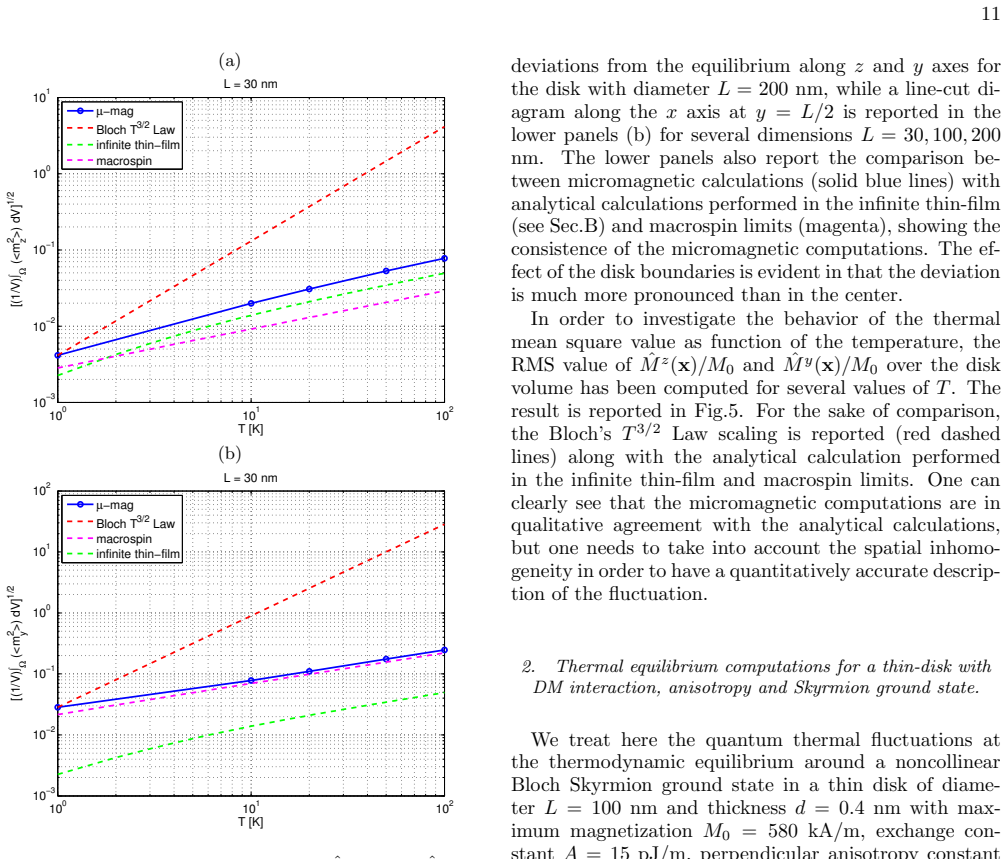
- [Sec. VII, after Eq. (67) and Figs. 3-5] The numerical thermal averages retain only the first 200 eigenmodes, as stated for the in-plane disk, while formulas (65) and (67) sum over all modes. No convergence check or estimate of the omitted high-mode contribution is provided. Because the edge-enhanced fluctuation profiles are a central quantitative result, the paper should demonstrate that truncation at 200 modes is sufficient, for example by varying the cutoff and comparing, or by estimating the tail of the sum.
minor comments (5)
- [Sec. VI] There are typographical errors, such as 'corrispond' for 'correspond', and similar issues in Sec. VII and Appendix B ('competion', 'perpedicular', 'asis').
- [Sec. IV, Eq. (27)] The replacement M_0^2 (1 + 1/S) ~ M_0^2 should be explicitly described as a large-S approximation, and the size of the neglected term should be quantified.
- [Sec. VII, Figs. 7-9] The notation for the thermal transverse deviation is inconsistent: some places use (M_perp^2/M_0^2)/2 and others M_perp^2/2; the text and figure axes should be aligned with the formulas (65)-(67).
- [References] Reference [43] appears in the bibliography but is not cited in the text; the range '[38]-[48]' in the introduction should be resolved into explicit citations.
- [Sec. VI, Eq. (46)] The summation over p in Z* with omega_p = omega_{-p} and c_p defined for negative p should be written out more explicitly to avoid ambiguity about the factor 1/2 and the counting of modes.
Circularity Check
No significant circularity: the magnon spectrum follows from the truncated quantum micromagnetic Hamiltonian and an externally documented generalized-eigenvalue theorem; the unproved DM/anisotropic-exchange extension is a completeness gap, not a circular reduction.
full rationale
The central derivation is self-contained: Eq. (29) is the quadratic Hamiltonian obtained by expanding the micromagnetic Hamiltonian around the classical ground state; Eq. (36) is the linearized quantum Landau-Lifshitz equation obtained from the commutation relations (34); the expansion (43) with conditions (47) and (52)-(53) defines the magnon basis; and the generalized eigenvalue problem (54) is the corresponding normal-mode pencil. No parameter is fitted to the thermal averages (65) and (67): material constants are taken from the literature (e.g., Ref. [55] for the skyrmion parameters), and the Bose occupation numbers (64) are computed from the derived frequencies. The only external load-bearing input is the spectral theorem cited to Ref. [34], whose authors overlap with the present paper. That citation is a peer-reviewed, parameter-free classical result and is not equivalent by construction to the present target; moreover, the text explicitly flags the extension: 'The extension of these proofs to the case treated here that includes DM interaction ... and anisotropic exchange is possible owing to the self-adjoint and the positive definite nature of the operator D0⊥.' This is an asserted proof obligation, not a circular step: the paper does not define its prediction in terms of a fitted quantity, and no equation reduces to its own input by construction. The unproved completeness of the D0⊥ pencil, located in Sec. VI around Eqs. (54)-(57), is a genuine correctness risk that should be resolved in a later version, but it does not make the derivation circular.
Assumptions & free parameters
free parameters (1)
- Number of eigenmodes retained in thermal averages =
200
assumptions (5)
- domain assumption Quantum states of interest have nearly maximal projection of the magnetization operator along the classical ground state; fluctuations are small.
- domain assumption Approximate commutation relations [M^01(x), M^02(x')] ≈ -i(γℏ)M0 δ(x-x') and M^03 ≈ M0 1.
- domain assumption The continuum limit of the ferromagnetic Heisenberg model is valid; itinerant electron effects are ignored.
- ad hoc to paper The eigenvalue theorem of Ref [34] extends to the operator D0⊥ with DM and anisotropic exchange terms.
- domain assumption The classical ground state M0(x) is the correct quantum vacuum; quantum corrections to the ground state are neglected.
Cite this review
Pith. "Pith review of Quantum Micromagnetic Theory of Magnons in Finite Nanostructures." pith.science (2026). https://pith.science/paper/GD4WGPVD
@misc{pith2026241113236,
  author       = {Pith},
  title        = {Pith review of: Quantum Micromagnetic Theory of Magnons in Finite Nanostructures},
  year         = {2026},
  howpublished = {\url{https://pith.science/paper/GD4WGPVD}},
  note         = {Machine review of arXiv:2411.13236}
}
read the original abstract
This paper presents a quantum field theoretical formalism for studying magnons in finite nanostructures with arbitrary shapes and spatially nonuniform ground states. It extends the classical micromagnetic formalism by introducing a micromagnetic Hamiltonian quantum operator, which incorporates exchange, Dzyaloshinsky-Moriya, anisotropy, magnetostatic, and Zeeman energies. The nonuniformity of the ground state is handled by pointwise aligning the quantization axis of the magnetization field operator with the classical ground state. The Hamiltonian is expanded in the large spin-number limit and truncated to retain only terms quadratic in the components of the magnetization operator transverse to the quantization axis. This quadratic Hamiltonian is used to derive the linear quantum Landau-Lifshitz equation. By diagonalizing this equation under appropriate boundary and normalization conditions, a discrete set of magnon creation and annihilation operators is obtained, enabling a complete description of the magnon spectrum. Finally, the theory is applied to study the effects of temperature and shape on low-temperature thermal equilibrium fluctuations of magnons in thin ferromagnetic nanodisks.
Figures


Figures from the paper (5 more)


Reference graph
Works this paper leans on
- [34]
-
[1]
We start by considering a thin disk of diameter L and thickness d = 5 nm as depicted in Fig 2
Thermal equilibrium computations for a soft thin-disk with in-plane ground state. We start by considering a thin disk of diameter L and thickness d = 5 nm as depicted in Fig 2. We assume that the disk is made of a soft magnetic material with M0 = 800 kA/m so that anisotropy can be neglected. We take the exchange constant with a value A = 13 pJ/m and no DM...
-
[2]
By using eq.(62) for the case when ˆF = ˆnm, we obtain ⟨ˆnm⟩T = 1 eβℏωm − 1 , (64) FIG
(63) where β = 1 /(kBT ), kB = 1 .380649 · 10−23 J/K is the Boltzmann constant, T the absolute temperature and Z = tr(exp(−β ˆH ′ 2)) is the partition function. By using eq.(62) for the case when ˆF = ˆnm, we obtain ⟨ˆnm⟩T = 1 eβℏωm − 1 , (64) FIG. 2. (Top) Thin-disk geometry ( L is diameter and d the thickness of the disk), and (bottom) classical microma...
-
[3]
Thermal equilibrium computations for a thin-disk with DM interaction, anisotropy and Skyrmion ground state. We treat here the quantum thermal fluctuations at the thermodynamic equilibrium around a noncollinear Bloch Skyrmion ground state in a thin disk of diame- ter L = 100 nm and thickness d = 0 .4 nm with max- imum magnetization M0 = 580 kA/m, exchange ...
work page 2010
-
[4]
The magnetostatic field operator present in the last term of eq.(A2) is given by the eqs.(11) , (12)
Expansion of the Hamiltonian around the ground state in the large S limit The quantum Hamiltonian (10) can be written in the following form: H[ ˆM] = W [ ˆM, ˆM] − Z Ω µ0 ˆM · HadV , (A1) where W [ · , · ] is a bilinear form associated to quadratic terms of the Hamiltonian (10) and it is given by the fol- lowing formula W [ ˆF, ˆG] = Z Ω dV ( Auv kh M 2 0...
-
[5]
Derivation of the torque form of linearized quantum Landau-Lifshitz equation In order to compute explicitly the right-hand-side of eq.(33), it is useful to compute first the following com- mutator: [ ˆM s ⊥(x), ˆM u ⊥(x′)] = = es 0a(x)eu 0b(x′)[ ˆM 0a(x), ˆM 0b(x′)] . (A21) By using eq.(31), the last equation can be written as [ ˆM s ⊥(x), ˆM u ⊥(x′)] = i...
-
[6]
In this conditions, the classical ground state is spatially uniform and given by M0 = M0ex
Spin wave derivation in the case of in-plane magnetized thin film In this case, we assume that no DM neither anisotropy terms are present, this means that Duv k = 0, K1 = 0. In this conditions, the classical ground state is spatially uniform and given by M0 = M0ex. The applied field is spatially uniform and applied along the x-direction, i.e. Ha = Haex. T...
-
[7]
Spin wave derivation in the case of out-of-plane magnetized film Here, for comparison with the second set of numerical computations presented in Sec. VII, we report the formu- las for the case of infinite thin film that admits a spatially uniform ground state in the z-direction, M0 = M0ez caused by a perpendicular anisotropy that is defined by a tensor K ...
Show all 62 references
-
[8]
Bloch, Zur Theorie des Ferromagnetismus, Z
F. Bloch, Zur Theorie des Ferromagnetismus, Z. Physik 61, 206 (1930)
1930
-
[9]
Bloch, Zur Theorie des Austauschproblems und der Remanenzerscheinung der Ferromagnetika, Z
F. Bloch, Zur Theorie des Austauschproblems und der Remanenzerscheinung der Ferromagnetika, Z. Physik74, 295 (1932)
1932
-
[10]
Holstein, H
T. Holstein, H. Primakoff, Field Dependence of the In- trinsic Domain Magnetization of a Ferromagnet, Phys. Rev. 58, 1098 (1940)
1940
-
[11]
Herring and C
C. Herring and C. Kittel, On the Theory of Spin Waves in Ferromagnetic Media Phys. Rev. 81, 869 (1951); Er- ratum Phys. Rev. 88, 1435 (1952)
1951
-
[12]
Dyson, General theory of Spin-Wave interactions, Phys
F.J. Dyson, General theory of Spin-Wave interactions, Phys. Rev. 102, 1217 (1956)
1956
-
[13]
Kittel, Quantum theory of solids, Wiley, (1963)
C. Kittel, Quantum theory of solids, Wiley, (1963)
1963
-
[14]
A. I. Akhiezer, V.G. Bariakhtar, S.V. Peletminskii, Spin Waves, Interscience Publishers, New York (1968)
1968
-
[15]
D. D. Stancil, A. Prabhakar, Spin Waves: Theory and Applications, Springer (2009)
2009
-
[16]
Sparks, Ferromagnetic Relaxation Theory, McGraw- Hill (1964).,
M. Sparks, Ferromagnetic Relaxation Theory, McGraw- Hill (1964).,
1964
-
[17]
Urazhdin, V
S. Urazhdin, V. E. Demidov, H. Ulrichs, T. Kendzior- czyk, T. Kuhn, J. Leuthold, G. Wilde, S. O. Demokritov Nanomagnonic devices based on the spin-transfer torque, Nature Nanotechnology 9, p. 509 (2014)
2014
-
[18]
V. E. Demidov, S. Urazhdin, A. Anane, V. Cros, S. O. Demokritov, Spin–orbit-torque magnonics, J. Appl. Phys. 127, 170901 (2020)
2020
-
[19]
B. Lenk, H. Ulrichs, F. Garbs, M. M¨ unzenberg, The building blocks of magnonics, Physics Reports, Volume 507, Issues 4–5, 2011
2011
-
[20]
Barman et al, The 2021 Roadmap on Magnonics J
A. Barman et al, The 2021 Roadmap on Magnonics J. Phys.: Condens. Matter, 33, 413001 (2021)
2021
-
[21]
Chumak, V
A. Chumak, V. Vasyuchka, V. Serga et al. Magnon spin- tronics. Nature Phys 111, 453–461 (2015)
2015
-
[22]
A. I. Chernov, M. A. Kozhaev, D. O. Ignatyeva, E. N. Beginin, A. V. Sadovnikov, A. A. Voronov, D. Karki, M. Levy, V. I. Belotelov, All-Dielectric Nanophotonics Enables Tunable Excitation of the Exchange Spin Waves, Nano Lett. 2020, 20, 7, 5259–5266, 2020
2020
-
[23]
Maksymov, Magneto-plasmonic nanoantennas: Basics and applications, Reviews in Physics, Volume 1, 2016
Ivan S. Maksymov, Magneto-plasmonic nanoantennas: Basics and applications, Reviews in Physics, Volume 1, 2016
2016
-
[24]
H.Y. Yuan, Y. Cao, A. Kamra, R. A. Duine, P. Yan, Quantum magnonics: When magnon spintronics meets quantum information science, Physics Reports 965 1 (2022)
2022
-
[25]
I. E. Dzyaloshinskii, A thermodynamic theory of “weak” ferromagnetism of antiferromagnetics, Journal of Physics and Chemistry of Solids 4, 4 (1958)
1958
-
[26]
Moriya, Anisotropic Superexchange Interaction and Weak Ferromagnetism, Phys
T. Moriya, Anisotropic Superexchange Interaction and Weak Ferromagnetism, Phys. Rev. 120, 91 (1960)
1960
-
[27]
Bogdanov, A
A. Bogdanov, A. Hubert, Thermodynamically stable magnetic vortex states in magnetic crystals, J. of Magn. and Magn. Mat. 138 255-269 (1994)
1994
-
[28]
A. Fert, N. Reyren, V. Cros, Magnetic skyrmions: ad- vances in physics and potential applications. Nat Rev Mater 2, 17031 (2017)
2017
-
[29]
William Fuller Brown, Micromagnetics, Interscience Publishers (1963)
1963
-
[30]
L. R. Walker, Magnetostatic Modes in Ferromagnetic Resonance, Phys. Rev. 105, 390 (1957)
1957
-
[31]
Aharoni, Exchange resonance modes in a ferromag- netic sphere, J
A. Aharoni, Exchange resonance modes in a ferromag- netic sphere, J. Appl. Phys. 69 7762 (1991)
1991
-
[32]
Arias, D.L
R. Arias, D.L. Mills, Theory of spin excitations and the microwave response of cylindrical ferromagnetic nanowires, Phys. Rev. B 43 134439 (2001); Phys. Rev. B 66 149903(E) (2002)
2001
-
[33]
Arias, D.L
R. Arias, D.L. Mills, Magnetostatic modes in ferromag- netic nanowires, Phys. Rev. B 70 094414 (2004)
2004
-
[35]
Arias, D.L
R. Arias, D.L. Mills, Magnetostatic modes in ferromag- netic nanowires. II. A method for cross sections with very large aspect ratio, Phys. Rev. B 72, 104418 (2005)
2005
-
[36]
Labb´ e, P.-Y
S. Labb´ e, P.-Y. Bertin, Microwave polarizability of fer- rite particles with non-uniform magnetization, J. Magn. Magn. Mater. 206, 93 (1999)
1999
-
[37]
Vukadinovic, O
N. Vukadinovic, O. Vacus, M. Labrune, O. Acher, D. Pain, Magnetic Excitations in a Weak-Stripe-Domain Structure: A 2D Dynamic Micromagnetic Approach, Phys. Rev. Lett. 85 2817 (2000)
2000
-
[38]
Grimsditch, G.K
M. Grimsditch, G.K. Leaf, H.G. Kaper, and D.A. Karpeev, R.E. Camley, Normal modes of spin excita- tions in magnetic nanoparticles, Phys. Rev. B 69, 174428 (2004)
2004
-
[39]
Grimsditch, L
M. Grimsditch, L. Giovannini, F. Montoncello, F. Niz- zoli, G.K. Leaf and H.G. Kaper, Magnetic normal modes in ferromagnetic nanoparticles: A dynamical matrix ap- proach, Phys. Rev. B 70, 054409 (2004)
2004
-
[40]
Rivkin, A
K. Rivkin, A. Heifetz, P.R. Sievert, and J.B. Ketterson, Resonant modes of dipole-coupled lattices, Phys. Rev. B 70, 184410 (2004)
2004
-
[41]
d’Aquino, C
M. d’Aquino, C. Serpico, G. Miano, C. Forestiere, A novel formulation for the numerical computation of mag- netization modes in complex micromagnetic systems, Journal of Computational Physics 228, p. 6130 (2009)
2009
-
[42]
R. D. McMichael, and M. D. Stiles, Magnetic nor- mal modes of nanoelements, J. Appl. Phys. 97, 10J901 (2005)
2005
-
[43]
Mills, Quantum theory of spin waves in finite sam- ples, JMMM 306 16 (2006)
D.L. Mills, Quantum theory of spin waves in finite sam- ples, JMMM 306 16 (2006)
2006
-
[44]
Mills, Spin Waves: History and a Summary of Re- cent Developments, Handbook of Magnetism and Ad- vanced Magnetic Materials, S
D.L. Mills, Spin Waves: History and a Summary of Re- cent Developments, Handbook of Magnetism and Ad- vanced Magnetic Materials, S. Parkin, H.Kronmueller (eds), Wiley (2007)
2007
-
[45]
Rastelli, Statistical Mechanics of Magnetic Excita- tions, From Spin Waves to Stripes and Checkerboards, World Scientific, Singapore (2013)
E. Rastelli, Statistical Mechanics of Magnetic Excita- tions, From Spin Waves to Stripes and Checkerboards, World Scientific, Singapore (2013)
2013
-
[46]
Diep, Quantum Spin-Wave Theory for Non- Collinear Spin Structures, a Review
H.T. Diep, Quantum Spin-Wave Theory for Non- Collinear Spin Structures, a Review. Symmetry 14, 1716 (2022)
2022
-
[47]
Sch¨ utz, M
F. Sch¨ utz, M. Kollar, and P. Kopietz, Persistent Spin Currents in Mesoscopic Heisenberg Rings, Phys. Rev. Lett. 91, 017205 (2003)
2003
-
[48]
Sch¨ utz, P
F. Sch¨ utz, P. Kopietz, M. Kollar, What are spin currents in Heisenberg magnets ?, Eur. Phys. J. B 41, 557 (2004)
2004
-
[49]
Sch¨ utz, M
F. Sch¨ utz, M. Kollar, and P. Kopietz, Persistent spin currents in mesoscopic Haldane-gap spin rings Phys. Rev. B 69, 035313 (2004)
2004
-
[50]
Kreisel, F
A. Kreisel, F. Sauli, L. Bartosch, and P. Kopietz, Eur. Phys. J. B 71, 59–68 (2009) 18
2009
-
[51]
Spremo, F
I. Spremo, F. Schuetz, P. Kopietz, V. Pashchenko, Mag- netic properties of a metal-organic antiferromagnet on a distorted honeycomb lattice Phys. Rev. B 72, 174429 (2005)
2005
-
[52]
Kreisel, F
A. Kreisel, F. Sauli, N. Hasselmann, and P. Kopietz, Quantum Heisenberg antiferromagnets in a uniform mag- netic field: Nonanalytic magnetic field dependence of the magnon spectrum, Phys. Rev. B 78, 035127 (2008)
2008
-
[53]
Rold` an-Molina, M
A. Rold` an-Molina, M. J. Santander, ´A. S. N´ un˜ ez, J. Fern´ andez-Rossier, Quantum theory of spin waves in fi- nite chiral spin chains, Phys. Rev. B 89, 054403 (2014)
2014
-
[54]
Rold` an-Molina, M
A. Rold` an-Molina, M. J. Santander, ´A. S. N´ un˜ ez, J. Fern´ andez-Rossier, Quantum fluctuations stabilize skyrmion textures, Phys. Rev. B 92, 245436 (2015)
2015
-
[55]
Rueckriegel, P
A. Rueckriegel, P. Kopietz, Spin currents, spin torques, and the concept of spin superfluidity Phys. Rev. B 95, 104436 (2017)
2017
-
[56]
Haraldsen, R
J.T. Haraldsen, R. S. Fishman, Spin rotation technique for non-collinear magnetic systems: application to the generalized Villain model, J. Phys.: Condens. Matter 21, 216001 (2009)
2009
-
[57]
Aharoni, Introduction to the Theory of Ferromag- netism, Clarendon Press (2000)
A. Aharoni, Introduction to the Theory of Ferromag- netism, Clarendon Press (2000)
2000
-
[58]
Abert, Micromagnetics and spintronics: models and numerical methods, Eur
C. Abert, Micromagnetics and spintronics: models and numerical methods, Eur. Phys. J. B 92, 120 (2019)
2019
-
[59]
H. Y. Yuan, W. P. Sterk, Akashdeep Kamra, and R.A. Duine, Master equation approach to magnon relaxation and dephasing, Physical Review B 106, 224422(2022)
2022
-
[60]
d’Aquino, Magnetization Geometrical Integration Code (MaGICo), http://wpage.unina.it/mdaquino/ index_file/MaGICo.html
M. d’Aquino, Magnetization Geometrical Integration Code (MaGICo), http://wpage.unina.it/mdaquino/ index_file/MaGICo.html
-
[61]
Heitler, The Quantum Theory of Radiation, Oxford (1935)
W. Heitler, The Quantum Theory of Radiation, Oxford (1935)
1935
-
[62]
A theory on skyrmion size
Wang, X.S., Yuan, H.Y., Wang, X.R. A theory on skyrmion size. Commun Phys 1, 31 (2018)
2018
Reviewed August 12, 2026 · model on record in the stance chip above.
Discussion (0). Continue with ORCID to comment.