REVIEW 4 major objections 5 minor 26 references
On lower bounds of the density of planar periodic sets without unit distances
T0 review · 4 major / 5 minor · reviewed 2026-08-12 · deepseek-v4-flash
Pith's one-line read The paper reduces the lower-bound problem for planar unit-distance-free sets to maximum independent sets on flat-torus graphs; over a wide tested range the best bound is 0.2246, below the standing 0.22936.
desk verdict A sound new reformulation of periodic 1-avoiding density as MIS on flat-torus graphs, with an honest negative data point, but the stronger claim that this approach cannot improve Croft is not supported because all reported maxima come from heuristic solvers. read the letter →
The pith
A machine-rendered reading of the paper's core claim, the machinery that carries it, and where it could break.
The reading
What carries the argument
The load-bearing object is the graph $G_{n,m}$ built on a perfectly periodic flat torus $T_{l_1,l_2,\alpha}$, where a flat torus is the parallelogram spanned by two non-collinear vectors with opposite sides identified. Perfect periodicity here means the sufficient condition $l_1\ge 2$ and $l_2\sin\alpha\ge 2$ (or the symmetric inequalities), which guarantees that a set avoiding unit distances on the torus lifts to a periodic set avoiding unit distances in the plane. The torus is triangulated by an $n\times m$ grid; each grid point is the center of an equal hexagonal Voronoi cell, and the triangulation's circumradius $r$ must satisfy $2r<1$ so every cell has diameter below 1. Two vertices are adjacent when their torus distance lies in $[1-2r,1+2r]$, the only interval in which points of their cells can be exactly one unit apart. An independent set $M$ selects whole hexagons with no unit distance between any two, and Theorem 1 converts the ratio $|M|/(nm)$ into a rigorous lower bound on $m_1(\mathbb{R}^2)$. The paper also proves the graph is shift-invariant and regular, so all edges can be generated from one vertex's neighborhood, which is what makes grids up to 90,000 vertices computationally feasible.
What would settle it
Run the same graph construction on the hexagonal torus of side about 1.965 and height about 1.70 that underlies the 1967 bound, with a grid fine enough that $2r<1$, and check directly whether an independent set lifts to a unit-distance-free periodic set with ratio above $0.22936$; finding such a set would show the paper's negative conclusion is limited to its tested parameter range. Alternatively, a single grid up to $400\times400$ on the identified local-maximum torus returning $|M|/(nm) > 0.22936$ would refute the saturation claim.
Extended reading notes
Core claim
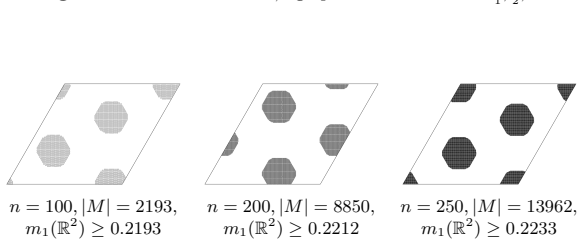
The central claim, stated as Theorem 1, is that for a flat torus $T_{l_1,l_2,\alpha}$ satisfying the perfect-periodicity conditions $l_1\ge 2$ and $l_2\sin\alpha\ge 2$ (or the symmetric pair), and for any grid sizes $n,m$ whose triangulation circumradius $r$ obeys $2r<1$, every independent set $M$ in the constructed graph $G_{n,m}$ gives a valid lower bound $m_1(\mathbb{R}^2)\ge |M|/(nm)$. The paper searches this family of tori over a broad parameter grid, locates a local maximum near side lengths $3.331,3.331$ with angle $60^\circ$, and runs four independent-set solvers on graphs up to $400\times400$ vertices. The best ratio obtained is $0.2246$, below the known $0.22936$ bound from 1967, and the independent sets resemble the classical tortoise-shaped construction. The paper therefore concludes that, within the range of parameters it tested, the MIS approach does not improve the known lower bound of $m_1(\mathbb{R}^2)$.
Load-bearing premise
The load-bearing premise is that the search only covers tori satisfying the sufficient perfect-periodicity condition $l_1\ge2$ and $l_2\sin\alpha\ge2$ (or its symmetric counterpart); if denser periodic constructions live on smaller tori outside this window, the observed failure to reach $0.22936$ would not prove anything about the method outside that range.
Editorial extensions
If this is right
- Every independent set found through the construction yields a rigorous, checkable lower bound $m_1(\mathbb{R}^2) \ge |M|/(nm)$ for any perfectly periodic torus satisfying the conditions, so the method is a proof engine rather than a heuristic estimate.
- Within the tested parameter range, the best bound increases with grid size but stays below $0.22936$; the largest graphs (up to 90,000 vertices) give $0.2246$.
- The optimal independent sets on the local-maximum torus are discrete approximations of the 1967 tortoise shape, indicating that the MIS approach saturates at the known construction within this family.
- Since the construction is valid for any independent set, better bounds in this formulation would come from larger grids or stronger MIS solvers; the paper's comparison indicates that exact branch-and-bound solving currently outperforms the neural and reinforcement-learning solvers on these geometric graphs.
- The same graph construction applies to other periodic-set density problems with a forbidden distance, provided the perfect-periodicity and cell-diameter conditions hold.
Reading between the lines
- A natural next step is to relax the perfect-periodicity height condition and test tori with $l_2\sin\alpha < 2$, checking the lifted set directly; the 1967 construction's lattice sits in this excluded regime, so a better bound could still hide there.
- If the extremal sets really are tortoise-like, then beating $m_1(\mathbb{R}^2)$ may require breaking periodicity or abandoning equal hexagonal cells; the MIS formulation as presented cannot see such configurations.
- The shift-invariance that lets $G_{n,m}$ be built from one vertex's neighborhood is specific to these geometric graphs, and it could make the family a useful stress test for independent-set solvers independent of the unit-distance problem.
Editorial analysis
A structured set of objections, weighed in public.
Referee Report
Summary. The paper proposes a computational framework for lower-bounding the maximal density m_1(R^2) of planar sets avoiding unit distances. It reformulates the problem on a flat torus T_{l1,l2,α} as a maximum independent set (MIS) problem on a finite graph G_{n,m} whose vertices are grid points and whose edges connect pairs whose torus distance lies in [1−2r,1+2r], where r is the circumradius of the triangulation cells. Under a sufficient 'perfectly periodic' condition on the torus (Lemma 2), Theorem 1 states that any independent set M of G_{n,m} yields a valid lower bound m_1(R^2) ≥ |M|/(nm). The paper runs several heuristic MIS solvers (KaMIS, DGL-TreeSearch, Intel-TreeSearch, LwD) on datasets of such graphs, finds a local optimum near (l1,l2,α)=(3.331,3.331,60°), and reports best densities of about 0.2246 for grids up to 400×400, below Croft's 0.22936. It concludes that, within the tested range, the approach does not improve the known lower bound, and it compares the solvers' performance.
Significance. If the theoretical framework is made fully rigorous and the negative conclusion were properly qualified, the paper would be a useful contribution: it gives a novel, general way to translate the Moser problem into a finite combinatorial optimization problem, it supplies open-source code and reproducible experiments, and it provides a systematic comparison of MIS solvers on a new family of geometric graphs. The observation that the found near-optimal sets resemble Croft's construction is also interesting. However, the paper's central negative claim currently overstates what the heuristic experiments can establish, and two proof errors in the theoretical core need correction before the framework can be relied upon.
major comments (4)
- [Lemma 2 (proof)] The proof of Lemma 2 contains an incorrect inequality: it states that for any nonzero integer pair (m,n), |m v1 + n v2| ≥ min{l1,l2}, which is false. For example, with l1 = l2 = 2 and α = 30°, the vector v1 − v2 has length 4 sin(15°) < 2, so the claimed lower bound fails. The statement of the lemma is nevertheless salvageable under its hypotheses: when n ≠ 0, the vertical component is |n| l2 sin α ≥ 2, and when n = 0, the length is |m| l1 ≥ 2. The proof must be rewritten using this argument rather than the false minimum-basis-vector bound. Since Lemma 2 is what justifies the 'perfectly periodic' condition used throughout the experimental parameter selection, this is a load-bearing proof error, though it is readily repairable.
- [Lemma 3 (proof)] In the proof of Lemma 3, the sentence 'by the construction of G, there are no two points p ∈ Fi, q ∈ Fj such that ρ(p,q) < 1' is incorrect: the graph construction rule only guarantees that ρ(p,q) ≠ 1 for such pairs, not that all distances are non-sub-unit. Consequently, the following line 'Consequently, ρ(P0,Q0) < 1' does not follow. The intended argument works if one instead uses ρ(P0,Q0) ≠ 1 directly and then applies the perfect-periodicity condition. Because Lemma 3 is the core of Theorem 1, this logical gap must be fixed before the theorem's proof is valid.
- [Section 5.4 and Conclusion (negative claim)] The paper's main conclusion that the MIS approach 'cannot improve' Croft's bound 0.22936 is not supported by the evidence presented. As the paper itself notes in Section 5.2, none of the solvers guarantees optimality, so every reported |M| is only a lower bound on the true maximum independent set size of the corresponding graph. The experiments therefore show that certain heuristic runs did not find a better set; they do not demonstrate that no such set exists, even within the tested parameter range. Moreover, the best densities increase with grid size (0.2193 at n=100, 0.2212 at n=200, 0.2218 at n=300, 0.2246 at n=400 for KaMIS), so the gap to Croft is not shown to be stable under refinement. The paper should either provide optimality certificates (for example, for small n) or explicitly rephrase the conclusion as 'no improvement was found by these heuristics' and state that the question remains open for finer grids and larger instances.
- [Abstract and Section 5.3 (parameter restriction)] The experimental search is restricted to tori satisfying the sufficient perfect-periodicity conditions l1 ≥ 2 and l2 sin α ≥ 2 (or the symmetric condition). Croft's own construction uses a hexagonal lattice of side length about 1.965, whose height is about 1.70, so it falls outside the tested regime. The abstract's phrase 'for a sufficiently wide range of parameters' is therefore potentially misleading: the most historically relevant parameter region is excluded. The paper should state this restriction explicitly in the abstract and in the conclusion, and it should not be implied that the tested range represents all plausible periodic constructions.
minor comments (5)
- [Table 2 caption] The caption contains a typo: 'flat tours datasets' should read 'flat tori datasets'.
- [Throughout] The paper uses the term 'maximal independent set' when it means 'maximum independent set' (the largest cardinality independent set). In graph theory, 'maximal' means inclusion-wise maximal, which is a different notion. Please correct the terminology throughout, including the title.
- [Section 4] The claim that the Voronoi cells of the grid points under the torus metric are equal hexagons with circumradius r is asserted without proof. This relies on the described triangulation being the Delaunay triangulation of the lattice. Since Theorem 1 depends on the hexagon decomposition and the equality of all cell areas, a short proof or a reference for this standard lattice fact should be provided.
- [Figures 4-8] The numeric labels in the figures should be checked for consistency. In particular, Figure 5 reports n = 250 with |M| = 13962 and density 0.2233, while the text says DGL-TreeSearch had difficulty scaling beyond 250² vertices; please verify these values against the repository data.
- [Lemma 1 proof] The proof of Lemma 1 treats only the case t1,t2 ≥ 0 in detail and states that other sign cases are 'analogous'. This is acceptable, but a short explanation of the definition of the vector w in the mixed-sign cases would improve readability.
Circularity Check
No significant circularity: the lower-bound derivation in Theorem 1 is self-contained, and the comparison with Croft's bound is an external benchmark rather than an input to the construction.
full rationale
The paper's derivation chain is not circular. Lemma 3 proves that any independent set in a graph built from a torus partition into sets of diameter < 1 yields a lower bound m1(R^2) >= sum(lambda2(F_i))/sum(lambda2(F_j)). Lemma 4 then proves that the particular edge set E_{n,m} = {(v1,v2) : rho(v1,v2) in [1-2r, 1+2r]} satisfies the required non-edge condition by a triangle inequality argument, and Theorem 1 combines these to obtain m1(R^2) >= |M|/(nm) for a perfectly periodic torus with 2r < 1. The bound 0.22936 of Croft is never used as an input or fitted target; it appears only as an external benchmark in the experimental comparison. The dataset construction (Section 5.3) is a grid search over torus parameters to locate a local maximum of independent-set size, not a fit to the target lower bound. The paper explicitly acknowledges that the solvers are heuristic and do not guarantee optimality (Section 5.2: 'none of these methods guarantee that the found set will be a true maximal independent set'), and the Conclusion qualifies the negative claim: 'based on our experiments, we cannot claim that the estimation cannot be improved in this way for other parameter values.' These are correctness/scope limitations, not circularity. The only self-reference is the author's software repository [25], which is not load-bearing for the mathematical derivation. Thus the core theoretical result is self-contained and the experimental conclusion, whether or not fully justified, does not reduce to its own inputs.
Assumptions & free parameters
free parameters (2)
- l1, l2, α (flat torus side lengths and angle) =
Scanned ranges: l1,l2 from [2,6] (Dataset-1) down to [3.328,3.340] (Dataset-4); α from [20°,90°] down to [59.5°,60.5°]
- n, m (grid resolution) =
n=m=100 for dataset scans; up to 400 for final runs
assumptions (4)
- standard math The flat torus metric ρ satisfies the triangle inequality.
- standard math Each Voronoi cell of the triangular lattice is contained in the disk of radius r (the circumradius of the Delaunay triangles) centered at its lattice vertex.
- domain assumption The upper density of a periodic set equals the area of the fundamental cell's subset divided by the area of the cell.
- domain assumption The sufficient conditions of Lemma 2 (l1 ≥ 2 and l2 sin α ≥ 2, or symmetric) guarantee perfect periodicity.
Cite this review
Pith. "Pith review of On lower bounds of the density of planar periodic sets without unit distances." pith.science (2026). https://pith.science/paper/DUUCBD5Q
@misc{pith2026241113248,
  author       = {Pith},
  title        = {Pith review of: On lower bounds of the density of planar periodic sets without unit distances},
  year         = {2026},
  howpublished = {\url{https://pith.science/paper/DUUCBD5Q}},
  note         = {Machine review of arXiv:2411.13248}
}
abstract
Determining the maximal density $m_1(\mathbb{R}^2)$ of planar sets without unit distances is a fundamental problem in combinatorial geometry. This paper investigates lower bounds for this quantity. We introduce a novel approach to estimating $m_1(\mathbb{R}^2)$ by reformulating the problem as a Maximal Independent Set (MIS) problem on graphs constructed from flat torus, focusing on periodic sets with respect to two non-collinear vectors. Our experimental results, supported by theoretical justifications of proposed method, demonstrate that for a sufficiently wide range of parameters this approach does not improve the known lower bound $0.22936 \le m_1(\mathbb{R}^2)$. The best discrete sets found are approximations of Croft's construction. In addition, several open source software packages for MIS problem are compared on this task.
Figures


Figures from the paper (7 more)



Reference graph
Works this paper leans on
-
[1]
In: Proceedings of the 37th International Conference on Machine Learning (ICML) (2020)
Ahn, S., Seo, Y., Shin, J.: Learning what to defer for maximum independent sets. In: Proceedings of the 37th International Conference on Machine Learning (ICML) (2020)
work page 2020
-
[2]
Mathematical Programming207, 303–327 (2024)
Ambrus, G., Csiszárik, A., Matolcsi, M., Varga, D., Zsámboki, P.: The density of planar sets avoiding unit distances. Mathematical Programming207, 303–327 (2024). https://doi.org/10.1007/s10107-023-02012-9
-
[3]
Discrete & Computational Geometry 67, 1–12 (06 2022)
Ambrus, G., Matolcsi, M.: Density Estimates of 1-Avoiding Sets via Higher Order Correlations. Discrete & Computational Geometry 67, 1–12 (06 2022). https: //doi.org/10.1007/s00454-020-00263-3
-
[4]
Anaconda Inc.: Anaconda software distribution (2020),https://docs.anaconda. com/
work page 2020
-
[5]
In: Proceedings of the International Conference on Learning Representations (ICLR) (2022)
Böther, M., Kißig, O., Taraz, M., Cohen, S., Seidel, K., Friedrich, T.: What’s Wrong with Deep Learning in Tree Search for Combinatorial Optimization. In: Proceedings of the International Conference on Learning Representations (ICLR) (2022)
work page 2022
-
[6]
Clustering in typical unit-distance avoiding sets
Cohen, A., Mani, N.: Clustering in typical unit-distance avoiding sets. https://arxiv.org/abs/2407.05071 (2024)
work page Pith review arXiv 2024
- [7]
-
[8]
https://arxiv.org/abs/1804.02385 (2018)
De Grey, A.D.: The chromatic number of the plane is at least 5. https://arxiv.org/abs/1804.02385 (2018)
arXiv 2018
Show all 26 references
-
[9]
In: Discrete Geometry and Convexity (New York, 1982), Annals of the New York Academy of Sciences
Erdős, P.: Problems and results in combinatorial geometry. In: Discrete Geometry and Convexity (New York, 1982), Annals of the New York Academy of Sciences. vol. 440, pp. 1–11. New York Academy of Sciences, New York (1985)
1985
-
[10]
Journal of the ACM25, 499–508 (1978)
Garey, M.R., Johnson, D.S.: Strong NP-Completeness Results: Motivation, Exam- ples, and Implications. Journal of the ACM25, 499–508 (1978)
1978
-
[11]
In: Advances in Neural Information Processing Systems (NeurIPS)
Hamilton, W., Ying, R., Leskovec, J.: Inductive Representation Learning on Large Graphs. In: Advances in Neural Information Processing Systems (NeurIPS). vol. 31 (2017)
2017
-
[12]
ACM Journal of Experimental Algorithmics24 (01 2019).https://doi.org/ 10.1145/3355502
Hespe,D.,Schulz,C.,Strash,D.:ScalableKernelizationforMaximumIndependent Sets. ACM Journal of Experimental Algorithmics24 (01 2019).https://doi.org/ 10.1145/3355502
2019 doi
-
[13]
Intel-TreeSearch: official repository (2018),https://github.com/isl-org/NPHard
2018
-
[14]
KaMIS: official repository (2019),https://github.com/KarlsruheMIS/KaMIS
2019
-
[15]
In: Proceedings of the 5th International Conference on Learning Repre- sentations (ICLR) (2017)
Kipf, T., Welling, M.: Semi-Supervised Classification with Graph Convolutional Networks. In: Proceedings of the 5th International Conference on Learning Repre- sentations (ICLR) (2017)
2017
-
[16]
Lamm, S., Sanders, P., Schulz, C., Strash, D., Werneck, R.F.: Finding near-optimal independent sets at scale. J. Heuristics23(4), 207–229 (2017)
2017
-
[17]
In: Proceedings of the Twenty-First Workshop on Algorithm Engineering and Exper- iments, ALENEX 2019
Lamm, S., Schulz, C., Strash, D., Williger, R., Zhang, H.: Exactly Solving the Maximum Weight Independent Set Problem on Large Real-World Graphs. In: Proceedings of the Twenty-First Workshop on Algorithm Engineering and Exper- iments, ALENEX 2019. pp. 144–158. SIAM (2019)
2019
-
[18]
Learning What to Defer (LwD): official repository (2020),https://github.com/ sungsoo-ahn/learningwhattodefer On lower bounds of the density of planar periodic sets without unit distances 21
2020
-
[19]
In: Advances in Neural Information Pro- cessing Systems (NeurIPS) (2018)
Li, Z., Chen, Q., Koltun, V.: Combinatorial Optimization with Graph Convolu- tional Networks and Guided Tree Search. In: Advances in Neural Information Pro- cessing Systems (NeurIPS) (2018)
2018
-
[20]
Mimeographed (1966)
Moser, L.: Poorly formulated unsolved problems of combinatorial geometry. Mimeographed (1966)
1966
-
[21]
In: Advances in Neural Information Processing Systems (NeurIPS)
Paszke, A., Gross, S., Massa, F., Lerer, A., Bradbury, J., Chanan, G., Killeen, T., Lin, Z., Gimelshein, N., Antiga, L., Desmaison, A., Köpf, A., Yang, E., DeVito, Z., Raison, M., Tejani, A., Chilamkurthy, S., Steiner, B., Fang, L., Chintala, S.: Pytorch: An imperative style, ...
2019
-
[22]
PolyMath16: Hadwiger-Nelson problem (2022),https://polymathprojects.org/ tag/polymath16
2022
-
[23]
https://arxiv.org/abs/1707.06347 (2017)
Schulman, J., Wolski, F., Dhariwal, P., Radford, A., Klimov, O.: Proximal Policy Optimization Algorithms. https://arxiv.org/abs/1707.06347 (2017)
2017 arXiv
-
[24]
In: Open Problems in Mathematics (2016)
Soifer, A.: The Hadwiger-Nelson Problem. In: Open Problems in Mathematics (2016)
2016
-
[25]
Tolmachev, A.: Package for the MIS finding on flat torus based graphs (2024), https://github.com/Alexandr-Tolmachev/flat-torus-MIS
2024
-
[26]
https://arxiv.org/abs/1909.01315 (2019)
Wang, M., Zheng, D., Ye, Z., Gan, Q., Li, M., Song, X., Zhou, J., Ma, C., Yu, L., Gai, Y., Xiao, T., He, T., Karypis, G., Li, J., Zhang, Z.: Deep Graph Li- brary: A Graph-Centric, Highly-Performant Package for Graph Neural Networks. https://arxiv.org/abs/1909.01315 (2019)
2019 arXiv
Reviewed August 12, 2026 · model on record in the stance chip above.
Discussion (0). Continue with ORCID to comment.