REVIEW 4 major objections 5 minor 30 references
Paying more attention to local contrast: improving infrared small target detection performance via prior knowledge
T0 review · 4 major / 5 minor · reviewed 2026-08-12 · deepseek-v4-flash
Pith's one-line read A handcrafted local-contrast attention map in a U-shaped network beats seven prior infrared small-target detectors while using 1.945M parameters, 4.862G FLOPs, and 70 fps.
desk verdict Useful lightweight IRSTD idea, but the SOTA numbers are the best row of a test-set hyperparameter sweep, so the central claim is unverified. read the letter →
The pith
A machine-rendered reading of the paper's core claim, the machinery that carries it, and where it could break.
The reading
What carries the argument
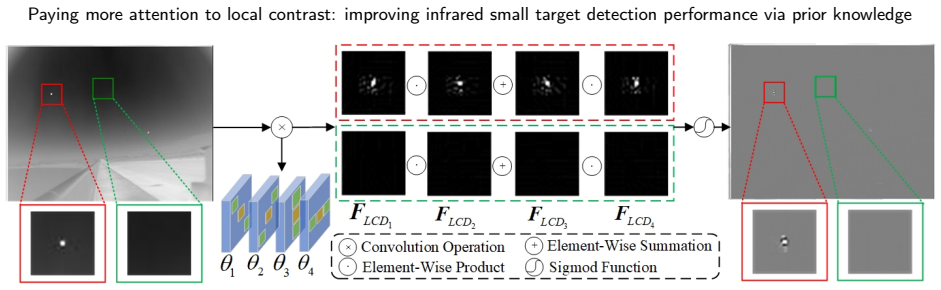
The central object is the Local Contrast Distance (LCD), computed by four fixed convolution kernels on the input image. Each kernel compares the center pixel, weighted by $\alpha$, against two pixels at dilation distance $d$, weighted by $\beta$, along one of four directions—the two diagonals, the horizontal, and the vertical. The Local Contrast Attention (LCA) is $\operatorname{Sigmoid}(F_{LCD1}\odot F_{LCD2} + F_{LCD3}\odot F_{LCD4})$, combining the element-wise product of diagonal measures with the product of orthogonal measures. This attention map, multiplied into the first feature map, carries the prior knowledge and performs the background suppression. The Channel Attention Enhancement (CAE) module is the second mechanism: global average pooling, a kernel-3 1D convolution, and a sigmoid produce per-channel weights that are added back residually, fusing channel information across the four downsampling stages.
What would settle it
Run LCAE-Net on an infrared test set whose targets are darker than their surroundings or non-Gaussian in shape, or synthetically invert contrast on existing test images. If the Local Contrast Attention map assigns those true targets values at or below the 0.5 background level and IoU falls by more than the no-LCE ablation gap, the Gaussian-bright-spot prior is falsified.
Extended reading notes
Core claim
On the paper's own terms, the central discovery is that a single-scale handcrafted local-contrast operator, placed as an attention mechanism before learned feature extraction, is sufficient to substantially improve infrared small-target detection. For each pixel, the Local Contrast Enhancement (LCE) module computes four Local Contrast Distances with fixed kernels—center weight $\alpha=1$, neighbor weight $\beta=0.5$, dilation $d=1$—and combines them into a sigmoid attention value: bright Gaussian-like targets score near 1, flat background near 0.5. Multiplying the first feature map by this attention suppresses background while preserving target responses, and a residual addition keeps context. The Channel Attention Enhancement (CAE) module then weights each channel using a 3-tap 1D convolution over globally pooled statistics, fusing information across downsampling stages. The paper claims that this design outperforms seven prior methods on NUDT-SIRST, NUAA-SIRST, and IRSTD-1K, with ablations showing each module helps alone and the pair works best.
Load-bearing premise
The whole gain rests on the prior that every infrared small target looks like a bright, roughly Gaussian blob whose center gray value is higher than the pixels immediately around it, so fixed kernels with $\alpha=1$, $\beta=0.5$, $d=1$ put high attention on true targets. If that prior fails, the Local Contrast Enhancement module suppresses the very targets it should amplify, and the reported gains would not transfer.
Editorial extensions
If this is right
- A single-scale local-contrast operator is enough: the paper explicitly argues against stacking multiscale operators, and its single-scale LCE outperforms multiscale local-contrast hybrids.
- Prior knowledge can substitute for data and compute: LCAE-Net reaches its reported accuracy with 1.945M parameters and 4.862G FLOPs after training on small infrared datasets, suggesting edge-device feasibility.
- Each module earns its place: ablations show the CAE module alone raises IoU by 0.732%, 0.235%, and 1.429% on the three datasets, the LCE module improves all metrics, and together they give the best results.
- False alarms remain the open frontier: on IRSTD-1K, LCAE-Net's IoU improves substantially but its false-alarm rate is slightly worse than DNA-Net and SCTransNet, and the authors identify reducing false alarms as future work.
Reading between the lines
- The fixed operator could be made adaptive: the paper's own hyperparameter tables show performance depends on $\alpha$, $\beta$, and $d$, so learning those values per image or per dataset is a natural extension the paper does not explore.
- The local-contrast prior is not limited to infrared: any imagery where targets appear as bright blobs on slower-changing backgrounds—night vision, maritime or aerial surveillance, or medical point lesions—could inherit the same attention mechanism, provided the Gaussian-brightness assumption holds.
- The LCA map doubles as an interpretability layer: because it is computed before any learning, it offers a human-readable explanation of where the model looks, which could be audited against ground-truth masks to understand failures.
- Dark-target and heavy-clutter regimes are the stress test: on IRSTD-1K's more cluttered scenes the method's gains shrink and false alarms rise, so extending the operator to signed or adaptive contrast is the clearest next test.
Editorial analysis
A structured set of objections, weighed in public.
Referee Report
Summary. The manuscript proposes LCAE-Net, a U-shaped network for infrared small target detection that combines a handcrafted Local Contrast Enhancement (LCE) module, which computes a Local Contrast Attention map from fixed dilated convolution operators, with a Channel Attention Enhancement (CAE) module for cross-channel fusion. Experiments on NUAA-SIRST, NUDT-SIRST, and IRSTD-1K report state-of-the-art IoU values of 80.421%, 94.746%, and 70.730%, respectively, together with favorable efficiency figures of 1.945M parameters, 4.862G FLOPs, and 70.23 fps. The paper also includes ablations of both modules and a hyperparameter analysis for the LCE kernel weights and dilation.
Significance. The idea of injecting a local-contrast prior through fixed kernels is well motivated, and the proposed architecture is simple and plausible for edge deployment. If the reported numbers were obtained under the protocol stated in Section 4.1.3, the improvements over strong baselines would be a meaningful contribution to the IRSTD literature. The paper is transparent about the sensitivity of its results to the LCE hyperparameters in Tables 4 and 5, and the ablation study in Table 3 supports the incremental contribution of each module. However, the central empirical claim is currently compromised by test-set hyperparameter selection and by the absence of variance estimates. The claimed margins over the runner-up are 3.651, 1.742, and 6.585 IoU points, which are comparable to the within-sweep spread on IRSTD-1K, so the contribution cannot be fully credited until the evaluation is made selection-free and the comparison is made symmetric.
major comments (4)
- [§4.1.3, §4.4, Tables 1, 4, 5] There is a direct contradiction between the fixed protocol and the reported main results. Section 4.1.3 states that alpha=1, beta=0.5, and d=3, but every LCAE-Net entry in Table 1 matches the row d=1, alpha=1, beta=0.5 in Tables 4 and 5, which Section 4.4 declares globally optimal. Because the sweep in Section 4.4 is scored on the same test splits used for Table 1, the headline numbers are the test-optimal row of a model-selection procedure, not the output of the protocol described in Section 4.1.3. Please either select hyperparameters on validation splits independent of the test splits, or report results under the fixed protocol, and state clearly which numbers correspond to which protocol.
- [§4.2, §4.4, Table 1] The state-of-the-art comparison is asymmetric. Section 4.2 states that all seven baselines were trained from scratch with default hyperparameters, whereas LCAE-Net benefited from a search over roughly 40 configurations in Tables 4 and 5, whose best rows are then reported. On IRSTD-1K the IoU spread across Table 5 is 6.569 points, which is essentially the same as the claimed 6.585-point margin over the runner-up in Table 1. To support the claimed margins, the baselines need a comparable tuning opportunity, or at least a sensitivity analysis, and the selection effect must be quantified.
- [§3.2, Eqs. (2)–(5)] The definition of the Local Contrast Distance is under-specified by an indexing swap. In Eq. (2), LCD2 is computed from the anti-diagonal neighbors (m-d,n+d) and (m+d,n-d), and LCD3 from the vertical neighbors (m,n-d) and (m,n+d). In Eq. (3), the roles are reversed: LCD2 uses vertical neighbors and LCD3 uses anti-diagonal neighbors. Since Eq. (4) multiplies LCD1 with LCD2 and LCD3 with LCD4, an independent implementation cannot decide which directional pairing is intended. Please correct the indexing, specify the kernel size L, and state explicitly which pairs are multiplied. In addition, Eq. (4) applies the sigmoid function, but Eq. (5) omits it, so the tensor form should be made consistent with the scalar formula.
- [§4.1.3, Tables 1, 3–5] All quantitative results are single-run point estimates with no error bars or significance tests. Given that the claimed margins over the runner-up are 3.651, 1.742, and 6.585 IoU points, and that the hyperparameter sweep itself reveals configuration-to-configuration variability of several points, a single seed leaves open whether the advantage over baselines is within optimization noise. Please report multiple seeds as mean and standard deviation, or otherwise establish that the differences are not due to random variation. This is especially important because no code for the proposed method is released, so the reader cannot assess run-to-run variability independently.
minor comments (5)
- [§3.3] The text says that global average pooling produces F_G_i in R^{1×H_i×W_i}; global average pooling over spatial dimensions should produce a vector or a tensor of shape C_i×1×1, not 1×H_i×W_i. Please correct the notation.
- [§4.4, Table 5] The last row of Table 5 is labeled 'distance' but it is computed as the maximum minus the minimum across the table; calling it 'range' or 'spread' would be more accurate and less likely to be confused with a statistical distance.
- [§4.1.3] The learning rate schedule is described as 'polynomial decay' with a 'decay rate set to 0.1, with adjustments made at epochs 200 and 300'; it is unclear whether the learning rate is multiplied by 0.1 at those epochs or whether a polynomial power is intended. Please specify the schedule explicitly.
- [Fig. 8] The ROC curves are presented without AUC values; reporting AUC or a similar summary statistic would make the comparison quantitative and easier to verify.
- [§4.1.3] The number of ResNeSt blocks is set to N_i = 1, 2, 4, 8 without an ablation or a justification for why this particular configuration was chosen; a brief explanation or sensitivity check would make the architecture choice more transparent.
Circularity Check
Table 1's SOTA numbers are the test-optimal row of the Section 4.4 hyperparameter sweep (d=1, alpha=1, beta=0.5), not the Section 4.1.3 protocol (d=3); baselines got no equivalent tuning, so the claimed margins are selection-biased.
-
fitted input called prediction
[In Section 4.2, Table 1 reports LCAE-Net's SOTA IoU values; these match the best row of the Section 4.4 hyperparameter sweep in Tables 4-5, while Section 4.1.3 sets d=3.]
"Table 1: "LCAE-Net 80.421 96.565 11.720 94.746 99.259 1.034 70.730 95.286 19.017". Section 4.1.3: "In terms of hyperparameters, α was set to 1, β was set to 0.5, and d was set to 3." Section 4.4: "the global optimal value is acquired when d is set to 1.""
The headline test metrics in Table 1 are not predictions of the model specified in Section 4.1.3 (d=3), which scores 79.347/93.172/68.706 IoU on the three datasets in Table 4. Instead, every Table 1 LCAE-Net entry equals the best row of the Section 4.4 test-set hyperparameter search, d=1, alpha=1, beta=0.5. Section 4.4 declares this row "global optimal" after scoring roughly 34 configurations on the same test splits used for SOTA comparison, while Section 4.2 states baselines were "trained in default hyperparameters from scratch" with no equivalent test-set tuning. The reported SOTA margins are therefore the argmax of a test-set search relabeled as the method's performance, so the comparison is forced by construction for the selected row.
full rationale
The architectural derivation itself is not circular: the LCE module's fixed local-contrast operators are defined from a Gaussian-like bright-target prior (Eqs. 1-7) and the CAE module is a standard channel-attention residual fusion, so no equation reduces to its own output. No self-citation chain is load-bearing, since the prior is attributed to Sun et al. (2023) and MPCM. The circularity is confined to the evaluation protocol: the paper fixes d=3 in Section 4.1.3, then Section 4.4 searches d, alpha, beta on the test sets and selects d=1, alpha=1, beta=0.5 as "global optimal"; Table 1 then reports exactly that selected row as LCAE-Net's SOTA result. Because the baselines were not given comparable test-set hyperparameter optimization, the claimed IoU margins (+3.651, +1.742, +6.585) are selection-biased rather than independent predictions. A separate reproducibility defect, noted here for completeness, is that Eq. (2) assigns LCD2 to the anti-diagonal and LCD3 to the vertical neighbors, while Eq. (3) swaps these meanings, making Eq. (4)'s paired products ambiguous for reimplementation; no code for LCAE-Net is released and the reported numbers appear to come from a single run without variance. These are evaluation and reproducibility problems, not derivation circularity, so the score is 6 rather than higher.
Assumptions & free parameters
free parameters (4)
- alpha (center kernel weight) =
1
- beta (surround kernel weight) =
0.5
- d (kernel dilation) =
1
- ResNeSt block counts N_i =
[1, 2, 4, 8]
assumptions (4)
- standard math Convolution, sigmoid, pooling, batch normalization, residual connection and backpropagation are valid background operations.
- domain assumption Infrared small targets appear as Gaussian-like bright spots with higher gray values than their immediate surroundings.
- domain assumption Small targets have contrast less than 15%, SNR less than 1.5, and area under 0.15% of the image (SPIE definition).
- ad hoc to paper A single-scale local contrast operator is sufficient; multiscale operators are unnecessary.
invented entities (1)
-
Local Contrast Attention (LCA) map
Cite this review
Pith. "Pith review of Paying more attention to local contrast: improving infrared small target detection performance via prior knowledge." pith.science (2026). https://pith.science/paper/VPHBWJ5A
@misc{pith2026241113260,
  author       = {Pith},
  title        = {Pith review of: Paying more attention to local contrast: improving infrared small target detection performance via prior knowledge},
  year         = {2026},
  howpublished = {\url{https://pith.science/paper/VPHBWJ5A}},
  note         = {Machine review of arXiv:2411.13260}
}
read the original abstract
The data-driven method for infrared small target detection (IRSTD) has achieved promising results. However, due to the small scale of infrared small target datasets and the limited number of pixels occupied by the targets themselves, it is a challenging task for deep learning methods to directly learn from these samples. Utilizing human expert knowledge to assist deep learning methods in better learning is worthy of exploration. To effectively guide the model to focus on targets' spatial features, this paper proposes the Local Contrast Attention Enhanced infrared small target detection Network (LCAE-Net), combining prior knowledge with data-driven deep learning methods. LCAE-Net is a U-shaped neural network model which consists of two developed modules: a Local Contrast Enhancement (LCE) module and a Channel Attention Enhancement (CAE) module. The LCE module takes advantages of prior knowledge, leveraging handcrafted convolution operator to acquire Local Contrast Attention (LCA), which could realize background suppression while enhance the potential target region, thus guiding the neural network to pay more attention to potential infrared small targets' location information. To effectively utilize the response information throughout downsampling progresses, the CAE module is proposed to achieve the information fusion among feature maps' different channels. Experimental results indicate that our LCAE-Net outperforms existing state-of-the-art methods on the three public datasets NUDT-SIRST, NUAA-SIRST, and IRSTD-1K, and its detection speed could reach up to 70 fps. Meanwhile, our model has a parameter count and Floating-Point Operations (FLOPs) of 1.945M and 4.862G respectively, which is suitable for deployment on edge devices.
Figures


Figures from the paper (5 more)


Reference graph
Works this paper leans on
- [1]
-
[8]
IEEE Geoscience and Remote Sensing Letters 19, 1–5
Istdu-net: Infrared small-target detection u-net. IEEE Geoscience and Remote Sensing Letters 19, 1–5. doi:10.1109/LGRS.2022.3141584. Hu,J.,Shen,L.,Sun,G.,2020. Squeeze-and-excitationnetworks. IEEETransactionsonPatternAnalysisandMachineIntelligence42,2011–2023. doi:10.1109/TPAMI.2019.2913372. Hu, L., Yang, D., Zhao, D., Zhang, J.,
arXiv 2022
-
[10]
IEEE Geoscience and Remote Sensing Letters 21, 1–5
Irgraphseg: infrared small target detection based on hierarchical gnn. IEEE Geoscience and Remote Sensing Letters 21, 1–5. doi:10.1109/LGRS.2024.3374431. Kou, R., Wang, C., Peng, Z., Zhao, Z., Chen, Y., Han, J., Huang, F., Yu, Y., Fu, Q.,
-
[12]
IEEE Transactions on Image Processing 32, 1745–1758
Dense nested attention network for infrared small target detection. IEEE Transactions on Image Processing 32, 1745–1758. doi:10.1109/TIP.2022.3199107. Li, X., Wang, W., Hu, X., Yang, J.,
arXiv 2022
-
[13]
Selective kernel networks, in: Proceedings of the IEEE/CVF conference on computer vision and pattern recognition, pp. 510–519. doi:10.1109/CVPR.2019.00060. Peichao Wang et al.:Preprint submitted to Elsevier Page 14 of 15 Paying more attention to local contrast: improving infrared small target detection performance via prior knowledge Liu,F.,Gao,C.,Chen,F....
arXiv 2019
-
[14]
Ssd: Single shot multibox detector, in: European conference on computer vision, Springer. pp. 21–37. Liu, W., Lu, H., Fu, H., Cao, Z., 2023b. Learning to upsample by learning to sample, in: Proceedings of the IEEE/CVF International Conference on Computer Vision, pp. 6004–6014. doi:10.1109/ICCV51070.2023.00554. Liu, Y., Peng, Z.,
-
[15]
IEEE Geoscience and Remote Sensing Letters 19, 1–5
Infrared small target detection based on resampling-guided image model. IEEE Geoscience and Remote Sensing Letters 19, 1–5. doi:10.1109/LGRS.2021.3087799. Luo, H., Wang, F., Chen, Z., Yu, L.,
arXiv 2021
-
[16]
Wu,T.,Li,B.,Luo,Y.,Wang,Y.,Xiao,C.,Liu,T.,Yang,J.,An,W.,Guo,Y.,2023
doi:10.1109/JPHOT.2024.3351189. Wu,T.,Li,B.,Luo,Y.,Wang,Y.,Xiao,C.,Liu,T.,Yang,J.,An,W.,Guo,Y.,2023. Mtu-net:multileveltransunetforspace-basedinfraredtinyship detection. IEEE Transactions on Geoscience and Remote Sensing 61, 1–15. doi:10.1109/TGRS.2023.3235002. Wu, X., Hong, D., Chanussot, J.,
arXiv 2024
Show all 30 references
-
[18]
Optimizing intersection-over-union in deep neural networks for image segmentation, in: International symposium on visual computing, Springer. pp. 234–244. Redmon,J.,Divvala,S.,Girshick,R.,Farhadi,A.,2016. Youonlylookonce:Unified,real-timeobjectdetection,in:ProceedingsoftheIEEE...
2016
-
[19]
IEEE Transactions on Geoscience and Remote Sensing 61, 1–11
Diff-mosaic: augmenting realistic representations in infrared small target detection via diffusion prior. IEEE Transactions on Geoscience and Remote Sensing 61, 1–11. doi:10.1109/TGRS.2024.3408045. Sun, H., Bai, J., Yang, F., Bai, X.,
2024
-
[20]
IEEE Transactions on Geoscience and Remote Sensing 61, 1–13
Receptive-field and direction induced attention network for infrared dim small target detection with a large-scale dataset irdst. IEEE Transactions on Geoscience and Remote Sensing 61, 1–13. doi:10.1109/TGRS.2023.3235150. Tianxiang,C.,Zhentao,T.,Tao,G.,Qi,C.,Yue,W.,Bin,L.,Jiep...
2023
-
[22]
false alarm: Adversarial learning for small object segmentation in infrared images, in: Proceedings of the IEEE/CVF International Conference on Computer Vision, pp
Miss detection vs. false alarm: Adversarial learning for small object segmentation in infrared images, in: Proceedings of the IEEE/CVF International Conference on Computer Vision, pp. 8509–8518. doi:10.1109/ICCV.2019.00860. Wang,K.,Du,S.,Liu,C.,Cao,Z.,2022. Interiorattention-a...
2019
-
[23]
Pattern Recognition 58, 216–226
Multiscale patch-based contrast measure for small infrared target detection. Pattern Recognition 58, 216–226. doi:10.1016/j.patcog.2016.04.002. Wu, A., Fan, X., Min, L., Qin, W., Yu, L.,
2016 doi
-
[25]
IEEE Transactions on Image Processing 32, 364–376
Uiu-net: U-net in u-net for infrared small object detection. IEEE Transactions on Image Processing 32, 364–376. doi:10.1109/TIP.2022.3228497. Xia, C., Chen, S., Huang, R., Hu, J., Chen, Z.,
2022
-
[27]
IEEE Geoscience and Remote Sensing Letters 17, 157–161
Infrared small target detection based on multiscale local contrast measure using local energy factor. IEEE Geoscience and Remote Sensing Letters 17, 157–161. doi:10.1109/LGRS.2019.2914432. Yang,H.,Mu,T.,Dong,Z.,Zhang,Z.,Wang,B.,Ke,W.,Yang,Q.,He,Z.,2024. Pbt:Progressivebackgrou...
2019
-
[29]
IEEE Transactions on Geoscience and Remote Sensing 62, 1–15
Sctransnet: Spatial-channel cross transformer network for infrared small target detection. IEEE Transactions on Geoscience and Remote Sensing 62, 1–15. doi:10.1109/TGRS.2024.3383649. Zeng,M.,Li,J.,Peng,Z.,2006. Thedesignoftop-hatmorphologicalfilterandapplicationtoinfraredtarge...
2024
-
[30]
IET Signal Processing 2024, 6814362
Infrared small target detection based on density peak search and local features. IET Signal Processing 2024, 6814362. doi:10.1016/j.infrared.2024.105315. Zhang, M., Zhang, R., Yang, Y., Bai, H., Zhang, J., Guo, J., 2022b. Isnet: shape matters for infrared small target detectio...
2024
-
[31]
Knowledge-Based Systems 265, 110344
Infrared ship target segmentation based on adversarial domain adaptation. Knowledge-Based Systems 265, 110344. doi:10.1016/j.knosys.2023.110344. Zhao, J., Shi, Z., Yu, C., Liu, Y.,
2023
-
[32]
arXiv preprint arXiv:2406.02037
Multi-scale direction-aware network for infrared small target detection. arXiv preprint arXiv:2406.02037 . Zhao,M.,Li,L.,Li,W.,Tao,R.,Li,L.,Zhang,W.,2020.Infraredsmall-targetdetectionbasedonmultiplemorphologicalprofiles.IEEETransactions on Geoscience and Remote Sensing 59, 607...
2020
-
[47]
Jia, G., Cheng, Y., Chen, T.,
doi:10.1109/TAES.2019.2946678. Jia, G., Cheng, Y., Chen, T.,
2019
-
[62]
Xia, C., Li, X., Zhao, L., Shu, R.,
doi:10.1109/TGRS.2024.3358831. Xia, C., Li, X., Zhao, L., Shu, R.,
2024
-
[2011]
Vision Research: An International Journal in Visual Science 51, 1484–1525
Visual attention: the past 25 years. Vision Research: An International Journal in Visual Science 51, 1484–1525. doi:10.1016/j. visres.2011.04.012. Nian, B., Jiang, B., Shi, H., Zhang, Y.,
2011 doi
-
[2013]
IEEE transactions on geoscience and remote sensing 52, 574–581
A local contrast method for small infrared target detection. IEEE transactions on geoscience and remote sensing 52, 574–581. doi:10.1109/TGRS.2013.2242477. Chen, Y., Li, L., Liu, X., Su, X.,
2013
-
[2015]
arXiv preprint arXiv:1511.07122
Multi-scale context aggregation by dilated convolutions. arXiv preprint arXiv:1511.07122 . Yuan, S., Qin, H., Yan, X., Akhtar, N., Mian, A.,
-
[2016]
Infrared Physics & Technology 77, 421–430
Infrared small target and background separation via column-wise weighted robust principal component analysis. Infrared Physics & Technology 77, 421–430. doi:10.1016/j.infrared.2016.06.021. Dai, Y., Wu, Y., Zhou, F., Barnard, K., 2021a. Asymmetric contextual modulation for infr...
2016
-
[2017]
IEEE journal of selected topics in applied earth observations and remote sensing 10, 3752–3767
Reweighted infrared patch-tensor model with both nonlocal and local priors for single-frame small target detection. IEEE journal of selected topics in applied earth observations and remote sensing 10, 3752–3767. doi:10.1109/JSTARS.2017.2700023. Dai, Y., Wu, Y., Song, Y.,
-
[2021]
IEEE Transactions on Geoscience and Remote Sensing 60, 1–17
Infrared small target detection using nonoverlapping patch spatial–temporal tensor factorization with capped nuclear norm regularization. IEEE Transactions on Geoscience and Remote Sensing 60, 1–17. doi:10.1109/TGRS.2021.3126608. Wang, H., Zhou, L., Wang, L.,
2021
-
[2022]
IEEE Transactions on Geoscience and Remote Sensing 60, 1–9
A multi-task framework for infrared small target detection and segmentation. IEEE Transactions on Geoscience and Remote Sensing 60, 1–9. doi:10.1109/TGRS.2022.3195740. Cui, Y., Lei, T., Chen, G., Zhang, Y., Peng, L., Hao, X., Zhang, G.,
2022
-
[2023]
Pattern Recognition 143, 109788
Infrared small target segmentation networks: A survey. Pattern Recognition 143, 109788. doi:10.1016/j.patcog.2023.109788. Li, B., Xiao, C., Wang, L., Wang, Y., Lin, Z., Li, M., An, W., Guo, Y.,
2023
-
[2024]
IEEE Geoscience and Remote Sensing Letters 21, 1–5
Hollow side window filter with saliency prior for infrared small target detection. IEEE Geoscience and Remote Sensing Letters 21, 1–5. doi:10.1109/LGRS.2023.3342981. Dai, Y., Wu, Y.,
2023
Reviewed August 12, 2026 · model on record in the stance chip above.
Discussion (0). Continue with ORCID to comment.