REVIEW 3 major objections 5 minor 43 references
Optimization of two-photon absorption for three-level atom
T0 review · 3 major / 5 minor · reviewed 2026-08-12 · deepseek-v4-flash
Pith's one-line read The paper proves that for any chosen time t there exists a two-photon state that excites a three-level ladder atom to its final state with probability one at t, and identifies that state as the time reversal of the atom's spontaneously…
desk verdict Clean derivation of the optimal two-photon state for a three-level ladder atom, correct within the Wigner-Weisskopf model; the universal perfect-excitation claim needs a model-caveat, and the appendix has a normalization typo. read the letter →
The pith
A machine-rendered reading of the paper's core claim, the machinery that carries it, and where it could break.
The reading
What carries the argument
The engine of the argument is the closed-form expression for the two-photon absorption probability \(P_f(t)\), Eq. (17), taken from Ref. [20] and derived in the Wigner-Weisskopf, rotating-wave, flat-coupling approximation with frequency integrals extended to minus infinity. Writing \(P_f(t_\star)\) as the squared modulus of an inner product of the input temporal amplitude with a fixed kernel (Appendix B) turns the optimization into a Cauchy-Schwarz problem: the maximum is 1, attained exactly when the input state is proportional to that kernel, which yields Eq. (23). The Schmidt decomposition then supplies the entanglement measure, and the Lorentzian marginals provide the reference shapes used in later sections.
What would settle it
Prepare a three-level ladder atom in \(|f\rangle\), collect the spontaneously emitted two-photon state, time-reverse it, and drive the ground-state atom with that shaped pulse; if the final-state population at the chosen time \(t_\star\) is not 1 within experimental uncertainties, the claim fails. Alternatively, compute \(P_f(t)\) from Eq. (17) for any product state with the same marginal distributions as (23); if it equals 1 for some \(\Gamma_e,\Gamma_f\), then entanglement would not be necessary for perfect excitation.
Extended reading notes
Core claim
The central claim is that for every time \(t_\star\) there exists a normalized two-photon state whose temporal amplitude is given by Eq. (23) and which drives the three-level ladder atom from \(|g\rangle\) to \(|f\rangle\) with probability \(P_f(t_\star)=1\). This state has a definite photon order, with the photon resonant with the lower transition arriving first, and its joint temporal density is \(p(t_2,t_1)=\Gamma_f\Gamma_e\exp[-\Gamma_f(t_\star-t_2)-\Gamma_e(t_2-t_1)]\). Its frequency-domain amplitude is a product of two Lorentzian factors encoding single- and two-photon resonances, with widths set by \(\Gamma_e\) and \(\Gamma_f\). The paper further characterizes how the optimal state's entanglement entropy grows with \(\Gamma_e/\Gamma_f\), how the expected arrival-time difference of the two photons equals \(1/\Gamma_e\), and how the state becomes nearly unentangled in the \(\Gamma_e\ll\Gamma_f\) limit while becoming strongly entangled in the \(\Gamma_e\gg\Gamma_f\) virtual-state limit.
Load-bearing premise
The perfect-excitation claim relies on the approximation that the atom-field coupling is flat and that the rotating-wave and Wigner-Weisskopf approximations hold, so that the two-photon absorption probability is exactly given by Eq. (17); if real level structure, broadband pulses, or non-flat coupling violate these, the state (23) would not produce unit probability.
Editorial extensions
If this is right
- Any experimentally prepared two-photon state that is not proportional to Eq. (23) must reach \(P_f(t_\star)<1\), so the optimum state serves as an upper bound for every realistic pulse shape.
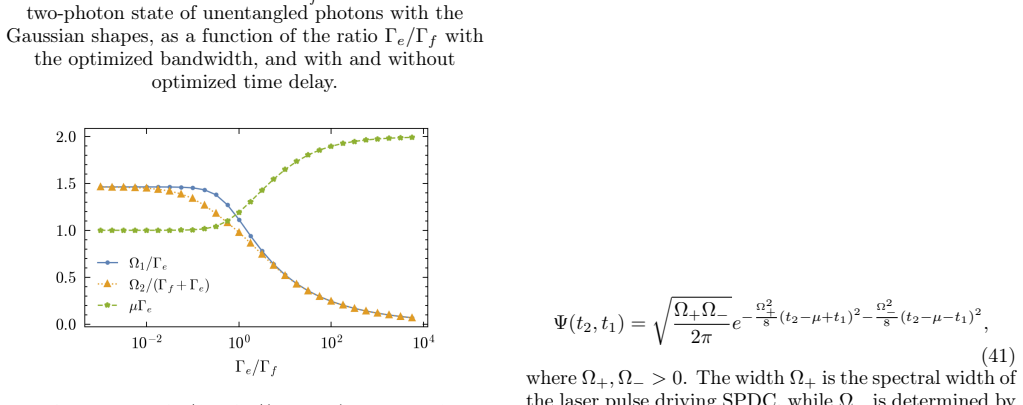
- In the \(\Gamma_e\ll\Gamma_f\) regime, optimal excitation is approached by two independent single-photon Gaussian pulses with a suitable delay, and the maximum probability converges to 0.64 for Gaussian shapes, the squared single-photon bound.
- In the \(\Gamma_e\gg\Gamma_f\) virtual-state regime, entangled photons are required for efficient excitation; unentangled and coherent states are suppressed, and only the two-photon resonance condition matters for the entangled pair.
- Coherent states with one photon per mode on average are systematically worse than two-photon Fock states, showing that photon-number statistics matter because the atom must interact with exactly one photon per transition.
Reading between the lines
- The time-reversal identification suggests a practical recipe: measure the two-photon state emitted in spontaneous emission from a ladder atom and time-reverse it to obtain the perfect excitation pulse, mirroring the known two-level case but now including entanglement.
- The same inner-product machinery could be applied to other level configurations, such as \(\Lambda\) or \(V\), where the optimal state may require different entanglement structures or may not be uniquely determined.
- Because pulsed sources are commonly Gaussian, the 0.64 and 0.23 ceilings for Gaussian and coherent inputs can serve as benchmarks for when a shaped source would give a meaningful advantage in realistic experiments.
- The fixed arrival-order property of the optimal state means it cannot be generated by a passive beamsplitter network acting on identical photons; source engineering or photon-shaping schemes that enforce the time order would be needed.
Editorial analysis
A structured set of objections, weighed in public.
Referee Report
Summary. The paper studies maximization of two-photon absorption for a three-level ladder atom in the Wigner-Weisskopf model. Starting from the analytic formula (17) for the final-state excitation probability, the authors construct the two-photon temporal amplitude (23) that, in the limit t0 -> -infinity, yields Pf(t*) = 1, and identify it with the time reversal of the spontaneously emitted two-photon state of the ladder atom. They analyze this optimal state's spectral and temporal marginals and compare optimized Gaussian, exponential, and coherent-state inputs, distinguishing regimes of comparable and highly different lifetimes of the intermediate and final states.
Significance. If the result is correct, the paper provides an explicit analytic solution to the problem of perfect excitation of a three-level ladder by two-photon light, with the useful physical message that atomic lifetimes determine the optimal input state. The overlap-based optimization idea is elegant, the paper gives explicit formulas for marginal distributions, and it includes a public numerical code/data repository, which supports reproducibility. The main mathematical theorem is plausible, but as written one supporting normalization step in Appendix B is incorrect, and a claim about the entanglement of the optimal state is not actually demonstrated. These issues are local and fixable, but they need attention before the paper can be accepted.
major comments (3)
- [Appendix B, Eq. (B2)] The kernel Psi_0 defined in Eq. (B2) is not normalized: its squared norm is Gamma_e Gamma_f exp(-Gamma_f t_star), not 1. The sentence immediately below Eq. (B2), 'we deal with two normalized functions', is therefore incorrect, and the inner-product proof of maximality fails as written. The correct normalized kernel is sqrt(Gamma_e Gamma_f) exp(-Gamma_f t_star/2) exp(((Gamma_f - Gamma_e) t_2 + Gamma_e t_1)/2), which coincides with the amplitude in Eq. (23); with this replacement the argument goes through. Please correct Eq. (B2) and rewrite the proof accordingly.
- [Section III, after Eq. (23)] The universal statement that 'for any time t there exists the two-photon state of light for which the probability of two-photon absorption at time t is equal to one' is proven only for the idealized limit t0 -> -infinity under the Sec. II assumptions (rotating-wave approximation, flat coupling, and frequency integrals extended to -infinity). The paper explicitly discusses the virtual-state regime Gamma_e >> Gamma_f as physically relevant; in that regime Eq. (27) gives the second-photon marginal width Gamma_e + Gamma_f, so for Gamma_e comparable to the optical carrier frequency the spectrum is no longer narrow compared with the carrier, and the Lorentzian negative-frequency tails contribute to P_max = 1. The claim should be qualified as a theorem of the idealized model, and a concrete validity condition for the physical interpretation should be stated.
- [Section III, paragraph after Eq. (30)] The text states that the degree of entanglement of the optimal state (23) can be represented as a function of Gamma_e/Gamma_f and refers to Fig. 7, but Fig. 7 plots the Shannon entropy of the optimized Gaussian state (41), not of the optimal state (23). No Schmidt decomposition, entropy, or other entanglement measure is computed for the optimal state itself. The qualitative claim that the entanglement of (23) increases with Gamma_e/Gamma_f is therefore unsupported as presented; please derive the Schmidt coefficients of (23) or explicitly rephrase the claim as a statement only about the optimized Gaussian family.
minor comments (5)
- [Section III, Eqs. (21)-(22)] The normalization factor N in Eq. (22) has a removable singularity at Gamma_e = Gamma_f, and no separate limiting expression is given for the amplitude (21) in that case, although Eq. (20) provides the corresponding limit for P_max. Please write the Gamma_e = Gamma_f limit of N and of the optimal amplitude explicitly.
- [Section II, Eq. (17)] Equation (17), the starting point of the whole optimization, is taken from the unpublished preprint Ref. [20] without a derivation sketch. For self-containedness, please include a brief derivation or a precise statement of the conditions under which Eq. (17) is valid, especially the extension of the frequency integrals to -infinity.
- [Section III, Eq. (25)] The Fourier convention connecting the continuous-mode operators in Eq. (2) to the frequency-domain amplitude in Eq. (25) is not stated explicitly. Please specify the sign and normalization convention used for the transform so that the inverse transform of Eq. (25) reproduces Eq. (23).
- [Section IV, text near Fig. 4] The sentence reporting that for Gamma_e << Gamma_f the maximal probability approaches 0.64 could be misread as a general bound; Appendix D shows that rising exponential pulses achieve P_max = 1 in the same regime. Please clarify that 0.64 is the optimal value within the Gaussian family only.
- [Section III, text before Eq. (30)] The phrase 'see Fig. 7' is a forward reference to a figure that first appears in Section V. Please use a cross-reference that clearly distinguishes the optimal state (23) from the optimized Gaussian state (41) when discussing entanglement.
Circularity Check
No significant circularity: the optimal state is an explicit Cauchy-Schwarz construction from the model kernel, not a fitted or self-defined input; the self-citation to Ref. [20] is parameter-free and not circular.
full rationale
The central derivation is self-contained in the sense required for circularity analysis. The optimal two-photon state, Eq. (23), is obtained as the explicit Cauchy-Schwarz equality function of the kernel in Eq. (17): substituting Psi_opt into Eq. (17) at resonance, with t0 -> -infinity, gives Pf(t*)=1 directly, so the claim is not defined in terms of the answer and no fitted constant is adjusted to force it. The main external input, Eq. (17) and the maximum formula Eq. (19), is taken from Ref. [20], which shares authors with the present paper, but this is a parameter-free analytical model with stated assumptions (RWA, Wigner-Weisskopf, flat coupling, frequency integrals extended to -infinity) that do not include the target result; under the review rules this counts as independent support rather than a circular self-citation chain. The numerical optimizations for Gaussian, exponential, and coherent states are separate calculations benchmarked against known two-level results, not fits to the paper's own conclusions. Two non-circular issues are nevertheless flagged. First, Appendix B claims 'we deal with two normalized functions' immediately after displaying Psi_0 in Eq. (B2) with prefactor Gamma_e Gamma_f e^{-Gamma_f t*}; this Psi_0 is not normalized (the correct prefactor would be sqrt(Gamma_e Gamma_f) e^{-Gamma_f t*/2}), so the inner-product proof as written needs correction. This is a proof slip, not circularity, because the claim remains directly verifiable from Eq. (17) and Eq. (23). Second, the Conclusions state that 'the model has limitations and cannot be implemented and discussed in isolation from the physical approximations on which it is based'; the universal 'for any time' claim therefore inherits the Sec. II idealizations, particularly in the Gamma_e >> Gamma_f regime where the optimal-state bandwidth can approach the carrier frequency. These are scope/correctness caveats, not reductions of the result to its inputs.
Assumptions & free parameters
assumptions (4)
- domain assumption The two-photon absorption probability is given by Eq. (17) from Ref. [20].
- domain assumption The atom-field coupling is flat (constant), within the rotating-wave approximation, and the frequency integration is extended to minus infinity (Wigner-Weisskopf approximation).
- domain assumption The two-photon input state is a pure state of the form (7) with a Schmidt decomposition (9).
- ad hoc to paper The maximization is performed at exact resonance and in the limit of initial time going to minus infinity.
Cite this review
Pith. "Pith review of Optimization of two-photon absorption for three-level atom." pith.science (2026). https://pith.science/paper/RMJ2LPLE
@misc{pith2026241113274,
  author       = {Pith},
  title        = {Pith review of: Optimization of two-photon absorption for three-level atom},
  year         = {2026},
  howpublished = {\url{https://pith.science/paper/RMJ2LPLE}},
  note         = {Machine review of arXiv:2411.13274}
}
read the original abstract
This work discusses the problem of optimal excitation of a three-level atom of ladder-configuration by light in the two-photon state and coherent light carrying an average of two photons. The applied atom-light interaction model is based on the Wigner-Weisskopf approximation. We characterize the properties of the optimal two-photon state that excites an atom perfectly, i.e. with probability equal to one: We find that the spectro-temporal shape of the optimal state of light is determined by the lifetimes of the atomic states, with the degree of photonic entanglement in the optimal state depends on the lifetime ratio. In consequence, two distinct interaction regimes can be identified in which the entanglement of the input state of light has qualitatively different impact. As the optimal states may be challenging to prepare in general, we compare the results with those obtained for photon pairs of selected experimentally-relevant pulse shapes. As these shapes are optimized for maximal atomic excitation probability, the results can be interpreted in terms of the overlap between the optimal and investigated pulse shapes.
Figures


Figures from the paper (9 more)



Reference graph
Works this paper leans on
- [20]
-
[1]
Rising exponential pulses Let us consider the case when the atom is driven by the light in the two-photon state for the unentangled photons with the temporal profiles: ξ(t) = √ Ω1e Ω1 2 t for t ≤ 0 0 for t >0 , (D1) ϕ(t) = √ Ω2e Ω2 2 t for t ≤ 0 0 for t >0 , (D2) where Ωi, i= 1 , 2 are positive parameters. In this case the probability of the finite-state ...
-
[2]
Decaying exponential pulses Let us consider the two-photon state for the unentan- gled photons with the temporal profiles: ξ(t) = 0 for t <0√ Ω1e− Ω1 2 t for t ≥ 0 , (D7) 14 ϕ(t) = 0 for t < ts√ Ω2e− Ω2 2 (t−ts) for t ≥ ts , (D8) where Ω1, Ω2 > 0, and ts is a shift time of the second pulse. We consider two scenarios, one with a fixedts = 0 and the other w...
-
[3]
J.D. Bhawalkar, N.D. Kumar, C.F. Zhao, & P. Prasad, Journal of clinical laser medicine & surgery,15(5), 201- 204, (1997)
work page 1997
-
[4]
B. R. Mollow, Phys. Rev.175.5, 1555, (1968)
work page 1968
-
[5]
For the small Γe/Γf ratio, due to the relatively low degree of entanglement, the sensitivity of the achieved excitation probability to variations inΩ+ and Ω− is sim- ilar. For largeΓe/Γf ratio, we observe an asymmetry: it is important forΩ− to be large in order to achieve a high degree of entanglement, but the sensitivity to the exact value of Ω− is limit...
-
[6]
M. F. García, R. J. Echeverría, M. Moll, R. M. Santos, R. P. Pinto, I. Vila, and M. Wiehe, Nucl. Instrum. Methods Phys. Res., Sect. A958, 162865, (2020)
work page 2020
-
[7]
J.H. Strickler & W.W. Webb, Optics letters, 16(22), 1780-1782, (1991)
work page 1991
Show all 43 references
-
[8]
Kwiat, K
P.G. Kwiat, K. Mattle, H. Weinfurter, A. Zeilinger, A.V. Sergienko & Y. Shih, Phys. Rev. Lett.75, 4337, (1995)
1995
-
[9]
Tabakaev, M
D. Tabakaev, M. Montagnese, G. Haack, L. Bonacina, J.-P. Wolf, H. Zbinden, and R. T. Thew, Phys. Rev. A, 103, 033701, (2021)
2021
-
[10]
Schlawin, J
F. Schlawin, J. Chem. Phys.160, 144117, (2024)
2024
-
[11]
Javanainen & P.L
J. Javanainen & P.L. Gould, Phys. Rev. A 41, 5088, (1990)
1990
-
[12]
N. Ph. Georgiades, E. S. Polzik, K. Edamatsu, H. J. Kim- ble, and A. S. Parkins, Phys. Rev. Lett.75, 3426, (1995)
1995
-
[13]
Dayan, A
B. Dayan, A. Pe’er, A.A. Friesem, Y. Silberberg, Phys. Rev. Lett.93, 023005, (2004)
2004
-
[14]
Gea-Banacloche, Phys
J. Gea-Banacloche, Phys. Rev. Lett.62, 1603, (1989)
1989
-
[15]
Schlawin & A
F. Schlawin & A. Buchleitner, New J. Phys. 19, 013009 (2017)
2017
-
[16]
Landes, M
T. Landes, M. G. Raymer, M. Allgaier, S. Merkouche, B. J. Smith & A. H. Marcus, Optics Express 29, 20022 (2021)
2021
-
[17]
Raymer, T
M.G. Raymer, T. Landes & A.H.Marcus, J. Chem. Phys. 155, 081501, (2021)
2021
-
[18]
Raymer & T
M.G. Raymer & T. Landes, Phys. Rev. A106, 013717, (2022)
2022
-
[19]
Carnio, A
E.G. Carnio, A. Buchleitner, F. Schlawin, J. Chem. Phys. 154, 214114, (2021)
2021
-
[21]
C. D. Rodriguez-Camargo, H. O. Gestsson, C. Na- tion, A. R. Jones, & A. Olaya-Castro, arXiv preprint arXiv:2412.12402, (2024)
2024 arXiv
-
[22]
B. Li & H. F. Hofmann, Phys. Rev. A108, 013706 (2023)
2023
- [23]
-
[24]
T. Lutz, P. Kolenderski, and T. Jennewein, Optics Let- ters, 38, 697, (2013)
2013
-
[25]
Gajewski and P
A. Gajewski and P. Kolenderski, Physical Review A,94, 013838, (2016)
2016
-
[26]
Pollmann, F
R. Pollmann, F. Roeder, V. Quiring, R. Ricken, C. Eigner, B. Brecht, and C. Silberhorn, Optics Express, 32, 23945, (2024)
2024
-
[27]
Serino, W
L. Serino, W. Ridder, A. Bhattacharjee, J. Gil-Lopez, B. Brecht, & C. Silberhorn, Optica Quantum,2(5), 339-345, (2024)
2024
-
[28]
Panahiyan, C.S
S. Panahiyan, C.S. Muñoz, M.V. Chekhova, & F. Schlawin, Phys. Rev. Lett.130, 203604, (2023)
2023
-
[29]
Loudon,The Quantum Theory of Light, third edition, (Oxford University Press, Oxford, 2000)
R. Loudon,The Quantum Theory of Light, third edition, (Oxford University Press, Oxford, 2000)
2000
-
[30]
C. W. Gardiner, P. Zoller, Quantum noise (Springer- Verlag, Berlin-Heidelberg, 2010) 16
2010
-
[31]
H. M. Wiseman, G. J. Milburn,Quantum measurement and control(University Press, Cambridge, 2010)
2010
-
[32]
M.O.Scully, M.S.Zubairy, Quantum Optics(Cambridge University Press, Cambridge, 1997)
1997
-
[33]
Gorini, A
V. Gorini, A. Kossakowski, and E. C. G. Sudarshan. J. Math. Phys.17, 821, (1976)
1976
-
[34]
Lindblad
G. Lindblad. Comm. Math. Phys.48, 119, (1976)
1976
-
[35]
B. Q. Baragiola, R. L. Cook, A. M. Brańczyk, and J. Combes, Phys. Rev. A,86, 013811, (2012)
2012
-
[36]
Dąbrowska, G
A. Dąbrowska, G. Sarbicki, D. Chruściński, Phys. A: Math. Theor.,52, 105303 (2019)
2019
-
[37]
Parker, S
S. Parker, S. Bose, and M. B. Plenio, Phys. Rev. A ,61, 032305, (2000)
2000
-
[38]
C. K. Law, I. A. Walmsley, and J. H. Eberly, Phys. Rev. Lett., 84, 5304, (2000)
2000
-
[39]
Stobińska, G
M. Stobińska, G. Alber, and G. Leuchs, Europhys. Lett. 86, 14007 (2009)
2009
-
[40]
Y. Wang, J. Minář, L. Sheridan, and V. Scarani, Phys. Rev. A,83, 063842, (2011)
2011
-
[41]
H. S. Rag and J. Gea-Banacloche, Phys. Rev. A 96, 033817, (2017)
2017
-
[42]
W. P. Grice, A. B. U’Ren, and I. A. Walmsley, Phys. Rev. A,64, 063815, (2001)
2001
-
[43]
D. F. Walls and G. J. Milburn, Quantum optics, (Springer, Berlin, 1994)
1994
Reviewed August 12, 2026 · model on record in the stance chip above.
Discussion (0). Continue with ORCID to comment.