REVIEW 4 major objections 5 minor 39 references
Unbiased Scene Graph Generation by Type-Aware Message Passing on Heterogeneous and Dual Graphs
T0 review · 4 major / 5 minor · reviewed 2026-08-12 · deepseek-v4-flash
Pith's one-line read A graph network that splits relations into two types improves rare and common scene graph prediction.
desk verdict A workmanlike SGG architecture paper with a genuinely new graph combination and consistent benchmark gains, but the advertised long-tail rebalancing mechanism is not actually implemented as described and the type split is underspecified. read the letter →
The pith
A machine-rendered reading of the paper's core claim, the machinery that carries it, and where it could break.
The reading
What carries the argument
The load-bearing mechanism is the combination of Heterogeneous and Dual Graph Construction (HDGC) with Type-Aware Message Passing (TAMP). HDGC starts from a fully connected object graph, prunes edges with a subject-object pair selection strategy that uses distance, confidence, and existence matrices, then builds a heterogeneous graph (objects as nodes, two types of relation edges) and a dual graph (relations as nodes, shared objects as edges). TAMP then refines features in two stages: the Intra-Type stage passes messages among relations and among objects on the dual graph, capturing context within the same type, and the Inter-Type stage passes messages between objects and relations on the heterogeneous graph, using separate weight matrices for interactive and non-interactive relations. The pre-defined function $\gamma$ maps relation classes to the two types, and the paper states that the Mean(·) is used as this function.
What would settle it
Run the same TA-HDG pipeline with the relation-type assignment replaced by a random partition of the 50 Visual Genome predicates into two groups, preserving all other settings. If the mean-recall gains on SGCls remain close to the reported values, the type-aware split is not the operative mechanism; if they collapse, the split is load-bearing.
Extended reading notes
Core claim
TA-HDG's central claim is that simultaneously modeling interactions among relations and interactions among objects—not just object-relation interactions—lets a scene graph generator refine features well enough to predict rare relations while keeping common relations accurate. The paper argues that prior methods neglect the 'intra-type' semantic context among different relations sharing an object and among different objects sharing a relation, and that this omission is why they favor head classes or lose them when rebalancing. To fix this, TA-HDG constructs a heterogeneous graph to model the dependence of relations on objects and a dual graph to model interactions between relations, then applies Type-Aware Message Passing in two stages: Intra-Type message passing on the dual graph and Inter-Type message passing on the heterogeneous graph, with the relation type (interactive or non-interactive) controlling the weight matrices. The reported result is that this architecture improves R@K and mR@K on Visual Genome and Open Images in all three evaluation modes, with ablations attributing the gains to both the dual-graph stage and the heterogeneous-graph stage.
Load-bearing premise
The result depends on the assumption that every relation can be meaningfully divided into just two categories, interactive and non-interactive, and that this division is what rebalances the long tail; the paper does not list which of the 50 Visual Genome or 31 Open Images predicates fall into each category, so the split itself cannot be checked without going back to the cited Motifs super-types.
Editorial extensions
If this is right
- On Visual Genome, TA-HDG reports top R@100 and mR@100 values in SGDet, SGCls, and PredCls, with mR@100 gains of 7.46, 9.63, and 11.39 percentage points over HL-Net in the three tasks.
- On Open Images, TA-HDG reports the best results on the weighted composite score (scorewtd = 45.19) by improving both R@50 (81.71) and mR@50 (43.28) over the compared methods.
- Ablations show that removing the heterogeneous graph + Inter-Type message passing lowers mR@K by at least 2% on SGDet, while removing the dual graph + Intra-Type message passing lowers R@K by about 1.5%; the paper reads this as the two stages contributing to tail and head relations respectively.
- The subject-object pair selection strategy, combining distance, confidence, and existence information, improves pair recall (pR@100) by roughly 2% over confidence-only selection on Visual Genome, and transfers to Open Images without retuning.
- Relation categorization raises the effective distribution ratio of each relation (for example, hanging from from 0.0023 to 0.0272 on Visual Genome), which the paper argues reduces data bias.
Reading between the lines
- A natural extension the paper does not run is a learned type assignment: if the interactive/non-interactive split is the true source of the rebalancing, a network that infers the type from data should match or beat the fixed Motifs-based split; the current paper only compares against the fixed split.
- Because the paper's own conclusion names detector dependence as a limit, a testable next step is to attach HDGC and TAMP to a detector-free panoptic scene graph architecture to see whether the type-aware context transfer survives the change.
- The dual graph's computational cost is acknowledged as high; an unstated consequence is that approximating the shared-object edges, for example by sampling relation neighborhoods, would determine how much of the gain is due to full relation-relation connectivity versus the type-aware message-passing design.
- The binary type split could be seen as a simple prior that might transfer to other long-tailed relational prediction tasks, such as human-object interaction detection; this is an inference from the paper's mechanism, not something it tests.
Editorial analysis
A structured set of objections, weighed in public.
Referee Report
Summary. The paper proposes TA-HDG, an unbiased scene graph generation (SGG) framework that combines a heterogeneous graph and a dual graph to model interactions between objects and between relations. It introduces a subject-object pair selection strategy based on distance, confidence, and existence information, and a Type-Aware Message Passing (TAMP) module with Intra-Type and Inter-Type stages. The authors claim state-of-the-art results on Visual Genome and Open Images, improving both R@K and mR@K across SGDet, SGCls, and PredCls, and attribute the gains to categorizing relations into interactive and non-interactive types.
Significance. If the empirical claims hold, the paper would contribute a competitive architecture for unbiased SGG, with a useful combination of heterogeneous and dual graphs and a sensible subject-object pair selection strategy. The ablations in Tables II and V are systematic and show consistent improvements as components are added, which is a strength. However, the central mechanistic claim—that type-aware message passing driven by an interactive/non-interactive relation split alleviates the long-tail problem—is not currently verifiable because the relation type mapping is undefined, and the provided evidence (Fig. 7) is a renormalization artifact. The significance is therefore conditional on the authors supplying the missing specification and either implementing actual rebalancing or revising the attribution.
major comments (4)
- [Sec. III-A, Eqs. (7) and (9)] The relation type mapping γ is never defined. The text states 'Note that the Mean (·) is utilized as the pre-defined function γ' (Sec. III-A), but γ : C → T must assign each of the 50 VG or 31 OI relation classes to either φ (interactive) or δ (non-interactive); 'Mean' is an aggregation operator, not a class-to-type assignment. No table or formula lists which predicates belong to which type, and the reference to 'relation super-types in Motifs [27]' does not supply this information because Motifs does not define such a binary split. Since Eqs. (7) and (9) use type-specific weight matrices W^i_t, W^j_t, W^{i→j}_t, the core type-aware mechanism is not reproducible or auditable. The authors must provide the explicit mapping.
- [Sec. III-A, Eq. (3)] The existence matrix M_l is not specified. The paper says it is 'calculated based on the class labels and co-linearities' but gives no formula, definition of co-linearity, or reference. Along with the undefined thresholds s_b and s_l, this makes the subject-object pair selection strategy irreproducible. This matters because Tables II and V attribute part of the performance gain to this selection strategy.
- [Sec. III-C and Fig. 7] The claim that categorizing relations into interactive and non-interactive types 'adjusts the distribution of relations' and alleviates the long-tail problem is not supported. The training loss in Eq. (14) is a plain BCE loss with no per-type weighting, sampling, or any other form of rebalancing. Fig. 7 shows the proportion of a relation within its assigned type (e.g., 'hanging from' rising from 0.0023 to 0.0272), which is a renormalization artifact: conditional shares within a type do not change the training-set frequency of any predicate. Consequently, the mR@K improvements in Tables I and IV cannot be attributed to the type categorization mechanism as opposed to the graph construction and subject-object pair selection. The authors should either introduce explicit per-type rebalancing in the loss or training procedure, or revise the causal narrative to match what the method actually does.
- [Tables I and IV] No error bars or statistical significance tests are reported. Several of the claimed improvements are very small (e.g., VG SGDet R@50: TA-HDG 33.71 vs. HL-Net 33.70, a 0.01 difference), and all comparisons are single runs. Without variance estimates or repeated trials, the state-of-the-art claim is fragile, especially for the metrics where the gap is within the expected run-to-run variability of such models.
minor comments (5)
- [Abstract] There is a typo: 'inter-relaitons' should be 'inter-relations'.
- [Sec. III-B, Eq. (6)] The text says the attention score α^{d,(l)}_{i→j} is 'calculated in the same way following Eq. 6', but the analogous attention formula is Eq. (5); this cross-reference should be corrected.
- [Sec. IV-A and Table V] The acronym 'NSM' in Sec. IV-A should be 'NMS' (non-maximum suppression). Also, Table V has a typo in the column header 'wmAPpht', which should be 'wmAPphr'.
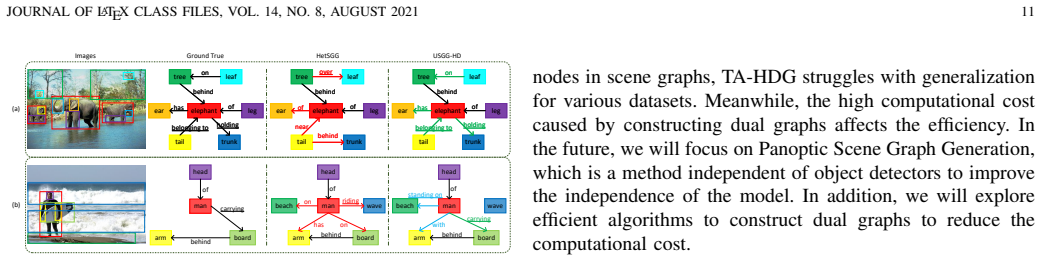
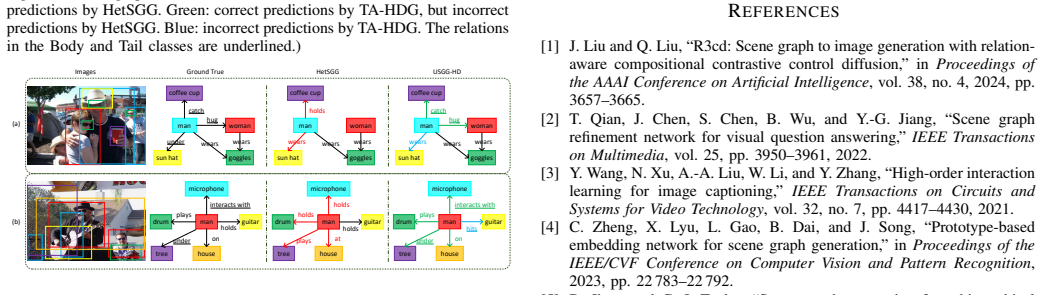
- [Figs. 9 and 10] The method name 'USGG-HD' in the figure labels appears to be a leftover from an earlier version; it should be 'TA-HDG'.
- [Sec. III-B, Eq. (7)] The initial feature notation is confusing: the text says the initial representations are f^{h,(0)}_{i→j} = f^{d,(L+1)}_{i→j} and f^{h,(0)}_i = f^{d,(L+1)}_i, but the dual-graph superscript uses (l+1) while the layer index for the heterogeneous graph is also (l); please clarify the layer indexing and the transition from the dual graph to the heterogeneous graph.
Circularity Check
No central circularity; the only definitional step is the Fig. 7 / Fig. 8 'effectiveness of relation categorization' argument, which renormalizes frequencies by construction.
-
renaming known result
[Sec. IV-B 'Effectiveness of the relation categorization', Fig. 7 (and Sec. IV-C / Fig. 8)]
"For instance, the relation hanging from is only 0.0023 for the distribution ratio in the entire dataset, but after the categorization, its ratio in the interactive relation type increases to 0.0272. This significant increase proves the effectiveness of the relation categorization. Furthermore, improving the distribution of each relation reduces the impact of data bias on the model."
The 'after categorization' ratio is p(r | T(r)) = p(r) / p(T(r)), i.e., the original dataset frequency renormalized by the type share. For any partition with p(T(r)) < 1, the ratio is guaranteed to rise by 1/p(T(r)) for every member, regardless of which predicates are grouped together or of any model behavior. The paper presents this definitional renormalization as proof that categorization 'adjusts the distribution' and helps the model learn tail classes, while the actual training objective (Eq. 14) is plain BCE with no per-type weighting or sampling. Thus the claimed long-tail benefit reduces to a change of coordinate (whole-dataset frequency vs. within-type conditional frequency), not to a measured model effect.
full rationale
The central contribution of TA-HDG is an empirical architecture: heterogeneous-plus-dual graph construction, subject-object pair selection, and type-aware message passing are evaluated on held-out Visual Genome and Open Images splits (Tables I, II, IV, V). No parameter is fitted to a subset and then reported as a prediction of a closely related quantity; all reported R@K/mR@K numbers come from standard benchmark evaluation, so the main derivation chain is self-contained. The paper contains no load-bearing self-citation: the 'relation super-types' attribution is to the external Motifs paper [27], and the HetSGG/EdgeSGG inspirations are also external. The one definitional step is the Fig. 7 / Fig. 8 evidence for the 'effectiveness of relation categorization': the apparent increase in class ratios is a mathematical consequence of conditioning on type totals, not experimental evidence. That step is minor and supporting, not the source of the benchmark gains, so the overall circularity score is low. Separately, the specification of gamma as 'the Mean (·)' is incomplete and the interactive/non-interactive split is never enumerated; this is a reproducibility weakness, not itself a circularity.
Assumptions & free parameters
free parameters (5)
- sb (distance threshold) =
600
- sl (existence/co-linearity threshold) =
0.00001
- K (rank cutoff for confidence threshold sp) =
4096
- interactive/non-interactive relation type mapping γ =
not specified (paper says 'Mean(·)')
- number of GNN layers L =
not reported
assumptions (6)
- standard math Standard GNN/attention update equations (Eqs. 4-11) are valid feature transformations.
- domain assumption Relations that share a subject or object are informative about each other, and objects sharing a relation are informative about each other.
- ad hoc to paper Every relation class can be assigned to exactly one of two types, interactive or non-interactive, and this split is stable across datasets.
- domain assumption The pre-trained Faster R-CNN object proposals provide reliable object class distributions and bounding boxes for graph construction.
- ad hoc to paper The thresholds sb, sl, K chosen on VG transfer unchanged to OI without performance loss.
- domain assumption Evaluation with R@K and mR@K adequately captures head and tail class performance.
Cite this review
Pith. "Pith review of Unbiased Scene Graph Generation by Type-Aware Message Passing on Heterogeneous and Dual Graphs." pith.science (2026). https://pith.science/paper/2JFMWLHK
@misc{pith2026241113287,
  author       = {Pith},
  title        = {Pith review of: Unbiased Scene Graph Generation by Type-Aware Message Passing on Heterogeneous and Dual Graphs},
  year         = {2026},
  howpublished = {\url{https://pith.science/paper/2JFMWLHK}},
  note         = {Machine review of arXiv:2411.13287}
}
read the original abstract
Although great progress has been made in the research of unbiased scene graph generation, issues still hinder improving the predictive performance of both head and tail classes. An unbiased scene graph generation (TA-HDG) is proposed to address these issues. For modeling interactive and non-interactive relations, the Interactive Graph Construction is proposed to model the dependence of relations on objects by combining heterogeneous and dual graph, when modeling relations between multiple objects. It also implements a subject-object pair selection strategy to reduce meaningless edges. Moreover, the Type-Aware Message Passing enhances the understanding of complex interactions by capturing intra- and inter-type context in the Intra-Type and Inter-Type stages. The Intra-Type stage captures the semantic context of inter-relaitons and inter-objects. On this basis, the Inter-Type stage captures the context between objects and relations for interactive and non-interactive relations, respectively. Experiments on two datasets show that TA-HDG achieves improvements in the metrics of R@K and mR@K, which proves that TA-HDG can accurately predict the tail class while maintaining the competitive performance of the head class.
Figures


Figures from the paper (8 more)


Reference graph
Works this paper leans on
-
[27]
Neural motifs: Scene graph parsing with global context,
R. Zellers, M. Yatskar, S. Thomson, and Y . Choi, “Neural motifs: Scene graph parsing with global context,” in Proceedings of the IEEE conference on computer vision and pattern recognition, 2018, pp. 5831– 5840
work page 2018
-
[1]
J. Liu and Q. Liu, “R3cd: Scene graph to image generation with relation- aware compositional contrastive control diffusion,” in Proceedings of the AAAI Conference on Artificial Intelligence , vol. 38, no. 4, 2024, pp. 3657–3665
work page 2024
-
[2]
Scene graph refinement network for visual question answering,
T. Qian, J. Chen, S. Chen, B. Wu, and Y .-G. Jiang, “Scene graph refinement network for visual question answering,” IEEE Transactions on Multimedia, vol. 25, pp. 3950–3961, 2022
2022
-
[3]
High-order interaction learning for image captioning,
Y . Wang, N. Xu, A.-A. Liu, W. Li, and Y . Zhang, “High-order interaction learning for image captioning,” IEEE Transactions on Circuits and Systems for Video Technology, vol. 32, no. 7, pp. 4417–4430, 2021
work page 2021
-
[4]
Prototype-based embedding network for scene graph generation,
C. Zheng, X. Lyu, L. Gao, B. Dai, and J. Song, “Prototype-based embedding network for scene graph generation,” in Proceedings of the IEEE/CVF Conference on Computer Vision and Pattern Recognition , 2023, pp. 22 783–22 792
work page 2023
-
[5]
Hierarchical Relationships: A New Perspective to Enhance Scene Graph Generation
B. Jiang and C. J. Taylor, “Scene graph generation from hierarchical relationship reasoning,” arXiv preprint arXiv:2303.06842 , vol. 7, no. 8, 2023
work page Pith review arXiv 2023
-
[6]
Scene graph generation: A comprehensive survey,
H. Li, G. Zhu, L. Zhang, Y . Jiang, Y . Dang, H. Hou, P. Shen, X. Zhao, S. A. A. Shah, and M. Bennamoun, “Scene graph generation: A comprehensive survey,” Neurocomputing, vol. 566, p. 127052, 2024
2024
-
[7]
Overview of scene graph generation approaches in computer vision,
A. T. Latipova and P. P. Kumar, “Overview of scene graph generation approaches in computer vision,” in 2023 International Russian Smart Industry Conference (SmartIndustryCon) . IEEE, 2023, pp. 655–659
work page 2023
Show all 39 references
-
[8]
Unbiased heterogeneous scene graph generation with relation-aware message passing neural network,
K. Yoon, K. Kim, J. Moon, and C. Park, “Unbiased heterogeneous scene graph generation with relation-aware message passing neural network,” in Proceedings of the AAAI Conference on Artificial Intelligence, vol. 37, no. 3, 2023, pp. 3285–3294
2023
-
[9]
Semantic scene graph generation based on an edge dual scene graph and message passing neural network,
H. Kim, S. Kim, J. T. Lee, and B. C. Ko, “Semantic scene graph generation based on an edge dual scene graph and message passing neural network,” arXiv preprint arXiv:2311.01192 , 2023
2023 arXiv
-
[10]
A unified deep sparse graph attention network for scene graph generation,
H. Zhou, Y . Yang, T. Luo, J. Zhang, and S. Li, “A unified deep sparse graph attention network for scene graph generation,” Pattern Recognition, vol. 123, p. 108367, 2022
2022
-
[11]
Part-aware interactive learning for scene graph generation,
H. Tian, N. Xu, A.-A. Liu, and Y . Zhang, “Part-aware interactive learning for scene graph generation,” in Proceedings of the 28th ACM International Conference on Multimedia , 2020, pp. 3155–3163
2020
-
[12]
Gps-net: Graph property sensing network for scene graph generation,
X. Lin, C. Ding, J. Zeng, and D. Tao, “Gps-net: Graph property sensing network for scene graph generation,” in Proceedings of the IEEE/CVF Conference on Computer Vision and Pattern Recognition , 2020, pp. 3746–3753
2020
-
[13]
Bipartite graph network with adaptive message passing for unbiased scene graph generation,
R. Li, S. Zhang, B. Wan, and X. He, “Bipartite graph network with adaptive message passing for unbiased scene graph generation,” in Proceedings of the IEEE/CVF conference on computer vision and pattern recognition, 2021, pp. 11 109–11 119
2021
-
[14]
Semantically similarity-wise dual-branch network for scene graph generation,
B. Zhao, Z. Mao, S. Fang, W. Zang, and Y . Zhang, “Semantically similarity-wise dual-branch network for scene graph generation,” IEEE Transactions on Circuits and Systems for Video Technology , vol. 32, no. 7, pp. 4573–4583, 2021
2021
-
[15]
Dual- branch hybrid learning network for unbiased scene graph generation,
C. Zheng, L. Gao, X. Lyu, P. Zeng, A. El Saddik, and H. T. Shen, “Dual- branch hybrid learning network for unbiased scene graph generation,” IEEE Transactions on Circuits and Systems for Video Technology, 2023
2023
-
[16]
Label semantic knowledge distillation for unbiased scene graph generation,
L. Li, J. Xiao, H. Shi, W. Wang, J. Shao, A.-A. Liu, Y . Yang, and L. Chen, “Label semantic knowledge distillation for unbiased scene graph generation,” IEEE Transactions on Circuits and Systems for Video Technology, vol. 34, no. 1, pp. 195–206, 2023
2023
-
[17]
Peer learning for unbiased scene graph generation,
L. Zhou, J. Hu, Y . Zhou, T. L. Lam, and Y . Xu, “Peer learning for unbiased scene graph generation,” arXiv preprint arXiv:2301.00146 , 2022
2022 arXiv
-
[18]
More knowledge, less bias: Unbias- ing scene graph generation with explicit ontological adjustment,
Z. Chen, S. Rezayi, and S. Li, “More knowledge, less bias: Unbias- ing scene graph generation with explicit ontological adjustment,” in Proceedings of the IEEE/CVF Winter Conference on Applications of Computer Vision, 2023, pp. 4023–4032. JOURNAL OF LATEX CLASS FILES, VOL. 14,...
2023
-
[19]
Template-guided data augmentation for unbiased scene graph generation,
Y . Zang, Y . Li, L. Cao, and R. Lu, “Template-guided data augmentation for unbiased scene graph generation,” in ICASSP 2024-2024 IEEE International Conference on Acoustics, Speech and Signal Processing (ICASSP). IEEE, 2024, pp. 3510–3514
2024
-
[20]
Importance weighted structure learning for scene graph generation,
D. Liu, M. Bober, and J. Kittler, “Importance weighted structure learning for scene graph generation,” IEEE Transactions on Pattern Analysis and Machine Intelligence, 2023
2023
-
[21]
Constrained structure learning for scene graph generation,
Liu, Daqi and Bober, Miroslaw and Kittler, Josef, “Constrained structure learning for scene graph generation,” IEEE Transactions on Pattern Analysis and Machine Intelligence , vol. 45, no. 10, pp. 11 588–11 599, 2023
2023
-
[22]
Scene graph generation by iterative message passing,
D. Xu, Y . Zhu, C. B. Choy, and L. Fei-Fei, “Scene graph generation by iterative message passing,” in Proceedings of the IEEE conference on computer vision and pattern recognition , 2017, pp. 5410–5419
2017
-
[23]
Bridging knowledge graphs to generate scene graphs,
A. Zareian, S. Karaman, and S.-F. Chang, “Bridging knowledge graphs to generate scene graphs,” in Computer Vision–ECCV 2020: 16th European Conference, Glasgow, UK, August 23–28, 2020, Proceedings, Part XXIII 16. Springer, 2020, pp. 606–623
2020
-
[24]
A novel framework for scene graph generation via prior knowledge,
Z. Wang, J. Lian, L. Li, and J. Zhao, “A novel framework for scene graph generation via prior knowledge,” IEEE Transactions on Circuits and Systems for Video Technology , 2023
2023
-
[25]
Ru-net: Regularized unrolling network for scene graph generation,
X. Lin, C. Ding, J. Zhang, Y . Zhan, and D. Tao, “Ru-net: Regularized unrolling network for scene graph generation,” in Proceedings of the IEEE/CVF Conference on Computer Vision and Pattern Recognition , 2022, pp. 19 457–19 466
2022
-
[26]
Neural belief propagation for scene graph generation,
D. Liu, M. Bober, and J. Kittler, “Neural belief propagation for scene graph generation,” IEEE transactions on pattern analysis and machine intelligence, vol. 45, no. 8, pp. 10 161–10 172, 2023
2023
-
[28]
Adaptive feature learning for unbiased scene graph generation,
J. Yang, C. Wang, L. Yang, Y . Jiang, and A. Cao, “Adaptive feature learning for unbiased scene graph generation,” IEEE Transactions on Image Processing, vol. 33, pp. 2252–2265, 2024
2024
-
[29]
Learning to generate scene graph from natural language supervision,
Y . Zhong, J. Shi, J. Yang, C. Xu, and Y . Li, “Learning to generate scene graph from natural language supervision,” in Proceedings of the IEEE/CVF International Conference on Computer Vision , 2021, pp. 1823–1834
2021
-
[30]
Recovering the unbiased scene graphs from the biased ones,
M.-J. Chiou, H. Ding, H. Yan, C. Wang, R. Zimmermann, and J. Feng, “Recovering the unbiased scene graphs from the biased ones,” in Proceedings of the 29th ACM International Conference on Multimedia , 2021, pp. 1581–1590
2021
-
[31]
Faster r-cnn: Towards real-time object detection with region proposal networks,
S. Ren, K. He, R. Girshick, and J. Sun, “Faster r-cnn: Towards real-time object detection with region proposal networks,” IEEE transactions on pattern analysis and machine intelligence, vol. 39, no. 6, pp. 1137–1149, 2016
2016
-
[32]
Binary cross entropy with deep learning technique for image classification,
U. Ruby and V . Yendapalli, “Binary cross entropy with deep learning technique for image classification,” Int. J. Adv. Trends Comput. Sci. Eng, vol. 9, no. 10, 2020
2020
-
[33]
Coun- terfactual critic multi-agent training for scene graph generation,
L. Chen, H. Zhang, J. Xiao, X. He, S. Pu, and S.-F. Chang, “Coun- terfactual critic multi-agent training for scene graph generation,” in Proceedings of the IEEE/CVF international conference on computer vision, 2019, pp. 4613–4623
2019
-
[34]
Learning to compose dynamic tree structures for visual contexts,
K. Tang, H. Zhang, B. Wu, W. Luo, and W. Liu, “Learning to compose dynamic tree structures for visual contexts,” in Proceedings of the IEEE/CVF conference on computer vision and pattern recognition, 2019, pp. 6619–6628
2019
-
[35]
Hose-net: Higher order structure embedded network for scene graph generation,
M. Wei, C. Yuan, X. Yue, and K. Zhong, “Hose-net: Higher order structure embedded network for scene graph generation,” in Proceedings of the 28th ACM International Conference on Multimedia , 2020, pp. 1846–1854
2020
-
[36]
Hl-net: Heterophily learning network for scene graph generation,
X. Lin, C. Ding, Y . Zhan, Z. Li, and D. Tao, “Hl-net: Heterophily learning network for scene graph generation,” in proceedings of the IEEE/CVF conference on computer vision and pattern recognition, 2022, pp. 19 476–19 485
2022
-
[37]
Visual genome: Connecting language and vision using crowdsourced dense image annotations,
R. Krishna, Y . Zhu, O. Groth, J. Johnson, K. Hata, J. Kravitz, S. Chen, Y . Kalantidis, L.-J. Li, D. A. Shammaet al., “Visual genome: Connecting language and vision using crowdsourced dense image annotations,” International journal of computer vision , vol. 123, pp. 32–73, 2017
2017
-
[38]
The open images dataset v4: Unified image classification, object detection, and visual relationship detection at scale,
A. Kuznetsova, H. Rom, N. Alldrin, J. Uijlings, I. Krasin, J. Pont-Tuset, S. Kamali, S. Popov, M. Malloci, A. Kolesnikovet al., “The open images dataset v4: Unified image classification, object detection, and visual relationship detection at scale,” International journal of co...
1956
-
[39]
Feature pyramid networks for object detection,
T.-Y . Lin, P. Doll´ar, R. Girshick, K. He, B. Hariharan, and S. Belongie, “Feature pyramid networks for object detection,” in Proceedings of the IEEE conference on computer vision and pattern recognition , 2017, pp. 2117–2125
2017
Reviewed August 12, 2026 · model on record in the stance chip above.
Discussion (0). Continue with ORCID to comment.