REVIEW 3 major objections 6 minor 52 references
An efficient, adaptive solver for accurate simulation of multicomponent shock-interface problems for thermally perfect species
T0 review · 3 major / 6 minor · reviewed 2026-08-12 · deepseek-v4-flash
Pith's one-line read A hybrid double-flux and conservative scheme suppresses interface pressure oscillations while preserving correct shock capturing for thermally perfect multicomponent flows.
desk verdict A useful incremental double-flux variant with clean derivations and broad validation, but the unspecified shock sensor threshold and AMR caveat need addressing. read the letter →
The pith
A machine-rendered reading of the paper's core claim, the machinery that carries it, and where it could break.
The reading
What carries the argument
The load-bearing mechanism is the hybridized flux and interpolation strategy built around an extended double-flux scheme. At each cell, the normalized pressure curvature $S_i = |\bar{p}_{i-1}-2\bar{p}_i+\bar{p}_{i+1}|/(\bar{p}_{i-1}+2\bar{p}_i+\bar{p}_{i+1})$ acts as a shock sensor: if $S_i$ stays below a user-set threshold, the cell is updated with the extended double-flux scheme, which freezes the averaged specific-heat ratio $\hat{\gamma}$ during the two RK stages and then corrects the total energy; if the sensor fires, the update switches to a fully conservative scheme with characteristic-decomposition MUSCL interpolation. The extended double-flux reformulation expresses total energy as $E = h^f_0 - p/(\hat{\gamma}-1) + (u^2+v^2)/2$ (Approach A) or $E = p/(\hat{\gamma}-1) + (u^2+v^2)/2$ (Approach B), so that freezing $\hat{\gamma}$ cancels the terms that would otherwise produce $\delta p \neq 0$ at a material front.
What would settle it
On the one-dimensional Sod problem using thermally perfect nitrogen, set the shock sensor threshold so that the double-flux scheme is active across the shock front; if the computed shock speed or post-shock pressure differs measurably from the fully conservative reference solution (or from the exact weak solution), the claim that the hybrid solver converges to the correct weak solution is falsified.
Extended reading notes
Core claim
The paper's central claim is that a hybridized finite-volume scheme, blending an extended double-flux algorithm with a traditional conservative scheme via a pressure-curvature shock sensor, solves multicomponent shock-interface problems for thermally perfect species without the pressure-oscillation artifacts of fully conservative schemes and without the incorrect-shock artifacts of non-conservative ones. The extended double-flux method freezes a single averaged specific-heat ratio $\hat{\gamma}$ during the cell update; this single auxiliary variable is enough to guarantee pressure and velocity equilibrium at a material front, and it reduces conservation loss in the energy compared with the original two-variable double-flux model. The hybrid solver is verified on entropy-wave advection, an inert H$_2$ bubble, the Sod problem, a two-dimensional viscous shock-bubble interaction, a reactive H$_2$ bubble, a deflagration-to-detonation transition, and a non-premixed planar rotating detonation engine; in the Sod test it "converges to the same weak solution correctly as compared to the fully conservative one," and in the detonation cases it avoids artificial partial extinction that the conservative scheme exhibits.
Load-bearing premise
The central reliability claim rests on the user-chosen shock sensor threshold $S_t$: if the threshold is set too high, the non-conservative double-flux scheme is applied near shocks and may converge to the wrong weak solution, and if set too low, interface oscillations are not cured; the paper gives no guidance or default values for $S_t$.
Editorial extensions
If this is right
- The hybrid solver reproduces the correct weak solution in the Sod problem, meaning the blending does not disrupt shock speed or post-shock states while removing the pressure spike at the material front.
- Only one auxiliary variable $\hat{\gamma}$ is frozen during the double-flux update, which simplifies implementation relative to the original double-flux method and reduces energy conservation loss; in the inert H2 bubble test, mass and momentum loss stay at machine accuracy and total energy loss is 0.002913 over the run.
- Because the shock sensor is resolution-independent, the hybrid scheme combines with block-structured adaptive mesh refinement; the DDT and RDE cases show it works with 3 to 4 refinement levels and reduces wall-clock time relative to a uniform fine grid.
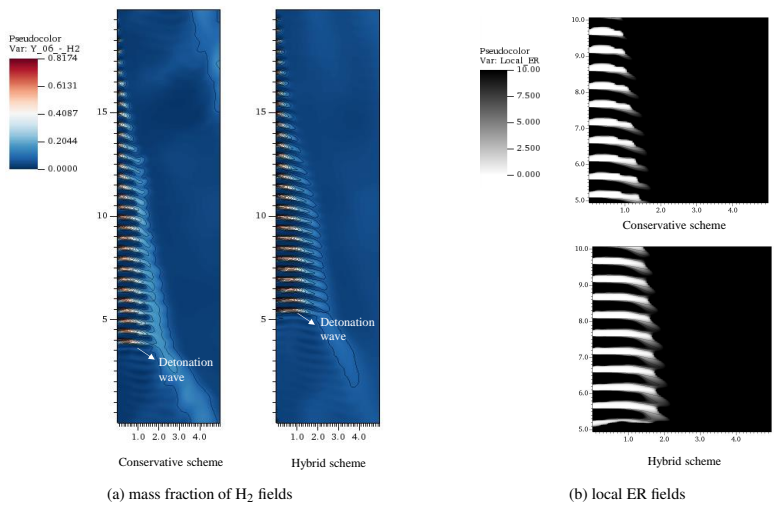
- For reactive cases, the hybrid scheme avoids spurious oscillation-induced mixing errors: in the non-premixed planar RDE, the conservative scheme drives partial detonation extinction through locally high equivalence ratios while the hybrid scheme maintains a self-sustained detonation.
- Both extended double-flux approaches (A and B) give virtually identical results, with Approach A slightly better for momentum conservation.
Reading between the lines
- The shock-sensor threshold $S_t$ is left user-specified with no guidance or default value; a natural next step is an automatic estimator based on local smoothness that adapts $S_t$ per cell, which would remove the main reliability caveat.
- The hybrid strategy should extend to higher-order base schemes such as WENO or discontinuous Galerkin as long as the double-flux energy correction is applied consistently per cell; the paper only demonstrates second-order MUSCL, but the mechanism is not tied to MUSCL.
- If the method generalizes to three dimensions and other reaction mechanisms, it offers a practical path for large-scale detonation and shock-interface simulations with detailed chemistry, where fully conservative schemes produce spurious mixing that can change the combustion outcome.
Editorial analysis
A structured set of objections, weighed in public.
Referee Report
Summary. This paper presents a second-order finite volume hybrid scheme for multicomponent compressible flows with thermally perfect species. The method extends the double-flux idea to require only one frozen auxiliary variable, \hat\gamma, and blends the extended double-flux update with a conservative HLLC/MUSCL scheme using a normalized pressure-curvature shock sensor, with characteristic decomposition used near shocks and primitive-variable interpolation elsewhere. The solver is embedded in block-structured AMR using the AMROC framework. Verification and demonstration cases include 1D and 2D entropy-wave convergence, advection of an H2 bubble, the 1D Sod problem, 2D inert shock-bubble interaction, DDT in a smooth channel, and a non-premixed planar RDE.
Significance. If the central claims hold, the paper offers a practical and relatively inexpensive cure for interface pressure oscillations in multicomponent reacting-flow simulations. The algebraic derivation of pressure equilibrium in Section 3.1 is clean, the method uses only one auxiliary variable, smooth entropy-wave tests show second-order convergence, the CPU overhead is reported to be below 10%, and the benchmark suite is substantial, including viscous and reactive cases. The main risk is that the correctness of the hybrid weak solution depends on a user-specified shock-sensor threshold for which no values or sensitivity analysis are given, and on an AMR nesting assumption that is not verified; these issues need to be addressed before the reliability claim is fully supported.
major comments (3)
- [Section 4.1, Eq. (40), Algorithm 1] The central reliability claim depends on the shock sensor threshold S_t, but the paper provides no values, no sensitivity study, and no automatic selection criterion for any test case. Section 4.1 states that S_t is "problem-related," and Section 4.3.1 reports only a single Sod comparison at one resolution. Since a too-large threshold applies non-conservative double-flux updates in or near shocks and can change the weak solution, while a too-small threshold restores interface oscillations, the claim that the hybrid solver "converges to the same weak solution correctly" is not yet demonstrated. Algorithm 1 is also not reproducible as written: Step 2 contains the incomplete condition "> S_T^k using shock-capturing scheme, > S_T^k with extended double-flux scheme," and Step 3 then branches on S_k < S_T^k; the exact switching logic and the values used must be stated clearly.
- [Section 4.3.1] The hybrid update is non-conservative at the material interface and at the interface between double-flux and conservative cells, so convergence to the correct weak solution needs a quantitative demonstration. The Sod test compares one resolution of the hybrid scheme with one resolution of the conservative scheme; no mesh-refinement study, no grid-convergence of the shock speed and strength, and no independent reference solution are provided. In addition, the paper does not quantify the conservation error produced by the cell-by-cell switching, where inconsistent left and right fluxes meet at a double-flux/conservative edge. Please add a grid-convergence study for a shock-interface problem and report the local conservation error at switching boundaries.
- [Section 4.2] The AMR claim is load-bearing but rests on an unverified premise. The paper states that the effects of coarse-fine prolongation and restriction on the non-conservative double-flux scheme have not been taken into account, and that the material interface is assumed to remain nested within the finest refinement level. For the AMR-based DDT simulation in Section 5.2, no evidence is given that this nesting condition is satisfied at all times, and no analysis of conservation errors at coarse-fine boundaries is provided. Please either verify the nesting condition for the presented AMR runs or analyze and control the conservation error introduced at coarse-fine interfaces.
minor comments (6)
- [Section 3.1.1, Eq. (31)] The sign of the pressure term in Eq. (31) is incorrect: from Eqs. (14) and (30) one obtains E = h_f0 + p/(\hat\gamma-1) + (u^2+v^2)/2, not minus. Equation (32) and Algorithm 1, Step 10 use the plus sign, so this appears to be a typo, but it should be corrected because Eq. (31) is central to the derivation.
- [Section 3.2.2, Eq. (39)] As written, e_n = |\psi_n - \psi_0|/\psi_n with \psi_0 = 0 and \psi_n the relative total-change measure evaluates to 1 identically; please restate the intended conservation-loss measure, probably e_n = |\sum_j(U_j^n - U_j^0)| / \sum_j U_j^n.
- [Section 5.1, Figure 12] The text says the temperature spikes are compared "with the same calculation time" at t = t1, but the figure caption reports t1 = 0.1 ms for the double-flux result and t2 = 0.008 ms for the conservative result; please clarify this apparent inconsistency.
- [Throughout] Many typos and inconsistent notation remain, including "Correponding," "auxillary," "Langrangian," "charatertistic," and "the the original" in the Highlights, as well as S_T^k versus S_t^i for the threshold. A careful proofread is needed.
- [Section 3.1.2] Approach B is claimed to guarantee pressure and velocity equilibrium by "a derivation analogous to Eq. (32)," but the derivation is not shown; since \hat C_p in Eq. (34) includes the enthalpy of formation whereas Eq. (30) does not, please state the analogous relations explicitly or note any difference.
- [Section 4.1] The statement that the pressure-curvature sensor is "resolution independent" is plausible for smooth pressure but is not demonstrated under AMR refinement; a short numerical demonstration or discussion would help.
Circularity Check
No significant circularity: the extended double-flux/hybrid derivation is self-contained, with only minor, non-load-bearing self-citations.
full rationale
The central result is not circular. The auxiliary variable \hat gamma is defined algebraically from the state: \hat C_p = \int_{T_ref}^T C_p(s)\,ds / T (Eq. 30) or \hat C_p = h/T (Eq. 34), so Eqs. (31) and (35) are algebraic reformulations of the thermally perfect energy expression Eq. (14), not fitted parameters. The pressure-equilibrium claim follows from the discrete Euler equations with \hat gamma frozen during the cell update: after cancellation of formation-enthalpy and kinetic-energy terms using Eqs. (21) and (33), Eq. (32) gives \delta p = 0 at a material front where \Delta p = 0. That is a genuine derivation from the governing equations, not an input or a renamed known result. The hybrid switching uses the normalized pressure-curvature sensor S_i of Eq. (40); the threshold S_t is described as "problem-related" and left to the user, and no threshold sweep is reported. This is a real robustness and verification limitation, but the threshold is a switching control external to the pressure-equilibrium derivation, so it is not a fitted parameter renamed as a prediction. The paper also contains self-citations: AMROC is cited for AMR validation with references [41,44,45], and reference [28], which shares a coauthor, is cited for the general observation that hybrid thresholds are problem-dependent. These are not load-bearing for the new extended-double-flux/hybrid contribution: AMROC is an independently developed and previously validated codebase, and [28] only supports a generic remark about hybrid methods. The Sod verification compares the hybrid result to the paper's own fully conservative scheme rather than to an independent exact solution; this weakens the convergence evidence but does not make the claim circular. Overall, the derivation chain is self-contained; the score is low, raised slightly only by the minor non-load-bearing self-citations.
Assumptions & free parameters
free parameters (1)
- Shock sensor threshold S_t =
not specified (problem-dependent)
assumptions (4)
- domain assumption Ideal gas law and thermally perfect equation of state (Eqs. 13-14) close the system.
- domain assumption The HLLC Riemann solver preserves velocity equilibrium across a material interface over one time step (Section 2.2).
- domain assumption The normalized pressure curvature shock sensor (Eq. 40) reliably distinguishes smooth regions from shocks for a user-chosen threshold.
- ad hoc to paper Material interfaces remain nested within the finest AMR level during simulation (Section 4.2).
Cite this review
Pith. "Pith review of An efficient, adaptive solver for accurate simulation of multicomponent shock-interface problems for thermally perfect species." pith.science (2026). https://pith.science/paper/L4RHCUR5
@misc{pith2026241113324,
  author       = {Pith},
  title        = {Pith review of: An efficient, adaptive solver for accurate simulation of multicomponent shock-interface problems for thermally perfect species},
  year         = {2026},
  howpublished = {\url{https://pith.science/paper/L4RHCUR5}},
  note         = {Machine review of arXiv:2411.13324}
}
read the original abstract
A second-order-accurate finite volume method, hybridized by blending an extended double-flux algorithm and a traditionally conservative scheme, is developed. In this scheme, hybrid convective fluxes as well as hybrid interpolation techniques are designed to ensure stability and accuracy in the presence of both material interfaces and shocks. Two computationally efficient approaches, extended from the original double-flux model, are presented to eliminate the well-known "pressure oscillation" phenomenon at material interfaces observed with the traditional conservative scheme. Numerous verification simulations confirm that the method is capable of handling multi-dimensional shock-interface problems reliably and efficiently, even in the presence of viscous and reactive terms.
Figures


Figures from the paper (17 more)


Reference graph
Works this paper leans on
-
[1]
B. Larrouturou, How to preserve the mass fractions positivity when computing compressible multi-component flows, Journal of computational physics 95 (1) (1991) 59–84
work page 1991
-
[2]
S. Karni, Multicomponent flow calculations by a consistent primitive algorithm, Journal of Computational Physics 112 (1) (1994) 31–43
work page 1994
-
[3]
R. Abgrall, How to prevent pressure oscillations in multicomponent flow calculations: a quasi conservative approach, Journal of Computational Physics 125 (1) (1996) 150–160
work page 1996
-
[4]
V. T. Ton, Improved shock-capturing methods for multicomponent and reacting flows, Journal of Computational Physics 128 (1) (1996) 237–253
work page 1996
- [5]
-
[6]
K.-M. Shyue, An efficient shock-capturing algorithm for compressible multicomponent prob- lems, Journal of Computational Physics 142 (1) (1998) 208–242
work page 1998
-
[7]
R. F. Johnson, A. D. Kercher, A conservative discontinuous galerkin discretization for the chemically reacting navier-stokes equations, Journal of Computational Physics 423 (2020) 109826. 41
work page 2020
-
[8]
R. P. Fedkiw, B. Merriman, S. Osher, High accuracy numerical methods for thermally perfect gas flows with chemistry, Journal of Computational Physics 132 (2) (1997) 175–190
work page 1997
Show all 52 references
-
[9]
R. P. Fedkiw, B. Merriman, S. Osher, Efficient characteristic projection in upwind differ- ence schemes for hyperbolic systems: the complementary projection method, Journal of Computational Physics 141 (1) (1998) 22–36
1998
-
[10]
R. P. Fedkiw, T. Aslam, B. Merriman, S. Osher, A non-oscillatory eulerian approach to interfaces in multimaterial flows (the ghost fluid method), Journal of computational physics 152 (2) (1999) 457–492
1999
-
[11]
R. P. Fedkiw, Coupling an eulerian fluid calculation to a lagrangian solid calculation with the ghost fluid method, Journal of Computational Physics 175 (1) (2002) 200–224
2002
-
[12]
Chang, X
C.-H. Chang, X. Deng, T. G. Theofanous, Direct numerical simulation of interfacial instabil- ities: a consistent, conservative, all-speed, sharp-interface method, Journal of Computational Physics 242 (2013) 946–990
2013
-
[13]
J. Luo, X. Hu, N. A. Adams, A conservative sharp interface method for incompressible multiphase flows, Journal of Computational Physics 284 (2015) 547–565
2015
-
[14]
L. Xu, W. Yang, T. Liu, An interface treatment for two-material multi-species flows involving thermally perfect gases with chemical reactions, Journal of Computational Physics 448 (2022) 110707
2022
-
[15]
Billet, R
G. Billet, R. Abgrall, An adaptive shock-capturing algorithm for solving unsteady reactive flows, Computers & fluids 32 (10) (2003) 1473–1495
2003
-
[16]
R. W. Houim, K. K. Kuo, A low-dissipation and time-accurate method for compressible multi-component flow with variable specific heat ratios, Journal of Computational Physics 230 (23) (2011) 8527–8553
2011
-
[17]
Y. Lv, M. Ihme, Discontinuous galerkin method for multicomponent chemically reacting flows and combustion, Journal of Computational Physics 270 (2014) 105–137
2014
-
[18]
Abgrall, S
R. Abgrall, S. Karni, Computations of compressible multifluids, Journal of computational physics 169 (2) (2001) 594–623
2001
-
[19]
R. W. Houim, A. Ozgen, E. S. Oran, The role of spontaneous waves in the deflagration-to- detonation transition in submillimetre channels, Combustion Theory and Modelling 20 (6) (2016) 1068–1087
2016
-
[20]
Goodwin, R
G. Goodwin, R. Houim, E. Oran, Effect of decreasing blockage ratio on ddt in small channels with obstacles, Combustion and Flame 173 (2016) 16–26
2016
-
[21]
Bando, M
K. Bando, M. Sekachev, M. Ihme, Comparison of algorithms for simulating multi-component reacting flows using high-order discontinuous galerkin methods, in: AIAA Scitech 2020 Forum, 2020, p. 1751. 42
2020
-
[22]
Johnsen, F
E. Johnsen, F. Ham, Preventing numerical errors generated by interface-capturing schemes in compressible multi-material flows, Journal of Computational Physics 231 (17) (2012) 5705–5717
2012
-
[23]
Y. Lv, M. Ihme, Development of discontinuous galerkin method for detonation and supersonic combustion, in: 51st AIAA Aerospace Sciences Meeting including the New Horizons Forum and Aerospace Exposition, 2013, p. 688
2013
-
[24]
Qiu, C.-W
J. Qiu, C.-W. Shu, A comparison of troubled-cell indicators for runge–kutta discontinu- ous galerkin methods using weighted essentially nonoscillatory limiters, SIAM Journal on Scientific Computing 27 (3) (2005) 995–1013
2005
-
[25]
Krivodonova, J
L. Krivodonova, J. Xin, J.-F. Remacle, N. Chevaugeon, J. E. Flaherty, Shock detection and limiting with discontinuous galerkin methods for hyperbolic conservation laws, Applied Numerical Mathematics 48 (3-4) (2004) 323–338
2004
-
[26]
G. Li, J. Qiu, Hybrid weighted essentially non-oscillatory schemes with different indicators, Journal of Computational Physics 229 (21) (2010) 8105–8129
2010
-
[27]
D. J. Hill, D. I. Pullin, Hybrid tuned center-difference-weno method for large eddy simulations in the presence of strong shocks, Journal of Computational Physics 194 (2) (2004) 435–450
2004
-
[28]
J. L. Ziegler, R. Deiterding, J. E. Shepherd, D. I. Pullin, An adaptive high-order hybrid scheme for compressive, viscous flows with detailed chemistry, Journal of Computational Physics 230 (20) (2011) 7598–7630
2011
-
[29]
Jiang, C
Z.-H. Jiang, C. Yan, J. Yu, Y. Li, Hybrid central-upwind finite volume schemes for solving the euler and navier–stokes equations, Computers & Mathematics with Applications 72 (9) (2016) 2241–2258
2016
-
[30]
Clain, S
S. Clain, S. Diot, R. Loub `ere, A high-order finite volume method for systems of conservation laws—multi-dimensional optimal order detection (mood), Journal of computational Physics 230 (10) (2011) 4028–4050
2011
-
[31]
Loubere, M
R. Loubere, M. Dumbser, S. Diot, A new family of high order unstructured mood and ader finite volume schemes for multidimensional systems of hyperbolic conservation laws, Communications in Computational Physics 16 (3) (2014) 718–763
2014
-
[32]
Dumbser, O
M. Dumbser, O. Zanotti, R. Loub `ere, S. Diot, A posteriori subcell limiting of the discontin- uous galerkin finite element method for hyperbolic conservation laws, Journal of Computa- tional Physics 278 (2014) 47–75
2014
-
[33]
S. F. Davis, A simplified tvd finite difference scheme via artificial viscosity, SIAM journal on scientific and statistical computing 8 (1) (1987) 1–18
1987
-
[34]
C. R. Wilke, A viscosity equation for gas mixtures, The journal of chemical physics 18 (4) (1950) 517–519. 43
1950
-
[35]
R. B. Bird, W. E. Stewart, E. N. Lightfoot, R. E. Meredith, Transport phenomena, Journal of The Electrochemical Society 108 (3) (1961) 78C
1961
-
[36]
Mathur, P
S. Mathur, P. Tondon, S. Saxena, Thermal conductivity of binary, ternary and quaternary mixtures of rare gases, Molecular physics 12 (6) (1967) 569–579
1967
-
[37]
M. P. Burke, M. Chaos, Y. Ju, F. L. Dryer, S. J. Klippenstein, Comprehensive h2/o2 kinetic model for high-pressure combustion, International Journal of Chemical Kinetics 44 (7) (2012) 444–474
2012
-
[38]
E. F. Toro, Riemann solvers and numerical methods for fluid dynamics: a practical introduc- tion, Springer Science & Business Media, 2013
2013
-
[39]
Liou, A sequel to ausm: Ausm+, Journal of computational Physics 129 (2) (1996) 364–382
M.-S. Liou, A sequel to ausm: Ausm+, Journal of computational Physics 129 (2) (1996) 364–382
1996
-
[40]
P. Kaps, P. Rentrop, Generalized runge-kutta methods of order four with stepsize control for stiff ordinary differential equations, Numerische Mathematik 33 (1979) 55–68
1979
-
[41]
Deiterding, Parallel adaptive simulation of multi-dimensional detonation structures, Dis- sertation
R. Deiterding, Parallel adaptive simulation of multi-dimensional detonation structures, Dis- sertation. de, 2003
2003
-
[42]
M. J. Berger, P. Colella, Local adaptive mesh refinement for shock hydrodynamics, Journal of computational Physics 82 (1) (1989) 64–84
1989
-
[43]
Deiterding, Block-structured adaptive mesh refinement-theory, implementation and appli- cation, in: Esaim: Proceedings, Vol
R. Deiterding, Block-structured adaptive mesh refinement-theory, implementation and appli- cation, in: Esaim: Proceedings, Vol. 34, EDP Sciences, 2011, pp. 97–150
2011
-
[44]
Deiterding, A parallel adaptive method for simulating shock-induced combustion with detailed chemical kinetics in complex domains, Computers & Structures 87 (11-12) (2009) 769–783
R. Deiterding, A parallel adaptive method for simulating shock-induced combustion with detailed chemical kinetics in complex domains, Computers & Structures 87 (11-12) (2009) 769–783
2009
-
[45]
X. Cai, J. Liang, R. Deiterding, Y. Mahmoudi, M. Sun, Experimental and numerical investi- gations on propagating modes of detonations: Detonation wave/boundary layer interaction, Combustion and flame 190 (2018) 201–215
2018
-
[46]
J. J. Quirk, S. Karni, On the dynamics of a shock–bubble interaction, Journal of Fluid Mechanics 318 (1996) 129–163
1996
-
[47]
Terashima, G
H. Terashima, G. Tryggvason, A front-tracking/ghost-fluid method for fluid interfaces in compressible flows, Journal of Computational Physics 228 (11) (2009) 4012–4037
2009
-
[48]
D. G. Goodwin, R. L. Speth, H. K. Moffat, B. W. Weber, Cantera: An object-oriented software toolkit for chemical kinetics, thermodynamics, and transport processes, Zenodo (2018)
2018
-
[49]
J. H. Lee, The detonation phenomenon, Cambridge University Press, 2008. 44
2008
-
[50]
Altantzis, C
C. Altantzis, C. Frouzakis, A. Tomboulides, M. Matalon, K. Boulouchos, Hydrodynamic and thermodiffusive instability effects on the evolution of laminar planar lean premixed hydrogen flames, Journal of fluid mechanics 700 (2012) 329–361
2012
-
[51]
Berger, K
L. Berger, K. Kleinheinz, A. Attili, H. Pitsch, Characteristic patterns of thermodiffusively unstable premixed lean hydrogen flames, Proceedings of the Combustion Institute 37 (2) (2019) 1879–1886
2019
-
[52]
Jiang, C.-W
G.-S. Jiang, C.-W. Shu, Efficient implementation of weighted eno schemes, Journal of com- putational physics 126 (1) (1996) 202–228. 45
1996
Reviewed August 12, 2026 · model on record in the stance chip above.
Discussion (0). Continue with ORCID to comment.