REVIEW 2 major objections 3 minor 88 references
Multicomponent cat states with sub-Planckian structures and their optomechanical analogues
T0 review · 2 major / 3 minor · reviewed 2026-08-12 · deepseek-v4-flash
Pith's one-line read This paper claims that equal-weight superpositions of six or more coherent states placed uniformly on a circle give isotropic, direction-independent sub-Planckian phase-space sensitivity, unlike the four-component compass state.
desk verdict Solid ideal-state analysis of isotropic sub-Planckian structures for even L>=6 cat superpositions; the optomechanical 'analogues' carry different phases and are not the states claimed. read the letter →
The pith
A machine-rendered reading of the paper's core claim, the machinery that carries it, and where it could break.
The reading
What carries the argument
The carrying object is the $L$-component cat state $|\beta_L\rangle$, an equal-weight superposition of coherent states spaced uniformly around a circle of radius $|\beta|$. For $L \ge 6$ its central Wigner term is a cosine sum whose zero set is a circle, which is what turns the sub-Planckian pattern isotropic. The sensitivity argument rides on the overlap formula; in the large-$L$ limit the Bessel function $J_0(2\beta|\delta\alpha|)$ supplies concentric circular zeros, so a displacement of size roughly $1/\beta$ in any direction makes the state orthogonal to its original. The optomechanical construction is carried by a Gaussian-sum identity that, at revival times $t = 2\pi M$, expresses the cavity field as a superposition of coherent states with equal moduli.
What would settle it
Directly compute the Wigner function or the overlap $O(\delta x,\delta p)$ for the revival states (32)-(37) with their actual coefficients at the value $\beta=8$ used in Fig. 12. If the central zero contour is not circular to within the fringe width, or if it differs materially from the ideal $L$-component result, the equivalence between the optomechanical analogues and the ideal states fails; a circular contour of radius about $1/\beta$ would confirm it.
Extended reading notes
Core claim
The central claim is that the equal-weight, uniformly phased superpositions $|\beta_L\rangle$ of Eq. (1) exhibit isotropic sub-Planckian structures for all even $L \ge 6$. Writing the central interference part of the Wigner function as a sum of cosines, the paper shows that the zero contour is circular for $L \ge 6$ but rectangular for $L=4$. The displacement overlap obeys $O(\delta x,\delta p) = |\langle \beta_L | \hat D(\delta\alpha) | \beta_L\rangle|^2$, which in the $L\to\infty$ limit with $\beta\gg 1$ becomes $e^{-|\delta\alpha|^2}|J_0(2\beta|\delta\alpha|)|^2$, making the sensitivity enhancement isotropic. The paper concludes that previously constructed isotropic compass-state superpositions are a subset of this family, and that the revival-time states of an optomechanical cavity have nearly identical central phase-space structures to the ideal states.
Load-bearing premise
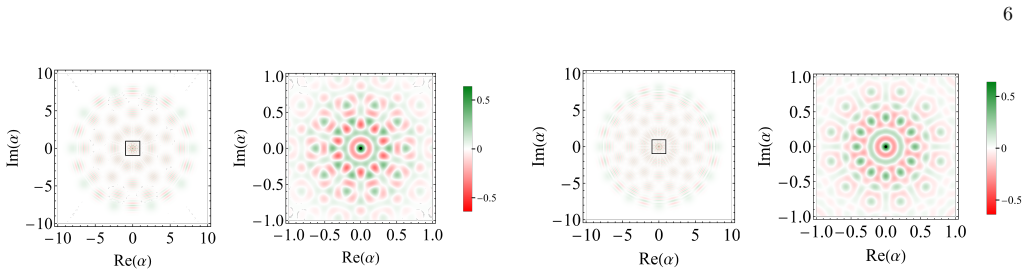
The load-bearing premise is that the optomechanical revival states of Eqs. (32)-(37), which carry additional relative phases not present in the ideal equal-phase states of Sec. II, have nearly identical central phase-space structures to those ideal states; the paper supports this by visual comparison in Fig. 12 rather than by an analytic or quantitative match of the interference terms.
Editorial extensions
If this is right
- Any even number $L \ge 6$ of coherent states, not just $L=8$ or $L=12$ compass-state superpositions, yields isotropic sub-Planckian structures; $L=6$ and $L=10$ are new examples.
- The displacement overlap has circular zero regions for $L \ge 6$, so a sensor based on these states can detect perturbations of size about $1/\beta$ in any phase-space direction with equal precision.
- Since the sensitivity scales as $1/\sqrt{\bar{n}}$ while direction dependence disappears, these states offer an improvement over two- and four-component cat states for the same mean photon number.
- The state family generated by an optomechanical cavity at revival times reproduces near versions of these states, making physical realization plausible without requiring strong single-photon optomechanical coupling.
- Under mechanical dissipation or cavity decay, purity and Wigner negativity drop and the central overlap peak blurs, so the enhanced sensitivity is lost while the overall phase-space shape is preserved.
Reading between the lines
- Editorial inference: the $L\to\infty$ Bessel form makes the central sensitivity purely radial, so any platform producing a radially symmetric superposition, not only the specific revival times considered here, should inherit the same isotropic metrology.
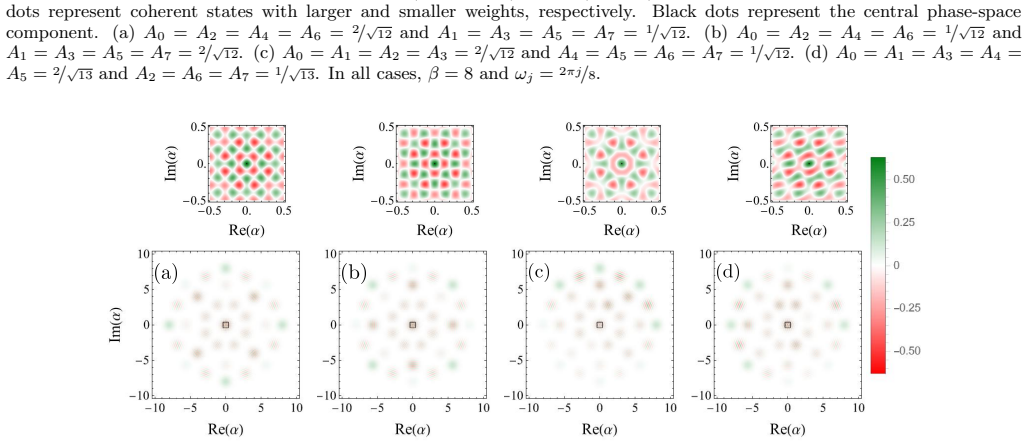
- Editorial inference: the appendix shows that uneven weights and uneven phases can break isotropy, which points to a natural open quantity: a tolerance bound on weight and phase noise that preserves the circular zero contour for given $L$ and $\beta$.
- Editorial inference: comparing the revival states (32)-(37) with the ideal states at smaller amplitudes, say $\beta=4$, would test whether the extra phases remain negligible, since the visual evidence in Fig. 12 is presented for a single large amplitude.
Editorial analysis
A structured set of objections, weighed in public.
Referee Report
Summary. The manuscript studies superpositions |β_L> = N^{-1/2} Σ_{j=0}^{L-1} |e^{2πij/L} β> of L coherent states arranged on a circle. For L=4 it recovers the compass state; for L=6,8,10,12 it plots Wigner functions and displacement overlaps, claiming that for even L≥6 the central interference region is an isotropic sub-Planckian structure and that the state is isotropically sensitive to displacements at the Heisenberg scale. The authors further propose an optomechanical cavity-mirror Hamiltonian (24) and claim that at multiples of the mechanical period the cavity state is an 'analogue' with nearly identical phase-space structure. They also analyze mechanical and cavity decoherence through master equations and quantify purity and Wigner negativity.
Significance. The ideal-state part is a clean analytic result: the central Wigner formulas (11), (13), (15), (17), (18) and the overlap approximation (22) are explicitly derived and are internally consistent; I found no fitted parameters and the claimed near-isotropy of the first zero contour is supported for the examples considered. This generalizes the earlier compass-state-superposition construction [19] and identifies simple cat-state superpositions with direction-independent sub-Planckian sensitivity, which is of genuine metrological interest. The optomechanical section is potentially valuable because generating such states in a cavity-mirror system would be a concrete experimental route. However, the 'nearly identical' claim is not supported by the relative phases of the generated states, and the main isotropy claim would benefit from a quantitative isotropy measure. These issues are repairable but currently prevent acceptance.
major comments (2)
- [§IV.A, Eqs. (32)–(37), Fig. 12; Conclusion] The claim that the optomechanical states are 'nearly identical' to the ideal states of Sec. II is unsupported and is contradicted by the relative phases in the generated superpositions. For L=6, Eq. (34) has coefficients c0=1, c3=e^{iπ/2}, c1=e^{-iπ/6}, etc. For an opposite pair j and j+3, the central Wigner term is proportional to c_j c_{j+3}^* e^{-4iβ Im(α e^{-iω_j})} plus its conjugate, so the interference becomes a sum of sines rather than the cosines of Eq. (11). At α=0 the generated L=6 state has W(0)=0, while the ideal central value is W#6(0)=2/π. The squared overlap between the ideal and generated L=6 states is |Σ_j c_j|^2/36 = 1/6, which is not 'nearly identical'. Similar phase imbalances occur in Eqs. (35)–(37) for L=8,10,12. The paper's own Appendix A shows that deviations from the ideal relative phases disrupt the central isotropic structure (Figs. 19–20), so these phase factors cannot be ignored. Please provide an explicit analytic derivation of the central Wigner pattern for the generated states and a quantitative comparison (e.g., fidelity or the angular variation of the first-zero radius), or identify a parameter choice that produces the exact ideal phases; otherwise the physical-realization conclusion should be substantially weakened.
- [§II.B and §III.A, Eqs. (11)–(18), Figs. 5–11] The central claim that the states have 'isotropic' sub-Planckian structures and isotropic displacement sensitivity is supported mainly by visual inspection of Wigner plots and overlap contours, and by examples for L=6,8,10,12. The central Wigner functions in Eqs. (11)–(17) are finite sums of cosines and are not exactly rotationally symmetric; the overlap contours in Fig. 11 are approximately circular but not provably isotropic. The conclusion that this holds for all even L≥6 is an extrapolation from four examples. I ask for a quantitative isotropy measure, such as the angular variance of the first-zero radius of the overlap or of the central Wigner function, and either a proof or a clear statement that isotropy is approximate/asymptotic rather than exact for finite L. This is load-bearing because 'isotropic' is the paper's principal novelty over the compass state.
minor comments (3)
- [Eq. (9)] The Gaussian factors G(1+i/2), G(-1+i/2), G(-1-i/2), and G(1-i/2) in the compass-state Wigner function appear to lack the factor β: with G(Θ)=e^{-2|α-Θ|^2} as defined, the interference terms for adjacent coherent states should be centered at β(1±i)/2, not at 1±i/2. Please check whether this is a typo or whether a rescaling of α is intended.
- [Figs. 13 and 14 captions] The captions state that the curves are 'under unitary evolution,' but the figures show purity and Wigner negativity under mechanical and cavity dissipation; the wording should be clarified, e.g., 'for different coupling parameters k at fixed evolution time'.
- [Reference [82]] The journal name in Ref. [82] is incomplete ('J. Mod. Opt.' is written as '. Mod. Opt.'); please correct the bibliographic entry.
Circularity Check
No significant circularity: the Wigner and overlap derivations are self-contained from textbook definitions, and the optomechanical analogue is visually argued but not circular.
full rationale
All load-bearing derivations in Secs. II and III are self-contained. Eq. (5) evaluates the Wigner function from the standard definition Eq. (4), and the central interference formulas Eqs. (11), (13), (15), (17), and (18) are fixed by the state definition Eq. (1) with no adjustable parameters fitted to the claimed isotropic sub-Planckian features. The overlap analysis in Sec. III.A, Eqs. (19)-(22), is a direct calculation from the displacement operator and the standard overlap formula, and the L->infinity Bessel limit Eq. (23) follows from the same expression. The isotropic feature is benchmarked against, not imported from, the known compass state. The comparison cases L=8 and L=12 are attributed to prior work [19], but the paper's new L=6 and L=10 cases are computed in the same framework, so that citation is not load-bearing for the central claim. The self-citations [16-18,38] provide context and are not used as authority to force a conclusion. The one evidentiary weakness is the optomechanical analogue section: the claim that the states in Eqs. (32)-(37) have 'nearly similar' phase-space features is supported only by visual inspection of Fig. 12, and the extra phases in those states differ from the ideal phases of Sec. II. That is an evidence gap and a possible correctness problem, but it is not circular: the optomechanical states are derived from the Hamiltonian and master equations, not from the Wigner features they are claimed to reproduce. No step in the derivation reduces to its own output, so the circularity score is 0.
Assumptions & free parameters
free parameters (2)
- beta (coherent-state amplitude) =
8 (used in figures; claims hold for beta >> 1)
- k (optomechanical coupling constant) =
1/sqrt(240) (Sec. IV.A); 1/sqrt(12), 1/sqrt(16), 1/sqrt(20), 1/sqrt(24) (Sec. IV.B)
assumptions (5)
- standard math Standard Wigner function for |beta'><beta''| (Eq. 4) and the overlap-displacement relation O = pi * integral W W_d (Eq. 19)
- standard math Gaussian-sum identity for fractional revivals (Eq. 29), attributed to Refs. [73,74]
- domain assumption Large-beta approximation: off-diagonal terms in normalization and overlap are negligible (N_L ≈ L, Eq. 22)
- domain assumption Optomechanical Hamiltonian (Eq. 24) and the master equations (Eqs. 39 and 45) from Refs. [54,75]
- domain assumption Initial product state |alpha0>_c ⊗ |beta0>_m with coherent cavity and mirror states (Eq. 38)
Cite this review
Pith. "Pith review of Multicomponent cat states with sub-Planckian structures and their optomechanical analogues." pith.science (2026). https://pith.science/paper/7PZY3JIU
@misc{pith2026241113349,
  author       = {Pith},
  title        = {Pith review of: Multicomponent cat states with sub-Planckian structures and their optomechanical analogues},
  year         = {2026},
  howpublished = {\url{https://pith.science/paper/7PZY3JIU}},
  note         = {Machine review of arXiv:2411.13349}
}
read the original abstract
We investigate the superposition of coherent states, emphasizing quantum states with distinct Wigner phase-space features relevant to quantum information applications. In this study, we introduce generalized versions of the compass state, which display enhanced phase-space characteristics compared with the conventional compass state, typically a superposition of four coherent states. Our findings reveal that, unlike sub-Planckian structures and phase-space sensitivity of the compass state, these generalized states produce isotropic sub-Planckian structures and sensitivity to phase-space displacements. We demonstrate that these desirable phase-space characteristics are maintained in superpositions comprising at least six distinct coherent states. Furthermore, we show that increasing the number of coherent states in the superposition preserves these characteristics, provided the number remains even. We examine an optomechanical system capable of generating the proposed quantum states, resulting in optomechanical counterparts with nearly identical phase-space structures, thereby suggesting the feasibility of physically realizing these generalized compass states.
Figures


Figures from the paper (14 more)






Reference graph
Works this paper leans on
-
[19]
W. H. Zurek, Sub-Planck structure in phase space and its relevance for quantum decoherence, Nature 412, 712 (2001)
2001
-
[1]
R. J. Glauber, Coherent and incoherent states of the ra- diation field, Phys. Rev. 131, 2766 (1963)
1963
-
[2]
(c) A0 = A1 = A2 = A3 = 2/ √ 12 and A4 = A5 = A6 = A7 = 1/ √
-
[3]
(d) A0 = A1 = A3 = A4 = A5 = 2/ √ 13 and A2 = A6 = A7 = 1/ √
-
[4]
Schr¨ odinger, Discussion of probability relations be- tween separated systems, Math
E. Schr¨ odinger, Discussion of probability relations be- tween separated systems, Math. Proc. Camb. Philos. Soc. 31, 555 (1935)
1935
-
[5]
J. Janszky, P. Domokos, and P. Adam, Coherent states on a circle and quantum interference, Phys. Rev. A 48, 2213 (1993)
work page 1993
-
[6]
Dodonov, I
V. Dodonov, I. Malkin, and V. Man’ko, Even and odd coherent states and excitations of a singular oscillator, Physica 72, 597 (1974)
1974
-
[7]
Yurke and D
B. Yurke and D. Stoler, Generating quantum mechanical superpositions of macroscopically distinguishable states via amplitude dispersion, Phys. Rev. Lett. 57, 13 (1986)
1986
Show all 88 references
-
[8]
Walschaers, Non-Gaussian quantum states and where to find them, PRX Quantum 2, 030204 (2021)
M. Walschaers, Non-Gaussian quantum states and where to find them, PRX Quantum 2, 030204 (2021)
2021
-
[9]
Ourjoumtsev, R
A. Ourjoumtsev, R. Tualle-Brouri, J. Laurat, and P. Grangier, Generating optical Schr¨ odinger kittens for quantum information processing, Science 312, 83 (2006)
2006
-
[10]
Shukla, N
N. Shukla, N. Akhtar, and B. C. Sanders, Quantum tetra- chotomous states: Superposition of four coherent states 18 on a line in phase space, Phys. Rev. A 99, 063813 (2019)
2019
-
[11]
L. A. Howard, T. J. Weinhold, F. Shahandeh, J. Combes, M. R. Vanner, A. G. White, and M. Ringbauer, Quantum hypercube states, Phys. Rev. Lett. 123, 020402 (2019)
2019
-
[12]
(b) A0 = A2 = A4 = A6 = 1/ √ 12 and A1 = A3 = A5 = A7 = 2/ √
-
[13]
In all cases, β = 8 and ωj = 2πj/8. FIG. 18. Wigner distributions of eight-component cat states with uneven weights for the cases presented in Fig. 17 for (a) Fig. 17(a), (b) Fig. 17(b), (c) Fig. 17(c), and (d) Fig. 17(d). The insets illustrate a close-up of the central phase-...
-
[14]
Schr¨ odinger cats
A. Ourjoumtsev, H. Jeong, R. Tualle-Brouri, and P. Grangier, Generation of optical “Schr¨ odinger cats” from photon number states, Nature 448, 784 (2007)
2007
-
[15]
Goto, Bifurcation-based adiabatic quantum compu- tation with a nonlinear oscillator network, Sci
H. Goto, Bifurcation-based adiabatic quantum compu- tation with a nonlinear oscillator network, Sci. Rep. 6, 21686 (2016)
2016
-
[16]
D. V. Sychev, A. E. Ulanov, A. A. Pushkina, M. W. Richards, I. A. Fedorov, and A. I. Lvovsky, Enlargement of optical Schr¨ odinger’s cat states, Nat. Photonics 11, 379 (2017)
2017
-
[17]
P. T. Cochrane, G. J. Milburn, and W. J. Munro, Macro- scopically distinct quantum-superposition states as a bosonic code for amplitude damping, Phys. Rev. A 59, 2631 (1999)
1999
-
[18]
Van Enk and O
S. Van Enk and O. Hirota, Entangled coherent states: Teleportation and decoherence, Phys. Rev. A 64, 022313 (2001)
2001
-
[20]
Akhtar, B
N. Akhtar, B. C. Sanders, and C. Navarrete- Benlloch, Sub-Planck structures: Analogies between the Heisenberg-Weyl and SU(2) groups, Phys. Rev. A 103, 053711 (2021)
2021
-
[21]
Akhtar, B
N. Akhtar, B. C. Sanders, and G. Xianlong, Sub-Planck phase-space structure and sensitivity for SU(1,1) com- pass states, Phys. Rev. A 106, 043704 (2022)
2022
-
[22]
Akhtar, J
N. Akhtar, J. Wu, J.-X. Peng, W.-M. Liu, and G. Xi- anlong, Sub-Planck structures and sensitivity of the su- perposed photon-added or photon-subtracted squeezed- vacuum states, Phys. Rev. A 107, 052614 (2023)
2023
-
[23]
Shukla and B
A. Shukla and B. C. Sanders, Superposing compass states for asymptotic isotropic sub-Planck phase-space sensitiv- ity, Phys. Rev. A 108, 043719 (2023)
2023
-
[24]
W. P. Schleich, Quantum Optics in Phase Space, 1st ed. (Wiley VCH, Weinheim, 2001)
2001
-
[25]
Castagnino and O
M. Castagnino and O. Lombardi, The classical limit of non-integrable quantum systems, a route to quantum chaos, Chaos Solitons Fractals 28, 879 (2006)
2006
-
[26]
H. P. Robertson, The uncertainty principle, Phys. Rev. 34, 163 (1929)
1929
-
[27]
J. A. Wheeler and W. H. Zurek, Quantum Theory and Measurement (Princeton University Press, Princeton, NJ, 1983)
1983
-
[28]
Akhtar, X
N. Akhtar, X. Yang, M. Asjad, J.-X. Peng, G. Xianlong, and Y. Chen, Compasslike states in a thermal reservoir and fragility of their nonclassical features, Phys. Rev. A 109, 053718 (2024)
2024
-
[29]
Q. S. Li, W. Y. Su, and J. Zou, Comparing two evi- dences of quantum chaos, Chaos Solitons Fractals 14, 975 (2002)
2002
-
[30]
Toscano, D
F. Toscano, D. A. R. Dalvit, L. Davidovich, and W. H. Zurek, Sub-Planck phase-space structures and Heisenberg-limited measurements, Phys. Rev. A 73, 023803 (2006)
2006
-
[31]
D. A. R. Dalvit, R. L. D. M. Filho, and F. Toscano, Quantum metrology at the Heisenberg limit with ion trap motional compass states, New J. Phys. 8, 276 (2006)
2006
-
[32]
Ag¨ uero, G
M. Ag¨ uero, G. Frias, and F. Ongay, Generalized coher- ent states and nonlinear dynamics of a lattice quasispin model, Chaos Solitons Fractals 11, 2203 (2000)
2000
-
[33]
G. S. Agarwal and P. K. Pathak, Mesoscopic superposi- tion of states with sub-Planck structures in phase space, Phys. Rev. A 70, 053813 (2004)
2004
-
[34]
Stobi´ nska, G
M. Stobi´ nska, G. J. Milburn, and K. W´ odkiewicz, Wigner function evolution of quantum states in the presence of self-Kerr interaction, Phys. Rev. A 78, 013810 (2008)
2008
-
[35]
U. Roy, S. Ghosh, P. K. Panigrahi, and D. Vitali, Sub- Planck-scale structures in the P¨ oschl-Teller potential and their sensitivity to perturbations, Phys. Rev. A 80, 052115 (2009)
2009
-
[36]
Ghosh, U
S. Ghosh, U. Roy, C. Genes, and D. Vitali, Sub-Planck- scale structures in a vibrating molecule in the presence of decoherence, Phys. Rev. A 79, 052104 (2009)
2009
-
[37]
Arman and P. K. Panigrahi, Generating overlap between compass states and squeezed, displaced, or Fock states, Phys. Rev. A 109, 033724 (2024)
2024
-
[38]
Vlastakis, G
B. Vlastakis, G. Kirchmair, Z. Leghtas, S. E. Nigg, L. Frunzio, S. M. Girvin, M. Mirrahimi, M. H. De- voret, and R. J. Schoelkopf, Deterministically encoding quantum information using 100-photon Schr¨ odinger cat states, Science 342, 607 (2013)
2013
-
[39]
Kirchmair, B
G. Kirchmair, B. Vlastakis, Z. Leghtas, S. E. Nigg, H. Paik, E. Ginossar, M. Mirrahimi, L. Frunzio, S. M. Girvin, and R. J. Schoelkopf, Observation of quantum state collapse and revival due to the single-photon Kerr effect, Nature 495, 205 (2013)
2013
-
[40]
K. G. Johnson, J. D. Wong-Campos, B. Neyenhuis, J. Mizrahi, and C. Monroe, Ultrafast creation of large Schr¨ odinger cat states of an atom, Nat. Commun.8, 697 (2017)
2017
-
[41]
Hastrup, J
J. Hastrup, J. S. Neergaard-Nielsen, and U. L. Andersen, Deterministic generation of a four-component optical cat state, Opt. Lett. 45, 640 (2020)
2020
-
[42]
Akhtar, X
N. Akhtar, X. Yang, J.-X. Peng, I. Ul Haq, Y. Xie, and Y. Chen, Sub-shot-noise sensitivity via superpositions of two deformed kitten states, Phys. Rev. A 111, 032407 (2025)
2025
-
[43]
Kilin and D
S. Kilin and D. Mogilevtsev, The generation of multiple Schr¨ odinger-cat states via a four-wave interaction, Phys. Lett. A 198, 85 (1995)
1995
-
[44]
D. B. Horoshko, S. De Bi` evre, M. I. Kolobov, and G. Pa- tera, Entanglement of quantum circular states of light, Phys. Rev. A 93, 062323 (2016)
2016
-
[45]
Horoshko, G
D. Horoshko, G. Patera, and M. Kolobov, Quantum tele- portation of qudits by means of generalized quasi-Bell states of light, Opt. Commun. 447, 67 (2019)
2019
-
[46]
S. J. van Enk, Entanglement capabilities in infinite di- mensions: Multidimensional entangled coherent states, Phys. Rev. Lett. 91, 017902 (2003)
2003
-
[47]
Lee, C.-W
S.-Y. Lee, C.-W. Lee, H. Nha, and D. Kaszlikowski, Quantum phase estimation using a multi-headed cat state, J. Opt. Soc. Am. B 32, 1186 (2015)
2015
-
[48]
Sun, S.-S
F.-X. Sun, S.-S. Zheng, Y. Xiao, Q. Gong, Q. He, and K. Xia, Remote generation of magnon Schr¨ odinger cat state via magnon-photon entanglement, Phys. Rev. Lett. 127, 087203 (2021)
2021
-
[49]
R. Y. Teh, S. Kiesewetter, P. D. Drummond, and M. D. Reid, Creation, storage, and retrieval of an optomechan- 19 ical cat state, Phys. Rev. A 98, 063814 (2018)
2018
-
[50]
D.-W. Liu, Y. Wu, and L.-G. Si, Magnon cat states in- duced by photon parametric coupling, Phys. Rev. Appl. 21, 044018 (2024)
2024
-
[51]
H. Yuan, Y. Cao, A. Kamra, R. A. Duine, and P. Yan, Quantum magnonics: When magnon spintronics meets quantum information science, Phys. Rep. 965, 1 (2022)
2022
-
[52]
B. Li, W. Qin, Y.-F. Jiao, C.-L. Zhai, X.-W. Xu, L.- M. Kuang, and H. Jing, Optomechanical Schr¨ odinger cat states in a cavity Bose-Einstein condensate, Fundam. Res. 3, 15 (2023)
2023
-
[53]
B. D. Hauer, J. Combes, and J. D. Teufel, Nonlinear sideband cooling to a cat state of motion, Phys. Rev. Lett. 130, 213604 (2023)
2023
-
[54]
Solki, A
H. Solki, A. Motazedifard, and M. H. Naderi, Improv- ing photon blockade, entanglement, and mechanical-cat- state generation in a generalized cross-Kerr optomechan- ical circuit, Phys. Rev. A 108, 063505 (2023)
2023
-
[55]
Kounalakis, G
M. Kounalakis, G. E. W. Bauer, and Y. M. Blanter, Ana- log quantum control of magnonic cat states on a chip by a superconducting qubit, Phys. Rev. Lett. 129, 037205 (2022)
2022
-
[56]
Zhang, D.-Y
W. Zhang, D.-Y. Wang, C.-H. Bai, T. Wang, S. Zhang, and H.-F. Wang, Generation and transfer of squeezed states in a cavity magnomechanical system by two-tone microwave fields, Opt. Express 29, 11773 (2021)
2021
-
[57]
Zuo, Z.-X
X. Zuo, Z.-X. Lu, Z.-Y. Fan, and J. Li, Squeezed light via exciton-phonon cavity QED, arXiv:2408.09323
-
[58]
S. Bose, K. Jacobs, and P. L. Knight, Preparation of nonclassical states in cavities with a moving mirror, Phys. Rev. A 56, 4175 (1997)
1997
-
[59]
Wigner, On the quantum correction for thermody- namic equilibrium, Phys
E. Wigner, On the quantum correction for thermody- namic equilibrium, Phys. Rev. 40, 749 (1932)
1932
-
[60]
Groenewold, On the principles of elementary quantum mechanics, Physica 12, 405 (1946)
H. Groenewold, On the principles of elementary quantum mechanics, Physica 12, 405 (1946)
1946
-
[61]
J. E. Moyal, Quantum mechanics as a statistical theory, Math. Proc. Camb. Philos. Soc. 45, 99 (1949)
1949
-
[62]
Zayed, A
E. Zayed, A. Daoud, M. AL-Laithy, and E. Naseem, The Wigner distribution function for squeezed vacuum super- posed state, Chaos Solitons Fractals 24, 967 (2005)
2005
-
[63]
Buˇ zek, A
V. Buˇ zek, A. Vidiella-Barranco, and P. L. Knight, Super- positions of coherent states: squeezing and dissipation, Phys. Rev. A 45, 6570 (1992)
1992
-
[64]
C. C. Gerry and R. Grobe, Two-mode SU(2) and SU(2) Schr¨ odinger cat states, J. Mod. Opt.44, 41 (1997)
1997
-
[65]
B. C. Sanders and C. C. Gerry, Connection between the NOON state and a superposition of SU(2) coherent states, Phys. Rev. A 90, 045804 (2014)
2014
-
[66]
El Naschie, Dead or alive: Desperately seeking Schr¨ odinger’s cat, Chaos Solitons Fractals26, 673 (2005)
M. El Naschie, Dead or alive: Desperately seeking Schr¨ odinger’s cat, Chaos Solitons Fractals26, 673 (2005)
2005
-
[67]
Sackett, C
C. Sackett, C. Monroe, and D. Wineland, Decoherence of motional superpositions of a trapped ion, Chaos Solitons Fractals 16, 431 (2003)
2003
-
[68]
H. Do, R. Malaney, and J. Green, in2019 IEEE Globecom Workshops (GC Wkshps) (IEEE, Waikoloa, HI, USA,
-
[69]
Yin and Z.-B
H.-L. Yin and Z.-B. Chen, Coherent-state-based twin- field quantum key distribution, Sci. Rep.9, 14918 (2019)
2019
-
[70]
X. Deng, S. Li, Z.-J. Chen, Z. Ni, Y. Cai, J. Mai, L. Zhang, P. Zheng, H. Yu, C.-L. Zou, S. Liu, F. Yan, Y. Xu, and D. Yu, Quantum-enhanced metrology with large Fock states, Nat. Phys. 20, 1874 (2024)
2024
-
[71]
Kol´ aˇ r and R
M. Kol´ aˇ r and R. Filip, Negative Wigner function by de- caying interaction from equilibrium, Quantum 8, 1566 (2024)
2024
-
[72]
Schr¨ odinger cat
M. Brune, S. Haroche, J. M. Raimond, L. Davidovich, and N. Zagury, Manipulation of photons in a cavity by dispersive atom-field coupling: Quantum-nondemolition measurements and generation of “Schr¨ odinger cat” states, Phys. Rev. A 45, 5193 (1992)
1992
-
[73]
Schneider, H
S. Schneider, H. Wiseman, W. Munro, and G. Milburn, Measurement and state preparation via ion trap quantum computing, Fortschr. Phys. 46, 391 (1998)
1998
-
[74]
C. K. Law, Interaction between a moving mirror and ra- diation pressure: A Hamiltonian formulation, Phys. Rev. A 51, 2537 (1995)
1995
-
[75]
Mancini, V
S. Mancini, V. I. Man’ko, and P. Tombesi, Ponderomotive control of quantum macroscopic coherence, Phys. Rev. A 55, 3042 (1997)
1997
-
[76]
Gerry and P
C. Gerry and P. Knight, Introductory Quantum Op- tics (Cambridge University Press, England, Cambridge, 2005)
2005
-
[77]
G. S. Agarwal and J. Banerji, Fractional revivals in sys- tems with two time scales, Phys. Rev. A 57, 3880 (1998)
1998
-
[78]
Robinett, Quantum wave packet revivals, Phys
R. Robinett, Quantum wave packet revivals, Phys. Rep. 392, 1 (2004)
2004
-
[79]
M. T. Naseem and ¨Ozg¨ ur E. M¨ ustecaplıo˘ glu1, Thermo- dynamic consistency of the optomechanical master equa- tion, Phys. Rev. A 98, 052123 (2018)
2018
-
[80]
Aspelmeyer, T
M. Aspelmeyer, T. J. Kippenberg, and F. Marquardt, Cavity optomechanics, Rev. Mod. Phys. 86, 1391 (2014)
2014
-
[81]
Campaioli, J
F. Campaioli, J. H. Cole, and H. Hapuarachchi, Quan- tum master equations: Tips and tricks for quantum op- tics, quantum computing, and beyond, PRX Quantum 5, 020202 (2024)
2024
-
[82]
Straniero, J
N. Straniero, J. Degallaix, R. Flaminio, L. Pinard, and G. Cagnoli, Realistic loss estimation due to the mirror surfaces in a 10 meters-long high finesse Fabry-Perot filter-cavity, Opt. Express 23, 21455 (2015)
2015
-
[83]
ˇSkvarˇ cek and M
J. ˇSkvarˇ cek and M. Hillery, Phase distribution of the mi- cromaser field with injected atomic coherence, Acta Phys. Slovaca 49, 765 (1999)
1999
-
[84]
Kenfack and K
A. Kenfack and K. ˙Zyczkowski, Negativity of the Wigner function as an indicator of non-classicality, J. Opt. B 6, 396 (2004)
2004
-
[85]
Li and G.-C
L.-X. Li and G.-C. Guo, Preparation of motional cat states for trapped ions using a standing wave in strong excitation, J. Opt. B: Quantum Semiclassical Opt. 1, 339 (1999)
1999
-
[86]
Zheng, Preparation of multicomponent cat states of the motion of a trapped ion by a single conditional measurement,
S.-B. Zheng, Preparation of multicomponent cat states of the motion of a trapped ion by a single conditional measurement, . Mod. Opt. 46, 633 (1999)
1999
-
[87]
Zheng, Preparation of motional macroscopic quantum-interference states of a trapped ion, Phys
S.-B. Zheng, Preparation of motional macroscopic quantum-interference states of a trapped ion, Phys. Rev. A 58, 761 (1998)
1998
-
[88]
Johnson, J
K. Johnson, J. Wong-Campos, B. Neyenhuis, J. Mizrahi, and C. Monroe, Ultrafast creation of large Schr¨ odinger cat states of an atom, Nat. Commun. 8, 697 (2017)
2017
Reviewed August 12, 2026 · model on record in the stance chip above.
Discussion (0). Continue with ORCID to comment.