REVIEW 4 major objections 5 minor 84 references
Recitation tasks revamped? Students' perceptions of smartphone-based experimental and programming tasks in introductory mechanics
T0 review · 4 major / 5 minor · reviewed 2026-08-12 · deepseek-v4-flash
Pith's one-line read This paper claims that weekly smartphone-based experimental tasks can be integrated into a large first-year mechanics course, that students perceive them as well-suited homework, and that these tasks outperform newly introduced…
desk verdict A serious semester-long feasibility study of smartphone experiments in a large intro course, but the comparative claims rest on a fragile three-task programming comparison. read the letter →
The pith
A machine-rendered reading of the paper's core claim, the machinery that carries it, and where it could break.
The reading
What carries the argument
The carrying mechanism is an evaluation design rather than a physical apparatus: twelve short weekly surveys measuring perceptions of learning with each individual experimental and programming task, plus two comparative surveys in which students rated affective responses to experimental tasks against programming tasks and against standard recitation tasks. The survey items were consolidated through exploratory factor analysis into scales such as goal clarity, feasibility at home, curiosity, interest, authenticity (split into reference to reality and disciplinary authenticity), experience during the tasks (competence, curiosity/interest, autonomy/creativity), perceived educational effectiveness, autonomy, and linking to the lecture. Comparisons use Bonferroni-corrected nonparametric tests, with effect sizes and confidence intervals benchmarked against a prior study of video-based analysis tasks. The tasks themselves rely on the phyphox app—a smartphone app that turns built-in and external sensors into physics measurement tools—together with preset experiment configurations and lent equipment such as sensor boxes, wooden wheels, and balls.
What would settle it
A matched comparison in which the three task types are newly designed with equal polish, comparable difficulty, and identical exam weight, and in which recitation tasks are rated mid-semester rather than days before the final exam, would settle whether the reported ordering persists; if experimental tasks then fall below programming tasks on the affective scales, or no longer beat recitation tasks on experience of competence, the central comparative claim would not generalize.
Extended reading notes
Core claim
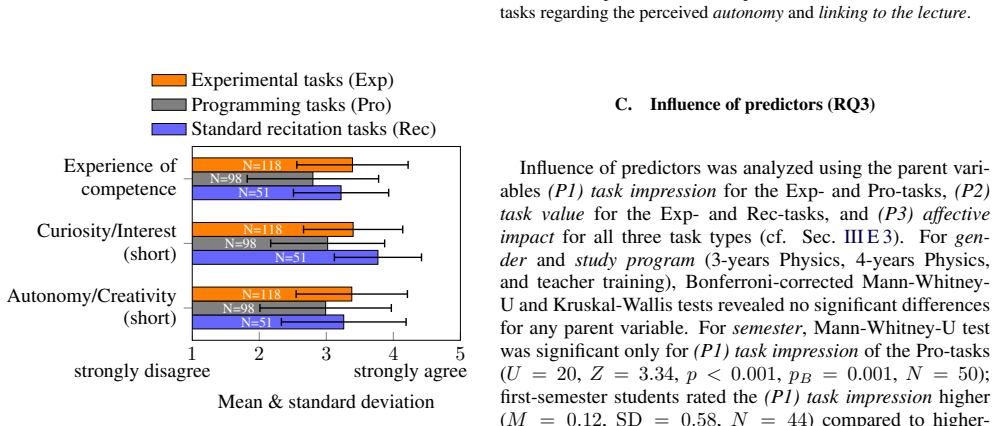
In an exploratory field study in a first-year mechanics course, nine smartphone-based experimental tasks using the phyphox app and external sensor boxes were implemented as weekly graded exercises, alongside three newly designed Python programming tasks and the course's traditional pen-and-paper recitation tasks. Students' responses show an overall ordering of recitation tasks at the top for curiosity, interest, perceived affective effectiveness, and linking to the lecture, with experimental tasks close behind and programming tasks generally lowest. The experimental tasks significantly outperformed the programming tasks in goal clarity, reference to reality, and experience of competence, and were rated significantly higher than the recitation tasks in experience of competence. On most other scales, including overall task rating, feasibility at home, time spent, use of technologies, autonomy, and disciplinary authenticity, the experimental tasks were statistically indistinguishable from the programming tasks or the recitation tasks. The authors interpret this as evidence that smartphone-based experimental tasks can be successfully integrated into undergraduate teaching and can enrich traditional recitation work, while noting that the programming tasks, one of which was rated too difficult by 43% of students, may not yet represent the format's potential.
Load-bearing premise
The comparative conclusions assume that the particular experimental, programming, and standard recitation tasks are fair representatives of their task types, meaning the observed differences are due to the task format itself rather than to differences in novelty, difficulty, instruction quality, or when the surveys happened to be administered.
Editorial extensions
If this is right
- Weekly smartphone-based experimental tasks can be run at scale in a large introductory course: logistics of lending equipment, grading submissions, and tying tasks to exam prerequisites were overcome for over a hundred student groups.
- Instructors can expect first-iteration experimental tasks to be perceived as clearly more competence-building than first-iteration programming tasks, even when overall ratings are similar.
- Newly introduced programming tasks need careful difficulty calibration: one task was rated too difficult by 43% of students and was the main drag on the programming-task format's affective scores.
- Students are likely to judge new experimental tasks as less curiosity-provoking and less lecture-linked than polished, exam-aligned textbook problems, at least when the comparison is made near the final exam.
- Affective perceptions of smartphone experiments are not automatically high simply because the technology is familiar; task design, difficulty, and perceived purpose appear to drive student responses.
Reading between the lines
- An implication the paper leaves implicit is that the experimental-versus-recitation gap in curiosity, interest, and perceived affective effectiveness may be partly a timing artefact: the comparison survey ran days before an exam covering only recitation tasks, so students may have rated textbook problems as more relevant and engaging than they would have earlier in the semester.
- A testable extension would be to compare matched task types with equivalent novelty: designing programming tasks as carefully calibrated as the experimental tasks, and measuring responses to recitation tasks at several points during the semester, would show whether the reported ordering Rec ≥ Exp ≥ Pro reflects the task formats themselves or the maturity of their implementation.
- The study establishes perceived feasibility and positive affect, not learning gains; a natural next step is a performance-based assessment of experimental skills, measurement uncertainty, or conceptual understanding to see whether the favorable perceptions correspond to measurable outcomes.
- The correlation between better high-school grades and a more favorable impression of the experimental tasks suggests that higher-achieving students may benefit most from this format, implying that differentiated support could be needed for students with weaker preparation.
Editorial analysis
A structured set of objections, weighed in public.
Referee Report
Summary. The manuscript reports an exploratory field study of weekly smartphone-based experimental tasks (Exp) in a first-year introductory mechanics course at RWTH Aachen, benchmarked against three Python programming tasks (Pro) and long-established standard recitation tasks (Rec). Nine Exp tasks and three Pro tasks were embedded in weekly exercise sheets, and data come from 14 online surveys: twelve weekly task surveys with participation ranging from 188 to 41 students, plus two comparative surveys with 108 and 78 respondents. The analyses address students' perceptions of learning (overall rating, goal clarity, feasibility at home, time spent, difficulty, open-text feedback) and affective responses (curiosity, interest, authenticity, experience during tasks, perceived effectiveness), together with a predictor analysis (RQ3). The main conclusions are that Exp tasks were generally well received, that Exp tasks outperformed Pro tasks on a subset of perception and affective variables (goal clarity, reference to reality, experience of competence), and that Exp tasks were comparable to or slightly below Rec tasks on most affective variables, with a higher experience of competence for Exp tasks.
Significance. If the comparative results are accepted, this is a useful contribution to the sparse evaluation literature on smartphone experiments in university physics: it provides a semester-long implementation, openly available data, detailed instruments with factor analyses, and a three-way comparison that goes beyond proof-of-concept. The paper's explicit treatment of limitations and its disclosure of the phyphox developer conflict of interest are strengths. However, the Exp-vs-Pro comparative claim, which is central to the abstract, is less robust than the descriptive feasibility claim, and the paper's own limitations section acknowledges the main threats. The recommendation therefore depends on whether the comparative claims can be reanalyzed or appropriately hedged.
major comments (4)
- [Abstract; Sec. IV.A; Table VI] The abstract's statement that the experimental tasks 'tend to outperform the programming tasks in terms of perceptions of learning with the tasks and affective responses' is stronger than the results in Table VI support. Of the twelve Exp-vs-Pro comparisons listed, only goal clarity, reference to reality, and experience of competence are statistically significant after the corrections reported; overall task rating, feasibility at home, time spent, use of technologies, curiosity, interest, disciplinary authenticity, and the short curiosity/interest and autonomy/creativity scales are not. In particular, Table X shows curiosity with Bonferroni-corrected p = 0.061 and interest with p = 0.63, so the word 'outperform' should be reserved for the specific subset of scales on which the difference was significant.
- [Sec. IV.A, Fig. 9; Sec. V.B.1; Table IV] The Exp-vs-Pro aggregate comparisons are not robust to the influence of Pro 1, and no sensitivity analysis is reported. Pro 1 is one of only three programming tasks; 43% of students rated it too difficult and 25% reported insufficient instructions (Fig. 9), and the open-text analysis attributes 29% of negative complexity statements and 28% of negative instruction statements for Pro tasks to this task (Table IV). The paper itself states in Sec. V.B.1 that 'the too-difficult task Pro 1 likely played a significant role in this outcome,' but the aggregate Mann-Whitney tests in Sec. IV.A and the affective comparisons in Sec. IV.B do not examine whether the reported Exp-over-Pro differences survive after excluding Pro 1 or after modeling task as a random effect. Without such an analysis, the claim that the Exp format generally outperformed the Pro format cannot be distinguished from the effect of one poorly calibrated task.
- [Sec. III.E.2; Sec. IV.B] The decision to combine Exp-task scores from Com 1 and Com 2 despite a significant difference on disciplinary authenticity (Z = 3.14, p_B = 0.008) is not fully justified. The authors attribute the difference to context and timing, but for students who responded to both surveys the average of the two measurements conflates the two comparison conditions and the two measurement times. Reporting the Com 1 and Com 2 analyses separately, or including survey as a factor, would make the combined analysis easier to evaluate.
- [Sec. III.B; Table X] The small and declining samples for the comparative analyses limit the strength of the conclusions. Participation fell from 188 (Exp 1) to 41 (Exp 9), and the three-way Friedman tests in Table X are based on N between 31 and 45. The non-significant '=' entries in Table VI should therefore be read as 'no significant difference detected' rather than equivalence; this is mostly handled in the text but the table itself invites the stronger reading. In addition, pairwise exclusion means the different rows in Table X are based on different subsets of students, which further complicates cross-scale comparisons.
minor comments (5)
- [Sec. III.B] The sentence 'totaling in 313 codes' is unclear; it is not specified whether this refers to survey responses, matched participants, or something else.
- [Fig. 9 and Fig. 19] The 'Mean Pro 1-3' and 'Mean Exp 1-9' bars average over tasks with different sample sizes per task; annotating the figures with the N range or using weighted means would improve interpretability.
- [Sec. V.B, Fig. 15] The comparison with Ref. [55] mixes matched-sample effect sizes from this study with independent-sample effect sizes from the earlier study; the figure caption should state that the confidence intervals for the reference data are not based on matched samples and may not be directly comparable.
- [Sec. III.C] The statement that items are presented in German with English translations as supplementary material would benefit from an explicit reference to the supplementary material file in the main text.
- [Table II; Sec. IV.A] The row for 'Use of technologies' indicates it was measured in weekly surveys and Com 1, but the text in Sec. IV.A reports only the weekly-survey comparison with N = 87; clarify where the N comes from.
Circularity Check
No circular derivation: the comparisons rest on newly collected student survey data, with self-citations only as instrument and comparison references.
full rationale
The paper's central claims are descriptive comparisons of student perceptions collected through 14 surveys, not predictions derived from fitted equations or from the authors' prior results. The instruments are based on published scales (including the authors' Refs. [53] and [55]), but the paper re-analyzes them with its own exploratory factor analysis, Cronbach's alpha, item-total correlations, and nonparametric tests on the current dataset, so the outcome variables are not set equal to prior outcomes by construction. The Exp-vs-Pro conclusion is explicitly sensitive to one task ('the too-difficult task Pro 1 likely played a significant role'), and the Exp-vs-Rec comparison is explicitly limited by a single late-semester measurement (Sec. V.D); these are acknowledged validity threats, not circularity. The disclosed phyphox-developer conflict is a transparency statement. No equation or fitted parameter from this study is recycled as a prediction, and no uniqueness or derivation claim is imported from a self-citation. The self-citations are minor and non-load-bearing: they supply item sources and external comparison data, while the load-bearing evidence is the students' independent responses analyzed in this paper.
Assumptions & free parameters
assumptions (4)
- domain assumption The self-report instruments measure the intended constructs (task quality, curiosity, interest, authenticity, etc.) in this student population.
- domain assumption The three task types are comparable representatives of their categories despite differences in content, difficulty, timing, and number of tasks.
- domain assumption Survey respondents are representative of the course population, and non-response is unrelated to task perceptions.
- domain assumption Individual student responses are independent despite students working in groups of three.
Cite this review
Pith. "Pith review of Recitation tasks revamped? Students' perceptions of smartphone-based experimental and programming tasks in introductory mechanics." pith.science (2026). https://pith.science/paper/IDL2E3CO
@misc{pith2026241113382,
  author       = {Pith},
  title        = {Pith review of: Recitation tasks revamped? Students' perceptions of smartphone-based experimental and programming tasks in introductory mechanics},
  year         = {2026},
  howpublished = {\url{https://pith.science/paper/IDL2E3CO}},
  note         = {Machine review of arXiv:2411.13382}
}
read the original abstract
This exploratory field study investigates the integration of innovative forms of recitation tasks in a first-year introductory mechanics course, focusing on smartphone-based experimental tasks alongside programming and standard recitation tasks. Smartphones, combined with external sensor modules, serve as a gateway enabling students to conduct various low-cost and authentic physics experiments with first-hand data collection outside traditional lab settings. These tasks aim to enhance students' agency in independent physics experimentation and enrich homework assignments by dissolving boundaries between lectures, recitation sessions, and traditional labs, and thereby linking theoretical and experimental aspects of undergraduate physics education. To explore this potential, we implemented and evaluated a sample set of nine smartphone-based experimental tasks and, for comparison, three programming tasks as weekly exercises in a first-year physics course at RWTH Aachen University. We investigated students' perceptions of learning with these new tasks through twelve short surveys involving up to 188 participants. In two additional surveys with 108 and 78 participants, students assessed affective responses to the smartphone-based experimental tasks relative to the programming and standard recitation tasks. Our findings indicate that the smartphone-based experimental tasks were generally well-suited to the students and tended to outperform the programming tasks in terms of perceptions of learning with the tasks and affective responses. Overall, students responded positively to the new experimental tasks, with perceptions comparable to, or only partly below, those of long-established standard recitation tasks. These results suggest that smartphone-based experimental tasks can be successfully integrated into teaching and contribute to refining traditional recitation tasks.
Figures


Figures from the paper (12 more)




Reference graph
Works this paper leans on
-
[1]
Students in our study rated the Exp-tasks, in tendency, higher than the Pro-tasks for curiosity (dp = 0.42, 95%-CI [0.00, 0.83]), interest (dp = 0.28, 95%-CI [−0.15, 0.71]), and reference to reality (dp = 1.22, 95%-CI [0.70, 1.73]). This can be partially explained by open-text responses from the weekly surveys, where students described the Pro-tasks some-...
-
[2]
The Exp-tasks (and Pro-tasks) were perceived as lower than the Rec-tasks regarding curiosity and interest. This find- 2 Reference [55] investigated a group of 36 students who analyzed partly given, partly self-recorded videos on kinematics and dynamics and 40 con- trol group students who completed comparable standard recitation tasks without video analysi...
-
[3]
To maxi- mize comparisons between the three task types, this analysis was conducted for three different groups of variables based on which were measured for the same task types (cf
Analysis of the influence of predictors (RQ3) To analyze the influence of surveyed predictors, we re- duced the number of dependent metrically scaled variables to broader parent variables through factor analysis. To maxi- mize comparisons between the three task types, this analysis was conducted for three different groups of variables based on which were ...
-
[4]
These simi- larities support comparing the Exp-tasks in our study with the video analysis tasks in Ref
Except for curiosity, the affective responses to the stan- dard recitation tasks were similar in both studies. These simi- larities support comparing the Exp-tasks in our study with the video analysis tasks in Ref. [55] showing medium to strong negative effect sizes ranging from dp = −0.62, 95%-CI [−1.00, −0.24], to dp = −1.14, 95%-CI [−1.53, −0.75], for ...
-
[5]
This indicates a similar level of rather strong guidance, typical for shorter weekly exercises
There are no significant differences in the scale au- tonomy between the task types (as in the variable auton- omy/creativity (short)). This indicates a similar level of rather strong guidance, typical for shorter weekly exercises
-
[6]
The disciplinary authenticity of the Exp-tasks is, in ten- dency (but not significantly), and of the Pro-tasks significantly lower than for the Rec-tasks. This perception may arise from students’ prior learning experiences also from school, where calculus- or algebra-based tasks dominate textbooks, exer- cises, and exams, where programming is rather uncom...
work page 2022
-
[7]
S. Chen, H.-C. Lo, J.-W. Lin, J.-C. Liang, H.-Y . Chang, F.-K. Hwang, G.-L. Chiou, Y .-T. Wu, S. W.-Y . Lee, H.-K. Wu, C.-Y . Wang, and C.-C. Tsai, Development and implications of tech- nology in reform-based physics laboratories, Physical Review Special Topics - Physics Education Research8, 020113 (2012)
work page 2012
-
[8]
R. Girwidz, L.-J. Thoms, H. Pol, V . López, M. Miche- lini, A. Stefanel, T. Greczyło, A. Müller, B. Gregorcic, and M. Hömöstrei, Physics teaching and learning with multimedia applications: a review of teacher-oriented literature in 34 local language journals from 2006 to 2015, International Journal of Science Education 41, 1181 (2019)
work page 2019
Show all 84 references
-
[9]
Sundgren, Blurring time and place in higher education with bring your own device applications: a literature review, Educa- tion and Information Technologies 22, 3081 (2017)
M. Sundgren, Blurring time and place in higher education with bring your own device applications: a literature review, Educa- tion and Information Technologies 22, 3081 (2017)
2017
-
[10]
Stampfer, H
C. Stampfer, H. Heinke, and S. Staacks, A lab in the pocket, Nature Reviews Materials 5, 169 (2020)
2020
-
[11]
Kuhn and P
J. Kuhn and P. V ogt, Smartphones and tablet pcs: Excellent dig- ital swiss pocket knives for physics education, in Smartphones 20 TABLE IX. Results of the exploratory factor analysis for the parent variables determined for RQ3 (cf. Sec. III E 3). Included variables and number...
2022
-
[12]
Sukariasih, Erniwati, La Sahara, L
L. Sukariasih, Erniwati, La Sahara, L. Hariroh, and S. Fayanto, Studies the use of smartphone sensor for physics learning, IN- TERNATIONAL JOURNAL OF SCIENTIFIC & TECHNOL- OGY RESEARCH 8, 862 (2019)
2019
-
[13]
Organtini and E
G. Organtini and E. Tufino, Effectiveness of a laboratory course with arduino and smartphones, Education Sciences 12, 898 (2022)
2022
-
[14]
Vieyra, C
R. Vieyra, C. Vieyra, P. Jeanjacquot, A. Marti, and M. Mon- teiro, Turn your smartphone into a science laboratory, The Sci- ence Teacher 082, 32 (2015)
2015
-
[15]
J. Kuhn, A. Müller, and P. V ogt, Kontextorientierter Physikun- terricht: Konzeptionen, Theorien und Forschung zu Motivation und Lernen [context-oriented physics teaching: concepts, theo- ries and research on motivation and learning], Praxis der Natur- wissenschaften - Physik ...
2010
-
[16]
J. Kuhn, Authentische Aufgaben im theoretischen Rahmen von Instruktions- und Lehr-Lern-Forschung: Optimierung von Ankermedien für eine neue Aufgabenkultur im Physikunterricht [Authentic tasks in the theoretical framework of instructional and teaching-learning research: Optimiz...
2010
-
[17]
Staacks, S
S. Staacks, S. Hütz, H. Heinke, and C. Stampfer, Advanced tools for smartphone-based experiments: phyphox, Physics Ed- ucation 53, 10.1088/1361-6552/aac05e (2018)
2018 doi
-
[18]
Dorsel, S
D. Dorsel, S. Staacks, S. Hütz, H. Heinke, and C. Stampfer, Smartphone-Experimente mit externen Sensoren [Smartphone experiments with external sensors], PhyDid B - Didaktik der Physik - Beiträge zur DPG-Frühjahrstagung - Würzburg 2018 , 393 (2018)
2018
-
[19]
Kuhn and P
J. Kuhn and P. V ogt, Diffraction experiments with infrared re- mote controls, The Physics Teacher 50, 118 (2012)
2012
-
[20]
Kuhn and P
J. Kuhn and P. V ogt, eds., Smartphones as Mobile Minilabs in Physics: Edited Volume Featuring more than 70 Examples from 10 Years The Physics Teacher-column iPhysicsLabs , 1st ed. (Springer, Cham, 2022)
2022
-
[21]
Monteiro and A
M. Monteiro and A. C. Martí, Resource letter mds-1: Mobile devices and sensors for physics teaching, American Journal of Physics 90, 328 (2022)
2022
-
[22]
Organtini, Physics experiments with Arduino and smart- phones (Springer, Cham, 2021)
G. Organtini, Physics experiments with Arduino and smart- phones (Springer, Cham, 2021)
2021
-
[23]
D. J. O’Brien, A guide for incorporating e-teaching of physics in a post-covid world, American Journal of Physics 89, 403 (2021). 21 1 2 3 4 5 Pro 3 (N=57) Pro 2 (N=84) Pro 1 (N=80) Exp 9 (N=39) Exp 8 (N=37) Exp 7 (N=63) Exp 6 (N=38) Exp 5 (N=79) Exp 4 (N=103) Exp 3 (N=80) Exp...
2021
-
[24]
Wilhelm and J
T. Wilhelm and J. Kuhn, Für alles eine App [An app for every- thing] (Springer, Berlin, Heidelberg, 2022)
2022
-
[25]
Zhao, Smartphone-based undergraduate physics labs: A comprehensive review of innovation, accessibility, and peda- gogical impact (2025)
Y . Zhao, Smartphone-based undergraduate physics labs: A comprehensive review of innovation, accessibility, and peda- gogical impact (2025)
2025
-
[26]
Heublein, C
U. Heublein, C. Hutzsch, and R. Schmelzer, Die Entwick- lung der Studienabbruchquoten in Deutschland: DZHW Brief 05|2022 [The development of study drop-out rates in Germany: DZHW letter 05|2022] (2022)
2022
-
[27]
Troendle, Mapping physics students in Europe (2004)
G. Troendle, Mapping physics students in Europe (2004)
2004
-
[28]
S. Z. Lahme, P. Klein, A. Lehtinen, A. Müller, P. Pirinen, L. Ron ˇcevi´c, and A. Sušac, Physics lab courses under digital transformation: A trinational survey among university lab in- structors about the role of new digital technologies and learn- ing objectives, Physical Rev...
2023 doi
-
[29]
Klein, L
P. Klein, L. Ivanjek, M. N. Dahlkemper, K. Jeli ˇci´c, M.-A. Geyer, S. Küchemann, and A. Susac, Studying physics dur- ing the COVID-19 pandemic: Student assessments of learn- ing achievement, perceived effectiveness of online recitations, and online laboratories, Physical Revi...
2021
-
[31]
Kaps and F
A. Kaps and F. Stallmach, Tilting motion and the moment of inertia of the smartphone, The Physics Teacher 58, 216 (2020)
2020
-
[32]
S. Z. Lahme, P. Klein, A. Lehtinen, P. Pirinen, A. Sušac, and B. Tomrlin, DigiPhysLab: Digital physics laboratory work for distance learning, PhyDid B - Beiträge zur Frühjahrstagung - virtuell 2022 , 383 (2022). 0 10 20 30 40 Pro 3 (N=57) Pro 2 (N=84) Pro 1 (N=80) Exp 9 (N=35)...
2022
-
[33]
Bernardini, M
E. Bernardini, M. Carli, M. Y . Elkhashab, A. Ferroglia, M. Fi- olhais, L. Gabelli, H. Jessen Munch, D. Krym, P. Mastrolia, G. Ossola, O. Pantano, J. Postiglione, J. S. Poveda Correa, C. Sirignano, and F. Soramel, Using smartphones to innovate laboratories in introductory phys...
2024 doi
-
[34]
J. C. Castro-Palacio, L. Velazquez, J. A. Gómez-Tejedor, F. J. Manjón, and J. A. Monsoriu, Using a smartphone accelera- tion sensor to study uniform and uniformly accelerated cir- cular motions, Revista Brasileira de Ensino de Física 36, 10.1590/S1806-11172014000200015 (2014)
2014 doi
-
[35]
Anni, Quantitative comparison between the smartphone based experiments for the gravity acceleration measurement at home, Education Sciences 11, 10.3390/educsci11090493 (2021)
M. Anni, Quantitative comparison between the smartphone based experiments for the gravity acceleration measurement at home, Education Sciences 11, 10.3390/educsci11090493 (2021)
2021 doi
-
[36]
Ballester, J
E. Ballester, J. C. Castro-Palacio, L. Velazquez-Abad, M. H. Gimenez, J. A. Monsoriu, and L. S. Ruiz, Smart physics with smartphone sensors, 2014 IEEE Frontiers in Education Confer- ence (FIE) Proceedings , 1 (2014)
2014
-
[37]
S. Hütz, S. Kuhlen, C. Stampfer, and H. Heinke, En- twicklung und Evaluation modularer V orlesungseinheiten mit Smartphone-Einsatz [Development and evaluation of modular lecture units with the use of smartphones], PhyDid B - Didaktik der Physik - Beiträge zur DPG Frühjahrstagu...
2017
-
[38]
Staacks, D
S. Staacks, D. Dorsel, S. Hütz, F. Stallmach, T. Splith, H. Heinke, and C. Stampfer, Collaborative smartphone exper- 22 iments for large audiences with phyphox, European Journal of Physics 43, 055702 (2022)
2022
-
[39]
A. Kaps, T. Splith, and F. Stallmach, Implementation of smartphone-based experimental exercises for physics courses at universities, Physics Education 56, 035004 (2021)
2021
-
[40]
Kaps and F
A. Kaps and F. Stallmach, Development and didactic analysis of smartphone-based experimental exercises for the smart physics lab, Physics Education 57, 045038 (2022)
2022
-
[41]
S. Hütz, S. Staacks, C. Stampfer, and H. Heinke, Kleiner Aufwand, großer Nutzen?: Experimentiersets zur Unter- stützung experimenteller Übungsaufgaben mit Smartphones [Small effort, big benefit? Experimental kits to support exper- imental exercises with smartphones), PhyDid B ...
2019
-
[42]
Barro, C
S. Barro, C. Beguin, D. Brouzet, L. Charosky, L. Darmendrail, and A. Müller, Smartphone experiments in undergraduate re- search (2023)
2023
-
[43]
S. Z. Lahme, P. Klein, and A. Müller, Smartphone-based under- graduate research projects in an introductory mechanics course, Journal of Physics: Conference Series 2693, 012008 (2024)
2024
-
[44]
Salinas, M
I. Salinas, M. H. Giménez, J. A. Monsoriu, and J. C. Castro- Palacio, Characterization of linear light sources with the smart- phone’s ambient light sensor, The Physics Teacher 56, 562 (2018)
2018
-
[45]
Pörn and M
R. Pörn and M. Braskén, Interactive modeling activities in the classroom—rotational motion and smartphone gyroscopes, Physics Education 51, 065021 (2016)
2016
-
[46]
S. H. Hawley and R. E. McClain, Visualizing sound directivity via smartphone sensors, The Physics Teacher 56, 72 (2018)
2018
-
[47]
Rayner, Using a cell phone to investigate the skin depth effect in salt water, The Physics Teacher55, 83 (2017)
J. Rayner, Using a cell phone to investigate the skin depth effect in salt water, The Physics Teacher55, 83 (2017)
2017
-
[48]
L. A. Testoni and G. Brockington, The use of smartphones to teach kinematics: an inexpensive activity, Physics Education 51, 063008 (2016)
2016
-
[49]
Shakur and J
A. Shakur and J. Kraft, Measurement of coriolis acceleration with a smartphone, The Physics Teacher 54, 288 (2016)
2016
-
[50]
Arribas, I
E. Arribas, I. Escobar, C. P. Suarez, A. Najera, and A. Belén- dez, Measurement of the magnetic field of small magnets with a smartphone: a very economical laboratory practice for in- troductory physics courses, European Journal of Physics 36, 065002 (2015)
2015
-
[51]
Azhikannickal, Sports, smartphones, and simulation as an engaging method to teach projectile motion incorporating air resistance, The Physics Teacher 57, 308 (2019)
E. Azhikannickal, Sports, smartphones, and simulation as an engaging method to teach projectile motion incorporating air resistance, The Physics Teacher 57, 308 (2019)
2019
-
[52]
B. M. Zwickl, T. Hirokawa, N. Finkelstein, and H. J. Lewandowski, Epistemology and expectations survey about ex- perimental physics: Development and initial results, Physi- cal Review Special Topics - Physics Education Research 10, 10.1103/PhysRevSTPER.10.010120 (2014)
2014 doi
-
[53]
Deslauriers, L
L. Deslauriers, L. S. McCarty, K. Miller, K. Callaghan, and G. Kestin, Measuring actual learning versus feeling of learning in response to being actively engaged in the classroom, Pro- ceedings of the National Academy of Sciences of the United States of America 116, 19251 (2019)
2019
-
[54]
Mazzella and I
A. Mazzella and I. Testa, An investigation into the effective- ness of smartphone experiments on students’ conceptual knowl- edge about acceleration, Physics Education 51, 10.1088/0031- 9120/51/5/055010 (2016)
2016 doi
-
[55]
Hochberg, J
K. Hochberg, J. Kuhn, and A. Müller, Using smartphones as experimental tools: Effects on interest, curiosity, and learning in physics education, Journal of Science Education and Tech- nology 27, 385 (2018)
2018
-
[56]
T. J. Atherton, Resource letter CP-3: Computational physics, American Journal of Physics 91, 7 (2023)
2023
-
[57]
Chabay and B
R. Chabay and B. Sherwood, Computational physics in the in- troductory calculus-based course, American Journal of Physics 76, 307 (2008)
2008
-
[59]
S. Z. Lahme, P. Klein, A. Lehtinen, A. Müller, P. Pirinen, L. Ron ˇcevi´c, and A. Sušac, Evaluating digital experimental tasks for physics laboratory courses, PhyDid B - Beiträge zur Frühjahrstagung - Hannover 2023 1, 339 (2023)
2023
-
[60]
Rauschenbach, R
I. Rauschenbach, R. Keddis, and D. Davis, Poster development and presentation to improve scientific inquiry and broaden ef- fective scientific communication skills, Journal of microbiology & biology education 19, 10.1128/jmbe.v19i1.1511 (2018)
2018 doi
-
[61]
P. Klein, Konzeption und Untersuchung videobasierter Auf- gaben im Rahmen vorlesungsbegleitender Übungen zur Ex- perimentalphysik (Mechanik) [Conception and investigation of video-based tasks in the context of lecture-accompanying exer- cises in experimental physics (mechanics...
2016
-
[62]
D. Rehfeldt, Erfassung der Lehrqualität naturwis- senschaftlicher Experimentalpraktika [Assessment of the teaching quality of scientific experimental labs] , Studien zum Physik- und Chemielernen, V ol. 246 (Logos, Berlin, 2017)
2017
-
[63]
Perceived Stress Questionnaire
H. Fliege, M. Rose, P. Arck, S. Levenstein, and B. F. Klapp, Validierung des "Perceived Stress Questionnaire" (PSQ) an einer deutschen Stichprobe [Validation of the “Perceived Stress Questionnaire” (PSQ) on a German sample], Diagnostica 47, 142 (2001)
2001
-
[64]
Baumert, W
J. Baumert, W. Blum, M. Brunner, T. Dubberke, A. Jordan, U. Klusmann, S. Krauss, M. Kunter, K. Löwen, M. Neubrand, and Y .-M. Tsai, Professionswissen von Lehrkräften, kogni- tiv aktivierender Mathematikunterricht und die Entwicklung von mathematischer Kompetenz (COACTIV): Doku...
2008
-
[65]
M. S. Feser and T. Plotz, Exploring the validity of a single- item instrument for assessing pre-service primary school teach- ers’ sense of belonging to science, Open Education Studies 5, 10.1515/edu-2022-0191 (2023)
2023 doi
-
[66]
C. S. Dweck, Self-theories: Their Role in Motivation, Person- ality, and Development (Psychology Press, New York, 1999)
1999
-
[67]
Dresel and R
M. Dresel and R. Grassinger, Changes in achievement moti- vation among university freshmen, Journal of Education and Training Studies 1, 159 (2013)
2013
-
[68]
Goulet-Pelletier and D
J.-C. Goulet-Pelletier and D. Cousineau, A review of effect sizes and their confidence intervals, Part I: The Cohen’s d fam- ily, The Quantitative Methods for Psychology 14, 242 (2018)
2018
-
[69]
C. O. Fritz, P. E. Morris, and J. J. Richler, Effect size estimates: current use, calculations, and interpretation, Journal of experi- mental psychology. General 141, 2 (2012)
2012
-
[70]
M. A. Ruiz-Primo, D. Briggs, H. Iverson, R. Talbot, and L. A. Shepard, Impact of undergraduate science course innovations on learning, Science 331, 1269 (2011)
2011
-
[72]
Wieman and N
C. Wieman and N. G. Holmes, Measuring the impact of an in- structional laboratory on the learning of introductory physics, American Journal of Physics 83, 972 (2015)
2015
-
[73]
A. B. Bauer, Experimentelle Kompetenz Physikstudierender: Entwicklung und erste Erprobung eines performanzorientierten Kompetenzstrukturmodells unter Nutzung qualitativer Metho- den [Experimental competence of physics students: Devel- opment and initial testing of a performanc...
2023
-
[76]
Pollard, A
B. Pollard, A. Werth, R. Hobbs, and H. J. Lewandowski, Impact of a course transformation on students’ reasoning about mea- surement uncertainty, Physical Review Physics Education Re- search 16, 10.1103/PhysRevPhysEducRes.16.020160 (2020)
2020 doi
-
[77]
Pillay, A
S. Pillay, A. Buffler, F. Lubben, and S. Allie, Effectiveness of a gum-compliant course for teaching measurement in the in- troductory physics laboratory, European Journal of Physics 29, 647 (2008)
2008
-
[78]
N. G. Holmes, C. E. Wieman, and D. A. Bonn, Teaching critical thinking, Proceedings of the National Academy of Sciences of the United States of America 112, 11199 (2015)
2015
-
[80]
B. R. Wilcox and H. J. Lewandowski, Students’ epistemologies about experimental physics: Validating the colorado learning attitudes about science survey for experimental physics, Phys- ical Review Physics Education Research 12, 10.1103/Phys- RevPhysEducRes.12.010123 (2016)
2016 doi
-
[81]
B. R. Wilcox and H. J. Lewandowski, Developing skills ver- sus reinforcing concepts in physics labs: Insight from a survey of students’ beliefs about experimental physics, Physical Re- view Physics Education Research 13, 10.1103/PhysRevPhysE- ducRes.13.010108 (2017)
2017 doi
-
[82]
Karelina and E
A. Karelina and E. Etkina, Acting like a physicist: Student ap- proach study to experimental design, Physical Review Special Topics - Physics Education Research 3, 10.1103/PhysRevST- PER.3.020106 (2007)
2007 doi
-
[83]
American Association of Physics Teachers, Goals of the in- troductory physics laboratory, The Physics Teacher 35, 546 (1997)
1997
-
[84]
Welzel, K
M. Welzel, K. Haller, M. Bandiera, D. Hammelev, P. Koumaras, H. Niedderer, A. Paulsen, K. Robinault, and S. von Auf- schnaiter, Teachers’ objectives for labwork: Research tool and cross country results: Working paper 6 (1998)
1998
-
[85]
B. M. Zwickl, N. Finkelstein, and H. J. Lewandowski, The process of transforming an advanced lab course: Goals, cur- riculum, and assessments, American Journal of Physics 81, 63 (2013)
2013
-
[86]
American Association of Physics Teachers, AAPT recommen- dations for the undergraduate physics laboratory curriculum: Report prepared by a subcommittee of the AAPT Committee on Laboratories: Endorsed by the AAPT Executive Board (2014)
2014
-
[87]
S. Z. Lahme, P. Pirinen, L. Ron ˇcevi´c, A. Lehtinen, A. Sušac, A. Müller, and P. Klein, A framework for designing experi- mental tasks in contemporary physics lab courses, Journal of Physics: Conference Series 2750, 012016 (2024)
2024
-
[88]
Götze, H
B. Götze, H. Heinke, J. Riese, C. Stampfer, and S. Kuhlen, Smartphone-Experimente zu harmonischen Pendelschwingun- gen mit der App phyphox [Smartphone experiments on har- monic pendulum oscillations with the phyphox app], PhyDid B - Didaktik der Physik - Beiträge zur DPG Frühj...
2017
-
[89]
Dorsel, S
D. Dorsel, S. Staacks, H. Heinke, and C. Stampfer, Using a smartphone pressure sensor as pitot tube speedometer, The Physics Teacher 60, 273 (2022)
2022
-
[90]
Abumezied, D
M. Abumezied, D. Dorsel, S. Staacks, C. Stampfer, and H. Heinke, Experiementieraufgaben für eine zeitgemäße Physikausbildung an Hochschulen [Experimental tasks for con- temporary physics education at universities], inFrühe naturwis- senschaftliche Bildung: Jahrestagung in Hamb...
2024
Reviewed August 12, 2026 · model on record in the stance chip above.
Discussion (0). Continue with ORCID to comment.