REVIEW 4 major objections 8 minor 49 references
Energy-based generative models for monoclonal antibodies
T0 review · 4 major / 8 minor · reviewed 2026-08-12 · deepseek-v4-flash
Pith's one-line read The paper shows that sampling from a human-antibody distribution biased by predicted affinity and solubility generates diverse, novel heavy-chain mutants along the Pareto front.
desk verdict A solid methods paper with honest synthetic benchmarks; the CB-119 Pareto front is a predicted front, and the solubility surrogate is the one unvalidated link. read the letter →
The pith
A machine-rendered reading of the paper's core claim, the machinery that carries it, and where it could break.
The reading
What carries the argument
The load-bearing object is the Boltzmann distribution over heavy-chain sequences, $p(x) = \frac{1}{Z} p_{\mathrm{HUM}}(x) \exp(-E(x)/T)$, where $p_{\mathrm{HUM}}$ is an autoregressive transformer trained on human heavy chains, $E(x) = -w \hat{f}_{\mathrm{aff}}(x) - (1-w)\hat{f}_{\mathrm{sol}}(x)$ combines a Gaussian-process affinity predictor and a SASA-plus-hydrophobicity solubility predictor, $T$ controls how far samples may wander from the human-antibody prior, and $w$ moves weight between affinity and solubility. The acquisition parameter $\beta$ enters through $\hat{f}_{\mathrm{aff}}(x) = \mu(x) + \beta \sigma(x)$, letting the sampler be pessimistic or optimistic about prediction uncertainty. Two samplers are used: Metropolis-Hastings over a single-mutation neighborhood with a six-mutation cap, and GFlowNet, an amortized generative model. The final selection step ranks samples by their distance to the empirical Pareto front.
What would settle it
Measure true dissociation constants (e.g., by surface plasmon resonance or AlphaSeq) and true HIC retention times for a few hundred of the generated four-to-six-mutation heavy chains, and compare the resulting empirical Pareto front with the predicted one; if the correlation between predicted and measured affinity on these held-out mutants is close to zero, or if the measured front is no better than that of random six-mutation mutants, the central claim fails.
Extended reading notes
Core claim
On the paper's own terms, the discovery is that the distribution $p(x) \propto p_{\mathrm{HUM}}(x)\,e^{-E(x)/T}$, with $E(x) = -w \hat{f}_{\mathrm{aff}}(x) - (1-w)\hat{f}_{\mathrm{sol}}(x)$, is a practical generative model for lead optimization. Sampling this distribution by Metropolis-Hastings or GFlowNet produces heavy-chain mutants within six mutations of the wild type that lie on the empirical Pareto frontier between predicted affinity and predicted solubility; higher solubility can be obtained at the cost of roughly an order of magnitude in predicted affinity. Because the samples are weighted by $p_{\mathrm{HUM}}$, they resemble natural human antibodies, and the temperature $T$ sets the diversity-versus-optimality trade-off. In synthetic tasks where the epistatic affinity function is known exactly, the same procedure generates more sequences above fixed affinity and solubility thresholds than the constrained local search baseline, and an optimistic choice of the acquisition parameter $\beta$ (using the upper confidence bound) is generally best. The paper explicitly states that the method's purpose is to 'generate diverse and novel sequences along the Pareto front between affinity and solubility.'
Load-bearing premise
The whole approach assumes the proxy models for affinity and solubility remain accurate for sequences with four to six mutations, even though the affinity model was validated on single, double, and triple mutants and the solubility model's correlation with measured retention time is moderate.
Editorial extensions
If this is right
- The generated heavy chains populate the predicted Pareto front continuously, so a developer can choose the trade-off between affinity and solubility rather than commit to a hard threshold.
- Increasing the predicted solubility score from roughly 2 to 6 costs about one order of magnitude in predicted affinity, quantifying the trade-off for the CB-119 binder.
- Sampled sets have mean pairwise Hamming distance between 4.5 and 5 (out of a maximum 12 under the six-mutation cap) and novelty between 2.5 and 4, so the method produces diverse, previously unseen candidates.
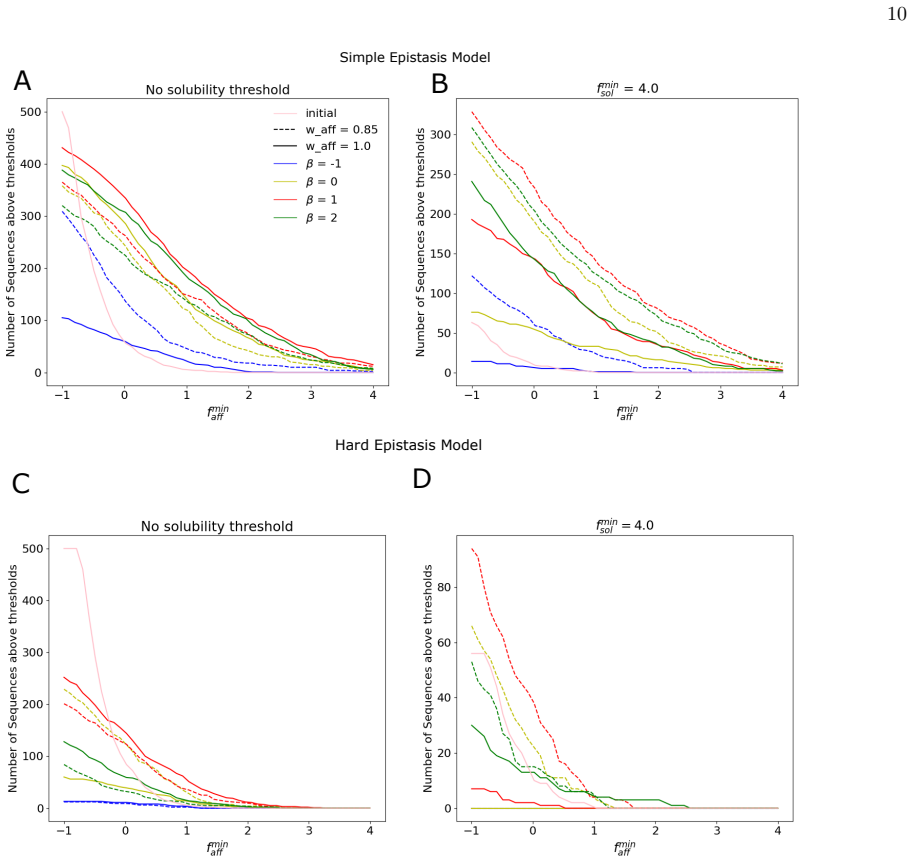
- On synthetic tasks, an optimistic acquisition parameter ($\beta = 1$ or $2$, depending on difficulty) outperforms a pessimistic one, except for very small budgets where conservative $\beta = 0$ is better.
- Both samplers beat the constrained local-search baseline on most synthetic tasks; GFlowNet only clearly wins on the hardest task with a solubility threshold.
Reading between the lines
- Because the affinity model's validation is limited to single-to-triple mutants (Pearson $r=0.58$) and the solubility model reaches Spearman $r=0.40$, the practical value of the generated Pareto front depends on whether these correlations persist at four to six mutations; a direct wet-lab check on generated sequences would settle this.
- The same energy-based scheme should extend to more than two objectives, as the authors note, but linear scalarization with fixed weights can only sweep convex regions of the front; the temperature term may be essential for exploring non-convex trade-offs.
- A solubility predictor with per-residue uncertainty estimates would let the acquisition function penalize or reward uncertain residues, potentially improving small-budget performance.
- The synthetic results suggest that ruggedness of the fitness landscape, not just noise, determines the best optimism level: the harder the epistatic task, the larger the $\beta$ needed, until the budget becomes tiny.
Editorial analysis
A structured set of objections, weighed in public.
Referee Report
Summary. The paper proposes an energy-based generative approach for single-round optimization of monoclonal antibody heavy-chain sequences. The generative distribution is p(x) ∝ pHUM(x) exp(-E(x)/T), with pHUM a human-antibody language model prior and E a linear combination of predicted affinity and predicted solubility. The authors implement sampling with Metropolis-Hastings and GFlowNet, restrict mutations to at most six positions from the wild-type CB-119 binder AB-14, and select candidates near an empirical Pareto front defined by the two predictions. The real-sequence part is complemented by a synthetic benchmark with an epistatic ground-truth affinity function, where the method is compared with antBO local search, a random baseline, and the training set. The central methodological claims are that the samplers produce diverse, novel, and Pareto-approximate sequences, and that the energy-based approach outperforms constrained local search on the synthetic tasks.
Significance. If the method's outputs are interpreted as candidates for wet-lab screening within a larger pipeline, the paper makes a useful contribution: it clearly demonstrates that energy-based sampling with a human-sequence prior can navigate a restricted mutation space and find diverse sequences that optimize in silico objectives, and the synthetic benchmark with known affinity ground truth provides a meaningful internal check of the optimization procedure. The manuscript is also strong in transparency: the Boltzmann derivation, the MCMC and GFlowNet implementations, and the comparison protocols are described in enough detail to be reproduced, and code and data are promised at a public repository. The main limitation is external validity: the real CB-119 Pareto front is built entirely from proxy predictions, and the solubility surrogate is validated only in a low-score regime, so the paper's more ambitious framing of generating antibodies that are actually Pareto-optimal in affinity and solubility is not supported by the evidence presented.
major comments (4)
- [II.C, II.D, Eq. (4), Fig. 3] The solubility surrogate is the main unvalidated link in the real-sequence Pareto claim. The model achieves Spearman r = 0.40 on 83 clinical-stage antibodies whose mean predicted solubility score is approximately 0.7 (Section II.C), yet the generated candidates in Fig. 3A/B have predicted fsol values of roughly 2 to 6, a regime with no validation points. Because the empirical Pareto front in Section II.D is defined using this same fsol, the claim that the generated sequences lie on a Pareto front between affinity and solubility is only a statement about the surrogate, not about measured solubility. The synthetic benchmark in Section II.E cannot resolve this, since the 'solubility' objective there is the same predicted fsol; it validates that the samplers optimize the surrogate but not that the surrogate measures real solubility. I request that the authors either explicitly reframe all real-sequence Pareto statements as being with respect to predicted properties, or provide additional validation (e.g., experimental HIC measurements, or at least a calibration analysis showing that fsol extrapolates beyond the validated range).
- [II.B and II.D] The affinity model is validated only on the training distribution of single, double, and triple mutants, with Pearson r = 0.58 on held-out data, but the generative process explores sequences with up to six mutations from the wild type. The GP's uncertainty estimate σ(x) is used in the acquisition function (β values) but does not by itself correct for systematic extrapolation error at mutational distances 4–6. The paper should quantify how many generated sequences fall at Hamming distance 4, 5, and 6 from the training set, report the associated GP predictive variances, and ideally use the synthetic benchmark to show that the method's advantage over antBO persists when the GP is trained only on up-to-triple mutants but evaluated on 4–6 mutation ground truth. Without this, the single-round optimization claim rests on an untested extrapolation.
- [II.E, Figs. 5–6] The synthetic benchmark provides a genuine ground-truth for affinity, but the solubility objective in the synthetic tasks is the very same predicted fsol used in the real-task energy. Consequently, the comparison with antBO demonstrates superiority at optimizing a composite surrogate but does not provide evidence about real solubility. This should be stated explicitly in the text, and the conclusion 'our energy based sampling method performs better than constrained optimization' (end of Section II.E) should be restricted to the in silico objectives. A cleaner test would use a second, independent solubility proxy, or a synthetic ground-truth solubility model, in the benchmark.
- [IV.D, Eq. (17)] There is a sign inconsistency in the derivation of the Boltzmann distribution. Equation (17) states p = arg max_π (Σ_x π(x) E(x) + T DKL(π||pHUM)), but the text immediately says 'the solution of this minimization is given by the Boltzmann law, Eq. 1.' Maximizing Σ π E + T DKL would favor high-energy, high-entropy distributions, not the low-energy distribution exp(-E/T)/Z. The correct formulation is a minimization (or a maximization with -E and -T DKL). Since this equation is the theoretical foundation of the method, it should be corrected; implementation-wise the authors do use Eq. (1), so this appears fixable as a sign/optimization-direction error, but it must be addressed.
minor comments (8)
- [II.C] Typo: 'time time it takes' should read 'time it takes'.
- [Eq. (5)] The second term in the distance-to-Pareto-front expression is missing a superscript: it should read (fsol(x) − fsol(x'))² / σ²_sol. The same typo appears in the displayed equation.
- [II.E, Fig. 5 caption] The main text sets the solubility threshold to fmin_sol = 4.0, but the caption of Fig. 5B/D says 'predicted solubility score above 3.' Please align the threshold value between text and caption.
- [Fig. S5 caption] Panel B of Fig. S5 is described as 'on the simple synthetic task' but the figure shows the hard epistasis model; this is likely a copy-paste error and should be corrected.
- [IV.A] Typo: 'distance to the first amino acidi' should be 'distance to the first amino acid i'.
- [References] Reference [33] has a placeholder 'year?' and should be completed before publication.
- [Eq. (8)] The notation hi(i) should be hi(xi), since the single-mutation effect depends on the amino acid identity, not just the position.
- [II.D] In the sentence introducing the inverse temperature, 'cloneness' appears to be a typo for 'closeness'.
Circularity Check
No significant circularity: the empirical Pareto front is explicitly defined with respect to the same proxy functions used in the energy, and the paper labels it as such; central claims are supported by held-out validation and synthetic affinity ground truth.
full rationale
The derivation chain is self-contained. The sampling distribution (Eqs. 1-2) follows from a max-entropy/KL objective, not from the target Pareto front. The distance-to-front metric (Eq. 5) uses the same faff and fsol as the energy, but the paper consistently calls the resulting front "empirical" and "with respect to the proxy functions" (Sections II.D and II.E), and it explicitly states that it cannot experimentally verify Kd or HIC. The affinity surrogate is validated on held-out mutants (Pearson r=0.58), the solubility surrogate is validated on 83 clinical-stage antibodies (Spearman r=0.40), and the synthetic benchmark provides an independent ground-truth affinity function (Eq. 8) against which the optimizer is compared to antBO and random baselines. The only self-citation of note, the epistatic model of Ref. [29], is used as a standard functional form with freshly sampled parameters, not as a fitted input, so it is not load-bearing. The main weakness is an external-validity gap: generated sequences reach predicted fsol values of 2-6, far beyond the validated range (mean ~0.7), so real solubility gains are unverified. That is a correctness risk, not a circularity, because the paper does not claim these candidates were validated in wet-lab experiments; the abstract's loose phrase "optimal Pareto front" is clarified in the body as an empirical front with respect to the predictive models.
Assumptions & free parameters
free parameters (8)
- affinity/solubility weight w =
0.85, 0.875, 0.9, 0.95, 1.0
- inverse temperature T^-1 =
20 for CB-119, 10 for synthetic tasks
- acquisition parameter beta =
-1, 0, 1, 2
- maximum mutation distance dlim =
6
- solubility threshold fmin_sol =
4.0 in synthetic filtering
- synthetic epistasis parameters =
simple: H~N(-0.5,0.5), J~N(0,0.5); hard: H~N(0,0.5), J~N(-0.5,0.5); noise N(0,1)
- GP kernel hyperparameters delta, lambda, sigma_n =
learned by minimizing log marginal likelihood on 30% of the affinity data
- hydrophobicity weights HW =
20 weights from Jain et al. [20]
assumptions (8)
- standard math Boltzmann form p(x) = pHUM(x) exp(-E(x)/T)/Z solves the KL-constrained objective (Eq. 17)
- domain assumption Affinity landscape is a Gaussian process with RBF kernel in embedding space
- domain assumption IGLM likelihood on 558M human heavy chains is a valid humanness and immunogenicity proxy
- domain assumption Per-residue SASA plus hydrophobicity weights predicts HIC retention time and solubility
- domain assumption Up to 6 CDR mutations from wild type preserve antigen binding
- ad hoc to paper Second-order epistatic model (Eq. 8) captures the structure of real antibody fitness landscapes
- domain assumption Linear scalarization explores the entire Pareto front
- domain assumption GFlowNet training has converged when Spearman correlation between log-probability and reward is high
Cite this review
Pith. "Pith review of Energy-based generative models for monoclonal antibodies." pith.science (2026). https://pith.science/paper/SENWIXY3
@misc{pith2026241113390,
  author       = {Pith},
  title        = {Pith review of: Energy-based generative models for monoclonal antibodies},
  year         = {2026},
  howpublished = {\url{https://pith.science/paper/SENWIXY3}},
  note         = {Machine review of arXiv:2411.13390}
}
read the original abstract
Since the approval of the first antibody drug in 1986, a total of 162 antibodies have been approved for a wide range of therapeutic areas, including cancer, autoimmune, infectious, or cardiovascular diseases. Despite advances in biotechnology that accelerated the development of antibody drugs, the drug discovery process for this modality remains lengthy and costly, requiring multiple rounds of optimizations before a drug candidate can progress to preclinical and clinical trials. This multi-optimization problem involves increasing the affinity of the antibody to the target antigen while refining additional biophysical properties that are essential to drug development such as solubility, thermostability or aggregation propensity. Additionally, antibodies that resemble natural human antibodies are particularly desirable, as they are likely to offer improved profiles in terms of safety, efficacy, and reduced immunogenicity, further supporting their therapeutic potential. In this article, we explore the use of energy-based generative models to optimize a candidate monoclonal antibody. We identify tradeoffs when optimizing for multiple properties, concentrating on solubility, humanness and affinity and use the generative model we develop to generate candidate antibodies that lie on an optimal Pareto front that satisfies these constraints.
Figures


Figures from the paper (3 more)


Reference graph
Works this paper leans on
-
[1]
(2017) Biophysical properties of the clinical- stage antibody landscape
Jain T, et al. (2017) Biophysical properties of the clinical- stage antibody landscape. Proceedings of the National Academy of Sciences 114:944–949
work page 2017
-
[2]
(2018) Yeast surface display plat- form for rapid discovery of conformationally selective nanobodies
McMahon C, et al. (2018) Yeast surface display plat- form for rapid discovery of conformationally selective nanobodies. Nature structural & molecular biology 25:289–296
work page 2018
-
[3]
Ledsgaard L, Kilstrup M, Karatt-Vellatt A, McCafferty J, Laustsen AH (2018) Basics of antibody phage display technology. Toxins 10:236
work page 2018
-
[4]
Ye W, et al. (2022) Improving antibody affinity through in vitro mutagenesis in complementarity determining re- gions. Journal of Biomedical Research 36:155
work page 2022
-
[5]
Antibody Engineering: Methods and Proto- cols, Second Edition pp 411–442
Hearty S, Leonard P, O’Kennedy R (2012) Measuring antibody–antigen binding kinetics using surface plasmon resonance. Antibody Engineering: Methods and Proto- cols, Second Edition pp 411–442
work page 2012
-
[6]
Khetan R, et al. (2022) Current advances in biopharma- ceutical informatics: guidelines, impact and challenges in the computational developability assessment of antibody therapeutics (Taylor & Francis), Vol. 14, p 2020082
work page 2022
-
[7]
Mason DM, et al. (2021) Optimization of therapeutic an- tibodies by predicting antigen specificity from antibody sequence via deep learning. Nature Biomedical Engineer- ing 5:600–612
work page 2021
-
[8]
Biswas S, Khimulya G, Alley EC, Esvelt KM, Church GM (2021) Low-n protein engineering with data-efficient deep learning. Nature methods 18:389–396
work page 2021
Show all 49 references
-
[9]
(2022) Biological sequence design with gflownets (PMLR), pp 9786–9801
Jain M, et al. (2022) Biological sequence design with gflownets (PMLR), pp 9786–9801
2022
-
[10]
(2024) Atomically accurate de novo design of single-domain antibodies
Bennett NR, et al. (2024) Atomically accurate de novo design of single-domain antibodies. bioRxiv
2024
-
[11]
BioRxiv pp 2021– 12
Shuai R W, Ruffolo JA, Gray JJ (2021) Generative lan- guage modeling for antibody design. BioRxiv pp 2021– 12
2021
-
[12]
Protein Science 31:141–146
Olsen TH, Boyles F, Deane CM (2022) Observed anti- body space: A diverse database of cleaned, annotated, and translated unpaired and paired antibody sequences. Protein Science 31:141–146
2022
-
[13]
pp 1352–1361
Haarnoja T, Tang H, Abbeel P, Levine S (2017) Rein- forcement learning with deep energy-based policies. pp 1352–1361
2017
-
[14]
(2023) Gflownet foundations (JML- RORG), Vol
Bengio Y, et al. (2023) Gflownet foundations (JML- RORG), Vol. 24, pp 10006–10060
2023
-
[15]
(2022) A dataset comprised of binding interactions for 104,972 antibodies against a sars-cov-2 peptide
Engelhart E, et al. (2022) A dataset comprised of binding interactions for 104,972 antibodies against a sars-cov-2 peptide. Scientific Data 9:653
2022
-
[16]
Advances in neu- ral information processing systems 31
Gardner J, Pleiss G, Weinberger KQ, Bindel D, Wilson AG (2018) Gpytorch: Blackbox matrix-matrix gaussian process inference with gpu acceleration. Advances in neu- ral information processing systems 31
2018
-
[17]
RESP-REP
The output of these 4 blocks is a matrix of dimen- sion L × H where L is the maximum sequence length and H is a hyper parameter representing the size of the encoding which we choose to be 16. We then feed to a decoder the ith column of this matrix to which we append two values...
-
[18]
(2023) Evolutionary-scale prediction of atomic-level protein structure with a language model
Lin Z, et al. (2023) Evolutionary-scale prediction of atomic-level protein structure with a language model. Science 379:1123–1130
2023
-
[19]
arXiv preprint arXiv:2112.07782
Ruffolo JA, Gray JJ, Sulam J (2021) Decipher- ing antibody affinity maturation with language mod- els and weakly supervised learning. arXiv preprint arXiv:2112.07782
2021 arXiv
-
[20]
Auer P (2002) Finite-time analysis of the multiarmed bandit problem
2002
-
[21]
lysozyme and insulin
Shrake A, Rupley JA (1973) Environment and exposure to solvent of protein atoms. lysozyme and insulin. Jour- nal of molecular biology 79:351–371
1973
-
[22]
Frontiers in immunology 13:958584
Cohen T, Halfon M, Schneidman-Duhovny D (2022) Nanonet: Rapid and accurate end-to-end nanobody modeling by deep learning. Frontiers in immunology 13:958584
2022
-
[23]
(2017) Prediction of delayed retention of antibodies in hydrophobic interaction chromatography from sequence using machine learning
Jain T, et al. (2017) Prediction of delayed retention of antibodies in hydrophobic interaction chromatography from sequence using machine learning. Bioinformatics 33:3758–3766
2017
-
[24]
Journal of molecular biology 427:478– 490
Sormanni P, Aprile F A, Vendruscolo M (2015) The cam- sol method of rational design of protein mutants with en- hanced solubility. Journal of molecular biology 427:478– 490
2015
-
[25]
Scientific reports 7:8200
Sormanni P, Amery L, Ekizoglou S, Vendruscolo M, Popovic B (2017) Rapid and accurate in silico solubil- ity screening of a monoclonal antibody library. Scientific reports 7:8200
2017
-
[26]
(2014) Sabdab: the structural antibody database
Dunbar J, et al. (2014) Sabdab: the structural antibody database. Nucleic acids research 42:D1140–D1146
2014
-
[27]
(2023) Machine learning optimization of candidate antibody yields highly diverse sub-nanomolar affinity antibody libraries
Li L, et al. (2023) Machine learning optimization of candidate antibody yields highly diverse sub-nanomolar affinity antibody libraries. Nature Communications 14:3454
2023
-
[28]
Protein Engineering, Design and Selection 4:155–161
Guruprasad K, Reddy BB, Pandit MW (1990) Corre- lation between stability of a protein and its dipeptide composition: a novel approach for predicting in vivo sta- bility of a protein from its primary sequence. Protein Engineering, Design and Selection 4:155–161
1990
-
[29]
(2022) Antbo: Towards real-world auto- mated antibody design with combinatorial bayesian op- timisation
Khan A, et al. (2022) Antbo: Towards real-world auto- mated antibody design with combinatorial bayesian op- timisation. arXiv preprint arXiv:2201.12570
2022 arXiv
-
[30]
(2021) Binding affinity landscapes constrain the evolution of broadly neutralizing anti- influenza antibodies
Phillips AM, et al. (2021) Binding affinity landscapes constrain the evolution of broadly neutralizing anti- influenza antibodies. eLife 10:e71393
2021
-
[31]
PLoS computational biology 12:e1004771
Poelwijk FJ, Krishna V, Ranganathan R (2016) The context-dependence of mutations: a linkage of for- malisms. PLoS computational biology 12:e1004771
2016
-
[32]
Cell systems 8:86–93
Adams RM, Kinney JB, Walczak AM, Mora T (2019) Epistasis in a fitness landscape defined by antibody- antigen binding free energy. Cell systems 8:86–93
2019
-
[33]
is the most similar to us in scope as it is designed to perform offline single round multi-objective optimiza- tion, although it optimizes thermostability whereas we optimize solubility. In addition, the idea of performing the exploration in the latent space of the auto-encode...
-
[34]
epistemic
on the other hand were designed for multi-round on- line active learning. Both methods use in-silico affinity prediction methods as faff , allowing them to bypass the more expensive and time-consuming wet lab experiments. In addition, [27] trained a GP on the dataset of [15] a...
-
[35]
(2022) Unconstrained generation of synthetic antibody–antigen structures to guide machine learning methodology for antibody specificity prediction
Robert PA, et al. (2022) Unconstrained generation of synthetic antibody–antigen structures to guide machine learning methodology for antibody specificity prediction. Nature Computational Science 2:845–865
2022
-
[36]
(year?) Antibody Design with Constrained Bayesian Optimization
Zeng Y, et al. (year?) Antibody Design with Constrained Bayesian Optimization
-
[37]
Gessner A, Ober SW, Vickery O, Ogli´ c D, U¸ car T (2024) Active learning for affinity prediction of antibodies.arXiv preprint arXiv:2406.07263
2024 arXiv
-
[38]
Advances in Neural Infor- mation Processing Systems 34:12849–12863
Moskovitz T, Parker-Holder J, Pacchiano A, Arbel M, Jordan M (2021) Tactical optimism and pessimism for deep reinforcement learning. Advances in Neural Infor- mation Processing Systems 34:12849–12863
2021
-
[39]
34, pp 6683–6694
Xie T, Cheng CA, Jiang N, Mineiro P, Agarwal A (2021) Bellman-consistent Pessimism for Offline Reinforcement Learning eds Ranzato M, Beygelzimer A, Dauphin Y, Liang P, Vaughan JW (Curran Associates, Inc.), Vol. 34, pp 6683–6694
2021
-
[40]
Shi L, Li G, Wei Y, Chen Y, Chi Y (2022) Pessimistic q- learning for offline reinforcement learning: Towards op- 17 timal sample complexity (PMLR), pp 19967–20025
2022
-
[41]
(2024) Information-Directed Pessimism for Offline Reinforcement Learning
Koppel A, et al. (2024) Information-Directed Pessimism for Offline Reinforcement Learning
2024
-
[42]
Bioinformatics 28:3150–3152
Fu L, Niu B, Zhu Z, Wu S, Li W (2012) Cd-hit: acceler- ated for clustering the next-generation sequencing data. Bioinformatics 28:3150–3152
2012
-
[43]
The Journal of Physical Chemistry B 114:6614–6624
Chennamsetty N, Voynov V, Kayser V, Helk B, Trout BL (2010) Prediction of aggregation prone regions of therapeutic proteins. The Journal of Physical Chemistry B 114:6614–6624
2010
-
[44]
Williams CK, Rasmussen CE (2006) Gaussian processes for machine learning (MIT press Cambridge, MA) Vol. 2
2006
-
[45]
(2022) Language models of protein sequences at the scale of evolution enable accurate structure pre- diction
Lin Z, et al. (2022) Language models of protein sequences at the scale of evolution enable accurate structure pre- diction. bioRxiv
2022
-
[46]
arXiv preprint arXiv:1810.04805
Devlin J (2018) Bert: Pre-training of deep bidirectional transformers for language understanding. arXiv preprint arXiv:1810.04805
2018 arXiv
-
[47]
(2016) Neural machine translation in linear time
Kalchbrenner N, et al. (2016) Neural machine translation in linear time. arXiv preprint arXiv:1610.10099
2016 arXiv
-
[48]
Cell Systems 15:286–294
Yang KK, Fusi N, Lu AX (2024) Convolutions are com- petitive with transformers for protein sequence pretrain- ing. Cell Systems 15:286–294
2024
-
[49]
(2023) Learning gflownets from partial episodes for improved convergence and stability (PMLR), pp 23467–23483
Madan K, et al. (2023) Learning gflownets from partial episodes for improved convergence and stability (PMLR), pp 23467–23483. 18 Supplementary information This section provides supplementary figures that support the main findings described in the document. B C DA FIG. S1: A. ...
2023
Reviewed August 12, 2026 · model on record in the stance chip above.
Discussion (0). Continue with ORCID to comment.