REVIEW 3 major objections 6 minor 54 references
Modeling the effect of hydrodynamic wakes in dynamical models of large-scale fish schools
T0 review · 3 major / 6 minor · reviewed 2026-08-12 · deepseek-v4-flash
Pith's one-line read Simulations with a DNS-parameterized wake model show that vortex wakes organize fish schools into oblique diamond patterns, especially when social alignment dominates attraction.
desk verdict A DNS-anchored vortex-wake ABM for fish schools that shows wakes can order schools, but the headline pattern hinges on an unvalidated wake-superposition assumption. read the letter →
The pith
A machine-rendered reading of the paper's core claim, the machinery that carries it, and where it could break.
The reading
What carries the argument
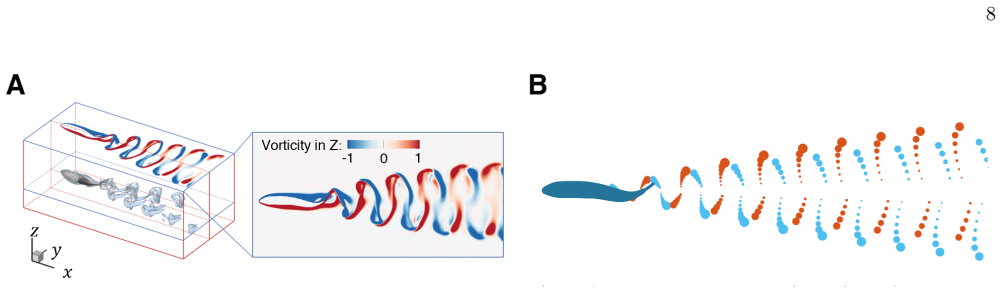
The central object is the phenomenological wake model: each half tail-beat sheds a line of discrete Rankine vortices of alternating sign, arranged in the oblique pattern observed in the authors' three-dimensional direct numerical simulations of a mackerel-like carangiform swimmer, with vortex strength and decay rates fitted to those simulations. This wake field is added to a potential-flow model of the fish body (four source-sink pairs shaped to an ellipsoid) to produce the velocity perturbation acting on each focal fish. Surge, sway, and yaw dynamics are governed by Newtonian equations in which hydrodynamic forces and moments are computed from DNS-fitted drag, lift, and moment coefficients, while social interactions enter through a vision-limited attraction and alignment torque with attention parsimony. The wake-induced organization emerges because the modeled oblique jet has narrow regions of favorable forward velocity near its edges, and the superposition of aligned wakes strengthens these edge regions as they propagate downstream.
What would settle it
Simulate a small school (two or three fish) with the same carangiform kinematics using a fully resolved multi-body DNS and measure the induced velocity field behind the leading fish; if the trailing fish do not preferentially settle near the wake-edge drifting regions, or if the first-PC explained variance does not increase when the wake is present, the model's central organizing mechanism is falsified. More directly, compare the modeled oblique Rankine-vortex wake to the actual wake of a fish swimming in a school: if the wake is substantially modified by neighbors, the superposition assumption breaks.
Extended reading notes
Core claim
The paper's key discovery is that incorporating a phenomenological model of the oblique vortex wake of a carangiform swimmer into a Newtonian agent-based school model produces significantly more organized school topologies than potential-flow-only models. In the high-alignment regime ($\alpha_T = 0.1$), where attraction is weak relative to alignment, wake-on simulations yield an oblique 'diamond' pattern in which each follower sits near the edge of the wake of the fish ahead; the first principal component of the reconstructed fish distribution explains 11.95% of the variance, compared with 1.54% when the wake is disabled. In the high-attraction regime ($\alpha_T=0.9$), the wake still improves spatial coherence (3.07% versus 1.42%) but the oblique structure is less pronounced because strong attraction overrides the passive hydrodynamic drafting. The paper further shows that wider wakes (lower Reynolds number or smaller caudal-fin aspect ratio) enhance ordering in high-alignment schools, and that there is an optimal vortex strength beyond which organization degrades.
Load-bearing premise
The multi-fish hydrodynamic interaction is represented as a linear superposition of a potential flow and discrete Rankine vortices whose parameters were fitted to a single-fish DNS, and the wake of a fish is assumed not to be modified by trailing or adjacent fish; the paper's conclusion about wake-induced school organization would not hold if this simplified wake representation is inaccurate in multi-fish configurations.
Editorial extensions
If this is right
- Wakes act as an ordering mechanism, so school shape is not set by social rules alone; hydrodynamic history matters.
- Fish that generate wider wakes, such as those swimming at lower Reynolds numbers or with smaller caudal-fin aspect ratios, should show more ordered diamond formations when highly polarized.
- There is an optimal wake strength: too-strong vortices partially destabilize the school, implying a sweet spot for hydrodynamic schooling benefits.
- The model predicts that wake-induced organization is strongest when alignment dominates over attraction, so species or contexts with weak social attraction should exhibit the clearest hydrodynamic patterning.
Reading between the lines
- A testable extension would be to apply the same PCA pipeline to experimental tracking of real fish schools; if wake-driven ordering is real, the first-PC explained variance should rise when visual or social cues are experimentally reduced.
- The assumption that each fish's wake is unaffected by neighbors is likely the first to fail in dense schools; including wake-wake interactions could shift the predicted optimal vortex strength and should be tested against multi-fish DNS.
- The emergence of diamond and staggered patterns offers a hydrodynamic rationale for the inline and phalanx configurations debated in the fish-schooling literature, and could inform bio-inspired design of underwater vehicle formations.
Editorial analysis
A structured set of objections, weighed in public.
Referee Report
Summary. The paper develops a two-dimensional agent-based model of fish schooling in which each fish is subject to social forces (attraction, alignment, wall avoidance) and to hydrodynamic forces from a potential-flow representation of the body plus a discrete Rankine-vortex wake whose parameters are fitted to the authors' three-dimensional direct numerical simulations of a single carangiform swimmer. The model is used to compare school topology in simulations with and without the wake model, for various numbers of fish and for high-alignment (alpha_T=0.1) versus high-attraction (alpha_T=0.9) social regimes. The central claim is that adding the vortex wake increases the spatial organization of the school, most strongly in the high-alignment regime, producing an oblique 'diamond' pattern; the first principal component of the school distribution explains 11.95% of the variance with wake versus 1.54% without (Section III.B, Fig. 15). The paper also reports sensitivities to wake angle (Section III.C) and vortex strength (Section III.D).
Significance. If the central claim holds, the work is a valuable contribution because it bridges behavior-focused agent-based models and hydrodynamic realism, and it generates concrete, falsifiable predictions: e.g., wider wakes and stronger vortices should enhance schooling organization in highly polarized groups (Figs. 17 and 18). The use of 300 ensemble runs per condition and DNS-calibrated hydrodynamic coefficients is a strength, and the model's explicit separation of social and hydrodynamic mechanisms allows the wake effect to be isolated cleanly. However, the absence of multi-fish validation of the wake-superposition assumption and the lack of uncertainty quantification on the PCA metrics currently limit the strength of the physical conclusions. The paper is well-suited to the journal and would benefit from targeted additional validation.
major comments (3)
- [Section II.H] Section II.H states that 'the wake flow generated by a given fish is not modified by any trailing or adjacent fish,' and Section II.E (Eq. 8) represents the school flow as a linear superposition of single-fish potential and wake fields. The central mechanism for the diamond pattern in Section III.B — that wake edges from successive fish superpose to create stronger attractive edges — is a direct consequence of this assumption. Because the superposition has not been validated for multi-fish configurations, the physical claim that vortices improve school organization is not yet robust. I recommend adding a targeted validation (e.g., a two-fish DNS or experiment) or, at minimum, a sensitivity test that perturbs or attenuates the wake behind a trailing fish to show that the qualitative result does not depend on the exact superposition.
- [Section II.D, Eq. (4)] The hydrodynamic force and moment coefficients C1, C2, C3 are quasi-steady, obtained from DNS of a stationary fish at fixed angles of attack. In the school simulations, fish are subjected to a periodically unsteady wake from neighbors, and the quasi-steady approximation neglects unsteady effects such as added mass, wake history, and dynamic stall. These effects could alter the magnitude and location of the hydrodynamic forces that are claimed to attract trailing fish to the wake edge. Please justify the quasi-steady assumption quantitatively, for example by comparing with an unsteady estimate of the forces on a fish in a periodic wake, or by showing that the time-averaged forces dominate the dynamics.
- [Section III.B, Figs. 14 and 15] The quantitative claim that wakes organize schools is based on the explained variance of the first principal component (11.95% vs. 1.54%). The PCA is computed from 300 simulations with five snapshots each, but no confidence intervals or statistical significance tests are reported. Since the ensemble size is finite, the difference could be sensitive to snapshot selection or to a few outlier configurations. Please include a bootstrap or permutation-based uncertainty estimate for the PCA variances, or otherwise demonstrate that the difference is statistically robust.
minor comments (6)
- [Section II.D] The formula for the flow angle phi appears mis-typeset; please clarify using an explicit atan2 expression for the two components of the relative velocity.
- [Table II] The preferred distance R0 is listed as '1/LB', which is dimensionally inconsistent; since lengths are nondimensionalized by LB, R0 should be a dimensionless value (or state R0 = 1 LB before nondimensionalization).
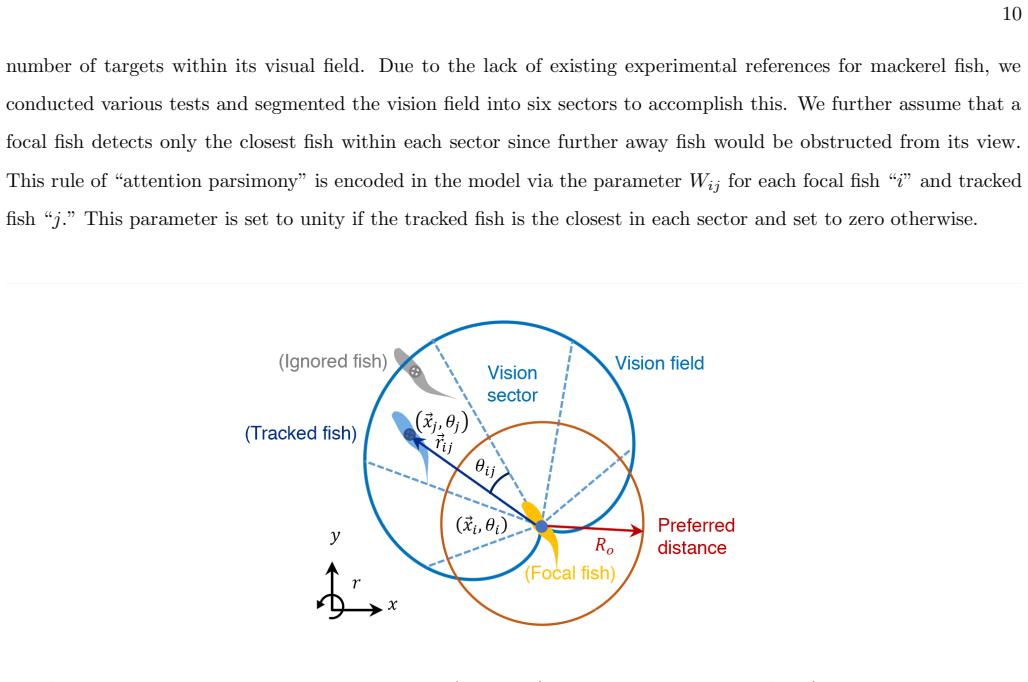
- [Section II.F] The segmentation of the vision field into six sectors is stated to be based on 'various tests' without details; please provide a reference, a description of the tests, or a brief sensitivity analysis.
- [Figs. 17 and 18 captions] The notation 'N = 1,500' in the captions refers to the number of PCA samples (300 simulations x 5 snapshots), which is easily confused with the number of fish; please relabel as 'Nsamples = 1,500'.
- [Section III.C] The description of the effect of wake angle on schooling organization is contradictory at first reading ('wider wakes greatly contribute' followed by 'wider wakes have a detrimental effect' for beta <= 11 degrees). Please revise to state the non-monotonic dependence clearly and define the threshold beta approx 14 degrees.
- [Section II.A and Fig. 1 caption] There is a typo 'Talbe I' in Section II.A, and in the Fig. 1 caption 'theta_ij is the angle between r_ij and U1' should refer to the surge direction rather than the scalar velocity U1.
Circularity Check
No significant circularity: the wake model is calibrated to single-fish DNS, and the school-level organization metrics are emergent outputs of simulations that are not used in the fitting procedure.
full rationale
The paper's central claim is that adding a vortex-wake model to a fish-schooling model changes emergent school topology, especially under high alignment. The wake model parameters are fitted to single-fish DNS data: force coefficients from static-body DNS at angle of attack (Section II.D) and wake vortex strengths, positions, and decay rates from single-fish wake DNS (Section II.E and Table IV). The school-level outcomes—diamond-like oblique patterns, nearest-neighbor-distance distributions, and PCA explained variance—are not inputs to these fits; they arise from simulating many interacting fish under identical social parameters with and without the wake. Thus the with-wake versus without-wake comparison is a genuine emergent prediction rather than a quantity forced by construction. The assertion that each fish's wake is not modified by neighboring fish (Section II.H) is an explicit modeling simplification, and the mechanism explaining the diamond pattern relies on linear superposition of unmodified wakes. This is a legitimate modeling assumption, not a circular reduction, because the predicted organization is not contained in the single-fish calibration data; it is a consequence of the assumed wake physics, whose validity is a correctness concern rather than a circularity concern. The paper cites several of the authors' prior DNS studies for wake structure and solver validation, but those are independent computational results used as calibration and comparison, not unverified self-citations invoked to forbid alternatives. No uniqueness theorem or ansatz is smuggled in via self-citation, and no fitted parameter is relabeled as a prediction. The derivation chain is self-contained relative to its stated inputs, and the central claim has independent content.
Assumptions & free parameters
free parameters (5)
- Potential-flow singularity strengths and positions (m1-m4, a1-a4) =
m = 7.677e-4, 7.726e-4, 7.677e-4, 4.562e-4; a = 0.40, 0.10, 0.30, 0.475
- Wake circulation and decay coefficients =
Gamma0 = 2*pi*Vs*R_wake; decay c1=-0.137, c2=0.4
- Wake geometry coefficients (spanwise spread, oblique angle, end strength) =
Vs fraction 0.25; multiple c1, c2, c3 values in Table IV
- Social interaction coefficients =
Kp=1, Kd=3, KAT+KAL=30, Kw=10, K_vision=1/n_tracked
- Vision field parameters =
alpha=2 LB, six visual sectors
assumptions (6)
- domain assumption Fish body assumed to be a neutrally buoyant ellipsoid with uniform density equal to water; motion restricted to a horizontal plane with surge, sway, and yaw degrees of freedom.
- ad hoc to paper Hydrodynamic forces and moments can be represented by quasi-steady coefficients (C1, C2, C3) from DNS of stationary fish at angles of attack.
- ad hoc to paper Wake velocity field is a linear superposition of potential flow and discrete Rankine vortices, with parameters fitted to a single-fish DNS.
- domain assumption Wake generated by a fish is not modified by trailing or adjacent fish (one-way coupling).
- domain assumption Fish sense neighbors only through vision, via a cardioid field with attention parsimony; lateral line and pressure sensing are omitted.
- domain assumption Bainbridge empirical tailbeat frequency relation F = (4/3)(Uo/LB + 1) applies.
invented entities (1)
-
Discrete Rankine vortex wake elements
Cite this review
Pith. "Pith review of Modeling the effect of hydrodynamic wakes in dynamical models of large-scale fish schools." pith.science (2026). https://pith.science/paper/M2YF7CHQ
@misc{pith2026241113406,
  author       = {Pith},
  title        = {Pith review of: Modeling the effect of hydrodynamic wakes in dynamical models of large-scale fish schools},
  year         = {2026},
  howpublished = {\url{https://pith.science/paper/M2YF7CHQ}},
  note         = {Machine review of arXiv:2411.13406}
}
read the original abstract
A novel model of the wake of swimming fish is developed and incorporated into a dynamical model of a fish school to explore the effect of hydrodynamics on the emergent behavior in schooling fish. The model incorporates well-established rules for attraction, alignment, and visual detection via a force-momentum balance in the surge, sway, and yaw directions, thereby allowing us to include the effects of body size, shape, and inertia in to the dynamics of fish motion. The key novelty of the model lies in the modeling of the hydrodynamics, which includes not only the potential flow induced by the body of the fish but also the vortex wakes generated by the fish. These hydrodynamic features, as well as the surge, sway, and yaw force coefficients, are parameterized via three-dimensional high-fidelity direct numerical simulations of a carangiform swimmer, thereby enabling a higher degree of realism in these models. The model is used to examine the effect of wake characteristics on the topology and movement of fish schools. The simulations indicate that these wake vortices lead to improved organization within the schools, especially in situations where the social forces are relatively weak.
Figures


Figures from the paper (17 more)





Reference graph
Works this paper leans on
-
[1]
Principal Component Analysis Metrics like polarity [11, 49], which quantifies the degree of co-orientation, and mean nearest neighbor distance (NND), which measures school compactness, are commonly used to analyze schooling behavior. While these scalar metrics provide valuable insights, they cannot capture the topology or spatial structure of the school. ...
-
[2]
These tables detail fish physiology, social behavior parameters, and hydrodynamic factors
Model Parameters Tables of the model parameters used in this study are included below for reference. These tables detail fish physiology, social behavior parameters, and hydrodynamic factors. The rich parameter space allows this model to fit different fish species with corresponding behavior and hydrodynamic features. 24 TABLE II: Parameters of fish physi...
-
[3]
B. L. Partridge, The structure and function of fish schools, Fish Morphology: Horizon of New Research 246, 114 (1982)
work page 1982
-
[4]
D. Pavlov and A. O. Kasumyan, Patterns and mechanisms of schooling behavior in fish: A review, Journal of Ichthyology 40, 163 (2000)
work page 2000
-
[5]
J. Zhou, J.-H. Seo, and R. Mittal, A flow-physics-informed dynamic model of collective swimming in fish, Bulletin of the American Physical Society 66 (2021)
work page 2021
-
[6]
Weihs, Hydromechanics of fish schooling, Nature 241, 290 (1973)
D. Weihs, Hydromechanics of fish schooling, Nature 241, 290 (1973)
1973
-
[7]
J. Zhou, J.-H. Seo, and R. Mittal, Complex emergent dynamics in fish schools-insights from a flow-physics-informed model of collective swimming in fish, Bulletin of the American Physical Society (2022)
work page 2022
-
[8]
T. J. Pitcher, A. E. Magurran, and I. J. Winfield, Fish in larger shoals find food faster, Behavioral Ecology and Sociobiology 10, 149 (1982)
1982
Show all 54 references
-
[9]
Zhou, J.-H
J. Zhou, J.-H. Seo, and R. Mittal, Effect of turbulence on the hydrodynamics of fish schools, Bulletin of the American Physical Society (2023)
2023
-
[10]
M.-L. B. Anras, J.-P. Lagard´ ere, and J.-Y. Lafaye, Diel activity rhythm of seabass tracked in a natural environment: group effects on swimming patterns and amplitudes, Canadian Journal of Fisheries and Aquatic Sciences 54, 162 (1997)
1997
-
[11]
Zhou, J.-H
J. Zhou, J.-H. Seo, and R. Mittal, Effect of schooling on flow generated sounds from carangiform swimmers, Bioinspiration & Biomimetics 19, 036015 (2024)
2024
-
[12]
Mittal, J
B. Mittal, J. Zhou, and R. Mittal, Exploring predator interaction with a school of prey fish using a flow-physics informed agent-based model, Bulletin of the American Physical Society (2023)
2023
-
[13]
Filella, F
A. Filella, F. Nadal, C. Sire, E. Kanso, and C. Eloy, Model of collective fish behavior with hydrodynamic interactions, 26 Physical Review Letters 120, 35 (2018)
2018
-
[14]
A. P. Maertens, A. Gao, and M. S. Triantafyllou, Optimal undulatory swimming for a single fish-like body and for a pair of interacting swimmers, Journal of Fluid Mechanics 813, 301 (2017)
2017
-
[15]
Seo and R
J.-H. Seo and R. Mittal, Improved swimming performance in schooling fish via leading-edge vortex enhancement, Bioin- spiration & Biomimetics 17, 066020 (2022)
2022
-
[16]
M. N. Mabrouk and D. Floryan, Group cohesion and passive dynamics of a pair of inertial swimmers with three-dimensional hydrodynamic interactions, Bioinspiration & Biomimetics 10.1088/1748-3190/ad936d (2024)
2024 doi
-
[17]
Pan and H
Y. Pan and H. Dong, Computational analysis of hydrodynamic interactions in a high-density fish school, Physics of Fluids 32, 10.1063/5.0028682 (2020)
2020 doi
-
[18]
Ashraf, H
I. Ashraf, H. Bradshaw, T. T. Ha, J. Halloy, R. Godoy-Diana, and B. Thiria, Simple phalanx pattern leads to energy saving in cohesive fish schooling, Proceedings of the National Academy of Sciences of the United States of America 114, 9599 (2017)
2017
-
[19]
Verma, G
S. Verma, G. Novati, and P. Koumoutsakos, Efficient collective swimming by harnessing vortices through deep reinforcement learning, Proceedings of the National Academy of Sciences of the United States of America 115, 5849 (2018)
2018
-
[20]
C. Wei, Q. Hu, T. Zhang, and Y. Zeng, Passive hydrodynamic interactions in minimal fish schools, Ocean Engineering 247, 10.1016/j.oceaneng.2022.110574 (2022)
2022
-
[21]
Saadat, F
M. Saadat, F. Berlinger, A. Sheshmani, R. Nagpal, G. V. Lauder, and H. Haj-Hariri, Hydrodynamic advantages of in-line schooling, Bioinspiration and Biomimetics 16, 10.1088/1748-3190/abe137 (2021)
2021 doi
-
[22]
T. Han, Q. Zhong, A. Mivehchi, D. B. Quinn, and K. W. Moored, Revealing the mechanism and scaling laws behind equilibrium altitudes of near-ground pitching hydrofoils, Journal of Fluid Mechanics 978, A5 (2024)
2024
-
[23]
P. C. Ormonde, M. Kurt, A. Mivechki, and K. W. Moored, Two-dimensionally stable self-organization arises in sim- ple schooling swimmers through hydrodynamic interactions, arXiv 2102.03571 (2021), version 3, revised 31 Jul 2023, 2102.03571
2021 arXiv
-
[24]
McKee, A
A. McKee, A. P. Soto, P. Chen, and M. J. McHenry, The sensory basis of schooling by intermittent swimming in the rummy-nose tetra (hemigrammus rhodostomus): Schooling by intermittent swimming, Proceedings of the Royal Society B: Biological Sciences 287, 10.1098/rspb.2020.0568 (2020)
2020
-
[25]
M. L. Timm, R. S. Pandhare, and H. Masoud, Multi-body hydrodynamic interactions in fish-like swimming, Applied Mechanics Reviews 76, 030801 (2024)
2024
-
[26]
J. C. Liao, A review of fish swimming mechanics and behaviour in altered flows, Philosophical Transactions of the Royal Society B: Biological Sciences 362, 1973 (2007)
2007
-
[27]
Huang, F
C. Huang, F. Ling, and E. Kanso, Collective phase transitions in confined fish schools, Proceedings of the National Academy of Sciences 121, e2406293121 (2024)
2024
-
[28]
Viana, T
F. Viana, T. Funada, D. Joseph, N. Tashiro, and Y. Sonoda, Potential flow of a second-order fluid over a tri-axial ellipsoid, Journal of applied mathematics 2005, 341 (2005)
2005
-
[29]
M¨ uller-Hartmann and J
E. M¨ uller-Hartmann and J. Zittartz, New type of phase transition, Physical Review Letters 33, 893 (1974)
1974
-
[30]
Huth and C
A. Huth and C. Wissel, The simulation of the movement of fish schools, Journal of Theoretical Biology 156, 365 (1992)
1992
-
[31]
Sannomiya, H
N. Sannomiya, H. Nakamine, and K. Matuda, Application of system theory to modeling of fish behavior, December , 0 (1990). 27
1990
-
[32]
Terzopoulos, X
D. Terzopoulos, X. Tu, and R. Grzeszczuk, Artificial fishes: Autonomous locomotion, perception, behavior, and learning in a simulated physical world, Artificial Life 1, 327 (1994)
1994
-
[33]
Czirok, H
A. Czirok, H. E. Stanley, and T. Vicsek, Spontaneously ordered motion of self-propelled particles, Journal of Physics A: Mathematical and General 30, 1375 (1997)
1997
-
[34]
Vabø and L
R. Vabø and L. Nøttestad, An individual based model of fish school reactions: predicting antipredator behaviour as observed in nature, Fisheries Oceanography 6, 155 (1997)
1997
-
[35]
I. D. Couzin, J. Krause, R. James, G. D. Ruxton, and N. R. Franks, Collective memory and spatial sorting in animal groups, Journal of Theoretical Biology 218, 1 (2002)
2002
-
[36]
Takagi, Y
T. Takagi, Y. Moritomi, J. Iwata, H. Nakamine, and N. Sannomiya, Mathematical model of fish schooling behaviour in a set-net, ICES Journal of Marine Science 61, 1214 (2004)
2004
-
[37]
D. S. Calovi, U. Lopez, S. Ngo, C. Sire, H. Chat´ e, and G. Theraulaz, Swarming, schooling, milling: Phase diagram of a data-driven fish school model, New Journal of Physics 16, 10.1088/1367-2630/16/1/015026 (2014)
2014 doi
-
[38]
X. Wang, S. Liu, Y. Yu, S. Yue, Y. Liu, F. Zhang, and Y. Lin, Modeling collective motion for fish schooling via multi-agent reinforcement learning, Ecological Modelling 477, 110259 (2023)
2023
-
[39]
W. C. Witt, L. Wen, and G. V. Lauder, Hydrodynamics of c-start escape responses of fish as studied with simple physical models, Integrative and comparative biology 55, 728 (2015)
2015
-
[40]
W¨ ohl and S
S. W¨ ohl and S. Schuster, The predictive start of hunting archer fish: a flexible and precise motor pattern performed with the kinematics of an escape c-start, Journal of Experimental Biology 210, 311 (2007)
2007
-
[41]
Bainbridge, The speed of swimming of fish as related to size and to the frequency and amplitude of the tail beat, Journal of Experimental Biology 35, 109 (1958)
R. Bainbridge, The speed of swimming of fish as related to size and to the frequency and amplitude of the tail beat, Journal of Experimental Biology 35, 109 (1958)
1958
-
[42]
Mittal, H
R. Mittal, H. Dong, M. Bozkurttas, F. Najjar, A. Vargas, and A. Von Loebbecke, A versatile sharp interface immersed boundary method for incompressible flows with complex boundaries, Journal of computational physics 227, 4825 (2008)
2008
-
[43]
Solano, C
T. Solano, C. Ni, R. Mittal, and K. Shoele, Perimeter leakage of face masks and its effect on the mask’s efficacy, Physics of Fluids 34, https://doi.org/10.1063/5.0086320 (2022)
2022 doi
-
[44]
Lopez, J
U. Lopez, J. Gautrais, I. D. Couzin, and G. Theraulaz, From behavioural analyses to models of collective motion in fish schools, Interface Focus 2, 693 (2012)
2012
-
[45]
H. Dong, R. Mittal, and F. M. Najjar, Wake topology and hydrodynamic performance of low-aspect-ratio flapping foils, Journal of Fluid Mechanics 566, 10.1017/S002211200600190X (2006)
2006 doi
-
[46]
J. P. Newman and H. Sayama, Effect of sensory blind zones on milling behavior in a dynamic self-propelled particle model, Phys. Rev. E 78, 10.1103/PhysRevE.78.011913 (2008)
2008 doi
-
[47]
A. K. Zienkiewicz, F. Ladu, D. A. W. Barton, M. Porfiri, and M. D. Bernardo, Data-driven modelling of social forces and collective behaviour in zebrafish, Journal of Theoretical Biology 443, 39 (2018)
2018
-
[48]
Y. Katz, K. Tunstrøm, C. C. Ioannou, C. Huepe, and I. D. Couzin, Inferring the structure and dynamics of interactions in schooling fish, Proceedings of the National Academy of Sciences 108, 18720 (2011)
2011
-
[49]
J. E. Herbert-Read, A. Perna, R. P. Mann, T. M. Schaerf, D. J. Sumpter, and A. J. Ward, Inferring the rules of interaction of shoaling fish, Proceedings of the National Academy of Sciences 108, 18726 (2011)
2011
-
[50]
Escobedo, V
R. Escobedo, V. Lecheval, V. Papaspyros, F. Bonnet, F. Mondada, C. Sire, and G. Theraulaz, A data-driven method for reconstructing and modelling social interactions in moving animal groups: Reconstructing social interactions, Philosophical 28 Transactions of the Royal Society ...
2020
-
[51]
J. K. Parrish, S. V. Viscido, and D. Gr¨ unbaum, Self-organized fish schools: An examination of emergent properties, Biological Bulletin 202, 296 (2002)
2002
-
[52]
Gautrais, F
J. Gautrais, F. Ginelli, R. Fournier, S. Blanco, M. Soria, H. Chat´ e, and G. Theraulaz, Deciphering interactions in moving animal groups, PLOS Computational Biology 8, e1002678 (2012)
2012
-
[53]
Tunstr¨ om, Y
K. Tunstr¨ om, Y. Katz, C. C. Ioannou, C. Huepe, M. J. Lutz, and I. D. Couzin, Collective states, multistability and transitional behavior in schooling fish, PLoS Computational Biology 9, 10.1371/journal.pcbi.1002915 (2013)
2013 doi
-
[54]
I. T. Jollife and J. Cadima, Principal component analysis: A review and recent developments, Philosophical Transactions of the Royal Society A: Mathematical, Physical and Engineering Sciences 374, 10.1098/rsta.2015.0202 (2016)
2016
Reviewed August 12, 2026 · model on record in the stance chip above.
Discussion (0). Continue with ORCID to comment.