REVIEW 3 major objections 5 minor 1 cited by
Online Optimisation of Machine Learning Collision Models to Accelerate Direct Molecular Simulation of Rarefied Gas Flows
T0 review · 3 major / 5 minor · reviewed 2026-08-12 · deepseek-v4-flash
Pith's one-line read A neural network trained live inside a gas simulation reproduces full-trajectory accuracy at a fraction of the cost.
desk verdict A genuinely new online-training method for DMS collision surrogates and VHS calibration, with credible speedups and mostly visual evidence; the VHS objective's sufficiency is the one real open question. read the letter →
The pith
A machine-rendered reading of the paper's core claim, the machinery that carries it, and where it could break.
The reading
What carries the argument
The load-bearing object is the collision model $\chi_{\mathrm{nn}}(e^*, b^*; \theta)$, a neural network that returns the scattering angle for a Lennard-Jones argon collision given non-dimensional collision energy and impact parameter. During the simulation, a small subset of collisions is evaluated by full classical trajectory integration, and the network is updated by stochastic gradient descent on the squared difference between its output and the CTC angle. For the VHS half of the paper, the mechanism is a Monte Carlo gradient estimator of the expected scattering angle difference $\mathbb{E}_t[\chi^i_{\mathrm{vhs},\omega}] - \mathbb{E}_t[\chi^i_{\mathrm{ctc}}]$, sampled by uniformly picking collision partners, which allows stochastic gradient descent on the VHS exponent $\omega$ during an ordinary DSMC run.
What would settle it
Run an online-calibrated VHS or ML-DMS simulation on a flow with strong anisotropy, such as a two-dimensional shock or an unsteady expansion, and compare the velocity distribution functions rather than only density and temperature against CTC-DMS; if the mean angles match but the distributions diverge at large angles or high energies, the expected-angle objective is insufficient.
Extended reading notes
Core claim
The central claim is that a neural network mapping collision energy and impact parameter to a scattering angle, trained in situ on a small fraction of the collisions encountered during a simulation, can stand in for classical trajectory calculations (CTC) in DMS. Across a wide range of shock conditions, the online-trained network produces density and temperature profiles that match CTC-DMS and molecular-dynamics results, whereas the same network trained offline on a fixed dataset degrades at conditions outside its training range. The paper also claims that calibrating the VHS parameter against the expected scattering angle computed from CTC trajectories yields a DSMC model that matches or improves on reference VHS parameters, especially at high Mach numbers, while requiring roughly 20 times less time than full CTC-DMS.
Load-bearing premise
The whole calibration hinges on matching the average scattering angle between the approximate and exact collision models, and if that first moment does not determine how the velocity distribution is reshaped by collisions, the optimized models could agree on the average while still getting the shock structure wrong.
Editorial extensions
If this is right
- An online-trained ML collision model can be dropped into DMS for new physical conditions without a precomputed training set, because the training data are generated at the conditions being simulated.
- Changing the interatomic potential does not require retraining a separate offline model, since the online loop regenerates trajectory data and recalibrates automatically.
- Online calibration of VHS parameters can replace manual parameter selection or viscosity-data fitting in situations where a full DMS reference profile is unavailable or too expensive.
- The same training loop extends in principle to collisions with rotational and vibrational degrees of freedom, where trajectory integration is more expensive and offline lookup tables become impractical.
- The method is demonstrated on 1D normal shocks, so its extension to multidimensional or unsteady rarefied flows is the stated next step rather than an established result.
Reading between the lines
- Beyond the paper's 1D shocks, the small online training set may miss rare high-energy collisions in multidimensional flows, so the accuracy at Mach 50 in a planar shock is not a guarantee of accuracy in a complex geometry.
- The expected-angle objective used for VHS calibration matches only a first moment of the collision outcome; whether that controls the full velocity distribution in anisotropic settings is an open question that could be checked with higher-order moments.
- The uniform-sampling Monte Carlo gradient estimator could in principle calibrate several DSMC parameters simultaneously, such as reference diameter and reference temperature alongside the viscosity exponent, which the paper notes but does not demonstrate.
- A direct test of the calibration's sufficiency would be to compare full post-collision angular distributions from calibrated VHS and from CTC in a shock; if the means agree but the distributions diverge, transport properties such as viscosity and heat flux could disagree even when density and temperature profiles agree.
Editorial analysis
A structured set of objections, weighed in public.
Referee Report
Summary. The paper develops an online optimization framework for calibrating collision models inside DSMC/DMS simulations. For Direct Molecular Simulation, a neural-network scattering model is trained on a small number of classical trajectory calculations generated in situ during a 1D argon normal-shock simulation, replacing the expensive trajectory integration; this is called ML-DMS. For standard DSMC, a Monte Carlo gradient estimator is derived to update the VHS exponent omega online, using CTC data from the same simulation. The methods are evaluated across Mach 1.55-50, densities from about 1e-4 to 1 kg/m^3, and temperatures from 16 K to 300 K, by comparing density and temperature profiles with CTC-DMS, MD from the literature, experimental data, and reference VHS DSMC. The reported results indicate that ML-DMS matches CTC-DMS and MD at roughly 5-15x lower cost, and that online-optimized VHS matches or improves upon reference VHS accuracy at roughly 20x lower cost than full CTC-DMS.
Significance. If the claims hold, this is a significant contribution: it demonstrates that in situ, online training of a lightweight surrogate can replace the most expensive part of DMS while preserving the microscopic-fidelity benefits, and that DSMC parameters can be calibrated autonomously from first-principles trajectory data rather than by manual tuning to macroscopic profiles. The paper is commendable for verifying the CTC-DMS baseline against MD and experiments, for providing detailed algorithmic pseudocode, and for including a variance comparison of alternative gradient estimators. The main weaknesses are that accuracy claims rest on visual profile comparisons without quantitative error metrics, and that the theoretical justification for the VHS calibration objective is incomplete.
major comments (3)
- [§5.1.1 and §5.2.2] The loss function in Eq. (27) minimizes the squared difference between expected per-particle scattering angles under VHS and CTC. For VHS the post-collision angle is isotropic with mean pi/2, so the objective effectively calibrates the collision rate sigma(g)g; for CTC it calibrates the collision-rate-weighted mean of chi_ctc(e,b). However, a 1D shock profile is controlled by the velocity dependence of transport coefficients, which for a monatomic gas depend on collision integrals such as Omega^(2,2) that weight (1-cos^2 chi), not on the first moment <chi>. The paper itself flags this in §5.2.2 as 'interesting' and offers only a heuristic reinterpretation of E[chi] as an effective cross section. Since VHS cannot represent the anisotropic scattering of CTC, matching one scalar moment cannot by itself guarantee correct macroscopic profiles. The empirical agreement in Figs. 18-19, while encouraging, is in-sample by construction because omega is tuned on CTC data from the same simulation used to judge the profiles. Please provide concrete evidence that the first-moment objective controls the relevant transport properties, for example by comparing the optimized omega to values obtained by matching viscosity collision integrals over the temperature range in the shock, or by reporting the resulting collision integrals.
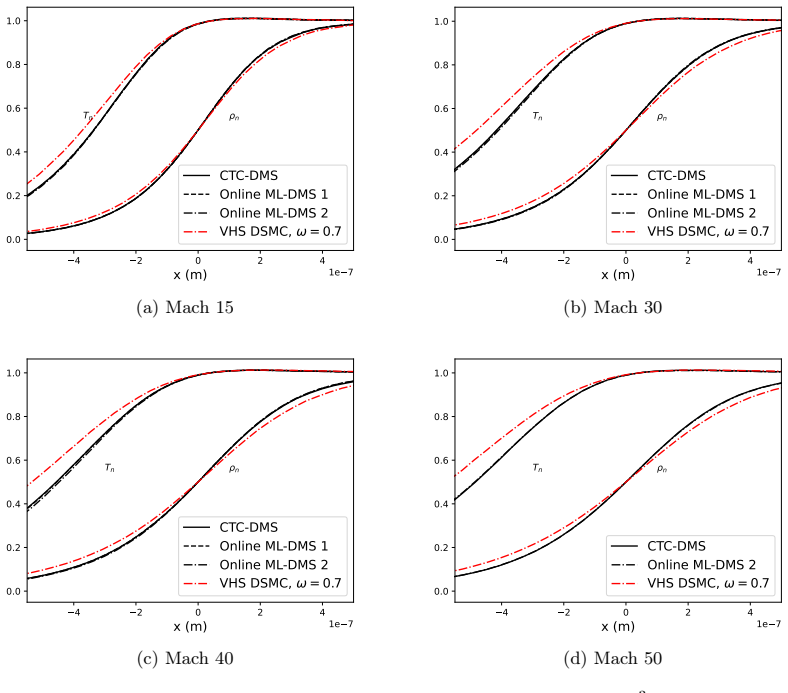
- [§4.2, Figs. 7-19] The central accuracy claims—that ML-DMS reproduces the accuracy of MD and CTC-DMS and that online VHS matches or significantly improves on reference VHS—are supported only by visual overlays of density and temperature profiles. The manuscript reports no quantitative error metric and no statistical uncertainty, such as error bars from independent runs or bootstrap resampling. This makes it difficult to assess whether deviations visible in the figures, for example the temperature profile at Mach 9 in Fig. 7(d), are representative of the method's typical performance. Please report a quantitative integrated error metric, such as L1 or L2 profile error relative to CTC-DMS or MD, for each case, together with an estimate of sampling variability.
- [§4.2.1 and §6] The section titled 'Out-of-Sample Evaluation' tests only transfer of the training hyperparameters: the online ML model is trained on CTC data generated in situ from each new condition, so the collision model itself is not evaluated out-of-sample. The text in §4.1 correctly states that the training procedure was not tuned for Mach 10-50, but the heading's use of 'out-of-sample' and the conclusion's claim that 'the online-optimised collision models ... accurately generalise to new prediction cases' overstate what is demonstrated. I recommend renaming this 'hyperparameter transfer' or 'untuned-condition evaluation' and qualifying the generalization statement to refer to the online-training procedure rather than to the trained model.
minor comments (5)
- [Section 1] The phrase 'we apply the online training procedure to DMSC' contains a typo: 'DMSC' should be 'DSMC'.
- [Section 2.2.1] The section title 'T rajectory Calculations' contains a stray space; it should read 'Trajectory Calculations'.
- [Section 5.1.1] The notation E_t in Eq. (27) is not defined before first use; please define it as the expectation conditional on the current positions and velocities of all particles at time t.
- [Section 4.3] Table 2 reports per-timestep walltimes, and the text further gives total walltime for DMS and online NN simulations, but the abstract's 'factor of ~5-15' is not clearly tied to a full-simulation walltime comparison for all methods; please state explicitly whether the speed-up factor refers to total simulation walltime and give the corresponding numbers for each method.
- [General] The manuscript does not include a data or code availability statement; given the emphasis on reproducibility and the custom PyTorch implementation, please add one.
Circularity Check
No circularity found: ML-DMS and VHS calibration are evaluated through emergent macroscopic profiles against independent benchmarks, not reduced to their training objectives by construction.
full rationale
The paper's derivation chain is self-contained. ML-DMS trains a neural-network scattering-angle surrogate on a small in-situ sample of CTC trajectories (Eq. 24) and then evaluates macroscopic density and temperature profiles against full CTC-DMS and independent MD/experimental data. The profiles are not used as training labels, and the surrogate is not a fitted re-expression of those profiles; the comparison therefore tests genuine generalization of the collision map to the remaining collisions. The VHS calibration minimizes a first-moment objective (Eq. 27) between expected VHS and CTC collision angles; the resulting omega is a single scalar fitted to microscopic collision data, whereas the reported shock profiles are emergent outputs, so the claim does not reduce to the fitted value. Section 5.2.2 explicitly flags that it is 'interesting' that this first-moment objective works, which is an acknowledged sufficiency gap rather than a circularity. There are no load-bearing self-citations: the cited DMS/MD works (Refs. [4,8,29,31]) are by other groups and are used as external benchmarks. The paper's claims are therefore not equivalent by construction to their inputs.
Assumptions & free parameters
free parameters (5)
- bmax power-law coefficients A, B =
A=69, B=-1/3
- Offline NN architecture and training ranges =
3 hidden layers of 50 ReLU units; e* in [0,100], b* in [0,5]
- Online NN training hyperparameters =
alpha0=1e-3, minibatch=250, 100 epochs per step, Ntrain=54,000, 20 initial steps or training every 20 steps
- VHS online SGD hyperparameters =
alpha0=0.2 (5 for the 16 K case), A=B=100, C=1, Ntrain=50,000
- CTC integration timestep =
1 fs
assumptions (7)
- domain assumption Newtonian mechanics with the Lennard-Jones potential phi(r) with epsilon_LJ=119.18 K and sigma_LJ=3.42 Angstrom describes argon collisions
- domain assumption The Nanbu-Babovsky DSMC acceptance-rejection procedure with conservatively large cross section sigma=pi bmax^2 and b=sqrt(R) bmax is a valid stochastic particle method
- domain assumption Velocity Verlet with a 1 fs timestep and Dcutoff=4 sigma conserves energy and gives converged collision angles
- domain assumption One-sided Maxwellian injection at boundaries with Rankine-Hugoniot downstream conditions is correct
- domain assumption A three-layer ReLU network with 50 units per layer can approximate the scattering-angle function over the sampled collision range
- ad hoc to paper Hyperparameters tuned on Mach<=9 cases transfer to Mach 10-50 and 100 K
- ad hoc to paper Matching the expected collision angle (Equation 27) is a sufficient objective for VHS calibration
Cite this review
Pith. "Pith review of Online Optimisation of Machine Learning Collision Models to Accelerate Direct Molecular Simulation of Rarefied Gas Flows." pith.science (2026). https://pith.science/paper/4MHD4CM6
@misc{pith2026241113423,
  author       = {Pith},
  title        = {Pith review of: Online Optimisation of Machine Learning Collision Models to Accelerate Direct Molecular Simulation of Rarefied Gas Flows},
  year         = {2026},
  howpublished = {\url{https://pith.science/paper/4MHD4CM6}},
  note         = {Machine review of arXiv:2411.13423}
}
abstract
We develop an online optimisation algorithm for in situ calibration of collision models in simulations of rarefied gas flows. The online optimised collision models are able to achieve similar accuracy to Direct Molecular Simulation (DMS) at significantly reduced computational cost for 1D normal shocks in argon across a wide range of temperatures and Mach numbers. DMS is a method of simulating rarefied gases which numerically integrates the trajectories of colliding molecules. It often achieves similar fidelity to Molecular Dynamics (MD) simulations, which fully resolve the trajectories of all particles at all times. However, DMS is substantially more computationally expensive than the popular Direct Simulation Monte Carlo (DSMC) method, which uses simple phenomenological models of the collisions. We aim to accelerate DMS by replacing the computationally costly Classical Trajectory Calculations (CTC) with a neural network collision model. A key feature of our approach is that the machine learning (ML) collision model is optimised online during the simulation on a small dataset of CTC trajectories generated in situ during simulations. The online Machine Learning DMS (ML-DMS) is able to reproduce the accuracy of MD and CTC-DMS for 1D normal shocks in argon at a significantly lower computational cost (by a factor of $\sim5$--$15$), at a wide range of physical conditions (Mach numbers $1.55\leq \text{Ma}\leq 50 $, densities $\sim 10^{-4}\text{kg}\text{m}^{-3}$ to $1\text{kg}\text{m}^{-3}$, and temperatures 16K to 300K). We also derive an online optimisation method for calibration of DSMC collision models given a model of the interatomic forces. In our numerical evaluations for 1D normal shocks, the online optimisation method matches or significantly improves the accuracy of VHS (Variable Hard Sphere) DSMC with respect to CTC-DMS (with a $\sim20 \times$ lower computational cost).
Figures


Figures from the paper (16 more)




Forward citations
Cited by 1 Pith paper
-
DSMC: A Statistical Mechanics Perspective
DSMC is reframed as a statistical mechanics method, with its stochastic fluctuations shown to be physical and useful, and statistical mechanics is proposed as a guardrail for applying machine learning to DSMC.
Reference graph
Works this paper leans on
-
[1]
G. A. Bird, Molecular gas dynamics and the direct simulation of gas flows, Oxford Engineering Science Series, Clarendon Press, Oxford, 1994.doi:10.1093/oso/9780198561958.001.0001
arXiv 1994
-
[2]
I. D. Boyd, T. E. Schwartzentruber, Nonequilibrium Gas Dynamics and Molecular Simulation, Cam- bridge Aerospace Series, Cambridge University Press, 2017.doi:10.1017/9781139683494
-
[3]
P. Valentini, T. E. Schwartzentruber, A combined event-driven/time-driven molecular dynamics algo- rithm for the simulation of shock waves in rarefied gases, Journal of Computational Physics 228 (23) (2009) 8766–8778. doi:10.1016/j.jcp.2009.08.026
-
[4]
T. Schwartzentruber, P. Valentini, Molecular dynamics simulations of normal shocks in dilute gases, in: 41st AIAA Thermophysics Conference, 2009.doi:10.2514/6.2009-3602. 33
-
[5]
K. Koura, Monte Carlo direct simulation of rotational relaxation of diatomic molecules using classical trajectory calculations: Nitrogen shock wave, Physics of Fluids 9 (11) (1997) 3543–3549.doi:10.1063/ 1.869462
work page 1997
-
[6]
K. Koura, Direct simulation Monte Carlo study of rotational nonequilibrium in shock wave and spherical expansion of nitrogen using classical trajectory calculations, Physics of Fluids 14 (5) (2002) 1689–1695. doi:10.1063/1.1467059
-
[7]
K. Koura, Monte Carlo direct simulation of rotational relaxation of nitrogen through high total temper- ature shock waves using classical trajectory calculations, Physics of Fluids 10 (10) (1998) 2689–2691. doi:10.1063/1.869782
doi:10.1063/1.869782 1998
-
[8]
P. Norman, P. Valentini, T. Schwartzentruber, GPU-accelerated Classical Trajectory Calculation Direct Simulation Monte Carlo applied to shock waves, Journal of Computational Physics 247 (2013) 153–167. doi:10.1016/j.jcp.2013.03.060
Show all 32 references
-
[9]
M. S. Grover, P. Valentini, Ab initio simulation of hypersonic flows past a cylinder based on accurate potential energy surfaces, Physics of Fluids 33 (5) (2021) 051704.doi:10.1063/5.0047945
2021 doi
-
[10]
M. S. Grover, P. Valentini, N. J. Bisek, A. M. Verhoff, First principle simulation of CUBRC double cone experiments, in: AIAA Aviation Forum, 2023.doi:10.2514/6.2023-3735
2023 doi
-
[11]
Duraisamy, G
K. Duraisamy, G. Iaccarino, H. Xiao, Turbulence modeling in the age of data, Annual Review of Fluid Mechanics 51 (2019) 357–377.doi:10.1146/annurev-fluid-010518-040547
2019 doi
-
[12]
Sirignano, K
J. Sirignano, K. Spiliopoulos, DGM: A deep learning algorithm for solving partial differential equations, Journal of Computational Physics 375 (2018) 1339–1364.doi:10.1016/j.jcp.2018.08.029
2018 doi
-
[13]
Raissi, P
M. Raissi, P. Perdikaris, G. Karniadakis, Physics-informed neural networks: A deep learning framework for solving forward and inverse problems involving nonlinear partial differential equations, Journal of Computational Physics 378 (2019) 686–707.doi:10.1016/j.jcp.2018.10.045
2019 doi
-
[14]
H. Schaeffer, Learning partial differential equations via data discovery and sparse optimization, Pro- ceedings of the Royal Society A: Mathematical, Physical and Engineering Sciences 473 (2197) (2017) 20160446. doi:10.1098/rspa.2016.0446
2017
-
[15]
Sirignano, J
J. Sirignano, J. F. MacArt, Deep learning closure models for large-eddy simulation of flows around bluff bodies, Journal of Fluid Mechanics 966 (2023) A26.doi:10.1017/jfm.2023.446
2023 doi
-
[16]
van Gastelen, W
T. van Gastelen, W. Edeling, B. Sanderse, Energy-conserving neural network for turbulence closure modeling, Journal of Computational Physics 508 (2024) 113003.doi:10.1016/j.jcp.2024.113003
2024
-
[17]
Valentini, M
P. Valentini, M. S. Grover, E. Josyula, Constructing feed-forward artificial neural networks to fit po- tential energy surfaces for molecular simulation of high-temperature gas flows, Physical Review E 102 (2020) 053302. doi:10.1103/PhysRevE.102.053302
2020 doi
-
[18]
Huang, B
C. Huang, B. M. Rubenstein, Machine Learning Diffusion Monte Carlo Forces, The Journal of Physical Chemistry A 127 (1) (2023) 339–355.doi:10.1021/acs.jpca.2c05904
2023 doi
-
[19]
Ayyaswamy, A
V. Ayyaswamy, A. Alexeenko, DSMC Collision Model for the Lennard-Jones Potential: Efficient Algo- rithm and Verification, in: 42nd AIAA Thermophysics Conference, 2012.doi:10.2514/6.2011-3313
2012 doi
-
[20]
Caflisch, D
R. Caflisch, D. Silantyev, Y. Yang, Adjoint DSMC for nonlinear Boltzmann equation constrained opti- mization, Journal of Computational Physics 439 (2021) 110404.doi:10.1016/j.jcp.2021.110404
2021
-
[21]
Y. Yang, D. Silantyev, R. Caflisch, Adjoint DSMC for nonlinear spatially-homogeneous Boltzmann equation with a general collision model, Journal of Computational Physics 488 (2023) 112247.doi: 10.1016/j.jcp.2023.112247
2023
-
[22]
Djordjić, G
V. Djordjić, G. Oblapenko, M. Pavić-Čolić, M. Torrilhon, Boltzmann collision operator for polyatomic gases in agreement with experimental data and DSMC method, Continuum Mechanics and Thermody- namics 35 (2023) 103–119.doi:10.1007/s00161-022-01167-8. 34
2023 doi
-
[23]
Djordjić, M
V. Djordjić, M. Pavić-Čolić, M. Torrilhon, Consistent, explicit, and accessible boltzmann collision oper- ator for polyatomic gases, Physical Review E 104 (2021) 025309.doi:10.1103/PhysRevE.104.025309
2021 doi
-
[24]
C. D. Pierce, P. Moin, Progress-variable approach for large-eddy simulation of non-premixed turbulent combustion, Journal of Fluid Mechanics 504 (2004) 73–97.doi:10.1017/S0022112004008213
2004 doi
-
[25]
R. L. Macdonald, R. L. Jaffe, D. W. Schwenke, M. Panesi, Construction of a coarse-grain quasi-classical trajectory method. I. Theory and application to N2–N2 system, The Journal of Chemical Physics 148 (5) (2018) 054309. doi:10.1063/1.5011331
2018 doi
-
[26]
R. L. Macdonald, M. S. Grover, T. E. Schwartzentruber, M. Panesi, Construction of a coarse-grain quasi-classical trajectory method. II. Comparison against the direct molecular simulation method, The Journal of Chemical Physics 148 (5) (2018) 054310.doi:10.1063/1.5011332
2018 doi
-
[27]
Experiments
L. Verlet, Computer “Experiments”’ on Classical Fluids. I. Thermodynamical Properties of Lennard- Jones Molecules, Physical Review 159 (1967) 98–103.doi:10.1103/PhysRev.159.98
1967 doi
-
[28]
Valentini, P
P. Valentini, P. A. Tump, C. Zhang, T. E. Schwartzentruber, Molecular dynamics simulations of shock waves in mixtures of noble gases, Journal of Thermophysics and Heat Transfer 27 (2) (2013) 226–234. doi:10.2514/1.T3903
2013 doi
-
[29]
Matsumoto, K
H. Matsumoto, K. Koura, Comparison of velocity distribution functions in an argon shock wave between experiments and Monte Carlo calculations for Lennard-Jones potential, Physics of Fluids 3 (12) (1991) 3038–3045. doi:10.1063/1.857848
1991 doi
-
[30]
Holtz, E
T. Holtz, E. P. Muntz, Molecular velocity distribution functions in an argon normal shock wave at Mach number 7, Physics of Fluids 26 (9) (1983) 2425–2436.doi:10.1063/1.864428
1983 doi
-
[31]
Valentini, T
P. Valentini, T. E. Schwartzentruber, Large-scale molecular dynamics simulations of normal shock waves in dilute argon, Physics of Fluids 21 (6) (2009) 066101.doi:10.1063/1.3149866
2009 doi
-
[32]
H. Alsmeyer, Density profiles in argon and nitrogen shock waves measured by the absorption of an electron beam, Journal of Fluid Mechanics 74 (3) (1976) 497–513.doi:10.1017/S0022112076001912. 35
1976 doi
Reviewed August 12, 2026 · model on record in the stance chip above.
Discussion (0). Continue with ORCID to comment.