REVIEW 3 major objections 3 minor 22 references
Comet 289P/Blanpain: Near-Perihelion Activity and the Phoenicids
T0 review · 3 major / 3 minor · reviewed 2026-08-12 · deepseek-v4-flash
Pith's one-line read Comet 289P/Blanpain is a remnant of a larger body that shattered between 1743 and 1819, not the source of the Phoenicid stream today.
desk verdict New NEOWISE near-perihelion photometry of 289P is worth having, but the stream-mass argument has a real time-integration error and the 'smallest active fraction' headline is inherited from an assumed ice patch radius, not measured. read the letter →
The pith
A machine-rendered reading of the paper's core claim, the machinery that carries it, and where it could break.
The reading
What carries the argument
The load-bearing object is the small-source approximation (SSA) model, which treats all observed activity as sublimation from a single small patch of water ice on the nucleus rather than from the whole surface. A radius $r_s \simeq 2$ m for that patch is not measured in the new data; it is carried over from the 1956 Phoenicid analysis, which combined eyewitness meteor magnitudes with dust-trail dynamics to infer millimeter-scale meteoroids ejected at about 0.5 m s$^{-1}$. That $r_s$ enters the ejecta equations and, through $f_A = r_s^2/(4 r_n^2)$, fixes the headline fractional active area once the adopted nucleus radius $r_n = 160 \pm 40$ m is inserted. The SSA model also yields the low dust ejection speeds used to argue that dust is lifted by weak gas drag, and it sets the dust-to-gas ratio $2 \le f_{dg} \le 6$ that converts measured dust rates into active-area fractions.
What would settle it
A decisive observation would be resolved imaging of 289P's nucleus and inner coma during a close perihelion passage, at scales of a few kilometers per pixel or better, to see whether the coma is produced by a compact active spot and to measure the actual size of the active region. If the true active patch is tens of meters, or if ejection velocities are far above the small-source values, the dust production rates could rise enough to close the gap to the stream mass. A second check would be a dynamical search for fragments or a debris trail matching ejection dates between 1743 and 1819.
Extended reading notes
Core claim
The central claim is that today's 289P is a leftover fragment, not the maker of the Phoenicid stream. The argument is built from infrared photometry at 3.4 and 4.6 micrometers taken on 2019 October 30 and 2020 January 11/12, which gives ejected dust masses of $4100 \pm 200$ kg and $1700 \pm 200$ kg, dust production rates of $0.01$--$0.02$ kg s$^{-1}$, and a dust-to-gas ratio between 2 and 6. These numbers, combined with a modeled sublimating ice patch about 2 m in radius inherited from 1956 Phoenicid meteoroid constraints, yield a fractional active area $f_A = 3.8 \pm 1.9 \times 10^{-5}$, the smallest yet reported for an active Jupiter-family comet, and a perihelion-normalized nongravitational acceleration about an order of magnitude below the trend of well-studied comets. The absence of a 4.6 micrometer excess indicates negligible CO$_2$ and CO. Since even favorable particle-size assumptions give only about $1.9 \times 10^8$ kg of dust over 300 years, compared with a stream mass plausibly in the range $4 \times 10^9$ to $10^{11}$ kg, the paper concludes that steady sublimation cannot supply the Phoenicids and that the required mass came from a disintegration event, probably rotational destruction of a sub-km precursor in 1743--1819. A possible 8.85 hour rotation period is reported but explicitly flagged as needing verification because its periodogram significance is only about 30 percent.
Load-bearing premise
The argument assumes that 289P's present activity is described by the small-source approximation with an ice-patch radius of about 2 m inherited from the 1956 Phoenicid meteoroid sizes and velocities; if the active area is actually much larger or the activity is not patch-like, the derived fractional active area and the dust production rates lose their footing, and with them the mass-budget comparison.
Editorial extensions
If this is right
- 289P's current steady-state mass loss cannot supply the Phoenicid stream within its roughly 300-year dynamical age, even under favorable particle size distributions.
- The required stream mass implies that a precursor body roughly 170 m in radius, or a 10 m-thick surface shell of the current nucleus, must have been shed sometime between 1743 and 1819.
- Because the comet shows no 4.6 micrometer excess, CO$_2$ and CO are essentially absent, leaving water ice as the only plausible driver of its weak activity.
- A sub-kilometer comet can look nearly dormant yet still show measurable nongravitational acceleration and a possible rotation near 8.85 hours, although the period is not secure.
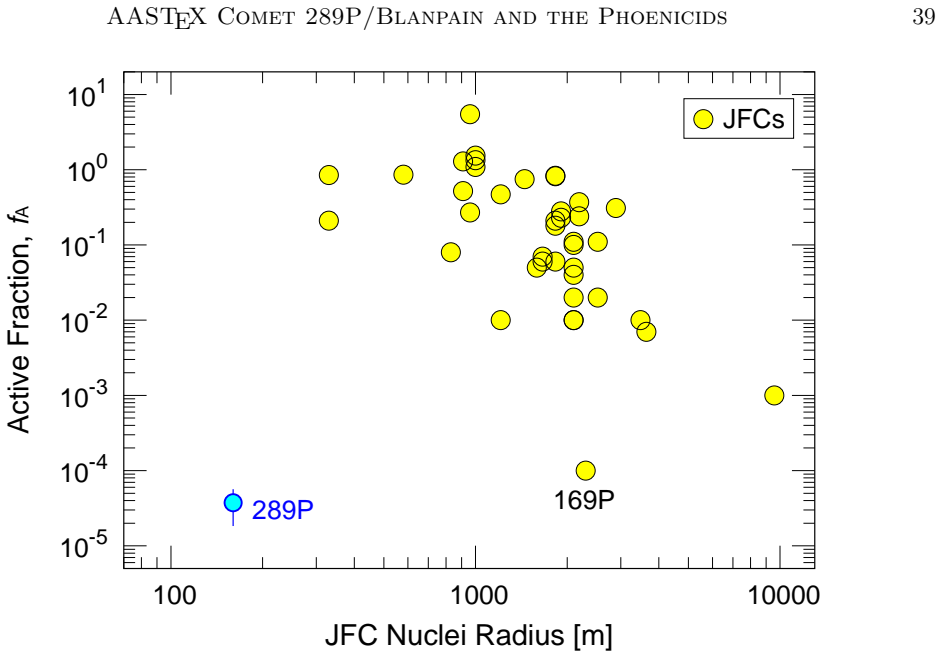
- The fractional active area of about $4 \times 10^{-5}$ places 289P at the extreme low end among Jupiter-family comets, comparable only to the dormant comet 169P.
Reading between the lines
- If the rotational-destruction picture is right, a substantial part of the Phoenicid stream may consist of precursor fragments rather than gas-lofted dust, which could make the meteoroids structurally different, for example more friable, from those of actively sublimating comets.
- The same logic could apply to other small, low-activity Jupiter-family comets that parent young meteor streams: their current dust production might systematically underestimate their past stream-building capacity by an order of magnitude or more.
- A testable prediction is that the Phoenicid stream should contain an overabundance of large, millimeter-to-decimeter fragments compared with streams supplied by steady sublimation, because breakup ejects material at roughly escape speed rather than at gas-drag speeds.
- The reported 8.85 hour rotation period, if confirmed by higher-signal observations, would imply a critical bulk density above roughly 1500 kg m$^{-3}$ for an elongated nucleus, which is unusually high for a cometary body and worth checking.
Editorial analysis
A structured set of objections, weighed in public.
Referee Report
Summary. This paper presents NEOWISE W1/W2 photometry of comet 289P/Blanpain at two epochs near its 2019/2020 perihelion, and from these data derives ejected dust masses, dust production rates, fractional active area, a candidate rotation period, absence of CO2/CO emission, and a perihelion-normalized nongravitational acceleration. The central claim is that current steady mass loss from 289P is an order of magnitude too small to produce the Phoenicid meteoroid stream within its ~300 yr dynamical lifetime, requiring an impulsive mass supply, most plausibly rotational destruction of a ~170 m precursor between 1743 and 1819. The observational data reduction and several derived quantities are useful, but the stream-mass argument in Section 5.1.1 and the fractional-active-area result in Section 4.1 contain internal inconsistencies that materially affect the paper's headline conclusions.
Significance. If established, the conclusion that 289P is a remnant of a larger, rotationally disrupted body rather than the current source of the Phoenicid stream would be an important contribution to our understanding of sub-km Jupiter-family comets and meteoroid stream formation. The NEOWISE photometry, the W2-based gas limit, and the nongravitational acceleration analysis are potentially valuable observational results. However, the paper as written overstates what the data demonstrate: the smallest-active-area claim is an algebraic consequence of adopted model parameters rather than a new measurement, and the steady-stream-mass estimate omits the active-arc duration by a factor of 15-25. These issues do not destroy the value of the observations, but they require a substantial revision of the paper's quantitative conclusions and abstract.
major comments (3)
- [§5.1.1, Eq. (13)] Equation (13) multiplies the instantaneous aperture dust mass, (4/3)ρd Cd \bar{a}, by Norb. Because Cd is the cross-section measured in the photometric aperture at one epoch, this aperture mass equals Qdust × τ, where τ = ρ/vd ≈ 4 d is the residence time of dust in the aperture. The total mass ejected per perihelion passage is instead Qdust × T_active, with T_active ≥ 73 d bracketed by the two NEOWISE visits (MJD 58786 and 58860; Table 1). Equation (13) therefore misses a factor T_active/τ ≈ 15-25. Applying this factor to the paper's own γ = 3.3 case raises M from 1.6×10^8 kg to roughly 3-4×10^9 kg, which reaches the lower edge of the adopted stream-mass range (4×10^9-10^11 kg). The statement in the abstract and Section 5.1.1 that steady mass loss is 'an order of magnitude too small regardless of plausible assumptions' is not supported by the paper's equations and must be revisited after correcting the time integration.
- [§4.1, Eqs. (11)-(12)] The reported fractional active area is not independently measured by the NEOWISE data. Substituting Eq. (11) into Eq. (12) gives fA = rs^2/(4 rn^2), so the measured Qdust cancels algebraically. With the adopted rs ≈ 2 m and rn = 160 m, fA = 3.9×10^-5, which reproduces the reported mean value. The abstract's 'smallest fractional active area' claim is therefore inherited from the 1956 Phoenicid dust-size and ejection-velocity assumptions (Watanabe et al. 2005), not from the new photometry. The paper should state this cancellation explicitly and reframe the fA result as a consistency check of the SSA model rather than a new measurement.
- [§4.1, Table 5 and §3.2] The uncertainties quoted for Md, Qdust and fA are statistical only and omit systematics in rn (160 ± 40 m), ρd = 1000 kg m^-3, ad = 2.0 µm, pv = 0.04, vd, and rs. The dust production rates are particularly sensitive to the SSA velocity model, which ties vd to rs; thus the derived rates already embed the Phoenicid stream parameter choices. A systematic error budget or a sensitivity table over these parameters is needed before the order-of-magnitude stream-mass comparison can be judged robust.
minor comments (3)
- [§3.3 and §6] The rotation period Prot = 8.8536 ± 0.3860 hr is presented in the summary as a finding, despite the low significance level of 30.5% and the authors' own caution that the light curves may not be reliable. The abstract and summary should carry the same caveat as the text.
- [§5.1.1] The size distribution integral in Eq. (14) should be stated more carefully: the normalization of n(a) is not defined, and the text should specify that \(\bar{a}\) is computed over the same a1-a2 interval in both the numerator and denominator.
- [Throughout] The manuscript contains several typographical and OCR artifacts (e.g., 'Pho enicids' in the running title, 'mc' in §2.2, 'our finings' in §5.1.2). A careful proofread is needed.
Circularity Check
The 'smallest fractional active area' fA is not measured by NEOWISE: combining the paper's Eqs. (11) and (12) gives fA = rs^2/(4 rn^2), so the headline value is a rescaling of the adopted SSA ice-patch radius inherited from Watanabe et al. (2005), not a new measurement.
-
self definitional
[Section 4.1, Equations (11) and (12) and following text]
"fdg = Qdust / (π r^2_s Fs), (11) ... The fraction of active area (ice patch) on the nucleus surface, fA, is derived using Luu & Jewitt (1992), fA = Qdust / (4π r^2_n fdg Fs). (12) Using the above parameters, we find fA ∼ 5.1×10⁻⁵ in Visit A and fA ∼ 2.4×10⁻⁵ in Visit B, respectively."
Substituting Eq. (11) into Eq. (12) gives fA = r_s^2/(4 r_n^2). Both Qdust and Fs cancel, so the NEOWISE-derived dust production rate does not enter the result. The quoted fA values are therefore the square of the adopted SSA ice-patch radius r_s ≈ 1.6–2.3 m (derived from 1956 Phoenicid meteoroid sizes and vd ≈ 0.5 m/s, Watanabe et al. 2005, with the present author as coauthor) divided by 4 r_n^2 with r_n = 160 ± 40 m (Jewitt 2006). The abstract's headline claim that fA = 3.8 ± 1.9 × 10⁻⁵ is 'the smallest yet reported' is thus an identity applied to pre-selected inputs, not a measurement from the new W1/W2 photometry.
full rationale
The one clear circular step is the fractional active area. The paper presents fA as a derived result of the NEOWISE observations, but algebraically fA ≡ r_s^2/(4 r_n^2). Since r_s is set by the SSA model using meteoroid sizes and ejection velocities from Watanabe et al. (2005) — a paper coauthored by the present author — and r_n is taken from Jewitt (2006), the 'smallest active fraction' claim is inherited from those inputs by construction. This is a self-definitional reduction of a headline numerical result. The rest of the paper is not circular in the same sense: Qdust and fdg are computed from the measured NEOWISE Cd and the SSA velocity model, and the stream-mass discussion in Section 5.1.1 uses Equation (13) with observed Cd and assumed particle power laws, so it does not reduce to its inputs by definition. A separate, non-circular concern is that Equation (13) multiplies an instantaneous aperture dust mass by Norb, implicitly restricting activity to the few-day aperture residence time rather than the ≥73-day observed active arc; if that factor is corrected, the steady-loss estimate rises by roughly an order of magnitude, weakening the paper's 'another mass supply is required' conclusion. That is a correctness or modeling issue, not a circularity, so it is not scored here. The total circularity score reflects that one central claimed result, featured in both the abstract and summary, is forced by the adopted parameters through Equation (12) rather than by the new NEOWISE data.
Assumptions & free parameters
free parameters (8)
- De (effective diameter) =
1.43 +/- 0.04 km (Visit A), 0.96 +/- 0.01 km (Visit B)
- rs (ice patch radius) =
1.6 to 2.3 m (adopted ~2 m), with an upper limit ~31 m
- rn (nucleus radius) =
160 +/- 40 m
- ad (dust particle radius) =
2.0 micrometers
- rho_d = rho_n (bulk density) =
1000 kg m^-3
- pv (geometric albedo) =
0.04
- vd (dust ejection velocity) =
11.5 m/s for 2.0 micrometer dust
- Prot (rotation period) =
8.8536 +/- 0.3860 hr
assumptions (6)
- domain assumption The small-source approximation (SSA) model of Jewitt et al. (2014) correctly relates dust ejection velocity, particle size, ice patch radius, and nucleus gravity.
- domain assumption The 1956 Phoenicid meteoroid constraints, ad >= 1 mm and vd ~ 0.5 m/s, are representative of dust ejected from 289P's current ice patch.
- domain assumption The Halley-Marcus composite phase function remains valid at phase angles near 70 degrees.
- domain assumption Cometary dust radiates as a blackbody at Td = 1.03 Tbb with emissivity 0.9.
- domain assumption The Phoenicid stream mass is of order the parent body mass, and the 1956 stream mass estimate of about 1e11 kg bounds the possible range from about 4e9 to 1e11 kg.
- ad hoc to paper The precursor body had a radius of roughly 170 m and underwent rotational destruction between 1743 and 1819.
invented entities (1)
-
Sub-km precursor body with radius ~170 m
Cite this review
Pith. "Pith review of Comet 289P/Blanpain: Near-Perihelion Activity and the Phoenicids." pith.science (2026). https://pith.science/paper/GEGDUGX4
@misc{pith2026241113501,
  author       = {Pith},
  title        = {Pith review of: Comet 289P/Blanpain: Near-Perihelion Activity and the Phoenicids},
  year         = {2026},
  howpublished = {\url{https://pith.science/paper/GEGDUGX4}},
  note         = {Machine review of arXiv:2411.13501}
}
abstract
We present NEOWISE observations of Jupiter family comet 289P/Blanpain, the parent body of the Phoenicid meteoroid stream. Near-infrared images at 3.4$\mu$m ($W1$) and 4.6$\mu$m ($W2$) were obtained near perihelion on two occasions: UT 2019-10-30 (inbound, heliocentric distance $R_{\rm h}$ = 1.20 au) and UT 2020-01-11/12 (outbound, $R_{\rm h}$ = 1.01 au). To assess faint activity, we establish constraints on dust production driven by the limited sublimating area of water ice, based on studies of the 1956 Phoenicids. The ejected dust mass is $M_{\rm d}$ = 4100 $\pm$ 200 kg (inbound) and 1700 $\pm$ 200 kg (outbound), respectively. The dust production rates are $Q_{\rm dust}$ = 0.01$-$0.02 kg s$^{-1}$, corresponding to dust-to-gas production ratio 2 $\leqslant\,f_{\rm dg}\,\leqslant$ 6. The resulting fractional active area, $f_{\rm A}$ = 3.8 $\pm$ 1.9 $\times 10^{-5}$, is the smallest yet reported. The absence of 4.6$\mu$m ($W2$) excess suggests that 289P contains negligible amounts of CO$_2$ and CO. Time-resolved analysis of weighted mean of $W1$ and $W2$ magnitudes finds a distinctive peak amplitude in the light curve having a rotational period $P_{\rm rot}$ = 8.8536 $\pm$ 0.3860 hr, however, further verification is needed. The perihelion-normalized nongravitational acceleration, $\alpha_{\rm NG}^\prime$ = 3.1 $\times$ 10$^{-6}$, is approximately an order of magnitude smaller than the trend observed for well-studied comets, consistent with weak outgassing. Current dust production from 289P, regardless of plausible assumptions for particle size and distribution, is an order of magnitude too small to produce the Phoenicid stream within its $\sim$300 yr dynamical lifetime. This suggests another mass supply, probably in 1743$-$1819, rapid rotational destruction of a sub-km precursor body, resulting in fragments equaling the mass of an object with radius $\sim$ 100 m.
Figures


Figures from the paper (11 more)




Reference graph
Works this paper leans on
-
[1]
Agarwal, J., Kim, Y., Kelley, M. S. P., & Marschall, R. 2023, arXiv e-prints, arXiv:2309.12759 A’Hearn, M. F., Schleicher, D. G., Millis, R. L., Feldman, P. D., & Thompson, D. T. 1984, AJ, 89, 579 Asher, D. J. 2000, in Proceedings of the International Meteor Conference, 18th IMC, Frasso Sabino, Italy, 1999, ed. R. Arlt, 5–21 Bauer, J. M., Choi, Y.-J., Wei...
arXiv 2024
-
[3]
Orbital Property of Comet 289P/Blanpain (2003 WY
work page 2003
-
[4]
a Modified Julian Date of the mid-point of the observation
Weighted Mean of W 1 and W 2 Magnitudes Visit MJD a W 1b W 2c Wwmd (mag) (mag) (mag) A 58786.0688 15.181 ±0.563e 11.662h 12.056±0.188 58786.1997 15.491 f 12.577h 13.474±0.166 58786.2650 15.645 f 13.033±0.151g 13.561±0.135 58786.3304 15.800 ±0.392e 13.490±0.198g 13.960±0.177 58786.3959 15.037 ±0.367e 12.860h 13.358±0.176 58786.4613 14.916 ±0.307e 12.231±0....
-
[5]
08 for asteroids, if a < a J = 5.2 au ( Jewitt et al. 2015 ). For reference, we list other comet-asteroid thresholds of TJ = 3 . 05 (Tancredi 2014 ) and TJ = 3 . 10 ( Hsieh & Haghighipour 2016 ) (see a re- view, Jewitt & Hsieh 2022 ). 26 Kasuga (2024) T able
work page 2024
-
[6]
Magnitude and Flux Density Visit W 1a W 2b W 1c W 2d (mag) (mag) (Jy) (Jy) Ae 15.903±0.133 13.035 ±0.066 1.35 ±0.17×10⁻⁴ 1.05±0.06×10⁻³ Bf 12.525±0.046 9.714 ±0.039 3.02 ±0.13×10⁻³ 2.24±0.08×10⁻² Note—Magnitudes are measured from the composite images and conv erted to flux densities for each band ( W right et al. 2010 ). a Measured magnitude at W 1 from th...
work page 2010
-
[7]
Rh=1.20 au, ∆=0.40 au, and α =49.8◦
e MJD 58786: UT 2019-10-30, inbound. Rh=1.20 au, ∆=0.40 au, and α =49.8◦. f MJD 58860: UT 2020-01-11/12, outbound. Rh=1.01 au, ∆=0.09 au, and α =70.2◦. AASTEX Comet 289P/Blanpain and the Phoenicids 27 T able
work page 2019
- [9]
-
[10]
b Cross-section of all the dust particles
(kg) (kg s −1) (kg s −1) Af 1.43±0.04 1.53 ±0.09 4100 ±200 1.0 ±0.1×10⁻² 1.0±0.2×10⁻²h Bg 0.96±0.01 0.64 ±0.08 1700 ±200 2.0 ±0.3×10⁻² 4.0±0.2×10⁻²i Note— a Effective diameter of a circle having the same area as the sum o f all the dust particles and nucleus. b Cross-section of all the dust particles. c Dust mass from Equation ( 7). d Dust production rate ...
work page 2019
Show all 22 references
-
[11]
Both frames have a size of 277 ′′ × 277′′
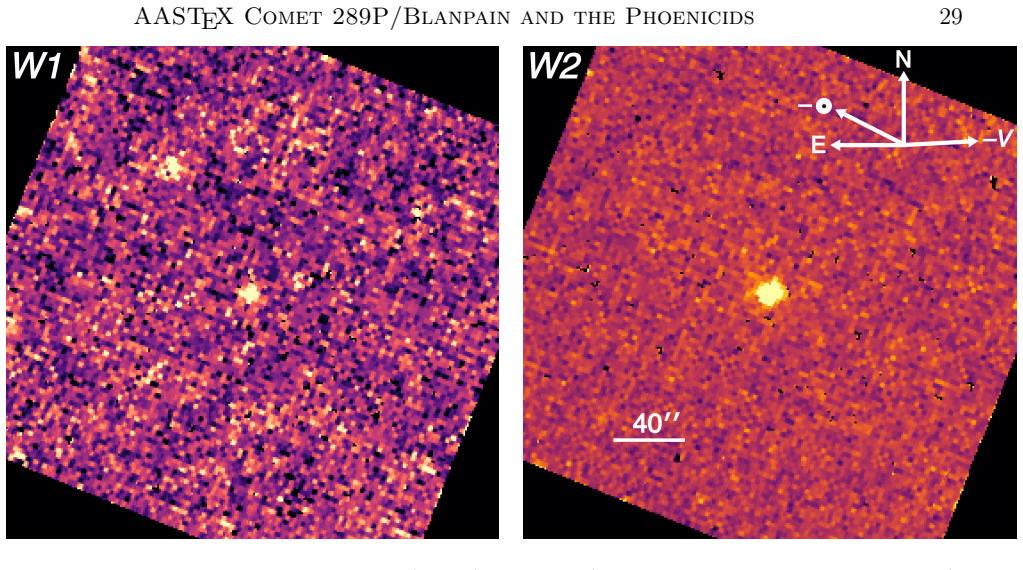
The ICORE coadded images of 289P (center) in Visit A (MJD 58786: UT 2019-10-30, inbound). Both frames have a size of 277 ′′ × 277′′. The left panel shows the W 1-band image (38.5 seconds integra- tion) with the FWHM θF = 7′′. 2, while the right panel shows the W 2-band image (...
2019
-
[12]
The cardinal directions ( N and E), the direction of the negative heliocentric velocity vector ( −V ), and the anti-solar direction ( −⊙) are marked
Heliocentric, WISE -centric distances and phase angle were Rh = 1.20 au, ∆ = 0.40 au and α = 49.8◦, respectively. The cardinal directions ( N and E), the direction of the negative heliocentric velocity vector ( −V ), and the anti-solar direction ( −⊙) are marked. A 40 ′′ scale...
2024
-
[13]
Both frames have a size of 200 ′′ × 200′′ with an integration time of 15.4 seconds
The median-combined images of 289P (center) in Visit B (MJD 58860: UT 2020-01-11/12, outbound). Both frames have a size of 200 ′′ × 200′′ with an integration time of 15.4 seconds. The left panel shows the W 1-band image with the FWHM θF = 6′′. 6, while the right panel shows th...
2020
-
[14]
The FWHM of 289P is θF = 6′′
Normalized surface brightness profiles of 289P (blue circle s) and a field star (black circles), from median-combined W 1 image in Visit B (MJD 58860: UT 2020-01-11/12, outbound) (Figure 2, left panel). The FWHM of 289P is θF = 6′′
2020
-
[15]
32 Kasuga (2024) 0.10 1.00 1 10 100 Star 289P Normalized Surface Brightness Linear Distance [arcsec] Figure
The linear distance > 40′′ is precluded (vertical dashed line) due to the nonuniform background, preventing further profile analysi s. 32 Kasuga (2024) 0.10 1.00 1 10 100 Star 289P Normalized Surface Brightness Linear Distance [arcsec] Figure
2024
-
[16]
The SSA model (blue curve) and the Whipple model (red curve) are comp ared
Models of the ejection velocity of dust from 289P as a functio n of particle radius. The SSA model (blue curve) and the Whipple model (red curve) are comp ared. The blue circle marks the particle radius ad = 1 mm and the velocity vd = 0.5 m s−1 determined by the 1956 Phoenicid...
2024
-
[17]
The blue curve displays fitting result having amplitude ∼ 1.3 mag
The left panel shows W 1-band photometry of 289P in Visit A (MJD 58786: UT 2019-10-30, inbound), phased to the two-peaked period Prot = 14.8224 ± 2.9899 hr ≈ 15 ± 3 hr. The blue curve displays fitting result having amplitude ∼ 1.3 mag. The right panel shows spectral analysis cu...
2019
-
[18]
The significance level is ∼45%
Same as Figure 6 but from the W 2-band, presenting the Prot =13.2168±2.3551 hr ≈ 13 ± 2 hr with an amplitude ∼2.0 mag in the left panel and the maxima Prot = 0.5507 day (= 13.2168 hr) in the right panel. The significance level is ∼45%. 36 Kasuga (2024) 11.5 12.0 12.5 13.0 13.5 ...
2024
-
[19]
The flux densities at W 1 (3.4µ m) and W 2 (4.6µ m) are shown as points
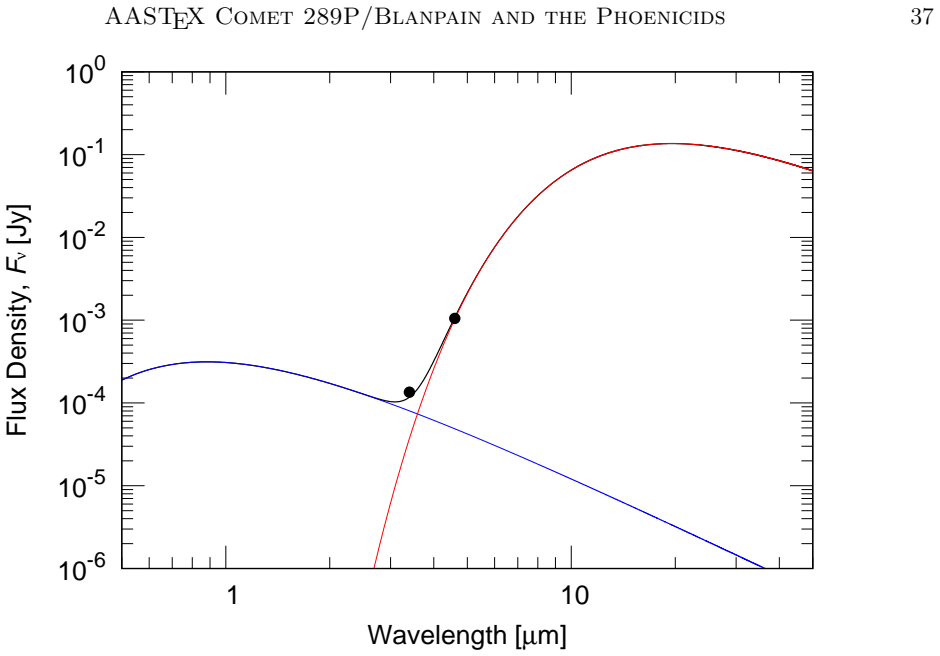
Calculated spectral energy distribution and measured flux d ensities from the 289P composite image in Visit A (MJD 58786: UT 2019-10-30, inbound). The flux densities at W 1 (3.4µ m) and W 2 (4.6µ m) are shown as points. The uncertainties are within the point s ize. The reflected ...
2024
-
[20]
Rh=1.01 au, ∆=0.09 au, and α =70.2◦ are used for the models
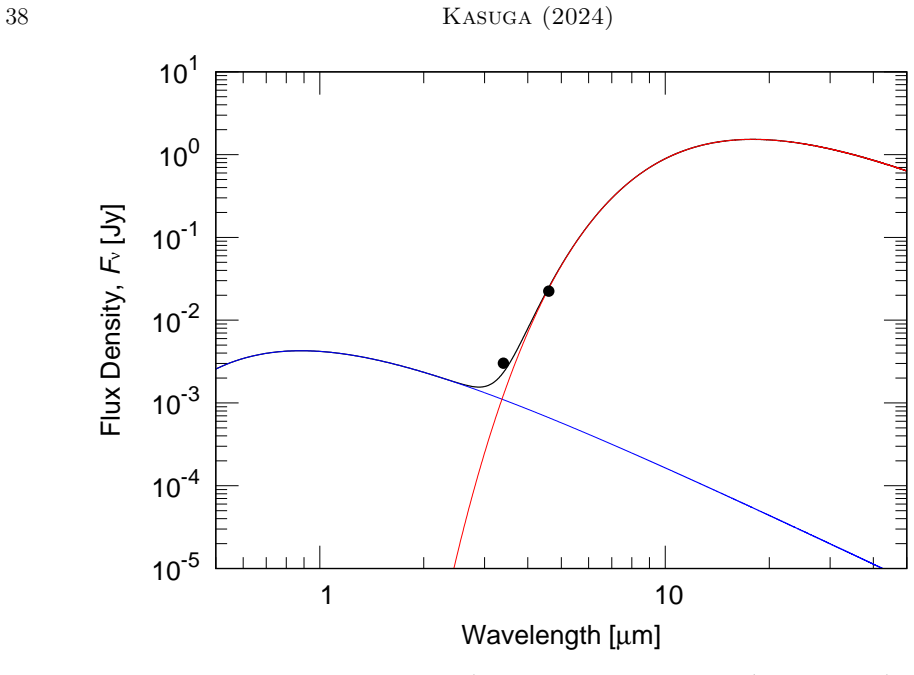
Same as Figure 9 but in Visit B (MJD 58860: UT 2020-01-11/12, outbound). Rh=1.01 au, ∆=0.09 au, and α =70.2◦ are used for the models. AASTEX Comet 289P/Blanpain and the Phoenicids 39 10-5 10-4 10-3 10-2 10-1 100 101 100 1000 10000 289P 169P JFCs Active Fraction, fA JFC Nuclei ...
2020
-
[21]
The fA of 289P is estimated near its perihelion, despite being among the lowe st in JFCs, comparable to the inactive state of 169P
Relationship between JFC nuclei radius and fractional acti ve area, fA. The fA of 289P is estimated near its perihelion, despite being among the lowe st in JFCs, comparable to the inactive state of 169P. 40 Kasuga (2024) Ms Mn γ−range of Comet−sourced Streams105 106 107 108 10...
2024
-
[22]
Phoenicid stream mass is plotted as a function of the different ial power-law index, γ, as a blue solid line ( γ ⁄= 3.0, 4.0 in Equation ( 13)). The possible stream mass range ( Ms), based on the nucleus mass (Mn, Jewitt 2006 ) and the estimated stream mass ( ∼ 1011 kg, Jennisk...
2006
-
[23]
Solid and dashed curves (black) show kT = 0.05 and 0.007 ( Jewitt 1997 , 2021), respectively
Precursor spin-up timescale is plotted as a function of radi us of ice sublimating area (patch), rps, from Equation ( 15). Solid and dashed curves (black) show kT = 0.05 and 0.007 ( Jewitt 1997 , 2021), respectively. A horizontal band (yellow) indicates the ran ge of spin-up t...
2024
-
[25]
b Eccentricity
aa eb ic qd ω e Ω f Qg Porbh TJi (au) (deg) (au) (deg) (deg) (au) (yr) 3.045 0.685 5.897 0.959 9.849 68.924 5.132 5.315 2.817 Note— From NASA JPL Small-Body Database Lookup (2458746.5 (2019 - Sep-20.0): Solution Date 2024-Jul-26) a Semimajor axis. b Eccentricity. c Inclination...
2019
Reviewed August 12, 2026 · model on record in the stance chip above.
Discussion (0). Continue with ORCID to comment.