REVIEW 5 major objections 6 minor 54 references
Deep Feature Response Discriminative Calibration
T0 review · 5 major / 6 minor · reviewed 2026-08-12 · deepseek-v4-flash
Pith's one-line read Calibrating feature responses with Gaussian confidence values improves classification accuracy and feature distinctiveness over ResNet and SENet.
desk verdict A clearly described GELU/SENet variant whose headline accuracy claim is contradicted by its own Table 1; the GCLU ablation is a useful empirical sweep, but the comparisons need fixing before the central claim can be taken at face value. read the letter →
The pith
A machine-rendered reading of the paper's core claim, the machinery that carries it, and where it could break.
The reading
What carries the argument
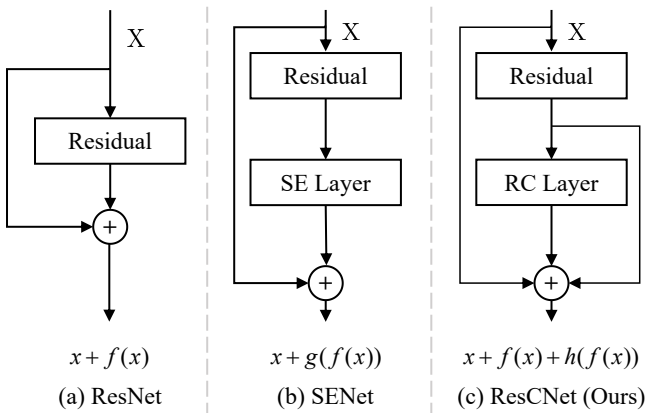
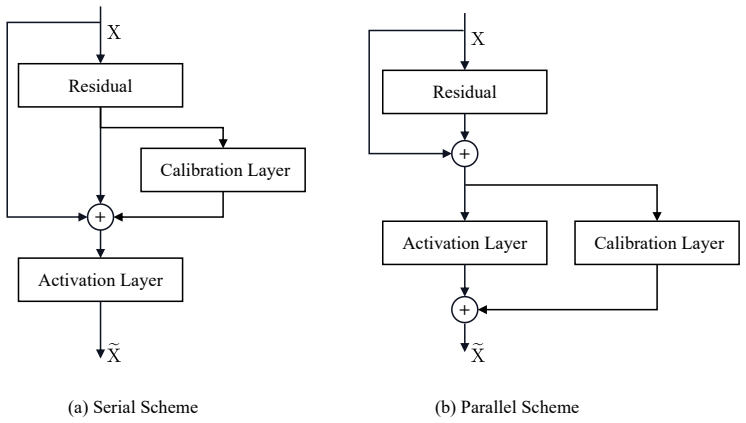
The central object is the response calibration weight $w_k$ defined by the folded Gaussian CDF: for a feature response $a_k$ with per-kernel mean $\mu_k$ and standard deviation $\sigma_k$, let $x=(a_k-\mu_k)/\sigma_k$; then $w_k = \Phi(x)$ for $a_k\le\mu_k$ and $w_k = 1-\Phi(x)$ for $a_k>\mu_k$, where $\Phi$ is the standard normal CDF. This weight is close to 1 near the mean and falls toward 0 in the tails, so responses that are typical of the kernel are kept at nearly full strength while atypical responses are suppressed. The calibration value $c_k = a_k w_k$ is added to the original response, and a module containing a global-pooling step plus two or three fully-connected layers learns the per-kernel $\mu_k$ and $\sigma_k$. This module is inserted after the final BatchNorm in each residual block, mirroring the SE layer's position, but with addition rather than multiplicative scaling, giving the RC layer and the ResCNet architecture.
What would settle it
Retrain ResCNet-32 on CIFAR-100 with the learnable Gaussian CDF weight replaced by a fixed, symmetric, non-Gaussian weight of the same shape (for instance, a triangular function of the standardized value); if accuracy is unchanged, the specific Gaussian assumption is not the source of the improvement.
Extended reading notes
Core claim
The central claim is that each convolutional kernel's response values follow a Gaussian distribution $\mathcal{N}(\mu_k, \sigma_k^2)$, and that this law can be exploited by defining a confidence weight for each response $a_k$ as the Gaussian CDF evaluated at the standardized value $x=(a_k-\mu_k)/\sigma_k$, with the weight mirrored for values above the mean: $w_k = \Phi(x)$ if $a_k \le \mu_k$ and $w_k = 1-\Phi(x)$ otherwise. The calibration value is $c_k = a_k w_k$, and the RC layer adds this calibration value to the original feature (not just scales it, as SENet does). The paper develops this into a plugin module placed after the last BatchNorm in a residual block, with two or three fully-connected layers fitting $\mu_k$ and $\sigma_k$ per kernel, and calls the resulting architecture ResCNet. Across CIFAR-10/100, SVHN, and ImageNet, ResCNet is reported to beat both ResNet and SENet baselines in accuracy, and the paper claims stronger feature distinctiveness as shown by response-value distributions. On CIFAR-100 with ResNet-50 and a series of standard tricks, ResCNet reaches 86.31%, which the authors state is the first time a 50-layer ResNet variant has exceeded 86% without extra data or pre-training.
Load-bearing premise
The load-bearing premise is that each convolutional kernel's response values follow a Gaussian distribution; if that distributional assumption fails, the confidence values that drive the calibration are no longer meaningful and the module becomes an arbitrary nonlinearity.
Editorial extensions
If this is right
- Because the RC layer is a plugin, the calibration mechanism can in principle be inserted into any convolutional backbone, not only ResNet.
- The paper's activation-function variant, GCLU, applies the same symmetric CDF weighting as a standalone activation and is reported to improve accuracy on shallow CNNs like AlexNet that lack BatchNorm.
- The reported 86.31% on CIFAR-100 with ResNet-50, if reproducible, marks a new performance point for a 50-layer ResNet variant without extra training data.
- The method suggests that feature discriminability can be improved by distribution-based response correction rather than by the scaling-only approach of SENet.
Reading between the lines
- The Gaussian assumption is asserted from a single violin plot and an appeal to the Central Limit Theorem; a natural extension would be to test other distributional families (e.g., logistic or heavy-tailed) for the same folded-weight construction, since the method's rationale would change if the true distributions deviate markedly from Gaussian.
- Because the calibration values are added to the original features rather than multiplied, the RC layer can be viewed as injecting a learned 'typicality' signal; this is conceptually similar to a residual attention mechanism, and one could test whether the improvement comes from the distributional modeling or simply from the extra non-linearity and parameters.
- The method could be probed on tasks beyond classification, such as object detection or segmentation, where feature distinctiveness matters, to see if the calibration transfers.
Editorial analysis
A structured set of objections, weighed in public.
Referee Report
Summary. The paper proposes Response Calibration Networks (ResCNet), a plug-in module that estimates a per-channel Gaussian model for convolutional feature responses, converts each response into a confidence weight via the standard normal CDF (with symmetric complementary weighting for above-mean responses), multiplies the original response by this weight, and adds the calibrated value to the original feature. The module is inserted after the second BatchNorm in a ResNet block, in a configuration analogous to but distinct from the SE layer. Experiments on CIFAR-10, CIFAR-100, SVHN, and ImageNet compare ResCNet with ResNet and SENet; a related activation-function variant, GCLU, is also evaluated across several architectures. The paper claims improved classification accuracy and improved feature discriminability.
Significance. If the central empirical comparison were clean, this would be a simple, plug-compatible feature-calibration module and a modestly interesting alternative to channel attention. The paper has concrete strengths: the code is publicly available, the experimental coverage spans four datasets, and the ablation study is fairly broad, including integration schemes, CDF approximations, and an activation-function variant. However, the current evidence does not establish the central claim. One of the key comparisons in the paper's own Table 1 contradicts the claim that ResCNet outperforms SENet; the ImageNet comparison is not epoch-matched; and no repeated-seed statistics or significance tests are reported. The conceptual novelty is also limited by the fact that the mean and standard deviation are learned parameters, so the calibrated transformation is a learned nonlinearity whose Gaussian interpretation is motivational unless quantitative distributional evidence is supplied.
major comments (5)
- [Section 5.2.1, Table 1] The central claim that 'as the depth of the model increases, the proposed ResCNet outperforms both ResNet and SENet' is contradicted by Table 1: on CIFAR-100, ResCNet-56 reaches 73.81%, which is 0.87 points below SENet-56 (74.68%) and only 0.02 points above ResNet-56 (73.79%). On CIFAR-10, ResNet-56 and SENet-56 both reach 94.51% while ResCNet-56 reaches 94.61%, a difference too small to count as an improvement in the absence of repeated runs. Please reconcile the stated claim with these numbers or explicitly narrow the scope of the claimed advantage.
- [Table 2 and Section 5.2.1] The ImageNet comparison is not controlled. SENet-50 is a published 100-epoch result, whereas ResCNet-50 is trained for 90 epochs; the ResNet-18 and ResNet-34 rows mix TorchVision pretrained checkpoints with in-house re-implementations; and parameter counts differ across methods. Without all baselines retrained under identical epochs, schedulers, augmentation, and hyperparameters, the statement that ResCNet-50 'outperformed SENet-50' is not justified. Please provide an epoch-matched comparison or both 90- and 100-epoch SENet baselines.
- [Section 5.2.1 and Tables 1-3] No standard deviations, multiple seeds, or significance tests are reported anywhere in the paper. Most reported gains are fractions of a percentage point, for example Table 1 shows CIFAR-10 ResCNet-32 at 93.79% versus SENet-32 at 93.73%, and Table 3 shows a baseline difference of 80.79% versus 80.87%. These differences are within typical run-to-run variation for CIFAR training. Please report at least three independent seeds with means and standard deviations, or provide a significance test, before claiming superiority over the baselines.
- [Section 3 and Eqs. (1)-(4)] The Gaussian assumption is supported only by visual inspection of a single violin plot and a CLT argument that does not account for dependencies, ReLU truncation, or the fact that the mean and standard deviation are learned parameters. Because Eq. (4) defines the calibration weights as Gaussian CDF integrals, this assumption is load-bearing for the stated rationale of the mechanism. Please provide a quantitative distributional test (for example, a goodness-of-fit check across multiple layers and datasets), or explicitly reframe the RC Layer as a learned nonlinearity whose Gaussian interpretation is only heuristic.
- [Section 5.2.2, Fig. 5] The claim that the calibrated features are 'more discriminative' is supported only by red dashed bounding boxes in a single visualization. Since discriminability is central to the paper's title and contribution, please report a quantitative metric, such as between-class versus within-class feature variance, k-nearest-neighbor classification accuracy on frozen features, or a margin-based measure, to substantiate the claim.
minor comments (6)
- [Section 5.3.1] The parameter-count argument for the three-FC-layer RC Layer states that 'the total parameter count becomes 3 * C * r'. For the described C -> C/r -> C architecture, the dominant term is 2*C^2/r, so the formula and the accompanying reasoning should be corrected and recomputed.
- [Table 1] The table header 'Params (K) FLOPs (M)' is shared between the 'CIFAR-10 & SVHN' and 'CIFAR-100' dataset columns in a confusing way. Please separate architecture statistics from dataset-specific classifier statistics and clarify how the FLOPs are computed.
- [Table 5] AlexNet with GELU on CIFAR-100 is reported at 1.23% accuracy, which strongly suggests a training failure. This row should either be discussed in the text or removed, because it distorts the activation-function comparison.
- [Section 5.2.3] The claim of being 'the first to achieve over 86% accuracy on the CIFAR-100 dataset with a 50-layer ResNet model variant' needs a verified, dated comparison with other published results rather than a leaderboard footnote, especially because the hyperparameters were selected on the same test set.
- [Section 5.1.2] Momentum, weight decay, and exact data-augmentation protocols for CIFAR and SVHN are not reported, although these choices materially affect the reported accuracy values. Please specify them or refer explicitly to the released code.
- [Throughout] There are numerous typographical and formatting issues, including 'Comparision' in Section 5.2.1, 'CIF AR' in place of 'CIFAR', 'T op-1' in Figure 4, and inconsistent capitalization of 'CaIT' versus 'Cait'. These should be corrected in a final revision.
Circularity Check
The derivation chain is self-contained: the calibration values are a learned nonlinear transform of each response, and the accuracy/discriminability claims are empirical measurements rather than predictions forced by the fitted parameters.
full rationale
No circular step reduces a claimed prediction to its own inputs. The paper's calibration mechanism (Eqs. 1–5) defines the weight w_k as a Gaussian CDF evaluated on the standardized response (a_k − µ_k)/σ_k, with µ_k and σ_k learned per kernel; adding a_k*w_k back to a_k is a trainable elementwise nonlinearity. The reported accuracies (Tables 1–3) are measured outcomes of training, not quantities derived from the fitted µ and σ, so there is no fitted-input-called-prediction structure. The Gaussian-response premise is asserted from a violin plot and CLT handwaving rather than rigorously established, but that is an unsupported assumption, not circular reasoning. The only author self-citation, Ref. [14], appears in a list of object-recognition applications and is not load-bearing for the method or its evaluation. The central claim is therefore independently testable: the empirical comparison with ResNet/SENet, while contestable on statistical grounds (single runs, non-epoch-matched ImageNet SENet row), does not reduce by construction.
Assumptions & free parameters
free parameters (3)
- Per-channel mean μ_k =
learned during training
- Per-channel standard deviation σ_k =
learned during training
- Reduction ratio r for the RC Layer bottleneck =
4 for ResNet-32/56, 16 for ResNet-18/34/50
assumptions (3)
- domain assumption Feature responses of each convolutional kernel follow a Gaussian distribution.
- ad hoc to paper The symmetric CDF weighting for above-mean responses (1-Phi(x)) is the correct way to measure confidence.
- domain assumption The MLP in the RC Layer can accurately estimate the mean and variance of each kernel's response distribution.
Cite this review
Pith. "Pith review of Deep Feature Response Discriminative Calibration." pith.science (2026). https://pith.science/paper/2F2NUHRF
@misc{pith2026241113582,
  author       = {Pith},
  title        = {Pith review of: Deep Feature Response Discriminative Calibration},
  year         = {2026},
  howpublished = {\url{https://pith.science/paper/2F2NUHRF}},
  note         = {Machine review of arXiv:2411.13582}
}
read the original abstract
Deep neural networks (DNNs) have numerous applications across various domains. Several optimization techniques, such as ResNet and SENet, have been proposed to improve model accuracy. These techniques improve the model performance by adjusting or calibrating feature responses according to a uniform standard. However, they lack the discriminative calibration for different features, thereby introducing limitations in the model output. Therefore, we propose a method that discriminatively calibrates feature responses. The preliminary experimental results indicate that the neural feature response follows a Gaussian distribution. Consequently, we compute confidence values by employing the Gaussian probability density function, and then integrate these values with the original response values. The objective of this integration is to improve the feature discriminability of the neural feature response. Based on the calibration values, we propose a plugin-based calibration module incorporated into a modified ResNet architecture, termed Response Calibration Networks (ResCNet). Extensive experiments on datasets like CIFAR-10, CIFAR-100, SVHN, and ImageNet demonstrate the effectiveness of the proposed approach. The developed code is publicly available at https://github.com/tcmyxc/ResCNet.
Figures


Figures from the paper (3 more)


Reference graph
Works this paper leans on
-
[1]
Krizhevsky, I
A. Krizhevsky, I. Sutskever, G. E. Hinton, Imagenet classification with deep convolutional neural networks, Advances in Neural Information Processing Systems 25 (2012)
2012
-
[2]
K. Simonyan, A. Zisserman, Very deep convolutional networks for large- scale image recognition, arXiv preprint arXiv:1409.1556 (2014)
arXiv 2014
-
[3]
C. Szegedy, W. Liu, Y. Jia, P. Sermanet, S. Reed, D. Anguelov, D. Er- han, V. Vanhoucke, A. Rabinovich, Going deeper with convolutions, in: Proceedings of the IEEE Conference on Computer Vision and Pattern Recognition, 2015, pp. 1–9. 19
work page 2015
-
[4]
K. He, X. Zhang, S. Ren, J. Sun, Deep residual learning for image recog- nition, in: Proceedings of the IEEE Conference on Computer Vision and Pattern Recognition, 2016, pp. 770–778
work page 2016
- [5]
-
[6]
A. G. Howard, M. Zhu, B. Chen, D. Kalenichenko, W. Wang, T. Weyand, M. Andreetto, H. Adam, Mobilenets: Efficient convolu- tional neural networks for mobile vision applications, arXiv preprint arXiv:1704.04861 (2017)
arXiv 2017
-
[7]
F. N. Iandola, S. Han, M. W. Moskewicz, K. Ashraf, W. J. Dally, K. Keutzer, Squeezenet: Alexnet-level accuracy with 50x fewer param- eters and ¡0.5 mb model size, arXiv preprint arXiv:1602.07360 (2016)
arXiv 2016
-
[8]
Guariglia, Harmonic sierpinski gasket and applications, Entropy 20 (9) (2018) 714
E. Guariglia, Harmonic sierpinski gasket and applications, Entropy 20 (9) (2018) 714
work page 2018
Show all 54 references
-
[9]
Guariglia, Primality, fractality, and image analysis, Entropy 21 (3) (2019) 304
E. Guariglia, Primality, fractality, and image analysis, Entropy 21 (3) (2019) 304
2019
-
[10]
Guariglia, Fractional calculus, zeta functions and shannon entropy, Open Mathematics 19 (1) (2021) 87–100
E. Guariglia, Fractional calculus, zeta functions and shannon entropy, Open Mathematics 19 (1) (2021) 87–100
2021
-
[11]
L. Yang, H. Su, C. Zhong, Z. Meng, H. Luo, X. Li, Y. Y. Tang, Y. Lu, Hyperspectral image classification using wavelet transform-based smooth ordering, International Journal of Wavelets, Multiresolution and Information Processing 17 (06) (2019) 1950050
2019
-
[12]
S. S. Basha, S. R. Dubey, V. Pulabaigari, S. Mukherjee, Impact of fully connected layers on performance of convolutional neural networks for image classification, Neurocomputing 378 (2020) 112–119
2020
-
[13]
K. N. Qureshi, O. Kaiwartya, G. Jeon, F. Piccialli, Neurocomputing for internet of things: object recognition and detection strategy, Neurocom- puting 485 (2022) 263–273
2022
-
[14]
L. Zhou, S. Zhang, T. Qiu, W. Xu, Z. Feng, M. Song, Patchdetector: Pluggable and non-intrusive patch for small object detection, Neuro- computing 589 (2024) 127715. 20
2024
-
[15]
S. G. Mallat, A theory for multiresolution signal decomposition: the wavelet representation, IEEE Transactions on Pattern Analysis and Ma- chine Intelligence 11 (7) (1989) 674–693
1989
-
[16]
Zheng, Y
X. Zheng, Y. Y. Tang, J. Zhou, A framework of adaptive multiscale wavelet decomposition for signals on undirected graphs, IEEE Transac- tions on Signal Processing 67 (7) (2019) 1696–1711
2019
-
[17]
R. C. Guido, Effectively interpreting discrete wavelet transformed sig- nals, IEEE Signal Processing Magazine 34 (3) (2017) 89–100
2017
-
[18]
Guariglia, S
E. Guariglia, S. Silvestrov, Fractional-wavelet analysis of positive def- inite distributions and wavelets on d’(c), in: Engineering mathematics II, Springer, 2016, pp. 337–353
2016
-
[19]
Z. Meng, Q. Qian, M. Xu, B. Yu, A. R. Yıldız, S. Mirjalili, Pinn-form: A new physics-informed neural network for reliability analysis with par- tial differential equation, Computer Methods in Applied Mechanics and Engineering 414 (2023) 116172
2023
-
[20]
M. Raissi, Forward–backward stochastic neural networks: deep learn- ing of high-dimensional partial differential equations, in: Peter Carr Gedenkschrift: Research Advances in Mathematical Finance, World Sci- entific, 2024, pp. 637–655
2024
-
[21]
Muhammad, J
K. Muhammad, J. Ahmad, S. W. Baik, Early fire detection using convo- lutional neural networks during surveillance for effective disaster man- agement, Neurocomputing 288 (2018) 30–42
2018
-
[22]
Gupta, S
A. Gupta, S. Watson, H. Yin, Deep learning-based aerial image segmen- tation with open data for disaster impact assessment, Neurocomputing 439 (2021) 22–33
2021
-
[23]
H. Yu, L. T. Yang, Q. Zhang, D. Armstrong, M. J. Deen, Convolutional neural networks for medical image analysis: state-of-the-art, compar- isons, improvement and perspectives, Neurocomputing 444 (2021) 92– 110
2021
-
[24]
Niyas, S
S. Niyas, S. Pawan, M. A. Kumar, J. Rajan, Medical image segmentation with 3d convolutional neural networks: A survey, Neurocomputing 493 (2022) 397–413. 21
2022
-
[25]
Ioffe, C
S. Ioffe, C. Szegedy, Batch normalization: Accelerating deep network training by reducing internal covariate shift, in: International Confer- ence on Machine Learning, pmlr, 2015, pp. 448–456
2015
-
[26]
J. Hu, L. Shen, G. Sun, Squeeze-and-excitation networks, in: Proceed- ings of the IEEE Conference on Computer Vision and Pattern Recogni- tion, 2018, pp. 7132–7141
2018
-
[27]
X. Chen, C. Liang, D. Huang, E. Real, K. Wang, H. Pham, X. Dong, T. Luong, C.-J. Hsieh, Y. Lu, et al., Symbolic discovery of optimiza- tion algorithms, Advances in neural information processing systems 36 (2024)
2024
-
[28]
Dou, S.-C
Z.-C. Dou, S.-C. Chu, Z. Zhuang, A. R. Yildiz, J.-S. Pan, Gbrun: A gradient search-based binary runge kutta optimizer for feature selection, Journal of Internet Technology 25 (3) (2024) 341–353
2024
-
[29]
J. L. Ba, J. R. Kiros, G. E. Hinton, Layer normalization, arXiv preprint arXiv:1607.06450 (2016)
2016 arXiv
-
[30]
Hendrycks, K
D. Hendrycks, K. Gimpel, Gaussian error linear units (gelus), arXiv preprint arXiv:1606.08415 (2016)
2016 arXiv
-
[31]
X. Li, W. Wang, X. Hu, J. Yang, Selective kernel networks, in: Proceed- ings of the IEEE Conference on Computer Vision and Pattern Recogni- tion, 2019, pp. 510–519
2019
-
[32]
M. U. Erda¸ s, M. Kopar, B. S. Yildiz, A. R. Yildiz, Optimum design of a seat bracket using artificial neural networks and dandelion optimization algorithm, Materials Testing 65 (12) (2023) 1767–1775
2023
-
[33]
S. M. Sait, P. Mehta, A. R. Yıldız, B. S. Yıldız, Optimal design of struc- tural engineering components using artificial neural network-assisted crayfish algorithm, Materials Testing (2024)
2024
-
[34]
Y. Wu, K. He, Group normalization, in: Proceedings of the European Conference on Computer Vision (ECCV), 2018, pp. 3–19
2018
-
[35]
Ulyanov, A
D. Ulyanov, A. Vedaldi, V. Lempitsky, Instance normalization: The missing ingredient for fast stylization, arXiv preprint arXiv:1607.08022 (2016). 22
2016 arXiv
-
[36]
S. Woo, J. Park, J.-Y. Lee, I. S. Kweon, Cbam: Convolutional block attention module, in: Proceedings of the European Conference on Com- puter Vision (ECCV), 2018, pp. 3–19
2018
-
[37]
D. Li, J. Hu, C. Wang, X. Li, Q. She, L. Zhu, T. Zhang, Q. Chen, Invo- lution: Inverting the inherence of convolution for visual recognition, in: Proceedings of the IEEE Conference on Computer Vision and Pattern Recognition, 2021, pp. 12321–12330
2021
-
[38]
Vaswani, P
A. Vaswani, P. Ramachandran, A. Srinivas, N. Parmar, B. Hechtman, J. Shlens, Scaling local self-attention for parameter efficient visual back- bones, in: Proceedings of the IEEE Conference on Computer Vision and Pattern Recognition, 2021, pp. 12894–12904
2021
-
[39]
Krizhevsky, G
A. Krizhevsky, G. Hinton, Learning multiple layers of features from tiny images, Master’s thesis, Department of Computer Science, University of Toronto (2009)
2009
-
[40]
Kingma, Auto-encoding variational bayes, arXiv preprint arXiv:1312.6114 (2013)
D. Kingma, Auto-encoding variational bayes, arXiv preprint arXiv:1312.6114 (2013)
2013 arXiv
-
[41]
Netzer, T
Y. Netzer, T. Wang, A. Coates, A. Bissacco, B. Wu, A. Y. Ng, et al., Reading digits in natural images with unsupervised feature learning, in: NIPS workshop on deep learning and unsupervised feature learning, Granada, Spain, 2011, p. 7
2011
-
[42]
J. Deng, W. Dong, R. Socher, L.-J. Li, K. Li, L. Fei-Fei, Imagenet: A large-scale hierarchical image database, in: 2009 IEEE Conference on Computer Vision and Pattern Recognition, Ieee, 2009, pp. 248–255
2009
-
[43]
Loshchilov, F
I. Loshchilov, F. Hutter, Sgdr: Stochastic gradient descent with warm restarts, arXiv preprint arXiv:1608.03983 (2016)
2016 arXiv
-
[44]
T. He, Z. Zhang, H. Zhang, Z. Zhang, J. Xie, M. Li, Bag of tricks for image classification with convolutional neural networks, in: Proceedings of the IEEE Conference on Computer Vision and Pattern Recognition, 2019, pp. 558–567
2019
-
[45]
E. D. Cubuk, B. Zoph, D. Mane, V. Vasudevan, Q. V. Le, Autoaug- ment: Learning augmentation strategies from data, in: Proceedings of 23 the IEEE Conference on Computer Vision and Pattern Recognition, 2019, pp. 113–123
2019
-
[46]
Zhong, L
Z. Zhong, L. Zheng, G. Kang, S. Li, Y. Yang, Random erasing data augmentation, in: Proceedings of the AAAI conference on Artificial Intelligence, 2020, pp. 13001–13008
2020
-
[47]
Zhang, M
H. Zhang, M. Cisse, Y. N. Dauphin, D. Lopez-Paz, mixup: Beyond empirical risk minimization, arXiv preprint arXiv:1710.09412 (2017)
2017 arXiv
-
[48]
S. Yun, D. Han, S. J. Oh, S. Chun, J. Choe, Y. Yoo, Cutmix: Regular- ization strategy to train strong classifiers with localizable features, in: Proceedings of the IEEE International Conference on Computer Vision, 2019, pp. 6023–6032
2019
-
[49]
DeVries, G
T. DeVries, G. W. Taylor, Improved regularization of convolutional neu- ral networks with cutout, arXiv preprint arXiv:1708.04552 (2017)
2017 arXiv
-
[50]
Dosovitskiy, L
A. Dosovitskiy, L. Beyer, A. Kolesnikov, D. Weissenborn, X. Zhai, T. Unterthiner, M. Dehghani, M. Minderer, G. Heigold, S. Gelly, et al., An image is worth 16x16 words: Transformers for image recognition at scale, arXiv preprint arXiv:2010.11929 (2020)
2020 arXiv
-
[51]
Z. Liu, Y. Lin, Y. Cao, H. Hu, Y. Wei, Z. Zhang, S. Lin, B. Guo, Swin transformer: Hierarchical vision transformer using shifted windows, in: Proceedings of the IEEE international conference on computer vision, 2021, pp. 10012–10022
2021
-
[52]
Touvron, M
H. Touvron, M. Cord, A. Sablayrolles, G. Synnaeve, H. J´ egou, Going deeper with image transformers, in: Proceedings of the IEEE interna- tional conference on computer vision, 2021, pp. 32–42
2021
-
[53]
E. Page, Approximations to the cumulative normal function and its inverse for use on a pocket calculator, Journal of the Royal Statistical Society Series C: Applied Statistics 26 (1) (1977) 75–76
1977
-
[54]
S. R. Bowling, M. T. Khasawneh, S. Kaewkuekool, B. R. Cho, A lo- gistic approximation to the cumulative normal distribution, Journal of Industrial Engineering and Management 2 (1) (2009) 114–127. 24
2009
Reviewed August 12, 2026 · model on record in the stance chip above.
Discussion (0). Continue with ORCID to comment.