REVIEW 4 major objections 4 minor 174 references
Investigating Graph Neural Networks and Classical Feature-Extraction Techniques in Activity-Cliff and Molecular Property Prediction
T0 review · 4 major / 4 minor · reviewed 2026-08-12 · deepseek-v4-flash
Pith's one-line read This thesis argues that replacing hash-based folding with frequency-ranked substructure selection improves ECFPs and is entropy-optimal under stated assumptions.
The pith
A machine-rendered reading of the paper's core claim, the machinery that carries it, and where it could break.
The reading
What carries the argument
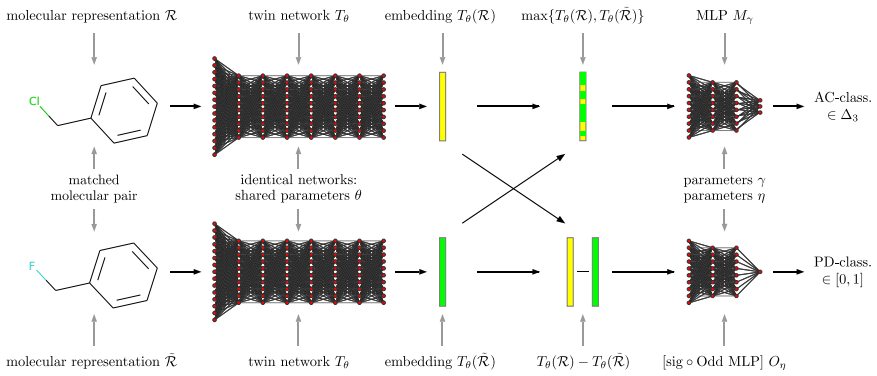
Substructure pooling is the general operation that maps a multiset of enumerated circular substructures, the unordered output of an ECFP-style enumeration, to a real-valued vector; hashing is one instance, and Sort & Slice is another. Sort & Slice ranks the substructures by training-set frequency and truncates to the most frequent ones. This frequency ranking is also the load-bearing mechanism of the proof: with the stated assumption that substructure frequency tracks informativeness, the top-frequency slice is shown to be entropy-optimal, meaning no other fixed-size selection of substructures can carry more Shannon information about the target. The thesis also develops a pair-based data-splitting scheme and a twin neural network whose max-pooling and odd-MLP design hard-code order-invariance for activity-cliff labels and order-equivariance for potency-direction labels.
What would settle it
Construct a property-prediction benchmark whose target is determined almost entirely by a deliberately rare substructure present in under 1% of training molecules, then compare Sort & Slice with hashed ECFPs on that benchmark: if hashing wins, the frequency-informativeness premise fails, since Sort & Slice is designed to drop rare substructures.
Extended reading notes
Core claim
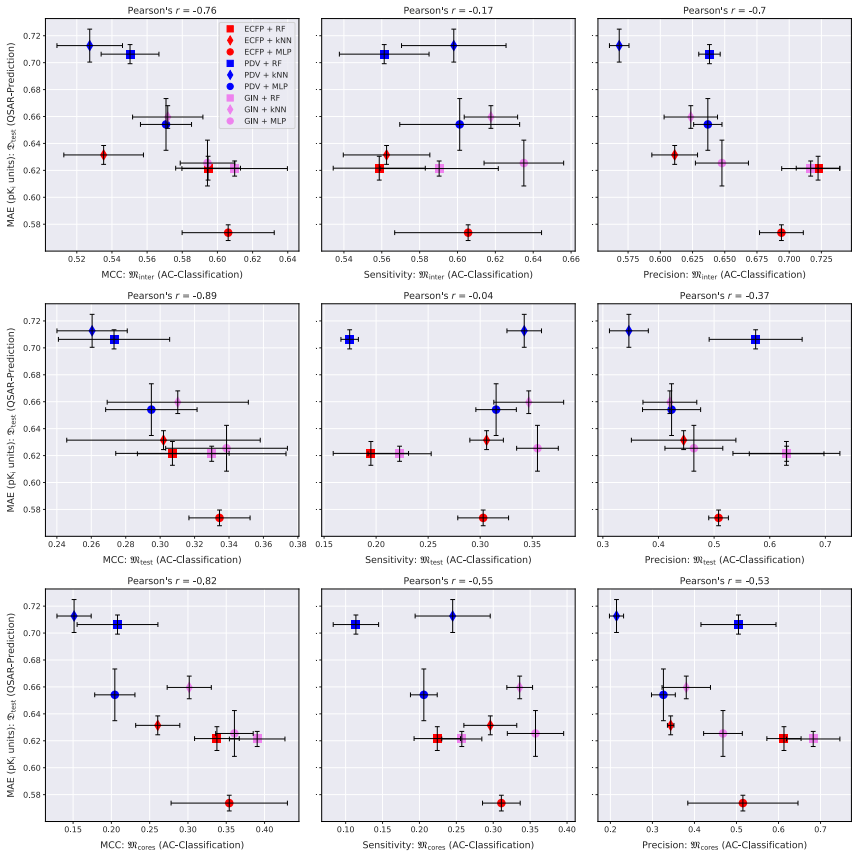
On the paper's own terms, the key discovery is that the hashing step in standard ECFP vectorisation is not a neutral technical detail: it is a lossy, collision-prone form of substructure pooling, and it can be replaced by a simpler frequency-ranked procedure that works better. Sort & Slice first sorts the enumerated circular substructures of a molecule according to their frequency in the training set and then keeps the most frequent substructures in the final vector, so each retained dimension corresponds to one concrete chemical substructure with no bit collisions. The accompanying mathematical argument shows that under the stated frequency-informativeness assumption, keeping the most frequent substructures is exactly the choice that maximises information about the target in an entropic sense. Empirically, the thesis reports that this simple pooling technique robustly beats hashing and two supervised substructure-selection schemes for molecular property prediction, with the advantage growing as the expected number of hash collisions increases. For the field's broader question, the thesis finds ECFPs still deliver the best QSAR predictions, while GIN-based features are competitive or better for activity-cliff classification.
Load-bearing premise
The proof depends on training-set substructure frequency being a faithful proxy for how informative a substructure is about the target, and on those frequencies persisting at test time; if a rare substructure carries the signal, Sort & Slice discards exactly the feature the model needs.
Editorial extensions
If this is right
- Molecular-property pipelines can replace hashed ECFPs with Sort & Slice at no extra model cost and obtain higher predictive performance, with each retained bit tied to one explicit substructure.
- The gap between Sort & Slice and hashing should widen when fingerprints are shorter or radii larger, because those settings raise the expected number of hash collisions.
- For QSAR prediction, classical ECFP features remain at least as strong as the tested GNN features, so claims that message-passing GNNs categorically supersede fingerprints need to be conditioned on task and data.
- For activity-cliff classification, GIN-based features and a twin network architecture can outperform repurposed QSAR baselines, giving practical baselines for future AC-prediction studies.
- When the activity of one compound in a matched pair is known, QSAR models detect cliffs much better than when both activities are unknown, so cliff-prediction performance should be reported separately for these two settings.
Reading between the lines
- The entropy-optimality result implies a testable design rule: choose the fingerprint dimension as the number of top-frequency substructures that cover most of the training-set mass, which could let practitioners set ECFP length without grid search.
- Because the frequency ranking is task-agnostic, a natural extension is to make the selection differentiable, for instance with self-attention weights, so the model learns which frequency bands matter rather than assuming frequency equals informativeness.
- The sharp activity-cliff sensitivity drop in the both-activities-unknown setting suggests that QSAR errors concentrate on the most informative pairs; a training loss that explicitly rewards sensitivity on predicted cliffs might improve models more than adding featurisation capacity.
- The twin network's hard-coded symmetry properties transfer to other pairwise chemistry problems, such as predicting reaction outcomes or matched-molecular-pair transformations, where label reversal rules are known a priori.
Editorial analysis
A structured set of objections, weighed in public.
Referee Report
Summary. The manuscript is a PhD thesis that investigates molecular featurisation methods for two tasks: quantitative structure-activity relationship (QSAR) prediction and activity-cliff (AC) prediction. Chapter 2 reviews physicochemical-descriptor vectors (PDVs), extended-connectivity fingerprints (ECFPs), and message-passing graph neural networks (GNNs), with an emphasis on graph isomorphism networks (GINs). Chapter 3 reports a computational study comparing nine combinations of featurisation and regression models on three pharmacological targets, and it introduces a pair-based data-splitting scheme for evaluating AC prediction. Chapter 4 proposes a twin neural network for AC and potency-direction (PD) classification, with proofs of built-in order-invariance and order-equivariance properties, and evaluates four versions of the model on a SARS-CoV-2 main protease data set. Chapter 5 introduces 'substructure pooling' as a general operation for vectorising structural fingerprints, proposes 'Sort & Slice' as an alternative to hashing that keeps the most frequent substructures, claims an entropy-optimality theorem under stated assumptions, and reports computational experiments suggesting that Sort & Slice outperforms hashing and other selection schemes for molecular property prediction. Chapter 6 outlines two future research directions.
Significance. If the Sort & Slice claim is correct, the manuscript identifies a simple, interpretable change to ECFP vectorisation that could replace hash-based folding in many molecular property prediction pipelines. The comparison against external baselines (hashing, standard QSAR models) rather than against the proposed models themselves is a methodological strength, and the symmetry proofs for the twin neural network (Propositions 4.1-4.3) are clean and machine-checkable in principle. The computational studies in the published chapters are careful in their use of cross-validation and hyperparameter optimisation. However, the central novelty of Chapter 5 is not yet supported to the standard claimed: the theoretical result relies on an unvalidated frequency-informativeness link, and the empirical robustness claim is not accompanied by code, full data, or significance tests. The featurisation comparisons in Chapter 3 also rest on a small number of targets and trials.
major comments (4)
- [Chapter 5, Section 5.2.2.2; abstract] The entropy-optimality proof for Sort & Slice is conditional on the assumption that the frequency of a circular substructure in the training set tracks its informativeness about the target property. The manuscript states this only as 'reasonable theoretical assumptions' and does not provide a formal, testable condition under which the proof holds. The method truncates to the most frequent substructures, so it discards rare substructures by construction; the activity-cliff example in Figure 3.1 shows that a rare substituent change can alter pKi by almost three orders of magnitude. Thus, the claim that Sort & Slice 'robustly leads to higher predictive performance than hashing' is not established for distributions in which rare substructures carry the predictive signal. The theoretical result collapses to a frequency filter if this assumption fails. Please either state and prove a label-dependent guarantee or explicitly restrict the scope of the optimality and robustness claims.
- [Chapter 5, Section 5.3 and Figures 5.2-5.7] The central empirical claim that Sort & Slice outperforms hashing 'across a large number of settings' is not supported by the information provided in the manuscript. No code or data are made available, the number of independent repetitions or seeds is not reported, and no statistical significance tests or confidence intervals are given for the comparisons in Figures 5.2-5.7. Table 5.2 lists hyperparameter ranges but not the per-model variability or the exact data-split protocol. For a claim of robust superiority, please provide the full experimental protocol, effect sizes with uncertainty, and a reproducibility package so that the comparison can be independently checked.
- [Chapter 3, Section 3.4 and Figures 3.7-3.12] The featurisation ranking (ECFPs best for QSAR, GINs best for AC classification) is based on only three pharmacological targets and six trials per model (2-fold cross-validation with three seeds), with no hypothesis tests. The error bars showing twice the standard deviation in Figures 3.7-3.12 indicate substantial variability relative to the reported differences, particularly for factor Xa in Figure 3.8. Statements such as 'ECFPs consistently deliver the best performance' and 'robust evidence' are stronger than the evidence supports. Please add significance tests (for example, paired bootstrap tests over the seeds) or additional datasets before making general claims about the relative merits of the featurisations.
- [Chapter 4, Section 4.3.2] The conclusion that the twin architecture 'outperforms standard QSAR models at AC-prediction in a variety of scenarios' is based on a single data set (SARS-CoV-2 main protease). In addition, the evaluation compares the twin model only to QSAR baselines, not to the existing tailored AC-prediction methods cited in Section 3.2 (for example, references [51], [104], and [111]), even though the chapter criticises those methods for lacking appropriate baselines. Please either add at least one additional target and include existing AC-prediction baselines, or explicitly limit the conclusion to the data set and baselines actually studied.
minor comments (4)
- [Throughout] There are several typos: 'activites' in Section 4.1, 'compunds' in Section 4.2.3, 'preferrable' in Section 2.3, 'alond' in Section 2.2, and 'T able' in the caption of Table 2.1. A proofreading pass is needed.
- [Section 1.1] The manuscript states that Chapter 3 is 'the first study that investigates the capabilities of QSAR models to classify between ACs and non-ACs,' but Section 3.2 cites related work that indirectly evaluates QSAR models on cliffy compounds. Please clarify the precise novelty claim.
- [Section 1.1] The text mentions 'one other work [48]' that investigates a technique similar to Sort & Slice, but the full reference is not visible in the bibliography excerpt. Please ensure the citation is complete.
- [Section 4.2.3] The notation `Mdouble` is introduced without a formal definition. Please define it explicitly, as the subsequent argument about containing one orientation of each MMP depends on it.
Circularity Check
No circular derivation established; Sort & Slice optimality proof is not inspectable and rests on an explicit assumption rather than a definitional circle.
full rationale
I walked the claimed derivation chain. The empirical studies in Chapters 3 and 4 are self-contained: models are trained on training folds and evaluated on disjoint test folds, and the twin-network contribution consists of architectural definitions plus symmetry proofs that do not assume the target results. The central new claim in Chapter 5 is that Sort & Slice, which keeps the most frequent circular substructures from the training set, 'robustly outperforms hash-based folding at molecular property prediction' and, 'under reasonable theoretical assumptions', 'only selects the most informative substructures from an entropic point of view'. The provided text does not include the equations of Section 5.2.2.2, so I cannot exhibit a specific reduction from the entropy-optimality theorem to its own assumptions. The frequency-informativeness link is an explicit assumption rather than a demonstrated identity; if the proof defined 'informative' as 'frequent' it would be self-definitional, but no such definition is available to quote. The self-citations in the thesis ([45], [46], [47]) point to the author's own previously published versions of the same empirical chapters and are not used to justify the Sort & Slice result, so they are not load-bearing. The absence of code and data for Chapter 5 and the unpublished status of that chapter are evidence/verification concerns, not circularity. I therefore find no significant circularity; the score of 2 reflects the presence of minor non-load-bearing self-citation within the normal 0-2 no-significant-circularity range.
Assumptions & free parameters
free parameters (2)
- Sort & Slice top-k substructure count =
not reported in abstract; optimized per data set
- Activity-cliff threshold dcrit =
1.5 pK units
assumptions (4)
- ad hoc to paper Substructure frequency in the training set approximates substructure informativeness for the target property
- domain assumption Training-set substructure frequencies generalize to test molecules
- domain assumption Activity cliffs are operationally defined by matched molecular pairs with >=100x activity difference, and non-cliffs by <=10x
- domain assumption ChEMBL and COVID Moonshot activity measurements, after duplicate unification, are reliable enough for benchmarking
Cite this review
Pith. "Pith review of Investigating Graph Neural Networks and Classical Feature-Extraction Techniques in Activity-Cliff and Molecular Property Prediction." pith.science (2026). https://pith.science/paper/CLGQS6I3
@misc{pith2026241113688,
  author       = {Pith},
  title        = {Pith review of: Investigating Graph Neural Networks and Classical Feature-Extraction Techniques in Activity-Cliff and Molecular Property Prediction},
  year         = {2026},
  howpublished = {\url{https://pith.science/paper/CLGQS6I3}},
  note         = {Machine review of arXiv:2411.13688}
}
read the original abstract
Molecular featurisation refers to the transformation of molecular data into numerical feature vectors. It is one of the key research areas in molecular machine learning and computational drug discovery. Recently, message-passing graph neural networks (GNNs) have emerged as a novel method to learn differentiable features directly from molecular graphs. While such techniques hold great promise, further investigations are needed to clarify if and when they indeed manage to definitively outcompete classical molecular featurisations such as extended-connectivity fingerprints (ECFPs) and physicochemical-descriptor vectors (PDVs). We systematically explore and further develop classical and graph-based molecular featurisation methods for two important tasks: molecular property prediction, in particular, quantitative structure-activity relationship (QSAR) prediction, and the largely unexplored challenge of activity-cliff (AC) prediction. We first give a technical description and critical analysis of PDVs, ECFPs and message-passing GNNs, with a focus on graph isomorphism networks (GINs). We then conduct a rigorous computational study to compare the performance of PDVs, ECFPs and GINs for QSAR and AC-prediction. Following this, we mathematically describe and computationally evaluate a novel twin neural network model for AC-prediction. We further introduce an operation called substructure pooling for the vectorisation of structural fingerprints as a natural counterpart to graph pooling in GNN architectures. We go on to propose Sort & Slice, a simple substructure-pooling technique for ECFPs that robustly outperforms hash-based folding at molecular property prediction. Finally, we outline two ideas for future research: (i) a graph-based self-supervised learning strategy to make classical molecular featurisations trainable, and (ii) trainable substructure-pooling via differentiable self-attention.
Figures


Figures from the paper (25 more)








Reference graph
Works this paper leans on
-
[51]
Prediction of activity cliffs on the basis of images using convolutional neural networks
Javed Iqbal, Martin Vogt, and J¨ urgen Bajorath. Prediction of activity cliffs on the basis of images using convolutional neural networks. Journal of Computer- Aided Molecular Design, 2021
2021
-
[104]
Prediction of activity cliffs using support vector machines
Kathrin Heikamp, Xiaoying Hu, Aixia Yan, and J¨ urgen Bajorath. Prediction of activity cliffs using support vector machines. Journal of Chemical Information and Modeling, 52(9):2354–2365, 2012
2012
-
[111]
Prediction of activity cliffs using condensed graphs of reaction representations
Dragos Horvath, Gilles Marcou, Alexandre Varnek, Shilva Kayastha, Antonio de la Vega de Le´ on, and J¨ urgen Bajorath. Prediction of activity cliffs using condensed graphs of reaction representations. Journal of Chemical Information and Modeling, 56(9):1631–1640, 2016
2016
-
[1]
Alex Krizhevsky, Ilya Sutskever, and Geoffrey E. Hinton. ImageNet classifica- tion with deep convolutional neural networks. In Advances in Neural Informa- tion Processing Systems, pages 1097–1105, 2012
2012
-
[2]
Very deep convolutional networks for large-scale image recognition
Karen Simonyan and Andrew Zisserman. Very deep convolutional networks for large-scale image recognition. arXiv preprint arXiv:1409.1556 , 2014
arXiv 2014
-
[3]
Zeiler and Rob Fergus
Matthew D. Zeiler and Rob Fergus. Visualizing and understanding convolu- tional networks. In Proceedings of the European Conference on Computer Vi- sion, pages 818–833, 2014
2014
-
[4]
Going deeper with convolutions
Christian Szegedy, Wei Liu, Yangqing Jia, Pierre Sermanet, Scott Reed, Dragomir Anguelov, Dumitru Erhan, Vincent Vanhoucke, and Andrew Rabi- novich. Going deeper with convolutions. In Proceedings of the IEEE Conference on Computer Vision and Pattern Recognition , pages 1–9, 2015
2015
-
[5]
Deep residual learn- ing for image recognition
Kaiming He, Xiangyu Zhang, Shaoqing Ren, and Jian Sun. Deep residual learn- ing for image recognition. In Proceedings of the IEEE Conference on Computer Vision and Pattern Recognition , pages 770–778, 2016
2016
Show all 174 references
-
[6]
A comprehensive comparison of molecular feature representations for use in predictive modeling
Tomaˇ z Stepiˇ snik, Blaˇ zˇSkrlj, J¨ org Wicker, and Dragi Kocev. A comprehensive comparison of molecular feature representations for use in predictive modeling. Computers in Biology and Medicine , 130:104197, 2021
2021
-
[7]
Large-scale comparison of machine learning methods for drug target prediction on ChEMBL
Andreas Mayr, G¨ unter Klambauer, Thomas Unterthiner, Marvin Steijaert, J¨ org K Wegner, Hugo Ceulemans, Djork-Arn´ e Clevert, and Sepp Hochreiter. Large-scale comparison of machine learning methods for drug target prediction on ChEMBL. Chemical Science, 9(24):5441–5451, 2018
2018
-
[8]
Could 163 graph neural networks learn better molecular representation for drug discov- ery? A comparison study of descriptor-based and graph-based models
Dejun Jiang, Zhenxing Wu, Chang-Yu Hsieh, Guangyong Chen, Ben Liao, Zhe Wang, Chao Shen, Dongsheng Cao, Jian Wu, and Tingjun Hou. Could 163 graph neural networks learn better molecular representation for drug discov- ery? A comparison study of descriptor-based and graph-based ...
2021
-
[9]
Mol- CLR: Molecular contrastive learning of representations via graph neural net- works
Yuyang Wang, Jianren Wang, Zhonglin Cao, and Amir Barati Farimani. Mol- CLR: Molecular contrastive learning of representations via graph neural net- works. arXiv preprint arXiv:2102.10056 , 2021
2021 arXiv
-
[10]
Using domain-specific fingerprints generated through neural networks to enhance ligand-based virtual screening
Janosch Menke and Oliver Koch. Using domain-specific fingerprints generated through neural networks to enhance ligand-based virtual screening. Journal of Chemical Information and Modeling , 61(2):664–675, 2021
2021
-
[11]
ChemBERTa: Large-Scale self-supervised pretraining for molecular property prediction
Seyone Chithrananda, Gabe Grand, and Bharath Ramsundar. ChemBERTa: Large-Scale self-supervised pretraining for molecular property prediction. arXiv preprint arXiv:2010.09885, 2020
2010 arXiv
-
[12]
Milios, and Axel J
Mar ´ ıa Virginia Sabando, Ignacio Ponzoni, Evangelos E. Milios, and Axel J. Soto. Using molecular embeddings in QSAR modeling: Does it make a differ- ence? arXiv preprint arXiv:2104.02604 , 2021
2021 arXiv
-
[13]
Learn- ing continuous and data-driven molecular descriptors by translating equivalent chemical representations
Robin Winter, Floriane Montanari, Frank No´ e, and Djork-Arn´ e Clevert. Learn- ing continuous and data-driven molecular descriptors by translating equivalent chemical representations. Chemical Science, 10(6):1692–1701, 2019
2019
-
[14]
Handbook of Molecular Descriptors
Roberto Todeschini and Viviana Consonni. Handbook of Molecular Descriptors. John Wiley & Sons, 2008
2008
-
[15]
Fingerprints, and other molec- ular descriptions for database analysis and searching
D´ avid Bajusz, Anita R´ acz, and K´ aroly H´ eberger. Fingerprints, and other molec- ular descriptions for database analysis and searching. 2017
2017
-
[16]
Extended-connectivity fingerprints
David Rogers and Mathew Hahn. Extended-connectivity fingerprints. Journal of Chemical Information and Modeling , 50(5):742–754, 2010
2010
-
[17]
Schoenholz, Patrick F
Justin Gilmer, Samuel S. Schoenholz, Patrick F. Riley, Oriol Vinyals, and George E. Dahl. Neural message passing for quantum chemistry. In Inter- national Conference on Machine Learning , pages 1263–1272. PMLR, 2017
2017
-
[18]
Kipf and Max Welling
Thomas N. Kipf and Max Welling. Semi-supervised classification with graph convolutional networks. arXiv preprint arXiv:1609.02907 , 2016. 164
2016 arXiv
-
[19]
Molecular graph convolutions: Moving beyond fingerprints
Steven Kearnes, Kevin McCloskey, Marc Berndl, Vijay Pande, and Patrick Riley. Molecular graph convolutions: Moving beyond fingerprints. Journal of Computer-Aided Molecular Design, 30(8):595–608, 2016
2016
-
[20]
Duvenaud, Dougal Maclaurin, Jorge Iparraguirre, Rafael Bombarell, Timothy Hirzel, Al´ an Aspuru-Guzik, and Ryan P
David K. Duvenaud, Dougal Maclaurin, Jorge Iparraguirre, Rafael Bombarell, Timothy Hirzel, Al´ an Aspuru-Guzik, and Ryan P. Adams. Convolutional net- works on graphs for learning molecular fingerprints. In Advances in Neural Information Processing Systems, pages 2224–2232, 2015
2015
-
[21]
Strategies for pre-training graph neural networks
Weihua Hu, Bowen Liu, Joseph Gomes, Marinka Zitnik, Percy Liang, Vijay Pande, and Jure Leskovec. Strategies for pre-training graph neural networks. arXiv preprint arXiv:1905.12265 , 2019
1905 arXiv
-
[22]
Analyzing learned molecular representations for property prediction
Kevin Yang, Kyle Swanson, Wengong Jin, Connor Coley, Philipp Eiden, Hua Gao, Angel Guzman-Perez, Timothy Hopper, Brian Kelley, Miriam Mathea, et al. Analyzing learned molecular representations for property prediction. Journal of Chemical Information and Modeling , 59(8):3370–3...
2019
-
[23]
Yu Philip
Zonghan Wu, Shirui Pan, Fengwen Chen, Guodong Long, Chengqi Zhang, and S. Yu Philip. A comprehensive survey on graph neural networks. IEEE Trans- actions on Neural Networks and Learning Systems , 2020
2020
-
[24]
A compact review of molecu- lar property prediction with graph neural networks
Oliver Wieder, Stefan Kohlbacher, M´ elaine Kuenemann, Arthur Garon, Pierre Ducrot, Thomas Seidel, and Thierry Langer. A compact review of molecu- lar property prediction with graph neural networks. Drug Discovery Today: Technologies, 2020
2020
-
[25]
Gated graph sequence neural networks
Yujia Li, Daniel Tarlow, Marc Brockschmidt, and Richard Zemel. Gated graph sequence neural networks. arXiv preprint arXiv:1511.05493 , 2015
2015 arXiv
-
[26]
Interaction networks for learning about objects, relations and physics
Peter Battaglia, Razvan Pascanu, Matthew Lai, Danilo Jimenez Rezende, et al. Interaction networks for learning about objects, relations and physics. In Ad- vances in Neural Information Processing Systems , pages 4502–4510, 2016
2016
-
[27]
Convolutional neural networks on graphs with fast localized spectral filtering
Micha¨ el Defferrard, Xavier Bresson, and Pierre Vandergheynst. Convolutional neural networks on graphs with fast localized spectral filtering. In Advances in Neural Information Processing Systems , pages 3844–3852, 2016. 165
2016
-
[28]
Chemi-Net: A molecular graph convo- lutional network for accurate drug property prediction
Ke Liu, Xiangyan Sun, Lei Jia, Jun Ma, Haoming Xing, Junqiu Wu, Hua Gao, Yax Sun, Florian Boulnois, and Jie Fan. Chemi-Net: A molecular graph convo- lutional network for accurate drug property prediction. International Journal of Molecular Sciences , 20(14):3389, 2019
2019
-
[29]
How powerful are graph neural networks? arXiv preprint arXiv:1810.00826 , 2018
Keyulu Xu, Weihua Hu, Jure Leskovec, and Stefanie Jegelka. How powerful are graph neural networks? arXiv preprint arXiv:1810.00826 , 2018
2018 arXiv
-
[30]
Towards deeper graph neural networks
Meng Liu, Hongyang Gao, and Shuiwang Ji. Towards deeper graph neural networks. In Proceedings of the 26th ACM SIGKDD International Conference on Knowledge Discovery and Data Mining , pages 338–348, 2020
2020
-
[31]
Universal readout for graph convolutional neural networks
Nicol` o Navarin, Dinh Van Tran, and Alessandro Sperduti. Universal readout for graph convolutional neural networks. In Proceedings of International Joint Conference on Neural Networks (IJCNN) , pages 1–7, 2019
2019
-
[32]
Quantitative evaluation of explainable graph neural networks for molecular property predic- tion
Jiahua Rao, Shuangjia Zheng, Yutong Lu, and Yuedong Yang. Quantitative evaluation of explainable graph neural networks for molecular property predic- tion. Patterns, page 100628, 2022
2022
-
[33]
Geometric deep learning au- tonomously learns chemical features that outperform those engineered by do- main experts
Patrick Hop, Brandon Allgood, and Jessen Yu. Geometric deep learning au- tonomously learns chemical features that outperform those engineered by do- main experts. Molecular Pharmaceutics, 15(10):4371–4377, 2018
2018
-
[34]
Edge attention-based multi-relational graph convolutional networks
Chao Shang, Qinqing Liu, Ko-Shin Chen, Jiangwen Sun, Jin Lu, Jinfeng Yi, and Jinbo Bi. Edge attention-based multi-relational graph convolutional networks. arXiv preprint arXiv: 1802.04944 , 2018
2018 arXiv
-
[35]
Learning graph-level representation for drug discovery
Junying Li, Deng Cai, and Xiaofei He. Learning graph-level representation for drug discovery. arXiv preprint arXiv:1709.03741 , 2017
2017 arXiv
-
[36]
Pushing the boundaries of molecular representation for drug discovery with the graph attention mechanism
Zhaoping Xiong, Dingyan Wang, Xiaohong Liu, Feisheng Zhong, Xiaozhe Wan, Xutong Li, Zhaojun Li, Xiaomin Luo, Kaixian Chen, Hualiang Jiang, et al. Pushing the boundaries of molecular representation for drug discovery with the graph attention mechanism. Journal of Medicinal Chem...
2019
-
[37]
Exposing the limitations of molecular machine learning with activity cliffs
Derek van Tilborg, Alisa Alenicheva, and Francesca Grisoni. Exposing the limitations of molecular machine learning with activity cliffs. ChemRxiv, 2022. doi: 10.26434/chemrxiv-2022-mfq52. 166
2022 doi
-
[38]
QSAR, rational approaches to the design of bioactive compounds
Carlo Silipo and Antonio Vittoria. QSAR, rational approaches to the design of bioactive compounds. In Proceedings of European Symposium on Quantitative Structure-Activity Relationships. Distributors for the US and Canada, Elsevier Science, 1991
1991
-
[39]
Maggiora
Gerald M. Maggiora. On outliers and activity cliffs: Why QSAR often disap- points. Journal of Chemical Information and Modeling , 46(4):1535–1535, 2006
2006
-
[40]
Sheridan, Prabha Karnachi, Matthew Tudor, Yuting Xu, Andy Liaw, Falgun Shah, Alan C
Robert P. Sheridan, Prabha Karnachi, Matthew Tudor, Yuting Xu, Andy Liaw, Falgun Shah, Alan C. Cheng, Elizabeth Joshi, Meir Glick, and Juan Alvarez. Experimental error, kurtosis, activity cliffs, and methodology: What limits the predictivity of quantitative structure–activity ...
1969
-
[41]
Medina-Franco, Yunierkis P´ erez-Castillo, Orazio Nicolotti, M
Maykel Cruz-Monteagudo, Jos´ e L. Medina-Franco, Yunierkis P´ erez-Castillo, Orazio Nicolotti, M. Nat´ alia D. S. Cordeiro, and Fernanda Borges. Activity cliffs in drug discovery: Dr Jekyll or Mr Hyde? Drug Discovery Today, 19(8): 1069–1080, 2014
2014
-
[42]
Recent progress in understanding activity cliffs and their utility in medicinal chem- istry: miniperspective
Dagmar Stumpfe, Ye Hu, Dilyana Dimova, and J¨ urgen Bajorath. Recent progress in understanding activity cliffs and their utility in medicinal chem- istry: miniperspective. Journal of Medicinal Chemistry , 57(1):18–28, 2014
2014
-
[43]
Evolving concept of ac- tivity cliffs
Dagmar Stumpfe, Huabin Hu, and J¨ urgen Bajorath. Evolving concept of ac- tivity cliffs. ACS Omega, 4(11):14360–14368, 2019
2019
-
[44]
Advances in exploring activity cliffs
Dagmar Stumpfe, Huabin Hu, and J¨ urgen Bajorath. Advances in exploring activity cliffs. Journal of Computer-Aided Molecular Design , 34(9):929–942, 2020
2020
-
[45]
Markus Dablander, Thierry Hanser, Renaud Lambiotte, and Garrett M. Morris. Exploring QSAR models for activity-cliff prediction. Journal of Cheminformat- ics, 15(1):47, 2023. URL https://doi.org/10.1186/s13321-023-00708-w
2023 doi
-
[46]
Mor- ris
Markus Dablander, Thierry Hanser, Renaud Lambiotte, and Garrett M. Mor- ris. Exploring molecular machine learning models for activity-cliff predic- tion. Poster presentation at the 10th International Congress on Industrial and Applied Mathematics (ICIAM). In-person, Tokyo, 202...
2023
-
[47]
Markus Dablander, Thierry Hanser, Renaud Lambiotte, and Garrett M. Morris. Siamese neural networks work for activity cliff prediction. Poster presentation at the 4th RSC-BMCS / RSC-CICAG Artificial Intelligence in Chemistry Sym- posium. Virtual, 2021. URL http://dx.doi.org/10....
2021 doi
-
[48]
(2022) Reduced collision fingerprints and pairwise molec- ular comparisons for explainable property prediction using deep learning
Thomas MacDougall. (2022) Reduced collision fingerprints and pairwise molec- ular comparisons for explainable property prediction using deep learning. M.Sc. thesis. Universit´ e de Montr´ eal. URLhttps://hdl.handle.net/1866/26533. Accessed on 05.10.2023
2022
-
[49]
Goh, Charles Siegel, Abhinav Vishnu, Nathan O
Garrett B. Goh, Charles Siegel, Abhinav Vishnu, Nathan O. Hodas, and Nathan Baker. Chemception: A deep neural network with minimal chemistry knowl- edge matches the performance of expert-developed QSAR/QSPR models. arXiv preprint arXiv:1706.06689, 2017
2017 arXiv
-
[50]
Prediction of molecular properties using molecular topo- graphic map
Atsushi Yoshimori. Prediction of molecular properties using molecular topo- graphic map. Molecules, 26(15):4475, 2021
2021
-
[52]
Can one hear the shape of a molecule (from its Coulomb matrix eigenvalues)? Journal of Chemical Information and Modeling, 60(8):3804–3811, 2020
Joshua Schrier. Can one hear the shape of a molecule (from its Coulomb matrix eigenvalues)? Journal of Chemical Information and Modeling, 60(8):3804–3811, 2020
2020
-
[53]
Uni-Mol: A universal 3D molecu- lar representation learning framework
Gengmo Zhou, Zhifeng Gao, Qiankun Ding, Hang Zheng, Hongteng Xu, Zhewei Wei, Linfeng Zhang, and Guolin Ke. Uni-Mol: A universal 3D molecu- lar representation learning framework. ChemRxiv, 2022. doi: 10.26434/ chemrxiv-2022-jjm0j-v2
2022
-
[54]
Keith Lloyd, and Robin J
Norman Biggs, E. Keith Lloyd, and Robin J. Wilson. Graph Theory, 1736-1936. Oxford University Press, 1986
1936
-
[55]
Comparison of atom representations in graph neural networks for molecular property prediction
Agnieszka Pocha, Tomasz Danel, and Lukasz Maziarka. Comparison of atom representations in graph neural networks for molecular property prediction. arXiv preprint arXiv:2012.04444 , 2020. 168
2012 arXiv
-
[56]
SMILES, a chemical language and information system
David Weininger. SMILES, a chemical language and information system. Jour- nal of Chemical Information and Computer Sciences , 28(1):31–36, 1988
1988
-
[57]
Weininger
David Weininger, Arthur Weininger, and Joseph L. Weininger. Algorithm for generation of unique SMILES notation. Journal of Chemical Information and Computer Sciences, 29(2):97–101, 1989
1989
-
[58]
Graphical depiction of chemical structures
David Weininger. Graphical depiction of chemical structures. Journal of Chem- ical Information and Computer Sciences , 30(3):237–243, 1990
1990
-
[59]
Image: Deriving the SMILES represen- tation of a chemical molecule, Shown example: ciprofloxacin, a fluoroquinolone antibiotic
Fdardel (original) and DMacks (edited). Image: Deriving the SMILES represen- tation of a chemical molecule, Shown example: ciprofloxacin, a fluoroquinolone antibiotic. URL https://commons.wikimedia.org/wiki/File:SMILES.png. CC BY-SA 3.0 License, via Wikimedia Commons. Accessed...
2022
-
[60]
InChI - the worldwide chemical structure identifier standard
Stephen Heller, Alan McNaught, Stephen Stein, Dmitrii Tchekhovskoi, and Igor Pletnev. InChI - the worldwide chemical structure identifier standard. Journal of Cheminformatics , 5(1):1–9, 2013
2013
-
[61]
Wei, David Duvenaud, Jos´ e Miguel Hern´ andez-Lobato, Benjam ´ ın S´ anchez-Lengeling, Dennis Sheberla, Jorge Aguilera-Iparraguirre, Timothy D
Rafael G´ omez-Bombarelli, Jennifer N. Wei, David Duvenaud, Jos´ e Miguel Hern´ andez-Lobato, Benjam ´ ın S´ anchez-Lengeling, Dennis Sheberla, Jorge Aguilera-Iparraguirre, Timothy D. Hirzel, Ryan P. Adams, and Al´ an Aspuru- Guzik. Automatic chemical design using a data-drive...
2018
-
[62]
Self-referencing embedded strings (SELFIES): A 100% robust molecular string representation
Mario Krenn, Florian H¨ ase, Akshat-Kumar Nigam, Pascal Friederich, and Alan Aspuru-Guzik. Self-referencing embedded strings (SELFIES): A 100% robust molecular string representation. Machine Learning: Science and Technology , 1 (4):045024, 2020
2020
-
[63]
DeepSMILES: An adaptation of SMILES for use in machine-learning of chemical structures
Noel O’Boyle and Andrew Dalke. DeepSMILES: An adaptation of SMILES for use in machine-learning of chemical structures. ChemRxiv, 2018. doi: 10.26434/ chemrxiv.7097960.v1
2018
-
[64]
Tomasz Puzyn, Jerzy Leszczynski, and Mark T. Cronin. Recent advances in QSAR studies: Methods and applications , volume 8. Springer Science & Busi- ness Media, 2010
2010
-
[65]
Mold 2, molecular descriptors 169 from 2D structures for chemoinformatics and toxicoinformatics
Huixiao Hong, Qian Xie, Weigong Ge, Feng Qian, Hong Fang, Leming Shi, Zhenqiang Su, Roger Perkins, and Weida Tong. Mold 2, molecular descriptors 169 from 2D structures for chemoinformatics and toxicoinformatics. Journal of Chemical Information and Modeling , 48(7):1337–1344, 2008
2008
-
[66]
Molecular descriptors in chemoinformatics, computational combinatorial chemistry, and virtual screening
Ling Xue and J¨ urgen Bajorath. Molecular descriptors in chemoinformatics, computational combinatorial chemistry, and virtual screening. Combinatorial Chemistry & High Throughput Screening , 3(5):363–372, 2000
2000
-
[67]
Molecular descriptors
Viviana Consonni and Roberto Todeschini. Molecular descriptors. In Recent Advances in QSAR Studies , pages 29–102. Springer, 2010
2010
-
[68]
Lipinski, Franco Lombardo, Beryl W
Christopher A. Lipinski, Franco Lombardo, Beryl W. Dominy, and Paul J. Feeney. Experimental and computational approaches to estimate solubility and permeability in drug discovery and development settings. Advanced Drug De- livery Reviews, 23(1-3):3–25, 1997
1997
-
[69]
Wildman and Gordon M
Scott A. Wildman and Gordon M. Crippen. Prediction of physicochemical pa- rameters by atomic contributions. Journal of Chemical Information and Com- puter Sciences, 39(5):868–873, 1999
1999
-
[70]
RDKit: Open-source cheminformatics
Greg Landrum. RDKit: Open-source cheminformatics. 2006. URL http:// www.rdkit.org. Accessed on 05.10.2023
2006
-
[71]
Alexandru T. Balaban. Highly discriminating distance-based topological index. Chemical Physics Letters , 89(5):399–404, 1982
1982
-
[72]
Molecular representation learn- ing with language models and domain-relevant auxiliary tasks
Benedek Fabian, Thomas Edlich, H´ el´ ena Gaspar, Marwin Segler, Joshua Mey- ers, Marco Fiscato, and Mohamed Ahmed. Molecular representation learn- ing with language models and domain-relevant auxiliary tasks. arXiv preprint arXiv:2011.13230, 2020
2011 arXiv
-
[73]
Harry L. Morgan. The generation of a unique machine description for chemical structures—A technique developed at chemical abstracts service. Journal of Chemical Documentation, 5(2):107–113, 1965
1965
-
[74]
Durant, Burton A
Joseph L. Durant, Burton A. Leland, Douglas R. Henry, and James G. Nourse. Reoptimization of MDL keys for use in drug discovery. Journal of Chemical Information and Computer Sciences , 42(6):1273–1280, 2002
2002
-
[75]
URL https://ftp
Online description of PubChem substructure fingerprints. URL https://ftp. ncbi.nlm.nih.gov/pubchem/specifications/pubchem_fingerprints.pdf. Accessed on 01.10.2023. 170
2023
-
[76]
Lianyi Han, Yanli Wang, and Stephen H. Bryant. Developing and validating predictive decision tree models from mining chemical structural fingerprints and high-throughput screening data in PubChem. BMC Bioinformatics, 9:1–8, 2008
2008
-
[77]
URL https:// www.daylight.com/dayhtml/doc/theory/theory.finger.html
Online description of Daylight substructure fingerprints. URL https:// www.daylight.com/dayhtml/doc/theory/theory.finger.html. Accessed on 01.10.2023
2023
-
[78]
Open-source platform to benchmark fin- gerprints for ligand-based virtual screening
Sereina Riniker and Greg Landrum. Open-source platform to benchmark fin- gerprints for ligand-based virtual screening. Journal of Cheminformatics , 5(1): 26, 2013
2013
-
[79]
Webel, Talia B
Henry E. Webel, Talia B. Kimber, Silke Radetzki, Martin Neuenschwander, Marc Nazar´ e, and Andrea Volkamer. Revealing cytotoxic substructures in molecules using deep learning. Journal of Computer-aided Molecular Design , 34(7):731–746, 2020
2020
-
[80]
Brown, and Mathew Hahn
David Rogers, Robert D. Brown, and Mathew Hahn. Using extended- connectivity fingerprints with Laplacian-modified Bayesian analysis in high- throughput screening follow-up. Journal of Biomolecular Screening, 10(7):682– 686, 2005
2005
-
[81]
Jonathan Alvarsson, Martin Eklund, Ola Engkvist, Ola Spjuth, Lars Carlsson, Jarl E. S. Wikberg, and Tobias Noeske. Ligand-based target prediction with signature fingerprints. Journal of Chemical Information and Modeling , 54(10): 2647–2653, 2014
2014
-
[82]
Bronstein, Joan Bruna, Yann LeCun, Arthur Szlam, and Pierre Vandergheynst
Michael M. Bronstein, Joan Bruna, Yann LeCun, Arthur Szlam, and Pierre Vandergheynst. Geometric deep learning: Going beyond Euclidean data. IEEE Signal Processing Magazine, 34(4):18–42, 2017
2017
-
[83]
Bronstein, Joan Bruna, Taco Cohen, and Petar Veliˇ ckovi´ c
Michael M. Bronstein, Joan Bruna, Taco Cohen, and Petar Veliˇ ckovi´ c. Geomet- ric deep learning: Grids, groups, graphs, geodesics, and gauges. arXiv preprint arXiv:2104.13478, 2021
2021 arXiv
-
[84]
Joshi, Thomas Laurent, Yoshua Bengio, and Xavier Bresson
Vijay Prakash Dwivedi, Chaitanya K. Joshi, Thomas Laurent, Yoshua Bengio, and Xavier Bresson. Benchmarking graph neural networks. arXiv preprint arXiv:2003.00982, 2020. 171
2003 arXiv
-
[85]
Continuous representa- tion of molecules using graph variational autoencoder
Mohammadamin Tavakoli and Pierre Baldi. Continuous representa- tion of molecules using graph variational autoencoder. arXiv preprint arXiv:2004.08152, 2020
2004 arXiv
-
[86]
Open graph benchmark: Datasets for machine learning on graphs
Weihua Hu, Matthias Fey, Marinka Zitnik, Yuxiao Dong, Hongyu Ren, Bowen Liu, Michele Catasta, and Jure Leskovec. Open graph benchmark: Datasets for machine learning on graphs. Advances in Neural Information Processing Systems, 33:22118–22133, 2020
2020
-
[87]
Multilayer feedforward networks are universal approximators
Kurt Hornik, Maxwell Stinchcombe, and Halbert White. Multilayer feedforward networks are universal approximators. Neural Networks, 2(5):359–366, 1989
1989
-
[88]
Understanding graph isomorphism net- work for rs-fMRI functional connectivity analysis
Byung-Hoon Kim and Jong Chul Ye. Understanding graph isomorphism net- work for rs-fMRI functional connectivity analysis. Frontiers in Neuroscience, page 630, 2020
2020
-
[89]
The reduction of a graph to canonical form and the algebra which appears therein
Boris Weisfeiler and Andrei Lehman. The reduction of a graph to canonical form and the algebra which appears therein. NTI, Series , 2(9):12–16, 1968
1968
-
[90]
Zafeiriou, and Michael Bron- stein
Giorgos Bouritsas, Fabrizio Frasca, Stefanos P. Zafeiriou, and Michael Bron- stein. Improving graph neural network expressivity via subgraph isomorphism counting. IEEE Transactions on Pattern Analysis and Machine Intelligence , 2022
2022
-
[91]
Hamilton, Jan Eric Lenssen, Gaurav Rattan, and Martin Grohe
Christopher Morris, Martin Ritzert, Matthias Fey, William L. Hamilton, Jan Eric Lenssen, Gaurav Rattan, and Martin Grohe. Weisfeiler and Leman go neural: Higher-order graph neural networks. In Proceedings of the AAAI Conference on Artificial Intelligence , volume 33, pages 460...
2019
-
[92]
Feature over- correlation in deep graph neural networks: A new perspective
Wei Jin, Xiaorui Liu, Yao Ma, Charu Aggarwal, and Jiliang Tang. Feature over- correlation in deep graph neural networks: A new perspective. arXiv preprint arXiv:2206.07743, 2022
2022 arXiv
-
[93]
Evaluating deep graph neural networks
Wentao Zhang, Zeang Sheng, Yuezihan Jiang, Yikuan Xia, Jun Gao, Zhi Yang, and Bin Cui. Evaluating deep graph neural networks. arXiv preprint arXiv:2108.00955, 2021
2021 arXiv
-
[94]
Gaunt, Alvaro Sanchez-Gonzalez, Yulia Rubanova, Petar Veliˇ ckovi´ c, James Kirkpatrick, and 172 Peter Battaglia
Jonathan Godwin, Michael Schaarschmidt, Alexander L. Gaunt, Alvaro Sanchez-Gonzalez, Yulia Rubanova, Petar Veliˇ ckovi´ c, James Kirkpatrick, and 172 Peter Battaglia. Simple GNN regularisation for 3D molecular property pre- diction and beyond. In International Conference on Le...
2021
-
[95]
Measuring and relieving the over-smoothing problem for graph neural networks from the topo- logical view
Deli Chen, Yankai Lin, Wei Li, Peng Li, Jie Zhou, and Xu Sun. Measuring and relieving the over-smoothing problem for graph neural networks from the topo- logical view. In Proceedings of the AAAI Conference on Artificial Intelligence , volume 34, pages 3438–3445, 2020
2020
-
[96]
Fast graph representation learning with PyTorch Geometric
Matthias Fey and Jan Eric Lenssen. Fast graph representation learning with PyTorch Geometric. arXiv preprint arXiv:1903.02428 , 2019
1903 arXiv
-
[97]
Data set modelability by QSAR
Alexander Golbraikh, Eugene Muratov, Denis Fourches, and Alexander Trop- sha. Data set modelability by QSAR. Journal of Chemical Information and Modeling, 54(1):1–4, 2014
2014
-
[98]
Leadley et al
Jr. Leadley et al. Coagulation factor Xa inhibition: Biological background and rationale. Current Topics in Medicinal Chemistry , 1(2):151–159, 2001
2001
-
[99]
From activity cliffs to activity ridges: Informative data structures for SAR analysis
Martin Vogt, Yun Huang, and J¨ urgen Bajorath. From activity cliffs to activity ridges: Informative data structures for SAR analysis. Journal of Chemical Information and Modeling , 51(8):1848–1856, 2011
2011
-
[100]
Activity cliff clusters as a source of structure–activity relationship information
Dilyana Dimova, Dagmar Stumpfe, Ye Hu, and J¨ urgen Bajorath. Activity cliff clusters as a source of structure–activity relationship information. Expert Opinion on Drug Discovery , 10(5):441–447, 2015
2015
-
[101]
Medina-Franco
Jos´ e L. Medina-Franco. Activity cliffs: Facts or artifacts? Chemical Biology & Drug Design , 81(5):553–556, 2013
2013
-
[102]
Maykel Cruz-Monteagudo, Jos´ e L. Medina-Franco, Yunier Perera-Sardi˜ na, Fer- nanda Borges, Eduardo Tejera, Cesar Paz-y Mino, Yunierkis P´ erez-Castillo, Aminael S´ anchez-Rodr ´ ıguez, Zuleidys Contreras-Posada, Nat´ alia DS Cordeiro, et al. Probing the hypothesis of SAR con...
2016
-
[103]
Winkler and Tu C
David A. Winkler and Tu C. Le. Performance of deep and shallow neural net- works, the universal approximation theorem, activity cliffs, and QSAR. Molec- ular Informatics , 36(1-2):1600118, 2017. 173
2017
-
[105]
Ligand-based activ- ity cliff prediction models with applicability domain
Shunsuke Tamura, Tomoyuki Miyao, and Kimito Funatsu. Ligand-based activ- ity cliff prediction models with applicability domain. Molecular Informatics, 39 (12):2000103, 2020
2020
-
[106]
Prediction of compound potency changes in matched molecular pairs using support vector regression
Antonio De la Vega de Le´ on and J¨ urgen Bajorath. Prediction of compound potency changes in matched molecular pairs using support vector regression. Journal of Chemical Information and Modeling , 54(10):2654–2663, 2014
2014
-
[107]
Beck and Clayton Springer
Jeremy M. Beck and Clayton Springer. Quantitative structure-activity relation- ship models of chemical transformations from matched pairs analyses. Journal of Chemical Information and Modeling , 54(4):1226–1234, 2014
2014
-
[108]
Searching for coordinated activity cliffs using particle swarm optimization
Vigneshwaran Namasivayam and J¨ urgen Bajorath. Searching for coordinated activity cliffs using particle swarm optimization. Journal of Chemical Informa- tion and Modeling , 52(4):927–934, 2012
2012
-
[109]
Prediction of individual compounds forming activity cliffs using emerging chemical patterns
Vigneshwaran Namasivayam, Preeti Iyer, and J¨ urgen Bajorath. Prediction of individual compounds forming activity cliffs using emerging chemical patterns. Journal of Chemical Information and Modeling , 53(12):3131–3139, 2013
2013
-
[110]
Structure-based predictions of activity cliffs
Jarmila Husby, Giovanni Bottegoni, Irina Kufareva, Ruben Abagyan, and An- drea Cavalli. Structure-based predictions of activity cliffs. Journal of Chemical Information and Modeling , 55(5):1062–1076, 2015
2015
-
[112]
Predicting activity cliffs with free-energy pertur- bation
Laura P´ erez-Benito, Nil Casajuana-Martin, Mireia Jim´ enez-Ros´ es, Herman van Vlijmen, and Gary Tresadern. Predicting activity cliffs with free-energy pertur- bation. Journal of Chemical Theory and Computation , 15(3):1884–1895, 2019
2019
-
[113]
Prediction of an MMP-1 inhibitor activity cliff using the SAR matrix approach and its experimental validation
Yasunobu Asawa, Atsushi Yoshimori, J¨ urgen Bajorath, and Hiroyuki Naka- mura. Prediction of an MMP-1 inhibitor activity cliff using the SAR matrix approach and its experimental validation. Scientific Reports, 10(1):14710, 2020. 174
2020
-
[114]
PCAC: A new method for predicting compounds with activity cliff property in QSAR approach
Mohammad Reza Keyvanpour, Mehrnoush Barani Shirzad, and Farhaneh Moradi. PCAC: A new method for predicting compounds with activity cliff property in QSAR approach. International Journal of Information Technology , 13(6):2431–2437, 2021
2021
-
[115]
ACGCN: Graph convolutional networks for activity cliff prediction be- tween matched molecular pairs
Junhui Park, Gaeun Sung, SeungHyun Lee, SeungHo Kang, and ChunKyun Park. ACGCN: Graph convolutional networks for activity cliff prediction be- tween matched molecular pairs. Journal of Chemical Information and Modeling, 2022
2022
-
[116]
DeepAC—Conditional transformer-based chemical language model for the prediction of activity cliffs formed by bioactive compounds
Hengwei Chen, Martin Vogt, and J¨ urgen Bajorath. DeepAC—Conditional transformer-based chemical language model for the prediction of activity cliffs formed by bioactive compounds. Digital Discovery, 2022
2022
-
[117]
Con- densed graph of reaction: Considering a chemical reaction as one single pseudo molecule
Frank Hoonakker, Nicolas Lachiche, Alexandre Varnek, and Alain Wagner. Con- densed graph of reaction: Considering a chemical reaction as one single pseudo molecule. International Journal on Artificial Intelligence Tools , 20(2):253–270, 2011
2011
-
[118]
Machine learning of generic reactions: 1
Philippe Jauffret, Thierry Hanser, Christian Tonnelier, and G´ erard Kaufmann. Machine learning of generic reactions: 1. Scope of the project; The GRAMS program. Tetrahedron Computer Methodology, 3(6):323–333, 1990
1990
-
[119]
Dopamine receptors and the dopamine hypothesis of schizophre- nia
Philip Seeman. Dopamine receptors and the dopamine hypothesis of schizophre- nia. Synapse, 1(2):133–152, 1987
1987
-
[120]
The SARS-CoV-2 main protease as drug target
Sven Ullrich and Christoph Nitsche. The SARS-CoV-2 main protease as drug target. Bioorganic & Medicinal Chemistry Letters , 30(17):127377, 2020
2020
-
[121]
Berman, John Westbrook, Zukang Feng, Gary Gilliland, Talapady N
Helen M. Berman, John Westbrook, Zukang Feng, Gary Gilliland, Talapady N. Bhat, Helge Weissig, Ilya N. Shindyalov, and Philip E. Bourne. The Protein Data Bank. Nucleic Acids Research, 28(1):235–242, 2000. URL https://www. rcsb.org
2000
-
[122]
Jorissen, and Michael K
Tiqing Liu, Yuhmei Lin, Xin Wen, Robert N. Jorissen, and Michael K. Gilson. BindingDB: A web-accessible database of experimentally determined protein- ligand binding affinities. Nucleic Acids Research, 35:D198–D201, 2007
2007
-
[123]
Bobby, Juliane Brun, BVNBS Sarma, Mark 175 Calmiano, et al
Hagit Achdout, Anthony Aimon, Elad Bar-David, Haim Barr, Amir Ben- Shmuel, James Bennett, Melissa L. Bobby, Juliane Brun, BVNBS Sarma, Mark 175 Calmiano, et al. COVID moonshot: Open science discovery of SARS-CoV-2 main protease inhibitors by combining crowdsourcing, high-throu...
2020
-
[124]
Patr ´ ıcia Bento, Anne Hersey, Eloy F´ elix, Greg Landrum, Anna Gaulton, Francis Atkinson, Louisa J
A. Patr ´ ıcia Bento, Anne Hersey, Eloy F´ elix, Greg Landrum, Anna Gaulton, Francis Atkinson, Louisa J. Bellis, Marleen de Veij, and Andrew R. Leach. An open source chemical structure curation pipeline using RDKit. Journal of Cheminformatics, 12(1):1–16, 2020
2020
-
[125]
Kenny and Jens Sadowski
Peter W. Kenny and Jens Sadowski. Structure modification in chemical databases. Chemoinformatics in Drug Discovery , 23:271–285, 2005
2005
-
[126]
Extending the activity cliff concept: Structural categorization of activity cliffs and systematic identification of different types of cliffs in the ChEMBL database
Ye Hu and J¨ urgen Bajorath. Extending the activity cliff concept: Structural categorization of activity cliffs and systematic identification of different types of cliffs in the ChEMBL database. Journal of Chemical Information and Modeling, 52(7):1806–1811, 2012
2012
-
[127]
mmpdb: An open-source matched molecular pair platform for large multiproperty data sets
Andrew Dalke, Jerome Hert, and Christian Kramer. mmpdb: An open-source matched molecular pair platform for large multiproperty data sets. Journal of Chemical Information and Modeling , 58(5):902–910, 2018
2018
-
[128]
Exploring activity cliffs from a chemoinformatics perspective
J¨ urgen Bajorath. Exploring activity cliffs from a chemoinformatics perspective. Molecular Informatics, 33(6-7):438–442, 2014
2014
-
[129]
MMP-cliffs: Systematic identification of activity cliffs on the basis of matched molecular pairs
Xiaoying Hu, Ye Hu, Martin Vogt, Dagmar Stumpfe, and J¨ urgen Bajorath. MMP-cliffs: Systematic identification of activity cliffs on the basis of matched molecular pairs. Journal of Chemical Information and Modeling , 52(5):1138– 1145, 2012
2012
-
[130]
Scikit-learn: Machine learning in Python
Fabian Pedregosa, Ga¨ el Varoquaux, Alexandre Gramfort, Vincent Michel, Bertrand Thirion, Olivier Grisel, Mathieu Blondel, Peter Prettenhofer, Ron Weiss, Vincent Dubourg, et al. Scikit-learn: Machine learning in Python. Jour- nal of Machine Learning Research , 12:2825–2830, 2011
2011
-
[131]
PyTorch: An imperative style, high-performance deep learning library
Adam Paszke, Sam Gross, Francisco Massa, Adam Lerer, James Bradbury, Gregory Chanan, Trevor Killeen, Zeming Lin, Natalia Gimelshein, Luca Antiga, et al. PyTorch: An imperative style, high-performance deep learning library. Advances in Neural Information Processing Systems , 32...
2019
-
[132]
Optuna: A next-generation hyperparameter optimization framework
Takuya Akiba, Shotaro Sano, Toshihiko Yanase, Takeru Ohta, and Masanori Koyama. Optuna: A next-generation hyperparameter optimization framework. In Proceedings of the 25th ACM SIGKDD International Conference on Knowl- edge Discovery & Data Mining , pages 2623–2631, 2019
2019
-
[133]
Batch normalization: Accelerating deep network training by reducing internal covariate shift
Sergey Ioffe and Christian Szegedy. Batch normalization: Accelerating deep network training by reducing internal covariate shift. InProceedings of Machine Learning Research, pages 448–456, 2015
2015
-
[134]
Decoupled weight decay regularization.arXiv preprint arXiv:1711.05101, 2017
Ilya Loshchilov and Frank Hutter. Decoupled weight decay regularization.arXiv preprint arXiv:1711.05101, 2017
2017 arXiv
-
[135]
Dropout: A simple way to prevent neural networks from overfitting
Nitish Srivastava, Geoffrey Hinton, Alex Krizhevsky, Ilya Sutskever, and Rus- lan Salakhutdinov. Dropout: A simple way to prevent neural networks from overfitting. The Journal of Machine Learning Research, 15(1):1929–1958, 2014
1929
-
[136]
Siamese neural networks: An overview
Davide Chicco. Siamese neural networks: An overview. Artificial Neural Net- works, pages 73–94, 2021
2021
-
[137]
Bentz, L´ eon Bottou, Isabelle Guyon, Yann LeCun, Cliff Moore, Eduard S¨ ackinger, and Roopak Shah
Jane Bromley, James W. Bentz, L´ eon Bottou, Isabelle Guyon, Yann LeCun, Cliff Moore, Eduard S¨ ackinger, and Roopak Shah. Signature verification us- ing a “Siamese” time delay neural network. International Journal of Pattern Recognition and Artificial Intelligence, 7(04):669–...
1993
-
[138]
Siamese neural net- works for one-shot image recognition
Gregory Koch, Richard Zemel, and Ruslan Salakhutdinov. Siamese neural net- works for one-shot image recognition. In ICML Deep Learning Workshop , vol- ume 2. Lille, 2015
2015
-
[139]
Deepface: Closing the gap to human-level performance in face verification
Yaniv Taigman, Ming Yang, Marc’Aurelio Ranzato, and Lior Wolf. Deepface: Closing the gap to human-level performance in face verification. In Proceedings of the IEEE Conference on Computer Vision and Pattern Recognition , pages 1701–1708, 2014
2014
-
[140]
Predicting drug-drug interactions from molecular structure images
Devendra Singh Dhami, Gautam Kunapuli, David Page, and Sriraam Natara- jan. Predicting drug-drug interactions from molecular structure images. In Proceedings of AAAI Fall Symposium on AI for Social Good , 2019
2019
-
[141]
Graph-augmented convolutional networks on drug-drug interactions pre- diction
Yi Zhong, Xueyu Chen, Yu Zhao, Xiaoming Chen, Tingfang Gao, and Zuquan Weng. Graph-augmented convolutional networks on drug-drug interactions pre- diction. arXiv preprint arXiv:1912.03702 , 2019. 177
1912 arXiv
-
[142]
AttentionDDI: Siamese attention-based deep learning method for drug-drug interaction predictions
Kyriakos Schwarz, Ahmed Allam, Nicolas Andres Perez Gonzalez, and Michael Krauthammer. AttentionDDI: Siamese attention-based deep learning method for drug-drug interaction predictions. arXiv preprint arXiv:2012.13248 , 2020
2012 arXiv
-
[143]
Exploring a Siamese neural network architecture for one-shot drug discovery
Luis Torres, Nelson Monteiro, Jos` e Oliveira, Joel Arrais, and Bernardete Ribeiro. Exploring a Siamese neural network architecture for one-shot drug discovery. In Proceedings of 20th International Conference on Bioinformatics and Bioengineering (BIBE) , pages 168–175, 2020
2020
-
[144]
Baskin, Vladimir A
Igor I. Baskin, Vladimir A. Palyulin, and Nikolai S. Zefirov. Neural networks in building QSAR models. In Artificial Neural Networks, pages 133–154. Springer, 2006
2006
-
[145]
Alvarez and Jaime Pahissa
Paulino A. Alvarez and Jaime Pahissa. QT alterations in psychopharmacology: Proven candidates and suspects. Current Drug Safety , 5(1):97–104, 2010
2010
-
[146]
Multifaceted protein-protein interaction prediction based on Siamese residual RCNN
Muhao Chen, Chelsea J-T Ju, Guangyu Zhou, Xuelu Chen, Tianran Zhang, Kai-Wei Chang, Carlo Zaniolo, and Wei Wang. Multifaceted protein-protein interaction prediction based on Siamese residual RCNN. Bioinformatics, 35 (14):i305–i314, 2019
2019
-
[147]
Siamese recurrent neural network with a self-attention mechanism for bioactivity prediction
Daniel Fern´ andez-Llaneza, Silas Ulander, Dea Gogishvili, Eva Nittinger, Hong- tao Zhao, and Christian Tyrchan. Siamese recurrent neural network with a self-attention mechanism for bioactivity prediction. ACS Omega, 6(16):11086– 11094, 2021
2021
-
[148]
ReSimNet: Drug response similarity prediction using Siamese neural networks
Minji Jeon, Donghyeon Park, Jinhyuk Lee, Hwisang Jeon, Miyoung Ko, Sunkyu Kim, Yonghwa Choi, Aik-Choon Tan, and Jaewoo Kang. ReSimNet: Drug response similarity prediction using Siamese neural networks. Bioinformatics, 35(24):5249–5256, 2019
2019
-
[149]
Purushothama, Vishal T
Nicholas Roberts, Poornav S. Purushothama, Vishal T. Vasudevan, Siddarth Ravichandran, Chen Zhang, William H. Gerwick, and Garrison W. Cottrell. Using deep Siamese neural networks to speed up natural products research. ICLR 2019 Conference Blind Submission , 2018
2019
-
[150]
McHardy, and Mohammad R
Esmaeil Nourani, Ehsaneddin Asgari, Alice C. McHardy, and Mohammad R. K. Mofrad. TripletProt: Deep representation learning of proteins based on Siamese networks. IEEE/ACM Transactions on Computational Biology and Bioinfor- matics, 19(6):3744–3753, 2021. 178
2021
-
[151]
Interpretable drug-target prediction using deep neural representa- tion
Kyle Yingkai Gao, Achille Fokoue, Heng Luo, Arun Iyengar, Sanjoy Dey, and Ping Zhang. Interpretable drug-target prediction using deep neural representa- tion. In Proceedings of International Joint Conference on Artificial Intelligence, volume 2018, pages 3371–3377, 2018
2018
-
[152]
Towards sparse hierarchical graph classifiers
C˘ at˘ alina Cangea, Petar Veliˇ ckovi´ c, Nikola Jovanovi´ c, Thomas Kipf, and Pietro Li` o. Towards sparse hierarchical graph classifiers. arXiv preprint arXiv:1811.01287, 2018
2018 arXiv
-
[153]
Self-attention graph pooling
Junhyun Lee, Inyeop Lee, and Jaewoo Kang. Self-attention graph pooling. In International Conference on Machine Learning, pages 3734–3743. PMLR, 2019
2019
-
[154]
Asap: Adaptive struc- ture aware pooling for learning hierarchical graph representations
Ekagra Ranjan, Soumya Sanyal, and Partha Talukdar. Asap: Adaptive struc- ture aware pooling for learning hierarchical graph representations. In Pro- ceedings of the AAAI Conference on Artificial Intelligence , volume 34, pages 5470–5477, 2020
2020
-
[155]
Path integral based convolution and pooling for graph neural networks
Zheng Ma, Junyu Xuan, Yu Guang Wang, Ming Li, and Pietro Li` o. Path integral based convolution and pooling for graph neural networks. Advances in Neural Information Processing Systems , 33:16421–16433, 2020
2020
-
[156]
A probabilistic molecular fingerprint for big data settings
Daniel Probst and Jean-Louis Reymond. A probabilistic molecular fingerprint for big data settings. Journal of Cheminformatics , 10:1–12, 2018
2018
-
[157]
Filtered circular fingerprints improve either prediction or runtime performance while retaining interpretability
Martin G¨ utlein and Stefan Kramer. Filtered circular fingerprints improve either prediction or runtime performance while retaining interpretability. Journal of Cheminformatics, 8(1):1–16, 2016
2016
-
[158]
Claude E. Shannon. A mathematical theory of communication. The Bell System Technical Journal, 27(3):379–423, 1948
1948
-
[159]
Cover, Joy A
Thomas M. Cover, Joy A. Thomas, et al. Entropy, relative entropy and mutual information. Elements of Information Theory , 2(1):12–13, 1991
1991
-
[160]
Daylight Chemical Information Systems
SMARTS Theory Manual. Daylight Chemical Information Systems . URL https://www.daylight.com/dayhtml/doc/theory/theory.smarts.html. Accessed on 05.10.2023
2023
-
[161]
Karl Pearson. On the criterion that a given system of deviations from the probable in the case of a correlated system of variables is such that it can be reasonably supposed to have arisen from random sampling. The London, 179 Edinburgh, and Dublin Philosophical Magazine and J...
1900
-
[162]
LIT-PCBA: An unbiased data set for machine learning and virtual screening
Viet-Khoa Tran-Nguyen, C´ elien Jacquemard, and Didier Rognan. LIT-PCBA: An unbiased data set for machine learning and virtual screening. Journal of Chemical Information and Modeling , 60(9):4263–4273, 2020
2020
-
[163]
Feinberg, Joseph Gomes, Caleb Geniesse, Aneesh S
Zhenqin Wu, Bharath Ramsundar, Evan N. Feinberg, Joseph Gomes, Caleb Geniesse, Aneesh S. Pappu, Karl Leswing, and Vijay Pande. MoleculeNet: A benchmark for molecular machine learning. Chemical Science, 9(2):513–530, 2018
2018
-
[164]
AqSolDB, a cu- rated reference set of aqueous solubility and 2D descriptors for a diverse set of compounds
Murat Cihan Sorkun, Abhishek Khetan, and S¨ uleyman Er. AqSolDB, a cu- rated reference set of aqueous solubility and 2D descriptors for a diverse set of compounds. Scientific Data , 6(1):143, 2019
2019
-
[165]
Benchmark data set for in silico prediction of Ames mutagenicity
Katja Hansen, Sebastian Mika, Timon Schroeter, Andreas Sutter, Antonius Ter Laak, Thomas Steger-Hartmann, Nikolaus Heinrich, and Klaus-Robert Muller. Benchmark data set for in silico prediction of Ames mutagenicity. Jour- nal of Chemical Information and Modeling , 49(9):2077–2...
2009
-
[166]
Bemis and Mark A
Guy W. Bemis and Mark A. Murcko. The properties of known drugs: Molecular frameworks. Journal of Medicinal Chemistry , 39(15):2887–2893, 1996
1996
-
[167]
Fast binary feature selection with conditional mutual infor- mation
Fran¸ cois Fleuret. Fast binary feature selection with conditional mutual infor- mation. Journal of Machine Learning Research , 5(9), 2004
2004
-
[168]
Ting Chen, Simon Kornblith, Kevin Swersky, Mohammad Norouzi, and Geof- frey E. Hinton. Big self-supervised models are strong semi-supervised learners. Advances in Neural Information Processing Systems , 33:22243–22255, 2020
2020
-
[169]
Gomez, Lukasz Kaiser, and Illia Polosukhin
Ashish Vaswani, Noam Shazeer, Niki Parmar, Jakob Uszkoreit, Llion Jones, Aidan N. Gomez, Lukasz Kaiser, and Illia Polosukhin. Attention is all you need. Advances in Neural Information Processing Systems , 30, 2017
2017
-
[170]
Set transformer: A framework for attention-based permutation- invariant neural networks
Juho Lee, Yoonho Lee, Jungtaek Kim, Adam Kosiorek, Seungjin Choi, and Yee Whye Teh. Set transformer: A framework for attention-based permutation- invariant neural networks. In International Conference on Machine Learning , pages 3744–3753. PMLR, 2019. 180
2019
-
[171]
Substructure-atom cross attention for molecular representation learning
Jiye Kim, Seungbeom Lee, Dongwoo Kim, Sungsoo Ahn, and Jaesik Park. Substructure-atom cross attention for molecular representation learning. arXiv preprint arXiv:2210.08243, 2022
2022 arXiv
-
[172]
Nonadditivity in public and inhouse data: Implications for drug design
Dea Gogishvili, Eva Nittinger, Christian Margreitter, and Christian Tyrchan. Nonadditivity in public and inhouse data: Implications for drug design. Journal of Cheminformatics , 13:1–18, 2021
2021
-
[173]
Implications of additivity and nonadditivity for machine learning and deep learning models in drug design
Karolina Kwapien, Eva Nittinger, Jiazhen He, Christian Margreitter, Alexey Voronov, and Christian Tyrchan. Implications of additivity and nonadditivity for machine learning and deep learning models in drug design. ACS Omega, 7 (30):26573–26581, 2022
2022
-
[174]
Do transformers really perform badly for graph representation? Advances in Neural Information Processing Systems, 34, 2021
Chengxuan Ying, Tianle Cai, Shengjie Luo, Shuxin Zheng, Guolin Ke, Di He, Yanming Shen, and Tie-Yan Liu. Do transformers really perform badly for graph representation? Advances in Neural Information Processing Systems, 34, 2021. 181
2021
Reviewed August 12, 2026 · model on record in the stance chip above.
Discussion (0). Continue with ORCID to comment.