REVIEW 3 major objections 5 minor 128 references
Sounds Good? Fast and Secure Contact Exchange in Groups
T0 review · 3 major / 5 minor · reviewed 2026-08-12 · deepseek-v4-flash
Pith's one-line read PairSonic, a group contact-exchange protocol that verifies exchanged keys through an audible acoustic channel, is significantly more usable than SafeSlinger and was preferred by 69% of 45 participants, with no significant difference in…
The pith
A machine-rendered reading of the paper's core claim, the machinery that carries it, and where it could break.
The reading
What carries the argument
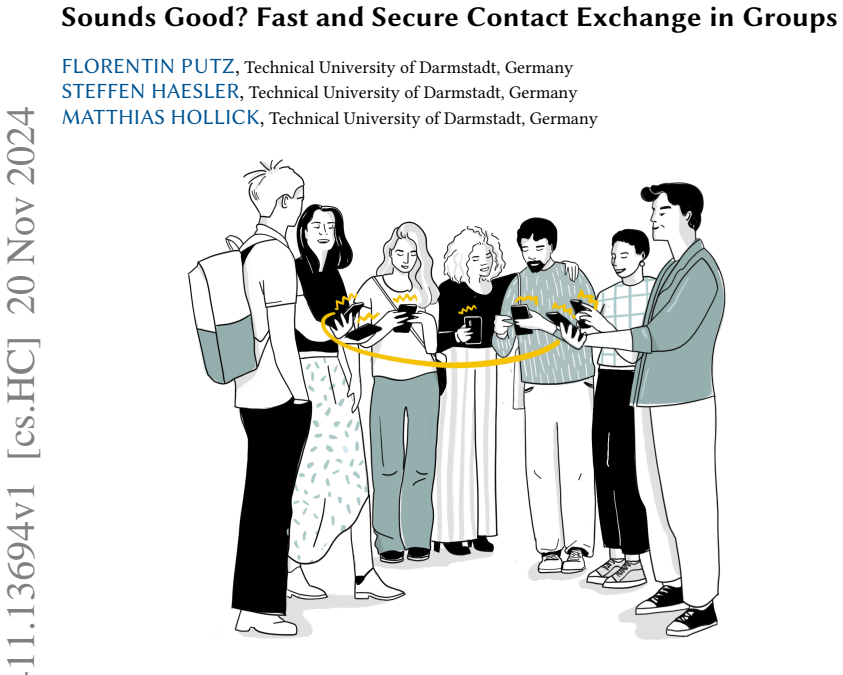
The load-bearing mechanism is the acoustic out-of-band channel, a location-limited sound link over which the coordinator's phone sends the WiFi Direct network credentials and, after the exchange, an acoustic hash of all participants' commitments and public keys. Because the channel is assumed authentic (eavesdroppable but not injectable), a matching green checkmark across devices replaces SafeSlinger's manual comparison of three-word phrases. Beneath that layer, PairSonic reuses SafeSlinger's hierarchical multi-value commitments and Group Diffie-Hellman key agreement, and the acoustic channel also carries longer hash values than SafeSlinger's 24-bit Short Authentication Strings, reducing collision risk without adding user effort.
What would settle it
Place a hidden speaker adjacent to a PairSonic group during the exchange and broadcast an altered acoustic hash; if any device displays the green checkmark and accepts the contacts, the authenticity assumption is falsified and PairSonic's security claim collapses.
Extended reading notes
Core claim
The paper's central claim is that secure contact exchange for groups can be made dramatically more usable without sacrificing security by automating the human verification steps with an acoustic out-of-band channel. PairSonic has one participant act as coordinator, enter the group size, and emit network details via sound; the other participants simply bring their phones near. After contact data and public keys are exchanged over a WiFi Direct network using SafeSlinger's commitment-based protocol, the coordinator broadcasts a hash of the aggregate data as an audible message, and each participant verifies a single bit: that all screens show the same green checkmark. In the study, PairSonic's SUS median was 85 versus SafeSlinger's 75 ($V=597.5$, $p=.004$, $r=-.43$), 31 of 45 participants preferred it ($p=.016$), and security ratings were statistically indistinguishable ($p=1$, $g=0$). The authors further state that PairSonic fulfills all security requirements of confidentiality, contact authentication, and collective pairwise security by inheriting SafeSlinger's cryptographic primitives and relying on the assumed authenticity of the acoustic channel.
Load-bearing premise
The load-bearing premise is that the acoustic out-of-band channel is authentic: an adversary can eavesdrop on it but cannot inject or modify messages undetected, and the paper supports this only by citing prior work on the physical constraints of sound rather than by analyzing PairSonic's own acoustic layer.
Editorial extensions
If this is right
- If PairSonic is adopted, secure group contact exchange no longer requires manual word-phrase comparisons or Internet connectivity; it works offline over a temporary WiFi Direct network.
- Group pairing scales better: only the coordinator enters the group size, so the per-user attentive effort does not grow quadratically with group size as in SafeSlinger.
- Automation reduces the risk from rushing users who skip comparisons, because the security of the exchange no longer depends on each user carefully reading and comparing phrases.
- Designers of automated authentication ceremonies face a usability-versus-perceived-security trade-off: minimal interaction can lower perceived security, so transparency and in-app education may be needed to maintain user trust.
- The acoustic channel allows longer verification hashes than SafeSlinger without burdening users, which reduces the practical risk of hash collisions during verification.
Reading between the lines
- Inference: The security guarantee is contingent on the acoustic channel's authenticity; a field study that tests whether ordinary room noise or a nearby attacker's speaker can make the green checkmark appear falsely would directly probe the paper's weakest link.
- Inference: PairSonic's usability advantage should grow with group size and with users who read slowly, since SafeSlinger's word-phrase comparison is the scaling bottleneck; a replication with larger groups (10 or more) and non-student participants would quantify this.
- Inference: The audible checkmark signal can be replaced by inaudible ultrasonic tones for quiet public settings; whether that removes the auditory reassurance some users liked is an open empirical question.
- Inference: PairSonic could serve as the physical-meeting bootstrap for a web of trust such as OpenPGP keysigning, so only one new group member needs a face-to-face exchange; the paper sketches this but does not implement it.
Editorial analysis
A structured set of objections, weighed in public.
Referee Report
Summary. This paper presents PairSonic, a group contact-exchange protocol that replaces SafeSlinger's manual phrase-comparison and lowest-ID steps with an acoustic out-of-band channel, and reports a within-subjects lab study (N=45, groups of 2-6) comparing the two systems. The main quantitative results are higher SUS for PairSonic (median 85 vs. 75, V=597.5, p=.004, r=-.43), a 69% preference for PairSonic (p=.016), no significant completion-time difference, and no significant difference in a single Likert-item security rating. Qualitative interviews indicate participants valued the reduced effort and the coordinator-based initialization, while some equated complexity with security. The authors conclude that PairSonic improves usability relative to the state of the art and discuss implications for CSCW scenarios.
Significance. The paper's intended contribution is an empirical usability comparison of a new acoustic group-pairing mechanism against an established protocol. If the usability finding holds, it is a useful result for CSCW and usable security: it operationalizes automated verification in a group setting, reports perceived-security effects, and ships an open-source implementation and a pseudonymized replication dataset. These artifacts are genuine strengths. However, the protocol's security claim is not established for the artifact as built: the acoustic channel's authenticity is assumed rather than verified, and the only security-relevant user check is a screen-level green-checkmark comparison. The centrality of the security claim in the title and Section 5.4.3 requires a major revision.
major comments (3)
- [Section 5.4.3, Section 2.3, Section 9.7, Section 5.3] Section 5.4.3 claims that PairSonic 'fulfills all security requirements of confidentiality, contact authentication, and collective pairwise security.' The preceding sections and Section 9.7 make clear that this rests on the acoustic out-of-band channel being authentic, an assumption stated in Section 2.3. The implemented physical layer, ggwave AUDIBLE_FAST (Section 5.3), is a bare FSK modem without per-message integrity protection, and Section 9.7 defers physical-layer integrity codes [89] to future work. Because the acoustic hash replaces SafeSlinger's user-compared phrases, an active adversary who can observe the WiFi traffic, substitute a victim's public key, compute the corresponding hash, and broadcast it while jamming the coordinator's audio could make every device show the same green checkmark; the remaining user check in Figure 2(c) only confirms that screens match, not that the audio originated from the coordinator. The paper should either provide a concrete authenticity analysis for the deployed physical layer or explicitly downgrade the security claim to conditional on a stated but unverified assumption.
- [Section 7.6, Section 10.2, Figure 11, Table 3] Section 7.6 reports that the order in which systems were encountered significantly correlates with SafeSlinger SUS, and Section 10.2 gives the order-specific medians (first PairSonic: SafeSlinger Mdn=67.5; first SafeSlinger: SafeSlinger Mdn=86.25). Since the headline usability result is the paired SUS difference (Table 3), a significant order effect on one condition means the reported aggregate comparison may confound intrinsic usability with presentation order. The counterbalancing reduces but does not eliminate this threat. Please report per-order comparisons or a mixed-effects model with order as a factor, and temper the causal wording of Section 7.1 ('PairSonic showed significantly better usability') accordingly.
- [Section 6.2.2, Section 9.7] Section 6.2.2 states that the 'active attack' was simulated by remotely disabling the protocol on one smartphone rather than by mounting an actual adversarial action. This is a reasonable usability probe, but it does not support the security-related statement in Section 9.7 that 'any WiFi interference attempt by the adversary ... would be futile, as PairSonic is designed to detect such modifications.' The study does not test detection of real acoustic-channel injection, and the simulated failure is observationally identical to a random crash. The manuscript should separate the usability observation (users react to a failure) from any empirical security validation, or report a real attack experiment.
minor comments (5)
- [Section 2.1, Section 7.5] There are several typos: Section 2.1 uses 'Usability Reqirements' instead of 'Usability Requirements,' and Section 7.5 contains 'Futhermore' instead of 'Furthermore.'
- [Section 10.2, Table 4] The order-effect discussion in Section 10.2 would be more informative with the actual statistical test results (e.g., correlation coefficient and p-value) tied to the medians, since Table 4 already reports a significant correlation between order and SafeSlinger SUS.
- [Appendix B.1, Section 7.2] The security perception measure is a single five-level item (Appendix B.1, item 11); the equal medians and g=0 may reflect low measurement precision. A validated multi-item perceived-security scale would strengthen RQ3.
- [Section 8.4.2] Section 8.4.2 mentions 'occasional protocol restarts due to failed acoustic transmissions' but does not quantify them; if available, reporting the number, group size, and conditions would help readers assess the reliability limitation.
- [Section 7.4] The completion-time analysis is based on only 12 groups (N=12), so the null result has low power; the text should state this explicitly rather than concluding that completion times are 'similar.'
Circularity Check
No significant circularity: usability findings are measured from participant data, and the security claim is a conditional assertion made under an explicit threat-model assumption, not a derivation from its own inputs.
full rationale
The paper's central derivation chain is empirical rather than formal. PairSonic's SUS score, preference share, security ratings, and completion times are measured outcomes from 45 participants, not quantities computed from the protocol's design parameters. The claim 'PairSonic is significantly more usable than SafeSlinger' (Section 7.1) is therefore not forced by construction; participants could in principle have disliked the automation. The security claim in Section 5.4.3 ('PairSonic thus fulfills all security requirements of confidentiality, contact authentication, and collective pairwise security') is an assertion that inherits SafeSlinger's cryptographic guarantees under the acoustic OOB channel authenticity assumption stated in Section 2.3: 'while adversaries can eavesdrop on this channel, they cannot transmit undetected.' This is a threat-model premise, not a conclusion derived from the premise, so it is not self-definitional in the paper's own framing. Section 9.7 explicitly concedes that a comprehensive security analysis is out of scope and that physical-layer integrity techniques from the authors' prior work [89] 'could' be incorporated in future work to 'enhance or replace the current ggwave physical layer,' which confirms that the implemented prototype does not rely on that self-citation for its current guarantee. The self-citation [89] (and the related [90], [91]) is present but not load-bearing for the measured usability result, and the security discussion itself labels the integrity mechanism as future work. Accordingly, there is no equation-level reduction, no fitted parameter renamed as a prediction, and no uniqueness argument imported from the authors' prior work. The main risk is a scoping/correctness concern about the unverified acoustic-channel authenticity assumption, which the paper itself discloses; that is not circularity.
Assumptions & free parameters
assumptions (4)
- domain assumption All users are physically co-located and can perform group demonstrative identification.
- domain assumption The acoustic OOB channel is authentic: adversaries can eavesdrop but cannot transmit undetected.
- domain assumption SafeSlinger's cryptographic protocol is secure (hierarchical multi-value commitments and Group Diffie-Hellman).
- domain assumption Participants accurately determine the group size and verify that received contacts match intended participants.
Cite this review
Pith. "Pith review of Sounds Good? Fast and Secure Contact Exchange in Groups." pith.science (2026). https://pith.science/paper/JHTJJA2H
@misc{pith2026241113694,
  author       = {Pith},
  title        = {Pith review of: Sounds Good? Fast and Secure Contact Exchange in Groups},
  year         = {2026},
  howpublished = {\url{https://pith.science/paper/JHTJJA2H}},
  note         = {Machine review of arXiv:2411.13694}
}
read the original abstract
Trustworthy digital communication requires the secure exchange of contact information, but current approaches lack usability and scalability for larger groups of users. We evaluate the usability of two secure contact exchange systems: the current state of the art, SafeSlinger, and our newly designed protocol, PairSonic, which extends trust from physical encounters to spontaneous online communication. Our lab study (N=45) demonstrates PairSonic's superior usability, automating the tedious verification tasks from previous approaches via an acoustic out-of-band channel. Although participants significantly preferred our system, minimizing user effort surprisingly decreased the perceived security for some users, who associated security with complexity. We discuss user perceptions of the different protocol components and identify remaining usability barriers for CSCW application scenarios.
Figures


Figures from the paper (8 more)


Reference graph
Works this paper leans on
-
[89]
Florentin Putz, Flor Álvarez, and Jiska Classen. 2020. Acoustic Integrity Codes: Secure Device Pairing Using Short- Range Acoustic Communication. In Proceedings of the 13th ACM Conference on Security and Privacy in Wireless and Mobile Networks. 31–41. https://doi.org/10.1145/3395351.3399420
-
[1]
Michel Abdalla, Emmanuel Bresson, Olivier Chevassut, and David Pointcheval. 2006. Password-Based Group Key Exchange in a Constant Number of Rounds. In Public Key Cryptography - PKC 2006 (Lecture Notes in Computer Science), Moti Yung, Yevgeniy Dodis, Aggelos Kiayias, and Tal Malkin (Eds.). Springer, Berlin, Heidelberg, 427–442. https://doi.org/10.1007/11745853_28
-
[2]
Angela Sasse, Joseph Bonneau, Anastasia Danilova, Alena Naiakshina, and Matthew Smith
Ruba Abu-Salma, M. Angela Sasse, Joseph Bonneau, Anastasia Danilova, Alena Naiakshina, and Matthew Smith. 2017. Obstacles to the Adoption of Secure Communication Tools. In 2017 IEEE Symposium on Security and Privacy (SP) . 137–153. https://doi.org/10.1109/SP.2017.65
-
[3]
N Asokan and Philip Ginzboorg. 2000. Key Agreement in Ad Hoc Networks. Computer Communications 23, 17 (Nov. 2000), 1627–1637. https://doi.org/10.1016/S0140-3664(00)00249-8
-
[4]
Hala Assal, Stephanie Hurtado, Ahsan Imran, and Sonia Chiasson. 2015. What’s the Deal with Privacy Apps? A Comprehensive Exploration of User Perception and Usability. In Proceedings of the 14th International Conference on Mobile and Ubiquitous Multimedia (MUM ’15) . Association for Computing Machinery, New York, NY, USA, 25–36. https://doi.org/10.1145/283...
arXiv 2015
-
[5]
Smetters, Paul Stewart, and H
Dirk Balfanz, Diana K. Smetters, Paul Stewart, and H. Chi Wong. 2002. Talking to Strangers: Authentication in Ad-Hoc Wireless Networks. In NDSS Symposium
2002
-
[6]
Matt Blaze, Joan Feigenbaum, and Jack Lacy. 1996. Decentralized Trust Management. In Proceedings 1996 IEEE Symposium on Security and Privacy . 164–173. https://doi.org/10.1109/SECPRI.1996.502679
arXiv 1996
-
[7]
John Brooke. 1996. SUS: A Quick and Dirty Usability Scale. Usability Evaluation in Industry (1996)
1996
Show all 128 references
-
[8]
Mike Burmester and Yvo G. Desmedt. 1997. Efficient and Secure Conference-Key Distribution. In Security Protocols (Lecture Notes in Computer Science), Mark Lomas (Ed.). Springer, Berlin, Heidelberg, 119–129. https://doi.org/10.1007/3- 540-62494-5_12
1997 doi
-
[9]
Germano Caronni. 2000. Walking the Web of Trust. In Proceedings IEEE 9th International Workshops on Enabling Technologies: Infrastructure for Collaborative Enterprises (WET ICE 2000) . 153–158. https://doi.org/10.1109/ENABL. 2000.883720
2000
-
[10]
Bin Chen, Koki Hatada, Keiju Okabayashi, Hiroyuki Kuromiya, Ichiro Hidaka, Yoshiharu Yamamoto, and Kazumasa Togami. 2019. Group Activity Recognition to Support Collaboration in Creative Digital Space. In Companion Publication of the 2019 Conference on Computer-Supported Cooper...
2019
-
[11]
McCune, Ahren Studer, Adrian Perrig, Bo-Yin Yang, and Tzong-Chen Wu
Chia-Hsin Owen Chen, Chung-Wei Chen, Cynthia Kuo, Yan-Hao Lai, Jonathan M. McCune, Ahren Studer, Adrian Perrig, Bo-Yin Yang, and Tzong-Chen Wu. 2008. GAnGS: Gather, Authenticate ’n Group Securely. InProceedings of the 14th ACM International Conference on Mobile Computing and N...
2008
-
[13]
Ming Ki Chong and Hans Gellersen. 2012. Usability Classification for Spontaneous Device Association. Personal and Ubiquitous Computing 16, 1 (Jan. 2012), 77–89. https://doi.org/10.1007/s00779-011-0421-1
2012 doi
-
[14]
Gellersen
Ming Ki Chong and Hans W. Gellersen. 2013. How Groups of Users Associate Wireless Devices. In Proceedings of the SIGCHI Conference on Human Factors in Computing Systems (CHI ’13) . Association for Computing Machinery, New York, NY, USA, 1559–1568. https://doi.org/10.1145/24706...
2013
-
[15]
Ming Ki Chong, Fahim Kawsar, and Hans Gellersen. 2011. Spatial Co-Location for Device Association: The Connected Object Way. In Proceedings of the 2011 International Workshop on Networking and Object Memories for the Internet of Things (NoME-IoT ’11). Association for Computing...
2011
-
[16]
Ming Ki Chong, Rene Mayrhofer, and Hans Gellersen. 2014. A Survey of User Interaction for Spontaneous Device Association. Comput. Surveys 47, 1 (May 2014), 8:1–8:40. https://doi.org/10.1145/2597768 Proc. ACM Hum.-Comput. Interact., Vol. 8, No. CSCW2, Article 425. Publication d...
2014 doi
-
[17]
Jacob Cohen. 1992. A power primer. Psychological bulletin 112(1) (1992), 155–159
1992
-
[18]
de Freitas and Anind K
Adrian A. de Freitas and Anind K. Dey. 2015. The Group Context Framework: An Extensible Toolkit for Opportunistic Grouping and Collaboration. In Proceedings of the 18th ACM Conference on Computer-Supported Cooperative Work & Social Computing (CSCW ’15) . Association for Comput...
2015
-
[19]
Sergej Dechand, Yasemin Acar, Dominik Schurmann, Sascha Fahl, Karoline Busse, and Matthew Smith. 2016. An Empirical Study of Textual Key-Fingerprint Representations. USENIX Security (2016)
2016
-
[20]
Danny Dolev and Andrew Yao. 1983. On the Security of Public Key Protocols. IEEE Transactions on Information Theory 29, 2 (March 1983), 198–208. https://doi.org/10.1109/TIT.1983.1056650
1983
-
[21]
John R. Douceur. 2002. The Sybil Attack. In Peer-to-Peer Systems (Lecture Notes in Computer Science) , Peter Druschel, Frans Kaashoek, and Antony Rowstron (Eds.). Springer, Berlin, Heidelberg, 251–260. https://doi.org/10.1007/3-540- 45748-8_24
2002 doi
-
[22]
Keith Edwards, Mark W
W. Keith Edwards, Mark W. Newman, Jana Z. Sedivy, Trevor F. Smith, Dirk Balfanz, D. K. Smetters, H. Chi Wong, and Shahram Izadi. 2002. Using Speakeasy for Ad Hoc Peer-to-Peer Collaboration. In Proceedings of the 2002 ACM Conference on Computer-Supported Cooperative Work (CSCW ...
2002
-
[23]
Michael Farb, Yue-Hsun Lin, Tiffany Hyun-Jin Kim, Jonathan McCune, and Adrian Perrig. 2013. SafeSlinger: Easy-to- Use and Secure Public-Key Exchange. In Proceedings of the 19th Annual International Conference on Mobile Computing & Networking (MobiCom ’13) . Association for Com...
2013
-
[24]
Habiba Farrukh, Muslum Ozmen, Faik Ors, and Berkay Celik. 2023. One Key to Rule Them All: Secure Group Pairing for Heterogeneous IoT Devices. In IEEE S&P 2023 . https://www.computer.org/csdl/proceedings-article/sp/2023/ 933600b693/1Js0EfOauaI
2023
-
[25]
Matthias Fassl, Lea Theresa Gröber, and Katharina Krombholz. 2021. Exploring User-Centered Security Design for Usable Authentication Ceremonies. In Proceedings of the 2021 CHI Conference on Human Factors in Computing Systems (CHI ’21). Association for Computing Machinery, New ...
2021
-
[26]
Matthias Fassl and Katharina Krombholz. 2023. Why I Can’t Authenticate — Understanding the Low Adoption of Authentication Ceremonies with Autoethnography. In Proceedings of the 2023 CHI Conference on Human Factors in Computing Systems (CHI ’23) . Hamburg, Germany. https://publ...
2023
-
[27]
Thayer, and Daphne Shaw
Hal Finney, Lutz Donnerhacke, Jon Callas, Rodney L. Thayer, and Daphne Shaw. 2007. OpenPGP Message Format. Request for Comments RFC 4880. Internet Engineering Task Force. https://doi.org/10.17487/RFC4880
2007 doi
-
[28]
Mikhail Fomichev, Flor Alvarez, Daniel Steinmetzer, Paul Gardner-Stephen, and Matthias Hollick. 2018. Survey and Systematization of Secure Device Pairing. IEEE Communications Surveys & Tutorials 20, 1 (2018), 517–550. https://doi.org/10.1109/COMST.2017.2748278
2018
-
[29]
Mikhail Fomichev, Max Maass, Lars Almon, Alejandro Molina, and Matthias Hollick. 2019. Perils of Zero-Interaction Security in the Internet of Things. Proc. ACM Interact. Mob. Wearable Ubiquitous Technol. 3, 1, Article 10 (mar 2019), 38 pages. https://doi.org/10.1145/3314397
2019 doi
-
[30]
Lesley Fosh, Steve Benford, and Boriana Koleva. 2016. Supporting Group Coherence in a Museum Visit. InProceedings of the 19th ACM Conference on Computer-Supported Cooperative Work & Social Computing (CSCW ’16) . Association for Computing Machinery, New York, NY, USA, 1–12. htt...
2016
-
[31]
Thomas Franke, Christiane Attig, and Daniel Wessel. 2019. A Personal Resource for Technology Interaction: Develop- ment and Validation of the Affinity for Technology Interaction (ATI) Scale.International Journal of Human–Computer Interaction (2019)
2019
-
[32]
Vadim Gerasimov and Walter Bender. 2000. Things That Talk: Using Sound for Device-to-Device and Device-to-Human Communication. IBM Systems Journal 39, 3.4 (2000), 530–546–530–546. https://doi.org/10.1147/sj.393.0530
2000 doi
-
[33]
Lyon, and Rif A
Pascal Getreuer, Chet Gnegy, Richard F. Lyon, and Rif A. Saurous. 2018/june. Ultrasonic Communication Using Consumer Hardware. IEEE Transactions on Multimedia 20, 6 (2018/june), 1277–1290. https://doi.org/10.1109/TMM. 2017.2766049
2018
-
[34]
Nirnimesh Ghose, Loukas Lazos, and Ming Li. 2017. HELP: Helper-Enabled in-Band Device Pairing Resistant against Signal Cancellation. InProceedings of the 26th USENIX Conference on Security Symposium (SEC’17). USENIX Association, USA, 433–450
2017
-
[35]
Nirnimesh Ghose, Loukas Lazos, and Ming Li. 2018. Secure Device Bootstrapping Without Secrets Resistant to Signal Manipulation Attacks. In 2018 IEEE Symposium on Security and Privacy (SP) . 819–835. https://doi.org/10.1109/SP. 2018.00055
2018
-
[36]
Nirnimesh Ghose, Loukas Lazos, and Ming Li. 2022. In-Band Secret-Free Pairing for COTS Wireless Devices. IEEE Transactions on Mobile Computing 21, 2 (Feb. 2022), 612–628. https://doi.org/10.1109/TMC.2020.3015010 Proc. ACM Hum.-Comput. Interact., Vol. 8, No. CSCW2, Article 425....
2022
-
[37]
Dan Goodin. 2018. Police Decrypt 258,000 Messages after Breaking Pricey IronChat Crypto App. https://arstechnica.com/ information-technology/2018/11/police-decrypt-258000-messages-after-breaking-pricey-ironchat-crypto-app/ [Re- trieved 2024-01-07]
2018
-
[38]
Goodrich, Michael Sirivianos, John Solis, Claudio Soriente, Gene Tsudik, and Ersin Uzun
Michael T. Goodrich, Michael Sirivianos, John Solis, Claudio Soriente, Gene Tsudik, and Ersin Uzun. 2009/february. Using Audio in Secure Device Pairing. Int. J. Secur. Netw. 4, 1/2 (2009/february), 57–68–57–68. https://doi.org/10. 1504/IJSN.2009.023426
2009 arXiv
-
[39]
Goodrich, Michael Sirivianos, John Solis, Gene Tsudik, and Ersin Uzun
Michael T. Goodrich, Michael Sirivianos, John Solis, Gene Tsudik, and Ersin Uzun. 2006. Loud and Clear: Human- Verifiable Authentication Based on Audio. In26th IEEE International Conference on Distributed Computing Systems (ICDCS. IEEE. https://doi.org/10.1109/icdcs.2006.52
2006 doi
-
[40]
Jens Emil Grønbæk, Mille Skovhus Knudsen, Kenton O’Hara, Peter Gall Krogh, Jo Vermeulen, and Marianne Graves Petersen. 2020. Proxemics Beyond Proximity: Designing for Flexible Social Interaction Through Cross-Device Interaction. In Proceedings of the 2020 CHI Conference on Hum...
2020
-
[41]
Dianqi Han, Ang Li, Jiawei Li, Yan Zhang, Tao Li, and Yanchao Zhang. 2021. DroneKey: A Drone-Aided Group-Key Generation Scheme for Large-Scale IoT Networks. In Proceedings of the 2021 ACM SIGSAC Conference on Computer and Communications Security (CCS ’21) . Association for Com...
2021
-
[42]
Herbsleb
Mark Handel and James D. Herbsleb. 2002. What Is Chat Doing in the Workplace?. In Proceedings of the 2002 ACM Conference on Computer Supported Cooperative Work (CSCW ’02) . Association for Computing Machinery, New York, NY, USA, 1–10. https://doi.org/10.1145/587078.587080
2002
-
[43]
Mahboobeh Harandi. 2019. Supporting Occasional Groups in Crowdsourcing Platforms. In Companion Publication of the 2019 Conference on Computer-Supported Cooperative Work & Social Computing (CSCW ’19 Companion) . Association for Computing Machinery, New York, NY, USA, 52–55. htt...
2019
-
[44]
Amir Herzberg and Hemi Leibowitz. 2016. Can Johnny Finally Encrypt? Evaluating E2E-encryption in Popular IM Applications. In Proceedings of the 6th Workshop on Socio-Technical Aspects in Security and Trust (STAST ’16) . Association for Computing Machinery, New York, NY, USA, 1...
2016
-
[45]
Amir Herzberg, Hemi Leibowitz, Kent Seamons, Elham Vaziripour, Justin Wu, and Daniel Zappala. 2021. Secure Messaging Authentication Ceremonies Are Broken. IEEE Security & Privacy 19, 2 (March 2021), 29–37. https: //doi.org/10.1109/MSEC.2020.3039727
2021
-
[46]
Yantian Hou, Ming Li, and Joshua D. Guttman. 2013. Chorus: Scalable In-band Trust Establishment for Multiple Constrained Devices over the Insecure Wireless Channel. In Proceedings of the Sixth ACM Conference on Security and Privacy in Wireless and Mobile Networks . ACM, 167–17...
2013
-
[48]
Tero Jokela, Ming Ki Chong, Andrés Lucero, and Hans Gellersen. 2015. Connecting Devices for Collaborative Interactions. Interactions 22, 4 (June 2015), 39–43. https://doi.org/10.1145/2776887
2015 doi
-
[49]
Tero Jokela and Andrés Lucero. 2013. A Comparative Evaluation of Touch-Based Methods to Bind Mobile Devices for Collaborative Interactions. In Proceedings of the SIGCHI Conference on Human Factors in Computing Systems (CHI ’13) . Association for Computing Machinery, New York, ...
2013
-
[50]
Tero Jokela and Andrés Lucero. 2014. FlexiGroups: Binding Mobile Devices for Collaborative Interactions in Medium- Sized Groups with Device Touch. In Proceedings of the 16th International Conference on Human-computer Interaction with Mobile Devices & Services (MobileHCI ’14) ....
2014
-
[51]
Tero Jokela, Parisa Pour Rezaei, and Kaisa Väänänen. 2016. Natural Group Binding and Cross-Display Object Movement Methods for Wearable Devices. In Proceedings of the 18th International Conference on Human-Computer Interaction with Mobile Devices and Services (MobileHCI ’16) ....
2016
-
[52]
Daniel Jones. 2022. How Near-Ultrasonic Audio Adds Spatial Awareness to the Sonos System. https://tech- blog.sonos.com/posts/how-near-ultrasonic-audio-adds-spatial-awareness-to-the-sonos-system/ [Retrieved 2024-01- 07]
2022
-
[53]
Ronald Kainda, Ivan Flechais, and A. W. Roscoe. 2009. Usability and Security of Out-of-Band Channels in Secure Device Pairing Protocols. In Proceedings of the 5th Symposium on Usable Privacy and Security (SOUPS ’09) . Association for Computing Machinery, New York, NY, USA, 1–1...
2009
-
[54]
Ronald Kainda, Ivan Flechais, and A. W. Roscoe. 2010. Two Heads Are Better than One: Security and Usability of Device Associations in Group Scenarios. In Proceedings of the Sixth Symposium on Usable Privacy and Security (SOUPS Proc. ACM Hum.-Comput. Interact., Vol. 8, No. CSCW...
2010
-
[55]
Maurice G. Kendall. 1938. A New Measure of Rank Correlation. Biometrika 30 (1938)
1938
-
[56]
Sye Loong Keoh, Emil Lupu, and Morris Sloman. 2009. Securing Body Sensor Networks: Sensor Association and Key Management. In 2009 IEEE International Conference on Pervasive Computing and Communications . 1–6. https: //doi.org/10.1109/PERCOM.2009.4912756
2009
-
[57]
Tim Kindberg and Armando Fox. 2002. System Software for Ubiquitous Computing. IEEE Pervasive Computing 1, 1 (Jan. 2002), 70–81. https://doi.org/10.1109/MPRV.2002.993146
2002
-
[58]
Darko Kirovski, Michael Sinclair, and David Wilson. 2007. The Martini Synch: Device Pairing via Joint Quantization. In 2007 IEEE International Symposium on Information Theory . 466–470. https://doi.org/10.1109/ISIT.2007.4557269
2007
-
[59]
Alfred Kobsa, Rahim Sonawalla, Gene Tsudik, Ersin Uzun, and Yang Wang. 2009. Serial Hook-Ups: A Comparative Usability Study of Secure Device Pairing Methods. In Proceedings of the 5th Symposium on Usable Privacy and Security (SOUPS ’09). Association for Computing Machinery, Ne...
2009 doi
-
[60]
Tonko Kovačević, Toni Perković, and Mario Čagalj. 2016. Flashing Displays: User-Friendly Solution for Bootstrapping Secure Associations between Multiple Constrained Wireless Devices. Security and Communication Networks 9, 10 (2016), 1050–1071. https://doi.org/10.1002/sec.1400
2016 doi
-
[61]
Christian Kray, Daniel Nesbitt, John Dawson, and Michael Rohs. 2010. User-Defined Gestures for Connecting Mobile Phones, Public Displays, and Tabletops. In Proceedings of the 12th International Conference on Human Computer Interaction with Mobile Devices and Services (MobileHC...
2010
-
[62]
Arun Kumar, Nitesh Saxena, Gene Tsudik, and Ersin Uzun. 2009. A Comparative Study of Secure Device Pairing Methods. Pervasive and Mobile Computing 5, 6 (Dec. 2009), 734–749. https://doi.org/10.1016/j.pmcj.2009.07.008
2009 doi
-
[63]
Cynthia Kuo, Mark Luk, Rohit Negi, and Adrian Perrig. 2007. Message-in-a-Bottle: User-Friendly and Secure Key Deployment for Sensor Nodes. In Proceedings of the 5th International Conference on Embedded Networked Sensor Systems (SenSys ’07) . Association for Computing Machinery...
2007
-
[64]
Cynthia Kuo, Ahren Studer, and Adrian Perrig. 2008. Mind Your Manners: Socially Appropriate Wireless Key Establishment for Groups. In Proceedings of the First ACM Conference on Wireless Network Security (WiSec ’08) . Association for Computing Machinery, New York, NY, USA, 125–...
2008
-
[65]
Sven Laur and Sylvain Pasini. 2008. SAS-Based Group Authentication and Key Agreement Protocols. In Public Key Cryptography – PKC 2008 (Lecture Notes in Computer Science) , Ronald Cramer (Ed.). Springer, Berlin, Heidelberg, 197–213. https://doi.org/10.1007/978-3-540-78440-1_12
2008 doi
-
[66]
Yee Wei Law, Giorgi Moniava, Zheng Gong, Pieter Hartel, and Marimuthu Palaniswami. 2011. KALwEN: A New Practical and Interoperable Key Management Scheme for Body Sensor Networks. Security and Communication Networks 4, 11 (Nov. 2011), 1309–1329. https://doi.org/10.1002/sec.256
2011 doi
-
[67]
Kim, Jun W
Hyewon Lee, Tae H. Kim, Jun W. Choi, and Sunghyun Choi. 2015/april. Chirp Signal-Based Aerial Acoustic Commu- nication for Smart Devices. In INFOCOM. 2407–2415. https://doi.org/10.1109/INFOCOM.2015.7218629
2015
-
[68]
Ada Lerner, Eric Zeng, and Franziska Roesner. 2017. Confidante: Usable Encrypted Email: A Case Study with Lawyers and Journalists. In 2017 IEEE European Symposium on Security and Privacy (EuroS&P) . 385–400. https: //doi.org/10.1109/EuroSP.2017.41
2017 doi
-
[69]
Ian Levy and Crispin Robinson. 2018. Principles for a More Informed Exceptional Access Debate . https://www. lawfaremedia.org/article/principles-more-informed-exceptional-access-debate [Retrieved 2024-01-07]
2018
-
[70]
Ming Li, Shucheng Yu, Wenjing Lou, and Kui Ren. 2010. Group Device Pairing Based Secure Sensor Association and Key Management for Body Area Networks. In 2010 Proceedings IEEE INFOCOM . 1–9. https://doi.org/10.1109/ INFCOM.2010.5462095
2010
-
[71]
Xiaopeng Li, Qiang Zeng, Lannan Luo, and Tongbo Luo. 2020. T2Pair: Secure and Usable Pairing for Heterogeneous IoT Devices. In Proceedings of the 2020 ACM SIGSAC Conference on Computer and Communications Security (CCS ’20) . Association for Computing Machinery, New York, NY, U...
2020
-
[72]
McCune, King-Hang Wang, Maxwell Krohn, Adrian Perrig, Bo-Yin Yang, Hung-Min Sun, Phen-Lan Lin, and Jason Lee
Yue-Hsun Lin, Ahren Studer, Yao-Hsin Chen, Hsu-Chun Hsiao, Li-Hsiang Kuo, Jonathan M. McCune, King-Hang Wang, Maxwell Krohn, Adrian Perrig, Bo-Yin Yang, Hung-Min Sun, Phen-Lan Lin, and Jason Lee. 2010. SPATE: Small-Group PKI-Less Authenticated Trust Establishment. IEEE Transac...
2010 doi
-
[73]
McCune, King-Hang Wang, Maxwell Krohn, Phen-Lan Lin, Adrian Perrig, Hung-Min Sun, and Bo-Yin Yang
Yue-Hsun Lin, Ahren Studer, Hsu-Chin Hsiao, Jonathan M. McCune, King-Hang Wang, Maxwell Krohn, Phen-Lan Lin, Adrian Perrig, Hung-Min Sun, and Bo-Yin Yang. 2009. SPATE: Small-Group PKI-less Authenticated Trust Establishment. In Proceedings of the 7th International Conference on...
2009
-
[74]
Lopes and Pedro M
Cristina V. Lopes and Pedro M. Q. Aguiar. 2003/july. Acoustic Modems for Ubiquitous Computing. IEEE Pervasive Computing 2, 3 (2003/july), 62–71. https://doi.org/10.1109/MPRV.2003.1228528
2003
-
[75]
Fischer, Stuart Reeves, and Olof Torgersson
Sus Lundgren, Joel E. Fischer, Stuart Reeves, and Olof Torgersson. 2015. Designing Mobile Experiences for Collocated Interaction. In Proceedings of the 18th ACM Conference on Computer Supported Cooperative Work & Social Computing (CSCW ’15). Association for Computing Machinery...
2015 doi
-
[76]
Anil Madhavapeddy, David Scott, and Richard Sharp. 2003. Context-Aware Computing with Sound. In UbiComp 2003: Ubiquitous Computing (Lecture Notes in Computer Science) , Anind K. Dey, Albrecht Schmidt, and Joseph F. McCarthy (Eds.). Springer, Berlin, Heidelberg, 315–332. https:...
2003 doi
-
[77]
Rene Mayrhofer and Hans Gellersen. 2009. Shake Well Before Use: Intuitive and Secure Pairing of Mobile Devices. IEEE Transactions on Mobile Computing 8, 6 (June 2009), 792–806. https://doi.org/10.1109/TMC.2009.51
2009 doi
-
[78]
Adib Mehrabi, Antonella Mazzoni, Daniel Jones, and Anthony Steed. 2019. Evaluating the User Experience of Acoustic Data Transmission. Personal and Ubiquitous Computing (Dec. 2019), 1–14–1–14. https://doi.org/10.1007/s00779-019- 01345-7
2019 doi
-
[79]
Merriam and Elizabeth J
Sharan B. Merriam and Elizabeth J. Tisdell. 2015. Qualitative Research: A Guide to Design and Implementation . John Wiley & Sons
2015
-
[80]
Meta. 2009. WhatsApp. https://whatsapp.com [Software]
2009
-
[81]
Ghita Mezzour, Ahren Studer, Michael Farb, Jason Lee, Jonathan McCune, Hsu-Chun Hsiao, and Adrian Perrig. 2010. Ho-Po Key: Leveraging Physical Constraints on Human Motion to Authentically Exchange Information in a Group . Technical Report CMU-CyLab-11-004. Carnegie Mellon University
2010
-
[82]
Knijnenburg
Moses Namara and Bart P. Knijnenburg. 2021. The Differential Effect of Privacy-Related Trust on Groupware Application Adoption and Use during the COVID-19 Pandemic. Proceedings of the ACM on Human-Computer Interaction 5, CSCW2 (Oct. 2021), 405:1–405:34. https://doi.org/10.1145/3479549
2021 doi
-
[83]
Chintalapudi, Venkat Padmanabhan, and Ramarathnam Venkatesan
Rajalakshmi Nandakumar, Krishna K. Chintalapudi, Venkat Padmanabhan, and Ramarathnam Venkatesan. 2013. Dhwani: Secure Peer-to-Peer Acoustic NFC. ACM SIGCOMM Computer Communication Review 43, 4 (Aug. 2013), 63–74–63–74. https://doi.org/10.1145/2534169.2486037
2013
-
[84]
Nguyen and Andrew W
Long H. Nguyen and Andrew W. Roscoe. 2008. Authenticating Ad Hoc Networks by Comparison of Short Digests. Information and Computation 206, 2 (Feb. 2008), 250–271. https://doi.org/10.1016/j.ic.2007.07.010
2008 doi
-
[85]
Rishab Nithyanand, Nitesh Saxena, Gene Tsudik, and Ersin Uzun. 2010. Groupthink: Usability of Secure Group Association for Wireless Devices. In Proceedings of the 12th ACM International Conference on Ubiquitous Computing (UbiComp ’10). Association for Computing Machinery, New ...
2010 doi
-
[86]
Sean Oesch, Ruba Abu-Salma, Oumar Diallo, Juliane Krämer, James Simmons, Justin Wu, and Scott Ruoti. 2022. User Perceptions of Security and Privacy for Group Chat. Digital Threats: Research and Practice 3, 2 (Feb. 2022), 15:1–15:29. https://doi.org/10.1145/3491265
2022 doi
-
[87]
Karl Pearson. 1900. X. On the criterion that a given system of deviations from the probable in the case of a correlated system of variables is such that it can be reasonably supposed to have arisen from random sampling. The London, Edinburgh, and Dublin Philosophical Magazine ...
1900
-
[88]
Toni Perković, Mario Čagalj, Toni Mastelić, Nitesh Saxena, and Dinko Begušić. 2012. Secure Initialization of Multiple Constrained Wireless Devices for an Unaided User. IEEE Transactions on Mobile Computing 11, 2 (2012), 337–351. https://doi.org/10.1109/TMC.2011.35
2012 doi
-
[90]
Florentin Putz, Steffen Haesler, and Matthias Hollick. 2024. Lab Study Dataset: Fast and Secure Contact Exchange in Groups. https://doi.org/10.5281/zenodo.13324112 [Dataset]
2024 doi
-
[91]
Florentin Putz, Steffen Haesler, Thomas Völkl, Maximilian Gehring, Nils Rollshausen, and Matthias Hollick. 2024. PairSonic: Helping Groups Securely Exchange Contact Information. In Companion Publication of the 2024 Conference on Computer-Supported Cooperative Work & Social Com...
2024
-
[92]
R Core Team. 2023. R: A Language and Environment for Statistical Computing . R Foundation for Statistical Computing
2023
-
[94]
Robert Rosenthal. 1991. Meta-Analytic Procedures for Social Research. Sage Publications, Inc
1991
-
[95]
Jeffrey Rubin and Dana Chrisnell. 2008. Handbook of Usability Testing (second edition ed.). Wiley Publishing, Inc. Proc. ACM Hum.-Comput. Interact., Vol. 8, No. CSCW2, Article 425. Publication date: November 2024. Sounds Good? Fast and Secure Contact Exchange in Groups 425:39
2008
-
[96]
We’re on the Same Page
Scott Ruoti, Jeff Andersen, Scott Heidbrink, Mark O’Neill, Elham Vaziripour, Justin Wu, Daniel Zappala, and Kent Seamons. 2016. "We’re on the Same Page": A Usability Study of Secure Email Using Pairs of Novice Users. In Proceedings of the 2016 CHI Conference on Human Factors i...
2016
-
[97]
Scott Ruoti, Nathan Kim, Ben Burgon, Timothy van der Horst, and Kent Seamons. 2013. Confused Johnny: When Automatic Encryption Leads to Confusion and Mistakes. In Proceedings of the Ninth Symposium on Usable Privacy and Security (SOUPS ’13) . Association for Computing Machiner...
2013
-
[98]
Enrico Santagati and Tommaso Melodia
G. Enrico Santagati and Tommaso Melodia. 2015. U-Wear: Software-Defined Ultrasonic Networking for Wearable Devices. In Proceedings of the 13th Annual International Conference on Mobile Systems, Applications, and Services . ACM, 241–256–241–256. https://doi.org/10.1145/2742647.2742655
2015
-
[99]
Borhan Uddin
Nitesh Saxena and Md. Borhan Uddin. 2009. Blink ’Em All: Scalable, User-Friendly and Secure Initialization of Wireless Sensor Nodes. In Cryptology and Network Security (Lecture Notes in Computer Science) , Juan A. Garay, Atsuko Miyaji, and Akira Otsuka (Eds.). Springer, Berlin...
2009 doi
-
[100]
Svenja Schröder, Markus Huber, David Wind, and Christoph Rottermanner. 2016. When SIGNAL Hits the Fan: On the Usability and Security of State-of-the-Art Secure Mobile Messaging. In EuroUSEC
2016
-
[101]
Shapiro and Martin B
Samuel S. Shapiro and Martin B. Wilk. 1965. An analysis of variance test for normality (complete samples).Biometrika 52 (1965)
1965
-
[102]
Maliheh Shirvanian and Nitesh Saxena. 2015. On the Security and Usability of Crypto Phones. In Proceedings of the 31st Annual Computer Security Applications Conference (ACSAC ’15) . Association for Computing Machinery, New York, NY, USA, 21–30. https://doi.org/10.1145/2818000.2818007
2015
-
[103]
Maliheh Shirvanian, Nitesh Saxena, and Jesvin James George. 2017. On the Pitfalls of End-to-End Encrypted Communications: A Study of Remote Key-Fingerprint Verification. In Proceedings of the 33rd Annual Computer Security Applications Conference (ACSAC ’17). Association for Co...
2017
-
[104]
Erica Shusas, Patrick Skeba, Eric P. S. Baumer, and Andrea Forte. 2023. Accounting for Privacy Pluralism: Lessons and Strategies from Community-Based Privacy Groups. In Proceedings of the 2023 CHI Conference on Human Factors in Computing Systems (CHI ’23) . Association for Com...
2023
-
[105]
Sidney Siegel. 1956. Nonparametric statistics for the behavioral sciences . McGraw-Hill, New York
1956
-
[106]
Signal Foundation. 2014. Signal. https://signal.org [Software]
2014
-
[107]
Claudio Soriente, Gene Tsudik, and Ersin Uzun. 2008. HAPADEP: Human-Assisted Pure Audio Device Pairing. In Information Security, Tzong-Chen Wu, Chin-Laung Lei, Vincent Rijmen, and Der-Tsai Lee (Eds.). Springer Berlin Heidelberg, 385–400–385–400. https://doi.org/10.1007/978-3-5...
2008 doi
-
[108]
Frank Stajano and Ross Anderson. 2000. The Resurrecting Duckling: Security Issues for Ad-hoc Wireless Networks. In Security Protocols (Lecture Notes in Computer Science) , Bruce Christianson, Bruno Crispo, James A. Malcolm, and Michael Roe (Eds.). Springer, Berlin, Heidelberg,...
2000 doi
-
[109]
Ahren Studer, Christina Johns, Jaanus Kase, Kyle O’Meara, and Lorrie Cranor. 2008. A Survey to Guide Group Key Protocol Development. In 2008 Annual Computer Security Applications Conference (ACSAC) . 475–484. https: //doi.org/10.1109/ACSAC.2008.28
2008 doi
-
[110]
Milan Stute, David Kreitschmann, and Matthias Hollick. 2018. One Billion Apples’ Secret Sauce: Recipe for the Apple Wireless Direct Link Ad Hoc Protocol. In Proceedings of the 24th Annual International Conference on Mobile Computing and Networking (New Delhi, India) (MobiCom ’...
2018
-
[111]
Joshua Tan, Lujo Bauer, Joseph Bonneau, Lorrie Faith Cranor, Jeremy Thomas, and Blase Ur. 2017. Can Unicorns Help Users Compare Crypto Key Fingerprints?. In Proceedings of the 2017 CHI Conference on Human Factors in Computing Systems (CHI ’17) . Association for Computing Machi...
2017
-
[112]
Telegram FZ LLC. 2013. Telegram. https://telegram.org/ [Software]
2013
-
[113]
Threema GmbH. 2012. Threema. https://threema.ch [Software]
2012
-
[114]
Peter Tolmie, Steve Benford, Chris Greenhalgh, Tom Rodden, and Stuart Reeves. 2014. Supporting Group Interactions in Museum Visiting. In Proceedings of the 17th ACM Conference on Computer-Supported Cooperative Work & Social Computing (CSCW ’14) . Association for Computing Mach...
2014
-
[115]
Alexander Ulrich, Ralph Holz, Peter Hauck, and Georg Carle. 2011. Investigating the OpenPGP Web of Trust. In Computer Security – ESORICS 2011 (Lecture Notes in Computer Science) , Vijay Atluri and Claudia Diaz (Eds.). Springer, Berlin, Heidelberg, 489–507. https://doi.org/10.1...
2011 doi
-
[116]
Gustavo Umbelino, Vivian Ta, Samuel Blake, Eric Truong, Amy Luo, and Steven Dow. 2019. ProtoTeams: Supporting Small Group Interactions in Co-Located Crowds. In Companion Publication of the 2019 Conference on Computer- Supported Cooperative Work & Social Computing (CSCW ’19 Com...
2019
-
[117]
Nik Unger, Sergej Dechand, Joseph Bonneau, Sascha Fahl, Henning Perl, Ian Goldberg, and Matthew Smith. 2015. SoK: Secure Messaging. In 2015 IEEE Symposium on Security and Privacy . 232–249. https://doi.org/10.1109/SP.2015.22
2015 doi
-
[118]
Ersin Uzun, Kristiina Karvonen, and N. Asokan. 2007. Usability Analysis of Secure Pairing Methods. In Financial Cryptography and Data Security (Lecture Notes in Computer Science) , Sven Dietrich and Rachna Dhamija (Eds.). Springer, Berlin, Heidelberg, 307–324. https://doi.org/...
2007 doi
-
[119]
Ersin Uzun, Nitesh Saxena, and Arun Kumar. 2011. Pairing Devices for Social Interactions: A Comparative Usability Evaluation. In Proceedings of the SIGCHI Conference on Human Factors in Computing Systems (CHI ’11) . Association for Computing Machinery, New York, NY, USA, 2315–...
2011
-
[120]
Asokan, and Kaisa Nyberg
Jukka Valkonen, N. Asokan, and Kaisa Nyberg. 2006. Ad Hoc Security Associations for Groups. In Security and Privacy in Ad-Hoc and Sensor Networks (Lecture Notes in Computer Science) , Levente Buttyán, Virgil D. Gligor, and Dirk Westhoff (Eds.). Springer, Berlin, Heidelberg, 15...
2006 doi
-
[121]
Vasile, Martin Kleppmann, Daniel R
Diana A. Vasile, Martin Kleppmann, Daniel R. Thomas, and Alastair R. Beresford. 2020. Ghost Trace on the Wire? Using Key Evidence for Informed Decisions. In Security Protocols XXVII (Lecture Notes in Computer Science) , Jonathan Anderson, Frank Stajano, Bruce Christianson, and...
2020 doi
-
[122]
Elham Vaziripour, Justin Wu, Mark O’Neill, Ray Clinton, Jordan Whitehead, Scott Heidbrink, Kent Seamons, and Daniel Zappala. 2017. Is That You, Alice? A Usability Study of the Authentication Ceremony of Secure Messaging Applications. In Proceedings of the Thirteenth USENIX Con...
2017
-
[123]
Elham Vaziripour, Justin Wu, Mark O’Neill, Daniel Metro, Josh Cockrell, Timothy Moffett, Jordan Whitehead, Nick Bonner, Kent Seamons, and Daniel Zappala. 2018. Action Needed! Helping Users Find and Complete the Authentication Ceremony in Signal. In Proceedings of the Fourteent...
2018
-
[124]
VERBI Software. 2021. MAXQDA 2022. VERBI Software, Berlin, Germany. https://www.maxqda.com [Software]
2021
-
[125]
Quian Wang, Kui Ren, Man Zhou, Tao Lei, Dimitrios Koutsonikolas, and Lu Su. 2016. Messages behind the Sound. In Proceedings of the 22nd Annual International Conference on Mobile Computing and Networking - MobiCom . ACM Press. https://doi.org/10.1145/2973750.2973765
2016
-
[126]
Honghao Wei, Cheng-Kang Hsieh, Longqi Yang, and Deborah Estrin. 2016. GroupLink: Group Event Recommendations Using Personal Digital Traces. In Proceedings of the 19th ACM Conference on Computer-Supported Cooperative Work & Social Computing Companion (CSCW ’16 Companion) . Asso...
2016
-
[127]
Rand Wilcox. 2017. Introduction to Robust Estimation and Hypothesis Testing . Elsevier, Academic Press
2017
-
[128]
Frank Wilcoxon. 1945. Individual Comparisons by Ranking Methods. Biometrics Bulletin 1, 6 (1945), 80–83. https: //doi.org/10.2307/3001968
1945 doi
-
[129]
Justin Wu, Cyrus Gatrell, Devon Howard, Jake Tyler, Elham Vaziripour, Kent Seamons, and Daniel Zappala. 2019. Something Isn’t Secure, but i’m Not Sure How That Translates into a Problem: Promoting Autonomy by Designing for Understanding in Signal. In Proceedings of the Fifteen...
2019
-
[130]
Weitao Xu, Junqing Zhang, Shunqi Huang, Chengwen Luo, and Wei Li. 2021. Key Generation for Internet of Things: A Contemporary Survey. Comput. Surveys 54, 1 (Jan. 2021), 14:1–14:37. https://doi.org/10.1145/3429740
2021 doi
-
[131]
Strongly disagree
Jiahuan Zheng, Xin Peng, Jiacheng Yang, Huaqian Cai, Gang Huang, Ying Zhang, and Wenyun Zhao. 2017. CollaDroid: Automatic Augmentation of Android Application with Lightweight Interactive Collaboration. In Proceedings of the 2017 ACM Conference on Computer-Supported Cooperative...
2017
Reviewed August 12, 2026 · model on record in the stance chip above.
Discussion (0). Continue with ORCID to comment.