REVIEW 3 major objections 4 minor 1 references
Beyond Dielectrics: Interfacial Water Polarization Governs Graphene-Based Electrochemical Interfaces
T0 review · 3 major / 4 minor · reviewed 2026-08-12 · deepseek-v4-flash
Pith's one-line read Water at graphene electrodes is polarized by the carbon surface itself, not by the ions, and this surface-induced polarization sets the electric potential distribution, the potential of zero charge, and the double-layer capacitance.
desk verdict Solid MD study with a provocative but plausible claim that interfacial water polarization, not ion screening, dominates the potential at graphene electrodes; the extended PB model is illustrative rather than independently predictive. read the letter →
The pith
A machine-rendered reading of the paper's core claim, the machinery that carries it, and where it could break.
The reading
What carries the argument
The load-bearing device is a linear decomposition of the electric potential: $\phi_{\mathrm{pzc,total}} = \phi_{\mathrm{pzc,ion}} + \phi^0_{\mathrm{pzc,H_2O}} + \chi_{\mathrm{H_2O}}$, where $\phi^0_{\mathrm{pzc,H_2O}}$ is the water-polarization potential measured in the pure graphene–water system, assigned to water oriented by the bare surface, and $\chi_{\mathrm{H_2O}}$ is the residual water response to the ions. The paper shows that $\chi_{\mathrm{H_2O}}$ is a near mirror image of $\phi_{\mathrm{pzc,ion}}$, with the ratio $\phi_{\mathrm{pzc,ion}}/(\phi_{\mathrm{pzc,ion}}+\chi_{\mathrm{H_2O}})$ close to the simulated dielectric constant of water — the signature of ordinary linear screening. The same decomposition, extended to charged surfaces, yields the modified Poisson–Boltzmann equations (Eqs. (2)–(3) and (5)–(6)): the ion distribution obeys the classic equation in the reduced potential $\phi_{\mathrm{ele,total}} - \phi^0_{\mathrm{pzc,H_2O}} - \Delta\phi^0_{\mathrm{H_2O,II}}$, and the surface water terms are added back afterward. A potential of mean force from the MD simulation supplies the non-electrostatic ion–surface interactions, with the surface water electrostatics removed to avoid double counting.
What would settle it
Recompute the O–H orientational distribution of the first water layer in the graphene–NaBF$_4$ simulation, subtract the response that scales linearly with the ion density, and compare the residual with the pure graphene–water distribution: if the residual deviates beyond statistical error at any distance within about 5 Å of the surface, the subtracted $\phi^0_{\mathrm{pzc,H_2O}}$ is not transferable and the overscreening decomposition fails. The published simulation framework already contains the trajectories needed to run this check.
Extended reading notes
Core claim
The central claim is that a significant portion of water polarization at a graphene/water interface responds to the graphene surface itself rather than screening the ions, and this surface-induced polarization governs the electric potential distribution. The paper demonstrates an overscreening effect in which the water contribution $\phi_{\mathrm{pzc,H_2O}}$ exceeds the ionic contribution $\phi_{\mathrm{pzc,ion}}$ in magnitude: in the graphene–NaBF$_4$ system the water term is $+1.71$ V against the ions' $-1.45$ V, so the total potential of zero charge is positive ($+0.26$ V) even though the interface is anion-rich. The mechanism is isolated by decomposing the water potential into a surface-induced part taken from the pure water system, $\phi^0_{\mathrm{pzc,H_2O}}$, and a residual part $\chi_{\mathrm{H_2O}}$ that mirrors the ionic potential and acts as ordinary linear dielectric screening. Because $\chi_{\mathrm{H_2O}}$ nearly cancels $\phi_{\mathrm{pzc,ion}}$ (the ratio $\phi_{\mathrm{pzc,ion}}/(\phi_{\mathrm{pzc,ion}}+\chi_{\mathrm{H_2O}})$ is close to the simulated dielectric constant of water), the total potential reduces to $\phi_{\mathrm{pzc,total}} \approx \phi^0_{\mathrm{pzc,H_2O}}$; at charged surfaces the interfacial water reorientation term $\Delta\phi^0_{\mathrm{H_2O,II}}$ accounts for roughly 94–97% of the potential change. The extended Poisson–Boltzmann equations, which subtract $\phi^0_{\mathrm{pzc,H_2O}}$ (and $\Delta\phi^0_{\mathrm{H_2O,II}}$) from the potential that the ions respond to, reproduce the MD surface potentials at Gr–NaCl within a few hundredths of a volt.
Load-bearing premise
The load-bearing premise is that the water polarization induced by the bare graphene surface is exactly the same when 0.8 M salt is present, so the pure-water profile $\phi^0_{\mathrm{pzc,H_2O}}$ can be cleanly subtracted from the electrolyte potential; the paper infers this from matching total potential oscillations but does not test the interfacial water orientation distribution directly in the salt solution.
Editorial extensions
If this is right
- Classic Poisson–Boltzmann and Gouy–Chapman–Stern models omit the surface-induced water term, so at graphene/aqueous interfaces they under-predict the potential of zero charge and surface potentials by about an order of magnitude.
- The potential of zero charge at uncharged graphene can be positive even when the interface is dominated by adsorbed anions, because the water orientation term, not the ion distribution, sets the sign.
- Subtracting the surface water polarization from the electrolyte potential leaves a reduced potential in which the ions follow the classic Poisson–Boltzmann equation, which is why the classic models still work semi-quantitatively in many electrochemical systems.
- Because the interfacial water reorientation supplies roughly 94–97% of the potential change at charged graphene surfaces, the double-layer capacitance of graphene electrodes is predominantly a property of the water's orientational response, not of ion packing.
- The extended model reproduces the MD surface potentials at Gr–NaCl — 0.34 V versus 0.33 V at the PZC, and 0.99 V versus 0.98 V at the positively charged surface — matching simulation within a few hundredths of a volt.
Reading between the lines
- Testable extension: varying the surface (different hydrophobicity, lattice spacing, or surface polarizability) while keeping the electrolyte fixed should move the surface water term $\phi^0_{\mathrm{pzc,H_2O}}$, so the model predicts PZC values track the strength of surface-induced water structuring rather than ion identity.
- The decomposition implies the sharper claim that on weakly polarizable, atomically flat electrodes the potential of zero charge is essentially a solvent-structure property; this would help explain why experimental PZC values at such surfaces cluster similarly across very different electrolytes.
- Surface-specific vibrational spectroscopy comparing the O–H orientation distribution at the graphene interface in pure water and in 0.8 M NaBF$_4$ at the PZC would directly test the transferability of $\phi^0_{\mathrm{pzc,H_2O}}$.
- The authors themselves restrict the claim to weakly polarizable surfaces and note that non-polarizable force fields omit induced electronic polarization; running the same decomposition with polarizable force fields or on metallic electrodes is the natural stress test of where the effect ends.
Editorial analysis
A structured set of objections, weighed in public.
Referee Report
Summary. The manuscript uses classical molecular dynamics (MD) simulations of graphene in pure water and in 0.8 M NaCl and NaBF4 electrolytes, for uncharged and charged graphene, to decompose the interfacial electric potential into ionic and water contributions by linear superposition of Maxwell's equations. The authors find that the water contribution to the potential at the potential of zero charge (PZC) is larger in magnitude than the ionic contribution, can reverse the sign of the total PZC (e.g., +1.71 V water vs -1.45 V ions in Gr-NaBF4), and that the total potential profiles are dominated by a component they attribute to surface-induced water polarization present even in the absence of ions. They then propose an extended Poisson-Boltzmann (PB) framework that explicitly subtracts the pure-water surface potential, and report improved agreement with MD potential profiles compared to classical PB and Gouy-Chapman-Stern models.
Significance. If the central interpretation holds, the paper challenges the long-standing treatment of water as a passive dielectric in electric double layer theory and provides a tractable modification of the PB equation for weakly polarizable electrodes. The direct Maxwell decomposition of potential into ionic and water contributions is a valid and useful diagnostic, and the comparison with experimental PZC values and with ab initio results strengthens the plausibility of the simulated water structure. The paper also delivers a falsifiable prediction (the dominance of the surface-induced water potential that persists in electrolytes) and a concrete model that can be tested on other surfaces and ion types. However, the significance is conditional on the transferability of the pure-water surface potential to concentrated electrolyte systems, which is currently supported only by qualitative evidence.
major comments (3)
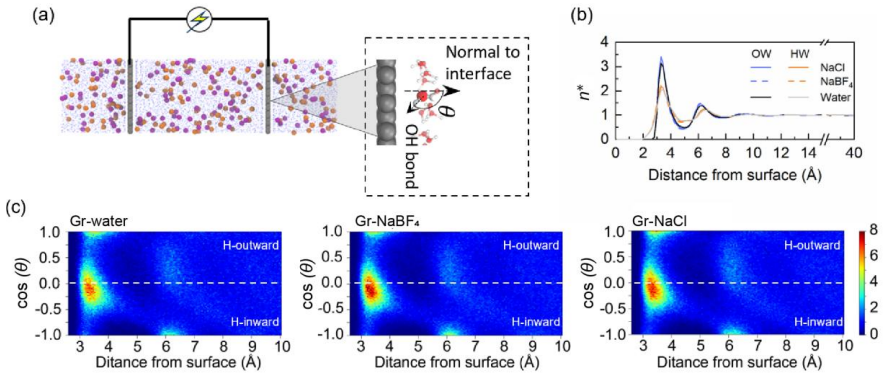
- [Interfacial water beyond a passive dielectric medium, Eq. (1)] The decomposition phi_pzc,H2O = phi_pzc,H2O^0 + chi_H2O assumes that the pure-water surface-induced water polarization phi_pzc,H2O^0 is unchanged when 0.8 M ions are added. This is load-bearing for the conclusion that a significant portion of water polarization responds directly to the graphene surface rather than screening ions, because any ion-induced restructuring of interfacial water would be silently absorbed into chi_H2O. The paper supports transferability by noting similar total potential oscillations and O-H orientation maps (Fig. 1c and Fig. 2a-b), but these are qualitative comparisons. I request a quantitative, uncertainty-aware comparison of the water dipole/orientational distributions in pure water versus the electrolytes, or an explicit test in which phi_pzc,H2O^0 is recomputed in the electrolyte system after removing the ions, to establish that chi_H2O is a clean ion-induced perturbation.
- [Interfacial water beyond a passive dielectric medium, Fig. 2c-d] The mirror-image relation between chi_H2O and phi_pzc,ion is largely a tautological consequence of the decomposition. Because the text states that phi_pzc,total is close to phi_pzc,H2O^0 (e.g., the paragraph following Eq. (1)), Eq. (1) directly implies chi_H2O ≈ -phi_pzc,ion. Similarly, the ratio phi_pzc,ion/(phi_pzc,ion + chi_H2O) being close to epsilon_r is not an independent test of linear dielectric screening, since it is derived from the same approximate relation. The authors should provide a more direct test of linear response, for example by varying ion concentration or surface charge and checking whether chi_H2O scales proportionally with phi_pzc,ion in a parameter-free manner.
- [The extended Poisson-Boltzmann EDL models, Eqs. (4)-(6)] The model's prediction of the PZC (0.34 V) is dominated by the MD-derived input phi_pzc,H2O^0 (0.33 V), so the close agreement with the MD value of 0.33 V is substantially built into the model rather than being an independent validation. Additionally, Eq. (6) relies on the assumption that non-electrostatic changes in the ion PMF compensate Delta_phi_H2O,II^0, which is asserted from Becker et al. but not directly verified for the present systems; the manuscript itself concedes 'More work should be done in future for this non-electrostatic interaction.' To support the claim of predictive capability, the model should be tested on a system or observable not used in constructing the inputs, or the sensitivity of the predictions to the transferability and compensation assumptions should be quantified.
minor comments (4)
- [Title] The title contains a typographical error: 'Polari zation' should be 'Polarization.'
- [Figure 1 caption] The sentence 'The horizontal white line divides the map into bonds pointing away from the group (termed H-outward) and toward the surface (H-inward)' uses 'group' where 'surface' or 'graphene' appears intended.
- [Reference 23] Reference 23 is incomplete: 'The Journal of Chemical Physics 157 (2022)' lacks the article number or page range; please provide the full citation.
- [Throughout] The notation phi_pzc,H2O^0 and the subscript/superscript formatting are occasionally inconsistent (e.g., in Eq. (4) and the surrounding text); standardizing the notation would improve readability.
Circularity Check
The extended-PB 'prediction' of the PZC is largely the MD input phi_pzc,H2O^0 reinserted, and the chi_H2O/phi_ion mirror relation is partly a consequence of the decomposition rather than independent evidence.
-
fitted input called prediction
[Section 'The extended Poisson-Boltzmann EDL models', Eqs. (1)-(2), Figure 4]
"𝜙pzc,total(𝑧) = 𝜙pzc,H2O^0 (z) + 𝜒H2O(𝑧) + 𝜙pzc,ion(𝑧) (1) ... our model predicted PZC value as 0.34 V, close to the MD result of 0.33 V."
The model's total potential is constructed by adding the MD-derived pure-water profile phi_pzc,H2O^0 to a PB solution for the ion/chi part. In Fig. 2, phi_pzc,H2O^0 already has a surface value of about 0.34 V, while phi_ion and chi_H2O nearly cancel. Therefore the 'predicted' electrolyte PZC of 0.34 V is essentially the input phi_pzc,H2O^0 value reinserted, not an independent prediction. The model also uses MD-derived PMF V_i^PMF, so the agreement with MD is in-sample. Comparing with the classic PB result of 0 V only shows that inserting the MD input changes the answer, not that the underlying physics has been independently validated.
-
self definitional
[Section 'Interfacial water beyond a passive dielectric medium', Eq. (1) and Fig. 2c-d]
"We dissect 𝜙pzc,H2O ... into two components: (1) a quenched component for interfacial water polarization 𝜙pzc,H2O^0; and (2) the residual perturbation component 𝜒H2O due to the presence of ions: 𝜙pzc,H2O = 𝜙pzc,H2O^0 + 𝜒H2O. The quenched component is adopted from the Gr-water system."
The surface-induced component is defined as the pure-water profile phi_pzc,H2O^0 and subtracted from the electrolyte water potential, with chi_H2O as the residual. The conclusion that a significant portion of water polarization responds to the graphene surface rather than to ions is therefore built into the decomposition: any ion-induced restructuring of the interfacial water is silently absorbed into chi_H2O and attributed to ion screening. The mirror relation between chi_H2O and phi_ion then follows algebraically from phi_total roughly equaling phi_pzc,H2O^0, rather than providing independent evidence of linear dielectric screening. Transferability of phi_pzc,H2O^0 to 0.8 M electrolytes is supported only qualitatively, so the central attribution is partly self-definitional.
full rationale
The MD-based Maxwell decomposition of the potential into ionic and water contributions is a legitimate, independent computation, and the observation that water's potential profile in electrolytes resembles pure water is a real empirical result. However, the paper's extended PB model is not an independent predictive test: its dominant input phi_pzc,H2O^0 is taken from the same MD framework, so the model's 'predicted' PZC of 0.34 V matching the MD value of 0.33 V is substantially forced by construction. The chi_H2O versus phi_ion mirror image, offered as evidence of linear dielectric screening, is partly a mathematical consequence of the definition chi_H2O = phi_pzc,total - phi_pzc,H2O^0 - phi_ion combined with the near-equality of total potentials. The transferability of the pure-water phi_pzc,H2O^0 to concentrated electrolytes is an assumption that is not quantitatively tested, and if it fails the central mechanism would be misattributed. These issues are significant but do not fully collapse the paper: the raw MD decomposition and the direct comparison of potential profiles retain independent content. Overall circularity score: 4.
Assumptions & free parameters
free parameters (4)
- Surface charge density sigma_s =
±0.00938 e per C atom (6.0 μC cm-2)
- Interfacial water potential phi_pzc,H2O^0(z) =
From Gr-water MD simulation
- Ion potential of mean force V_i^PMF(z) =
From MD (Fig. S5)
- Water relative dielectric constant epsilon_r =
From MD (Supplemental Sec. 8)
assumptions (5)
- standard math Electrostatic superposition: total potential is the sum of ion and water contributions (Maxwell linearity).
- domain assumption Classical non-polarizable force fields represent interfacial water orientation and the relevant dielectric response at graphene.
- domain assumption Ions follow a Boltzmann distribution in the extended PB model with a PMF that captures non-electrostatic effects.
- ad hoc to paper The pure-water surface potential phi_pzc,H2O^0 is transferable to 0.8 M electrolyte systems.
- ad hoc to paper Surface-charge-induced changes in non-electrostatic ion interactions compensate Delta_phi_H2O,II^0, so that term can be omitted from the Boltzmann factor.
Cite this review
Pith. "Pith review of Beyond Dielectrics: Interfacial Water Polarization Governs Graphene-Based Electrochemical Interfaces." pith.science (2026). https://pith.science/paper/GPY2IA5B
@misc{pith2026241113747,
  author       = {Pith},
  title        = {Pith review of: Beyond Dielectrics: Interfacial Water Polarization Governs Graphene-Based Electrochemical Interfaces},
  year         = {2026},
  howpublished = {\url{https://pith.science/paper/GPY2IA5B}},
  note         = {Machine review of arXiv:2411.13747}
}
read the original abstract
Water molecules are traditionally regarded as passive dielectric media in electrochemical systems. In this work, we challenge this conventional perspective using molecular dynamics simulations and theoretical analysis. We show that interfacial water is polarized differently from bulk water and effectively screens the electrostatic potential between ions and the surface. This goes beyond the classic electric double layer (EDL) model, which treated water as merely a passive dielectric. The observed overscreening occurs because a significant portion of water polarization directly responds to the graphene surface, in addition to screening the electrostatic interactions between ions and charged surfaces. Furthermore, we reveal that this surface-induced polarization of interfacial water governs the electric potential distribution and EDL capacitance, and can even invert the electrode surface potential polarity, overriding the contribution of ions. These molecular-level insights lead to a revised EDL model that more accurately describes the electric and chemical potential distributions in the interfacial EDL regions.
Figures


Reference graph
Works this paper leans on
-
[1]
1 Bard, A. J., Faulkner, L. R. & White, H. S. Electrochemical methods: fundamentals and applications. (John Wiley & Sons, 2022). 19 2 Waegele, M. M., Gunathunge, C. M., Li, J. & Li, X. How cations affect the electric double layer and the rates and selectivity of electrocatalytic processes. J Chem Phys 151, 160902 (2019). https://doi.org/10.1063/1.5124878 ...
Reviewed August 12, 2026 · model on record in the stance chip above.
Discussion (0). Continue with ORCID to comment.