REVIEW 4 major objections 4 minor 36 references
Robust Steganography with Boundary-Preserving Overflow Alleviation and Adaptive Error Correction
T0 review · 4 major / 4 minor · reviewed 2026-08-12 · deepseek-v4-flash
Pith's one-line read A preprocessing scheme that removes spatial overflow mostly inside 8x8 blocks while sparing their boundaries, combined with adaptive Reed-Solomon error correction, makes robust JPEG steganography harder to detect than ROAST-ST and GMAS at…
desk verdict A plausible incremental improvement to robust JPEG steganography, but the security claim rests on thresholds chosen on the evaluation set. read the letter →
The pith
A machine-rendered reading of the paper's core claim, the machinery that carries it, and where it could break.
The reading
What carries the argument
The central object is the boundary-preserving overflow preprocessing, which partitions each 8x8 spatial block into an interior (I, 6x6), a boundary (B, the 28 edge pixels including the four corners), and corners (C). The rule 'remove overflow in I when its count exceeds O1; then remove overflow in B only when its count is below O2' is what lets the method stabilize quantized DCT coefficients while leaving the most detectable pixels untouched. This is paired with Algorithm 1, an adaptive RS(31, k*) search that embeds, recompresses, and extracts at each iteration, records the best error rate seen, and stops when the error threshold is met or k* reaches 7. Together they turn the whole image into a robust embedding region with minimal boundary footprint and minimal coding redundancy.
What would settle it
Run the same pipeline twice on the same covers, once with the O2 boundary-stopping rule (the proposed method) and once with unconditional boundary de-overflowing (equivalent to ROAST-ST preprocessing), while keeping the adaptive RS loop identical, and compare the reported steganalysis detectors at a fixed payload (e.g., 0.3 bpnzac) and channel quality 85. If the boundary-preserving variant does not show a higher average detection error than the unconditional variant, the central security claim is falsified. Alternatively, directly measure whether boundary pixels are in fact more detectable than interior pixels under the large modification magnitudes typical of overflow removal; if they are not, the design premise fails.
Extended reading notes
Core claim
Analyzing overflow on a benchmark of 10,000 grayscale images compressed at quality factor 65, the authors observe that spatial truncation causes overflow disproportionately at the edges of 8x8 blocks rather than uniformly. They exploit this with a two-threshold preprocessing rule: the 6x6 interior of each block is de-overflowed when its overflow count exceeds O1 (chosen as 0), and the surrounding boundary is de-overflowed only when its own overflow count is below O2 (chosen as 18), so heavily overflowed boundaries are deliberately left modified to preserve inter-block correlations. They complement this with an adaptive RS(31, k*) error-correction search that keeps the code that achieved the lowest measured error rate so far, which avoids the pathological case—documented on smooth-texture images—where longer codes increase the error rate. The paper reports that this combination lifts the average detection error of CCPEV, DCTR, and SRNet steganalysis relative to ROAST-ST and GMAS at payloads up to 0.5 bpnzac for channel qualities 85 and 95, with extraction errors below 0.0001.
Load-bearing premise
The security gain rests on the premise, taken from prior work cited in the paper, that modifying spatial block boundaries is more detectable than modifying block interiors, and that this ordering still holds for the relatively large overflow-removal adjustments the preprocessing makes.
Editorial extensions
If this is right
- The method supports payloads of 0.1–0.5 bpnzac—higher than the 0.05–0.15 range typical of previous robust adaptive steganography—without collapsing security.
- The adaptive RS loop with best-error tracking removes the failure mode, documented on smooth-texture images, where lengthening the error-correction code raises the extraction error rate.
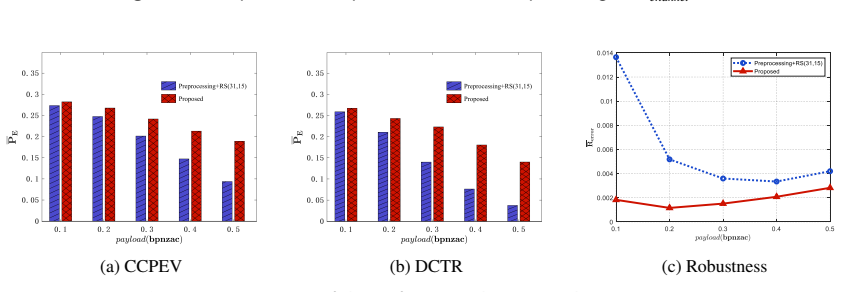
- Reported security gains include over 2% higher average detection error than ROAST-ST at 0.16 bpnzac under a CNN-based steganalyzer, and over 10% higher DCTR detection error than fixed-RS coding at 0.5 bpnzac.
- Because overflow preprocessing stabilizes coefficients across the entire DCT domain, the method eliminates the need for robust-domain selection, simplifying the embedding pipeline.
Reading between the lines
- The same boundary-sparing heuristic could be transferred to other block-based codecs (e.g., HEVC, AV1) or color images, where the block geometry and quantization tables differ, though the overflow statistics would need re-measuring.
- If the prior finding that boundary modifications are more detectable does not survive the large modification magnitudes that overflow removal introduces, the O2 threshold would need re-calibration by channel quality and payload.
- The adaptive RS search could likely be replaced by a one-shot complexity predictor that estimates the image's error rate from block statistics, avoiding the repeated embed–recompress–extract iterations and lowering computational cost.
- A steganalyzer trained specifically on boundary modifications—rather than the general CCPEV/DCTR/SRNet detectors—might reduce the reported security gap; testing against such a detector would sharpen the claim.
Editorial analysis
A structured set of objections, weighed in public.
Referee Report
Summary. The paper proposes a robust steganographic method for upward JPEG recompression scenarios. The main contribution is a preprocessing step that selectively removes spatial overflow in 8×8 JPEG blocks while deliberately limiting modifications to block boundaries, based on the observation that boundaries are more prone to overflow and more sensitive for steganalysis. The second contribution is an adaptive Reed-Solomon error-correction scheme that iteratively searches for a short code length that still meets a robustness threshold. The method is evaluated on a 2,000-image subset of BOSSbase v1.01 (QF 65 covers, Q_channel 85 and 95), comparing anti-steganalysis performance (CCPEV, DCTR, SRNet), robustness, and image quality against ROAST-OS, ROAST-ST, GMAS, and Adaptive-GMAS. The reported results show improved anti-steganalysis performance over baselines at payloads up to 0.5 bpnzac while keeping extraction error below 0.0001 at Q_channel 85 and 95.
Significance. If the reported results are reliable, the paper offers a practical improvement in the security-robustness-capacity tradeoff for robust steganography, a problem of genuine relevance for covert communication over social networks. The use of standard, publicly available steganalysis detectors (CCPEV, DCTR, SRNet) and a public dataset (BOSSbase) are strengths, as is the inclusion of ablation experiments for both the preprocessing and the adaptive error-correction components. However, the paper does not release code or data, and the experimental protocol has load-bearing weaknesses—in-sample threshold selection and missing statistical analysis—that must be addressed before the central claim can be accepted. The core idea (boundary-aware overflow removal and adaptive RS coding) is plausible and worth further study, but the current evidence is not yet out-of-sample.
major comments (4)
- [Section 4.2, Fig. 7] The parameters O1 and O2 are selected on the same 2,000-image subset that is then used for all subsequent security, robustness, and ablation evaluations in Sections 4.3–4.6. The reported advantage over ROAST-ST and GMAS is therefore based on thresholds chosen to perform well on the evaluation set. A held-out validation set or nested cross-validation must be used to support the central empirical claim; otherwise the improvement may be an artifact of in-sample tuning.
- [Section 3.3, Algorithm 1] The while condition in Algorithm 1 is 'R_error > threshold or k* >= 7', which contradicts the accompanying text ('This process continues until k* equals 7 or the error rate reaches a preset threshold') and the intended early stopping. As written, the loop will always continue down to k*=7 for every image, even when the error threshold is already met, and the output stego image corresponds to the last iteration, not to best_k*. This is a load-bearing algorithmic specification error; the pseudocode must be corrected and the actual implementation clarified.
- [Section 4.1 and 4.3] The steganalysis evaluation does not describe the train/test split, number of folds, or any variance estimates. Reported differences such as 'over 2% increase' (Section 4.3) and 'more than 10%' (Section 4.6) are presented without confidence intervals or significance tests. Given the small dataset (2,000 images), the empirical security claim needs error bars or a significance test to distinguish actual improvement from sampling noise.
- [Section 3.3, Algorithm 1] The adaptive error-correction loop requires the embedder to know the exact Q_channel and to simulate recompression at embedding time (line 7). This is a matching-robust requirement, not an upward-robust one as claimed in the contributions. The manuscript should clarify whether Q_channel is assumed to be known to the sender and how the method would behave if the actual channel quality differs from the assumed value.
minor comments (4)
- [Throughout] There are several typos and grammatical issues: 'develpment' (Introduction), 'cofficients' (Introduction), 'thershold' (Table 2), 'Over an 2% increase' (Section 4.3), and inconsistent spacing such as 'partI' and 'partB'.
- [Section 2.4 and 3.2] The claim that 'spatial block boundaries are more prone to overflow' is presented as a statistical finding (Fig. 4a), but no quantitative distribution or statistical test is reported. Adding a small table or histogram with the actual overflow counts would strengthen this load-bearing observation.
- [Section 4.3, Table 3] The sentence 'Except for Adaptive-GMAS, the stego images generated by the proposed method exhibit significantly higher image quality' is ambiguous: at payload 0.2, Adaptive-GMAS reports higher PSNR than the proposed method. Please rephrase to clarify that the comparison excludes Adaptive-GMAS where it cannot run.
- [Section 4.1] The statement 'we conducted multiple independent repeat experiments' is not supported by any detail. Please specify what was repeated (e.g., random message seeds, classifier initializations) and report the resulting variance.
Circularity Check
No significant circularity: security and robustness are empirically benchmarked against external steganalysis on BOSSbase; the adaptive-RS component is a refined prior scheme (Duan et al. 2023, with overlapping author) but is ablated in Section 4.6, so the self-citation is not load-bearing. In-sample O1/O2 tuning is a validation gap, not a circular step.
full rationale
The paper's claimed derivation chain is empirical rather than definitional. Section 3.2 motivates boundary-preserving preprocessing from a statistical overflow analysis and from an external prior result (Wang et al. 2020) about block-boundary detectability; the security gain is then tested against CCPEV, DCTR, and SRNet classifiers on the public BOSSbase dataset, so no equation reduces the reported security to a fitted input. Section 3.3's adaptive RS algorithm (Algorithm 1) is a refinement of Adaptive-GMAS (Duan et al. 2023), which shares author Zhaoxia Yin with the present paper; however, the method is implemented and compared against fixed RS coding in Section 4.6, so the self-citation is not the load-bearing evidence. ROAST-ST's preprocessing formula and T1=8, mu=0.5 are imported from external prior work (Zeng et al. 2024), not from the authors' own results. The main caveat is validation-related, not circular: Section 4.1 fixes one 2,000-image BOSSbase subset, Section 4.2 selects O1=0 and O2=18 on that same subset, and Sections 4.3-4.6 report the resulting security and robustness comparisons on the same images. This in-sample threshold selection could inflate the reported advantage over ROAST-ST and GMAS and should be checked with a held-out split, but it is an experimental-design weakness rather than a derivation that reduces the predicted quantity to the fitted parameter by construction. No circular step meeting the quoted-evidence standard was found.
Assumptions & free parameters
free parameters (5)
- O1 =
0
- O2 =
18
- T1 =
8
- mu =
0.5
- robustness_threshold =
0.0001
assumptions (4)
- domain assumption JPEG recompression consists solely of spatial truncation, spatial rounding, and coefficient quantization (Eqs. 1-4).
- domain assumption Modifications to spatial block boundaries are more detectable than modifications to interiors (Wang et al., 2020).
- standard math Dither modulation provides error-free embedding when only quantization affects the coefficients.
- domain assumption The BOSSbase v1.01 subset of 2000 images (seed 25) is representative for benchmarking.
Cite this review
Pith. "Pith review of Robust Steganography with Boundary-Preserving Overflow Alleviation and Adaptive Error Correction." pith.science (2026). https://pith.science/paper/UQEQXCKC
@misc{pith2026241113819,
  author       = {Pith},
  title        = {Pith review of: Robust Steganography with Boundary-Preserving Overflow Alleviation and Adaptive Error Correction},
  year         = {2026},
  howpublished = {\url{https://pith.science/paper/UQEQXCKC}},
  note         = {Machine review of arXiv:2411.13819}
}
read the original abstract
With the rapid evolution of the Internet, the vast amount of data has created opportunities for fostering the development of steganographic techniques. However, traditional steganographic techniques encounter challenges due to distortions in online social networks, such as JPEG recompression. Presently, research into the lossy operations of spatial truncation in JPEG recompression remains limited. Existing methods aim to ensure the stability of the quantized coefficients by reducing the effects of spatial truncation. Nevertheless, these approaches may induce notable alterations to image pixels, potentially compromising anti-steganalysis performance. In this study, we analyzed the overflow characteristics of spatial blocks and observed that pixel values at the boundaries of spatial blocks are more prone to overflow. Building upon this observation, we proposed a preprocessing method that performs overflow removal operations based on the actual overflow conditions of spatial blocks. After preprocessing, our algorithm enhances coefficient stability while minimizing modifications to spatial block boundaries, favoring image quality preservation. Subsequently, we employed adaptive error correction coding to reduce coding redundancy, thereby augmenting robustness and mitigating its impact on anti-steganalysis performance. The experimental results indicate that the proposed method possesses a strong embedding capacity, maintaining a high level of robustness while enhancing security.
Figures


Figures from the paper (9 more)


Reference graph
Works this paper leans on
-
[1]
write newline
" write newline "" before.all 'output.state := FUNCTION n.dashify 't := "" t empty not t #1 #1 substring "-" = t #1 #2 substring "--" = not "--" * t #2 global.max substring 't := t #1 #1 substring "-" = "-" * t #2 global.max substring 't := while if t #1 #1 substring * t #2 global.max substring 't := if while FUNCTION word.in bbl.in ":" * " " * FUNCTION f...
-
[2]
author Bas, P. , author Filler, T. , author Pevn \`y , T. , year 2011 . title ” break our steganographic system”: the ins and outs of organizing boss , in: booktitle International workshop on information hiding , organization Springer . pp. pages 59--70
work page 2011
-
[3]
author Boroumand, M. , author Chen, M. , author Fridrich, J. , year 2019 . title Deep residual network for steganalysis of digital images . journal IEEE Transactions on Information Forensics and Security volume 14 , pages 1181--1193
work page 2019
-
[4]
author Chen, B. , author Wornell, G.W. , year 2001 . title Quantization index modulation: A class of provably good methods for digital watermarking and information embedding . journal IEEE Transactions on Information theory volume 47 , pages 1423--1443
work page 2001
-
[5]
author Duan, X. , author Li, B. , author Yin, Z. , author Zhang, X. , author Luo, B. , year 2023 . title Robust image steganography against lossy jpeg compression based on embedding domain selection and adaptive error correction . journal Expert Systems with Applications volume 229 , pages 120416
work page 2023
-
[6]
author Filler, T. , author Judas, J. , author Fridrich, J. , year 2011 . title Minimizing additive distortion in steganography using syndrome-trellis codes . journal IEEE Transactions on Information Forensics and Security volume 6 , pages 920--935
work page 2011
-
[7]
author Gan, Q.W. , author Yau, W.C. , author Gan, Y. , author Salam, I. , author Guo, S. , author Chang, C.C. , author Wu, Y. , author Zhou, L. , year 2024 . title Dsteganom: Deep steganography for motion capture data . journal Expert Systems with Applications volume 238 , pages 121955
work page 2024
-
[8]
author Guo, F. , author Sun, S. , author Weng, S. , author Yu, L. , author He, J. , year 2024 . title A two-stream-network based steganalysis network: Tsnet . journal Expert Systems with Applications volume 255 , pages 124796
work page 2024
Show all 36 references
-
[9]
, author Fridrich, J
author Holub, V. , author Fridrich, J. , year 2014 . title Low-complexity features for jpeg steganalysis using undecimated dct . journal IEEE Transactions on Information forensics and security volume 10 , pages 219--228
2014
-
[10]
, author Fridrich, J
author Holub, V. , author Fridrich, J. , author Denemark, T. , year 2014 . title Universal distortion function for steganography in an arbitrary domain . journal EURASIP Journal on Information Security volume 2014 , pages 1--13
2014
-
[11]
, author Wang, M
author Hu, K. , author Wang, M. , author Ma, X. , author Chen, J. , author Wang, X. , author Wang, X. , year 2024 . title Learning-based image steganography and watermarking: A survey . journal Expert Systems with Applications volume 249 , pages 123715
2024
-
[12]
, author Fridrich, J
author Kodovsk \`y , J. , author Fridrich, J. , year 2009 . title Calibration revisited , in: booktitle Proceedings of the 11th ACM workshop on Multimedia and security , pp. pages 63--74
2009
-
[13]
, author Fridrich, J
author Kodovsky, J. , author Fridrich, J. , author Holub, V. , year 2011 . title Ensemble classifiers for steganalysis of digital media . journal IEEE Transactions on information forensics and security volume 7 , pages 432--444
2011
-
[14]
, author Zhang, Y
author Kong, P. , author Zhang, Y. , author Huang, L. , author Zhou, L. , author Chen, L. , author Qin, C. , year 2024 . title Neural network-based reversible data hiding for medical image . journal Expert Systems with Applications volume 256 , pages 124903
2024
-
[15]
, author Cui, Q
author Li, M. , author Cui, Q. , author Wang, X. , author Zhang, Y. , author Xiang, Y. , year 2024 . title Ftpe-bc: Fast thumbnail-preserving image encryption using block-churning . journal Expert Systems with Applications volume 255 , pages 124574
2024
-
[16]
, author Sloane, N.J.A
author MacWilliams, F.J. , author Sloane, N.J.A. , year 1977 . title The theory of error-correcting codes . volume volume 16 . publisher Elsevier
1977
-
[17]
, author Jiang, X
author Meng, L. , author Jiang, X. , author Sun, T. , author Zhao, Z. , author Xu, Q. , year 2023 . title A robust coverless video steganography based on the similarity of inter-frames . journal IEEE Transactions on Multimedia , pages 1--16
2023
-
[18]
, author Niimi, M
author Noda, H. , author Niimi, M. , author Kawaguchi, E. , year 2006 . title High-performance jpeg steganography using quantization index modulation in dct domain . journal Pattern Recognition Letters volume 27 , pages 455--461
2006
-
[19]
, author Fridrich, J
author Pevny, T. , author Fridrich, J. , year 2007 . title Merging markov and dct features for multi-class jpeg steganalysis , in: booktitle Security, steganography, and watermarking of multimedia contents IX , organization SPIE . pp. pages 28--40
2007
-
[20]
, author Bajwa, U.I
author Rehman, H.A. , author Bajwa, U.I. , author Raza, R.H. , author Alfarhood, S. , author Safran, M. , author Zhang, F. , year 2024 . title Leveraging coverless image steganography to hide secret information by generating anime characters using gan . journal Expert Systems ...
2024
-
[21]
, author Andono, P.N
author Rustad, S. , author Andono, P.N. , author Shidik, G.F. , et al., year 2023 . title Digital image steganography survey and investigation (goal, assessment, method, development, and dataset) . journal Signal processing volume 206 , pages 108908
2023
-
[22]
, author Jamzad, M
author Sajedi, H. , author Jamzad, M. , year 2010 . title Bss: Boosted steganography scheme with cover image preprocessing . journal Expert Systems with Applications volume 37 , pages 7703--7710
2010
-
[23]
, author Wei, P
author Song, B. , author Wei, P. , author Wu, S. , author Lin, Y. , author Zhou, W. , year 2024 . title A survey on deep-learning-based image steganography . journal Expert Systems with Applications volume 254 , pages 124390
2024
-
[24]
, author Li, S
author Tao, J. , author Li, S. , author Zhang, X. , author Wang, Z. , year 2018 . title Towards robust image steganography . journal IEEE Transactions on Circuits and Systems for Video Technology volume 29 , pages 594--600
2018
-
[25]
, author Zhang, W
author Wang, Y. , author Zhang, W. , author Li, W. , author Yu, N. , year 2020 . title Non-additive cost functions for jpeg steganography based on block boundary maintenance . journal IEEE Transactions on Information Forensics and Security volume 16 , pages 1117--1130
2020
-
[26]
, author Wang, K
author Xiao, F. , author Wang, K. , author Shen, Y. , author Yao, Y. , year 2024 . title High-capacity reversible data hiding in encrypted images based on adaptive block coding selection . journal Journal of Visual Communication and Image Representation volume 104 , pages 104291
2024
-
[27]
, author Wang, J
author Yao, Y. , author Wang, J. , author Chang, Q. , author Ren, Y. , author Meng, W. , year 2024 . title High invisibility image steganography with wavelet transform and generative adversarial network . journal Expert Systems with Applications volume 249 , pages 123540
2024
-
[28]
, author Ke, L
author Yin, Z. , author Ke, L. , year 2021 . title Robust adaptive steganography based on dither modulation and modification with re-compression . journal IEEE Transactions on Signal and Information Processing over Networks volume 7 , pages 336--345
2021
-
[29]
, author Chen, K
author Yu, X. , author Chen, K. , author Wang, Y. , author Li, W. , author Zhang, W. , author Yu, N. , year 2020 . title Robust adaptive steganography based on generalized dither modulation and expanded embedding domain . journal Signal Processing volume 168 , pages 107343
2020
-
[30]
, author Chen, K
author Zeng, K. , author Chen, K. , author Zhang, W. , author Wang, Y. , year 2024 . title Upward robust steganography based on overflow alleviation . journal IEEE Transactions on Multimedia volume 26 , pages 299--312
2024
-
[31]
, author Chen, K
author Zeng, K. , author Chen, K. , author Zhang, W. , author Wang, Y. , author Yu, N. , year 2023 . title Robust steganography for high quality images . journal IEEE Transactions on Circuits and Systems for Video Technology volume 33 , pages 4893--4906
2023
-
[32]
, author Feng, B
author Zhang, F. , author Feng, B. , author Xia, Z. , author Weng, J. , author Lu, W. , author Chen, B. , year 2024 a. title Conditional image hiding network based on style transfer . journal Information Sciences volume 662 , pages 120225
2024
-
[33]
, author Sun, H
author Zhang, H. , author Sun, H. , author Meng, F. , year 2024 b. title Adaptive reversible data hiding scheme based on difference division interpolation . journal Expert Systems with Applications volume 254 , pages 124338
2024
-
[34]
, author Luo, X
author Zhang, Y. , author Luo, X. , author Guo, Y. , author Qin, C. , author Liu, F. , year 2019 . title Multiple robustness enhancements for image adaptive steganography in lossy channels . journal IEEE Transactions on Circuits and Systems for Video Technology volume 30 , pag...
2019
-
[35]
, author Zhu, X
author Zhang, Y. , author Zhu, X. , author Qin, C. , author Yang, C. , author Luo, X. , year 2018 . title Dither modulation based adaptive steganography resisting jpeg compression and statistic detection . journal Multimedia Tools and Applications volume 77 , pages 17913--17935
2018
-
[36]
, author Guan, Q
author Zhao, Z. , author Guan, Q. , author Zhang, H. , author Zhao, X. , year 2018 . title Improving the robustness of adaptive steganographic algorithms based on transport channel matching . journal IEEE Transactions on Information Forensics and Security volume 14 , pages 1843--1856
2018
Reviewed August 12, 2026 · model on record in the stance chip above.
Discussion (0). Continue with ORCID to comment.