REVIEW 4 major objections 5 minor 60 references
Multitask Learning for SAR Ship Detection with Gaussian-Mask Joint Segmentation
T0 review · 4 major / 5 minor · reviewed 2026-08-12 · deepseek-v4-flash
Pith's one-line read Jointly training rotated SAR ship detection with speckle suppression and Gaussian-mask segmentation yields top AP50 scores on SSDD+ and HRSID.
desk verdict Plausible engineering result with a load-bearing missing detail: the 137k HH/HV pairs behind the denoising module have no documented source or split, so the SOTA claim is conditional. read the letter →
The pith
A machine-rendered reading of the paper's core claim, the machinery that carries it, and where it could break.
The reading
What carries the argument
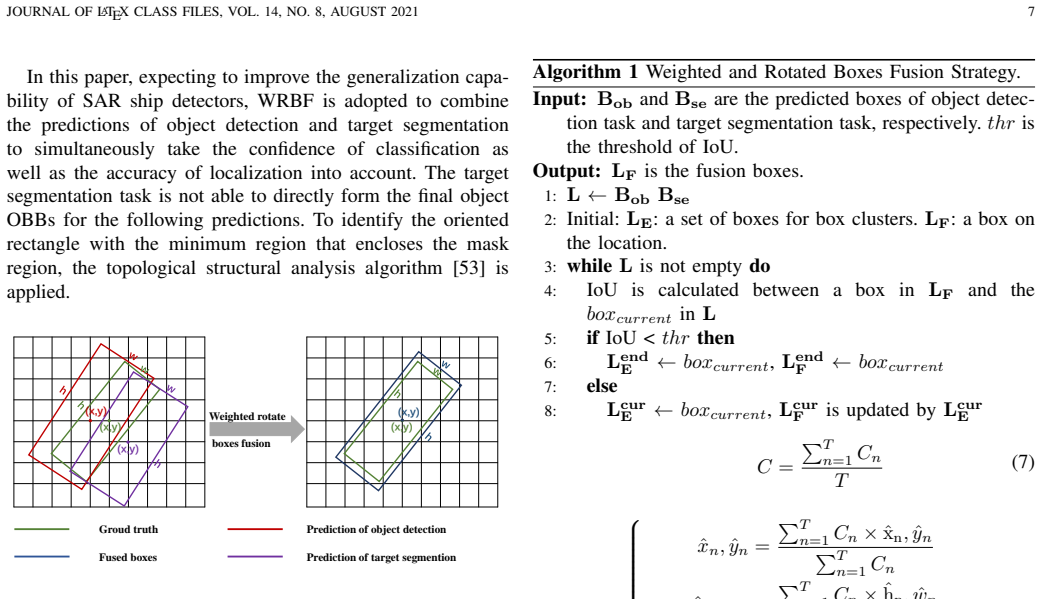
The machinery has four cooperating parts. The rotated Gaussian mask is a soft segmentation label: a ship's center carries the highest probability and surrounding pixels decay under a two-dimensional Gaussian whose covariance depends on the ship's aspect ratio and rotation, so the segmentation head learns to concentrate on the ship body rather than its enclosing background. The denoised feature fusion module (DFF) is pretrained on 137,327 HH–HV polarization image pairs treated as noisy/clean label pairs, then uses a dual-feature fusion attention mechanism to concatenate channel-refined denoised features with shallow features, preserving small targets while suppressing speckle. The angle-classification loss with aspect-ratio weighting multiplies smooth L1 angle error by $|\sin(\alpha(\theta-\hat{\theta}))|$ with $\alpha=2$ for square-like boxes, making the angle loss periodic where angular periodicity otherwise inflates training loss. Weighted rotated boxes fusion (WRBF) clusters detection and segmentation boxes and averages their coordinates weighted by confidence, so localization, not just classification score, determines the final box. The load-bearing idea is that sharing one backbone across detection, denoising, and segmentation regularizes the detector.
What would settle it
Run MLDet's full pipeline on a test set of single-polarization SAR images with the denoised feature fusion module removed, and compare AP50 against the full model; if the gap disappears or reverses, the paired-polarization denoising pretraining, not the shared architecture, is the source of the reported gains.
Extended reading notes
Core claim
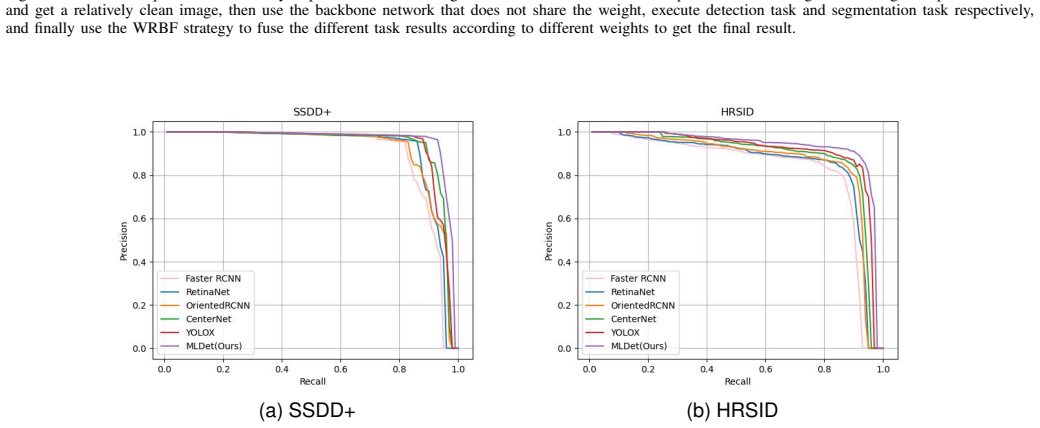
The paper's central claim is that the three tasks interact positively: the denoised feature fusion module suppresses speckle while preserving small-target features, the target segmentation module with the rotated Gaussian mask directs the network's attention to ship interiors, and the weighted rotated boxes fusion yields more accurate boxes than confidence-only NMS. On SSDD+ and HRSID the paper reports that MLDet outperforms Faster R-CNN, RetinaNet, Oriented R-CNN, CenterNet, and YOLOX on AP50 for both inshore and offshore subsets, with the full model reaching 95.3% AP50 on SSDD+ and 92.8% on HRSID at the 0.5 IoU threshold. The paper also reports larger AP75 gains over the baseline, which it attributes to more accurate localization from joint segmentation and fusion.
Load-bearing premise
The load-bearing premise is that the 137,327 HH–HV image pairs used to train the denoising module are genuine same-scene registrations, so the network learns to remove speckle rather than legitimate polarization-dependent scattering; the paper also leaves unspecified how the DFF module is fed at test time when only single-polarization images are available.
Editorial extensions
If this is right
- The framework outputs detection, denoised features, and segmentation from one shared backbone, which the paper presents as an end-to-end alternative to separate denoising and detection pipelines.
- The reported AP75 gains over all comparison detectors imply that the segmentation and fusion components improve localization, not only recall, which matters for densely docked ship scenes.
- The ARW loss should reduce angle-mismatch training losses for near-square ship boxes, making rotated detectors more stable on small or broadside ships.
- Because the model is trained from scratch without pretrained weights, the multitask recipe offers a path for SAR domains where pretrained features transfer poorly.
Reading between the lines
- Editorial inference: the same three-task design could be tested on other noisy rotating-object domains, such as optical satellite images of ships with wakes or aerial images of parked aircraft, where the Gaussian-mask segmentation would supply similar center-biased supervision.
- Editorial inference: because the DFF module is pretrained on HH–HV pairs and the paper does not specify its test-time input on single-polarization datasets, the reported gains may depend on paired-polarization pretraining; an evaluation with DFF ablated at test time would separate denoising pretraining from architectural benefit.
- Editorial inference: the rotated Gaussian mask could be used as a soft target for weakly supervised instance segmentation, generating pixel-level pseudo-labels from box annotations without extra human labeling.
Editorial analysis
A structured set of objections, weighed in public.
Referee Report
Summary. The paper proposes MLDet, a rotated bounding-box ship detector for SAR images that combines a CSPDarknet detection module with two auxiliary tasks: a denoised feature fusion (DFF) module trained on paired HH/HV SAR images, and a target segmentation (TS) module supervised by rotated Gaussian masks. It also introduces an angle classification loss with aspect-ratio weighting (ARW), a weighted rotated boxes fusion (WRBF) post-processing strategy, and reports experiments on SSDD+ and HRSID with ablations and comparisons against Faster R-CNN, RetinaNet, Oriented R-CNN, CenterNet, and YOLOX. The central claim is that the full MLDet model achieves state-of-the-art AP50 on both datasets.
Significance. If the central claim holds, the paper would provide a useful template for combining speckle suppression, segmentation, and rotated detection in SAR imagery. The strengths are that the experiments use two public benchmarks, standard detection metrics (AP50, AP75, precision, recall, F1), an ablation for each proposed module, and comparisons against five baselines. The paper also states that code is available. However, the load-bearing evidence depends on an undisclosed 137,327-pair HH/HV pretraining corpus, on the unclear test-time use of the denoising module, and on baseline re-implementations whose configurations are not given; these issues must be resolved before the state-of-the-art claim can be accepted.
major comments (4)
- [Section III-A, Section III-C, Tables I, II, VIII] The provenance of the 137,327 HH/HV training pairs for the DFF module is undisclosed and appears inconsistent with the described datasets. Section III-A states that SSDD+ has 1160 images and HRSID has 5604 images, so neither dataset can alone yield 137,327 corresponding pairs without extensive, unspecified patchification. Section III-C additionally says the DFF module is 'independently trained by the dataset SSDD+.' Because the ablations attribute approximately five AP50 points to the DFF module, this pretraining corpus is load-bearing for the state-of-the-art claim. The authors must report the source, polarization channels, registration procedure, patchification, and exact train/test split of these pairs. They must also rule out test-set leakage from SSDD+/HRSID and perform a controlled comparison in which baselines receive the same auxiliary data, or show that DFF still helps without this pretraining.
- [Section II-B, Section III-A] The test-time operation of the DFF module is unspecified. The denoising loss in Eq. (4) uses paired HH and HV images as noisy/clean label pairs, but the detection evaluation on SSDD+ and HRSID is reported without stating which polarization is used for a given test image and without explaining how DFF is applied when no HH/HV pair is available. If DFF at inference takes a single input image, the paper should state this explicitly and reconcile it with the paired-image training setup. Otherwise, the reported gains may not transfer to the evaluation protocol actually used.
- [Section III-C, Eq. (9)] The description of the training procedure contradicts the 'multitask learning' and 'end-to-end' claims in the abstract and Section I. In the second training stage, λ1 is set to 0 and the DFF parameters are frozen, so the speckle-suppression task is not jointly optimized with detection and segmentation. The paper should either present results with truly joint training of all three tasks or revise the claims to describe DFF as a pretrained, frozen feature-enhancement module rather than a jointly learned subtask.
- [Section III-G, Table VIII] The headline improvements over YOLOX (+2.86 on SSDD+ and +5.05 on HRSID) are offshore-subset values, not full-dataset values. The text in Section III-G-1 lists these numbers without specifying that they are offshore, which overstates the overall margin. In addition, the five baselines are re-implemented without shipping code or configuration files, so the exact training schedules, anchor settings, and test-time details used for the comparisons are not verifiable. The authors should report full-dataset AP separately, make baseline configurations available, or use official pre-trained models and published results.
minor comments (5)
- [Throughout] There are numerous typos and inconsistent abbreviations, e.g., 'supression', 'DDF' vs. 'DFF', 'ARWS' vs. 'ARW', 'simutanously', 'demenstrates', 'organzied', and 'Guassion'. A careful proofread is needed.
- [Section III-E, Tables V and VI] The denoising comparison uses 'real SAR-1' and 'real SAR-2' images whose origin, resolution, and polarization are not described, and the ENL/EPD-ROA values are reported without error bars or a description of how many regions were selected. Please specify the data source and variability.
- [Section II-D, Algorithm 1] Equations (7) and (8) are placed inside Algorithm 1 but not referenced in the surrounding text; please integrate them or cite them explicitly so the WRBF update rule is clear.
- [Section II-C, Eq. (5)] The Gaussian-mask formula uses 'ih' and 'jh' for coordinates of the horizontal Gaussian mask but the notation is not defined in the text; please define all variables in Eq. (5) explicitly.
- [Section III-A] The sentence '137327 pairs of corresponding HH and HV images are selected as the training set for DDF module' has a typo ('DDF' should be 'DFF') and, more importantly, does not state whether these pairs come from SSDD+, HRSID, or an external corpus; this should be clarified.
Circularity Check
No significant circularity: the multitask detection claim is benchmarked externally and does not reduce to its training inputs by construction.
full rationale
The paper's central claim, that MLDet outperforms five CNN-based baselines on SSDD+ and HRSID, is supported by direct evaluation on external datasets against public methods. The ablation results for the DFF, TS, ARW, and WRBF components are empirical measurements of trained models, not quantities derived by construction from the method's own assumptions. No fitted parameter is renamed as a prediction: the AP50/AP75 values are computed from test-set detections, and the loss terms (Ldenoise, Lsegment, Lobject) are training objectives, not components of the evaluation metric. There is no load-bearing self-citation chain; the coauthor's earlier works cited in the paper concern unrelated topics such as network pruning and background modeling, and the cited despeckling pair-label idea [56], [57] is external to the authors. The main caveat is experimental-validity rather than circularity: Section III-A states that 137,327 HH/HV pairs are used to train the DFF module without disclosing their source, registration quality, or whether they overlap the SSDD+/HRSID test splits. If those pairs included test scenes, the frozen denoised feature extractor could leak information into detection, and the comparison in Table VIII would conflate a data advantage with the architecture contribution. But this is a missing-protocol or leakage risk, not a circular step: the reported detection numbers are not equal by construction to the training input or to any fitted parameter, and the same auxiliary data could in principle be supplied to the baselines. Accordingly, the derivation chain is self-contained with respect to circularity.
Assumptions & free parameters
free parameters (5)
- aspect ratio threshold r in angle loss =
1.5
- Gaussian mask covariance factors lambda_w, lambda_h =
not reported
- focal loss gamma for segmentation =
not reported
- loss weights lambda_1, lambda_2, lambda_3 =
1/0/0 then 0/1/1 in two-stage training
- WRBF IoU threshold thr =
not reported
assumptions (3)
- domain assumption Trained-from-scratch detection models can match or exceed pretrained models on these datasets
- domain assumption HH and HV image pairs are sufficiently aligned to serve as noisy/clean training pairs
- domain assumption The ground-truth oriented boxes for SSDD+ and HRSID are accurate enough for the Gaussian mask supervision
Cite this review
Pith. "Pith review of Multitask Learning for SAR Ship Detection with Gaussian-Mask Joint Segmentation." pith.science (2026). https://pith.science/paper/CSUHA2BK
@misc{pith2026241113847,
  author       = {Pith},
  title        = {Pith review of: Multitask Learning for SAR Ship Detection with Gaussian-Mask Joint Segmentation},
  year         = {2026},
  howpublished = {\url{https://pith.science/paper/CSUHA2BK}},
  note         = {Machine review of arXiv:2411.13847}
}
read the original abstract
Detecting ships in synthetic aperture radar (SAR) images is challenging due to strong speckle noise, complex surroundings, and varying scales. This paper proposes MLDet, a multitask learning framework for SAR ship detection, consisting of object detection, speckle suppression, and target segmentation tasks. An angle classification loss with aspect ratio weighting is introduced to improve detection accuracy by addressing angular periodicity and object proportions. The speckle suppression task uses a dual-feature fusion attention mechanism to reduce noise and fuse shallow and denoising features, enhancing robustness. The target segmentation task, leveraging a rotated Gaussian-mask, aids the network in extracting target regions from cluttered backgrounds and improves detection efficiency with pixel-level predictions. The Gaussian-mask ensures ship centers have the highest probabilities, gradually decreasing outward under a Gaussian distribution. Additionally, a weighted rotated boxes fusion (WRBF) strategy combines multi-direction anchor predictions, filtering anchors beyond boundaries or with high overlap but low confidence. Extensive experiments on SSDD+ and HRSID datasets demonstrate the effectiveness and superiority of MLDet.
Figures


Figures from the paper (13 more)






Reference graph
Works this paper leans on
-
[1]
Ship surveillance with TerraSAR-X,
S. Brusch, S. Lehner, T. Fritz, M. Soccorsi, A. Soloviev, and B. van Schie, “Ship surveillance with TerraSAR-X,” IEEE Trans. Geosci. Remote Sens. , vol. 49, no. 3, pp. 1092–1103, 2011
work page 2011
-
[2]
W. Ao, F. Xu, Y . Li, and H. Wang, “Detection and discrimination of ship targets in complex background from spaceborne alos-2 SAR images,” IEEE J. Sel. Topics Appl. Earth Observ. Remote Sens. , vol. 11, no. 2, pp. 536–550, 2018
work page 2018
-
[3]
Survey of the study on ship wake detection in SAR imagery,
G. Biao and H. Weigen, “Survey of the study on ship wake detection in SAR imagery,” Remote Sensing Technology and Application , vol. 27, no. 6, pp. 829–836, 2013
work page 2013
-
[4]
An automatic ship and ship wake detection system for spaceborne SAR images in coastal regions,
K. Eldhuset, “An automatic ship and ship wake detection system for spaceborne SAR images in coastal regions,” IEEE Trans. Geosci. Remote Sens., vol. 34, no. 4, pp. 1010–1019, 1996
work page 1996
-
[5]
Automatic detection approach of ship using radarsat-1 synthetic aperture radar,
C.-S. Yang, “Automatic detection approach of ship using radarsat-1 synthetic aperture radar,” Journal of the Korean Society of Marine Environment & Safety , vol. 14, no. 2, pp. 163–168, 2008
work page 2008
-
[6]
An improved superpixel-level cfar detection method for ship targets in high-resolution SAR images,
T. Li, Z. Liu, R. Xie, and L. Ran, “An improved superpixel-level cfar detection method for ship targets in high-resolution SAR images,” IEEE J. Sel. Topics Appl. Earth Observ. Remote Sens. , vol. PP, no. 1, pp. 1–11, 2018
work page 2018
-
[7]
J. A. Lorenzzetti, R. L. Paes, and D. M. Gheradi, “A performance comparison of a cfar ship detection algorithm using envisat, radarsat, cosmo-skymed and TerraSAR-X images,” SeaSAR 2010 , vol. 679, p. 32, 2010
work page 2010
-
[8]
Ais- based evaluation of target detectors and SAR sensors characteristics for maritime surveillance,
R. Pelich, N. Longepe, G. Mercier, G. Hajduch, and R. Garello, “Ais- based evaluation of target detectors and SAR sensors characteristics for maritime surveillance,” IEEE J. Sel. Topics Appl. Earth Observ. Remote Sens., vol. 8, no. 8, pp. 3892–3901, 2016
work page 2016
Show all 60 references
-
[9]
Statistical modeling of pma detector for ship detection in high-resolution dual-polarization SAR images,
G. Gui, Y . Luo, K. Ouyang, and S. Zhou, “Statistical modeling of pma detector for ship detection in high-resolution dual-polarization SAR images,” IEEE Trans. Geosci. Remote Sens. , vol. 54, no. 7, pp. 4302– 4313, 2016
2016
-
[10]
Scheme of pa- rameter estimation for generalized gamma distribution and its application to ship detection in SAR images,
G. Gao, K. Ouyang, Y . Luo, S. Liang, and S. Zhou, “Scheme of pa- rameter estimation for generalized gamma distribution and its application to ship detection in SAR images,” IEEE Trans. Geosci. Remote Sens. , vol. 55, no. 3, pp. 1812–1832, 2016
2016
-
[11]
Target detection with synthetic aperture radar,
J. Li and E. G. Zelnio, “Target detection with synthetic aperture radar,” IEEE Trans. Aerosp. Electron. Syst. , vol. 32, no. 2, pp. 613–627, 2002
2002
-
[12]
Noncircularity parameters and their potential in ship detection from high resolution SAR imagery,
X. Leng, K. Ji, S. Zhou, and H. Zou, “Noncircularity parameters and their potential in ship detection from high resolution SAR imagery,” in Proc. IEEE Int. Geosci. Remote Sens. Symp. (IGARSS) , 2017, pp. 1876– 1879
2017
-
[13]
Imbalanced learning-based automatic SAR images change detection by morphologi- cally supervised pca-net,
R. Wang, J. Zhang, J. Chen, L. Jiao, and M. Wang, “Imbalanced learning-based automatic SAR images change detection by morphologi- cally supervised pca-net,” IEEE Geosci. Remote Sens. Lett. , vol. 16, no. 4, pp. 554–558, 2018
2018
-
[14]
Ship detection in polarimetric SAR images via variational bayesian inference,
S. Song, B. Xu, and J. Yang, “Ship detection in polarimetric SAR images via variational bayesian inference,” IEEE J. Sel. Topics Appl. Earth Observ. Remote Sens. , vol. 10, no. 6, pp. 2819–2829, 2017
2017
-
[15]
Ship detection in polarimetric SAR images via variational bayesian inference,
A. Marino, N. Walker, and I. Woodhouse, “Ship detection in polarimetric SAR images via variational bayesian inference,” in Proc. IEEE Int. Geosci. Remote Sens. Symp. (IGARSS) , 2010
2010
-
[16]
Rich feature hierar- chies for accurate object detection and semantic segmentation,
R. Girshick, J. Donahue, T. Darrell, and J. Malik, “Rich feature hierar- chies for accurate object detection and semantic segmentation,” in Proc. IEEE Conf. Comput. Vis. Pattern Recognit. (CVPR) , 2014, pp. 580–587
2014
-
[17]
Fast r-cnn,
R. Girshick, “Fast r-cnn,” in Proc. IEEE Int. Conf. Comput. Vis. (ICCV) , 2015, pp. 1440–1448. JOURNAL OF LATEX CLASS FILES, VOL. 14, NO. 8, AUGUST 2021 16
2015
-
[18]
Faster r-cnn: Towards real- time object detection with region proposal networks,
S. Ren, K. He, R. Girshick, and J. Sun, “Faster r-cnn: Towards real- time object detection with region proposal networks,”IEEE Trans. Pattern Anal. Machine Intell. , vol. 39, no. 6, pp. 1137–1149, 2017
2017
-
[21]
You only look once: Unified, real-time object detection,
J. Redmon, S. Divvala, R. Girshick, and A. Farhadi, “You only look once: Unified, real-time object detection,” in IEEE Conf. Comput. Vis. Pattern Recognit. (CVPR) , 2016, pp. 779–788
2016
-
[22]
Yolov3: An incremental improvement,
J. Redmon and A. Farhadi, “Yolov3: An incremental improvement,” arXiv preprint arXiv:1804.02767 , 2018
2018 arXiv
-
[23]
Spatial pyramid pooling in deep convolutional networks for visual recognition,
K. He, X. Zhang, S. Ren, and J. Sun, “Spatial pyramid pooling in deep convolutional networks for visual recognition,” IEEE Trans. Pattern Anal. Machine Intell. , vol. 37, no. 9, pp. 1904–1916, 2015
1904
-
[24]
Focal loss for dense object detection,
T. Y . Lin, P. Goyal, R. Girshick, K. He, and P. Dollár, “Focal loss for dense object detection,” IEEE Trans. Pattern Anal. Machine Intell. , vol. PP, no. 99, pp. 2999–3007, 2017
2017
-
[25]
Mask r-cnn,
K. He, G. Gkioxari, P. Dollár, and R. Girshick, “Mask r-cnn,” in Proc. IEEE Int. Conf. Comput. Vis. (ICCV) , 2017, pp. 2961–2969
2017
-
[26]
R-fcn: Object detection via region- based fully convolutional networks,
J. Dai, Y . Li, K. He, and J. Sun, “R-fcn: Object detection via region- based fully convolutional networks,” Proc. Adv. Neural Inf. Process. Syst., vol. 29, 2016
2016
-
[27]
Feature pyramid networks for object detection,
T.-Y . Lin, P. Dollár, R. Girshick, K. He, B. Hariharan, and S. Belongie, “Feature pyramid networks for object detection,” in Proc. IEEE Conf. Comput. Vis. Pattern Recognit. (CVPR) , 2017, pp. 2117–2125
2017
-
[28]
Libra r-cnn: Towards balanced learning for object detection,
J. Pang, K. Chen, J. Shi, H. Feng, W. Ouyang, and D. Lin, “Libra r-cnn: Towards balanced learning for object detection,” in IEEE Conf. Comput. Vis. Pattern Recognit. (CVPR) , 2019, pp. 821–830
2019
-
[29]
Deep network pruning for object detection,
S. Ghosh, S. K. Srinivasa, P. Amon, A. Hutter, and A. Kaup, “Deep network pruning for object detection,” in Proc. IEEE Int. Conf. Acoust. Speech Signal Process. , 2019, pp. 3915–3919
2019
-
[30]
Real-time moving object detection in video sequences using spatio-temporal adaptive gaussian mixture models
K. Quast, M. Obermann, and A. Kaup, “Real-time moving object detection in video sequences using spatio-temporal adaptive gaussian mixture models.” VISAPP , 2010, pp. 413–418
2010
-
[31]
Sparse convolutional neural networks,
B. Liu, M. Wang, H. Foroosh, M. Tappen, and M. Pensky, “Sparse convolutional neural networks,” in IEEE Conf. Comput. Vis. Pattern Recognit. (CVPR) , 2015, pp. 806–814
2015
-
[32]
Learning the structure of deep convolutional networks,
J. Feng and T. Darrell, “Learning the structure of deep convolutional networks,” in Proc. IEEE Int. Conf. Comput. Vis. (ICCV) , 2015, pp. 2749– 2757
2015
-
[33]
Model selection and estimation in regression with grouped variables,
M. Yuan and Y . Lin, “Model selection and estimation in regression with grouped variables,” J. R. STA.T SO.C B.) , vol. 68, no. 1, pp. 49–67, 2006
2006
-
[34]
Cascade r-cnn: Delving into high quality object detection,
Z. Cai and N. Vasconcelos, “Cascade r-cnn: Delving into high quality object detection,” in Proc. IEEE Conf. Comput. Vis. Pattern Recognit. (CVPR), 2018, pp. 6154–6162
2018
-
[35]
Yolov4: Optimal speed and accuracy of object detection,
A. Bochkovskiy, C.-Y . Wang, and H.-Y . M. Liao, “Yolov4: Optimal speed and accuracy of object detection,”arXiv preprint arXiv:2004.10934, 2020
2004 arXiv
-
[36]
Cornernet: Detecting objects as paired keypoints,
H. Law and J. Deng, “Cornernet: Detecting objects as paired keypoints,” Int. J. Comput. Vis. , vol. 128, no. 3, pp. 642–656, 2020
2020
-
[37]
Fcos: Fully convolutional one- stage object detection,
Z. Tian, C. Shen, H. Chen, and T. He, “Fcos: Fully convolutional one- stage object detection,” in Proc. IEEE Int. Conf. Comput. Vis , 2019, pp. 9627–9636
2019
-
[38]
Objects as points,
X. Zhou, D. Wang, and P. Krähenbühl, “Objects as points,” arXiv preprint arXiv:1904.07850, 2019
1904 arXiv
-
[39]
A hierarchical convolution neural network (cnn)-based ship target detection method in spaceborne SAR imagery,
J. Wang, T. Zheng, P. Lei, and X. Bai, “A hierarchical convolution neural network (cnn)-based ship target detection method in spaceborne SAR imagery,” Remote Sens. , vol. 11, no. 6, p. 620, 2019
2019
-
[40]
Saliency-guided single shot multibox detector for target detection in SAR images,
L. Du, L. Li, D. Wei, and J. Mao, “Saliency-guided single shot multibox detector for target detection in SAR images,” IEEE Trans. Geosci. Remote Sens., vol. 58, no. 5, pp. 3366–3376, 2020
2020
-
[41]
Attention receptive pyramid network for ship detection in SAR images,
Y . Zhao, L. Zhao, B. Xiong, and G. Kuang, “Attention receptive pyramid network for ship detection in SAR images,” IEEE J. Sel. Topics Appl. Earth Observ. Remote Sens. , vol. PP, no. 99, pp. 1–1, 2020
2020
-
[42]
Learning deep ship detector in SAR images from scratch,
Z. Deng, H. Sun, S. Zhou, and J. Zhao, “Learning deep ship detector in SAR images from scratch,” IEEE Trans. Geosci. Remote Sens. , vol. 57, no. 6, pp. 4021–4039, 2019
2019
-
[43]
Ssd: Single shot multibox detector,
W. Liu, D. Anguelov, D. Erhan, C. Szegedy, S. Reed, C.-Y . Fu, and A. C. Berg, “Ssd: Single shot multibox detector,” in Proc. Eur . Conf. Comput. Vis., 2016, pp. 21–37
2016
-
[44]
A novel cnn-based detector for ship detection based on rotatable bounding box in SAR images,
R. Yang, Z. Pan, X. Jia, L. Zhang, and Y . Deng, “A novel cnn-based detector for ship detection based on rotatable bounding box in SAR images,” IEEE J. Sel. Topics Appl. Earth Observ. Remote Sens. , vol. PP, no. 99, pp. 1–1, 2021
2021
-
[45]
Learning slimming SAR ship object detector through network pruning and knowledge distillation,
S. Chen, R. Zhan, W. Wang, and J. Zhang, “Learning slimming SAR ship object detector through network pruning and knowledge distillation,” IEEE J. Sel. Topics Appl. Earth Observ. Remote Sens. , vol. PP, no. 99, pp. 1–1, 2020
2020
-
[46]
Ship detection in gaofen-3 SAR images based on sea clutter distribution analysis and deep convolutional neural network,
Q. An, Z. Pan, and H. You, “Ship detection in gaofen-3 SAR images based on sea clutter distribution analysis and deep convolutional neural network,” Sensors, vol. 18, no. 2, pp. 334–, 2018
2018
-
[47]
A modified faster r-cnn based on cfar algorithm for SAR ship detection,
K. Miao, X. Leng, L. Zhao, and K. Ji, “A modified faster r-cnn based on cfar algorithm for SAR ship detection,” in 2017 International Workshop on Remote Sensing with Intelligent Processing (RSIP) , 2017
2017
-
[48]
Hrsid: A high-resolution SAR images dataset for ship detection and instance segmentation,
S. Wei, X. Zeng, Q. Qu, M. Wang, and J. Shi, “Hrsid: A high-resolution SAR images dataset for ship detection and instance segmentation,” IEEE Access, vol. 8, pp. 1–1, 2020
2020
-
[49]
Ship detection in SAR images based on an improved faster r-cnn,
J. Li, C. Qu, and J. Shao, “Ship detection in SAR images based on an improved faster r-cnn,” in 2017 SAR in Big Data Era: Models, Methods and Applications (BIGSARDATA) , 2017, pp. 1–6
2017
-
[50]
Oriented r-cnn for object detection,
X. Xie, G. Cheng, J. Wang, X. Yao, and J. Han, “Oriented r-cnn for object detection,” in Proc. IEEE Int. Conf. Comput. Vis , 2021, pp. 3520– 3529
2021
-
[51]
Yolox: Exceeding yolo series in 2021,
Z. Ge, S. Liu, F. Wang, Z. Li, and J. Sun, “Yolox: Exceeding yolo series in 2021,” arXiv preprint arXiv:2107.08430 , 2021
2021 arXiv
-
[52]
Hrsid: A high-resolution SAR images dataset for ship detection and instance segmentation,
S. Wei, X. Zeng, Q. Qu, M. Wang, H. Su, and J. Shi, “Hrsid: A high-resolution SAR images dataset for ship detection and instance segmentation,” Ieee Access , vol. 8, pp. 120 234–120 254, 2020
2020
-
[53]
Topological structural analysis of digitized binary images by border following,
S. Suzuki et al. , “Topological structural analysis of digitized binary images by border following,” Computer vision, graphics, and image processing, vol. 30, no. 1, pp. 32–46, 1985
1985
-
[54]
Sar despeckling using overcomplete convolutional networks,
M. V . Perera, W. G. C. Bandara, J. M. J. Valanarasu, and V . M. Patel, “Sar despeckling using overcomplete convolutional networks,” in Proc. IEEE Int. Geosci. Remote Sens. Symp. (IGARSS) , 2022, pp. 401–404
2022
-
[55]
A nonlocal SAR image denoising algorithm based on llmmse wavelet shrinkage,
S. Parrilli, M. Poderico, C. V . Angelino, and L. Verdoliva, “A nonlocal SAR image denoising algorithm based on llmmse wavelet shrinkage,” Transactions on Geoscience amp; Remote Sensing , vol. 50, no. 2, pp. 606–616, 2012
2012
-
[56]
A CNN- based self-supervised synthetic aperture radar image denoising approach,
S. Tan, X. Zhang, H. Wang, L. Yu, Y . Du, J. Yin, and B. Wu, “A CNN- based self-supervised synthetic aperture radar image denoising approach,” IEEE Trans. Geosci. Remote Sens. , vol. 60, pp. 1–15, 2022
2022
-
[57]
Transformer-based SAR image despeckling,
M. V . Perera, W. G. C. Bandara, J. M. J. Valanarasu, and V . M. Patel, “Transformer-based SAR image despeckling,” in Proc. IEEE Int. Geosci. Remote Sens. Symp. (IGARSS) , 2022, pp. 751–754
2022
-
[58]
Speckle analysis and smoothing of synthetic aperture radar images,
J. S. Lee, “Speckle analysis and smoothing of synthetic aperture radar images,” Comput. Graphics Image Process. , vol. 17, no. 1, pp. 24–32, 1981
1981
-
[59]
Learning deep features for discriminative localization,
B. Zhou, A. Khosla, A. Lapedriza, A. Oliva, and A. Torralba, “Learning deep features for discriminative localization,” in IEEE Conf. Comput. Vis. Pattern Recognit. (CVPR) , 2016, pp. 2921–2929
2016
-
[60]
Sar image despeckling by the use of variational methods with adaptive nonlocal functionals,
X. Ma, H. Shen, X. Zhao, and L. Zhang, “Sar image despeckling by the use of variational methods with adaptive nonlocal functionals,” IEEE Trans. Geosci. Remote Sens. , vol. 54, no. 6, pp. 3421–3435, 2016
2016
-
[61]
Microsoft COCO: Common Objects in Context,
T.-Y . Lin, M. Maire, S. Belongie, L. Bourdev, R. Girshick, J. Hays, P. Perona, D. Ramanan, C. L. Zitnick, and P. Dollár, “Microsoft COCO: Common Objects in Context,” arXiv e-prints , p. arXiv:1405.0312, May 2014
2014 arXiv
-
[62]
Dsod: Learning deeply supervised object detectors from scratch,
Z. Shen, Z. Liu, J. Li, Y .-G. Jiang, Y . Chen, and X. Xue, “Dsod: Learning deeply supervised object detectors from scratch,” in Proc. IEEE Int. Conf. Comput. Vis. (ICCV) , 2017, pp. 1937–1945
2017
Reviewed August 12, 2026 · model on record in the stance chip above.
Discussion (0). Continue with ORCID to comment.