REVIEW 4 major objections 6 minor 72 references
ALKPU: an active learning method for the DeePMD model with Kalman filter
T0 review · 4 major / 6 minor · reviewed 2026-08-12 · deepseek-v4-flash
Pith's one-line read The paper proposes a Kalman-filter-derived uncertainty score, KPU, and proves that labeling configurations with the highest KPU is the locally fastest way to reduce a DeePMD model's prediction uncertainty, enabling active learning with a…
desk verdict A genuinely useful single-model active learning scheme for DeePMD, with a theory that is conditional in exactly the regime where it matters. read the letter →
The pith
A machine-rendered reading of the paper's core claim, the machinery that carries it, and where it could break.
The reading
What carries the argument
The load-bearing object is the Kalman Prediction Uncertainty, KPU, defined through the RLEKF optimizer's block-diagonal weight covariance $P_t$. Because RLEKF keeps a Gaussian approximation of the network weights in Kalman-filter form, the paper can compute the variance of any scalar output by back-propagating its Jacobian $D_w h(\hat{w}_t,x)$, splitting it according to the reorganized layers, and forming $H_l P_{t,l} H_l^T$ per layer. The active learning loop uses the average of these scores over a random subset of atomic force components, $KPU_{\mathrm{force}}$, and accepts a trajectory configuration only when this score falls in a band $[\sigma_0,\sigma_1]$, rejecting both low-uncertainty redundant points and very-high-uncertainty points too far from the physical trajectory. The same machinery connects the covariance to the Fisher information matrix through Theorem 4.1, which is what turns KPU into an entropy-reduction quantity.
What would settle it
Take a system with a double-well or strongly anharmonic potential, train a partial DeePMD model, and compare the next configurations chosen by KPU with those chosen by an acquisition rule using the exact Hessian of the log-posterior; if the rankings differ substantially, the local-fastest claim of Theorem 4.2 fails in that regime. A cheaper check is to measure the correlation between $KPU_{\mathrm{force}}$ and the true force RMSE on an extrapolation validation set; Theorem 4.3 predicts a lower bound, so a validation set where low KPU coincides with high error would break the premise.
Extended reading notes
Core claim
The central discovery is that the uncertainty of a DeePMD prediction can be quantified as $KPU_t(x) = D_w h(\hat{w}_t,x) P_t D_w h(\hat{w}_t,x)^T$, the output variance obtained by linearizing the network around the current weight estimate $\hat{w}_t$ and using the covariance $P_t$ that the extended Kalman filter maintains for the weights. Under a quadratic approximation of the log-posterior, Theorem 4.2 derives the entropy reduction after labeling $(x,y)$ as $S_t = \frac{1}{2}\ln\det\left(I + \kappa\alpha_t^{-2} KPU_t(x)\right)$, so ranking candidate configurations by KPU is the same as ranking them by expected uncertainty reduction. This makes ALKPU a locally fastest uncertainty-reduction procedure. The paper also proves that for data the model already covers, the expected squared prediction error is bounded below by the KPU (Theorem 4.3), connecting the score to actual force and energy errors. Experiments on Cu, Si, Al, and Ni show that one-model ALKPU matches the accuracy of the four-model DP-GEN approach while using less training compute.
Load-bearing premise
The proof that KPU ranks configurations by entropy reduction assumes the log-posterior of the network weights is quadratic, which drops all second and higher derivatives of $h(w,x)$ except the outer-product term; if strong nonlinearity prevails away from the current weights, that guarantee can fail, and the paper does not validate the assumption on the test systems.
Editorial extensions
If this is right
- ALKPU requires training one model instead of a four-model committee, so each active learning round costs less training compute while still reaching comparable final accuracy.
- The entropy-reduction result makes 'label the highest-KPU configuration' a principled uncertainty-sampling rule rather than a heuristic, at least within the quadratic log-posterior approximation.
- The scalar $KPU_{\mathrm{force}}$ band $[\sigma_0,\sigma_1]$ gives a concrete operational criterion for deciding which explored configurations are undercovered but physical, and which are too far outside the model's reliable range.
- The inequality $\mathbb{E}_w[|y-\hat{y}_t|^2] \ge \alpha_t^{-2} KPU_t(x)$ implies that, for covered data, KPU can serve as a per-configuration lower-bound proxy for the actual force and energy MSE.
- Because KPU computation reuses the same back-propagation machinery as training, the active learning overhead is concentrated in one cheap post-training pass instead of multiple full model trainings.
Reading between the lines
- Inference: Since KPU is defined purely from a filter covariance and a Jacobian, it could be attached to any neural network trained by a Kalman-style optimizer; the paper states this generality but demonstrates it only for DeePMD.
- Inference: On strongly nonlinear potential-energy surfaces, the flat-region approximation in Eq. (4.9) may break down, so a direct comparison between KPU-ranked acquisition and exact-Hessian entropy reduction would reveal how far the local optimality extends.
- Inference: The current rule scores each configuration independently; adding a diversity penalty among selected points could improve batch active learning, a direction the paper does not explore.
- Inference: KPU could double as a stopping criterion: when the maximum KPU over newly explored trajectories stays below $\sigma_0$, the model has covered that region and further labeling rounds would add little information.
Editorial analysis
A structured set of objections, weighed in public.
Referee Report
Summary. The manuscript proposes ALKPU, an active learning method for DeePMD that quantifies model prediction uncertainty through the Kalman Prediction Uncertainty (KPU). KPU is derived from the covariance estimate produced by the RLEKF optimizer and computed for configurations generated during an exploration MD trajectory; configurations with KPU above a lower threshold are selected for labeling, while those above an upper threshold are discarded. The authors provide a theoretical analysis claiming that max-KPU selection locally yields the fastest reduction of model uncertainty (Theorem 4.2), and they report experiments on Cu, Si, Al, and Ni systems comparing ALKPU with DP-GEN in terms of selection statistics, training convergence, final energy/force errors, and phonon spectra.
Significance. If the central claims are established, ALKPU would be a practically valuable single-model alternative to the four-model DP-GEN approach, reducing computational overhead while providing a principled uncertainty signal for neural-network force fields. The paper has concrete strengths: a clear algorithmic specification (KPU_cal, KPUforce), a proof-based analysis connecting the Kalman covariance to Fisher information and entropy reduction, and tests on four physical systems. However, the theoretical guarantee depends on an approximation whose validity in the extrapolation regime is not verified, and the experimental comparison is not fully controlled. These issues must be resolved before the main claims can be accepted.
major comments (4)
- [Section 4, Eq. (4.9) and Theorem 4.2] The proof of Theorem 4.2 replaces the full Hessian of the squared prediction error with grad h grad h^T, dropping the term -(y - h(w,x)) grad^2 h(w,x). ALKPU is designed to select configurations where the current model is unreliable, i.e., where the residual y - h(w,x) is expected to be large, so the omitted term is largest exactly in the regime the method targets. No measurement of the relative size of this term is reported for any of the four test systems. The claim that ALKPU 'locally leads to the fastest reduction of model uncertainty' is therefore unsupported unless the approximation is validated on the candidate configurations or the claim is restricted to configurations near the training manifold.
- [Section 3.2, Algorithm 3 and Theorem 4.2] Theorem 4.2 is stated for a scalar output (y has dimension 1). In practice, Algorithm 3 computes KPUforce as an average over three force components of n randomly selected atoms and uses this scalar for thresholding and selection. No argument is given that maximizing or thresholding this averaged quantity inherits the entropy-reduction property of the scalar-output theorem. The authors should either extend the theorem to vector outputs or empirically demonstrate that the averaged criterion leads to the same selections as applying the scalar criterion componentwise.
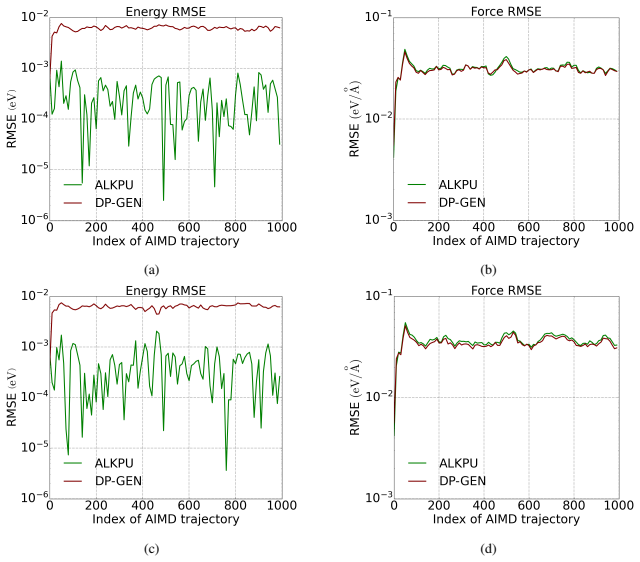
- [Section 5, Table 3 and Figures 3–4] The comparison between ALKPU and DP-GEN is not controlled. Table 3 reports ALKPU training with batch size 128 and 100 epochs against DP-GEN training with batch size 1 and 400 epochs, and the thresholds for DP-GEN were changed from the default (0.05, 0.15) to (0.02, 0.2) because the default 'can not work well.' The convergence and RMSE comparisons in Figures 3–4 are therefore comparing different training regimes rather than isolating the effect of the selection strategy. Moreover, all experiments are single-run; no error bars or multiple seeds are reported. Please provide a matched comparison (e.g., same compute budget or same number of optimizer steps, several random initializations) to support the efficiency conclusions.
- [Section 3.2, threshold sigma1] The statement that configurations with KPU above sigma1 'deviate too far from the real AIMD trajectory and thus should be discarded' is a design assumption, not derived from the theoretical framework. The thresholds c0 = 1.25 and c1 = 2.0 are manually chosen, and the paper does not provide a sensitivity analysis for c0, c1, or the fraction frac used in Algorithm 3. Since the selection outcome depends on these free parameters, the robustness of the reported active-learning behavior should be demonstrated.
minor comments (6)
- [Abstract] The verb 'coverage' in 'it can efficiently coverage the system's configuration space' should be 'cover.'
- [Section 5, Figure 6 and text] 'Photon spectra' should read 'phonon spectra' throughout the experimental section and the figure caption.
- [Section 6, first sentence] The sentence beginning 'his approach uses the efficient RLEKF optimizer' is missing the initial 'T' and should read 'This approach ...'.
- [Section 2, smoothing function] In the description of the smoothing function s(r), the conditions are written as 'for x< rcs' and 'for x> rc' while the argument is r; the variable should be consistent.
- [Equation (4.6)] The phrase 'symmetric semi-definite' should be 'symmetric positive semi-definite' to match the standard definition of the Fisher information matrix.
- [Section 5, text near Table 2] The sentence 'a large amount of extra configurations should be select as the temporary increases from 300K to 1400K' contains grammatical errors; it should read 'a large number of extra configurations should be selected as the temperature increases from 300K to 1400K.'
Circularity Check
No significant circularity: empirical ALKPU/DP-GEN comparison is independent, and Theorem 4.2 is an explicitly conditional Gauss-Newton derivation; the main concern is the unvalidated approximation in Eq. (4.9), a robustness issue, not a circular one.
full rationale
The central empirical claim—ALKPU selects configurations that improve DeePMD accuracy while training one model—is evaluated against DFT validation sets and against DP-GEN (Tables 2–3, Figures 3–6). These benchmarks are external to the definition of KPU and do not fit any parameter to the validation data, so the method's usefulness is independently grounded. The theoretical claim of local optimality (Theorem 4.2) is derived from a Bayesian update under an explicitly stated Gauss-Newton approximation: Eq. (4.9) drops the residual-dependent Hessian term and Eq. (4.10) then expresses the entropy reduction as a monotone function of KPU_t(x). This is a conditional mathematical statement, not a fitted prediction; the definition of KPU (Def. 3.1) and the entropy formula (4.10) are distinct objects, and the theorem does not assume its conclusion. The valid concern raised by the skeptic is that the approximation in Eq. (4.9) is least reliable precisely in the extrapolation regions ALKPU targets, and the paper does not measure the omitted term; however, this is a robustness gap, not circularity. Self-citations to RLEKF [33] and PWmat [36,37] are normal dependencies on prior published work and are not load-bearing in a way that makes the present results equivalent to their inputs. Score 2 reflects routine self-citation and a caveat about the theorem's scope, not a circular derivation.
Assumptions & free parameters
free parameters (6)
- c0 =
1.25
- c1 =
2.0
- frac =
0.5
- lambda_1 =
0.98
- nu =
0.9987
- P0 =
I
assumptions (6)
- domain assumption Observation noise is Gaussian: eta_t ~ N(0, R_t) for the training data model.
- domain assumption The network output h(w,x) is smooth enough for a first-order Taylor expansion around the current weight estimate.
- domain assumption Flat-region approximation (4.9): 1/2 multiplied by the Hessian of the squared error is approximated by the outer product of gradients, dropping second and higher derivatives.
- domain assumption The EKFfm posterior covariance faithfully represents the uncertainty of the trained network parameters.
- ad hoc to paper Configurations with KPU above sigma1 are too far from the real AIMD trajectory and should be discarded.
- standard math Standard matrix identities and information theory results (Sherman-Morrison-Woodbury, Weinstein-Aronszajn, Shannon entropy of Gaussian distributions) hold.
invented entities (1)
-
KPU (Kalman Prediction Uncertainty)
independent evidence
Cite this review
Pith. "Pith review of ALKPU: an active learning method for the DeePMD model with Kalman filter." pith.science (2026). https://pith.science/paper/SXE5TGZC
@misc{pith2026241113850,
  author       = {Pith},
  title        = {Pith review of: ALKPU: an active learning method for the DeePMD model with Kalman filter},
  year         = {2026},
  howpublished = {\url{https://pith.science/paper/SXE5TGZC}},
  note         = {Machine review of arXiv:2411.13850}
}
read the original abstract
Neural network force field models such as DeePMD have enabled highly efficient large-scale molecular dynamics simulations with ab initio accuracy. However, building such models heavily depends on the training data obtained by costly electronic structure calculations, thereby it is crucial to carefully select and label the most representative configurations during model training to improve both extrapolation capability and training efficiency. To address this challenge, based on the Kalman filter theory we propose the Kalman Prediction Uncertainty (KPU) to quantify uncertainty of the model's prediction. With KPU we design the Active Learning by KPU (ALKPU) method, which can efficiently select representative configurations that should be labelled during model training. We prove that ALKPU locally leads to the fastest reduction of model's uncertainty, which reveals its rationality as a general active learning method. We test the ALKPU method using various physical system simulations and demonstrate that it can efficiently coverage the system's configuration space. Our work demonstrates the benefits of ALKPU as a novel active learning method, enhancing training efficiency and reducing computational resource demands.
Figures


Figures from the paper (3 more)


Reference graph
Works this paper leans on
-
[1]
S.-i. Amari. Information geometry and its applications, volume 194. Springer, 2016
work page 2016
-
[2]
M. Aminpour, C. Montemagno, and J. A. Tuszynski. An overview of molecular modeling for drug discovery with specific illustrative examples of applications. Molecules, 24(9):1693, 2019
work page 2019
-
[3]
D. Angluin. Queries revisited. In Algorithmic Learning Theory: 12th International Conference, ALT 2001 Washington, DC, USA, November 25–28, 2001 Proceedings 12, pages 12–31. Springer, 2001
work page 2001
-
[4]
A. P. Bartók, R. Kondor, and G. Csányi. On representing chemical environments. Physical Review B, 87:184115, May 2013
work page 2013
-
[5]
S. Batzner, A. Musaelian, L. Sun, M. Geiger, J. P. Mailoa, M. Kornbluth, N. Molinari, T. E. Smidt, and B. Kozinsky. E(3)-equivariant graph neural networks for data-efficient and accurate interatomic potentials. Nature Communications, 13(1):2453, May 2022
work page 2022
-
[6]
J. Behler. Atom-centered symmetry functions for constructing high-dimensional neural network potentials. The Journal of Chemical Physics, 134(7):074106, 2011
work page 2011
-
[7]
J. Behler. Representing potential energy surfaces by high-dimensional neural network potentials. Journal of Physics: Condensed Matter , 26(18):183001, apr 2014
work page 2014
-
[8]
J. Behler. Constructing high-dimensional neural network potentials: a tutorial review. International Journal of Quantum Chemistry , 115(16):1032–1050, 2015
work page 2015
Show all 72 references
-
[9]
J. Behler. First principles neural network potentials for reactive simulations of large molecular and condensed systems. Angewandte Chemie International Edition, 56(42):12828–12840, 2017
2017
-
[10]
J. Behler. Four generations of high-dimensional neural network potentials. Chemical Reviews, 121(16):10037–10072, 2021
2021
-
[11]
Behler and M
J. Behler and M. Parrinello. Generalized neural-network representation of high-dimensional potential-energy surfaces. Phys. Rev. Lett., 98:146401, Apr 2007
2007
-
[12]
T. B. Blank, S. D. Brown, A. W. Calhoun, and D. J. Doren. Neural network models of potential energy surfaces. The Journal of Chemical Physics, 103(10):4129–4137, 1995
1995
-
[13]
Botu and R
V . Botu and R. Ramprasad. Adaptive machine learning framework to accelerate ab initio molecular dynamics. International Journal of Quantum Chemistry, 115(16):1074–1083, 2015
2015
-
[14]
Car and M
R. Car and M. Parrinello. Unified approach for molecular dynamics and density-functional theory. Physical Review Letters, 55:2471–2474, Nov 1985
1985
-
[15]
C. K. Chui and G. Chen. Kalman filtering. Springer, 2017
2017
-
[16]
D. Cohn. Neural network exploration using optimal experiment design. Advances in neural information processing systems, 6, 1993
1993
-
[17]
D. A. Cohn, Z. Ghahramani, and M. I. Jordan. Active learning with statistical models. Journal of artificial intelligence research, 4:129–145, 1996
1996
-
[18]
H. Cramér. Mathematical Methods of Statistics. Princeton University Press, Princeton, 1946
1946
-
[19]
V . L. Deringer, A. P. Bartók, N. Bernstein, D. M. Wilkins, M. Ceriotti, and G. Csányi. Gaussian process regression for materials and molecules. Chemical Reviews, 121(16):10073–10141, 2021
2021
-
[20]
Desai, S
S. Desai, S. T. Reeve, and J. F. Belak. Implementing a neural network interatomic model with performance portability for emerging exascale architectures. Computer Physics Communications, 270:108156, 2022. 18
2022
-
[21]
Faria, D
B. Faria, D. Perdigão, J. Brás, and L. Macedo. The joint role of batch size and query strategy in active learning-based prediction – a case study in the heart attack domain. In Progress in Artificial Intelligence, pages 464–475, Cham, 2022. Springer International Publishing
2022
-
[22]
Friederich, F
P. Friederich, F. Häse, J. Proppe, and A. Aspuru-Guzik. Machine-learned potentials for next-generation matter simulations. Nature Materials, 20(6):750–761, 2021
2021
-
[23]
Gal and Z
Y . Gal and Z. Ghahramani. Dropout as a Bayesian approximation: Representing model uncertainty in deep learning. InInternational conference on machine learning, pages 1050–1059. PMLR, 2016
2016
-
[24]
Y . Gal, J. Hron, and A. Kendall. Concrete dropout. Advances in neural information processing systems, 30, 2017
2017
-
[25]
Gasteiger, S
J. Gasteiger, S. Giri, J. T. Margraf, and S. Günnemann. Fast and uncertainty-aware directional message passing for non-equilibrium molecules. In Machine Learning for Molecules Workshop, NeurIPS, 2020
2020
-
[26]
Gasteiger, J
J. Gasteiger, J. Groß, and S. Günnemann. Directional message passing for molecular graphs. In International Conference on Learning Representations (ICLR), 2020
2020
-
[27]
Gilmer, S
J. Gilmer, S. S. Schoenholz, P. F. Riley, O. Vinyals, and G. E. Dahl. Neural message passing for quantum chemistry. InInternational conference on machine learning, pages 1263–1272. PMLR, 2017
2017
-
[28]
Gómez-Bombarelli, J
R. Gómez-Bombarelli, J. N. Wei, D. Duvenaud, J. M. Hernández-Lobato, B. Sánchez-Lengeling, D. Sheberla, J. Aguilera-Iparraguirre, T. D. Hirzel, R. P. Adams, and A. Aspuru-Guzik. Automatic chemical design using a data-driven continuous representation of molecules. ACS central s...
2018
-
[29]
Haghighatlari, J
M. Haghighatlari, J. Li, X. Guan, O. Zhang, A. Das, C. J. Stein, F. Heidar-Zadeh, M. Liu, M. Head-Gordon, L. Bertels, et al. Newtonnet: A newtonian message passing network for deep learning of interatomic potentials and forces. Digital Discovery, 1(3):333–343, 2022
2022
-
[30]
S. S. Haykin. Kalman filtering and neural networks, volume 284. Wiley Online Library, 2001
2001
-
[31]
F. Heimes. Extended Kalman filter neural network training: experimental results and algorithm improvements. In SMC’98 Conference Proceedings. 1998 IEEE International Conference on Systems, Man, and Cybernetics (Cat. No.98CH36218), volume 2, pages 1639–1644, 1998
1998
-
[32]
J. M. Hernández-Lobato, J. Requeima, E. O. Pyzer-Knapp, and A. Aspuru-Guzik. Parallel and distributed thompson sampling for large-scale accelerated exploration of chemical space. In International conference on machine learning, pages 1470–1479. PMLR, 2017
2017
-
[33]
S. Hu, W. Zhang, Q. Sha, F. Pan, L.-W. Wang, W. Jia, G. Tan, and T. Zhao. RLEKF: An optimizer for deep potential with ab initio accuracy. In Proceedings of the AAAI Conference on Artificial Intelligence, volume 37, pages 7910–7918, 2023
2023
-
[34]
Hutchinson and M
M. Hutchinson and M. Widom. V ASP on a GPU: Application to exact-exchange calculations of the stability of elemental boron.Computer Physics Communications, 183(7):1422–1426, 2012
2012
-
[35]
A. Jain, S. P. Ong, G. Hautier, W. Chen, W. D. Richards, S. Dacek, S. Cholia, D. Gunter, D. Skinner, G. Ceder, and K. A. Persson. Commentary: The Materials Project: A materials genome approach to accelerating materials innovation. APL Materials, 1(1):011002, July 2013
2013
-
[36]
W. Jia, Z. Cao, L. Wang, J. Fu, X. Chi, W. Gao, and L. Wang. The analysis of a plane wave pseudopotential density functional theory code on a GPU machine - sciencedirect. Computer Physics Communications, 184(1):9–18, 2013
2013
-
[37]
W. Jia, J. Fu, Z. Cao, W. Long, and L. W. Wang. Fast plane wave density functional theory molecular dynamics calculations on multi-GPU machines. Journal of Computational Physics, 251(23):102–115, 2013
2013
-
[38]
W. Jia, H. Wang, M. Chen, D. Lu, L. Lin, R. Car, W. E, and L. Zhang. Pushing the limit of molecular dynamics with ab initio accuracy to 100 million atoms with machine learning. In SC20: International conference for high performance computing, networking, storage and analysis, ...
2020
-
[39]
W. L. Jorgensen, D. S. Maxwell, and J. Tirado-Rives. Development and testing of the opls all-atom force field on conformational energetics and properties of organic liquids. Journal of the American Chemical Society, 118(45):11225–11236, 1996
1996
-
[40]
R. E. Kalman. Contributions to the theory of optimal control. Bol. soc. mat. mexicana, 5(2):102–119, 1960
1960
-
[41]
D. P. Kingma and J. Ba. Adam: A method for stochastic optimization. In 3rd International Conference on Learning Representations, ICLR 2015, 2015
2015
-
[42]
K. Lee, D. Yoo, W. Jeong, and S. Han. Simple-nn: An e fficient package for training and executing neural-network interatomic potentials. Computer Physics Communications, 242:95–103, 2019
2019
-
[43]
Li and Y
Y . Li and Y . Gal. Dropout inference in Bayesian neural networks with alpha-divergences. InInternational conference on machine learning, pages 2052–2061. PMLR, 2017
2017
-
[44]
Lorenz, A
S. Lorenz, A. Gro, and M. Scheffler. Representing high-dimensional potential-energy surfaces for reactions at surfaces by neural networks. Chemical Physics Letters, 395(4–6):210–215, 2004
2004
-
[45]
D. J. MacKay. Information-based objective functions for active data selection. Neural Computation, 4(4):590–604, 1992
1992
-
[46]
Marx and J
D. Marx and J. Hutter. Ab Initio Molecular Dynamics: Basic Theory and Advanced Methods. Cambridge University Press, 2009
2009
-
[47]
S. Nosé. A molecular dynamics method for simulations in the canonical ensemble. Molecular Physics, 52(2):255–268, 1984
1984
-
[48]
E. V . Podryabinkin and A. V . Shapeev. Active learning of linearly parametrized interatomic potentials.Computational Materials Science, 140:171–180, 2017
2017
-
[49]
Proppe, S
J. Proppe, S. Gugler, and M. Reiher. Gaussian process-based refinement of dispersion corrections. Journal of Chemical Theory and Computation, 15(11):6046–6060, 2019
2019
-
[50]
Puskorius and L
G. Puskorius and L. Feldkamp. Decoupled extended Kalman filter training of feedforward layered networks. In IJCNN-91-Seattle International Joint Conference on Neural Networks, volume 1, pages 771–777, 1991
1991
-
[51]
C. R. Rao. Information and the accuracy attainable in the estimation of statistical parameters. Bulletin of the Calcutta Mathematical Society., 37:81–89, 1945
1945
-
[52]
C. E. Rasmussen, C. K. Williams, et al. Gaussian processes for machine learning, volume 1. Springer, 2006
2006
-
[53]
J.-Y . Raty, F. Gygi, and G. Galli. Growth of carbon nanotubes on metal nanoparticles: a microscopic mechanism from ab initio molecular dynamics simulations. Physical Review Letters, 95(9):096103, 2005
2005
-
[54]
Roy and A
N. Roy and A. McCallum. Toward optimal active learning through Monte Carlo estimation of error reduction. ICML, 2:441–448, 2001
2001
-
[55]
Schütt, O
K. Schütt, O. Unke, and M. Gastegger. Equivariant message passing for the prediction of tensorial properties and molecular spectra. In International Conference on Machine Learning, pages 9377–9388. PMLR, 2021. 19
2021
-
[56]
K. T. Schütt, F. Arbabzadah, S. Chmiela, K. R. Müller, and A. Tkatchenko. Quantum-chemical insights from deep tensor neural networks. Nature Communications, 8(1):13890, Jan 2017
2017
-
[57]
B. Settles. Active learning literature survey. University of Wisconsin Madison, 2010
2010
-
[58]
Settles, M
B. Settles, M. Craven, and S. Ray. Multiple-instance active learning. Advances in neural information processing systems, 20, 2007
2007
-
[59]
H. S. Seung, M. Opper, and H. Sompolinsky. Query by committee. In Proceedings of the fifth annual workshop on Computational learning theory, pages 287–294, 1992
1992
-
[60]
G. N. Simm and M. Reiher. Error-controlled exploration of chemical reaction networks with Gaussian processes. Journal of Chemical Theory and Computation, 14(10):5238–5248, 2018
2018
-
[61]
J. S. Smith, B. Nebgen, N. Lubbers, O. Isayev, and A. E. Roitberg. Less is more: Sampling chemical space with active learning. The Journal of Chemical Physics, 148(24):241733, 2018
2018
-
[62]
F. H. Stillinger and T. A. Weber. Computer simulation of local order in condensed phases of silicon. Physical Review B, 1985
1985
-
[63]
O. T. Unke, S. Chmiela, M. Gastegger, K. T. Schütt, H. E. Sauceda, and K.-R. Müller. Spookynet: Learning force fields with electronic degrees of freedom and nonlocal effects. Nature Communications, 12(1):7273, Dec 2021
2021
-
[64]
H. Wang, L. Zhang, J. Han, and W. E. DeePMD-kit: A deep learning package for many-body potential energy representation and molecular dynamics. Computer Physics Communications, 228:178–184, 2018
2018
-
[65]
K. Yao, J. E. Herr, S. N. Brown, and J. Parkhill. Intrinsic bond energies from a bonds-in-molecules neural network. The Journal of Physical Chemistry Letters, 8(12):2689–2694, 2017. PMID: 28573865
2017
-
[66]
J. Zeng, L. Cao, M. Xu, T. Zhu, and J. Z. Zhang. Neural network based in silico simulation of combustion reactions. arXiv:1911.12252, 2019
1911 arXiv
-
[67]
J. Zeng, L. Zhang, H. Wang, and T. Zhu. Exploring the chemical space of linear alkane pyrolysis via deep potential generator. Energy & Fuels, 35(1):762–769, 2020
2020
-
[68]
L. Zhang. Machine learning for multi-scale molecular modeling: theories, algorithms, and applications. PhD thesis, Princeton University, 2020
2020
-
[69]
Zhang, J
L. Zhang, J. Han, H. Wang, and R. Car. Deep potential molecular dynamics: a scalable model with the accuracy of quantum mechanics. Physical Review Letters, 120(14):143001, 2018
2018
-
[70]
Zhang, J
L. Zhang, J. Han, H. Wang, W. Saidi, R. Car, et al. End-to-end symmetry preserving inter-atomic potential energy model for finite and extended systems. Advances in neural information processing systems, 31, 2018
2018
-
[71]
Zhang, D.-Y
L. Zhang, D.-Y . Lin, H. Wang, R. Car, and W. E. Active learning of uniformly accurate interatomic potentials for materials simulation.Physical Review Materials, 3(2):023804, 2019
2019
-
[72]
Zhang, H
Y . Zhang, H. Wang, W. Chen, J. Zeng, L. Zhang, H. Wang, and W. E. DP-GEN: A concurrent learning platform for the generation of reliable deep learning based potential energy models. Computer Physics Communications, 253:107206, 2020. 20
2020
Reviewed August 12, 2026 · model on record in the stance chip above.
Discussion (0). Continue with ORCID to comment.