REVIEW 3 major objections 8 minor 48 references
CLFace: A Scalable and Resource-Efficient Continual Learning Framework for Lifelong Face Recognition
T0 review · 3 major / 8 minor · reviewed 2026-08-12 · deepseek-v4-flash
Pith's one-line read The paper claims that a face recognition model can keep learning new identities from a continuous stream without storing old images or using identity labels, by training a student on three distillation losses from a frozen teacher.
desk verdict Plausible distillation recipe for label-free incremental face recognition, but the paper never measures accuracy on previously learned identities, so its central anti-forgetting claim is unsupported. read the letter →
The pith
A machine-rendered reading of the paper's core claim, the machinery that carries it, and where it could break.
The reading
What carries the argument
The carrying mechanism is teacher-student distillation with a frozen teacher and a student initialized from it. MSFD transfers local spatial structure: for each intermediate stage except the first, both models' feature maps are pooled across channels and L2-normalized, and the squared L2 distance between the resulting attention maps is penalized. GPKD transfers global geometry: cosine similarity between the teacher's and student's normalized embeddings is maximized so the embedding space is not rotated. CKD adds discriminative contrast: within each batch, the positive pair is the teacher and student embedding of the same identity, and all other identities are negatives, optimized through an InfoNCE-style loss. Removing the classification layer keeps the architecture and parameter count fixed across steps, which is what makes the approach scalable and label-free.
What would settle it
Run the same incremental protocol but, after every step, test on held-out samples of the identities trained in every previous step, as in standard class-incremental evaluation. If verification or identification accuracy on those old identities drops substantially after later steps, the distillation objective has not actually preserved the learned knowledge, even though unseen-identity accuracy could remain high.
Extended reading notes
Core claim
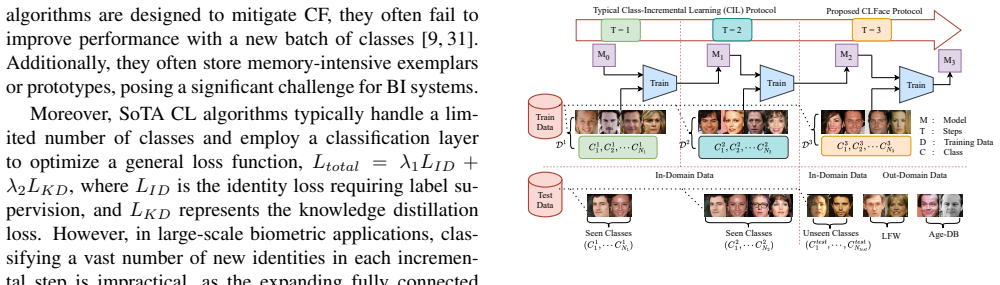
CLFace is a continual learning framework for face recognition in which a student model, initialized from a frozen teacher, is trained on each new batch of identities with no classification layer and no label supervision. The objective is a weighted sum of three losses: multiscale feature distillation (MSFD), which takes channel-wise pooled and L2-normalized spatial attention maps at intermediate stages and minimizes their L2 distance between student and teacher; geometry-preserving knowledge distillation (GPKD), which keeps the cosine orientation of the L2-normalized embeddings aligned; and contrastive knowledge distillation (CKD), an InfoNCE-style loss that pulls the teacher and student embeddings of the same identity together while pushing embeddings of different identities apart. The paper's claim is that this combination lets the student inherit the teacher's learned representation, avoids catastrophic forgetting, and sharpens discrimination of new identities. In experiments with 5-step and 10-step protocols on VGGFace2, MS1MV2, and WebFace12M, CLFace achieves higher verification accuracy on unseen identities than fine-tuning, LwM, PODNet, and CRL, on both in-domain and out-of-domain benchmarks including LFW, AGE-DB, CALFW, CFP-FP, CPLFW, IJB-B, IJB-C, and TinyFace.
Load-bearing premise
The experiments never evaluate accuracy on identities the model saw in earlier incremental steps, so the claim that CLFace preserves previously learned knowledge rests on the assumption that stable or improved accuracy on unseen identities is enough to prove no catastrophic forgetting occurred.
Editorial extensions
If this is right
- Deployed face recognition systems could be updated continuously on streams of new identities without storing exemplars, removing a major privacy and storage bottleneck.
- Because the architecture is fixed and classifier-free, memory and compute use stay bounded as the number of enrolled identities grows.
- The label-free objective permits incremental training on unlabeled face collections, which supports open-set recognition in deployment settings.
- The reported pattern that larger incremental steps produce larger gains implies the benefit of lifelong updates grows with the volume of the identity stream.
Reading between the lines
- Inference: because the evaluation only covers unseen identities, the reported gains may reflect improved general feature quality rather than actual retention of identities from earlier steps; an evaluation on old identities would separate the two effects.
- Inference: the ablation results suggest the three losses play distinct roles—MSFD preserves spatial structure, GPKD stabilizes embedding orientation, and CKD adds contrastive discrimination among new identities—so the same recipe may transfer to other embedding-based incremental metric-learning tasks such as person re-identification or speaker verification.
- Inference: the reported improvements over CRL are small on high-quality benchmarks, which hints that the main advantage may be architectural, namely removing the classification layer and label supervision, rather than the specific choice of distillation losses; isolating this by ablating CRL's own losses without its classifier would test that.
Editorial analysis
A structured set of objections, weighed in public.
Referee Report
Summary. The paper proposes CLFace, a continual learning framework for face recognition that removes the classification layer and avoids storing exemplars. A frozen teacher model supervises a student model through three distillation losses: multiscale feature distillation (MSFD), geometry-preserving knowledge distillation (GPKD), and contrastive knowledge distillation (CKD). The model is trained incrementally on batches of new face identities and evaluated on unseen identities from in-domain datasets (VGGFace2, MS1MV2, WebFace12M) and out-of-domain benchmarks (LFW, AGEDB, CALFW, CFPFP, CPLFW, IJB-B, IJB-C, TinyFace). The paper reports that CLFace outperforms fine-tuning, LwM, PODNet, and CRL, and provides ablations of the loss components and the amount of base training data.
Significance. If the central claim were fully validated, the framework would be practically significant: it is label-free during incremental steps, uses a fixed-size architecture, and does not store old samples, which is attractive for privacy-constrained biometric deployments. The experimental effort is substantial, including large-scale datasets, multiple incremental-step settings, out-of-domain benchmarks, and ablation studies. However, the significance is conditional because the protocol never measures accuracy on identities learned in earlier incremental steps, so the paper's stated goal of preventing catastrophic forgetting of previously learned identities is not directly supported.
major comments (3)
- [§3.1, §4.3–4.4] The central claim that CLFace preserves learned knowledge and mitigates catastrophic forgetting is never directly measured. In §3.1 the in-domain test set D_test is defined with identities disjoint from all training steps (C_t ∩ C_test = ∅ for t = 1,...,T), and the results in Figure 3 and Tables 2–5 are all verification accuracies on this disjoint set. A model that completely forgets the identities from steps 1,...,T−1 would still obtain these scores, because the total loss in Eq. (5) is computed only on the current step's batch and no exemplars or prototypes are retained. The inference in §4.5 that incremental improvement on unseen identities 'confirms that CLFace effectively mitigates CF' is therefore not valid. I recommend adding a direct backward-transfer evaluation, e.g., reporting verification or closed-set identification accuracy on the identities from each previous step after each incremental step, or, if the authors intend to claim only open-set generalization, removing the catastrophic-forgetting claims from the Abstract and Section 1.
- [§4.5, Table 5] The ablation that is supposed to show the effect of removing identity supervision does not display the comparison it describes. Table 5's final row is 'ID + MSFD + GPKD + CKD', but there is no row for 'MSFD + GPKD + CKD' without ID; the text compares the no-ID objective from Table 3 against 'ID + GPKD' from Table 5. Since the reported conclusion is that 'replacing ID supervision with CKD loss does not compromise generalizability', the table should include the exact no-ID row, or the text should explicitly state that the comparison is across Tables 3 and 5.
- [§4.2, Table 2, Figure 3] The reported improvements over the strongest baseline CRL are very small—between 0.0 and 0.35 percentage points in Table 2 and around 0.04–0.10 points in Figure 3—yet the paper gives only the mean over three random class orders with no standard deviation or significance measure. Given that the claimed advantage is of the same order as typical run-to-run variation in face-verification benchmarks, the comparison is not robust without error bars. Please report mean ± std and, if possible, the per-order values.
minor comments (8)
- [Algorithm 1 caption] The algorithm title reads 'CL2Face Implementation' and should be 'CLFace Implementation'.
- [Figure 2] The label 'Contrastiave Knowledge Distillation' contains a typo; it should be 'Contrastive'.
- [§3.3, §4.5] The acronym for the multiscale feature distillation loss is inconsistent: 'MFSD' appears in the contributions bullet list, 'MSD' appears in the ablation text, and Eq. (2) defines 'MSFD'. Use one spelling throughout.
- [§3.1] The formulation allows overlapping identities across steps ({C_t ∩ C_t'} ≠ ∅), but the experimental protocol in §4.2 uses disjoint sets. Clarify whether the overlap scenario is ever tested, since it is one of the properties claimed in Section 1.
- [Table 2] The mixed-quality and low-quality columns for LWF-MC, LwM, PODNet, and CRL are all dashes, which is inconsistent with the text's claim that CLFace outperforms these methods 'across all datasets'. Complete these entries or restrict the claim to the datasets where comparisons exist.
- [§1, §4.6] The phrase 'open-set face recognition' is not standard: the protocol evaluates on unseen identities but does not include an open-set rejection (unknown-class) component. Please qualify the terminology.
- [§2, §4.2] The claim of 'label-free supervision' applies only to incremental steps; the base model is trained with ArcFace label supervision. Please state this explicitly.
- [§4.5, Table 4] In the discussion of the base-training ablation, the text says 'Rank-1' for TinyFace while Table 4 and Table 2 consistently use Rank-5. Correct this inconsistency.
Circularity Check
No significant circularity; CLFace is an empirical combination of existing distillation losses, and its reported accuracies are not forced by construction.
full rationale
CLFace's derivation chain is an engineering combination, not a theorem. The objective in Eq. 5 is a weighted sum of three distillation terms (Eqs. 2-4), each explicitly borrowed from or inspired by cited prior work (PODNet-style feature pooling, LUCIR-style embedding orientation, InfoNCE-style contrastive learning). The weights in Table 1 are selected by grid search, and the reported accuracies are measured on held-out folds with test identities disjoint from all incremental steps (Section 3.1). There is no equation under which the reported verification accuracy is algebraically forced by the fitted hyperparameters or by the loss definitions; the method could in principle fail, and indeed the paper reports mixed ablation results (Table 5) and admits limitations (Section 4.6). The only serious concern is experimental validity rather than circularity: because D_test is disjoint from every C_t and no experiment evaluates accuracy on identities seen in earlier steps, the paper's claim of preserving previously learned knowledge is not directly verified. That is a missing-evidence gap, not a self-referential reduction. Citation use is benign: prior references are external, and no uniqueness theorem or author self-citation is load-bearing.
Assumptions & free parameters
free parameters (4)
- lambda_1 (MSFD weight) =
3
- lambda_2 (GPKD weight) =
12
- lambda_3 (CKD weight) =
1
- tau (temperature in CKD) =
2
assumptions (5)
- domain assumption Cosine similarity between ArcFace embeddings is a valid verification score with a threshold learned from nine folds.
- domain assumption Each mini-batch contains unique identities, so all non-positive pairs in CKD are negatives.
- domain assumption L2-normalized channel-wise pooled attention maps from stages 2-4 are comparable across teacher and student with L2 distance.
- domain assumption The combination of MSFD, GPKD, and CKD is sufficient to transfer the teacher's recognition capability to the student without labels or exemplars.
- domain assumption Pre-training on half the identities with ArcFace produces a teacher strong enough for lifelong learning.
Cite this review
Pith. "Pith review of CLFace: A Scalable and Resource-Efficient Continual Learning Framework for Lifelong Face Recognition." pith.science (2026). https://pith.science/paper/WETSNAR5
@misc{pith2026241113886,
  author       = {Pith},
  title        = {Pith review of: CLFace: A Scalable and Resource-Efficient Continual Learning Framework for Lifelong Face Recognition},
  year         = {2026},
  howpublished = {\url{https://pith.science/paper/WETSNAR5}},
  note         = {Machine review of arXiv:2411.13886}
}
read the original abstract
An important aspect of deploying face recognition (FR) algorithms in real-world applications is their ability to learn new face identities from a continuous data stream. However, the online training of existing deep neural network-based FR algorithms, which are pre-trained offline on large-scale stationary datasets, encounter two major challenges: (I) catastrophic forgetting of previously learned identities, and (II) the need to store past data for complete retraining from scratch, leading to significant storage constraints and privacy concerns. In this paper, we introduce CLFace, a continual learning framework designed to preserve and incrementally extend the learned knowledge. CLFace eliminates the classification layer, resulting in a resource-efficient FR model that remains fixed throughout lifelong learning and provides label-free supervision to a student model, making it suitable for open-set face recognition during incremental steps. We introduce an objective function that employs feature-level distillation to reduce drift between feature maps of the student and teacher models across multiple stages. Additionally, it incorporates a geometry-preserving distillation scheme to maintain the orientation of the teacher model's feature embedding. Furthermore, a contrastive knowledge distillation is incorporated to continually enhance the discriminative power of the feature representation by matching similarities between new identities. Experiments on several benchmark FR datasets demonstrate that CLFace outperforms baseline approaches and state-of-the-art methods on unseen identities using both in-domain and out-of-domain datasets.
Figures


Reference graph
Works this paper leans on
-
[1]
VGGFace2: A dataset for recognising faces across pose and age
Qiong Cao, Li Shen, Weidi Xie, Omkar M Parkhi, and An- drew Zisserman. VGGFace2: A dataset for recognising faces across pose and age. In IEEE international conference on automatic face & gesture recognition, pages 67–74, 2018
work page 2018
-
[2]
Riemannian walk for incremen- tal learning: Understanding forgetting and intransigence
Arslan Chaudhry, Puneet K Dokania, Thalaiyasingam Ajan- than, and Philip HS Torr. Riemannian walk for incremen- tal learning: Understanding forgetting and intransigence. In Eur. Conf. Comput. Vis., pages 532–547, 2018
work page 2018
-
[3]
Low- resolution face recognition
Zhiyi Cheng, Xiatian Zhu, and Shaogang Gong. Low- resolution face recognition. In ACCV, pages 605–621, 2019
work page 2019
-
[4]
CLIFER: Continual learning with imagination for facial expression recognition
Nikhil Churamani and Hatice Gunes. CLIFER: Continual learning with imagination for facial expression recognition. In IEEE International Conference on Automatic Face & Ges- ture Recognition, pages 322–328, 2020
work page 2020
-
[5]
Nikhil Churamani, Ozgur Kara, and Hatice Gunes. Domain- Incremental Continual Learning for Mitigating Bias in Facial Expression and Action Unit Recognition. IEEE Trans. on Affective Comput., pages 1–15, 2022
work page 2022
-
[6]
ImageNet: A large-scale hierarchical image database
Jia Deng, Wei Dong, Richard Socher, Li-Jia Li, Kai Li, and Li Fei-Fei. ImageNet: A large-scale hierarchical image database. In IEEE Conf. Comput. Vis. Pattern Recog., pages 248–255, 2009
work page 2009
-
[7]
ArcFace: additive angular margin loss for deep face recognition
Jiankang Deng, Jia Guo, Niannan Xue, and Stefanos Zafeiriou. ArcFace: additive angular margin loss for deep face recognition. In IEEE Conf. Comput. Vis. Pattern Recog., pages 4685–4694, 2019
work page 2019
-
[8]
Prithviraj Dhar, Rajat Vikram Singh, Kuan-Chuan Peng, Ziyan Wu, and Rama Chellappa. Learning without mem- orizing. In IEEE Conf. Comput. Vis. Pattern Recog. , pages 5138–5146, 2019
work page 2019
Show all 48 references
-
[9]
PODNet: pooled outputs dis- tillation for small-tasks incremental learning
Arthur Douillard, Matthieu Cord, Charles Ollion, Thomas Robert, and Eduardo Valle. PODNet: pooled outputs dis- tillation for small-tasks incremental learning. In Eur. Conf. Comput. Vis., pages 86–102, 2020
2020
-
[10]
Lifelong person re-identification by pseudo task knowledge preservation
Wenhang Ge, Junlong Du, Ancong Wu, Yuqiao Xian, Ke Yan, Feiyue Huang, and Wei-Shi Zheng. Lifelong person re-identification by pseudo task knowledge preservation. In AAAI, pages 688–696, 2022
2022
-
[11]
An empirical investigation of catas- trophic forgetting in gradient-based neural networks
Ian J Goodfellow, Mehdi Mirza, Da Xiao, Aaron Courville, and Yoshua Bengio. An empirical investigation of catas- trophic forgetting in gradient-based neural networks. Int. Conf. Learn. Represent., 2013
2013
-
[12]
Deep residual learning for image recognition
Kaiming He, Xiangyu Zhang, Shaoqing Ren, and Jian Sun. Deep residual learning for image recognition. In IEEE Conf. Comput. Vis. Pattern Recog., pages 770–778, 2016
2016
-
[13]
Distilling the knowledge in a neural network
Geoffrey Hinton, Oriol Vinyals, and Jeff Dean. Distilling the knowledge in a neural network. Neural Information Pro- cessing Systems, Deep Learning and Representation Learn- ing Workshop, 2015
2015
-
[14]
Learning a unified classifier incrementally via re- balancing
Saihui Hou, Xinyu Pan, Chen Change Loy, Zilei Wang, and Dahua Lin. Learning a unified classifier incrementally via re- balancing. In IEEE Conf. Comput. Vis. Pattern Recog., pages 831–839, 2019
2019
-
[15]
Labeled faces in the wild: A database forstudying face recognition in unconstrained environments
Gary B Huang, Marwan Mattar, Tamara Berg, and Eric Learned-Miller. Labeled faces in the wild: A database forstudying face recognition in unconstrained environments. In Workshop on faces in Real-Life Images: detection, align- ment, and recognition, 2008
2008
-
[16]
AdaFace: quality adaptive margin for face recognition
Minchul Kim, Anil K Jain, and Xiaoming Liu. AdaFace: quality adaptive margin for face recognition. In IEEE Conf. Comput. Vis. Pattern Recog., pages 18750–18759, 2022
2022
-
[17]
Overcoming catastrophic forgetting in neural networks.Pro- ceedings of the national academy of sciences, 114(13):3521– 3526, 2017
James Kirkpatrick, Razvan Pascanu, Neil Rabinowitz, Joel Veness, Guillaume Desjardins, Andrei A Rusu, and et al. Overcoming catastrophic forgetting in neural networks.Pro- ceedings of the national academy of sciences, 114(13):3521– 3526, 2017
2017
-
[18]
Learning multiple layers of features from tiny images
Alex Krizhevsky, Geoffrey Hinton, et al. Learning multiple layers of features from tiny images. Technical report, Uni- versity of Toronto, 2009
2009
-
[19]
Rethinking feature- based knowledge distillation for face recognition
Jingzhi Li, Zidong Guo, Hui Li, Seungju Han, Ji-won Baek, Min Yang, Ran Yang, and Sungjoo Suh. Rethinking feature- based knowledge distillation for face recognition. In IEEE Conf. Comput. Vis. Pattern Recog. , pages 20156–20165, 2023
2023
-
[20]
Learning without forgetting
Zhizhong Li and Derek Hoiem. Learning without forgetting. In Eur. Conf. Comput. Vis., 2016
2016
-
[21]
Knowledge distilla- tion via the target-aware transformer
Sihao Lin, Hongwei Xie, Bing Wang, Kaicheng Yu, Xiaojun Chang, Xiaodan Liang, and Gang Wang. Knowledge distilla- tion via the target-aware transformer. InIEEE Conf. Comput. Vis. Pattern Recog., pages 10915–10924, 2022
2022
-
[22]
Mnemonics training: Multi-class incremental learning without forgetting
Yaoyao Liu, Yuting Su, An-An Liu, Bernt Schiele, and Qianru Sun. Mnemonics training: Multi-class incremental learning without forgetting. In IEEE Conf. Comput. Vis. Pat- tern Recog., pages 12245–12254, 2020
2020
-
[23]
Incremental learning from low-labelled stream data in open- set video face recognition
Eric Lopez-Lopez, Xose M Pardo, and Carlos V Regueiro. Incremental learning from low-labelled stream data in open- set video face recognition. Pattern Recognition, 131:108885, 2022
2022
-
[24]
Temporal model adaptation for person re- identification
Niki Martinel, Abir Das, Christian Micheloni, and Amit K Roy-Chowdhury. Temporal model adaptation for person re- identification. In Eur. Conf. Comput. Vis., pages 858–877, 2016
2016
-
[25]
Iarpa janus benchmark-c: Face dataset and protocol
Brianna Maze, Jocelyn Adams, James A Duncan, Nathan Kalka, Tim Miller, Charles Otto, and et al. Iarpa janus benchmark-c: Face dataset and protocol. In 2018 interna- tional conference on biometrics (ICB), pages 158–165, 2018
2018
-
[26]
Michael McCloskey and Neal J. Cohen. Catastrophic inter- ference in connectionist networks: the sequential learning problem. Psychol. of Learn. Motivat., 24:109–165, 1989
1989
-
[27]
MagFace: A universal representation for face recognition and quality assessment
Qiang Meng, Shichao Zhao, Zhida Huang, and Feng Zhou. MagFace: A universal representation for face recognition and quality assessment. In IEEE Conf. Comput. Vis. Pattern Recog., pages 14225–14234, 2021
2021
-
[28]
Agedb: the first manually collected, in-the-wild age database
Stylianos Moschoglou, Athanasios Papaioannou, Chris- tos Sagonas, Jiankang Deng, Irene Kotsia, and Stefanos Zafeiriou. Agedb: the first manually collected, in-the-wild age database. In IEEE Conf. Comput. Vis. Pattern Recog. , pages 51–59, 2017
2017
-
[29]
Repre- sentation learning with contrastive predictive coding
Aaron van den Oord, Yazhe Li, and Oriol Vinyals. Repre- sentation learning with contrastive predictive coding. arXiv preprint arXiv:1807.03748, 2018. 9
2018 arXiv
-
[30]
Lifelong person re-identification via adaptive knowl- edge accumulation
Nan Pu, Wei Chen, Yu Liu, Erwin M Bakker, and Michael S Lew. Lifelong person re-identification via adaptive knowl- edge accumulation. In IEEE Conf. Comput. Vis. Pattern Recog., pages 7901–7910, 2021
2021
-
[31]
Sylvestre-Alvise Rebuffi, Alexander Kolesnikov, Georg Sperl, and Christoph H. Lampert. iCaRL: incremental classi- fier and representation learning. In IEEE Conf. Comput. Vis. Pattern Recog., 2017
2017
-
[32]
FitNets: Hints for thin deep nets
Adriana Romero, Nicolas Ballas, Samira Kahou Ebrahimi, Antoine Chassang, Carlo Gatta, and Yoshua Bengio. FitNets: Hints for thin deep nets. In Int. Conf. Learn. Represent. , 2015
2015
-
[33]
Rusu, Neil C
Andrei A. Rusu, Neil C. Rabinowitz, Guillaume Desjardins, Hubert Soyer, James Kirkpatrick, Koray Kavukcuoglu, Raz- van Pascanu, and Raia Hadsell. Progressive neural networks. arXiv preprint 1606.04671, 2016
2016 arXiv
-
[34]
Frontal to profile face verification in the wild
Soumyadip Sengupta, Chen Jun-Cheng Chen, Castillo Car- los, Vishal M Patel, Chellappa Rama, and David W Jacobs. Frontal to profile face verification in the wild. In IEEE Win- ter Conf. on App. of Comput. Vis., February 2016
2016
-
[35]
Continual learning with deep generative replay
Hanul Shin, Jung Kwon Lee, Jaehong Kim, and Jiwon Kim. Continual learning with deep generative replay. Adv. Neural Inform. Process. Syst., 30, 2017
2017
-
[36]
Incremental learning of object detectors without catas- trophic forgetting
Konstantin Shmelkov, Cordelia Schmid, and Karteek Ala- hari. Incremental learning of object detectors without catas- trophic forgetting. In IEEE Conf. Comput. Vis. Pattern Recog., pages 3400–3409, 2017
2017
-
[37]
Deep continual learning for emerging emotion recognition
Selvarajah Thuseethan, Sutharshan Rajasegarar, and John Yearwood. Deep continual learning for emerging emotion recognition. IEEE Trans. Multimedia, 24:4367–4380, 2022
2022
-
[38]
The caltech-ucsd birds-200-2011 dataset
Catherine Wah, Steve Branson, Peter Welinder, Pietro Per- ona, and Serge Belongie. The caltech-ucsd birds-200-2011 dataset. California Institute of Technology, 2011
2011
-
[39]
Iarpa janus benchmark-b face dataset
Cameron Whitelam, Emma Taborsky, Austin Blanton, Bri- anna Maze, Jocelyn Adams, Tim Miller, and et al. Iarpa janus benchmark-b face dataset. In IEEE Conf. Comput. Vis. Pattern Recog. Worksh., pages 90–98, 2017
2017
-
[40]
Memory replay GANs: Learn- ing to generate new categories without forgetting
Chenshen Wu, Luis Herranz, Xialei Liu, Joost Van De Wei- jer, Bogdan Raducanu, et al. Memory replay GANs: Learn- ing to generate new categories without forgetting. Adv. Neu- ral Inform. Process. Syst., 31, 2018
2018
-
[41]
A gift from knowledge distillation: Fast optimization, network minimization and transfer learning
Junho Yim, Donggyu Joo, Jihoon Bae, and Junmo Kim. A gift from knowledge distillation: Fast optimization, network minimization and transfer learning. In IEEE Conf. Comput. Vis. Pattern Recog., pages 4133–4141, 2017
2017
-
[42]
Paying more at- tention to attention: Improving the performance of convo- lutional neural networks via attention transfer
Sergey Zagoruyko and Nikos Komodakis. Paying more at- tention to attention: Improving the performance of convo- lutional neural networks via attention transfer. In Int. Conf. Learn. Represent., 2017
2017
-
[43]
Continual representation learning for biometric identification
Bo Zhao, Shixiang Tang, Dapeng Chen, Hakan Bilen, and Rui Zhao. Continual representation learning for biometric identification. In IEEE Winter Conf. on App. of Comput. Vis., pages 1198–1208, 2021
2021
-
[44]
Zheng and W
T. Zheng and W. Deng. Cross-pose lfw: A database for studying cross-pose face recognition in unconstrained envi- ronments. Technical report, Beijing University of Posts and Telecommunications, 2018
2018
-
[45]
Cross-age lfw: A database for studying cross-age face recognition in un- constrained environments
Tianyue Zheng, Weihong Deng, and Jiani Hu. Cross-age lfw: A database for studying cross-age face recognition in un- constrained environments. arXiv preprint arXiv:1708.08197, 2017
2017 arXiv
-
[46]
Prototype augmentation and self-supervision for incremental learning
Fei Zhu, Xu-Yao Zhang, Chuang Wang, Fei Yin, and Cheng- Lin Liu. Prototype augmentation and self-supervision for incremental learning. In IEEE Conf. Comput. Vis. Pattern Recog., pages 5871–5880, 2021
2021
-
[47]
Self-sustaining representation expansion for non- exemplar class-incremental learning
Kai Zhu, Wei Zhai, Yang Cao, Jiebo Luo, and Zheng- Jun Zha. Self-sustaining representation expansion for non- exemplar class-incremental learning. InIEEE Conf. Comput. Vis. Pattern Recog., pages 9296–9305, 2022
2022
-
[48]
Webface260m: A benchmark unveiling the power of million-scale deep face recognition
Zheng Zhu, Guan Huang, Jiankang Deng, Yun Ye, Junjie Huang, Xinze Chen, et al. Webface260m: A benchmark unveiling the power of million-scale deep face recognition. In IEEE Conf. Comput. Vis. Pattern Recog. , pages 10492– 10502, 2021. 10
2021
Reviewed August 12, 2026 · model on record in the stance chip above.
Discussion (0). Continue with ORCID to comment.