REVIEW 3 major objections 5 minor 73 references
A cohomology-based Gromov-Hausdorff metric approach for quantifying molecular similarity
T0 review · 3 major / 5 minor · reviewed 2026-08-12 · deepseek-v4-flash
Pith's one-line read This paper introduces a cohomology-based Gromov-Hausdorff ultrametric for molecular similarity and shows it clusters halide perovskites by halogen atom with near-perfect Adjusted Rand Index.
desk verdict A genuinely new descriptor idea with an acknowledged but unquantified basis-dependence problem; worth refereeing, but the empirical claim needs a stability check before trusting it. read the letter →
The pith
A machine-rendered reading of the paper's core claim, the machinery that carries it, and where it could break.
The reading
What carries the argument
The load-bearing object is the cohomology generator space H^p(K), the set of harmonic representatives of cohomology classes obtained as the kernel of the combinatorial Hodge Laplacian L_p. By the Hodge decomposition, each cohomology class has a unique harmonic representative, so these eigenvectors can serve as coordinate descriptions of a molecule's loop and cavity geometry. Pairwise distances among generators—L1 distance, cocycle distance, or Wasserstein distance—turn the generator set into a finite metric space. Hierarchical clustering converts that metric space into a dendrogram, which is an ultrametric space, and the Gromov-Hausdorff ultrametric uGH between two such dendrograms is the final molecular similarity score.
What would settle it
Take one OIHP configuration, compute its L1-based uGH features, then recompute after applying a random orthogonal transformation to the zero-eigenvalue eigenvectors of the Hodge Laplacian; if the resulting distance matrix and the K-means clusters change substantially, the method's central similarity claim is not stable.
Extended reading notes
Core claim
The central claim is that the space of harmonic cohomology representatives of a molecular simplicial complex can be treated as a metric space, and that the Gromov-Hausdorff ultrametric between two such spaces quantifies molecular structural similarity. Because cohomology classes correspond to loops, voids, and higher cavities, the descriptors carry topological information that is localized and geometry-aware. The paper constructs cohomology generators as eigenvectors spanning the kernel of the p-th combinatorial Hodge Laplacian, equips the generator set with one of three pairwise distances, converts the resulting metric space into a dendrogram and hence an ultrametric space, and then computes the Gromov-Hausdorff ultrametric between molecules. The numerical experiments show that this approach clusters halide perovskites by X-site atom nearly perfectly, and the paper presents it as the first cohomology-based Gromov-Hausdorff ultrametric method for such molecular similarity questions.
Load-bearing premise
The method assumes that the particular cohomology generators computed for a molecule are meaningful descriptors, but whenever a molecule has multiple independent loops the harmonic representatives can be rotated by an orthogonal change of basis, and the pairwise distances—and therefore the uGH features—can change.
Editorial extensions
If this is right
- If the method is correct, molecular similarity can be quantified from a molecule's intrinsic loop and cavity geometry without needing atom-type labels or chemical fingerprints.
- Clustering tasks such as distinguishing halide perovskites by halide atom become nearly perfect using only structural coordinates, indicating that topology-geometry descriptors carry chemically relevant signal.
- Because the Gromov-Hausdorff ultrametric is computable in polynomial time, the approach can in principle scale beyond the small molecules tested here to larger structural datasets, at least for first cohomology.
- The framework extends to higher-dimensional cohomology groups by the same recipe, so voids and higher-dimensional cavities can be incorporated into the same similarity measure.
- The dendrogram representation gives a hierarchical view of molecular similarity rather than a single scalar distance, which may support multi-scale analysis of structurally related molecules.
Reading between the lines
- A natural stress test is whether the reported clustering advantage survives when the kernel-basis ambiguity is controlled by averaging or optimizing over orthogonal rotations of the harmonic generators; the paper itself leaves this open.
- The same pipeline could be applied to protein conformations or ligand binding pockets, where loop and cavity geometry is thought to drive function; the paper mentions this direction but does not test it.
- Combining uGH features with machine-learning models may yield descriptors complementary to persistent-homology barcodes, since uGH preserves geometric placement of features rather than only their persistence.
- The three distance measures may behave differently under basis rotation, so choosing between L1, cocycle, and Wasserstein distances is an empirical question not settled in the paper.
Editorial analysis
A structured set of objections, weighed in public.
Referee Report
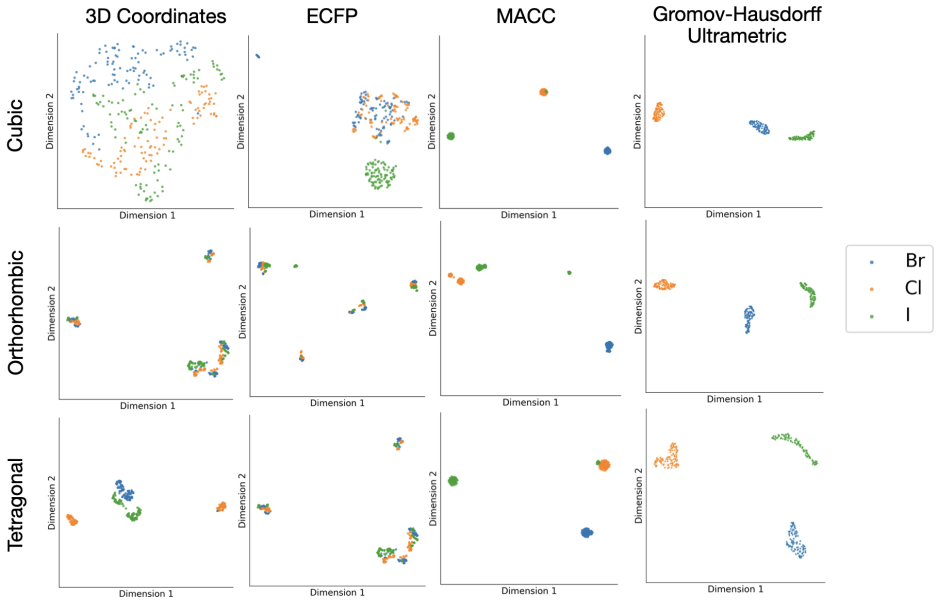
Summary. The paper proposes a molecular similarity descriptor built from cohomology. For each molecular structure, an Alpha complex is constructed at several filtration thresholds; the 1-dimensional Hodge Laplacian is formed; its zero eigenvectors, called cohomology generators, are treated as points in a metric space under one of three pairwise distances (L1, cocycle, Wasserstein). The resulting distance matrix is converted into an ultrametric space via a dendrogram construction, and the Gromov-Hausdorff ultrametric (uGH) between two such ultrametric spaces is used as a dissimilarity measure. The method is applied to 900 molecular-dynamics configurations of nine organic-inorganic halide perovskite structures, and K-means clustering by halide atom is compared against clustering from 3D coordinates, ECFP, and MACCS fingerprints. The paper reports near-perfect Adjusted Rand Index values for the uGH features (0.980-1.000) and claims the approach captures loops and cavities better than traditional persistent homology.
Significance. If the construction is well defined and stable, the paper offers a novel, parameter-free topological descriptor for molecular similarity that is attractive in several ways: it uses Hodge-theoretic harmonic representatives rather than only Betti numbers, it avoids fitted constants and label-dependent tuning, and the authors provide code and data in a public repository. The experimental comparison is meaningful in design because the uGH features are computed directly from atomic coordinates without training on cluster labels. However, the central object of the method, the set of cohomology generators of the 1-dimensional Hodge Laplacian, is not basis invariant when the first Betti number exceeds one, and the paper's own Discussion acknowledges this non-uniqueness. The empirical claims therefore currently rest on an arbitrary eigensolver basis, which is a load-bearing issue that must be resolved before the reported clustering results can be interpreted as properties of the method.
major comments (3)
- [Method, Definition 1; Discussion] Definition 1 defines distances between individual zero eigenvectors of L1. When β1 > 1, the zero eigenspace has dimension greater than one, and the eigenvectors returned by an eigensolver form an arbitrary orthonormal basis. An orthogonal change of basis generally changes the vectors themselves, the pairwise L1 distances ||v - w||_1, and hence the dendrogram, the ultrametric space H1(K), and the resulting uGH values. The sign-fixing convention described in the Method fixes only the sign of each eigenvector and does not resolve rotations within a multidimensional kernel. The Discussion acknowledges this non-uniqueness, but the Results use a single solver basis with no sensitivity analysis. Since the ARI values in Table 1 (0.980-1.000) are the paper's main empirical claim, the current evidence does not establish that the clustering is a property of the method rather than of a particular eigensolver output. Please either reformulate the construction using a basis-invariant object (for example, distances between the harmonic subspaces themselves, or spectral invariants of the Hodge Laplacian) or add a systematic sensitivity analysis over random orthogonal bases of ker L1 and report the range and robustness of the resulting ARI values.
- [Abstract; Results; Definition 1/Definition 3] The claim that the method 'incorporates geometric information' is only partially supported. With the L1 distance (Definition 1) and the cocycle distance (Definition 2), the pairwise distances between cohomology generators are computed solely from the entries of the harmonic representatives, which depend only on the simplicial complex combinatorics; atomic coordinates enter only through the filtration threshold used to build the Alpha complex. The Wasserstein distance (Definition 3) does use simplex coordinates, but the OIHP experiments reported in the Results state that only the L1 distance was used. The reported separation of halide atoms may therefore be driven by the multiscale Alpha filtration rather than by geometric information within the cohomology-generator metric. Please clarify this point, and if a geometric contribution is claimed, provide a comparison against a purely combinatorial analogue or report experiments using the Wasserstein distance.
- [Results, Table 1] The baseline comparison is under-specified. It is not clear how '3D coordinates' are converted into a fixed-length feature vector for K-means clustering, and the statement that fingerprints are compared 'without including additional information such as atomic number and weight' is difficult to interpret because ECFP and MACCS keys are defined in terms of atom invariants and structural keys; modifying those inputs changes the fingerprints themselves. The very low ECFP ARI for the orthorhombic phase (0.030) suggests the baseline features may not be standard implementations. Please specify the exact fingerprint generation parameters and the coordinate-feature representation so that the comparison in Table 1 is reproducible and fair.
minor comments (5)
- [Background, Simplicial complexes] The barycentric-coordinate definition of a p-simplex writes the condition as sum λ_i = 0; it should be sum λ_i = 1, since the current condition is inconsistent with 0 ≤ λ_i ≤ 1 except for the zero vector.
- [Results, Table 1 and text] The fingerprint name is written as 'MACC' in the Results and Table 1; it should be 'MACCS' (as in the Introduction and reference [29]).
- [Method, L1 Distance] The sign convention 'we enforce that the first element of each cohomology generator is non-negative' is incomplete when the first entry is zero; a tie-breaking rule, such as the first non-zero entry, should be specified.
- [Abstract and Introduction] The paper advertises analysis of 1-dimensional and higher-dimensional (co)homology, but all numerical experiments use only the 1-dimensional Hodge Laplacian. The Discussion correctly defers higher-order Laplacians to future work, but the abstract and introduction should be aligned with what is actually demonstrated.
- [Method, ultrametric transformation] The manuscript refers to 'Algorithm 1 in [48]' for the transformation from a distance matrix to an ultrametric space, but does not state the algorithm. Since the resulting uGH values depend on this transformation, a brief description or restatement would improve reproducibility.
Circularity Check
No circularity found: uGH features are derived directly from coordinates through Hodge Laplacians and ultrametric transformations, with no fitted parameters, label-dependent tuning, or self-citation chain supporting the central claim.
full rationale
I walked the derivation chain: atomic coordinates are converted to Alpha complexes; 1-dimensional Hodge Laplacians are computed; zero eigenvectors (cohomology generators) are extracted; pairwise distances among generators are formed via Definitions 1-3; these metric spaces are converted to ultrametric spaces via dendrogram transformation; uGH values are computed between structures; and finally those uGH features are clustered and compared with external baselines. At no point is the target quantity (cluster separation by halide atom, ARI) used to define the features or to fit any free parameter. The distance definitions and the uGH computation are deterministic functions of the simplicial complex once the solver's arbitrary kernel basis is fixed. The paper's self-citations, refs [61] and [70], serve as background context for Hodge-theoretic biomolecular data analysis and OIHP structural stabilization; they do not supply a load-bearing premise for the method's validity. The acknowledged non-uniqueness of kernel vectors for the Hodge Laplacian, stated in the Discussion, is a stability and soundness caveat about the descriptor, not a case where the reported prediction reduces by construction to an input. No equation equates the output with an input, no fitted parameter is renamed as a prediction, and no uniqueness theorem is imported from the authors' own prior work to force the choice of descriptor. Therefore the paper contains no significant circularity.
Assumptions & free parameters
free parameters (3)
- Alpha complex filtration thresholds =
3.5 Å, 4 Å, 5 Å, 6 Å
- Cohomology generator distance measure =
L1 distance
- Sign convention for generators =
first entry non-negative
assumptions (4)
- standard math Hodge decomposition theorem gives ker(δ_p) = im(δ_{p-1}) ⊕ ker(L_p), so each cohomology class has a unique harmonic representative.
- domain assumption The eigenbasis of the kernel of the 1-dimensional Hodge Laplacian is an acceptable representation of the loop space, and the L1 distances between chosen basis vectors form a valid metric space.
- domain assumption Algorithm 1 of [48] transforms any finite metric space into an ultrametric space that preserves enough structure for uGH comparison.
- domain assumption Alpha complexes built from atomic coordinates at the chosen radii capture the chemically relevant geometry.
Cite this review
Pith. "Pith review of A cohomology-based Gromov-Hausdorff metric approach for quantifying molecular similarity." pith.science (2026). https://pith.science/paper/KE6TYQM5
@misc{pith2026241113887,
  author       = {Pith},
  title        = {Pith review of: A cohomology-based Gromov-Hausdorff metric approach for quantifying molecular similarity},
  year         = {2026},
  howpublished = {\url{https://pith.science/paper/KE6TYQM5}},
  note         = {Machine review of arXiv:2411.13887}
}
read the original abstract
We introduce, for the first time, a cohomology-based Gromov-Hausdorff ultrametric method to analyze 1-dimensional and higher-dimensional (co)homology groups, focusing on loops, voids, and higher-dimensional cavity structures in simplicial complexes, to address typical clustering questions arising in molecular data analysis. The Gromov-Hausdorff distance quantifies the dissimilarity between two metric spaces. In this framework, molecules are represented as simplicial complexes, and their cohomology vector spaces are computed to capture intrinsic topological invariants encoding loop and cavity structures. These vector spaces are equipped with a suitable distance measure, enabling the computation of the Gromov-Hausdorff ultrametric to evaluate structural dissimilarities. We demonstrate the methodology using organic-inorganic halide perovskite (OIHP) structures. The results highlight the effectiveness of this approach in clustering various molecular structures. By incorporating geometric information, our method provides deeper insights compared to traditional persistent homology techniques.
Figures


Figures from the paper (1 more)
Reference graph
Works this paper leans on
-
[1]
Carlsson, G. Topology and data. Bull. Am. Math. Soc. 46, 255–308 (2009)
work page 2009
-
[2]
Wasserman, L. Topological data analysis. Annu. Rev. Stat. Its Appl. 5, 501–532 (2018)
work page 2018
-
[3]
Le Roux, B. & Rouanet, H. Geometric data analysis: from correspondence analysis to structured data analysis (Springer Science & Business Media, 2004)
work page 2004
-
[4]
Kirby, M. Geometric data analysis: an empirical approach to dimensionality reduction and the study of patterns (John Wiley & Sons, Inc., 2000)
work page 2000
-
[5]
Klette, R. & Rosenfeld, A. Digital geometry: Geometric methods for digital picture analysis (Elsevier, 2004)
work page 2004
-
[6]
Topological pattern recognition for point cloud data
Carlsson, G. Topological pattern recognition for point cloud data. Acta Numer. 23, 289–368 (2014). 12
work page 2014
-
[7]
Gao, J. & Guibas, L. Geometric algorithms for sensor networks. Philos. T ransactions Royal Soc. A: Math. Phys. Eng. Sci. 370, 27–51 (2012)
work page 2012
-
[8]
Search-based path planning with homotopy class constraints
Bhattacharya, S. Search-based path planning with homotopy class constraints. Proc. AAAI Conf. on Artif. Intell. 24, 1230–1237 (2010)
work page 2010
Show all 73 references
-
[9]
& Guibas, L
Skraba, P ., Ovsjanikov, M., Chazal, F . & Guibas, L. Persistence-based segmentation of deformable shapes. In 2010 IEEE Computer Society Conference on Computer Vision and Pattern Recognition- Workshops, 45–52 (IEEE, 2010)
2010
-
[10]
The persistent cosmic web and its filamentary structure–i
Sousbie, T. The persistent cosmic web and its filamentary structure–i. theory and implementation. Mon. Notices Royal Astron. Soc. 414, 350–383 (2011)
2011
-
[11]
& Laubenbacher, R
Skaf, Y . & Laubenbacher, R. Topological data analysis in biomedicine: A review.J. Biomed. Informatics 130, 104082 (2022)
2022
-
[12]
Topological methods for exploring low-density states in biomolecular folding pathways
Y ao, Y .et al. Topological methods for exploring low-density states in biomolecular folding pathways. The J. Chem. Phys. 130 (2009)
2009
-
[13]
Topological persistence and simplification
Edelsbrunner, Letscher & Zomorodian. Topological persistence and simplification. Discret. & Comput. Geom. 28, 511–533 (2002)
2002
-
[14]
& Carlsson, G
Zomorodian, A. & Carlsson, G. Computing persistent homology. In Proceedings of the twentieth annual symposium on Computational geometry , 347–356 (2004)
2004
-
[15]
Hirani, A. N. Discrete exterior calculus (California Institute of Technology, 2003)
2003
-
[16]
& Niyogi, P
Belkin, M. & Niyogi, P . Laplacian eigenmaps for dimensionality reduction and data representation.Neural Comput. 15, 1373–1396 (2003)
2003
-
[17]
Ricci curvature of markov chains on metric spaces.J
Ollivier, Y . Ricci curvature of markov chains on metric spaces.J. Funct. Analysis 256, 810–864 (2009)
2009
-
[18]
Bochner’s method for cell complexes and combinatorial ricci curvature
Forman. Bochner’s method for cell complexes and combinatorial ricci curvature. Discret. & Comput. Geom. 29, 323–374 (2003)
2003
-
[19]
Villani, C. et al. Optimal transport: old and new , vol. 338 (Springer, 2009)
2009
-
[20]
Curves and surfaces for computer-aided geometric design: a practical guide (Elsevier, 2014)
Farin, G. Curves and surfaces for computer-aided geometric design: a practical guide (Elsevier, 2014)
2014
-
[21]
Jin, M., Kim, J., Luo, F . & Gu, X. Discrete surface ricci flow.IEEE T ransactions on Vis. Comput. Graph. 14, 1030–1043 (2008)
2008
-
[22]
& Glen, R
Bender, A. & Glen, R. C. Molecular similarity: a key technique in molecular informatics. Org. & Biomol. Chem. 2, 3204–3218 (2004)
2004
-
[23]
Vilar, S. et al. Drug—drug interaction through molecular structure similarity analysis. J. Am. Med. Informatics Assoc. 19, 1066–1074 (2012)
2012
-
[24]
& Bajorath, J
Eckert, H. & Bajorath, J. Molecular similarity analysis in virtual screening: foundations, limitations and novel approaches. Drug Discov. T oday 12, 225–233 (2007)
2007
-
[25]
A., Jammal, V
Arteca, G. A., Jammal, V. B., Mezey, P . G. & Mezey, P . G. Shape group studies of molecular similarity and regioselectivity in chemical reactions. J. Comput. Chem. 9, 608–619 (1988)
1988
-
[26]
Petrone, P . M.et al. Rethinking molecular similarity: comparing compounds on the basis of biological activity. ACS Chem. Biol. 7, 1399–1409 (2012)
2012
-
[27]
C., Grunwald, G
Basak, S. C., Grunwald, G. D., Host, G. E., Niemi, G. J. & Bradbury, S. P . A comparative study of molecular similarity, statistical, and neural methods for predicting toxic modes of action. Environ. T oxicol. Chem. An Int. J. 17, 1056–1064 (1998)
1998
-
[28]
& Hahn, M
Rogers, D. & Hahn, M. Extended-connectivity fingerprints. J. Chem. Inf. Model. 50, 742–754 (2010)
2010
-
[29]
Installation and operational experiences with maccs (molecular access system)
Polton, D. Installation and operational experiences with maccs (molecular access system). Online Rev. 6, 235–242 (1982)
1982
-
[30]
& Héberger, K
Bajusz, D., Rácz, A. & Héberger, K. Why is Tanimoto index an appropriate choice for fingerprint-based similarity calculations? J. Cheminformatics 7, 1–13 (2015). 13
2015
-
[31]
& Consonni, V
Todeschini, R. & Consonni, V. Handbook of molecular descriptors (John Wiley & Sons, 2008)
2008
-
[32]
S., Riley, P
Gilmer, J., Schoenholz, S. S., Riley, P . F ., Vinyals, O. & Dahl, G. E. Neural message passing for quantum chemistry. In International conference on machine learning , 1263–1272 (PMLR, 2017)
2017
-
[33]
A., Gallardo, M
Grant, J. A., Gallardo, M. A. & Pickup, B. T. A fast method of molecular shape comparison: A simple application of a gaussian description of molecular shape. J. Comput. Chem. 17, 1653–1666 (1996)
1996
-
[34]
Good, A. C. & Richards, W. G. Rapid evaluation of shape similarity using gaussian functions. J. Chem. Inf. Comput. Sci. 33, 112–116 (1993)
1993
-
[35]
P ., Hymel, J
Townsend, J., Micucci, C. P ., Hymel, J. H., Maroulas, V. & Vogiatzis, K. D. Representation of molecular structures with persistent homology for machine learning applications in chemistry. Nat. Commun. 11, 3230 (2020)
2020
-
[36]
& Wei, G.-W
Xia, K. & Wei, G.-W. Persistent homology analysis of protein structure, flexibility, and folding. Int. J. for Numer. Methods Biomed. Eng. 30, 814–844 (2014)
2014
-
[37]
E., Mémoli, F .et al
Carlsson, G. E., Mémoli, F .et al. Characterization, stability and convergence of hierarchical clustering methods. J. Mach. Learn. Res. 11, 1425–1470 (2010)
2010
-
[38]
& Mémoli, F
Carlsson, G. & Mémoli, F . Persistent clustering and a theorem of j. kleinberg. arXiv preprint arXiv:0808.2241 (2008)
2008 arXiv
-
[39]
K., Kang, H., Kim, B.-N
Lee, H., Chung, M. K., Kang, H., Kim, B.-N. & Lee, D. S. Computing the shape of brain networks using graph filtration and gromov-hausdorff metric. In Medical Image Computing and Computer-Assisted Intervention–MICCAI 2011: 14th International Conference, T oronto, Canada, Septem...
2011
-
[40]
K., Kim, B.-N
Lee, H., Kang, H., Chung, M. K., Kim, B.-N. & Lee, D. S. Persistent brain network homology from the perspective of dendrogram. IEEE T ransactions on Med. Imaging 31, 2267–2277 (2012)
2012
-
[41]
K., Lee, H., Solo, V., Davidson, R
Chung, M. K., Lee, H., Solo, V., Davidson, R. J. & Pollak, S. D. Topological distances between brain networks. In Connectomics in NeuroImaging: First International Workshop, CNI 2017, Held in Conjunction with MICCAI 2017, Quebec City , QC, Canada, September 14, 2017, Proceedin...
2017
-
[42]
Edwards, D. A. The structure of superspace. In Studies in T opology, 121–133 (Elsevier, 1975)
1975
-
[43]
Groups of polynomial growth and expanding maps (with an appendix by Jacques Tits)
Gromov, M. Groups of polynomial growth and expanding maps (with an appendix by Jacques Tits). Publ. Mathématiques de l’IHÉS 53, 53–78 (1981)
1981
-
[44]
On the use of Gromov-Hausdorff Distances for Shape Comparison
Memoli, F . On the use of Gromov-Hausdorff Distances for Shape Comparison. In Botsch, M., Pajarola, R., Chen, B. & Zwicker, M. (eds.) Eurographics symposium on point-based graphics , DOI: 10.2312/ SPBG/SPBG07/081-090 (The Eurographics Association, 2007)
-
[45]
M., Bronstein, M
Bronstein, A. M., Bronstein, M. M., Kimmel, R., Mahmoudi, M. & Sapiro, G. A gromov-Hausdorff framework with diffusion geometry for topologically-robust non-rigid shape matching. Int. J. Comput. Vis. 89, 266–286 (2010)
2010
-
[46]
J., Mémoli, F
Chazal, F ., Cohen-Steiner, D., Guibas, L. J., Mémoli, F . & Oudot, S. Y . Gromov-Hausdorff stable signatures for shapes using persistence. Comput. Graph. Forum 28, 1393–1403 (2009)
2009
-
[47]
Some properties of Gromov–Hausdorff distances.Discret
Mémoli, F . Some properties of Gromov–Hausdorff distances.Discret. & Comput. Geom. 48, 416–440 (2012)
2012
-
[48]
& Wan, Z
Mémoli, F ., Smith, Z. & Wan, Z. The gromov-hausdorff distance between ultrametric spaces: its structure and computation. J. Comput. Geom. 14, 78–143 (2023)
2023
-
[49]
Gromov-Hausdorff ultrametric
Zarichnyi, I. Gromov-Hausdorff ultrametric. arXiv preprint math/0511437 (2005)
2005 arXiv
-
[50]
Chemoinformatics: concepts, methods, and tools for drug discovery , vol
Bajorath, J. Chemoinformatics: concepts, methods, and tools for drug discovery , vol. 275 (Springer Science & Business Media, 2004)
2004
-
[51]
C., Rensi, S
Lo, Y . C., Rensi, S. E., Torng, W. & Altman, R. B. Machine learning in chemoinformatics and drug discovery. Drug Discov. T oday 23, 1538–1546 (2018). 14
2018
-
[52]
Harmonische funktionen und randwertaufgaben in einem komplex
Eckmann, B. Harmonische funktionen und randwertaufgaben in einem komplex. Commentarii Math. Helvetici 17, 240–255 (1944)
1944
-
[53]
Hodge Laplacians on graphs
Lim, L.-H. Hodge Laplacians on graphs. SIAM Rev. 62, 685–715 (2020). https://doi.org/10.1137/ 18M1223101
2020
-
[54]
& Y ogeshwaran, D
Shukla, S. & Y ogeshwaran, D. Spectral gap bounds for the simplicial Laplacian and an application to random complexes. J. Comb. Theory , Ser. A 169, 105134 (2020)
2020
-
[55]
Torres, J. J. & Bianconi, G. Simplicial complexes: higher-order spectral dimension and dynamics. J. Physics: Complex. 1, 015002 (2020)
2020
-
[56]
& Egerstedt, M
Muhammad, A. & Egerstedt, M. Control using higher order Laplacians in network topologies. In Proc. of 17th International Symposium on Mathematical Theory of Networks and Systems , 1024–1038 (Citeseer, 2006)
2006
-
[57]
& Jost, J
Horak, D. & Jost, J. Spectra of combinatorial Laplace operators on simplicial complexes. Adv. Math. 244, 303–336 (2013)
2013
-
[58]
& Sardellitti, S
Barbarossa, S. & Sardellitti, S. Topological signal processing over simplicial complexes. IEEE T ransac- tions on Signal Process. 68, 2992–3007 (2020)
2020
-
[59]
& Steenbergen, J
Mukherjee, S. & Steenbergen, J. Random walks on simplicial complexes and harmonics. Random Struct. & Algorithms 49, 379–405 (2016)
2016
-
[60]
& Rosenthal, R
Parzanchevski, O. & Rosenthal, R. Simplicial complexes: spectrum, homology and random walks. Random Struct. & Algorithms 50, 225–261 (2017)
2017
-
[61]
Wei, R. K. J., Wee, J., Laurent, V. E. & Xia, K. Hodge theory-based biomolecular data analysis. Sci. Reports 12, 9699 (2022)
2022
-
[62]
T., Benson, A
Schaub, M. T., Benson, A. R., Horn, P ., Lippner, G. & Jadbabaie, A. Random walks on simplicial complexes and the normalized Hodge 1-Laplacian. SIAM Rev. 62, 353–391 (2020). https://doi.org/10. 1137/18M1201019
2020
-
[63]
Gurnari, D. et al. Probing omics data via harmonic persistent homology. arXiv preprint arXiv:2311.06357 (2023)
2023 arXiv
-
[64]
& Cox, N
Basu, S. & Cox, N. Harmonic persistent homology. SIAM J. on Appl. Algebr. Geom. 8, 189–224 (2024)
2024
-
[65]
7 (von Veit, 1914)
Hausdorff, F .Grundzüge der mengenlehre , vol. 7 (von Veit, 1914)
1914
-
[66]
R., Thorpe, M., Slepcev, D
Kolouri, S., Park, S. R., Thorpe, M., Slepcev, D. & Rohde, G. K. Optimal mass transport: Signal processing and machine-learning applications. IEEE Signal Process. Mag. 34, 43–59 (2017)
2017
-
[67]
T opics in optimal transportation, vol
Villani, C. T opics in optimal transportation, vol. 58 (American Mathematical Soc., 2021)
2021
-
[68]
& De Silva, V
Carlsson, E., Carlsson, G. & De Silva, V. An algebraic topological method for feature identification. Int. J. Comput. Geom. & Appl. 16, 291–314 (2006)
2006
-
[69]
Computational aspects of the Gromov–Hausdorff distance and its application in non-rigid shape matching
Schmiedl, F . Computational aspects of the Gromov–Hausdorff distance and its application in non-rigid shape matching. Discret. & Comput. Geom. 57, 854–880 (2017)
2017
-
[70]
V., Xu, Q., Wee, J., Xia, K
Anand, D. V., Xu, Q., Wee, J., Xia, K. & Sum, T. C. Topological feature engineering for machine learning based halide perovskite materials design. npj Comput. Mater. 8, 203 (2022)
2022
-
[71]
& Melville, J
McInnes, L., Healy, J. & Melville, J. Umap: uniform manifold approximation and projection for dimension reduction. arxiv. arXiv preprint arXiv:1802.03426 10 (2018)
2018 arXiv
-
[72]
Ballester, R. et al. Attending to topological spaces: The cellular transformer. arXiv preprint arXiv:2405.14094 (2024)
2024 arXiv
-
[73]
M.Molecular similarity in drug design (Springer Science & Business Media, 2012)
Dean, P . M.Molecular similarity in drug design (Springer Science & Business Media, 2012). 15 Acknowledgements This work was supported in part by the Singapore Ministry of Education Academic Research fund Tier 1 grant RG16/23, Tier 2 grants MOE-T2EP20120-0010 and MOE-T2EP20221...
2012
Reviewed August 12, 2026 · model on record in the stance chip above.
Discussion (0). Continue with ORCID to comment.