REVIEW 2 major objections 4 minor 64 references
Simulating squirmers with smoothed particle dynamics
T0 review · 2 major / 4 minor · reviewed 2026-08-12 · deepseek-v4-flash
Pith's one-line read This paper introduces a boundary treatment that assigns artificial slip velocities to boundary particles, enabling one Lagrangian particle solver to reproduce pusher, neutral, and puller squirmers from clean fluids to droplets with…
desk verdict First SPD squirmer model with thorough validation; the only real gap is an untested regularization parameter in the slip boundary condition. read the letter →
The pith
A machine-rendered reading of the paper's core claim, the machinery that carries it, and where it could break.
The reading
What carries the argument
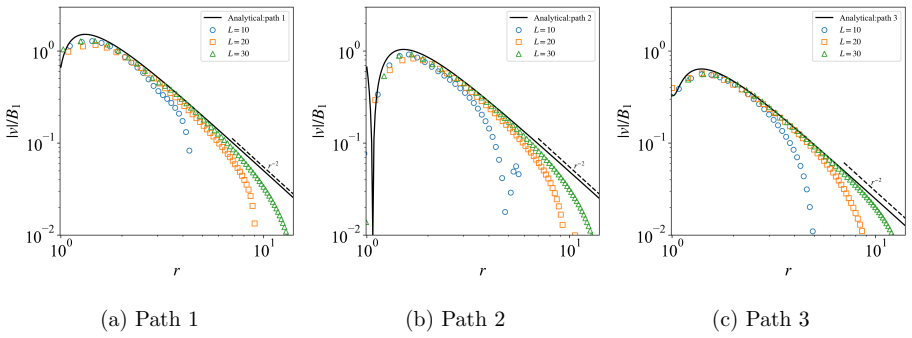
The central object is the artificial-velocity interpolation expressed in Eq. (34). For every fluid particle $A$ near the squirmer, the paper draws a normal to the tangent plane at the nearest surface point, then assigns each neighboring boundary particle $B$ an artificial velocity $v_B$ by linearly extrapolating the fluid velocity $v_A$ across the gap so that the interpolated value at the surface point equals the prescribed surface velocity $v_C + v_s$. This artificial velocity enters only the dissipative force, leaving the squirmer's rigid-body kinematics untouched; it turns the geometric slip condition into a local pairwise force. Because the tangent plane is defined locally for each fluid particle, the same rule can in principle handle arbitrary boundary geometry, and the paper combines it with pressure interpolation from fluid to boundary particles to maintain a correct pressure gradient at the surface.
What would settle it
Use a squirmer with radius comparable to the particle smoothing length so that the gap from a fluid particle to the tangent plane is only one or two particle spacings, and compare the measured swimming speed and near-field flow to the analytic Stokes solution; a visible departure from the zero-Reynolds speed $\frac{2}{3}B_1$ would show that the linear interpolation in Eq. (34) no longer enforces the prescribed slip velocity.
Extended reading notes
Core claim
On its own terms, the discovery is that a prescribed surface slip velocity can be injected into an SPD simulation by changing only the pairwise dissipative force between fluid and boundary particles: each boundary particle receives a different artificial velocity for each fluid neighbor, chosen so that the velocity linearly interpolated across the gap matches the rigid-body plus slip velocity at the tangent point. This yields the correct steady swimming speed $U_0 = \frac{2}{3}|B_1|$, the expected pusher/neutral/puller flow-field structures, and the correct far-field decay. The same construction carries through when random thermal forces are added, and it coexists with the surface-tension force in a squirmer-in-droplet setup, where the authors observe qualitatively different co-swimming behavior depending on squirmer type and droplet size.
Load-bearing premise
The load-bearing premise is that the velocity profile between a fluid particle and a nearby boundary particle is linear, so that an artificial boundary-particle velocity can be chosen to enforce the prescribed slip at the surface; a violation of that linearity in thin gaps or strongly curved regions would break the swimming speed and flow field.
Editorial extensions
If this is right
- A single SPD implementation can now address single-swimmer flow fields, squirmer-wall and squirmer-squirmer interactions, thermally fluctuating squirmers, and a squirmer inside a droplet without changing the boundary method.
- The model reproduces the analytic result that the swimming speed is set by the first mode $B_1$ alone, while the squirmer parameter $\beta = B_2/|B_1|$ selects pusher, neutral, or puller character.
- Near a wall at Reynolds number 1, the model reproduces the three published trajectory regimes: escape, oscillate-and-slide along the wall, and forward bouncing.
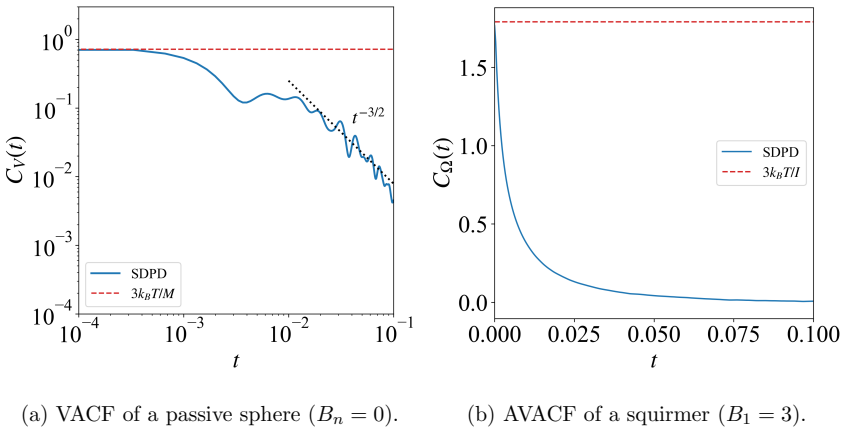
- With thermal fluctuations, the model recovers equipartition values and the long-time decay of the velocity and angular velocity autocorrelation functions at the mesoscale.
- In a multiphase setting, the model predicts that pusher and neutral squirmers co-swim with their droplet in a direction opposite to their head orientation, whereas a puller drags the droplet along its heading after puncturing the interface.
Reading between the lines
- If the linear-interpolation assumption survives thinner boundary layers, the same tangent-plane construction could implement arbitrary prescribed surface slip for any immersed body in SPH, not only spherical squirmers.
- A natural extension is non-spherical active particles such as ellipsoidal squirmers; the local tangent-plane machinery is ready for them, but the interpolation error would need to be checked where curvature is high.
- The squirmer-inside-droplet results suggest that the composite object behaves as an effective squirmer whose polarity reverses for pusher and neutral swimmers; measuring the dipole strength of the droplet-swimmer pair in the far field would provide a clean test.
- Because the artificial velocity is recomputed per fluid neighbor, the scheme retains the local structure of SPD, so it should scale to dense suspensions of many swimmers in the same framework.
Editorial analysis
A structured set of objections, weighed in public.
Referee Report
Summary. The paper proposes a smoothed particle dynamics (SPD) framework for simulating squirmers, in which the tangential slip velocity at the squirmer surface is imposed through artificial velocities assigned to boundary particles during the pairwise dissipative force calculation. The method is validated against analytical Stokes-flow solutions for a single squirmer, perturbation-theory results at small Reynolds number, prior simulations of two-squirmer collisions and near-wall dynamics, and equilibrium statistical-mechanical predictions for velocity and angular-velocity autocorrelation functions. The paper closes with a qualitative demonstration of a squirmer encapsulated in a droplet in a multiphase flow, reporting distinct co-swimming behaviors for pushers, neutral swimmers, and pullers. The central claim is that the SPD-squirmer model accurately represents a range of microswimmer types across scales and flow regimes.
Significance. If the central claim holds, the paper offers a unified Lagrangian solver for squirmer hydrodynamics that handles moving fluid-solid boundaries, multiphase interfaces, and thermal fluctuations within a single framework. The validation is unusually broad: single-squirmer slip-velocity distributions, flow-field decay, swimming speed versus β, pairwise collisions, wall-bounded motion, and Brownian dynamics are all compared with external analytical or numerical benchmarks. A notable strength is that no parameter is fitted to the target swimming quantities; the slip velocity is prescribed, and the swimming speed emerges dynamically. The multiphase section, however, is only qualitative, and the key boundary-condition formulation contains a regularization term whose influence is not quantified. The paper is therefore a potentially valuable methods contribution, but two load-bearing points need additional support.
major comments (2)
- [§II.D, Eq. (36)] The text states that the artificial velocity v_B is assigned so that linear interpolation between v_A and v_B satisfies the slip condition at the surface point C, but Eq. (36) uses a denominator d_A + αh, not d_A + d_B. A genuine interpolation would give v_B = v_C - (d_B/d_A)(v_A - v_C - v_s) - v_s, so the regularization with αh means the desired surface velocity is enforced only approximately, with an error that depends on d_A, d_B, and αh. Since the paper's abstract claims that the boundary-condition treatment accurately represents pushers, neutral swimmers, and pullers, the sensitivity of all reported results to α should be established. The resolution study in §III.A changes Δx but keeps α fixed at 0.05, so it does not separate discretization error from this regularization error. Please add an α-sensitivity study (e.g., α from 0.01 to 0.2 at fixed resolution) for the swimming speed and flow field, and report the residual slip-velocity error at the surface as a function of d_A and αh.
- [§III.D] The multiphase results are presented without any quantitative validation. The paper reports different co-swimming behaviors for pushers, neutral swimmers, and pullers in a droplet, but there is no comparison with an analytical solution, a resolved computational benchmark, or an experimental observation; the only quantitative statement is that 'the results converge as the resolution increases' (just before Fig. 12), which is not shown with error metrics. Given that the abstract and introduction emphasize multiphase interface tracking as a motivation for the SPD approach, the accuracy claim for multiphase squirmer dynamics is not yet supported. Please provide a convergence study with quantified errors for the droplet-squirmer system, or at least a grid-convergence table for the steady-state squirmer velocity and droplet deformation.
minor comments (4)
- [§II.D, Eq. (34)] The definition 'v_B = (v^τ_A, v^n_A, v^k_A)' appears to be a typo: the right-hand side should be the fluid particle velocity v_A, not v_B.
- [§II.D, before Eq. (37)] 'parawise dissipative force' should be 'pairwise dissipative force'.
- [Fig. 7 caption] The caption says 'For pushers with β = 5', which conflicts with the convention β < 0 for pushers stated in Eq. (3) and used in the text; this is likely a sign error and should be corrected.
- [§III.C, Fig. 9] The VACF and AVACF plots would benefit from showing standard deviations or confidence bands across the 20 independent runs, since the ensemble size is modest and the decay at long times is where statistical noise is most visible.
Circularity Check
No circularity: the SPD-squirmer model's outputs (swimming velocity, flow fields, interactions) are compared against external analytical and independent numerical results, and the slip velocity is prescribed rather than fitted.
full rationale
I find no step in which a prediction reduces to an input by construction. The slip velocity vs(θ) is prescribed from the Lighthill-Blake squirmer theory (Eqs. 2 and 4) with fixed modal amplitudes B1 and β; no parameter is fitted to any measured quantity, so the 'fitted input called prediction' pattern does not apply. The swimming velocity is not forced by the scheme: Eqs. (34)-(37) assign an artificial boundary velocity so that linear interpolation at the surface point C equals vs(rs,e)+vC, with vC built from the instantaneous (simulated) V0 and Ω0; U0 then emerges from the force balance in Eqs. (7)-(8) and is compared with the independent analytical value U0 = 2|B1|/3 (Eq. 5) and with Khair and Chisholm's perturbation theory. Agreement is non-trivial: pushers, neutral swimmers, and pullers produce distinct, theoretically predicted flow topologies (Fig. 4) and decay laws (Fig. 5 vs. Eq. A1). Interaction tests against Ishikawa et al. [22] and Li et al. [20,23], and the VACF/AVACF against the equipartition theorem, are all external benchmarks the model could have failed. The only self-citations ([56] arbitrary-slip boundary scheme; [2] and [43] as literature context) are not load-bearing: the slip-enforcement scheme is re-validated in this paper against the analytic slip distribution (Fig. 2) and Stokes flow decay (Fig. 5), so the central claim does not rest on an unverified self-citation. The fixed regularization α=0.05 in Eq. (36) and the wall-case trajectory discrepancy (Sec. III.B) are correctness/robustness caveats, not circularity, since they are concerns about parameter sensitivity rather than identities between inputs and outputs.
Assumptions & free parameters
free parameters (3)
- alpha in Eq. (34) =
0.05
- smoothing length ratio h/dx =
1.2
- short-range repulsion parameters epsilon and d_r =
epsilon=1e-4, d_r=0.5*dx
assumptions (4)
- domain assumption Blake squirmer slip velocity with first two modes B1 and B2 (Eq. 2)
- ad hoc to paper Linear interpolation of tangential velocity in solid near the interface (Eq. 34)
- standard math Weakly compressible equation of state relating pressure to density (Eq. 11)
- domain assumption Boundary particles have identical mass and resolution as fluid particles
Cite this review
Pith. "Pith review of Simulating squirmers with smoothed particle dynamics." pith.science (2026). https://pith.science/paper/QFWAZZDL
@misc{pith2026241113893,
  author       = {Pith},
  title        = {Pith review of: Simulating squirmers with smoothed particle dynamics},
  year         = {2026},
  howpublished = {\url{https://pith.science/paper/QFWAZZDL}},
  note         = {Machine review of arXiv:2411.13893}
}
read the original abstract
Microswimmers play an important role in shaping the world around us. The squirmer is a simple model for microswimmer whose cilia oscillations on its spherical surface induce an effective slip velocity to propel itself. The rapid development of computational fluid dynamics methods has markedly enhanced our capacity to study the behavior of squirmers in aqueous environments. Nevertheless, a unified methodology that can fully address the complexity of fluid-solid coupling at multiple scales and interface tracking for multiphase flows remains elusive, posing an outstanding challenge to the field. To this end, we investigate the potential of the smoothed particle dynamics (SPD) method as an alternative approach for simulating squirmers. The Lagrangian nature of the method allows it to effectively address the aforementioned difficulty. By introducing a novel treatment of the boundary condition and assigning appropriate slip velocities to the boundary particles, the SPD-squirmer model is able to accurately represent a range of microswimmer types including pushers, neutral swimmers, and pullers. We systematically validate the steady-state velocity of the squirmer, the resulting flow field, its hydrodynamic interactions with the surrounding environment, and the mutual collision of two squirmers. In the presence of Brownian motion, the model is also able to correctly calculate the velocity and angular velocity autocorrelation functions at the mesoscale. Finally, we simulate a squirmer within a multiphase flow by considering a droplet that encloses a squirmer and imposing a surface tension between the two flow phases. We find that the squirmer within the droplet exhibits different motion types.
Figures


Figures from the paper (11 more)




Reference graph
Works this paper leans on
-
[1]
J. Ingraham and C. Ingraham, Introduction to Microbiology: A Case-History Approach (Brooks/Cole, Pacific Grove, CA, 2003)
work page 2003
-
[2]
C. Mo, G. Li, and X. Bian, Challenges and attempts to make intelligent microswimmers, Frontiers in Physics 11, 1279883 (2023)
work page 2023
-
[3]
Ishikawa, Fluid dynamics of squirmers and ciliated microorganisms, Annual Review of Fluid Mechanics 56, 119 (2024)
T. Ishikawa, Fluid dynamics of squirmers and ciliated microorganisms, Annual Review of Fluid Mechanics 56, 119 (2024)
2024
-
[4]
E. M. Purcell, Life at low Reynolds number, in Physics and our world: reissue of the proceed- ings of a symposium in honor of Victor F Weisskopf (World Scientific, 2014) pp. 47–67
work page 2014
-
[5]
S. Khan and J. M. Scholey, Assembly, functions and evolution of archaella, flagella and cilia, Current Biology 28, R278 (2018). FIG. 13: The stream lines and velocity field for a pusher ( β = −5), a neutral squirmer (β = 0) and a puller ( β = 5 ) in multi-phase flow in the frame moving with the swimmer. 27 (a) Path 1 (b) Path 2 (c) Path 3 FIG. 14: Box siz...
work page 2018
-
[6]
C. Fisch and P. Dupuis-Williams, Ultrastructure of cilia and flagella–back to the future!, Biology of the Cell 103, 249 (2011)
work page 2011
-
[7]
Elgeti, R
J. Elgeti, R. G. Winkler, and G. Gompper, Physics of microswimmers—single particle motion and collective behavior: a review, Reports on Progress in Physics 78, 056601 (2015)
2015
-
[8]
K. Drescher, R. E. Goldstein, N. Michel, M. Polin, and I. Tuval, Direct measurement of the flow field around swimming microorganisms, Physical Review Letters 105, 168101 (2010)
work page 2010
Show all 64 references
-
[9]
S. L. Tamm and G. A. Horridge, The relation between the orientation of the central fibrils and the direction of beat in cilia of opalina, Proceedings of the Royal Society of London. Series B. Biological Sciences 175, 219 (1970)
1970
-
[10]
Hausmann and R
K. Hausmann and R. D. Allen, Electron microscopy of paramecium (ciliata), in Methods in Cell Biology , Vol. 96 (Elsevier, 2010) pp. 143–173
2010
-
[11]
D. L. Kirk, Volvox: a search for the molecular and genetic origins of multicellularity and cellular differentiation, 33 (Cambridge University Press, 1998)
1998
-
[12]
Brennen, An oscillating-boundary-layer theory for ciliary propulsion, Journal of Fluid Me- chanics 65, 799 (1974)
C. Brennen, An oscillating-boundary-layer theory for ciliary propulsion, Journal of Fluid Me- chanics 65, 799 (1974). 28
1974
-
[13]
Michelin and E
S. Michelin and E. Lauga, Efficiency optimization and symmetry-breaking in a model of ciliary locomotion, Physics of Fluids 22 (2010)
2010
-
[14]
D. R. Brumley, M. Polin, T. J. Pedley, and R. E. Goldstein, Hydrodynamic synchronization and metachronal waves on the surface of the colonial alga volvox carteri, Physical Review Letters 109 (2012)
2012
-
[15]
G. I. Taylor, Analysis of the swimming of microscopic organisms, Proceedings of the Royal Society of London. Series A. Mathematical and Physical Sciences 209, 447 (1951)
1951
-
[16]
M. J. Lighthill, On the squirming motion of nearly spherical deformable bodies through liquids at very small Reynolds numbers, Communications on Pure and Applied Mathematics 5, 109 (1952)
1952
-
[17]
J. R. Blake, A spherical envelope approach to ciliary propulsion, Journal of Fluid Mechanics 46, 199 (1971)
1971
-
[18]
Magar, T
V. Magar, T. Goto, and T. J. Pedley, Nutrient uptake by a self-propelled steady squirmer, The Quarterly Journal of Mechanics and Applied Mathematics 56, 65 (2003)
2003
-
[19]
Michelin and E
S. Michelin and E. Lauga, Unsteady feeding and optimal strokes of model ciliates, Journal of Fluid Mechanics 715, 1 (2013)
2013
-
[20]
Li and A
G.-J. Li and A. M. Ardekani, Hydrodynamic interaction of microswimmers near a wall, Phys- ical Review E 90, 013010 (2014)
2014
-
[21]
Ishimoto and E
K. Ishimoto and E. A. Gaffney, Squirmer dynamics near a boundary, Physical Review E 88, 062702 (2013)
2013
-
[22]
Ishikawa, M
T. Ishikawa, M. Simmonds, and T. J. Pedley, Hydrodynamic interaction of two swimming model micro-organisms, Journal of Fluid Mechanics 568, 119 (2006)
2006
-
[23]
G. Li, A. Ostace, and A. M. Ardekani, Hydrodynamic interaction of swimming organisms in an inertial regime, Physical Review E 94, 053104 (2016)
2016
-
[24]
V. A. Shaik and A. M. Ardekani, Squirming in density-stratified fluids, Physics of Fluids 33 (2021)
2021
-
[25]
Datt and G
C. Datt and G. J. Elfring, Active particles in viscosity gradients, Physical Review Letters 123, 158006 (2019)
2019
-
[26]
L. Zhu, E. Lauga, and L. Brandt, Self-propulsion in viscoelastic fluids: Pushers vs. pullers, Physics of Fluids 24 (2012). 29
2012
-
[27]
Ouyang, Z
Z. Ouyang, Z. Lin, J. Lin, N. Phan-Thien, and J. Zhu, Swimming of an inertial squirmer and squirmer dumbbell through a viscoelastic fluid, Journal of Fluid Mechanics 969, A34 (2023)
2023
-
[28]
Ishikawa and T
T. Ishikawa and T. J. Pedley, Coherent structures in monolayers of swimming particles, Phys- ical Review Letters 100, 088103 (2008)
2008
-
[29]
Z¨ ottl and H
A. Z¨ ottl and H. Stark, Hydrodynamics determines collective motion and phase behavior of active colloids in quasi-two-dimensional confinement, Physical Review Letters 112, 118101 (2014)
2014
-
[30]
Kyoya, D
K. Kyoya, D. Matsunaga, Y. Imai, T. Omori, and T. Ishikawa, Shape matters: Near-field fluid mechanics dominate the collective motions of ellipsoidal squirmers, Physical Review E 92, 063027 (2015)
2015
-
[31]
KVS and S
C. KVS and S. P. Thampi, Wall-curvature driven dynamics of a microswimmer, Physical Review Fluids 6, 083101 (2021)
2021
-
[32]
D. Nie, K. Zhang, and J. Lin, Enhanced speed of microswimmers adjacent to a rough surface, Physical Review E 110, 045101 (2024)
2024
-
[33]
M. R. Bailey, C. M. B. Guti´ errez, J. Mart ´ ın-Roca, V. Niggel, V. Carrasco-Fadanelli, I. Butti- noni, I. Pagonabarraga, L. Isa, and C. Valeriani, Minimal numerical ingredients describe chem- ical microswimmers’3-d motion, Nanoscale 16, 2444 (2024)
2024
-
[34]
F. A. Overberg, G. Gompper, and D. A. Fedosov, Motion of microswimmers in cylindrical microchannels, Soft Matter 20, 3007 (2024)
2024
-
[35]
M. T. Downton and H. Stark, Simulation of a model microswimmer, Journal of Physics: Condensed Matter 21, 204101 (2009)
2009
-
[36]
I. O. G¨ otze and G. Gompper, Mesoscale simulations of hydrodynamic squirmer interactions, Physical Review E 82, 041921 (2010)
2010
-
[37]
Z¨ ottl and H
A. Z¨ ottl and H. Stark, Simulating squirmers with multiparticle collision dynamics, The Euro- pean Physical Journal E 41, 1 (2018)
2018
-
[38]
Liu and G
M. Liu and G. Liu, Smoothed particle hydrodynamics (sph): an overview and recent develop- ments, Archives of Computational Methods in Engineering 17, 25 (2010)
2010
-
[39]
J. J. Monaghan, Smoothed particle hydrodynamics and its diverse applications, Annual Re- view of Fluid Mechanics 44, 323 (2012)
2012
-
[40]
Zhang, Y.-j
C. Zhang, Y.-j. Zhu, D. Wu, N. A. Adams, and X. Hu, Smoothed particle hydrodynamics: Methodology development and recent achievement, Journal of Hydrodynamics 34, 767 (2022). 30
2022
-
[41]
X. Y. Hu and N. A. Adams, A multi-phase sph method for macroscopic and mesoscopic flows, Journal of Computational Physics 213, 844 (2006)
2006
-
[42]
K. Wang, H. Liang, C. Zhao, and X. Bian, Dynamics of a droplet in shear flow by smoothed particle hydrodynamics, Frontiers in Physics 11, 1286217 (2023)
2023
-
[43]
Zheng, X
Z. Zheng, X. Cai, F. Zheng, X. Bian, H. Tang, S. Yuan, and Y. Ma, Exploring the air im- pacts on the state development of pipe flow using the smooth particle hydrodynamic method, AQUA—Water Infrastructure, Ecosystems and Society 73, 487 (2024)
2024
-
[44]
X. Bian, S. Litvinov, R. Qian, M. Ellero, and N. A. Adams, Multiscale modeling of particle in suspension with smoothed dissipative particle dynamics, Physics of Fluids 24 (2012)
2012
-
[45]
V´ azquez-Quesada, X
A. V´ azquez-Quesada, X. Bian, and M. Ellero, Three-dimensional simulations of dilute and concentrated suspensions using smoothed particle hydrodynamics, Computational Particle Mechanics 3, 167 (2016)
2016
-
[46]
X. Cai, X. Li, and X. Bian, Dynamics of an elliptical cylinder in confined poiseuille flow, Physics of Fluids 36 (2024)
2024
-
[47]
Espa˜ nol and M
P. Espa˜ nol and M. Revenga, Smoothed dissipative particle dynamics, Physical Review E 67, 026705 (2003)
2003
-
[48]
Grmela and H
M. Grmela and H. C. ¨Ottinger, Dynamics and thermodynamics of complex fluids. I. Develop- ment of a general formalism, Physical Review E 56, 6620 (1997)
1997
-
[49]
L. D. Landau and E. M. Lifshitz, Fluid Mechanics: Course of Theoretical Physics, Volume 6 , Vol. 6 (Pergmon Press, 1959)
1959
-
[50]
X. Bian, Z. Li, M. Deng, and G. E. Karniadakis, Fluctuating hydrodynamics in periodic domains and heterogeneous adjacent multidomains: Thermal equilibrium, Physical Review E 92, 053302 (2015)
2015
-
[51]
X. Bian, M. Deng, Y. H. Tang, and G. E. Karniadakis, Analysis of hydrodynamic fluctua- tions in heterogeneous adjacent multidomains in shear flow, Physical Review E - Statistical, Nonlinear, and Soft Matter Physics 93, 1 (2016)
2016
-
[52]
Ellero and P
M. Ellero and P. Espa˜ nol, Everything you always wanted to know about sdpd(but were afraid to ask), Applied Mathematics and Mechanics 39, 103 (2018)
2018
-
[53]
Litvinov, M
S. Litvinov, M. Ellero, X. Hu, and N. A. Adams, Smoothed dissipative particle dynamics model for polymer molecules in suspension, Physical Review E 77, 066703 (2008). 31
2008
-
[54]
V´ azquez-Quesada, M
A. V´ azquez-Quesada, M. Ellero, and P. Espa˜ nol, Smoothed particle hydrodynamic model for viscoelastic fluids with thermal fluctuations, Physical Review E - Statistical, Nonlinear, and Soft Matter Physics 79, 1 (2009)
2009
-
[55]
T. Ye, N. Phan-Thien, C. T. Lim, L. Peng, and H. Shi, Hybrid smoothed dissipative particle dynamics and immersed boundary method for simulation of red blood cells in flows, Physical Review E 95, 1 (2017)
2017
-
[56]
X. Cai, Z. Li, and X. Bian, Arbitrary slip length for fluid-solid interface of arbitrary geometry in smoothed particle dynamics, Journal of Computational Physics 494, 112509 (2023)
2023
-
[57]
J. P. Morris, P. J. Fox, and Y. Zhu, Modeling low Reynolds number incompressible flows using SPH, Journal of Computational Physics 136, 214 (1997)
1997
-
[58]
Lafaurie, C
B. Lafaurie, C. Nardone, R. Scardovelli, S. Zaleski, and G. Zanetti, Modelling merging and fragmentation in multiphase flows with surfer, Journal of Computational Physics 113, 134 (1994)
1994
-
[59]
J. P. Morris, Simulating surface tension with smoothed particle hydrodynamics, International Journal for Numerical Methods in Fluids 33, 333 (2000)
2000
-
[60]
Adami, X
S. Adami, X. Hu, and N. A. Adams, A transport-velocity formulation for smoothed particle hydrodynamics, Journal of Computational Physics 241, 292 (2013)
2013
-
[61]
Adami, X
S. Adami, X. Y. Hu, and N. A. Adams, A generalized wall boundary condition for smoothed particle hydrodynamics, Journal of Computational Physics 231, 7057 (2012)
2012
-
[62]
A. S. Khair and N. G. Chisholm, Expansions at small reynolds numbers for the locomotion of a spherical squirmer, Physics of Fluids 26 (2014)
2014
-
[63]
Glowinski, T.-W
R. Glowinski, T.-W. Pan, T. I. Hesla, D. D. Joseph, and J. Periaux, A fictitious domain approach to the direct numerical simulation of incompressible viscous flow past moving rigid bodies: application to particulate flow, Journal of Computational Physics 169, 363 (2001)
2001
-
[64]
S. E. Spagnolie and E. Lauga, Hydrodynamics of self-propulsion near a boundary: predictions and accuracy of far-field approximations, Journal of Fluid Mechanics 700, 105 (2012). 32
2012
Reviewed August 12, 2026 · model on record in the stance chip above.
Discussion (0). Continue with ORCID to comment.