REVIEW 3 major objections 6 minor 96 references
Panther: Illuminate the Sight of Multimodal LLMs with Instruction-Guided Visual Prompts
T0 review · 3 major / 6 minor · reviewed 2026-08-12 · deepseek-v4-flash
Pith's one-line read Turning the user's question into visual prompts that are injected early into a frozen vision encoder improves multimodal LLM performance, especially on vision-centric benchmarks.
desk verdict Sensible, mostly solid empirical paper; the instruction-conditioning mechanism is under-supported because the decisive random-prompt control is missing, and one table-text mismatch needs fixing. read the letter →
The pith
A machine-rendered reading of the paper's core claim, the machinery that carries it, and where it could break.
The reading
What carries the argument
The load-bearing object is the instruction-aware visual prompt, written as $\Gamma_{T\to I}[F_T(q_k)]$: the current question $q_k$ is passed through a frozen CLIP text encoder and a two-layer MLP projector, then the resulting vectors are prepended to the visual tokens entering the frozen vision Transformer, alongside 24 shared learnable prompts. The shared prompts give the model a stable training slot, while the projected instruction prompts carry question content into the visual self-attention that computes the features the LLM later reads. To keep multi-turn training within the 2048-token budget, Panther-Bridge prunes per-turn visual tokens whose cosine similarity to the previous turn's tokens exceeds a threshold of $\tau = 0.95$.
What would settle it
Run the same training recipe with the instruction prompt replaced by a fixed, question-independent prompt of the same length and parameter budget; if VQAv2, GQA, and MMVP gains match the full model, the content of the question is not doing the work, while if the gains collapse, cross-modal prompt steering is what carries the result.
Extended reading notes
Core claim
The paper's central claim is that the Amblyopia problem of encoder-decoder MLLMs, where visual details relevant to the user's instruction are filtered out before text and image meet, can be mitigated by injecting instruction information into the vision encoder itself. The concrete mechanism is an instruction-aware visual prompt: a frozen text encoder encodes the current question, a small MLP projects those embeddings into the visual token space, and the resulting prompt tokens are prepended to the image patch tokens inside a frozen ViT. Because the prompt is regenerated for every turn, the same image yields different visual features for different questions. The paper reports that this change, combined with a token-pruning bridge and interleaved decoder training, consistently beats the base model on general question answering and by larger margins on vision-centric benchmarks.
Load-bearing premise
The method rests on the assumption that a CLIP text embedding projected into visual space and prepended to a frozen ViT actually steers the visual features the LLM sees, rather than merely adding trainable capacity that would help regardless of the question text.
Editorial extensions
If this is right
- Vision-centric error patterns caused by overly diffuse attention can be reduced by moving instruction fusion earlier, without changing image resolution or unfreezing the vision backbone.
- The same image can legitimately produce different visual tokens for different questions, and those differences matter for answering correctly in multi-turn conversations.
- Cosine-similarity pruning of per-turn visual tokens can cut multi-turn training cost while retaining most of the benefit of instruction-aware encoding.
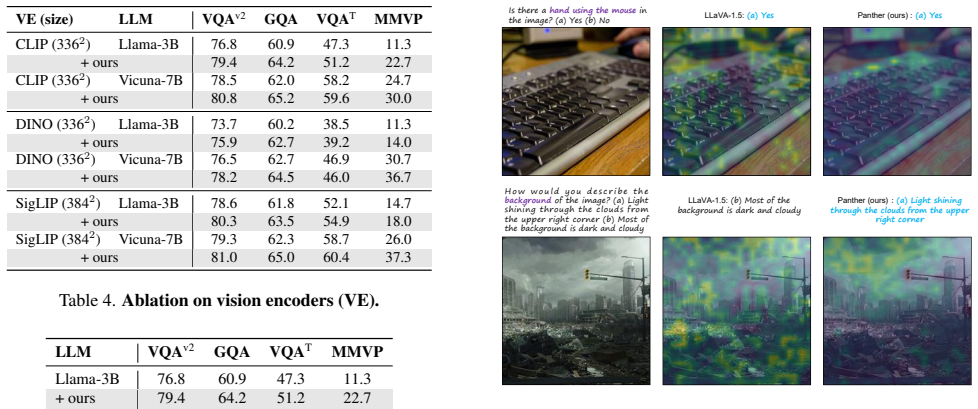
- The improvement transfers across vision encoders such as CLIP, DINOv2, and SigLIP and across LLMs such as OpenLlama-3B, Vicuna-7B, Mistral-7B, and Llama 3-8B, so the method is orthogonal to those architectural choices.
Reading between the lines
- Beyond the paper's experiments, earlier instruction conditioning may also help Q-former-style connectors that currently cross-attend to visual features only at the final encoder layer, since the paper's result suggests that late conditioning is the failure point.
- A testable extension would be to regenerate prompts from multi-turn conversational context rather than only the current question, since follow-up questions such as 'no, the other one' depend on earlier answers.
- The token-pruning idea suggests a cheap way to decide when a follow-up question needs new visual information: turns whose prompted visual tokens are nearly identical to the previous turn's could skip re-encoding entirely, which the paper does not explore.
Editorial analysis
A structured set of objections, weighed in public.
Referee Report
Summary. The paper proposes Panther, an MLLM architecture whose central novelty is Panther-VE: user instructions are encoded by a frozen CLIP text encoder, projected by a small MLP into per-sample instruction-aware visual prompts (IP), and prepended to the patch tokens of a frozen ViT together with shared prompts (SP). A Panther-Bridge prunes redundant visual tokens across multi-turn training, and a Panther-Decoder uses interleaved autoregressive training. The authors evaluate on general VQA, instruction-following, and vision-centric benchmarks, reporting gains over LLaVA-1.5 on VQAv2, GQA, MMVP, and CV-Bench with both Vicuna-7B and Llama 3-8B backbones, and they ablate the SP/IP components, vision encoders, LLMs, and the pruning threshold.
Significance. If the instruction-conditioning mechanism is real, the paper makes a useful and largely orthogonal contribution: it offers a way to inject textual intent into a frozen visual encoder without multiple encoders or high-resolution inputs, and it does so with the same training data and base model as LLaVA-1.5. The experimental program is thorough in coverage: the method is tested across three vision encoders and four LLMs, and the controlled LLaVA-1.5 baseline makes the headline comparisons interpretable. The significance of the central claim, however, rests on whether the IP prompts actually carry instruction information into visual features rather than merely adding tunable capacity, and the paper's own ablation does not yet settle that question.
major comments (3)
- [Section 4.3 / Table 2] The text states 'Our Panther surpasses Cambrian-dev in all the 4 benchmarks,' but Table 2 shows a tie on MMVP for the Vicuna-7B configuration: Panther achieves 30.0 and Cambrian-dev achieves 30.0. The sentence should be corrected to 'matches or exceeds' or should explicitly say Panther exceeds Cambrian-dev on three of the four benchmarks.
- [Section 4.4 / Table 3] The ablation does not isolate instruction alignment from added capacity. On VQAv2, GQA, and VQA-T, the alignment-free BGE-b text encoder matches the CLIP text encoder within 1.0 point in both LLM settings (e.g., Vicuna-7B: 80.7 vs 80.8, 65.6 vs 65.2, 58.8 vs 59.6; Llama-3B: 79.0 vs 79.4, 63.8 vs 64.2, 52.2 vs 51.2). Since the IP branch adds a trained two-layer MLP and 77 per-sample tokens, the headline gains on VQAv2 and GQA are compatible with a pure-capacity explanation. The decisive missing control is 'w/ SP + per-sample random prompts' with matched token count and a trained projector; without it, the paper's own data support instruction injection only on MMVP, not on the larger benchmarks.
- [Section 4.4 / Table 3, MMVP] The only benchmark on which CLIP-based IP clearly beats BGE-based IP is MMVP, which contains 150 questions and is reported as a single run without variance. For Vicuna-7B the CLIP advantage over BGE is 2.0 points (30.0 vs 28.0), about 3 questions, which is within one binomial standard error; for Llama-3B the 7.4-point gap (22.7 vs 15.3) is roughly two standard errors. To make this result load-bearing, the authors should report multiple seeds or confidence intervals, and ideally also the random-prompt control requested above.
minor comments (6)
- [Section 3.2.1 / Eq. (4)] The manuscript does not specify at which ViT layers the SP and IP tokens are inserted; the equation only describes prepending to the visual embedding, while Figure 3(b) may be read as prompt insertion at every Transformer layer. Please state the insertion depth explicitly.
- [Section 3.2.2 / Algorithm 1] In the pseudocode for `prune_tokens`, the line `ref_token = cur_T['tensor'][j]` should be `ref_T['tensor'][j]`; as written, the reference token is taken from the current turn's tensor rather than from the reference turn.
- [Section 3.2.1 / Section 4.1] The method text says the lightweight text encoder is 'for instance, BERT [11]', but the implementation uses CLIP's text encoder; please make this consistent.
- [Section 4.4 / Token-Pruning Analysis] The text refers to 'Table 3.2.2' when presenting the pruning analysis; this should be Table 6.
- [References] Reference [81] is cited for BGE-base, but the given entry describes C-Pack rather than the BGE text embedding model; please cite the correct source.
- [Throughout] There are several typos and grammatical errors, including 'we does not make pruning' in Section 3.3, 'the remained texts' in Section 3.2.2, and 'pervious models' in Section 4.3; a language edit would improve readability.
Circularity Check
No significant circularity: Panther's central claims are empirical results on external benchmarks, not consequences of its own definitions or fitted parameters.
full rationale
Panther is an empirical architecture paper. Its central claims—that instruction-aware visual prompts improve general VQA and vision-centric benchmarks—are substantiated by comparisons against LLaVA-1.5, Cambrian-dev, and other baselines on held-out benchmark suites (VQAv2, GQA, MMVP, CV-Bench, etc.). These benchmarks are not used to define the visual-prompt generator, the loss, or the architecture; the ViT is frozen and the instruction-prompt generator is trained with the standard supervised instruction-tuning objective. There is no equation in the paper in which an output quantity is defined in terms of the benchmark result it is said to predict, and no fitted parameter is renamed as a prediction. Hyperparameters such as the 24 shared prompts and the pruning threshold tau = 0.95 are selected empirically on the reported evaluation sets, which is a test-set selection concern rather than definitional circularity. The only self-references are related-work citations to the authors' prior prompt-learning papers, and those citations are not load-bearing for any architectural or empirical claim. The skeptic's point that the CLIP-versus-BGE ablation in Table 3 leaves an added-capacity confound is a valid experimental-control limitation, but it does not reduce any stated result to its inputs by construction: the reported numbers could have come out differently and are not forced by the method's definitions.
Assumptions & free parameters
free parameters (4)
- Number of shared prompts (sp) =
24
- Number of instruction-aware prompts (IP) =
77 with masking
- Pruning threshold tau =
0.95
- Panther-VE base learning rate =
1e-4
assumptions (4)
- domain assumption CLIP image-text alignment transfers when text-derived vectors are prepended as visual prompts in a frozen ViT.
- domain assumption The LLaVA-1.5 pretraining and instruction-tuning datasets (558K and 665K samples) are sufficient and the reproduced baseline matches published LLaVA-1.5 numbers.
- domain assumption Cosine-similarity pruning during training retains enough visual information for the final model.
- domain assumption Frozen ViT plus learned prompts is a valid substitute for visual encoder fine-tuning.
invented entities (1)
-
Amblyopia (named visual impairment of MLLMs)
Cite this review
Pith. "Pith review of Panther: Illuminate the Sight of Multimodal LLMs with Instruction-Guided Visual Prompts." pith.science (2026). https://pith.science/paper/ZQCR6P5F
@misc{pith2026241113909,
  author       = {Pith},
  title        = {Pith review of: Panther: Illuminate the Sight of Multimodal LLMs with Instruction-Guided Visual Prompts},
  year         = {2026},
  howpublished = {\url{https://pith.science/paper/ZQCR6P5F}},
  note         = {Machine review of arXiv:2411.13909}
}
read the original abstract
Multimodal large language models (MLLMs) are closing the gap to human visual perception capability rapidly, while, still lag behind on attending to subtle images details or locating small objects precisely, etc. Common schemes to tackle these issues include deploying multiple vision encoders or operating on original high-resolution images. Few studies have concentrated on taking the textual instruction into improving visual representation, resulting in losing focus in some vision-centric tasks, a phenomenon we herein termed as Amblyopia. In this work, we introduce Panther, a MLLM that closely adheres to user instruction and locates targets of interests precisely, with the finesse of a black panther. Specifically, Panther comprises three integral components: Panther-VE, Panther-Bridge, and Panther-Decoder. Panther-VE integrates user instruction information at the early stages of the vision encoder, thereby extracting the most relevant and useful visual representations. The Panther-Bridge module, equipped with powerful filtering capabilities, significantly reduces redundant visual information, leading to a substantial savings in training costs. The Panther-Decoder is versatile and can be employed with any decoder-only architecture of LLMs without discrimination. Experimental results, particularly on vision-centric benchmarks, have demonstrated the effectiveness of Panther.
Figures


Figures from the paper (1 more)
Reference graph
Works this paper leans on
-
[1]
Fuyu-8b: A multimodal architecture for ai agents
Adept AI. Fuyu-8b: A multimodal architecture for ai agents. https://www.adept.ai/blog/fuyu-8b, 2024. 1
2024
-
[2]
Flamingo: a vi- sual language model for few-shot learning
Jean-Baptiste Alayrac, Jeff Donahue, Pauline Luc, Antoine Miech, Iain Barr, Yana Hasson, Karel Lenc, Arthur Mensch, Katie Millican, Malcolm Reynolds, et al. Flamingo: a vi- sual language model for few-shot learning. arXiv preprint arXiv:2204.14198, 2022. 1, 14
arXiv 2022
-
[3]
Qwen-vl: A frontier large vision-language model with versatile abilities
Jinze Bai, Shuai Bai, Shusheng Yang, Shijie Wang, Sinan Tan, Peng Wang, Junyang Lin, Chang Zhou, and Jingren Zhou. Qwen-vl: A frontier large vision-language model with versatile abilities. arXiv preprint arXiv:2308.12966, 2023. 2, 6
arXiv 2023
-
[4]
To- ken merging: Your vit but faster
Daniel Bolya, Cheng-Yang Fu, Xiaoliang Dai, Peizhao Zhang, Christoph Feichtenhofer, and Judy Hoffman. To- ken merging: Your vit but faster. arXiv preprint arXiv:2210.09461, 2022. 14
arXiv 2022
-
[5]
Language models are few-shot learners
Tom B Brown. Language models are few-shot learners. arXiv preprint arXiv:2005.14165, 2020. 3
arXiv 2005
-
[6]
Meyer, Yuning Chai, Dennis Park, and Yong Jae Lee
Mu Cai, Haotian Liu, Siva Karthik Mustikovela, Gregory P. Meyer, Yuning Chai, Dennis Park, and Yong Jae Lee. Mak- ing large multimodal models understand arbitrary visual prompts. In IEEE Conference on Computer Vision and Pat- tern Recognition, 2024. 2, 3
2024
-
[7]
Auroracap: Efficient, performant video detailed captioning and a new benchmark
Wenhao Chai, Enxin Song, Yilun Du, Chenlin Meng, Vashisht Madhavan, Omer Bar-Tal, Jeng-Neng Hwang, Sain- ing Xie, and Christopher D Manning. Auroracap: Efficient, performant video detailed captioning and a new benchmark. arXiv preprint arXiv:2410.03051, 2024. 14
-
[8]
Towards unifying medical vision-and-language pre-training via soft prompts, 2023
Zhihong Chen, Shizhe Diao, Benyou Wang, Guanbin Li, and Xiang Wan. Towards unifying medical vision-and-language pre-training via soft prompts, 2023. 3
2023
Show all 96 references
-
[9]
Gonzalez, Ion Stoica, and Eric P
Wei-Lin Chiang, Zhuohan Li, Zi Lin, Ying Sheng, Zhang- hao Wu, Hao Zhang, Lianmin Zheng, Siyuan Zhuang, Yong- hao Zhuang, Joseph E. Gonzalez, Ion Stoica, and Eric P. Xing. Vicuna: An open-source chatbot impressing gpt-4 with 90%* chatgpt quality, 2023. 6, 7
2023
-
[10]
Instructblip: Towards general- purpose vision-language models with instruction tuning
Wenliang Dai, Junnan Li, Dongxu Li, Anthony Meng Huat Tiong, Junqi Zhao, Weisheng Wang, Boyang Li, Pascale Fung, and Steven Hoi. Instructblip: Towards general- purpose vision-language models with instruction tuning. arXiv preprint arXiv:2305.06500, 2023. 2, 6, 14
2023 arXiv
-
[11]
Bert: Pre-training of deep bidirectional transformers for language understanding
Jacob Devlin, Ming-Wei Chang, Kenton Lee, and Kristina Toutanova. Bert: Pre-training of deep bidirectional transformers for language understanding. arXiv preprint arXiv:1810.04805, 2018. 3, 4
2018 arXiv
-
[12]
Internlm-xcomposer2- 4khd: A pioneering large vision-language model handling resolutions from 336 pixels to 4k hd
Xiaoyi Dong, Pan Zhang, Yuhang Zang, Yuhang Cao, Bin Wang, Linke Ouyang, Songyang Zhang, Haodong Duan, Wenwei Zhang, Yining Li, et al. Internlm-xcomposer2- 4khd: A pioneering large vision-language model handling resolutions from 336 pixels to 4k hd. arXiv preprint arXiv:2404.0...
2024 arXiv
-
[13]
An image is worth 16x16 words: Trans- formers for image recognition at scale
Alexey Dosovitskiy, Lucas Beyer, Alexander Kolesnikov, Dirk Weissenborn, Xiaohua Zhai, Thomas Unterthiner, Mostafa Dehghani, Matthias Minderer, Georg Heigold, Syl- vain Gelly, et al. An image is worth 16x16 words: Trans- formers for image recognition at scale. In ICLR, 2020. 3
2020
-
[14]
The llama 3 herd of models, 2024
Abhimanyu Dubey, Abhinav Jauhri, Abhinav Pandey, Ab- hishek Kadian, Ahmad Al-Dahle, Aiesha Letman, Akhil Mathur, Alan Schelten, Amy Yang, et al. The llama 3 herd of models, 2024. 6, 7
2024
-
[15]
Mme: A comprehensive evaluation benchmark for multimodal large language models
Chaoyou Fu, Peixian Chen, Yunhang Shen, Yulei Qin, Mengdan Zhang, Xu Lin, Zhenyu Qiu, Wei Lin, Jinrui Yang, Xiawu Zheng, et al. Mme: A comprehensive evaluation benchmark for multimodal large language models. arXiv preprint arXiv:2306.13394, 2023. 1, 3, 6
2023 arXiv
-
[16]
Domain adaptation via prompt learning
Chunjiang Ge, Rui Huang, Mixue Xie, Zihang Lai, Shiji Song, Shuang Li, and Gao Huang. Domain adaptation via prompt learning. IEEE Transactions on Neural Networks and Learning Systems, 2023. 3
2023
-
[17]
Seed-x: Mul- timodal models with unified multi-granularity comprehen- sion and generation
Yuying Ge, Sijie Zhao, Jinguo Zhu, Yixiao Ge, Kun Yi, Lin Song, Chen Li, Xiaohan Ding, and Ying Shan. Seed-x: Mul- timodal models with unified multi-granularity comprehen- sion and generation. arXiv preprint arXiv:2404.14396, 2024. 2
2024 arXiv
-
[18]
Openllama: An open reproduc- tion of llama, 2023
Xinyang Geng and Hao Liu. Openllama: An open reproduc- tion of llama, 2023. 7
2023
-
[19]
Making the v in vqa matter: Elevating the role of image understanding in visual question answer- ing
Yash Goyal, Tejas Khot, Douglas Summers-Stay, Dhruv Ba- tra, and Devi Parikh. Making the v in vqa matter: Elevating the role of image understanding in visual question answer- ing. In Proceedings of the IEEE conference on computer vision and pattern recognition , pages 6904–691...
2017
-
[20]
Vizwiz grand challenge: Answering visual questions from blind people
Danna Gurari, Qing Li, Abigale J Stangl, Anhong Guo, Chi Lin, Kristen Grauman, Jiebo Luo, and Jeffrey P Bigham. Vizwiz grand challenge: Answering visual questions from blind people. In Proceedings of the IEEE conference on computer vision and pattern recognition, pages 3608–3617,
-
[21]
Ma-lmm: Memory-augmented large multimodal model for long-term video understanding
Bo He, Hengduo Li, Young Kyun Jang, Menglin Jia, Xue- fei Cao, Ashish Shah, Abhinav Shrivastava, and Ser-Nam Lim. Ma-lmm: Memory-augmented large multimodal model for long-term video understanding. In Proceedings of the IEEE/CVF Conference on Computer Vision and Pattern Recogni...
2024
-
[22]
Gqa: A new dataset for real-world visual reasoning and compositional question answering
Drew A Hudson and Christopher D Manning. Gqa: A new dataset for real-world visual reasoning and compositional question answering. In CVPR, 2019. 1, 3, 6
2019
-
[24]
Vi- sual prompt tuning
Menglin Jia, Luming Tang, Bor-Chun Chen, Claire Cardie, Serge Belongie, Bharath Hariharan, and Ser-Nam Lim. Vi- sual prompt tuning. In ECCV, 2022. 3
2022
-
[25]
Albert Q. Jiang, Alexandre Sablayrolles, Arthur Mensch, Chris Bamford, Devendra Singh Chaplot, Diego de las Casas, Florian Bressand, Gianna Lengyel, Guillaume Lam- ple, Lucile Saulnier, L ´elio Renard Lavaud, Marie-Anne Lachaux, Pierre Stock, Teven Le Scao, Thibaut Lavril, 9 T...
2023
-
[26]
Enhancing multimodal large language models with vision detection models: An empirical study
Qirui Jiao, Daoyuan Chen, Yilun Huang, Yaliang Li, and Ying Shen. Enhancing multimodal large language models with vision detection models: An empirical study. arXiv preprint arXiv:2401.17981, 2024. 2, 3
2024 arXiv
-
[27]
Maple: Multi-modal prompt learning
Muhammad Uzair Khattak, Hanoona Rasheed, Muhammad Maaz, Salman Khan, and Fahad Shahbaz Khan. Maple: Multi-modal prompt learning. In Proceedings of the IEEE/CVF Conference on Computer Vision and Pattern Recognition, pages 19113–19122, 2023. 3
2023
-
[28]
Segment any- thing
Alexander Kirillov, Eric Mintun, Nikhila Ravi, Hanzi Mao, Chloe Rolland, Laura Gustafson, Tete Xiao, Spencer White- head, Alexander C Berg, Wan-Yen Lo, et al. Segment any- thing. arXiv preprint arXiv:2304.02643, 2023. 1, 3
2023 arXiv
-
[29]
Spvit: Enabling faster vision transformers via soft token pruning
Zhenglun Kong, Peiyan Dong, Xiaolong Ma, Xin Meng, Wei Niu, Mengshu Sun, Bin Ren, Minghai Qin, Hao Tang, and Yanzhi Wang. Spvit: Enabling faster vision transformers via soft token pruning. In ECCV, 2022. 14
2022
-
[30]
The power of scale for parameter-efficient prompt tuning
Brian Lester, Rami Al-Rfou, and Noah Constant. The power of scale for parameter-efficient prompt tuning. In EMNLP,
-
[31]
Seed-bench: Benchmarking mul- timodal llms with generative comprehension
Bohao Li, Rui Wang, Guangzhi Wang, Yuying Ge, Yix- iao Ge, and Ying Shan. Seed-bench: Benchmarking mul- timodal llms with generative comprehension. arXiv preprint arXiv:2307.16125, 2023. 1
2023 arXiv
-
[32]
Task-specific fine-tuning via variational information bottle- neck for weakly-supervised pathology whole slide image classification
Honglin Li, Chenglu Zhu, Yunlong Zhang, Yuxuan Sun, Zhongyi Shui, Wenwei Kuang, Sunyi Zheng, and Lin Yang. Task-specific fine-tuning via variational information bottle- neck for weakly-supervised pathology whole slide image classification. In Proceedings of the IEEE/CVF Confer...
2023
-
[33]
Rethinking transformer for long contextual histopathology whole slide image analysis, 2024
Honglin Li, Yunlong Zhang, Pingyi Chen, Zhongyi Shui, Chenglu Zhu, and Lin Yang. Rethinking transformer for long contextual histopathology whole slide image analysis, 2024. 3
2024
-
[34]
Blip-2: Bootstrapping language-image pre-training with frozen image encoders and large language models
Junnan Li, Dongxu Li, Silvio Savarese, and Steven Hoi. Blip-2: Bootstrapping language-image pre-training with frozen image encoders and large language models. arXiv preprint arXiv:2301.12597, 2023. 1, 2, 3, 6
2023 arXiv
-
[35]
Tokenpacker: Efficient visual projector for multimodal llm, 2024
Wentong Li, Yuqian Yuan, Jian Liu, Dongqi Tang, Song Wang, Jie Qin, Jianke Zhu, and Lei Zhang. Tokenpacker: Efficient visual projector for multimodal llm, 2024. 6, 14
2024
-
[36]
Prefix-tuning: Optimizing continuous prompts for generation
Xiang Lisa Li and Percy Liang. Prefix-tuning: Optimizing continuous prompts for generation. In ACL (Long Paper),
-
[37]
Evaluating object hallucina- tion in large vision-language models
Yifan Li, Yifan Du, Kun Zhou, Jinpeng Wang, Wayne Xin Zhao, and Ji-Rong Wen. Evaluating object hallucina- tion in large vision-language models. arXiv preprint arXiv:2305.10355, 2023. 6
2023 arXiv
-
[38]
Mon- key: Image resolution and text label are important things for large multi-modal models
Zhang Li, Biao Yang, Qiang Liu, Zhiyin Ma, Shuo Zhang, Jingxu Yang, Yabo Sun, Yuliang Liu, and Xiang Bai. Mon- key: Image resolution and text label are important things for large multi-modal models. In Proceedings of the IEEE/CVF Conference on Computer Vision and Pattern Recog...
2024
-
[39]
Not all patches are what you need: Expediting vision transformers via token reorganiza- tions
Youwei Liang, Chongjian Ge, Zhan Tong, Yibing Song, Jue Wang, and Pengtao Xie. Not all patches are what you need: Expediting vision transformers via token reorganiza- tions. ICLR, 2022. 14
2022
-
[40]
Video-llava: Learning united visual represen- tation by alignment before projection
Bin Lin, Bin Zhu, Yang Ye, Munan Ning, Peng Jin, and Li Yuan. Video-llava: Learning united visual represen- tation by alignment before projection. arXiv preprint arXiv:2311.10122, 2023. 14
2023 arXiv
-
[41]
Vila: On pre-training for visual language models, 2023
Ji Lin, Hongxu Yin, Wei Ping, Yao Lu, Pavlo Molchanov, Andrew Tao, Huizi Mao, Jan Kautz, Mohammad Shoeybi, and Song Han. Vila: On pre-training for visual language models, 2023. 6
2023
-
[42]
Draw-and-understand: Leveraging visual prompts to enable mllms to comprehend what you want,
Weifeng Lin, Xinyu Wei, Ruichuan An, Peng Gao, Bocheng Zou, Yulin Luo, Siyuan Huang, Shanghang Zhang, and Hongsheng Li. Draw-and-understand: Leveraging visual prompts to enable mllms to comprehend what you want,
-
[43]
Rethinking visual prompting for multimodal large language models with exter- nal knowledge
Yuanze Lin, Yunsheng Li, Dongdong Chen, Weijian Xu, Ronald Clark, Philip Torr, and Lu Yuan. Rethinking visual prompting for multimodal large language models with exter- nal knowledge. arXiv preprint arXiv:2407.04681, 2024. 2, 3, 6
2024 arXiv
-
[44]
Sphinx: The joint mixing of weights, tasks, and visual embeddings for multi-modal large language models, 2023
Ziyi Lin, Chris Liu, Renrui Zhang, Peng Gao, Longtian Qiu, Han Xiao, Han Qiu, Chen Lin, Wenqi Shao, Keqin Chen, Ji- aming Han, Siyuan Huang, Yichi Zhang, Xuming He, Hong- sheng Li, and Yu Qiao. Sphinx: The joint mixing of weights, tasks, and visual embeddings for multi-modal l...
2023
-
[45]
Visual instruction tuning
Haotian Liu, Chunyuan Li, Qingyang Wu, and Yong Jae Lee. Visual instruction tuning. In NeurIPS, 2023. 1, 2, 6, 14
2023
-
[46]
Improved baselines with visual instruction tuning
Haotian Liu, Chunyuan Li, Yuheng Li, and Yong Jae Lee. Improved baselines with visual instruction tuning. In Pro- ceedings of the IEEE/CVF Conference on Computer Vision and Pattern Recognition, pages 26296–26306, 2024. 1, 3, 14
2024
-
[47]
Llava-1.6: Improved reasoning, ocr, and world knowledge, 2024
Haotian Liu, Chunyuan Li, Yuheng Li, Bo Li, Yuanhan Zhang, Sheng Shen, and Yong Jae Lee. Llava-1.6: Improved reasoning, ocr, and world knowledge, 2024. 14
2024
-
[48]
World model on million-length video and language with blockwise ringattention, 2024
Hao Liu, Wilson Yan, Matei Zaharia, and Pieter Abbeel. World model on million-length video and language with blockwise ringattention, 2024. 2, 6
2024
-
[49]
P-tuning: Prompt tuning can be comparable to fine-tuning across scales and tasks
Xiao Liu, Kaixuan Ji, Yicheng Fu, Weng Tam, Zhengxiao Du, Zhilin Yang, and Jie Tang. P-tuning: Prompt tuning can be comparable to fine-tuning across scales and tasks. In ACL (Short Paper), 2022. 3
2022
-
[50]
Mmbench: Is your multi-modal model an all-around player? arXiv preprint arXiv:2307.06281, 2023
Yuan Liu, Haodong Duan, Yuanhan Zhang, Bo Li, Songyang Zhang, Wangbo Zhao, Yike Yuan, Jiaqi Wang, Conghui He, Ziwei Liu, et al. Mmbench: Is your multi-modal model an all-around player? arXiv preprint arXiv:2307.06281, 2023. 1, 3, 6
2023 arXiv
-
[51]
Deepseek-vl: towards real-world vision- language understanding
Haoyu Lu, Wen Liu, Bo Zhang, Bingxuan Wang, Kai Dong, Bo Liu, Jingxiang Sun, Tongzheng Ren, Zhuoshu Li, Yaofeng Sun, et al. Deepseek-vl: towards real-world vision- language understanding. arXiv preprint arXiv:2403.05525,
-
[52]
Learn to explain: Multimodal reasoning via 10 thought chains for science question answering
Pan Lu, Swaroop Mishra, Tanglin Xia, Liang Qiu, Kai-Wei Chang, Song-Chun Zhu, Oyvind Tafjord, Peter Clark, and Ashwin Kalyan. Learn to explain: Multimodal reasoning via 10 thought chains for science question answering. Advances in Neural Information Processing Systems, 2022. 6
2022
-
[53]
An empirical study of scal- ing instruct-tuned large multimodal models
Yadong Lu, Chunyuan Li, Haotian Liu, Jianwei Yang, Jian- feng Gao, and Yelong Shen. An empirical study of scal- ing instruct-tuned large multimodal models. arXiv preprint arXiv:2309.09958, 2023. 1
2023 arXiv
-
[54]
Visual percep- tion by large language model’s weights
Feipeng Ma, Hongwei Xue, Guangting Wang, Yizhou Zhou, Fengyun Rao, Shilin Yan, Yueyi Zhang, Siying Wu, Mike Zheng Shou, and Xiaoyan Sun. Visual percep- tion by large language model’s weights. arXiv preprint arXiv:2405.20339, 2024. 14
2024 arXiv
-
[55]
Token pooling in vision transformers
Dmitrii Marin, Jen-Hao Rick Chang, Anurag Ranjan, An- ish Prabhu, Mohammad Rastegari, and Oncel Tuzel. Token pooling in vision transformers. arXiv:2110.03860 [cs.CV],
-
[56]
Chatgpt plugins
OpenAI. Chatgpt plugins. https://openai.com/ blog/chatgpt-plugins, 2023. 1
2023
-
[57]
Gpt-4v(ision) system card
OpenAI. Gpt-4v(ision) system card. https://cdn. openai.com/papers/GPTV_System_Card.pdf ,
-
[58]
V o, Marc Szafraniec, Vasil Khalidov, Pierre Fernandez, Daniel Haziza, Francisco Massa, Alaaeldin El-Nouby, Rus- sell Howes, Po-Yao Huang, et al
Maxime Oquab, Timoth ´ee Darcet, Theo Moutakanni, Huy V . V o, Marc Szafraniec, Vasil Khalidov, Pierre Fernandez, Daniel Haziza, Francisco Massa, Alaaeldin El-Nouby, Rus- sell Howes, Po-Yao Huang, et al. Dinov2: Learning robust visual features without supervision, 2023. 1, 3, 7
2023
-
[59]
Less is more: Pay less attention in vision transform- ers
Zizheng Pan, Bohan Zhuang, Haoyu He, Jing Liu, and Jian- fei Cai. Less is more: Pay less attention in vision transform- ers. In AAAI, 2022. 14
2022
-
[60]
Language models are unsu- pervised multitask learners
Alec Radford, Jeffrey Wu, Rewon Child, David Luan, Dario Amodei, Ilya Sutskever, et al. Language models are unsu- pervised multitask learners. OpenAI blog, 1(8):9, 2019. 3
2019
-
[61]
Learn- ing transferable visual models from natural language super- vision
Alec Radford, Jong Wook Kim, Chris Hallacy, Aditya Ramesh, Gabriel Goh, Sandhini Agarwal, Girish Sastry, Amanda Askell, Pamela Mishkin, Jack Clark, et al. Learn- ing transferable visual models from natural language super- vision. In ICML, 2021. 1, 6
2021
-
[62]
Learn- ing transferable visual models from natural language super- vision
Alec Radford, Jong Wook Kim, Chris Hallacy, Aditya Ramesh, Gabriel Goh, Sandhini Agarwal, Girish Sastry, Amanda Askell, Pamela Mishkin, Jack Clark, et al. Learn- ing transferable visual models from natural language super- vision. arXiv preprint arXiv:2103.00020, 2021. 2, 3, 7
2021 arXiv
-
[63]
Tokenlearner: Adaptive space-time tokenization for videos
Michael Ryoo, AJ Piergiovanni, Anurag Arnab, Mostafa Dehghani, and Anelia Angelova. Tokenlearner: Adaptive space-time tokenization for videos. In NeurIPS, 2021. 14
2021
-
[64]
Autoprompt: Eliciting knowl- edge from language models with automatically generated prompts
Taylor Shin, Yasaman Razeghi, Robert L Logan IV , Eric Wallace, and Sameer Singh. Autoprompt: Eliciting knowl- edge from language models with automatically generated prompts. arXiv preprint arXiv:2010.15980, 2020. 3
2010 arXiv
-
[65]
What does clip know about a red cir- cle? visual prompt engineering for vlms
Aleksandar Shtedritski, Christian Rupprecht, and An- drea Vedaldi. What does clip know about a red cir- cle? visual prompt engineering for vlms. arXiv preprint arXiv:2304.06712, 2023. 3
2023 arXiv
-
[66]
Unleashing the power of prompt-driven nu- cleus instance segmentation, 2024
Zhongyi Shui, Yunlong Zhang, Kai Yao, Chenglu Zhu, Sunyi Zheng, Jingxiong Li, Honglin Li, Yuxuan Sun, Ruizhe Guo, and Lin Yang. Unleashing the power of prompt-driven nu- cleus instance segmentation, 2024. 3
2024
-
[67]
Towards vqa models that can read
Amanpreet Singh, Vivek Natarajan, Meet Shah, Yu Jiang, Xinlei Chen, Dhruv Batra, Devi Parikh, and Marcus Rohrbach. Towards vqa models that can read. InProceedings of the IEEE/CVF conference on computer vision and pattern recognition, pages 8317–8326, 2019. 6
2019
-
[68]
Chameleon: Mixed-modal early-fusion foundation models
Chameleon Team. Chameleon: Mixed-modal early-fusion foundation models. arXiv preprint arXiv:2405.09818, 2024. 1, 2
2024 arXiv
-
[69]
Gemini 1.5: Unlocking multimodal under- standing across millions of tokens of context, 2024
Gemini Team. Gemini 1.5: Unlocking multimodal under- standing across millions of tokens of context, 2024. 1
2024
-
[70]
Cambrian- 1: A fully open, vision-centric exploration of multimodal llms
Shengbang Tong, Ellis Brown, Penghao Wu, Sanghyun Woo, Manoj Middepogu, Sai Charitha Akula, Jihan Yang, Shusheng Yang, Adithya Iyer, Xichen Pan, et al. Cambrian- 1: A fully open, vision-centric exploration of multimodal llms. arXiv preprint arXiv:2406.16860, 2024. 1, 3, 6
2024 arXiv
-
[71]
Eyes wide shut? exploring the visual shortcomings of multimodal llms
Shengbang Tong, Zhuang Liu, Yuexiang Zhai, Yi Ma, Yann LeCun, and Saining Xie. Eyes wide shut? exploring the visual shortcomings of multimodal llms. In Proceedings of the IEEE/CVF Conference on Computer Vision and Pattern Recognition, pages 9568–9578, 2024. 1, 3, 6
2024
-
[72]
Llama 2: Open foundation and fine-tuned chat models.arXiv preprint arXiv:2307.09288, 2023
Hugo Touvron, Louis Martin, Kevin Stone, Peter Albert, Amjad Almahairi, Yasmine Babaei, Nikolay Bashlykov, Soumya Batra, Prajjwal Bhargava, Shruti Bhosale, et al. Llama 2: Open foundation and fine-tuned chat models.arXiv preprint arXiv:2307.09288, 2023. 1
2023 arXiv
-
[73]
Attention is all you need
Ashish Vaswani, Noam Shazeer, Niki Parmar, Jakob Uszko- reit, Llion Jones, Aidan N Gomez, Łukasz Kaiser, and Illia Polosukhin. Attention is all you need. In NeurIPS, 2017. 3
2017
-
[74]
What makes for good visual to- kenizers for large language models? arXiv preprint arXiv:2305.12223, 2023
Guangzhi Wang, Yixiao Ge, Xiaohan Ding, Mohan Kankan- halli, and Ying Shan. What makes for good visual to- kenizers for large language models? arXiv preprint arXiv:2305.12223, 2023. 3
2023 arXiv
-
[75]
Tarsier: Recipes for training and evaluating large video description models, 2024
Jiawei Wang, Liping Yuan, Yuchen Zhang, and Haomiao Sun. Tarsier: Recipes for training and evaluating large video description models, 2024. 14
2024
-
[76]
Qwen2-vl: Enhancing vision-language model’s perception of the world at any resolution, 2024
Peng Wang, Shuai Bai, Sinan Tan, Shijie Wang, Zhihao Fan, Jinze Bai, Keqin Chen, Xuejing Liu, Jialin Wang, Wenbin Ge, Yang Fan, Kai Dang, Mengfei Du, Xuancheng Ren, Rui Men, Dayiheng Liu, Chang Zhou, Jingren Zhou, and Jun- yang Lin. Qwen2-vl: Enhancing vision-language model’s ...
2024
-
[77]
Learning to prompt for con- tinual learning
Zifeng Wang, Zizhao Zhang, Chen-Yu Lee, Han Zhang, Ruoxi Sun, Xiaoqi Ren, Guolong Su, Vincent Perot, Jen- nifer Dy, and Tomas Pfister. Learning to prompt for con- tinual learning. In Proceedings of the IEEE/CVF conference on computer vision and pattern recognition, pages 139–149,
-
[78]
Mio: A foun- dation model on multimodal tokens, 2024
Zekun Wang, King Zhu, Chunpu Xu, Wangchunshu Zhou, Jiaheng Liu, Yibo Zhang, Jiashuo Wang, Ning Shi, Siyu Li, Yizhi Li, Haoran Que, Zhaoxiang Zhang, Yuanxing Zhang, Ge Zhang, Ke Xu, Jie Fu, and Wenhao Huang. Mio: A foun- dation model on multimodal tokens, 2024. 1
2024
-
[79]
Vila-u: a unified foundation model inte- grating visual understanding and generation
Yecheng Wu, Zhuoyang Zhang, Junyu Chen, Haotian Tang, Dacheng Li, Yunhao Fang, Ligeng Zhu, Enze Xie, Hongxu Yin, Li Yi, et al. Vila-u: a unified foundation model inte- grating visual understanding and generation. arXiv preprint arXiv:2409.04429, 2024. 1, 2, 6 11
2024 arXiv
-
[80]
Grok-1.5 vision preview
X.ai. Grok-1.5 vision preview. https://x.ai/blog/ grok-1.5v, 2024. 1, 3, 6
2024
-
[81]
C-pack: Packaged resources to advance general chi- nese embedding, 2023
Shitao Xiao, Zheng Liu, Peitian Zhang, and Niklas Muen- nighoff. C-pack: Packaged resources to advance general chi- nese embedding, 2023. 7
2023
-
[82]
Show-o: One single transformer to unify multimodal understanding and generation
Jinheng Xie, Weijia Mao, Zechen Bai, David Junhao Zhang, Weihao Wang, Kevin Qinghong Lin, Yuchao Gu, Zhijie Chen, Zhenheng Yang, and Mike Zheng Shou. Show-o: One single transformer to unify multimodal understanding and generation. arXiv preprint arXiv:2408.12528 , 2024. 1, 2, 6
2024 arXiv
-
[83]
Pllava: Parameter-free llava extension from images to videos for video dense captioning
Lin Xu, Yilin Zhao, Daquan Zhou, Zhijie Lin, See Kiong Ng, and Jiashi Feng. Pllava: Parameter-free llava extension from images to videos for video dense captioning. arXiv preprint arXiv:2404.16994, 2024. 14
2024 arXiv
-
[84]
Libra: Building decoupled vision system on large lan- guage models
Yifan Xu, Xiaoshan Yang, Yaguang Song, and Changsheng Xu. Libra: Building decoupled vision system on large lan- guage models. In Forty-first International Conference on Machine Learning, 2024. 2
2024
-
[85]
Efficient model personalization in federated learning via client-specific prompt generation
Fu-En Yang, Chien-Yi Wang, and Yu-Chiang Frank Wang. Efficient model personalization in federated learning via client-specific prompt generation. In 2023 IEEE/CVF In- ternational Conference on Computer Vision (ICCV) , pages 19102–19111, 2023. 3
2023
-
[86]
Minicpm-v: A gpt-4v level mllm on your phone, 2024
Yuan Yao, Tianyu Yu, Ao Zhang, Chongyi Wang, Junbo Cui, Hongji Zhu, Tianchi Cai, Haoyu Li, Weilin Zhao, Zhihui He, Qianyu Chen, Huarong Zhou, Zhensheng Zou, Haoye Zhang, Shengding Hu, Zhi Zheng, Jie Zhou, Jie Cai, Xu Han, Guoyang Zeng, Dahai Li, Zhiyuan Liu, and Maosong Sun. M...
2024
-
[87]
mplug-owl2: Revolutionizing multi-modal large language model with modality collaboration
Qinghao Ye, Haiyang Xu, Jiabo Ye, Ming Yan, Anwen Hu, Haowei Liu, Qi Qian, Ji Zhang, and Fei Huang. mplug-owl2: Revolutionizing multi-modal large language model with modality collaboration. In Proceedings of the IEEE/CVF Conference on Computer Vision and Pattern Recognition , ...
2024
-
[88]
Mm-vet: Evaluating large multimodal models for integrated capabilities
Weihao Yu, Zhengyuan Yang, Linjie Li, Jianfeng Wang, Kevin Lin, Zicheng Liu, Xinchao Wang, and Lijuan Wang. Mm-vet: Evaluating large multimodal models for integrated capabilities. arXiv preprint arXiv:2308.02490, 2023. 1, 3
2023 arXiv
-
[89]
Sigmoid loss for language image pre-training
Xiaohua Zhai, Basil Mustafa, Alexander Kolesnikov, and Lucas Beyer. Sigmoid loss for language image pre-training. In Proceedings of the IEEE/CVF International Conference on Computer Vision, pages 11975–11986, 2023. 1, 3, 7
2023
-
[90]
Anygpt: Unified multimodal llm with dis- crete sequence modeling
Jun Zhan, Junqi Dai, Jiasheng Ye, Yunhua Zhou, Dong Zhang, Zhigeng Liu, Xin Zhang, Ruibin Yuan, Ge Zhang, Linyang Li, et al. Anygpt: Unified multimodal llm with dis- crete sequence modeling. arXiv preprint arXiv:2402.12226,
-
[91]
Video-llama: An instruction-tuned audio-visual language model for video un- derstanding
Hang Zhang, Xin Li, and Lidong Bing. Video-llama: An instruction-tuned audio-visual language model for video un- derstanding. arXiv preprint arXiv:2306.02858, 2023. 14
2023 arXiv
-
[92]
Long context transfer from language to vision, 2024
Peiyuan Zhang, Kaichen Zhang, Bo Li, Guangtao Zeng, Jingkang Yang, Yuanhan Zhang, Ziyue Wang, Haoran Tan, Chunyuan Li, and Ziwei Liu. Long context transfer from language to vision, 2024. 14
2024
-
[93]
Treat visual tokens as text? but your mllm only needs fewer efforts to see
Zeliang Zhang, Phu Pham, Wentian Zhao, Kun Wan, Yu-Jhe Li, Jianing Zhou, Daniel Miranda, Ajinkya Kale, and Chen- liang Xu. Treat visual tokens as text? but your mllm only needs fewer efforts to see. arXiv preprint arXiv:2410.06169,
-
[94]
Learning to prompt for vision-language models
Kaiyang Zhou, Jingkang Yang, Chen Change Loy, and Ziwei Liu. Learning to prompt for vision-language models. In- ternational Journal of Computer Vision, 130(9):2337–2348,
-
[95]
Minigpt-4: Enhancing vision-language understanding with advanced large language models
Deyao Zhu, Jun Chen, Xiaoqian Shen, Xiang Li, and Mo- hamed Elhoseiny. Minigpt-4: Enhancing vision-language understanding with advanced large language models. arXiv preprint arXiv:2304.10592, 2023. 1, 2 12 Panther: Illuminate the Sight of Multimodal LLMs with Instruction-Guide...
2023 arXiv
-
[96]
utilizes selective token attention, inactive head pruning, and layer dropping to streamline token processing. VLoRA
-
[97]
uniquely converts visual tokens into LLM weights, providing a novel approach to token efficiency. In video un- derstanding, AURORACAP [7] implement the token merg- ing [4] strategy, reducing the number of input visual tokens to address the overhead caused by lengthy video sequ...
Reviewed August 12, 2026 · model on record in the stance chip above.
Discussion (0). Continue with ORCID to comment.