REVIEW 4 major objections 6 minor 2 references
Predictive Maintenance Study for High-Pressure Industrial Compressors: Hybrid Clustering Models
T0 review · 4 major / 6 minor · reviewed 2026-08-12 · deepseek-v4-flash
Pith's one-line read Adding cluster-derived features to classifiers raises compressor fault-detection accuracy by 4.87%.
desk verdict The 4.87% accuracy gain is an artifact of test-set leakage in the clustering step; the paper needs a leakage-free refit before the claim can be trusted. read the letter →
The pith
A machine-rendered reading of the paper's core claim, the machinery that carries it, and where it could break.
The reading
What carries the argument
The mechanism is pre-clustering: six unsupervised algorithms (K-Means, HDBSCAN, OPTICS, BIRCH, Gaussian Mixture Models, and Adaptive Mean Shift) are run on the standardized, correlation-filtered sensor data with tuned parameters (number of clusters = 6, epsilon = 0.8). The cluster labels from the four algorithms with the best ARI and NMI scores against the expert-defined normal/abnormal periods (HDBSCAN, GMM, K-Means, MS-AMS) are appended to the original features as extra columns for the classifiers. The clusters are meant to capture the compressor's temporal and operational regimes, giving the classifier access to structure that the raw sensor values alone do not make explicit.
What would settle it
Rerun the pipeline with cluster parameters and cluster labels computed inside cross-validation on training folds only, then compare test-set accuracy with and without the cluster features; if the average gain drops to statistical non-significance or negative values, the claim fails. A second check is to repeat the study on a different compressor or on a held-out season of data from the same machine.
Extended reading notes
Core claim
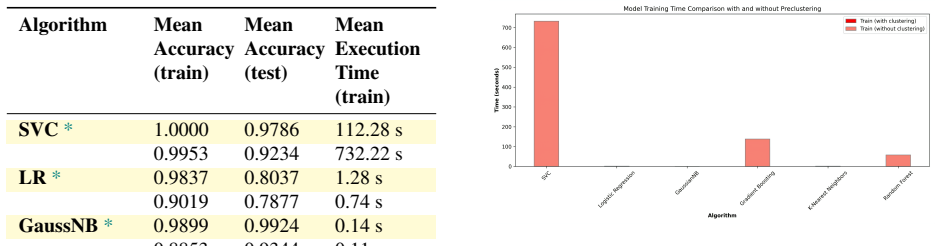
The central discovery claim is that appending cluster labels from unsupervised pre-clustering to sensor features improves the test-set accuracy of failure-detection classifiers by an average of 4.87%, with an improvement that is statistically significant (p = 0.0368). The largest gains appear in SVC, going from 92.34% to 97.86%, GaussianNB from 93.44% to 99.24%, and KNN from 85.85% to 98.19%; Random Forest and Gradient Boosting change little. The paper also claims that pre-clustering cuts average training time by 22.96%, but that reduction is not statistically significant (p = 0.3104) and varies by algorithm. On its own terms, the contribution is a demonstrated, statistically significant accuracy improvement for predictive maintenance via clustering-derived features.
Load-bearing premise
The load-bearing premise is that pre-clustering the entire dataset, including the test observations, does not leak test-set structure into the classifiers, so the reported 4.87% accuracy gain is a fair measure of generalization.
Editorial extensions
If this is right
- If the claim holds, the same pre-clustering step can be added to existing predictive-maintenance pipelines for rotating machinery, improving fault detection without changing sensors or classifiers.
- Classifiers that are expensive to train, such as SVC, become much cheaper: training time drops from about 732 seconds to about 112 seconds when cluster features are used.
- The statistically significant accuracy gain across six classifier families suggests the benefit is not tied to one model class, making the approach a plausible plug-in feature-engineering step.
- Cluster labels from HDBSCAN, GMM, K-Means, and MS-AMS carry the information; OPTICS and BIRCH do not, so algorithm selection matters more than the mere presence of clustering.
- The non-significant training-time reduction (p = 0.31) means efficiency gains should not be marketed as a general feature; they are algorithm-dependent.
Reading between the lines
- Because the pre-clustering used the entire dataset including test rows, the reported 4.87% average gain may be optimistic; a fair estimate would fit cluster parameters and labels on training folds only, and the paper does not quantify how much of the gain survives that correction.
- The cluster labels likely encode operating regimes such as startup, shutdown, and load changes rather than incipient faults; if so, the accuracy gain mainly reflects better modeling of operating state, and the method's value for true fault prediction should be tested on failures that occur within a single regime.
- The same enrichment strategy could be combined with autoencoder-based anomaly detection, since the paper notes a deep-learning comparison as future work but does not run it.
- Cluster labels could be treated as a form of weak supervision; a promising extension is to use them to pre-train a representation for a smaller labelled set, which would reduce the need for expert-labelled operating periods.
Editorial analysis
A structured set of objections, weighed in public.
Referee Report
Summary. The paper proposes a hybrid clustering approach for predictive maintenance of a high-pressure industrial compressor. After preprocessing, the authors tune clustering parameters (epsilon and number of clusters), evaluate six clustering algorithms using ARI and NMI computed against Normal Operating Condition (NoC) labels, select the best-performing cluster assignments, and use the resulting cluster labels as additional input features for six classifiers. They report that these enriched features improve average test accuracy by 4.87% (p = 0.0368) over models without cluster features, while training time is reduced by 22.96% (not statistically significant). The central claim is that clustering-derived features provide a measurable, significant improvement in compressor failure detection accuracy.
Significance. The application domain is relevant, and the paper documents a real industrial dataset with a clear experimental setup. If the claimed improvement were valid, the approach could offer a practical, interpretable way to boost predictive maintenance classifiers. The paper also has some strengths: it uses multiple clustering and classification algorithms, reports per-model results, and acknowledges a potential data-leakage risk in the pre-clustering step. However, the evaluation protocol is compromised by multiple target-information leakage paths, so the central quantitative claim is not supported. The paper does not currently justify its conclusions, though the underlying idea might be salvageable with a properly separated feature-construction pipeline.
major comments (4)
- [§3.2] Section 3.2 explicitly states: 'we employed a pre-clustering strategy on the entire dataset, combining both test and training data.' Since the cluster labels produced by this step are used as features for the classifiers in Section 3.4, the features for test observations are computed using information from the test set itself. This is a direct leakage of test-set structure into the feature representations, and the resulting test accuracies in Tables 2 and 3 are not valid estimates of generalization. The stated mitigation—'the final classification model was trained and validated separately'—addresses only the supervised training step, not the feature-construction step, so it does not resolve the leakage.
- [§3.3, Table 1] The clustering algorithms are selected by comparing their cluster assignments to the NoC-derived labels using ARI and NMI computed over the entire dataset. Since the NoC labels are the same labels used to define the NORMAL/ABNORMAL target for classification in Section 3.4, the choice of which cluster-derived features to include is informed by target information on the test observations. This creates a second, independent leakage path: the enrichment features themselves are selected based on how well they reproduce the target on the full data, making the reported accuracy improvement in Section 4 an artifact of target leakage.
- [§3.1] The ANOVA feature selection described in Section 3.1 is performed on the full dataset using the NORMAL target variable, and the correlation-based filtering also uses global statistics from all observations. This step incorporates test-set label information before any train/test separation, affecting both the baseline and enriched pipelines. While this may bias both arms of the comparison, it still violates the requirement that all preprocessing and feature selection be confined to the training set, and it further undermines the validity of the cross-validated accuracy estimates in Tables 2 and 3.
- [§4] The statistical significance claim for the 4.87% average improvement is reported as 'p-value = 0.0368', but the paper does not specify which statistical test was used, how the paired structure of the six algorithms was handled, or whether the test accounts for the fact that the same test set is reused across algorithms. More importantly, because of the leakage paths identified above, the accuracy differences feeding this test are not unbiased estimates of generalization, so the p-value is uninterpretable as evidence for the method's benefit.
minor comments (6)
- [§3.3] The text says 'we have kept as additional features only those related to the three best metrics' but then lists four algorithms: HDBSCAN, GMM, K-MEANS, and MS-AMS. This should be corrected.
- [Table 1] The algorithm label 'OPTIC' should be 'OPTICS' for consistency with the text and with the abbreviation used in Section 3.3.
- [§3.4] The application of SMOTE is not described in enough detail: it is not stated whether SMOTE is applied before or after the train/test split, and whether it operates only on the training folds. If SMOTE is applied to the full dataset before splitting, it would constitute another leakage source.
- [§3.5] The paper does not specify how the train/test split was performed (e.g., random vs. temporal, and what proportion), which is important for a time-series predictive maintenance application because adjacent observations are highly autocorrelated.
- [References] There are several reference formatting issues, including 'Donato Tiano Angela Bonifati, Raymond Ng (2021)' which appears incomplete, and some URLs that are broken across lines.
- [§4] The text uses the phrase 'clustering models' in several places when referring to the classification models (e.g., 'the accuracy of clustering models on the test set'), which is confusing given the paper's own distinction between clustering and classification.
Circularity Check
Pre-clustering on the full dataset and target-guided cluster selection make the 4.87% test-accuracy gain a leaked, not independent, result.
-
fitted input called prediction
[Section 3.2, 'Pre-clustering']
"In our study, we employed a pre-clustering strategy on the entire dataset, combining both test and training data, to achieve a comprehensive understanding of the data’s global structure. Although this approach introduces a risk of data leakage, it was chosen to ensure that the clustering reflected the full dataset’s characteristics, revealing patterns that might be obscured if data were partitioned beforehand."
The cluster labels used as additional features in Section 3.4 are computed from a clustering that was fit on the entire dataset, including the test observations. Each test point's cluster feature is therefore a function of the test matrix itself and encodes the global structure of the test set. The later test-accuracy comparison in Table 2 is not an evaluation on unseen data: the 'predicted' test rows already contributed to the feature construction. The paper's own mitigation, training the classifier separately, does not remove this leakage because the leakage occurs in feature construction, not in classifier training. Thus the reported 4.87% average improvement is partly manufactured by the evaluation protocol.
-
fitted input called prediction
[Section 3.3, 'Clustering and Metrics' and Table 1]
"We evaluated the clustering quality by labeling the dataset with known periods from the NoC. To assess the quality of the clustering, we used the Adjusted Rand Index (ARI) and Normalized Mutual Information (NMI) metrics... Because of the analysis performed, we have kept as additional features only those related to the three best metrics (HDBSCAN, GMM, K-MEANS, and MS-AMS), according to the ARI and NMI metrics."
The choice of which clustering outputs become input features is made by comparing cluster labels against the NORMAL/ABNORMAL target labels from the NoC file on the full dataset, including test periods. Those selected cluster labels are then fed as features to classifiers whose task is to predict the same NORMAL/ABNORMAL labels. The feature-selection step is therefore supervised by the very target the classifiers are evaluated on, so the measured improvement is statistically forced rather than an independent estimate of generalization. The clustering itself is unsupervised, which prevents full circularity, but the algorithm-selection step makes the reported gain partially circular.
full rationale
Score 6, not 10, because the core clustering mechanism is genuinely unsupervised: cluster assignments are functions of the sensor inputs only, so the pipeline is not definitionally equivalent to predicting the NoC label. However, the central quantitative claim, a 4.87% average test-accuracy improvement with p=0.0368, is evaluated under two target-informed and leakage-prone operations. First, Section 3.2 fits the clustering on the entire dataset, including test rows, so each test observation's cluster feature is a function of the test matrix; the paper acknowledges the 'risk of data leakage' but the stated mitigation only separates classifier training from validation, which does not fix leakage in feature construction. Second, Section 3.3 selects which cluster algorithms to use as feature sources by computing ARI and NMI against the NoC NORMAL/ABNORMAL labels on the full data, then feeds those selected cluster labels to classifiers predicting the same labels. This target-guided feature selection makes the accuracy comparison not independent of the labels it claims to predict. There are no load-bearing self-citations or imported uniqueness theorems, and the result is not equivalent to the input by pure definition, so the score is 6 rather than 8-10.
Assumptions & free parameters
free parameters (4)
- epsilon =
0.8
- number of clusters =
6
- correlation threshold =
0.8
- ANOVA p-value threshold =
0.05
assumptions (4)
- domain assumption The NoC labels provided by field experts accurately identify normal and abnormal operating periods.
- standard math Standard implementations of clustering and classification algorithms in scikit-learn behave as documented.
- domain assumption The dataset of 8 months of operation is representative of the compressor's failure modes.
- ad hoc to paper Cluster labels computed on the full dataset do not leak test information into the classifiers.
Cite this review
Pith. "Pith review of Predictive Maintenance Study for High-Pressure Industrial Compressors: Hybrid Clustering Models." pith.science (2026). https://pith.science/paper/QE2IVQOB
@misc{pith2026241113919,
  author       = {Pith},
  title        = {Pith review of: Predictive Maintenance Study for High-Pressure Industrial Compressors: Hybrid Clustering Models},
  year         = {2026},
  howpublished = {\url{https://pith.science/paper/QE2IVQOB}},
  note         = {Machine review of arXiv:2411.13919}
}
read the original abstract
This study introduces a predictive maintenance strategy for high pressure industrial compressors using sensor data and features derived from unsupervised clustering integrated into classification models. The goal is to enhance model accuracy and efficiency in detecting compressor failures. After data pre processing, sensitive clustering parameters were tuned to identify algorithms that best capture the dataset's temporal and operational characteristics. Clustering algorithms were evaluated using quality metrics like Normalized Mutual Information (NMI) and Adjusted Rand Index (ARI), selecting those most effective at distinguishing between normal and non normal conditions. These features enriched regression models, improving failure detection accuracy by 4.87 percent on average. Although training time was reduced by 22.96 percent, the decrease was not statistically significant, varying across algorithms. Cross validation and key performance metrics confirmed the benefits of clustering based features in predictive maintenance models.
Figures


Figures from the paper (4 more)



Reference graph
Works this paper leans on
-
[1]
Predictive Maintenance of Oil and Gas Equipment using Recurrent Neural Network
Abbasi, Tayaba, King Hann Lim, and Ke San Yam (2019). “Predictive Maintenance of Oil and Gas Equipment using Recurrent Neural Network”. In: IOP Conference Series: Materials Science and Engineering. DOI: 10.1088/1757-899X/495/ 1/012067. Arinze, Chuka Anthony et al. (2024). “Predictive maintenance in oil and gas facilities, leveraging ai for asset integrity...
-
[10]
Time Series Clustering: A Complex Network-Based Approach for Feature Selection in Multi-Sensor Data
1007/s10618-019-00611-4 . Bonacina, Fabrizio, Eric Stefan Miele, and Alessandro Corsini (2020). “Time Series Clustering: A Complex Network-Based Approach for Feature Selection in Multi-Sensor Data”. In: Modelling 1.1, pp. 1–21. DOI: 10.3390/modelling1010001. Brockwell, Peter J. and Richard A. Davis (2016). Introduction to Time Series and Forecasting . 3rd...
arXiv 2020
Reviewed August 12, 2026 · model on record in the stance chip above.
Discussion (0). Continue with ORCID to comment.