REVIEW 5 major objections 4 minor 23 references
Material synthesis through simulations guided by machine learning: a position paper
T0 review · 5 major / 4 minor · reviewed 2026-08-12 · deepseek-v4-flash
Pith's one-line read A tuned gradient-boosting model predicts concrete porosity with a mean squared error of 0.1077, suggesting machine-learning-guided simulations could replace costly trial-and-error mix design for stone-cutting sludge reuse.
desk verdict The paper's real content is a small, reproducible regression benchmark on concrete porosity with Bayesian tuning; the 'simulation' and sludge-reuse promise are unsupported, so it reads as an overclaimed position paper. read the letter →
The pith
A machine-rendered reading of the paper's core claim, the machinery that carries it, and where it could break.
The reading
What carries the argument
The central mechanism is the machine-learning-based 'simulator': a regression model (gradient boosting, after tuning) that takes material characteristics — water-to-binder ratio, binder content, fly ash, slag, superplasticizer, aggregate ratio, curing days, and strength — as inputs and outputs a predicted porosity. Hyperparameter tuning is carried out by Bayesian optimization, which the paper describes as a meta-learning approach: it builds a Gaussian-process surrogate of the objective function and selects promising hyperparameter combinations, balancing exploration and exploitation. This tuning step is what lifts gradient boosting from the worst-performing model (test R² 0.2820) to the best (test R² 0.8887), and it is the load-bearing procedure for the paper's claim that ML can be made trustworthy for mix-design guidance.
What would settle it
Collect a dataset of marble-sludge concrete mixes with measured porosity (or any target property), train the same gradient-boosting model with Bayesian optimization on it, and evaluate on a held-out test set; if the test MSE is substantially worse than the 0.1077 achieved on concrete, or no better than predicting the mean, the transfer claim collapses. A simpler check: compare the model's predicted optimal sludge mix against a randomly chosen mix in a physical experiment; if the model-guided mix does not reliably outperform the baseline, the practical value is unproven.
Extended reading notes
Core claim
The paper's central claim is that machine-learning-guided simulation can replace much of the empirical trial-and-error in material mix design, specifically for reusing marble sludge. On the concrete dataset, the authors apply five regression models (linear regression, support vector regression, random forest, gradient boosting, and XGBoost) and then tune them with Bayesian optimization. After tuning, gradient boosting performs best, reaching a test MSE of 0.1077, a test R² of 0.8887, and a test MAPE of 0.6933. The authors conclude that this level of accuracy 'unlocks the possibility of trusting the simulation' and performing only a restricted number of real experiments. They propose extending the same approach to stone-cutting sludge mix design once relevant data become available, arguing that the concrete task is a similar proxy.
Load-bearing premise
The load-bearing premise is that concrete porosity prediction is a valid proxy for marble-sludge mix design, so a model trained on concrete data will transfer to sludge-based mixtures with different chemistry and variability — but no sludge-specific data or transfer experiment is provided.
Editorial extensions
If this is right
- If the approach transfers, stone producers could screen candidate sludge mix designs computationally before running any physical tests, cutting both cost and waste.
- The same tuned-regression pipeline could be applied to other material properties — not just porosity — such as compressive strength or durability, whenever a relevant dataset exists.
- Simulation-driven mix design could be adapted to different regional building regulations by retraining on local data, reducing the need for redundant experiments in each jurisdiction.
- The demonstrated performance jump from Bayesian optimization suggests that many existing ML applications in materials may be underperforming simply due to poor hyperparameter choices.
- A reliable porosity simulator would let researchers explore a far wider mix-design space than laboratory budgets allow, potentially discovering better-performing recipes than current heuristics.
Reading between the lines
- The paper's use of the term 'meta-learning' is nonstandard: Bayesian optimization for hyperparameter tuning is not learning from multiple related tasks in the usual meta-learning sense, so readers should interpret the claim accordingly.
- The strongest test of the proposal would be to run the identical pipeline on an actual marble-sludge mix-design dataset; until that is done, the concrete result remains a proxy demonstration, and the transfer is an assumption rather than an established finding.
- If sludge-specific data are too scarce for training, the paper's own logic suggests a more direct route: collect a modest set of sludge mixes, tune the model with Bayesian optimization, and check whether the predicted optimal mix outperforms a random or heuristic baseline in physical testing.
- The approach could be extended to active learning, where the simulator suggests which experiments to run next, using the model's uncertainty to minimize the number of physical tests needed.
Editorial analysis
A structured set of objections, weighed in public.
Referee Report
Summary. This position paper proposes using machine learning, with hyperparameter optimization via 'meta-learning' (identified as Bayesian optimization), to guide material mix design for marble sludge reuse. The authors train several regression models (SVM, LR, RF, GB, XGB) on a public dataset of 240 concrete records and report that after Bayesian optimization, gradient boosting predicts porosity with a test MSE of 0.1077 and R² of 0.8887, claiming this unlocks simulation-driven mix design and that the approach can be transferred to stone-cutting sludge. The paper presents the concrete experiment as a proxy because no sludge-specific dataset is available.
Significance. If fully supported, the paper would offer a low-cost, data-efficient path for estimating concrete porosity and a plausible first step toward ML-guided mix design for recycled stone sludge. The manuscript has clear strengths: it uses a public dataset, reports standard metrics (MSE, R², MAPE) with a held-out test set, compares five models, and documents the practical motivation for stone-cutting sludge reuse in detail. However, the central contribution is not delivered: the 'simulator' is a supervised regressor and cannot generate the promised large dataset, no sludge-specific data or transfer experiment is provided, and the 'meta-learning' claim is a mislabeling of Bayesian hyperparameter optimization. The paper therefore does not substantiate its headline claims.
major comments (5)
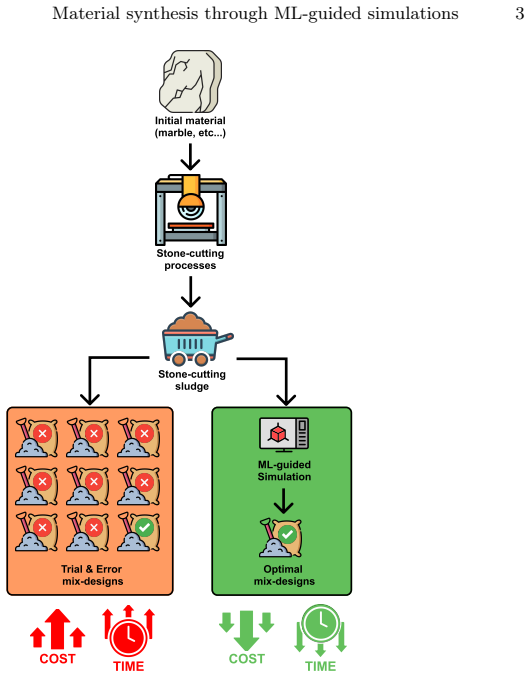
- [Section 3.4] The 'simulator' is not a simulator and cannot generate large datasets as the Abstract promises. The text claims that the model 'enabl[es] the estimation of porosity without relying on historical data and using only current material inputs,' but the model's parameters are learned entirely from 240 historical concrete records. A supervised regressor can only interpolate predictions for new feature combinations; it cannot generate new ground-truth data points. No generative model, physical forward model, or sampling procedure is described. Consequently, the Abstract's statement that 'through simulations, a large dataset can be generated' is unsupported, and the title's promise of 'material synthesis through simulations' is not met.
- [Section 4] The transfer to stone-cutting sludge is untested and rests on an unverified analogy. Section 4 justifies the concrete dataset by stating 'Concrete quality estimation is a very similar task to the one we aim to solve,' but no sludge-specific features (e.g., CaCO3 content, particle-size distribution, sludge-to-binder ratio) are used, and no transfer experiment is performed. The conclusion that ML 'can estimate the correct quantity of stone-cutting sludge to be used in aggregates' (Abstract) is therefore a speculation about transfer across materials with different chemistry, variability, and processing, not a demonstrated result.
- [Table 1] The feature set includes Strength as an input to predict porosity. In a mix-design workflow, strength is a target property that would not be known before the mix is produced; using it as an input makes the model an inverse or diagnostic predictor, not a forward design simulator. The paper does not explain how a user of the proposed simulator would supply 'Strength' before making and testing the concrete, which undermines the claimed applicability of the simulator for discovering optimal mix designs.
- [Section 3.2] The identification of Bayesian hyperparameter optimization as 'meta-learning' is a terminology error with consequences for the paper's central claim. Meta-learning refers to learning across tasks (e.g., few-shot learning, learning-to-learn); Bayesian optimization is a standard hyperparameter-search technique applied to a single dataset. No multi-task or few-shot experiments are reported, so the paper's advertised advantage of using meta-learning in data-constrained settings is not demonstrated.
- [Section 3.3 and Figure 2] The evaluation protocol is underspecified regarding the test set. The paper does not state whether Bayesian optimization used the same test partition for feedback (Figure 2 shows 'evaluation feedback' but not its source); if the test set was used to select hyperparameters, the reported test MSE of 0.1077 would be optimistically biased. Moreover, the random 80/20 split on 240 records from only 74 unique mixture designs may place the same design in both training and testing, inflating performance. A grouped split by mixture design should be reported as a check.
minor comments (4)
- [Section 3.1] The term 'Z-Normalization' is nonstandard; use 'z-score normalization' or 'standardization'.
- [Sections 3.2 and 3.3] The headings 'T raining' and 'T esting' contain spurious spaces that should be removed.
- [Section 4.1] The figure references appear inconsistent: the text says 'Figure 4 displays the performance ... before any hyper-parameter optimization,' but Figure 3 is captioned 'without meta-learning' and Figure 4 'with meta-learning.' Please correct the numbering or the verbal description.
- [Section 4.1] The discussion of GB states 'GB performs the worst among the models, with an (R2 = 0.4738)' without specifying whether this is the training or test value; from Table 2 the value appears to be the test R², but the sentence should state this explicitly.
Circularity Check
Empirical porosity benchmark is independent, but the paper's 'simulation generates a large dataset' advantage restates the fitted regressor as a generative simulator, a renaming that reduces by construction to the training data.
-
renaming known result
[Section 3.4 'Simulator'; cf. Abstract advantage (i)]
"Unlike a traditional predictor, which forecasts outcomes based solely on historical data, our simulator offers more comprehensive capabilities. It models and simulates the complex relationships between various material parameters, enabling the estimation of porosity without relying on historical data and using only current material inputs."
Section 3.2 trains this simulator on the 240-record historical concrete dataset, so its porosity output is by construction a function of those historical labels. Thus the Abstract's claimed advantage that 'through simulations, a large dataset can be generated' reduces to evaluating the fitted regressor on new feature vectors; such a generated dataset contains no new ground truth and is a re-encoding of the training data plus interpolation. The claim 'without relying on historical data' is contradicted by the training stage. The reported held-out MSE remains an independent benchmark; the circularity is in the simulation-generation framing.
full rationale
The only quantified result — GB with Bayesian optimization reaching a test MSE of 0.1077 on the public concrete dataset — is an ordinary supervised regression evaluated on a held-out split, so it is not circular: the model's output is not defined in terms of the test labels. The circularity concern is confined to the framing. Section 3.4 calls the trained model a 'simulator' and claims it estimates porosity 'without relying on historical data,' although Section 3.2 trained it on exactly those historical data; the Abstract's claimed advantage (i), that 'through simulations, a large dataset can be generated,' is therefore equivalent by construction to evaluating the fitted regressor, and such a generated dataset adds no new ground-truth information. The paper itself honestly concedes that sludge-specific transfer is untested ('we propose that this strategy could be effectively applied to achieve improved results with smaller datasets of this type'), which is a non-circular external-validity gap. The Table 1 statement that 'features were chosen based on their Pearson correlation with porosity' and the inclusion of Strength as an input are potential leakage/correlation caveats for the reported MSE, but they are not formal derivation-equivalence issues. No self-citation chain is used; the external dataset [7] is genuine independent evidence. On balance, the empirical benchmark is self-contained, while the paper's central simulation-generation promise is partially circular by renaming a fitted predictor as a generative simulator.
Assumptions & free parameters
free parameters (4)
- Model hyperparameters (GB, XGB, RF, SVM) =
Not reported in paper
- 80/20 random train-test split =
Not reported (no seed)
- Feature set selected by Pearson correlation with porosity =
Eight features listed in Table 1
- Bayesian optimization settings =
Not reported
assumptions (5)
- domain assumption Concrete porosity data is a good proxy for stone-cutting sludge mix design.
- domain assumption A trained supervised regressor functions as a simulator that can generate a large dataset of material properties.
- ad hoc to paper Bayesian optimization of hyperparameters constitutes meta-learning.
- ad hoc to paper Strength can be used as an input feature to predict porosity in a design workflow.
- standard math Standard regression and train/test split assumptions.
invented entities (1)
-
ML-guided simulator
Cite this review
Pith. "Pith review of Material synthesis through simulations guided by machine learning: a position paper." pith.science (2026). https://pith.science/paper/LEFK3T6I
@misc{pith2026241113953,
  author       = {Pith},
  title        = {Pith review of: Material synthesis through simulations guided by machine learning: a position paper},
  year         = {2026},
  howpublished = {\url{https://pith.science/paper/LEFK3T6I}},
  note         = {Machine review of arXiv:2411.13953}
}
read the original abstract
In this position paper, we propose an approach for sustainable data collection in the field of optimal mix design for marble sludge reuse. Marble sludge, a calcium-rich residual from stone-cutting processes, can be repurposed by mixing it with various ingredients. However, determining the optimal mix design is challenging due to the variability in sludge composition and the costly, time-consuming nature of experimental data collection. Also, we investigate the possibility of using machine learning models using meta-learning as an optimization tool to estimate the correct quantity of stone-cutting sludge to be used in aggregates to obtain a mix design with specific mechanical properties that can be used successfully in the building industry. Our approach offers two key advantages: (i) through simulations, a large dataset can be generated, saving time and money during the data collection phase, and (ii) Utilizing machine learning models, with performance enhancement through hyper-parameter optimization via meta-learning, to estimate optimal mix designs reducing the need for extensive manual experimentation, lowering costs, minimizing environmental impact, and accelerating the processing of quarry sludge. Our idea promises to streamline the marble sludge reuse process by leveraging collective data and advanced machine learning, promoting sustainability and efficiency in the stonecutting sector.
Figures


Figures from the paper (1 more)

Reference graph
Works this paper leans on
-
[1]
Qubahan Academic Journal1(2), 81–90 (2021)
Abdullah, D.M., Abdulazeez, A.M.: Machine learning applications based on svm classification a review. Qubahan Academic Journal1(2), 81–90 (2021)
work page 2021
-
[2]
The Journal of Solid Waste Technology and Management47(1), 56–60 (2021)
Al-Zboon, K., Masoud, T.: Recycling of stone cutting waste in the construction sector: A review. The Journal of Solid Waste Technology and Management47(1), 56–60 (2021)
work page 2021
-
[3]
International Journal of Environmental Science and Engineering1(4), 167–172 (2009)
Alzboon, K.K., Mahasneh, K.N.: Effect of using stone cutting waste on the com- pression strength and slump characteristics of concrete. International Journal of Environmental Science and Engineering1(4), 167–172 (2009)
work page 2009
-
[4]
Procedia Engineering 00 (2013) 000–000 (2013)
Bahoria, B., Parbat, D., Nagarnaik, P., Waghe, U.: Effect of replacement of natural sand by quarry dust and waste plastic on compressive & split tensile strength of m20 concrete. Procedia Engineering 00 (2013) 000–000 (2013)
work page 2013
-
[5]
In: In- ternational Congress on Engineering and Sustainability in the XXI Century
Branco, F.G., Ortega, J.M., Marques, L., Pereira, L.: Partial replacement of port- land cement by stone cutting sludge in mortars–hygrometric performance. In: In- ternational Congress on Engineering and Sustainability in the XXI Century. pp. 289–299. Springer (2023)
work page 2023
-
[6]
Applied Ocean Research 104, 102339 (2020) Material synthesis through ML-guided simulations 15
Callens, A., Morichon, D., Abadie, S., Delpey, M., Liquet, B.: Using random forest and gradient boosting trees to improve wave forecast at a specific location. Applied Ocean Research 104, 102339 (2020) Material synthesis through ML-guided simulations 15
work page 2020
-
[7]
Results in Engineering 17, 100794 (2023)
Cao, C.: Prediction of concrete porosity using machine learning. Results in Engineering 17, 100794 (2023). https://doi.org/https://doi.org/10.1016/j. rineng.2022.100794, https://www.sciencedirect.com/science/article/pii/ S2590123022004649
arXiv 2023
-
[8]
Information Sciences 591, 155–175 (2022)
Du, L., Gao, R., Suganthan, P.N., Wang, D.Z.: Bayesian optimization based dy- namic ensemble for time series forecasting. Information Sciences 591, 155–175 (2022)
work page 2022
Show all 23 references
-
[9]
Ginga, C., Ongpeng, J.: materials circular economy on construction and demolition waste:Aliteraturereviewonmaterialrecoveryandproduction.Materials 13(2020)
2020
-
[10]
Indian Geotechnical Journal50 (2020)
Jain, A., Jha, A., , S.: Improvement in subgrade soils with marble dust for highway construction: A comparative study. Indian Geotechnical Journal50 (2020)
2020
-
[11]
Construction and Building Materials325, 126607 (2022)
Liu, J., Liu, F., Zheng, C., Zhou, D., Wang, L.: Optimizing asphalt mix design through predicting effective asphalt content and absorbed asphalt content using machine learning. Construction and Building Materials325, 126607 (2022)
2022
-
[12]
Journal of environmental management90(1), 466–470 (2009)
Nasserdine, K., Mimi, Z., Bevan, B., Elian, B.: Environmental management of the stone cutting industry. Journal of environmental management90(1), 466–470 (2009)
2009
-
[13]
Minerals13 (2023)
Segui, P., Safhi, A., Amrani, M., Benzaazoua, M.: Mining wastes as road construc- tion material: A review. Minerals13 (2023)
2023
-
[14]
Proceedings of the IEEE 104(1), 148–175 (2015)
Shahriari, B., Swersky, K., Wang, Z., Adams, R.P., De Freitas, N.: Taking the human out of the loop: A review of bayesian optimization. Proceedings of the IEEE 104(1), 148–175 (2015)
2015
-
[15]
Buildings13(7), 1856 (2023)
Silva, L.S., Amario, M., Stolz, C.M., Figueiredo, K.V., Haddad, A.N.: A com- prehensive review of stone dust in concrete: Mechanical behavior, durability, and environmental performance. Buildings13(7), 1856 (2023)
2023
-
[16]
Environmental Earth Sciences67 (2011)
Song, Y.S., Kim, M.I., Woo, K.s.: Stability of embankments constructed from soil mixed with stone dust in quarry reclamation. Environmental Earth Sciences67 (2011)
2011
-
[17]
Journal of environmental management231, 86–97 (2019)
Tunc, E.T.: Recycling of marble waste: A review based on strength of concrete containing marble waste. Journal of environmental management231, 86–97 (2019)
2019
-
[18]
MATEC Web of Conferences331, 1–7 (2020)
Turuallo, G., Mallisa, H., Rupang, N.: Sustainable development: Using stone dust to replace a part of sand in concrete mixture. MATEC Web of Conferences331, 1–7 (2020)
2020
-
[19]
Open Geosciences 12, 1247–1262 (2020)
Ural, N., Yakşe, G.: Utilization of marble piece wastes as base materials. Open Geosciences 12, 1247–1262 (2020)
2020
-
[20]
Neurocomputing415, 295–316 (2020)
Yang, L., Shami, A.: On hyperparameter optimization of machine learning algo- rithms: Theory and practice. Neurocomputing415, 295–316 (2020)
2020
-
[21]
arXiv preprint arXiv:2003.05689 (2020)
Yu, T., Zhu, H.: Hyper-parameter optimization: A review of algorithms and appli- cations. arXiv preprint arXiv:2003.05689 (2020)
2020 arXiv
-
[22]
Materials Proceedings 5(1), 57 (2021)
Zichella, L., Bellopede, R., Marini, P.: Ornamental stone cutting processing and sludge production evaluation with the goal of ending waste. Materials Proceedings 5(1), 57 (2021)
2021
-
[23]
Journal of cleaner production 178, 866–876 (2018)
Zichella, L., Bellopede, R., Spriano, S., Marini, P.: Preliminary investigations on stone cutting sludge processing for a future recovery. Journal of cleaner production 178, 866–876 (2018)
2018
Reviewed August 12, 2026 · model on record in the stance chip above.
Discussion (0). Continue with ORCID to comment.