REVIEW 3 major objections 6 minor 35 references
Dehazing-aided Multi-Rate Multi-Modal Pose Estimation Framework for Mitigating Visual Disturbances in Extreme Underwater Domain
T0 review · 3 major / 6 minor · reviewed 2026-08-12 · deepseek-v4-flash
Pith's one-line read Adding a GAN-based dehazing stage to a learning-based VIO pipeline reduces pose error in extreme underwater conditions on the AQUALOC dataset.
desk verdict A sensible dehazing-aided VIO idea, but the main comparison is likely contaminated because the dehazing GAN appears to have trained on the test sequences. read the letter →
The pith
A machine-rendered reading of the paper's core claim, the machinery that carries it, and where it could break.
The reading
What carries the argument
The central object is DU-VIO, a multi-rate multi-modal VIO pipeline whose distinguishing component is a GAN-based dehazing front-end that cleans raw underwater frames before they reach the pose network. The generator uses a DenseNet-121 encoder-decoder with skip connections, and the discriminator judges whether a generated image looks clear. The pose estimator is a hybrid CNN-LSTM: FlowNetSimple extracts visual features from two consecutive dehazed frames, three 1D convolutional layers extract inertial features from the 11 IMU readings between those frames, the two feature vectors are concatenated, and a two-layer LSTM followed by a two-layer MLP regresses the 6-DoF pose at each time step. Multi-rate fusion is built into the design by using a fixed window of high-rate IMU samples per low-rate image pair.
What would settle it
Retrain the dehazing module using only the h02–h06 training/validation split, then rerun DU-VIO on h01 and h07 across all three scenarios; if the translation and rotation RMSE improvement over U-VIO disappears or drops sharply, the claimed benefit is an artifact of test-set leakage rather than general dehazing.
Extended reading notes
Core claim
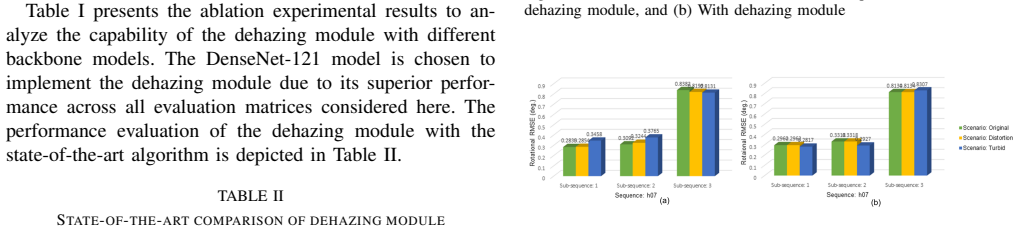
The central claim is that adding a learned dehazing stage before a visual-inertial odometry network materially improves pose estimation in visually degraded underwater environments. DU-VIO builds on VS-VIO by replacing its policy network with a GAN-based visibility enhancement module, so the visual encoder always receives dehazed, higher-contrast frames. The paper evaluates this by comparing DU-VIO against U-VIO (the same network without dehazing) on the modified AQUALOC dataset under three scenarios—original low-texture, added distortion, and added turbidity—and reports that the dehazed version yields lower translation and rotation RMSE on the two test sequences in most sub-sequence comparisons. It further reports that DU-VIO's RMSE on the original scenario is lower than the compared baselines OKVIS, ORB-SLAM3, and VINet. The paper also documents inference speed and GPU resource usage, positioning DU-VIO as a deployable pipeline.
Load-bearing premise
The reported benefit of dehazing assumes the dehazing network was not trained on the same h01 and h07 images used to test pose accuracy; Section IV-C says the GAN was trained on 80% of the entire modified dataset, and the paper does not show these test sequences were excluded.
Editorial extensions
If this is right
- If DU-VIO's results hold, adding a learned dehazing front-end can improve existing learning-based VIO systems for underwater vehicles without redesigning the pose network.
- The framework's performance on distortion and turbidity scenarios suggests the dehazing step helps recover features the visual encoder would otherwise lose, which could extend to other degraded visual conditions such as fog or murky water.
- The reported hardware metrics (about 40 seconds inference time, 47 W power, 4% GPU utilization on an A100) indicate the pipeline is light enough for onboard deployment, though real-time operation depends on sequence length and hardware.
- DU-VIO's lower RMSE than OKVIS, ORB-SLAM3, and VINet on the original scenario implies that data-driven multi-modal VIO with a learned enhancement module can compete with classical geometry-based methods in underwater settings.
Reading between the lines
- A fair test of the dehazing benefit would retrain the GAN on only the h02–h06 split and test on h01/h07; the paper does not state that h01/h07 images were excluded from the dehazing training set, so the reported improvement may partly reflect exposure to test scenes.
- If the dehazing front-end generalizes across sites, the same preprocessing could benefit other downstream underwater tasks such as SLAM, object detection, or segmentation, since all depend on visible features in turbid water.
- The multi-rate fusion design (11 IMU samples per image pair) is a reusable recipe for other learning-based VIO systems where sensor rates differ by an order of magnitude.
- The authors' removal of the policy network from VS-VIO suggests that in static or slow underwater motion, selective modality gating may be unnecessary; testing this claim would require comparing DU-VIO against VS-VIO with the policy network retained.
Editorial analysis
A structured set of objections, weighed in public.
Referee Report
Summary. The paper proposes DU-VIO, a dehazing-aided visual-inertial odometry framework for underwater pose estimation. DU-VIO preprocesses raw camera images with a GAN-based dehazing module and then feeds the enhanced images, together with raw IMU data, into a hybrid CNN-LSTM pose estimation network derived from VS-VIO. The central claim is that adding the dehazing module reduces translation and rotation RMSE on two test sequences (h01 and h07) from the AQUALOC harbor dataset under original, distortion, and turbidity scenarios, comparing DU-VIO with a U-VIO baseline that omits dehazing. The paper also reports an ablation of dehazing backbones, a comparison with other dehazing methods, a comparison with geometric and data-driven VIO baselines, and hardware metrics for inference.
Significance. If the reported comparison were clean, the paper would provide a useful empirical data point for the underwater robotics community: an end-to-end learning-based VIO system augmented by a visibility-enhancement preprocessing module, evaluated on a public underwater dataset. The paper gives credit where due by building explicitly on VS-VIO [9] and its own dehazing module [23], and it includes a backbone ablation, a dehazing state-of-the-art comparison, and hardware resource measurements that are not always reported in VIO papers. However, the central empirical claim is currently compromised by an unresolved overlap between the dehazing training corpus and the pose-estimation test sequences, and the evaluation is otherwise thin (two test sequences, no error bars, interpolated ground truth). The work in its present form does not convincingly establish that dehazing improves pose estimation in extreme underwater conditions.
major comments (3)
- [Section IV-C and Section IV-B] The dehazing module is trained on "80% whole images from the modified AQUALOC dataset" (Section IV-C), while h01 and h07 are designated as the pose-model test sequences in Section IV-B. No information is given about whether the dehazing training split excluded h01 and h07. Since the modified dataset consists of the seven harbor sequences, a random 80% split almost certainly includes frames from h01 and h07. This matters because the paper's central comparison is DU-VIO versus U-VIO, i.e., the same pose estimator with and without the dehazing preprocessor; if the dehazing GAN saw test-sequence frames during training, the RMSE reductions reported in Figures 5-8 may reflect memorization rather than a generalizable dehazing benefit. The authors must report the dehazing data split and either verify that h01 and h07 were excluded or retrain the dehazing module on a split that excludes them and rerun the pose evaluation.
- [Section IV-A and Section V] The evaluation rests on only two test sequences, h01 and h07, with each sequence divided into three sub-sequences, and no error bars, confidence intervals, or repeated-run statistics are provided. Section IV-A states that ground truth poses are linearly interpolated from Colmap poses computed on a subset of images (one in five), and only one-third of each trajectory is used for pose estimation. With this small and smoothed test set, the U-VIO versus DU-VIO differences in Figures 5-8 could lie within run-to-run or interpolation-induced variability. The authors should provide aggregate statistics across multiple training runs and, ideally, additional test sequences before claiming that the dehazing module consistently improves pose accuracy.
- [Table III] The state-of-the-art comparison in Table III is reported only for the original scenario, only for DU-VIO, and not for the U-VIO baseline. The table caption also does not state whether the reported numbers are translation RMSE, rotation RMSE, or a combined error, nor whether they are normalized by trajectory length. Without this information, and without results for the distortion and turbidity scenarios, the superiority claim in the text is not fully supported. At minimum, the same comparison should be provided for all three scenarios and for the U-VIO baseline.
minor comments (6)
- [Section IV-C] There is a typo: "foe 50 epochs" should be "for 50 epochs," and "80% whole images" should be "80% of the whole images."
- [Section II-A] The phrase "improve textile and content representations" should likely be "improve texture and content representations."
- [Section IV-B] The Adam optimizer parameters are written as "alpha = 0.9 and beta = 0.999"; in Adam these are conventionally beta1 and beta2, while alpha usually denotes the learning rate, which was already introduced as 1e-6. Please clarify the notation.
- [Section IV-B] The sentence "The Adam optimizer ... is used due to due to its comparatively lower memory demand" contains a duplicated "due to."
- [Section V] The axes in Figures 5-8 are not labeled with units, and the sub-sequence indexing is not defined in the text; please add units and explain how the three sub-sequences are formed.
- [General] The text uses both "harbor site" (Section IV) and "harbour site" (Section V); please standardize the spelling.
Circularity Check
Dehazing GAN is trained on 80% of the full modified AQUALOC image set with no exclusion of h01/h07, so DU-VIO's gain over U-VIO reduces to a fitted-input prediction.
-
fitted input called prediction
[Section IV-C (Details of Computing Resources) and Section IV-B (test-set definition)]
"To effectively remove the visual disturbances, 80% whole images from the modified AQUALOC dataset was used to train the dehazing module foe 50 epochs. ... the trajectory sequences {h02, h04, h06} are used for training, {h03, h05} are used for validation and the sequences {h01, h07} are used for testing the DU-VIO framework under original, distortion and turbid scenario for 20 epochs."
The dehazing module is fitted to 80% of all images in the modified AQUALOC dataset, while the pose-estimation test set is h01 and h07 from that same dataset. The paper reports no split excluding h01/h07 from the dehazing training pool, so the dehazing weights are fit to the very sequences used to compute the DU-VIO vs U-VIO RMSE comparison. The dehazed test images are therefore not out-of-sample; the reported translation/rotation RMSE reductions in Figures 5-8 can be attributed to the dehazing network having memorized the test scenes rather than to a generalizable visibility-enhancement benefit. The central claim that adding dehazing improves pose estimation reduces to a fitted preprocessing network applied to its own training distribution.
full rationale
The paper is an empirical systems paper without a formal derivation chain, so the classical 'Eq. X = Eq. Y by construction' circularity does not appear. The component citations ([9] VS-VIO backbone and [23] dehazing architecture) are normal reuse; [23] has an overlapping author but the pose RMSE experiments are new, so that self-citation is not load-bearing. The one significant circularity is in the data split: the dehazing module is trained on 80% of the entire modified AQUALOC image corpus, and the pose test sequences h01/h07 are drawn from that same corpus with no stated exclusion. Because the variable whose effect is being measured (dehazing) is fitted on the test sequences, the reported DU-VIO improvement over U-VIO is not an independent prediction of dehazing benefit; it is a fitted-input comparison. This warrants a score of 6: one central 'prediction' reduces by construction to the dehazing training procedure. If the authors can show h01/h07 were excluded from dehazing training, the score would drop to 2 or lower; as written, the paper does not provide that evidence.
Assumptions & free parameters
free parameters (8)
- Rotation loss weight alpha in Eq. (5) =
not reported
- LSTM hidden units =
1024 per layer
- Visual feature dimension =
512
- Inertial feature dimension =
256x11
- IMU samples per image interval =
11
- Learning rate =
1e-6
- Batch size =
16
- Dehazing training fraction =
80% of full modified dataset
assumptions (4)
- domain assumption Colmap-derived ground truth poses in AQUALOC, linearly interpolated to fill missing instances, are accurate enough to serve as reference for RMSE differences.
- domain assumption Publicly available noise models added to AQUALOC images faithfully reproduce distortion and turbidity in extreme underwater conditions.
- ad hoc to paper The dehazing GAN trained on 80% of the full modified dataset did not encode test-sequence appearance in a way that inflates pose results on h01 and h07.
- domain assumption Learning-based VIO trained on the harbor subset of AQUALOC transfers to the claimed extreme underwater scenarios.
Cite this review
Pith. "Pith review of Dehazing-aided Multi-Rate Multi-Modal Pose Estimation Framework for Mitigating Visual Disturbances in Extreme Underwater Domain." pith.science (2026). https://pith.science/paper/RDALRCNA
@misc{pith2026241113988,
  author       = {Pith},
  title        = {Pith review of: Dehazing-aided Multi-Rate Multi-Modal Pose Estimation Framework for Mitigating Visual Disturbances in Extreme Underwater Domain},
  year         = {2026},
  howpublished = {\url{https://pith.science/paper/RDALRCNA}},
  note         = {Machine review of arXiv:2411.13988}
}
read the original abstract
This paper delves into the potential of DU-VIO, a dehazing-aided hybrid multi-rate multi-modal Visual-Inertial Odometry (VIO) estimation framework, designed to thrive in the challenging realm of extreme underwater environments. The cutting-edge DU-VIO framework is incorporating a GAN-based pre-processing module and a hybrid CNN-LSTM module for precise pose estimation, using visibility-enhanced underwater images and raw IMU data. Accurate pose estimation is paramount for various underwater robotics and exploration applications. However, underwater visibility is often compromised by suspended particles and attenuation effects, rendering visual-inertial pose estimation a formidable challenge. DU-VIO aims to overcome these limitations by effectively removing visual disturbances from raw image data, enhancing the quality of image features used for pose estimation. We demonstrate the effectiveness of DU-VIO by calculating RMSE scores for translation and rotation vectors in comparison to their reference values. These scores are then compared to those of a base model using a modified AQUALOC Dataset. This study's significance lies in its potential to revolutionize underwater robotics and exploration. DU-VIO offers a robust solution to the persistent challenge of underwater visibility, significantly improving the accuracy of pose estimation. This research contributes valuable insights and tools for advancing underwater technology, with far-reaching implications for scientific research, environmental monitoring, and industrial applications.
Figures


Figures from the paper (5 more)




Reference graph
Works this paper leans on
-
[9]
Efficient deep visual and iner- tial odometry with adaptive visual modality selection,
M. Yang, Y . Chen, and H.-S. Kim, “Efficient deep visual and iner- tial odometry with adaptive visual modality selection,” in European Conference on Computer Vision , pp. 233–250, Springer, 2022
work page 2022
-
[23]
Vision-Based Autonomous Navigation for Unmanned Surface Vessel in Extreme Marine Conditions
M. Ahmed, A. B. Bakht, T. Hassan, W. Akram, A. Humais, L. Senevi- ratne, S. He, D. Lin, and I. Hussain, “Vision-based autonomous navigation for unmanned surface vessel in extreme marine conditions,” arXiv preprint arXiv:2308.04283 , 2023
work page Pith review arXiv 2023
-
[1]
Real-time positioning and tracking for vision-based unmanned underwater vehicles,
J. Qin, K. Yang, M. Li, J. Zhong, and H. Zhang, “Real-time positioning and tracking for vision-based unmanned underwater vehicles,” The International Archives of the Photogrammetry, Remote Sensing and Spatial Information Sciences , vol. 46, pp. 163–168, 2022
work page 2022
-
[2]
A survey on underwater computer vision,
S. P. Gonz ´alez-Sabbagh and A. Robles-Kelly, “A survey on underwater computer vision,” ACM Computing Surveys , 2023
work page 2023
-
[3]
Experimental comparison of open source vision- based state estimation algorithms,
A. Quattrini Li, A. Coskun, S. M. Doherty, S. Ghasemlou, A. S. Jagtap, M. Modasshir, S. Rahman, A. Singh, M. Xanthidis, J. M. O’Kane, et al. , “Experimental comparison of open source vision- based state estimation algorithms,” in 2016 International Symposium on Experimental Robotics , pp. 775–786, Springer, 2017
work page 2016
-
[4]
Underwater navigation, localization and path planning for autonomous vehicles: A review,
F. Jalal and F. Nasir, “Underwater navigation, localization and path planning for autonomous vehicles: A review,” in 2021 International Bhurban Conference on Applied Sciences and Technologies (IBCAST), pp. 817–828, IEEE, 2021
work page 2021
-
[5]
Vinet: Visual-inertial odometry as a sequence-to-sequence learning problem,
R. Clark, S. Wang, H. Wen, A. Markham, and N. Trigoni, “Vinet: Visual-inertial odometry as a sequence-to-sequence learning problem,” in Proceedings of the AAAI Conference on Artificial Intelligence , vol. 31, 2017
work page 2017
-
[6]
Multisensor fusion for marine infrastructures’ inspection and safety,
V . Sudevan, N. Mankovskii, S. Javed, H. Karki, G. De Masi, and J. Dias, “Multisensor fusion for marine infrastructures’ inspection and safety,” in OCEANS 2022, Hampton Roads , pp. 1–7, IEEE, 2022
work page 2022
Show all 35 references
-
[7]
Ego-motion estimation using recurrent convolutional neural networks through optical flow learning,
B. Zhao, Y . Huang, H. Wei, and X. Hu, “Ego-motion estimation using recurrent convolutional neural networks through optical flow learning,” Electronics, vol. 10, no. 3, p. 222, 2021
2021
-
[8]
Selfvio: Self-supervised deep monocu- lar visual–inertial odometry and depth estimation,
Y . Almalioglu, M. Turan, M. R. U. Saputra, P. P. de Gusm ˜ao, A. Markham, and N. Trigoni, “Selfvio: Self-supervised deep monocu- lar visual–inertial odometry and depth estimation,” Neural Networks, vol. 150, pp. 119–136, 2022
2022
-
[10]
Visibility enhancement for underwater visual slam based on underwater light scattering model,
Y . Cho and A. Kim, “Visibility enhancement for underwater visual slam based on underwater light scattering model,” in 2017 IEEE In- ternational Conference on Robotics and Automation (ICRA) , pp. 710– 717, IEEE, 2017
2017
-
[11]
An underwater image enhancement method for simultaneous localization and mapping of autonomous underwater vehicle,
Z. Huang, L. Wan, M. Sheng, J. Zou, and J. Song, “An underwater image enhancement method for simultaneous localization and mapping of autonomous underwater vehicle,” in 2019 3rd International Con- ference on Robotics and Automation Sciences (ICRAS) , pp. 137–142, IEEE, 2019
2019
-
[12]
Real-time gan-based image enhancement for robust underwater monocular slam,
Z. Zheng, Z. Xin, Z. Yu, and S.-K. Yeung, “Real-time gan-based image enhancement for robust underwater monocular slam,” Frontiers in Marine Science , 2023
2023
-
[13]
Underwater image super- resolution using deep residual multipliers,
M. J. Islam, S. S. Enan, P. Luo, and J. Sattar, “Underwater image super- resolution using deep residual multipliers,” in 2020 IEEE International Conference on Robotics and Automation (ICRA) , pp. 900–906, IEEE, 2020
2020
-
[14]
Real-time image enhancement for vision-based autonomous underwater vehicle nav- igation in murky waters,
W. Chen, M. Rahmati, V . Sadhu, and D. Pompili, “Real-time image enhancement for vision-based autonomous underwater vehicle nav- igation in murky waters,” in Proceedings of the 14th International Conference on Underwater Networks & Systems , pp. 1–8, 2019
2019
-
[15]
A multi-state constraint kalman filter for vision-aided inertial navigation,
A. I. Mourikis and S. I. Roumeliotis, “A multi-state constraint kalman filter for vision-aided inertial navigation,” in Proceedings 2007 IEEE International Conference on Robotics and Automation , IEEE, 2007
2007
-
[16]
Rd-vio: Relative-depth- aided visual-inertial odometry for autonomous underwater vehicles,
S. Ding, T. Ma, Y . Li, S. Xu, and Z. Yang, “Rd-vio: Relative-depth- aided visual-inertial odometry for autonomous underwater vehicles,” Applied Ocean Research , vol. 134, p. 103532, 2023
2023
-
[17]
Keyframe-based visual–inertial odometry using nonlinear optimization,
S. Leutenegger and et al., “Keyframe-based visual–inertial odometry using nonlinear optimization,” The International Journal of Robotics Research, vol. 34, no. 3, pp. 314–334, 2015
2015
-
[18]
Vins-mono: A robust and versatile monoc- ular visual-inertial state estimator,
T. Qin, P. Li, and S. Shen, “Vins-mono: A robust and versatile monoc- ular visual-inertial state estimator,” IEEE Transactions on Robotics , vol. 34, no. 4, pp. 1004–1020, 2018
2018
-
[19]
Deepvo: Towards end-to-end visual odometry with deep recurrent convolutional neural networks,
S. Wang, R. Clark, H. Wen, and N. Trigoni, “Deepvo: Towards end-to-end visual odometry with deep recurrent convolutional neural networks,” in 2017 IEEE international conference on robotics and automation (ICRA), pp. 2043–2050, IEEE, 2017
2017
-
[20]
Hvionet: A deep learning based hybrid visual–inertial odometry approach for unmanned aerial system position estimation,
M. F. Aslan and et al., “Hvionet: A deep learning based hybrid visual–inertial odometry approach for unmanned aerial system position estimation,” Neural Networks, vol. 155, pp. 461–474, 2022
2022
-
[21]
Flownet: Learning optical flow with convolutional networks,
A. Dosovitskiy and et al., “Flownet: Learning optical flow with convolutional networks,” in Proceedings of the IEEE International Conference on Computer Vision , 2015
2015
-
[22]
Deepvio: Self-supervised deep learning of monocular visual inertial odometry using 3d geometric constraints,
L. Han, Y . Lin, G. Du, and S. Lian, “Deepvio: Self-supervised deep learning of monocular visual inertial odometry using 3d geometric constraints,” in 2019 IEEE/RSJ International Conference on Intelligent Robots and Systems (IROS) , pp. 6906–6913, IEEE, 2019
2019
-
[24]
Aqualoc: An underwater dataset for visual–inertial–pressure localization,
M. Ferrera, V . Creuze, J. Moras, and P. Trouv ´e-Peloux, “Aqualoc: An underwater dataset for visual–inertial–pressure localization,” The International Journal of Robotics Research, vol. 38, no. 14, pp. 1549– 1559, 2019
2019
-
[25]
Adam: A method for stochastic optimiza- tion,
D. P. Kingma and J. Ba, “Adam: A method for stochastic optimiza- tion,” arXiv preprint arXiv:1412.6980 , 2014
2014 arXiv
-
[26]
A survey on visual navigation and positioning for autonomous uuvs,
J. Qin, M. Li, D. Li, J. Zhong, and K. Yang, “A survey on visual navigation and positioning for autonomous uuvs,” Remote Sensing , vol. 14, no. 15, p. 3794, 2022
2022
-
[27]
Densely connected convolutional networks,
G. Huang, Z. Liu, L. Van Der Maaten, and K. Q. Weinberger, “Densely connected convolutional networks,” in Proceedings of the IEEE con- ference on computer vision and pattern recognition , pp. 4700–4708, 2017
2017
-
[28]
Deep residual learning for image recognition,
S. Jian, H. Kaiming, R. Shaoqing, and Z. Xiangyu, “Deep residual learning for image recognition,” in IEEE Conference on Computer Vision & Pattern Recognition , pp. 770–778, 2016
2016
-
[29]
An image is worth 16x16 words: Transformers for image recognition at scale,
A. Dosovitskiy, L. Beyer, A. Kolesnikov, D. Weissenborn, X. Zhai, T. Unterthiner, M. Dehghani, M. Minderer, G. Heigold, S. Gelly,et al., “An image is worth 16x16 words: Transformers for image recognition at scale,” arXiv preprint arXiv:2010.11929 , 2020
2010 arXiv
-
[30]
Mo- bilenetv2: Inverted residuals and linear bottlenecks,
M. Sandler, A. Howard, M. Zhu, A. Zhmoginov, and L.-C. Chen, “Mo- bilenetv2: Inverted residuals and linear bottlenecks,” in Proceedings of the IEEE conference on computer vision and pattern recognition , pp. 4510–4520, 2018
2018
-
[31]
Very deep convolutional networks for large-scale image recognition,
K. Simonyan and A. Zisserman, “Very deep convolutional networks for large-scale image recognition,” arXiv preprint arXiv:1409.1556 , 2014
2014 arXiv
-
[32]
Fda: Fourier domain adaptation for semantic segmentation,
Y . Yang and S. Soatto, “Fda: Fourier domain adaptation for semantic segmentation,” in Proceedings of the IEEE/CVF conference on com- puter vision and pattern recognition , pp. 4085–4095, 2020
2020
-
[33]
Vision transformers for single image dehazing,
Y . Song, Z. He, H. Qian, and X. Du, “Vision transformers for single image dehazing,” IEEE Transactions on Image Processing , vol. 32, pp. 1927–1941, 2023
1927
-
[34]
Ffa-net: Feature fusion attention network for single image dehazing,
X. Qin, Z. Wang, Y . Bai, X. Xie, and H. Jia, “Ffa-net: Feature fusion attention network for single image dehazing,” in Proceedings of the AAAI conference on artificial intelligence , vol. 34, pp. 11908–11915, 2020
2020
-
[35]
Orb-slam3: An accurate open-source library for visual, visual–inertial, and multimap slam,
C. Campos, R. Elvira, J. J. G. Rodr ´ıguez, J. M. Montiel, and J. D. Tard ´os, “Orb-slam3: An accurate open-source library for visual, visual–inertial, and multimap slam,” IEEE Transactions on Robotics , vol. 37, no. 6, pp. 1874–1890, 2021
2021
Reviewed August 12, 2026 · model on record in the stance chip above.
Discussion (0). Continue with ORCID to comment.