REVIEW 3 major objections 6 minor 9 references
Dual-Arm Telerobotic Platform for Robotic Hotbox Operations for Nuclear Waste Disposition in EM Sites
T0 review · 3 major / 6 minor · reviewed 2026-08-12 · deepseek-v4-flash
Pith's one-line read An integrated dual-arm telerobotic platform can run a full surrogate nuclear-waste disposition sequence from a remote operator station.
desk verdict A solid integration-and-demo paper whose feasibility claim holds, but whose EM-site applicability claim is unsupported by the data. read the letter →
The pith
A machine-rendered reading of the paper's core claim, the machinery that carries it, and where it could break.
The reading
What carries the argument
The load-bearing mechanism is a bilateral teleoperation loop built around off-the-shelf collaborative robots. On the remote side, an admittance controller maps measured external force into compliant end-effector motion, so the arm yields safely when it touches bottles or fixtures. A 4-channel bilateral teleoperation architecture, which transmits both position and force in both directions, ties the remote arms to the local haptic device; a position-force variant is also implemented and the operator can switch between them. The dexterous hands are controlled in parallel by a position-force loop that sends finger positions from a haptic glove to the remote hand and returns force estimates—from motor current or tactile sensing—to the glove. A head-tracked stereo camera with spherical rendering supplies the visual channel and reduces displayed latency. The software stack deliberately carries the complexity so the specialized hardware can remain commercial and reproducible.
What would settle it
A single concrete check would settle it: expose the integrated robot arms, dexterous hands, head camera, and control electronics to a gamma source at the dose rates expected in an EM hot cell and run the nine-task sequence; if joint controllers drift, force sensing degrades, or vision fails, the non-radiation demonstration does not transfer. A complementary check would rerun the same tasks under controlled network latency and record completion times and contact-force stability, which the current paper does not report.
Extended reading notes
Core claim
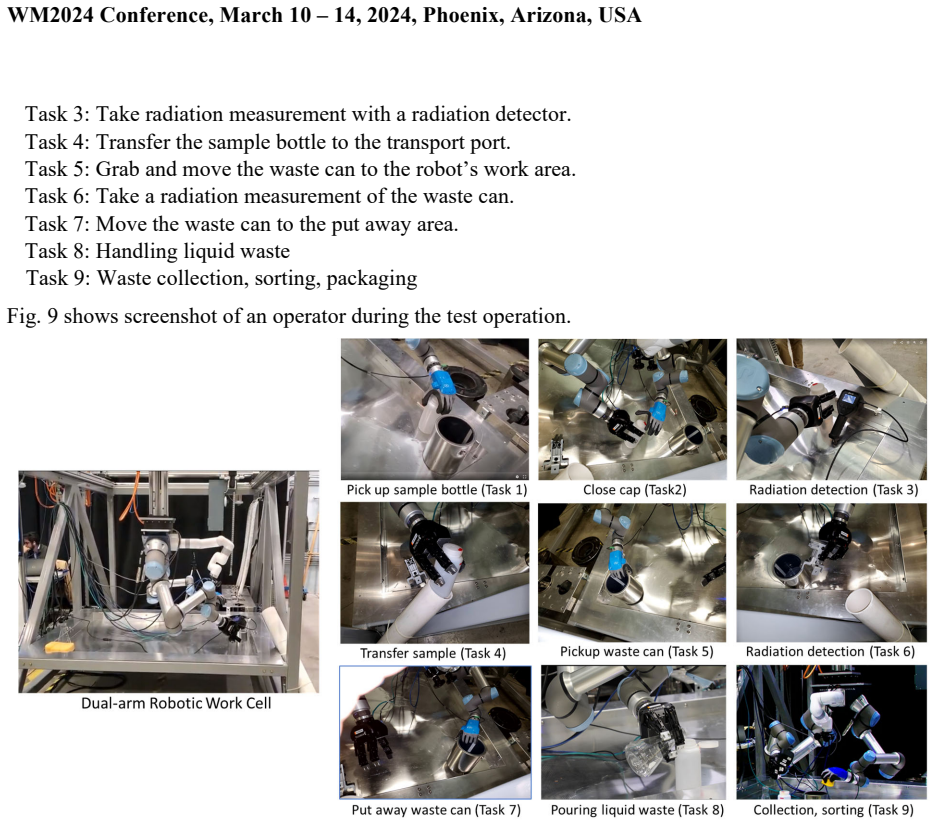
The paper's central claim is that its integrated dual-arm telerobotic platform—a gantry-mounted pair of collaborative robot arms with dexterous hands, a stereo head camera that mirrors the operator's head motion, and a bimanual haptic workstation with a hand-worn haptic glove and head-mounted display—can execute a realistic waste-disposition scenario remotely. In the demonstration the operator completed the full task sequence, including bottle pickup, capping, radiation measurement, transfer to a transport port, handling of a waste can and liquid waste, and final packaging. The authors credit feasible force reflection and two-arm collaboration for the result: contact forces during bottle pickup and while capping were reflected back to the operator through bilateral control, and control parameters were adjusted on the fly to keep the motion stable. When the first attempt to transfer the bottle failed because its orientation was unreachable, the second hand was used to re-grasp and recover, which the authors cite as evidence of the dual-arm system's resilience. The conclusion is that the platform validates practical applicability of telerobotic hot-cell operations for waste disposition.
Load-bearing premise
The demonstration was run in a non-radiation environment, so the conclusion rests on the assumption that radiation will not change the behavior of the off-the-shelf arms, hands, cameras, and electronics enough to break the task, and that surrogate waste motions match real hot-cell operations.
Editorial extensions
If this is right
- A single operator outside the contamination area can perform bimanual tasks that normally require human entry into a hot cell or glovebox.
- The operator's ability to switch between position-force and 4-channel control makes the same hardware usable for both free-motion tasks and contact-heavy tasks like capping.
- Because the arms, hands, cameras, and workstation are largely commercial components, a similar hotbox could be assembled and maintained at cleanup sites without custom hot-cell machinery.
- If the surrogate results transfer, the platform gives workers a way to keep human judgment and tactile feedback in waste-handling decisions while removing the person from radiation exposure.
Reading between the lines
- Beyond the paper: the recovered transfer failure suggests a design principle—dual-arm teleoperation provides a fail-soft recovery mechanism, letting the operator re-grasp with one arm when the other reaches an unreachable pose; quantifying recovery frequency would strengthen this.
- Beyond the paper: a direct test of radiation tolerance is the next bottleneck; the paper reports only a non-radiation surrogate, so a gamma-exposure test of the arms, hands, and cameras at EM-relevant dose rates would tell whether the demonstration transfers.
- Beyond the paper: adding controlled network latency and measuring task completion time and contact-force stability would turn the qualitative success into a performance envelope for the bilateral controller.
- Beyond the paper: the separate remote-handling and dexterous-manipulation mechanisms were not demonstrated in a single integrated workflow, so a combined run would be needed before full deployment.
Editorial analysis
A structured set of objections, weighed in public.
Referee Report
Summary. The paper describes the development and integration of a dual-arm telerobotic platform intended for nuclear waste handling in a portable "hotbox." The remote platform combines two collaborative robot arms (UR5e and UR16e), a dexterous hand (qbSofthand2 or Shadow Dexterous Hand), and a head-tracked stereo camera system, while the operator station uses a Franka-based bimanual haptic device, a haptic glove, and a head-mounted VR display. The software architecture includes admittance control for the remote arm, position-force or 4-channel bilateral teleoperation, and position-force bilateral control for the hand. A non-radiation test operation consisting of nine waste-handling tasks was completed, including bottle capping and radiation-measurement tasks. The abstract and conclusion claim that the results demonstrate system effectiveness and potential applicability in real EM sites.
Significance. If the demonstrated capability is taken as a feasibility result, the paper's value is as a system-integration report: it shows that commercially available collaborative arms, dexterous hands, and haptic devices can be integrated and can complete a surrogate waste-handling scenario under teleoperation. The paper does not introduce new theoretical results or algorithms; its control architectures are drawn from standard references. There are no machine-checked proofs or code releases, and the paper makes no quantitative predictive claims. The main potential contribution is the demonstration of an integrated off-the-shelf-based teleoperation system for a specific nuclear-waste task sequence, provided that the claims are carefully limited to the non-radiation test environment.
major comments (3)
- [Abstract and 'Test Operation'] The abstract and conclusion claim that the test operation demonstrates the system's effectiveness and "potential applicability in real EM sites," but the 'Test Operation' section states that testing was performed "in a non-radiation environment." The paper provides no assessment of radiation tolerance, total ionizing dose, dose rate, or radiation-induced degradation for any of the commercial off-the-shelf components, including the UR5e, UR16e, Franka Research 3, Shadow Dexterous Hand, qbSofthand2, and cameras. Without such evidence, the generalization from a non-radiation surrogate demonstration to real EM hot-cell conditions is unsupported. The authors should either add a radiation-hardness assessment or explicitly restrict the claims to a non-radiation feasibility demonstration.
- [Test Operation and Test Results] No quantitative performance metrics are reported. The results section states only that "it was possible to successfully perform the full sequence of scenario operations," with no completion times, success rates, number of trials, force-tracking errors, position errors, latency values, or statistical validation. In particular, the claims that force reflection was "feasible" and that contact forces were "well handled" are not backed by any recorded force or haptic-feedback data, even though the text says such data were recorded. The "effectiveness" claim in the abstract therefore rests entirely on qualitative observation. Please add at least basic quantitative results, such as task-wise completion times, success/failure counts, and representative force/torque or latency traces, or revise the claims to a proof-of-concept feasibility statement.
- [Robot Arm Control] The admittance-control equation in the 'Robot Arm Control' section is presented with matrices M, B, and K, but the paper does not specify how these parameters were chosen or tuned, nor does it provide stability or transparency analysis for the position-force and 4-channel bilateral teleoperation architectures. Since the central claimed benefit is "feasible force reflection" and stable contact during manipulation, the absence of any stability conditions or experimental performance data makes this claim unverifiable. Please provide parameter values, stability conditions, or experimental data that support stable operation during the contact tasks described in the test operation.
minor comments (6)
- [Robot Arm Control] In the admittance-control equation, the variables M, B, K, and x are not fully defined; please define x as the end-effector pose and M, B, K as the symmetric positive-definite desired inertia, damping, and stiffness matrices.
- [System Overview] The 'digital twin framework' is listed as a key component of the system, but its role, implementation, and any data connections to the control architecture are not described or evaluated anywhere else in the paper; please clarify its role or remove it from the list of key components.
- [References] References [2] and [6] are listed as "Under review" without preprint identifiers; please provide current status, DOIs, or preprint links if available.
- [Test Results] Task 4's initial failure is described qualitatively; if this anecdote is retained, please give the number of attempts or a brief explanation of the recovery procedure so that the resilience claim can be assessed.
- [Test Results / Figure 10] Figure 10 is said to show "some test results," but no quantitative axes, traces, or force plots are described in the text; consider adding data plots that support the qualitative descriptions.
- [Software Architecture] The sentence about the spherical rendering algorithm and latency reduction would benefit from a short explanation of the mechanism and, if available, a measured latency value.
Circularity Check
No circularity: the system-effectiveness claim rests on direct empirical demonstration, not on fitted parameters, derived predictions, or a load-bearing self-citation chain.
full rationale
The paper's derivation chain consists of standard control implementations and a direct empirical test, not a predictive or fitted result. The admittance controller and the position-force/4-channel bilateral teleoperation architectures are cited from established external textbooks and papers (refs. 7–9), and no quantity is fitted from data and then renamed as a prediction. The central claim of effectiveness is supported by the reported scenario execution, which is an observed test outcome rather than a consequence of any equation. The two under-review self-citations by author Lee (refs. 2 and 6) support peripheral design choices such as arm configuration optimization and friction compensation, but they are not used to justify the demonstrated task success, so they are not load-bearing and do not make the argument circular. Finally, the generalization from a non-radiation surrogate test to real EM-site applicability is an evidentiary limitation or correctness concern, not a circularity: it is a missing test condition, not an input secretly reused as an output. No step in the paper reduces by construction to its own inputs.
Assumptions & free parameters
assumptions (4)
- standard math Standard admittance control and bilateral teleoperation stability results (Lawrence 1993; Yokokohji and Yoshikawa 1994) are correct for the implemented system.
- domain assumption Surrogate non-radiation tests are representative of real EM hot cell tasks.
- domain assumption Off-the-shelf collaborative robots and hands will operate reliably in radioactive hot cell environments.
- domain assumption Haptic feedback and head-tracked viewing improve task performance compared to non-haptic teleoperation.
Cite this review
Pith. "Pith review of Dual-Arm Telerobotic Platform for Robotic Hotbox Operations for Nuclear Waste Disposition in EM Sites." pith.science (2026). https://pith.science/paper/5NPVTVQA
@misc{pith2026241113994,
  author       = {Pith},
  title        = {Pith review of: Dual-Arm Telerobotic Platform for Robotic Hotbox Operations for Nuclear Waste Disposition in EM Sites},
  year         = {2026},
  howpublished = {\url{https://pith.science/paper/5NPVTVQA}},
  note         = {Machine review of arXiv:2411.13994}
}
read the original abstract
This paper introduces a dual-arm telerobotic platform designed to efficiently and safely execute hot cell operations for nuclear waste disposition at EM sites. The proposed system consists of a remote robot arm platform and a teleoperator station, both integrated with a software architecture to control the entire system. The dual-arm configuration of the remote platform enhances versatility and task performance in complex and hazardous environments, ensuring precise manipulation and effective handling of nuclear waste materials. The integration of a teleoperator station enables human teleoperator to remotely control the entire system real-time, enhancing decision-making capabilities, situational awareness, and dexterity. The control software plays a crucial role in our system, providing a robust and intuitive interface for the teleoperator. Test operation results demonstrate the system's effectiveness in operating as a remote hotbox for nuclear waste disposition, showcasing its potential applicability in real EM sites.
Figures


Figures from the paper (7 more)



Reference graph
Works this paper leans on
-
[1]
Fishel, J. A., & Loeb, G. E. (2012, June). Sensing tactile microvibrations with the BioTac— Comparison with human sensitivity. In 2012 4t h IEEE RAS & EMBS international conference on biomedical robotics and biomechatronics (BioRob) (pp. 1122-1127). IEEE
work page 2012
-
[2]
Lee, J. K. & Ryu, J. H. (Under review). Optimizing Setup Configuration of a Collaborative Robot Arm- Based Bimanual Haptic Display for Improved Performance. IEEE Robotics and Automation Letters
-
[3]
Schwarz, M., & Behnke, S. (2021, July). Low-latenc y immersive 6D televisualization with spherical rendering. In 2020 IEEE-RAS 20th International C onference on Humanoid Robo ts (Humanoids) (pp. 320-325). IEEE
work page 2021
-
[4]
ROS: an open-source Robot Operating System,
M. Quigley et al., “ROS: an open-source Robot Operating System,” In Int. Conf. Robotics and Automation Workshop on open source software, Vol. 3, No. 3.2, pp. 5, May. 2009
work page 2009
-
[5]
Albu-Schäffer, A., Ott, C., & Hirzinger, G. ( 2007). A unified passivity-based control framework for position, torque and impedance control of flexible joint robots. The interna tional journal of robotics research, 26(1), 23-39. WM2024 Conference, March 10 – 14, 2024, Phoenix, Arizona, USA 9
work page 2007
- [6]
-
[7]
M., & Park, F
Lynch, K. M., & Park, F. C. (2017). 11.7.2 Ad mittance-Control Algorithm. In Modern robotics. Cambridge University Press
2017
-
[8]
Lawrence, D. A. (1993). Stability and transparency in bilateral teleoperation. IEEE transactions on robotics and automation, 9(5), 624-637
1993
Show all 9 references
-
[9]
Yokokohji, Y., & Yoshikawa, T. (1994). Bilateral control of master-slave manipulators for ideal kinesthetic coupling-formulation and experiment. IEEE transactions on robotics and automation, 10(5), 605-620. ACKNOWLEDGEMENTS This work is supported by the U.S. Department of Ener...
1994
Reviewed August 12, 2026 · model on record in the stance chip above.
Discussion (0). Continue with ORCID to comment.