REVIEW 4 major objections 6 minor 45 references
REFOL: Resource-Efficient Federated Online Learning for Traffic Flow Forecasting
T0 review · 4 major / 6 minor · reviewed 2026-08-12 · deepseek-v4-flash
Pith's one-line read REFOL claims that federated traffic-flow forecasting can skip most model updates without losing accuracy by letting each sensor detect concept drift locally, and that this makes online federated learning cheap enough for real traffic nodes.
desk verdict REFOL is a legitimate but incremental extension of FedOSTC whose resource-saving gate is underspecified and whose main table hides the closest baseline. read the letter →
The pith
A machine-rendered reading of the paper's core claim, the machinery that carries it, and where it could break.
The reading
What carries the argument
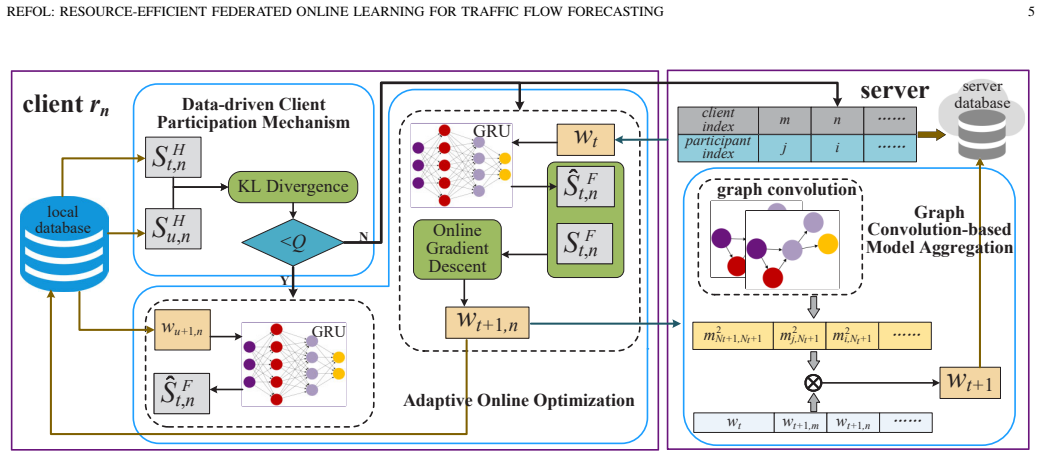
The load-bearing object is the client participation gate: a thresholded Kullback-Leibler divergence $D_{KL}(S^H_{t,n} \| S^H_{u,n})$ between the current and the saved 12-step input windows, compared with a fixed threshold $Q$ (chosen as 0.0003). Below $Q$ the client keeps its locally saved model and contributes nothing to the round; at or above $Q$ it downloads the global model, runs $E$ steps of online gradient descent, and uploads. The second piece is the server-side aggregation, which adds a virtual participant holding the previous global model and applies two layers of symmetric normalized graph convolution $V_t = (D_t^{'-1/2} A_t' D_t^{'-1/2})^2$ to turn participant indegrees into aggregation weights.
What would settle it
On a traffic stream with a gradual ramp in speed distribution (e.g., a construction zone shifting mean speed by 1 km/h per day), compute the 12-step KLD against the saved window and the 1-hour-ahead RMSE; if RMSE grows substantially while KLD stays below Q=0.0003, the gate fails to fire and REFOL's accuracy degrades toward FOL-vanilla. A second check is to rerun REFOL on METR-LA with Q swept from 0 to 0.0006 and compare participation fraction and RMSE against PEMS-BAY to test whether Q transfers between datasets.
Extended reading notes
Core claim
REFOL's central claim is that a data-driven participation gate plus an adaptive online optimizer plus a graph-convolution aggregator jointly guarantee prediction performance in a communication-lightweight, computation-efficient way. On PEMS-BAY it reports RMSE gains over CNFGNN of 45-52% depending on forecast horizon, and it reduces client computational and communication cost by 76.56% and 87.57% relative to FedOSTC on PEMS-BAY (41.76% and 62.52% on METR-LA) while staying within a small RMSE gap of FedOSTC. The method treats concept drift as a per-client, per-round event judged by KLD between the current and saved input windows; only drift-detecting clients upload models, and the server aggregates them through a 2-layer graph convolution that includes a virtual participant carrying the previous global model, so spatial importance is assessed with no extra client transmissions.
Load-bearing premise
The whole resource saving rests on the assumption that a Kullback-Leibler divergence below the fixed threshold Q computed on 12-step windows reliably means the locally saved model is still good and the client has no useful contribution to the spatial aggregation.
Editorial extensions
If this is right
- If correct, REFOL makes federated online learning deployable on resource-constrained traffic nodes, since most clients skip most rounds (28% participation at Q=0.0003) without losing accuracy to offline baselines.
- The approach extends in principle to any spatio-temporal forecasting task with concept drift, such as cellular traffic, weather, or retail, by tuning Q to the desired accuracy-cost trade-off, as the paper itself argues in its discussion.
- The ablation claims both components matter: random selection (REFOL-V1) degrades RMSE by roughly 74% on PEMS-BAY compared with the data-driven gate, and averaging aggregation (REFOL-V2) underperforms the graph-convolution aggregator.
- The KLD check itself is cheap: the paper computes its client-side cost as roughly $H \times 7$ FLOPs per round, negligible next to the forward and backward passes it replaces.
Reading between the lines
- The KLD gate compares only 12-step input windows, so slow or gradual drifts that leave pairwise-window KLD below Q could evade detection even while accumulated prediction error grows; a testable extension is to compare the gate against an error-based drift detector such as DDM.
- The threshold Q=0.0003 is selected on PEMS-BAY, and the paper applies the same value to METR-LA without an ablation there; sweeping Q on METR-LA would show whether the threshold transfers or needs per-dataset tuning.
- The graph-convolution weights reward low-indegree participants because a node influenced by many others is deemed less important; this could systematically underweight hubs that are actually system-critical, an effect the paper does not investigate.
- Since the saved model is only refreshed when drift is flagged, the gate is only as good as the KLD estimate; replacing the heuristic on raw speed values with a proper density-ratio estimate might make the drift criterion more reliable.
Editorial analysis
A structured set of objections, weighed in public.
Referee Report
Summary. The paper proposes REFOL, a federated online learning method for traffic flow forecasting. REFOL combines three components: a data-driven client participation mechanism that uses a Kullback-Leibler divergence threshold to decide whether a client should download the global model and update locally; an adaptive online optimization step (online gradient descent on a GRU predictor) applied only when the client participates; and a graph convolution-based server-side aggregation mechanism that weights participant models using a two-layer graph convolution over a subgraph augmented with a virtual node. Experiments on PEMS-BAY and METR-LA compare REFOL with twelve offline baselines and with two federated online baselines (FedOSTC and FOL-vanilla), reporting RMSE, MAE, MSIS, computational cost, and communication cost. The central claim is that REFOL guarantees prediction performance while substantially reducing communication and computation relative to the existing online method FedOSTC.
Significance. If the empirical claims are confirmed, REFOL is a useful contribution to resource-efficient federated online spatio-temporal forecasting: the idea of letting clients skip participation based on local distribution shift is practically motivated, and the graph-convolution aggregation avoids extra client-side communication. The paper has clear strengths: the source code is released, the ablation study isolates the three components, and the cost analysis is explicit about FLOPs and communication volume. However, the strongest accuracy claim is weakened by the omission of FedOSTC from the main accuracy table, by an underspecified and unvalidated participation gate, and by absent repeated-run statistics. These issues do not invalidate the method's potential, but they need to be addressed before the headline claims can be accepted.
major comments (4)
- [Section V-B, Table II vs. Table III] Table II reports REFOL as the best among the twelve listed baselines, but FedOSTC, the only federated online baseline and the method this paper directly builds on, is omitted from that table. Table III later shows FedOSTC achieving lower RMSE and MAE than REFOL for every forecasting horizon on both datasets (e.g., PEMS-BAY F=12: 1.91 vs. 2.44; METR-LA F=12: 4.98 vs. 5.29). Because the paper's motivation is to improve on the existing FOL method, the phrase “the proposed REFOL performs best among the baselines” is not accurate. Please include FedOSTC in the main accuracy table and either revise the superiority claim or explicitly frame the contribution as a resource–accuracy trade-off relative to FedOSTC.
- [Section IV-A, Algorithm 2, Section V-E] The participation gate is the sole source of the claimed resource savings, yet the divergence D_KL(S_H_{t,n}||S_H_{u,n}) is never defined. The only specification is the FLOP accounting in Section V-C, which implies that two H=12 windows are normalized to probability vectors before applying division, logarithm, and multiplication; with 12 samples this is a high-variance, order-less estimate of distribution shift. In addition, Q=0.0003 is selected by sweeping on PEMS-BAY (Section V-E) with no validation split described, and is then reused on METR-LA without a sensitivity study. Please provide the exact formula, state how zero values are handled, report Q sensitivity on both datasets, and evaluate the gate against an oracle such as whether participation actually reduced the client's subsequent prediction error, reporting false-positive and false-negative rates.
- [Fig. 4(d) and Table II] The text states that on METR-LA 100% of REFOL's absolute errors are smaller than 1, but Table II reports RMSE=3.29 and MAE=3.29 for REFOL at F=1 on METR-LA, which cannot hold if every absolute error is below 1. This is an internal inconsistency between the figure, the text, and the table. Please correct the figure axis, the text, or the table entries and re-verify the corresponding comparison with CNFGNN.
- [Section V-B and Fig. 6] No repeated runs, standard deviations, or confidence intervals are reported for any of the tables, and the critical difference diagram in Fig. 6 is presented without describing the statistical test, the number of runs, or the significance level. Since the paper claims significant superiority over twelve baselines, please report means and variances over multiple seeds and specify the test procedure used to construct the diagram.
minor comments (6)
- [Algorithm 2] The loop on line 10 should read 'for e = 1, ..., E' rather than 'for e ≤ E', and the input list should include the threshold Q, which is used in the condition on line 2 but is not declared as an input.
- [Table II] The last row of Table II contains corrupted glyph sequences (e.g., '/uni00000013/…') that must be repaired before publication.
- [Fig. 2] The labels hwn and fwn in Fig. 2 appear to be rendered as 'A' in several places; please correct the figure so the notation matches Section IV-A.
- [Section V-E] The sentence “the prediction performance of REFOL is consistently superior to that of the baselines, until Q increases to 0.0003” is ambiguous because the set of baselines is not restated in that subsection and FedOSTC is not part of that comparison; please specify which methods are meant.
- [Section V-D] REFOL-D is described as data-driven but performs no server aggregation, so it is a distributed online learning variant rather than a federated one; please clarify this in Table IV to avoid confusion with the data-driven participation mechanism.
- [Section V-E] There is a typo in the phrase 'raw raw traffic flows'; it should read 'raw traffic flows'.
Circularity Check
No significant circularity: REFOL's central claims are empirical outcomes, not by-construction consequences of the fitted KLD threshold.
full rationale
The paper's derivation chain is self-contained rather than circular. The participation decision in Algorithm 2 compares D_KL(S_H_t,n || S_H_u,n) with a threshold Q, but the reported RMSE/MAE are measured prediction errors and the communication/computation costs are counted FLOPs/bytes; neither is defined in terms of the KLD value or Q, so no predicted quantity equals a fitted input by construction (Eqs. 10, 16, 17, 25-27). The graph-convolution aggregation weights (Eqs. 12-16) are computed purely from adjacency, indegree, and outdegree structure, not from prediction errors or from the participation gate, and the ablation REFOL-V2 vs REFOL tests that mechanism against averaging. The only self-citation is [13] (FedOSTC), which is used for motivation and as a cost baseline; it is not invoked as a theorem or used to forbid alternatives. Section V-E's Q sweep on PEMS-BAY is a hyperparameter-selection/overfitting concern rather than circularity, since the RMSE gain is an empirical outcome of the chosen Q, not analytically equal to it. Section VI's stated limitations (e.g., homogeneous client resources) further show the claims are conditional empirical claims, not self-referential definitions. No circular step can be exhibited with an equation-level reduction.
Assumptions & free parameters
free parameters (2)
- KLD threshold Q =
0.0003
- Graph convolution layers =
2
assumptions (3)
- ad hoc to paper KLD divergence between two H-step traffic windows is a valid indicator of concept drift, and KLD < Q implies the saved local model is still competent.
- ad hoc to paper Two-layer graph convolution on the participant subgraph with a virtual node produces aggregation weights that reflect true spatial importance.
- domain assumption All traffic nodes have similar computing and communication resources.
invented entities (1)
-
Virtual participant node r_{I_{t,N+1}}
Cite this review
Pith. "Pith review of REFOL: Resource-Efficient Federated Online Learning for Traffic Flow Forecasting." pith.science (2026). https://pith.science/paper/D2B7FWNI
@misc{pith2026241114046,
  author       = {Pith},
  title        = {Pith review of: REFOL: Resource-Efficient Federated Online Learning for Traffic Flow Forecasting},
  year         = {2026},
  howpublished = {\url{https://pith.science/paper/D2B7FWNI}},
  note         = {Machine review of arXiv:2411.14046}
}
read the original abstract
Multiple federated learning (FL) methods are proposed for traffic flow forecasting (TFF) to avoid heavy-transmission and privacy-leaking concerns resulting from the disclosure of raw data in centralized methods. However, these FL methods adopt offline learning which may yield subpar performance, when concept drift occurs, i.e., distributions of historical and future data vary. Online learning can detect concept drift during model training, thus more applicable to TFF. Nevertheless, the existing federated online learning method for TFF fails to efficiently solve the concept drift problem and causes tremendous computing and communication overhead. Therefore, we propose a novel method named Resource-Efficient Federated Online Learning (REFOL) for TFF, which guarantees prediction performance in a communication-lightweight and computation-efficient way. Specifically, we design a data-driven client participation mechanism to detect the occurrence of concept drift and determine clients' participation necessity. Subsequently, we propose an adaptive online optimization strategy, which guarantees prediction performance and meanwhile avoids meaningless model updates. Then, a graph convolution-based model aggregation mechanism is designed, aiming to assess participants' contribution based on spatial correlation without importing extra communication and computing consumption on clients. Finally, we conduct extensive experiments on real-world datasets to demonstrate the superiority of REFOL in terms of prediction improvement and resource economization.
Figures


Figures from the paper (6 more)


Reference graph
Works this paper leans on
-
[1]
T. Afrin and N. Yodo, “A survey of road traffic congestion measures towards a sustainable and resilient transportation system,” Sustainability, vol. 12, no. 11, p. 4660, 2020
work page 2020
-
[2]
Attention based spatial- temporal graph convolutional networks for traffic flow forecasting,
S. Guo, Y . Lin, N. Feng, C. Song, and H. Wan, “Attention based spatial- temporal graph convolutional networks for traffic flow forecasting,” in Proceedings of the AAAI conference on artificial intelligence , vol. 33, no. 01, 2019, pp. 922–929
2019
-
[3]
A. Miglani and N. Kumar, “Deep learning models for traffic flow prediction in autonomous vehicles: A review, solutions, and challenges,” Vehicular Communications, vol. 20, p. 100184, 2019
work page 2019
-
[4]
F. Zhao, G.-Q. Zeng, and K.-D. Lu, “Enlstm-wpeo: Short-term traf- fic flow prediction by ensemble lstm, nnct weight integration, and population extremal optimization,” IEEE Transactions on Vehicular Technology, vol. 69, no. 1, pp. 101–113, 2020
work page 2020
-
[5]
Urbanfm: Inferring fine-grained urban flows,
Y . Liang, K. Ouyang, L. Jing, S. Ruan, Y . Liu, J. Zhang, D. S. Rosen- blum, and Y . Zheng, “Urbanfm: Inferring fine-grained urban flows,” in Proceedings of the 25th ACM SIGKDD international conference on knowledge discovery & data mining , 2019, pp. 3132–3142
work page 2019
-
[6]
Gman: A graph multi-attention network for traffic prediction,
C. Zheng, X. Fan, C. Wang, and J. Qi, “Gman: A graph multi-attention network for traffic prediction,” in Proceedings of the AAAI conference on artificial intelligence , vol. 34, no. 01, 2020, pp. 1234–1241
2020
-
[7]
Federated machine learning: Concept and applications,
Q. Yang, Y . Liu, T. Chen, and Y . Tong, “Federated machine learning: Concept and applications,” ACM Transactions on Intelligent Systems and Technology (TIST), vol. 10, no. 2, pp. 1–19, 2019
2019
-
[8]
Privacy-preserving traffic flow prediction: A federated learning approach,
Y . Liu, J. James, J. Kang, D. Niyato, and S. Zhang, “Privacy-preserving traffic flow prediction: A federated learning approach,” IEEE Internet of Things Journal, vol. 7, no. 8, pp. 7751–7763, 2020
work page 2020
Show all 45 references
-
[9]
Fastgnn: A topological information protected federated learning approach for traffic speed fore- casting,
C. Zhang, S. Zhang, J. James, and S. Yu, “Fastgnn: A topological information protected federated learning approach for traffic speed fore- casting,” IEEE Transactions on Industrial Informatics , vol. 17, no. 12, pp. 8464–8474, 2021
2021
-
[10]
Cross-node federated graph neural network for spatio-temporal data modeling,
C. Meng, S. Rambhatla, and Y . Liu, “Cross-node federated graph neural network for spatio-temporal data modeling,” in Proceedings of the 27th ACM SIGKDD Conference on Knowledge Discovery & Data Mining , 2021, pp. 1202–1211. REFOL: RESOURCE-EFFICIENT FEDERATED ONLINE LEARNING F...
2021
-
[11]
Learning under concept drift: A review,
J. Lu, A. Liu, F. Dong, F. Gu, J. Gama, and G. Zhang, “Learning under concept drift: A review,” IEEE transactions on knowledge and data engineering, vol. 31, no. 12, pp. 2346–2363, 2018
2018
-
[12]
Online learning: A compre- hensive survey,
S. C. Hoi, D. Sahoo, J. Lu, and P. Zhao, “Online learning: A compre- hensive survey,” Neurocomputing, vol. 459, pp. 249–289, 2021
2021
-
[13]
Online spatio-temporal correlation-based federated learning for traffic flow forecasting,
Q. Liu, S. Sun, M. Liu, Y . Wang, and B. Gao, “Online spatio-temporal correlation-based federated learning for traffic flow forecasting,” IEEE Transactions on Intelligent Transportation Systems , vol. 25, no. 10, pp. 13 027–13 039, 2024
2024
-
[14]
Time series analysis,
W. W. Wei, “Time series analysis,” in The Oxford Handbook of Quan- titative Methods in Psychology: Vol. 2 , 2006
2006
-
[15]
Combining kohonen maps with arima time series models to forecast traffic flow,
M. Van Der V oort, M. Dougherty, and S. Watson, “Combining kohonen maps with arima time series models to forecast traffic flow,” Trans- portation Research Part C: Emerging Technologies , vol. 4, no. 5, pp. 307–318, 1996
1996
-
[16]
Application of subset autoregressive in- tegrated moving average model for short-term freeway traffic volume forecasting,
S. Lee and D. B. Fambro, “Application of subset autoregressive in- tegrated moving average model for short-term freeway traffic volume forecasting,” Transportation research record, vol. 1678, no. 1, pp. 179– 188, 1999
1999
-
[17]
Traffic flow prediction using lstm with feature enhancement,
B. Yang, S. Sun, J. Li, X. Lin, and Y . Tian, “Traffic flow prediction using lstm with feature enhancement,” Neurocomputing, vol. 332, pp. 320–327, 2019
2019
-
[18]
Short-term traffic flow prediction method for urban road sections based on space–time analysis and gru,
G. Dai, C. Ma, and X. Xu, “Short-term traffic flow prediction method for urban road sections based on space–time analysis and gru,” IEEE Access, vol. 7, pp. 143 025–143 035, 2019
2019
-
[19]
Ssgru: A novel hybrid stacked gru- based traffic volume prediction approach in a road network,
P. Sun, A. Boukerche, and Y . Tao, “Ssgru: A novel hybrid stacked gru- based traffic volume prediction approach in a road network,” Computer Communications, vol. 160, pp. 502–511, 2020
2020
-
[20]
A short-term traffic speed prediction model based on lstm networks,
Y .-L. Hsueh and Y .-R. Yang, “A short-term traffic speed prediction model based on lstm networks,” International journal of intelligent transportation systems research, vol. 19, no. 3, pp. 510–524, 2021
2021
-
[21]
Diffusion convolutional recurrent neural network: Data-driven traffic forecasting,
Y . Li, R. Yu, C. Shahabi, and Y . Liu, “Diffusion convolutional recurrent neural network: Data-driven traffic forecasting,” in International Conference on Learning Representations , 2018. [Online]. Available: https://openreview.net/forum?id=SJiHXGW AZ
2018
-
[22]
Personalized federated learning for cross-city traffic prediction,
Y . Zhang, H. Lu, N. Liu, Y . Xu, Q. Li, and L. Cui, “Personalized federated learning for cross-city traffic prediction,” in 33rd International Joint Conference on Artificial Intelligence, IJCAI 2024 . International Joint Conferences on Artificial Intelligence, 2024, pp. 5526–5534
2024
-
[23]
Short-term traffic flow prediction based on graph convolutional networks and federated learning,
M. Xia, D. Jin, and J. Chen, “Short-term traffic flow prediction based on graph convolutional networks and federated learning,” IEEE Trans- actions on Intelligent Transportation Systems , 2022
2022
-
[24]
Multilevel federated learning-based intelligent traffic flow forecasting for transportation network management,
L. Liu, Y . Tian, C. Chakraborty, J. Feng, Q. Pei, L. Zhen, and K. Yu, “Multilevel federated learning-based intelligent traffic flow forecasting for transportation network management,” IEEE Transactions on Network and Service Management , vol. 20, no. 2, pp. 1446–1458, 2023
2023
-
[25]
Stfl: A spatial-temporal federated learning framework for graph neural networks,
G. Lou, Y . Liu, T. Zhang, and X. Zheng, “Stfl: A spatial-temporal federated learning framework for graph neural networks,” in AAAI Conference on Artificial Intelligence Workshop on Deep Learning on Graphs: Methods and Applications , 2022
2022
-
[26]
Fedstn: Graph representation driven federated learning for edge computing enabled urban traffic flow prediction,
X. Yuan, J. Chen, J. Yang, N. Zhang, T. Yang, T. Han, and A. Taherko- rdi, “Fedstn: Graph representation driven federated learning for edge computing enabled urban traffic flow prediction,” IEEE Transactions on Intelligent Transportation Systems, 2022
2022
-
[27]
Fedgtp: Exploiting inter-client spatial dependency in federated graph- based traffic prediction,
L. Yang, W. Chen, X. He, S. Wei, Y . Xu, Z. Zhou, and Y . Tong, “Fedgtp: Exploiting inter-client spatial dependency in federated graph- based traffic prediction,” in Proceedings of the 30th ACM SIGKDD Conference on Knowledge Discovery and Data Mining, 2024, pp. 6105– 6116
2024
-
[28]
A concept drift-tolerant case-base editing technique,
N. Lu, J. Lu, G. Zhang, and R. L. De Mantaras, “A concept drift-tolerant case-base editing technique,” Artificial Intelligence, vol. 230, pp. 108– 133, 2016
2016
-
[29]
Detecting change in data streams,
D. Kifer, S. Ben-David, and J. Gehrke, “Detecting change in data streams,” in VLDB, vol. 4. Toronto, Canada, 2004, pp. 180–191
2004
-
[30]
Concept drift detection based on equal density estimation,
F. Gu, G. Zhang, J. Lu, and C.-T. Lin, “Concept drift detection based on equal density estimation,” in 2016 International Joint Conference on Neural Networks (IJCNN) . IEEE, 2016, pp. 24–30
2016
-
[31]
An incremental change detection test based on density difference estimation,
L. Bu, D. Zhao, and C. Alippi, “An incremental change detection test based on density difference estimation,” IEEE Transactions on Systems, Man, and Cybernetics: Systems , vol. 47, no. 10, pp. 2714–2726, 2017
2017
-
[32]
Learning with drift detection,
J. Gama, P. Medas, G. Castillo, and P. Rodrigues, “Learning with drift detection,” in Advances in Artificial Intelligence–SBIA 2004: 17th Brazilian Symposium on Artificial Intelligence, Sao Luis, Maranhao, Brazil, September 29-Ocotber 1, 2004. Proceedings 17. Springer, 2004, p...
2004
-
[33]
Early drift detection method,
M. Baena-Garcıa, J. del Campo- ´Avila, R. Fidalgo, A. Bifet, R. Gavalda, and R. Morales-Bueno, “Early drift detection method,” in Fourth inter- national workshop on knowledge discovery from data streams , vol. 6. Citeseer, 2006, pp. 77–86
2006
-
[34]
Detecting concept drift using statistical testing,
K. Nishida and K. Yamauchi, “Detecting concept drift using statistical testing,” in Discovery science, vol. 4755. Springer, 2007, pp. 264–269
2007
-
[35]
Communication-efficient learning of deep networks from decentralized data,
B. McMahan, E. Moore, D. Ramage, S. Hampson, and B. A. y Arcas, “Communication-efficient learning of deep networks from decentralized data,” in Artificial intelligence and statistics . PMLR, 2017, pp. 1273– 1282
2017
-
[36]
Kullback-leibler divergence,
J. M. Joyce, “Kullback-leibler divergence,” in International encyclopedia of statistical science . Springer, 2011, pp. 720–722
2011
-
[37]
Learning phrase representations using RNN encoder–decoder for statistical machine translation,
K. Cho, B. van Merri ¨enboer, C. Gulcehre, D. Bahdanau, F. Bougares, H. Schwenk, and Y . Bengio, “Learning phrase representations using RNN encoder–decoder for statistical machine translation,” in Proceed- ings of the 2014 Conference on Empirical Methods in Natural Language Pr...
2014
-
[38]
Semi-supervised classification with graph convolutional networks,
T. N. Kipf and M. Welling, “Semi-supervised classification with graph convolutional networks,” in International Conference on Learning Rep- resentations, 2017, 2017
2017
-
[39]
Svm-based models for predicting wlan traffic,
H. Feng, Y . Shu, S. Wang, and M. Ma, “Svm-based models for predicting wlan traffic,” in 2006 IEEE international conference on communications, vol. 2. IEEE, 2006, pp. 597–602
2006
-
[40]
Spatio-temporal graph convolutional networks: a deep learning framework for traffic forecasting,
B. Yu, H. Yin, and Z. Zhu, “Spatio-temporal graph convolutional networks: a deep learning framework for traffic forecasting,” in 27th International Joint Conference on Artificial Intelligence, IJCAI 2018 , 2018, pp. 3634–3640
2018
-
[41]
Spatio-temporal meta-graph learning for traffic forecasting,
R. Jiang, Z. Wang, J. Yong, P. Jeph, Q. Chen, Y . Kobayashi, X. Song, S. Fukushima, and T. Suzumura, “Spatio-temporal meta-graph learning for traffic forecasting,” in Proceedings of the AAAI conference on artificial intelligence, vol. 37, no. 7, 2023, pp. 8078–8086
2023
-
[42]
Strictly proper scoring rules, prediction, and estimation,
T. Gneiting and A. E. Raftery, “Strictly proper scoring rules, prediction, and estimation,” Journal of the American statistical Association , vol. 102, no. 477, pp. 359–378, 2007
2007
-
[43]
Generalizing the theta method for automatic forecasting,
E. Spiliotis, V . Assimakopoulos, and S. Makridakis, “Generalizing the theta method for automatic forecasting,” European Journal of Operational Research , vol. 284, no. 2, pp. 550–558, 2020. [Online]. Available: https://www.sciencedirect.com/science/article/pii/ S0377221720300242
2020
-
[44]
Pruning convolutional neural networks for resource efficient inference,
P. Molchanov, S. Tyree, T. Karras, T. Aila, and J. Kautz, “Pruning convolutional neural networks for resource efficient inference,” in 5th International Conference on Learning Representations, ICLR 2017- Conference Track Proceedings, 2019
2017
-
[45]
What’s the backward-forward flop ratio for neural networks?
M. Hobbhahn and J. Sevilla, “What’s the backward-forward flop ratio for neural networks?” 2021, accessed: 2023-4-18. [Online]. Available: https://epochai.org/blog/backward-forward-FLOP-ratio REFOL: RESOURCE-EFFICIENT FEDERATED ONLINE LEARNING FOR TRAFFIC FLOW FORECASTING 16 Qi...
2021
Reviewed August 12, 2026 · model on record in the stance chip above.
Discussion (0). Continue with ORCID to comment.