REVIEW 5 major objections 6 minor 1 cited by
Meaning at the Planck scale? Contextualized word embeddings for doing history, philosophy, and sociology of science
T0 review · 5 major / 6 minor · reviewed 2026-08-12 · deepseek-v4-flash
Pith's one-line read Domain-adapted BERT models map how 'Planck' changed meaning in physics texts.
desk verdict A clear and useful HPSS methods experiment whose headline model-comparison claims are undercut by in-sample prototype evaluation and corpus overlap, while the diachronic Planck-mission result is solid and interesting. read the letter →
The pith
A machine-rendered reading of the paper's core claim, the machinery that carries it, and where it could break.
The reading
What carries the argument
The central object is the contextualized word embedding (CWE): a vector for a single occurrence of a word produced by averaging the last four hidden layers of a BERT-style transformer. The paper combines three operations on these vectors, cosine similarity between occurrences, prototypical embeddings averaged over labeled groups, and K-means clustering, to perform word sense disambiguation, word sense induction, and lexical semantic change analysis. A novel purity indicator based on the coefficient of variation of label distributions within clusters measures how well each clustering separates known senses.
What would settle it
Have two or more independent annotators label the same 'Planck' occurrences and compute inter-annotator agreement; if agreement is low, or if a non-contextual baseline such as static word2vec embeddings or bag-of-words classifiers matches the domain-adapted BERT scores on sense prediction, the claim that contextualized, domain-adapted embeddings are necessary for this kind of HPSS analysis would be undercut.
Extended reading notes
Core claim
The central claim is that contextualized word embeddings from BERT provide a practical, transferable method for studying how scientific concepts acquire and change meanings. On the test term 'Planck', domain-adapted models (SciBERT, astroBERT, PhysBERT, and the author's Astro-HEP-BERT) beat the general-purpose BERT baseline in supervised sense prediction, unsupervised sense clustering, and cluster quality; Astro-HEP-BERT reaches parity with or exceeds from-scratch domain models despite being a cheaper continue-pretraining adaptation. Applied to over 300,000 unlabeled occurrences in the Astro-HEP Corpus, the embeddings show the Planck mission sense overtaking Planck units as the dominant meaning around 2012 to 2013, while the two semantic-change indicators spike in 1997 and 2013, matching the mission's renaming and public data releases.
Load-bearing premise
The entire evaluation rests on a single researcher's manual annotation of 2,900 plus 1,186 occurrences of 'Planck' into 21 sense labels, with no second annotator to confirm the labels; if those labels are inconsistent or incomplete, every performance comparison inherits that error.
Editorial extensions
If this is right
- Domain-adapted BERT models can automatically disambiguate and induce the senses of scientific terms, reducing the need for manual close reading in large corpora.
- The method transfers to other scientific concepts, because it requires only a small labeled set and an off-the-shelf model adapted with continue-pretraining.
- Lexical semantic change indicators JSD and CDPT align with known historical milestones, suggesting embeddings can date when a new meaning becomes dominant.
- Astro-HEP-BERT demonstrates that reusing general-purpose pretrained weights is a cost-effective alternative to training a domain model from scratch.
- The two labeled 'Planck' corpora provide reusable evaluation datasets for future computational studies of scientific language.
Reading between the lines
- The success on 'Planck' suggests the same pipeline could detect paradigm shifts or 'trading zone' borrowings in other polysemous scientific terms, though the paper does not test that extension.
- Because the sense labels come from a single annotator, the reported F-1 and purity scores should be treated as provisional; an independent second annotation set could change the model ranking.
- A direct comparison against non-contextual embeddings such as word2vec would clarify whether the contextual component or the domain adaptation is doing the heavy lifting in these tasks.
- The diachronic analysis assumes sense clusters remain stable over time; allowing clusters to split or merge across years might yield a different picture of how the mission sense emerged.
Editorial analysis
A structured set of objections, weighed in public.
Referee Report
Summary. The paper proposes contextualized word embeddings (CWEs) as a scalable tool for the history, philosophy, and sociology of science (HPSS), using the term "Planck" as a test case. It compares five BERT-based models (BERT, SciBERT, astroBERT, PhysBERT, and the author's Astro-HEP-BERT) on supervised word sense prediction, unsupervised clustering purity, cluster separation/cohesion, and lexical semantic change. The central claim is that domain-adapted models outperform general-purpose models in disambiguating and clustering senses of "Planck," and that domain-adapted CWEs can track the emergence of the Planck mission sense over time.
Significance. If the empirical claims were established, this would be a valuable contribution to computational HPSS, offering a reusable pipeline and releasing two labeled corpora and a domain-adapted model. The diachronic finding that the Planck mission sense rose to dominance in the 2010s is plausible and historically meaningful. However, the current evaluation design undermines the comparative model-ranking claim, so the paper's significance is conditional on a re-analysis with proper held-out evaluation and leakage checks. The author's effort to release data and models is a clear strength that should be credited regardless of the revisions.
major comments (5)
- [§5] The 1NN sense prediction in Section 5 is an in-sample evaluation: the sense prototypes are computed by averaging the CWEs of all labeled "Planck" occurrences (second paragraph of Section 5), and the F-1 scores are then computed on those same labeled occurrences. Each test vector is therefore a component of its own correct prototype, which mechanically inflates nearest-prototype accuracy. Since this evaluation is the primary evidence for the abstract's claim that domain-adapted models outperform general-purpose ones, the claim is not established by the reported F-1 scores; a held-out split or leave-one-out evaluation is required.
- [§3–§4] Astro-HEP-BERT was further pretrained on the Astro-HEP Corpus (Section 4), and the Astro-HEP-Planck Corpus is a sample of paragraphs from that same Astro-HEP Corpus (Section 3). The paper does not report any de-duplication or exclusion of evaluation paragraphs (or near-duplicates) from the continued pretraining data. Consequently, the superior F-1 and purity scores of Astro-HEP-BERT on the Astro-HEP-Planck Corpus might reflect memorized or highly similar paragraphs rather than better sense disambiguation. The author should check for overlap between the labeled paragraphs and the pretraining data, and ideally retrain the model with the evaluation paragraphs held out.
- [§3] The ground-truth labels for both corpora were created by a single researcher with no inter-annotator agreement or adjudication (Section 3, paragraph 2). Because every quantitative result in Sections 5–8 is computed against these labels, any inconsistency or noise in the annotation scheme (21 predefined labels, with very low-frequency labels such as PERSON in the Astro-HEP-Planck Corpus) propagates into all F-1, purity, JSD, and CDPT values. The paper should provide an annotation guideline, report agreement on a sample of doubly-annotated occurrences, and discuss how borderline cases are handled.
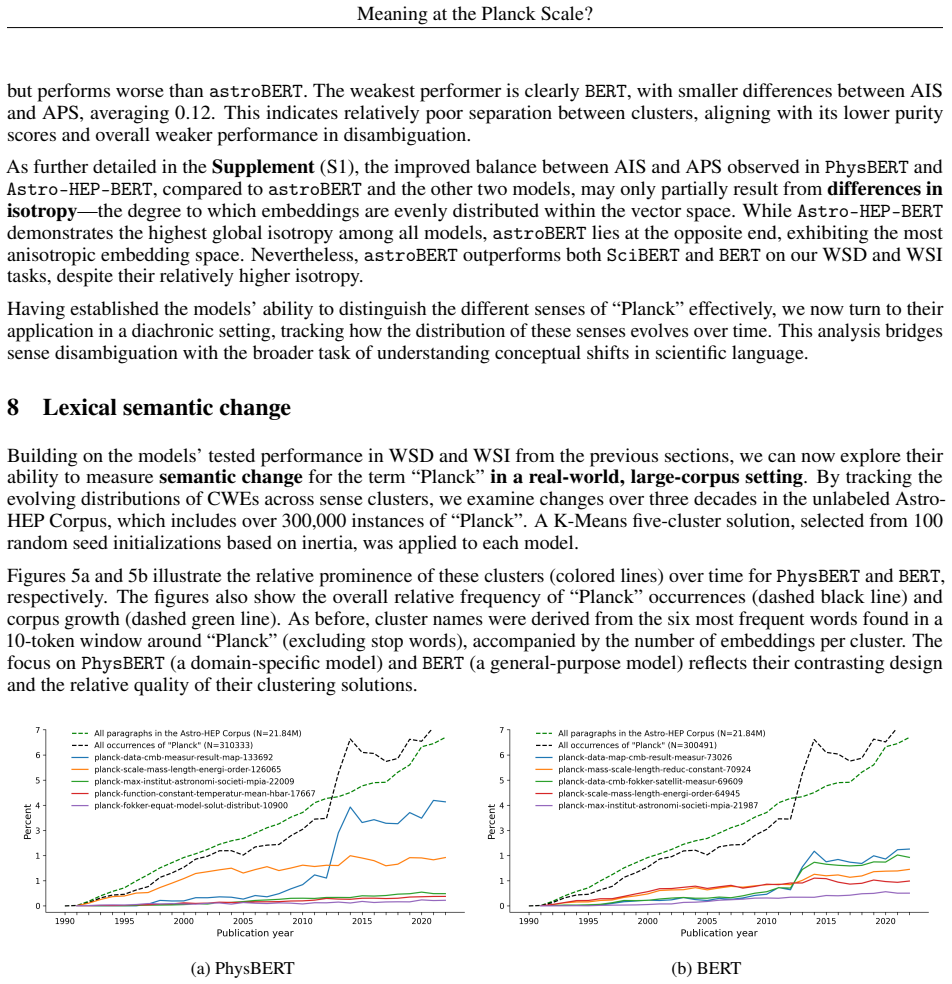
- [§8] The diachronic analysis in Section 8 is presented primarily through the qualitative interpretability of PhysBERT's and BERT's five-cluster solutions (Figure 5), and the claim that domain-specific models show 'greater sensitivity' to semantic change is not backed by quantitative comparisons across all five models in the text. Although Figure 6 appears to plot JSD and CDPT for each model, no numerical values, statistical tests, or separate figures are provided to substantiate the relative-sensitivity claim. This weakens the conclusion that domain adaptation improves lexical semantic change tracking.
- [§6] The 'novel purity indicator' introduced in Section 6 is used as the sole measure of cluster quality for the WSI comparison, but the paper does not validate it against standard metrics (e.g., cluster purity, adjusted Rand index, normalized mutual information) or on synthetic data with known cluster structure. Without such validation, it is difficult to assess whether the reported differences (e.g., Astro-HEP-BERT above 0.95 vs BERT at 0.92) are meaningful or an artifact of the metric's dependence on label frequency distributions.
minor comments (6)
- [§2] In the paragraph on domain adaptation, 'they have found to underperform' should be 'they have been found to underperform.'
- [§4] In the Astro-HEP-BERT description, 'using on my Astro-HEP Corpus' should be 'using my Astro-HEP Corpus.'
- [References] The reference to Simons (2024) gives an empty arXiv identifier; please provide the full citation or a working URL.
- [Figure 2 caption] The caption says 'two to six labels in the Astro-HEP-Planck Corpus' but the surrounding text mentions subsets with up to seven labels; please make the range descriptions consistent.
- [Table 1] The PERSON label has only 4 occurrences in the Astro-HEP-Planck Corpus; consider reporting results with and without such rare labels to assess robustness.
- [Supplement S1] The isotropy analysis in the supplement is clearly presented and adds useful context; consider moving a brief summary of it into the main text, since Section 7 relies on it.
Circularity Check
In-sample prototype evaluation and pretraining overlap with the evaluation corpus compromise the central domain-adaptation comparison.
-
fitted input called prediction
[Section 5, Word sense prediction using sense prototypes]
"For each corpus, the sense prototypes are generated by averaging the CWEs of all labeled “Planck” occurrences corresponding to each sense."
The 1NN classifier is evaluated on the same labeled occurrences used to build the prototypes: each test vector is a component of its own correct prototype. A vector's cosine similarity to its own prototype is inflated by self-membership, especially for small classes such as PERSON (n=4) and LAW (n=52) in the Astro-HEP-Planck Corpus, so the reported weighted F-1 scores are in-sample fits rather than independent predictions. The headline claim that domain-adapted models “outperform ... in disambiguating the target term” therefore rests on a comparison in which the prediction target is partly built into the predictor.
-
fitted input called prediction
[Sections 3-4, Datasets and labels and Models]
"For this analysis, I compiled two labeled datasets: (1) the Astro-HEP-Planck Corpus, consisting of 2,900 labeled occurrences of “Planck” sampled from 1,500 paragraphs in the Astro-HEP Corpus ... I reused BERT’s learned linguistic patterns and vocabulary and retrained the model for three additional epochs using on my Astro-HEP Corpus."
Astro-HEP-BERT's additional pretraining corpus is the Astro-HEP Corpus, and the Astro-HEP-Planck evaluation set is explicitly a sample of paragraphs from that same corpus. No de-duplication or exclusion of the 1,500 evaluation paragraphs is reported, so the model saw the evaluation texts, albeit unlabeled, during continued pretraining. Its higher F-1 and purity scores on the Astro-HEP-Planck Corpus may therefore reflect memorization of those paragraphs rather than superior sense disambiguation, making the domain-adaptation advantage partly an artifact of training/evaluation overlap.
full rationale
The main WSD evaluation is circular in its evaluation design: sense prototypes are averages of exactly the labeled occurrences being scored, so the reported F-1 values are in-sample and partly reflect self-similarity rather than predictive skill. Independently, Astro-HEP-BERT was further pretrained on the same Astro-HEP Corpus from which the Astro-HEP-Planck evaluation paragraphs were sampled, with no exclusion reported, so the model's advantage on that corpus may be inflated by memorization. These two issues bear directly on the paper's strongest claim that domain-adapted models outperform general-purpose ones in disambiguating Planck. The qualitative diachronic alignment with mission milestones and the cluster-cohesion analysis are separate, non-circular evidence, and the paper does not rely on a self-citation chain or imported uniqueness theorem; therefore the circularity is partial rather than total.
Assumptions & free parameters
free parameters (2)
- Number of clusters k in K-means =
2 to 7 for WSI subsets; 5 for LSC
- Label subset cutoffs =
2 to 7 most frequent labels
assumptions (4)
- domain assumption The 21 predefined sense labels are exhaustive and mutually exclusive for occurrences of 'Planck' in the corpora.
- domain assumption Manual annotations by a single researcher are correct and reproducible.
- domain assumption Average of the final four hidden BERT layers yields a suitable word embedding for semantic tasks.
- domain assumption Cosine similarity and K-means on CWEs reflect semantic relatedness in the way humans would label senses.
Cite this review
Pith. "Pith review of Meaning at the Planck scale? Contextualized word embeddings for doing history, philosophy, and sociology of science." pith.science (2026). https://pith.science/paper/7WLMWCCO
@misc{pith2026241114073,
  author       = {Pith},
  title        = {Pith review of: Meaning at the Planck scale? Contextualized word embeddings for doing history, philosophy, and sociology of science},
  year         = {2026},
  howpublished = {\url{https://pith.science/paper/7WLMWCCO}},
  note         = {Machine review of arXiv:2411.14073}
}
read the original abstract
This paper explores the potential of contextualized word embeddings (CWEs) as a new tool in the history, philosophy, and sociology of science (HPSS) for studying contextual and evolving meanings of scientific concepts. Using the term "Planck" as a test case, I evaluate five BERT-based models with varying degrees of domain-specific pretraining, including my custom model Astro-HEP-BERT, trained on the Astro-HEP Corpus, a dataset containing 21.84 million paragraphs from 600,000 articles in astrophysics and high-energy physics. For this analysis, I compiled two labeled datasets: (1) the Astro-HEP-Planck Corpus, consisting of 2,900 labeled occurrences of "Planck" sampled from 1,500 paragraphs in the Astro-HEP Corpus, and (2) a physics-related Wikipedia dataset comprising 1,186 labeled occurrences of "Planck" across 885 paragraphs. Results demonstrate that the domain-adapted models outperform the general-purpose ones in disambiguating the target term, predicting its known meanings, and generating high-quality sense clusters, as measured by a novel purity indicator I developed. Additionally, this approach reveals semantic shifts in the target term over three decades in the unlabeled Astro-HEP Corpus, highlighting the emergence of the Planck space mission as a dominant sense. The study underscores the importance of domain-specific pretraining for analyzing scientific language and demonstrates the cost-effectiveness of adapting pretrained models for HPSS research. By offering a scalable and transferable method for modeling the meanings of scientific concepts, CWEs open up new avenues for investigating the socio-historical dynamics of scientific discourses.
Figures


Figures from the paper (3 more)


Forward citations
Cited by 1 Pith paper
-
Astro-HEP-BERT: A bidirectional language model for studying the meanings of concepts in astrophysics and high energy physics
This paper introduces Astro-HEP-BERT, a BERT model adapted to astrophysics and high-energy physics text, plus a large arXiv-based corpus, as a low-cost tool for studying conceptual change in science.
Reference graph
Works this paper leans on
-
[1]
Ait-Saada, M. and Nadif, M. (2023). Is anisotropy truly harmful? a case study on text clustering. In Rogers, A., Boyd-Graber, J., and Okazaki, N., editors, Proceedings of the 61st Annual Meeting of the Association for Computational Linguistics (Volume 2: Short Papers) , pages 1194--1203. Association for Computational Linguistics
work page 2023
-
[2]
Beltagy, I., Lo, K., and Cohan, A. (2019). SciBERT : A pretrained language model for scientific text. arXiv :1903.10676
arXiv 2019
-
[3]
Bevilacqua, M., Pasini, T., Raganato, A., and Navigli, R. (2021). Recent trends in word sense disambiguation: A survey. In Proceedings of the Thirtieth International Joint Conference on Artificial Intelligence , pages 4330--4338
work page 2021
-
[4]
Biś, D., Podkorytov, M., and Liu, X. (2021). Too much in common: Shifting of embeddings in transformer language models and its implications. In Toutanova, K., Rumshisky, A., Zettlemoyer, L., Hakkani-Tur, D., Beltagy, I., Bethard, S., Cotterell, R., Chakraborty, T., and Zhou, Y., editors, Proceedings of the 2021 Conference of the North American Chapter of ...
work page 2021
- [5]
-
[6]
Bowker, G. C. and Star, S. L. (1999). Sorting things out: classification and its consequences . MIT Press
work page 1999
-
[7]
Boyack, K. W., Newman, D., Duhon, R. J., Klavans, R., Patek, M., Biberstine, J. R., Schijvenaars, B., Skupin, A., Ma, N., and Börner, K. (2011). Clustering more than two million biomedical publications: Comparing the accuracies of nine text-based similarity approaches. PloS one , 6(3):e18029
work page 2011
-
[8]
Cai, X., Huang, J., Bian, Y., and Church, K. (2020). Isotropy in the contextual embedding space: Clusters and manifolds. In International conference on learning representations
work page 2020
Show all 64 references
-
[9]
A., and Bauin, S
Callon, M., Courtial, J.-P., Turner, W. A., and Bauin, S. (1983). From translations to problematic networks: An introduction to co-word analysis. Social Science Information , 22(2):191 --235
1983
-
[10]
Canguilhem, G. (1991). The Normal and the Pathological . MIT Press
1991
-
[11]
Chang, H. (2007). Inventing Temperature: Measurement and Scientific Progress . Oxford University Press
2007
-
[12]
E., Mamo, L., Fosket, J
Clarke, A. E., Mamo, L., Fosket, J. R., Fishman, J. R., and Shim, J. K., editors (2010). Biomedicalization: Technoscience , Health , and Illness in the U . S . Duke University Press
2010
-
[13]
and Law, J
Courtial, J.-P. and Law, J. (1989). A co-word study of artificial intelligence. Social Studies of Science , 19(2):301 --311
1989
-
[14]
and Galison, P
Daston, L. and Galison, P. (2007). Objectivity . Zone Books
2007
-
[15]
T., Furnas, G
Deerwester, S., Dumals, S. T., Furnas, G. W., Landauer, K., T., and Harshman, R. (1990). Indexing by latent semantic analysis. Journal of the American Society for Information Science , 41(6):391--407
1990
-
[16]
Devlin, J., Chang, M.-W., Lee, K., and Toutanova, K. (2018). BERT : Pre-training of deep bidirectional transformers for language understanding. arXiv :1810.04805
2018 arXiv
-
[17]
Ding, Y., Martinkus, K., Pascual, D., Clematide, S., and Wattenhofer, R. (2022). On isotropy calibration of transformer models. In Tafreshi, S., Sedoc, J., Rogers, A., Drozd, A., Rumshisky, A., and Akula, A., editors, Proceedings of the Third Workshop on Insights from Negative...
2022
-
[18]
Ethayarajh, K. (2019). How contextual are contextualized word representations? comparing the geometry of BERT , ELMo , and GPT -2 embeddings. arXiv :1909.00512
2019 arXiv
-
[19]
Fleck, L. (1979). Genesis and development of a scientific fact . University of Chicago Press
1979
-
[20]
Foucault, M. (1970). The Order of Things: An Archaeology of Human Sciences . Random House
1970
-
[21]
Galison, P. (1997). Image and Logic: A Material Culture of Microphysics . Univ of Chicago Pr, illustrated edition edition
1997
-
[22]
Gläser, J., Laudel, G., Grieser, C., and Meyer, U. (2018). Scientific fields as epistemic regimes: new opportunities for comparative science studies. TUTS Working Papers, 3-2018
2018
-
[23]
Godey, N., de la Clergerie, E., and Sagot, B. (2023). Is anisotropy inherent to transformers? arXiv :2306.07656
2023 arXiv
-
[24]
J., Shapurian, G., Henneken, E., Grant, C
Grezes, F., Allen, T., Blanco-Cuaresma, S., Accomazzi, A., Kurtz, M. J., Shapurian, G., Henneken, E., Grant, C. S., Thompson, D. M., Hostetler, T. W., Templeton, M. R., Lockhart, K. E., Chen, S., Koch, J., Jacovich, T., and Protopapas, P. (2022). Improving astroBERT using sema...
2022 arXiv
-
[25]
J., Shapurian, G., Henneken, E., Grant, C
Grezes, F., Blanco-Cuaresma, S., Accomazzi, A., Kurtz, M. J., Shapurian, G., Henneken, E., Grant, C. S., Thompson, D. M., Chyla, R., McDonald , S., Hostetler, T. W., Templeton, M. R., Lockhart, K. E., Martinovic, N., Chen, S., Tanner, C., and Protopapas, P. (2021). Building as...
2021 arXiv
-
[26]
Gu, Y., Tinn, R., Cheng, H., Lucas, M., Usuyama, N., Liu, X., Naumann, T., Gao, J., and Poon, H. (2021). Domain-specific language model pretraining for biomedical natural language processing. ACM Transactions on Computing for Healthcare ( HEALTH ) , 3(1):1--23
2021
-
[27]
Hacking, I. (1975). The emergence of probability: A philosophical study of early ideas about probability, induction and statistical inference . Cambridge University Press
1975
-
[28]
Hacking, I. (1999). The Social Construction of What? Harvard University Press
1999
-
[29]
Hellert, T., Montenegro, J., and Pollastro, A. (2024). PhysBERT : A Text Embedding Model for Physics Scientific Literature . arXiv :2408.09574
2024 arXiv
-
[30]
Kleymann, R., Niekler, A., and Burghardt, M. (2022). Conceptual forays: A corpus-based study of “theory” in digital humanities journals. Journal of Cultural Analytics , 7(4)
2022
-
[31]
Kuhn, T. S. (1962). The structure of scientific revolutions . University of Chicago Press
1962
-
[32]
Kuhn, T. S. (2022). The Last Writings of Thomas S. Kuhn: Incommensurability in Science . University of Chicago Press
2022
-
[33]
Latour, B. (1987). Science in action: How to follow scientists and engineers through society . Harvard University Press
1987
-
[34]
D., Maienschein, J., and Renn, J
Laubichler, M. D., Maienschein, J., and Renn, J. (2019). Computational history of knowledge: Challenges and opportunities. Isis , 110(3):502--512
2019
-
[35]
M., Rivelli, L., and Pence, C
Lean, O. M., Rivelli, L., and Pence, C. H. (2023). Digital literature analysis for empirical philosophy of science. The British Journal for the Philosophy of Science , 74(4):875--898
2023
-
[36]
H., and Kang, J
Lee, J., Yoon, W., Kim, S., Kim, D., Kim, S., So, C. H., and Kang, J. (2019). BioBERT : a pre-trained biomedical language representation model for biomedical text mining. arXiv :1901.08746
2019 arXiv
-
[37]
and Rafols, I
Leydesdorff, L. and Rafols, I. (2009). A global map of science based on the ISI subject categories. Journal of the American Society for Information Science and Technology , 60(2):348--362
2009
-
[38]
Liu, Y., Ott, M., Goyal, N., Du, J., Joshi, M., Chen, D., Levy, O., Lewis, M., Zettlemoyer, L., and Stoyanov, V. (2019). RoBERTa : A robustly optimized BERT pretraining approach. arXiv :1907.11692
2019 arXiv
-
[39]
N., White, I
Loureiro, D., D'Souza, A., Muhajab, A. N., White, I. A., Wong, G., Anke, L. E., Neves, L., Barbieri, F., and Camacho-Collados, J. (2022). TempoWiC : An evaluation benchmark for detecting meaning shift in social media. arXiv :2209.07216
2022 arXiv
-
[40]
T., and Camacho-Collados, J
Loureiro, D., Rezaee, K., Pilehvar, M. T., and Camacho-Collados, J. (2020). Language models and word sense disambiguation: An overview and analysis. arXiv :2008.11608
2020 arXiv
-
[41]
and Léonard, M
Malaterre, C. and Léonard, M. (2024). Epistemic markers in the scientific discourse. Philosophy of Science , 91(1):151--174
2024
-
[42]
Merchant, C. (1980). The Death of Nature: Women, Ecology, and the Scientific Revolution . Harper & Row
1980
-
[43]
Mickus, T., Grönroos, S.-A., and Attieh, J. (2024). Isotropy, clusters, and classifiers. arXiv :2402.03191
2024 arXiv
-
[44]
Mikolov, T., Chen, K., Corrado, G., and Dean, J. (2013). Efficient estimation of word representations in vector space. arXiv :1301.3781
2013 arXiv
-
[45]
Mol, A. (2002). The Body Multiple: Ontology in Medical Practice . Duke University Press
2002
-
[46]
Mu, J., Bhat, S., and Viswanath, P. (2018). All-but-the-top: Simple and effective postprocessing for word representations. arXiv :1702.01417
2018 arXiv
-
[47]
Overton, J. A. (2013). “explain” in scientific discourse. Synthese , 190(8):1383--1405
2013
-
[48]
Pence, C. H. and Ramsey, G. (2018). How to do digital philosophy of science. Philosophy of Science , 85(5):930--941
2018
-
[49]
and Montanelli, S
Periti, F. and Montanelli, S. (2024). Lexical semantic change through large language models: a survey. ACM Computing Surveys , 56(11):282:1--282:38
2024
-
[50]
Pickering, A. (1995). The Mangle of Practice: Time, Agency, and Science . University of Chicago Press
1995
-
[51]
Pilehvar, M. T. and Camacho-Collados, J. (2019). WiC : the word-in-context dataset for evaluating context-sensitive meaning representations. In Burstein, J., Doran, C., and Solorio, T., editors, Proceedings of the 2019 Conference of the North American Chapter of the Associatio...
2019
-
[52]
and Gurevych, I
Reimers, N. and Gurevych, I. (2019). Sentence- BERT : Sentence embeddings using siamese BERT -networks. arXiv :1908.10084
2019 arXiv
-
[53]
and Courtial, J
Rip, A. and Courtial, J. P. (1984). Co-word maps of biotechnology: An example of cognitive scientometrics. Scientometrics , 6(6):381--400
1984
-
[54]
Simons, A. (2024). Astro-hep-bert: A bidirectional language model for studying the meanings of concepts in astrophysics and high energy physics. arXiv :
2024
-
[55]
Steinle, F. (2016). Exploratory Experiments: Ampère, Faraday, and the Origins of Electrodynamics . University of Pittsburgh Press
2016
-
[56]
and Platos, J
Sun, Y. and Platos, J. (2023). A method for constructing word sense embeddings based on word sense induction. Scientific Reports , 13(1):12945
2023
-
[57]
and Dubossarsky, H
Tahmasebi, N. and Dubossarsky, H. (2023). Computational modeling of semantic change. arXiv :2304.06337
2023 arXiv
-
[58]
Teich, E., Fankhauser, P., Degaetano-Ortlieb, S., and Bizzoni, Y. (2021). Less is more/more diverse: On the communicative utility of linguistic conventionalization. Frontiers in Communication , 5
2021
-
[59]
Venturini, T., Baya Laffite, N., Cointet, J.-P., Gray, I., Zabban, V., and De Pryck, K. (2014). Three maps and three misunderstandings: A digital mapping of climate diplomacy. Big Data & Society , 1(2)
2014
-
[60]
Wang, L., Huang, J., Huang, K., Hu, Z., Wang, G., and Gu, Q. (2020). Improving neural language generation with spectrum control. In Proceedings of the International Conference on Learning Representations 2020
2020
-
[61]
and Koolen, M
Wevers, M. and Koolen, M. (2020). Digital begriffsgeschichte: Tracing semantic change using word embeddings. Historical Methods: A Journal of Quantitative and Interdisciplinary History , 53(4):226--243
2020
-
[62]
Wiedemann, G., Remus, S., Chawla, A., and Biemann, C. (2019). Does BERT make any sense? interpretable word sense disambiguation with contextualized embeddings. arXiv :1909.10430
2019 arXiv
-
[63]
Yin, S., Fu, C., Zhao, S., Li, K., Sun, X., Xu, T., and Chen, E. (2024). A survey on multimodal large language models. arXiv :2306.13549
2024 arXiv
-
[64]
and Wüthrich, A
Zichert, M. and Wüthrich, A. (2024). Tracing the development of the virtual particle concept using semantic change detection. arXiv :2410.16855
2024 arXiv
Reviewed August 12, 2026 · model on record in the stance chip above.
Discussion (0). Continue with ORCID to comment.