REVIEW 2 major objections 4 minor 17 references
Photon drag at the junction between metal and 2d semiconductor
T0 review · 2 major / 4 minor · reviewed 2026-08-12 · deepseek-v4-flash
Pith's one-line read A metal contact to a 2D semiconductor converts incident light into a photon-drag photovoltage whose p-polarized response survives as the sheet conductivity tends to zero.
desk verdict Clean theory paper with a genuinely new prediction of strong junction photon drag in 2D materials; the main open question is whether nonlocal corrections near the metal edge change the headline numbers. read the letter →
The pith
A machine-rendered reading of the paper's core claim, the machinery that carries it, and where it could break.
The reading
What carries the argument
The calculation is carried by three ingredients: (i) the wave-mean-force expression $f_{pd}=\langle\rho E\rangle+c^{-1}\langle j\times B\rangle$, which after time-averaging and using the continuity equation and the local Ohm's law $j_\omega(x)=\sigma_\omega(x)E_\omega(x)$ becomes $\frac{2}{\omega}\mathrm{Im}\{\sigma_\omega[\partial_x E_x E_x^*-\partial_x E_y^*E_y]\}$; (ii) the exact Wiener-Hopf diffraction spectra for the local fields, Eqs. (14) and (16), obtained from factorized 2D dielectric functions $\varepsilon_p(q)=1+\eta\sqrt{k_0^2-q^2}/k_0$ and $\varepsilon_s(q)=1+\eta k_0/\sqrt{k_0^2-q^2}$; and (iii) the momentum balance plus thermal balance equations that separate the photon-drag voltage from the thermoelectric voltage. The singular behavior enters through the edge field $E_x(0)=E_0/\sqrt{\eta(1+\eta)}$, which keeps $\eta|E_x|^2$ finite as $\eta\to0$, and through the long-range $e^{ik_0x}/\sqrt{x}$ cylindrical wave whose logarithmic divergence in the drag integral is cut off at distance $\sim\lambda_0/\eta$.
What would settle it
A direct check: measure the zero-bias photovoltage at a metal-graphene junction under focused p-polarized terahertz illumination while a back gate tunes the sheet density and hence $\eta$ over at least a decade. The theory predicts a response that tracks $1/n_{2d}$ with $\alpha_x\simeq0.45$ essentially independent of $\eta$; observation of a strong $\eta$-dependent deviation, or of an $\alpha_x$ that vanishes with $\eta$, would rule out the local-field drag mechanism described here. For s-polarization, the signature is the superlinear $\alpha_y\propto \eta\ln(1/\eta)$ growth, which should be absent if nonlocal corrections dominate.
Extended reading notes
Core claim
At a straight interface between a perfect metal and a 2D electron system, the open-circuit photovoltage from photon drag is $V_{pd}=-(2/\omega e n_{2d})\int_0^\infty \mathrm{Im}\{\sigma_\omega[\partial_x E_x E_x^*-\partial_x E_y^* E_y]\}\,dx$, and for normal incidence the responsivity factorizes into a universal $1/(\omega e n_{2d})$ prefactor times the sum of momentum-transfer coefficients $\alpha_x+\alpha_y$. The $p$-polarized coefficient stays nonzero in the zero-conductivity limit because the singular edge field concentrates the drag force in a narrow region of width $\sim\eta\lambda_0$; the $s$-polarized coefficient is dominated by the long cylindrical wave emitted by the half-plane and scales as $\eta\ln(1/\eta)$. The same expression shows that the ordinary bulk photon drag is smaller by a factor $\eta' k_x L$, so the junction effect removes both conventional smallness parameters: photon momentum and low absorbance.
Load-bearing premise
The derivation assumes that the current at each point responds locally to the electric field, $j_\omega(x)=\sigma_\omega(x)E_\omega(x)$; near the contact for small $\eta$ the field changes over a length $\sim\eta\lambda_0$, which can be shorter than the electron mean free path or screening length, so nonlocal spatial-dispersion corrections could shift the value of $\alpha_x$ and the predicted scaling.
Editorial extensions
If this is right
- At terahertz frequencies, junction photon drag can dominate the hot-carrier thermoelectric response for $p$-polarized light whenever $\omega\tau_\varepsilon\gtrsim1$, which is typical for wavelengths of about 30 $\mu$m and shorter.
- For $s$-polarized light the photovoltage is essentially pure photon drag, since the thermoelectric contribution at the edge is small and $\alpha_y$ remains positive.
- The responsivity contains no factor of photon momentum or small absorbance: the prefactor $2/(\omega e n_{2d})$ alone gives tens of $\mu$V cm$^2$/W at 1 THz and $n_{2d}=10^{11}$ cm$^{-2}$.
- The theory applies to any 2D conductor describable by a local dynamic conductivity, including graphene, semiconductor quantum wells, and transition-metal dichalcogenides.
- Plasmonic resonances do not resonantly enhance the drag: the plasmon quality factor multiplies the dissipative conductivity, so the momentum-transfer coefficients remain smooth across the complex-$\eta$ plane.
Reading between the lines
- Editorial inference: because the drag force is proportional to $\mathrm{Im}\,\sigma_\omega$ and the field profile is set by both $\eta'$ and $\eta''$, measuring the photovoltage with focused light at both polarizations gives separate access to the real and imaginary parts of the sheet conductivity without patterning a separate antenna.
- Editorial inference: the same mechanism should contribute to the DC photoresponse of contacted 2D detectors usually fitted by plasma-wave or hot-carrier rectification, so polarization-resolved contact-illumination measurements could isolate this contact drag from those channels.
- Editorial inference: the local-Ohm's-law assumption can be relaxed by replacing $\sigma_\omega(x)$ with a nonlocal conductivity kernel; since the $p$-polarized drag is generated within $\sim\eta\lambda_0$ of the edge, the first nonlocal corrections are expected when this length becomes comparable to the electron mean free path or screening length.
Editorial analysis
A structured set of objections, weighed in public.
Referee Report
Summary. The manuscript develops a theory of photon drag at the junction between a metal and a two-dimensional electron system (2DES). The authors combine exact Wiener-Hopf diffraction spectra for the local electromagnetic fields at a metal-2DES edge with a microscopic transport-theory expression for the ponderomotive force on the 2D carriers. Their central result, Eq. (18), is a photovoltage responsivity r_pd = -2/(omega e n_2d)(alpha_x + alpha_y), where the dimensionless momentum-transfer coefficients alpha_i depend only on the normalized 2D conductivity eta = 2*pi*sigma/c and on polarization. For p-polarized light, alpha_x approaches a finite constant (~0.45) as eta -> 0, which the authors attribute to the dynamic lightning-rod field singularity at the edge; for s-polarized light, alpha_y scales as eta ln(1/eta), arising from a long-range cylindrical wave emitted by the metal half-plane. The paper also compares the junction photon drag with the contact thermoelectric effect, concluding that for p-polarization the ratio is set by omega*tau_epsilon and for s-polarization photon drag dominates.
Significance. If the central prediction is correct, the paper identifies a qualitatively new route to terahertz photodetection: junction photon drag is not suppressed by the small free-photon momentum or by the small absorbance of typical 2D materials, and it can exceed the thermoelectric response in common contact geometries. The derivation from the ponderomotive force, Eqs. (3)-(13), is clean and internally consistent, and the use of parameter-free Wiener-Hopf diffraction spectra from Refs. 33 and 34, with no fitted parameters, is a genuine strength. The two scaling laws (alpha_x -> const and alpha_y ~ eta ln eta^{-1}) are falsifiable predictions that can be tested in photocurrent-mapping experiments. However, the universality of these predictions rests on assumptions whose breakdown scales are not quantified, in particular the locality of the Ohm's law in the singular near-edge region and the treatment of the logarithmic divergence in the s-polarization channel.
major comments (2)
- [Section II.A and Eq. (21)] The locality assumption j_omega(x) = sigma_omega(x) E_omega(x) is load-bearing for the p-polarization result. The text states that for small eta the p-polarized field diverges at the edge as E_x(0) ~ E_0/sqrt(eta(1+eta)) and varies over a length l ~ eta*lambda_0. For eta ~ 10^-2 (graphene at THz frequencies) and lambda_0 = 30-100 micrometers, l is roughly 0.3-1 micrometer, which is comparable to or shorter than the electron mean free path in high-mobility 2D systems at low temperature. In this regime a q-dependent conductivity sigma(q,omega) modifies both the field profile and the integral in Eq. (19), so the numerical value alpha_x ~ 0.45 and its claimed eta -> 0 limit are not established. The manuscript acknowledges the locality assumption but provides no estimate of the breakdown scale. Please quantify the nonlocal correction, for example by comparing q ~ 1/l with the inverse mean free path, or clearly state the parameter regime in which the universal value of alpha_x is expected to hold.
- [Section III, s-polarization scaling paragraph] The claim that alpha_y depends only on eta and polarization is complicated by the logarithmic divergence described for s-polarization. The text states that the integral (19) diverges logarithmically at large distances and is cut off by finite absorption in the 2DES at L ~ lambda_0/eta, but this cutoff is not derived. In a finite sample of length L_sd < lambda_0/eta, the coefficient will depend on ln(L_sd/lambda_0) or on the actual absorption length, so the abstract's statement that the momentum-transfer coefficient depends only on eta and polarization is not universal. A finite-length expression for alpha_y(L_sd), or an explicit statement that the scaling requires L_sd >> lambda_0/eta, is needed to make the s-polarization prediction usable for experiments.
minor comments (4)
- [Section II.B] In the sentence introducing Eqs. (12)-(13), "Demoting the Seebeck coefficient" should read "Denoting the Seebeck coefficient".
- [Section III] The word "superliner" should be "superlinear" in the discussion of the s-polarization scaling.
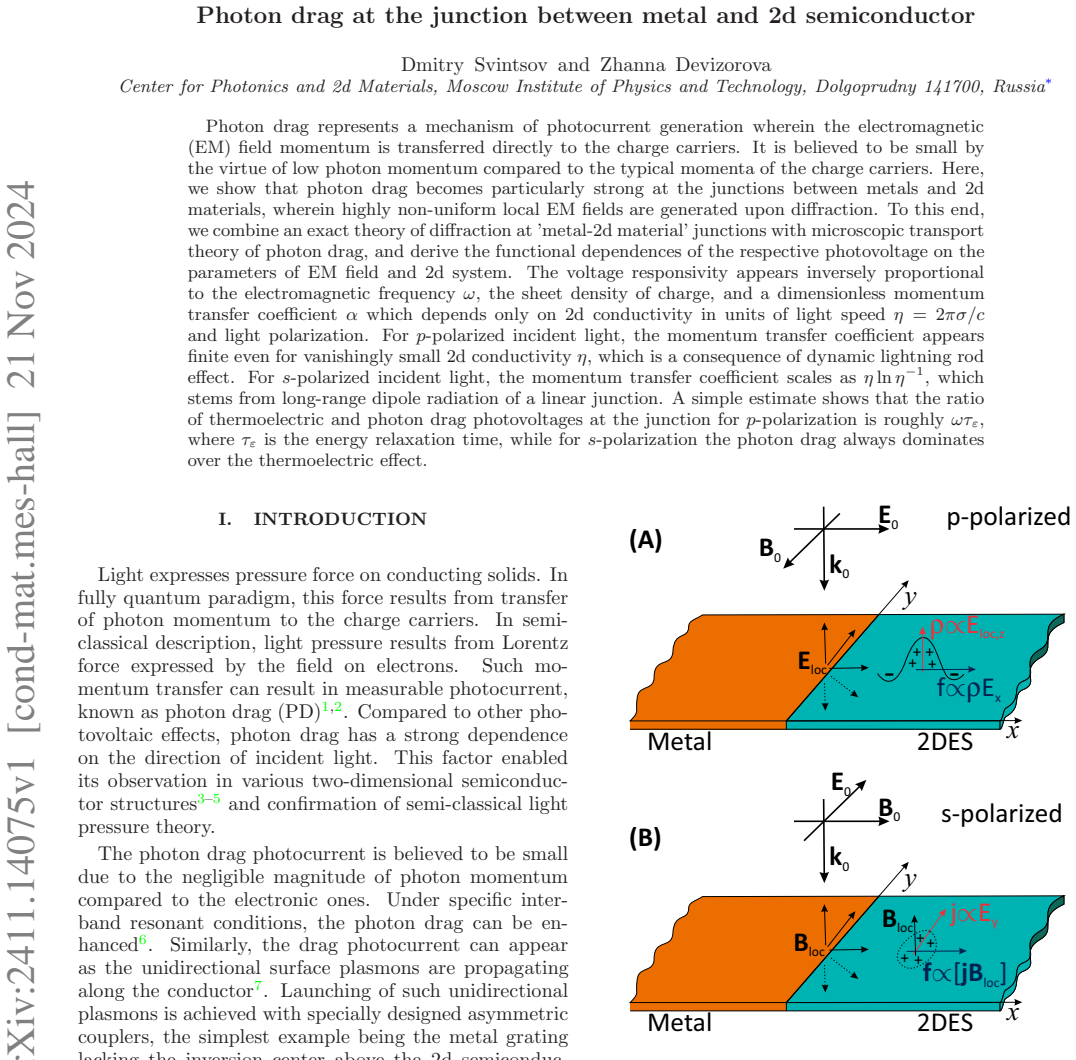
- [Fig. 1 caption] The second bullet in the caption describes the s-polarized case (E0 parallel to the junction), but the text labels it as "For p-polarized incident wave"; this should be corrected to s-polarized.
- [Eq. (21)] Equation (21) as typeset appears as E_x(0) = E_0 sqrt(eta(1+eta)), which contradicts the surrounding text stating that the field diverges as eta -> 0. The intended expression is presumably E_x(0) = E_0 / sqrt(eta(1+eta)); the typesetting should be corrected.
Circularity Check
No circular derivation: the central α(η) scalings are computed from parameter-free Wiener-Hopf field spectra; only a mild same-group citation is present.
full rationale
The paper's central claim—r_pd = -2/(ω e n2d)(αx+αy) with αx tending to a finite constant and αy ∝ η ln(1/η) at small η—is obtained by substituting the Fourier spectra of the local fields, Eqs. (14) and (16), into the independently derived momentum-transfer integral, Eq. (19). No parameter is fitted to the target quantity; αi is computed from the field solution, not defined into existence by the claimed result. The field spectra are quoted from Refs. 33 and 34, which are by the same group, but those are exact Wiener-Hopf solutions of Maxwell's equations for a step junction with local conductivity; their assumptions (local Ohm's law, stepwise carrier density) do not include the value of α, and the solutions are parameter-free and externally checkable. The photovoltage formula also overlaps with Ref. 11, but that is a prior independent result by other authors and is explicitly generalized to confined 2DES. The only substantive caveat is the locality assumption j=σE near the singular edge, stated in Sec. II.A, which is a correctness risk about nonlocal corrections rather than a circular step. Thus no load-bearing input reduces to the output by construction; the score of 2 reflects the mild same-author citation of the diffraction solution, not an actual circular reduction.
Assumptions & free parameters
assumptions (5)
- domain assumption Locality of the current-field relation j_ω(x)=σ_ω(x)E_ω(x), i.e., no spatial dispersion.
- domain assumption Truncation of the second-order distribution function to angular harmonics 0 and 1; the stress tensor reduces to scalar pressure.
- domain assumption Open-circuit condition with a perfect metallic contact (n(x<0)→∞) and photovoltage detected between the contact and the 2DES bulk.
- domain assumption The exact diffraction field spectra (14) and (16) from Refs. 33,34 describe the local fields at a sharp metal-2DES junction.
- domain assumption Thermal balance with local energy relaxation time τε, Eq. (8), for estimating the thermoelectric photovoltage.
Cite this review
Pith. "Pith review of Photon drag at the junction between metal and 2d semiconductor." pith.science (2026). https://pith.science/paper/7RCFURNB
@misc{pith2026241114075,
  author       = {Pith},
  title        = {Pith review of: Photon drag at the junction between metal and 2d semiconductor},
  year         = {2026},
  howpublished = {\url{https://pith.science/paper/7RCFURNB}},
  note         = {Machine review of arXiv:2411.14075}
}
abstract
Photon drag represents a mechanism of photocurrent generation wherein the electromagnetic (EM) field momentum is transferred directly to the charge carriers. It is believed to be small by the virtue of low photon momentum compared to the typical momenta of the charge carriers. Here, we show that photon drag becomes particularly strong at the junctions between metals and 2d materials, wherein highly non-uniform local EM fields are generated upon diffraction. To this end, we combine an exact theory of diffraction at 'metal-2d material' junctions with microscopic transport theory of photon drag, and derive the functional dependences of the respective photovoltage on the parameters of EM field and 2d system. The voltage responsivity appears inversely proportional to the electromagnetic frequency $\omega$, the sheet density of charge, and a dimensionless momentum transfer coefficient $\alpha$ which depends only on 2d conductivity in units of light speed $\eta = 2\pi \sigma/c$ and light polarization. For $p$-polarized incident light, the momentum transfer coefficient appears finite even for vanishingly small 2d conductivity $\eta$, which is a consequence of dynamic lightning rod effect. For $s$-polarized incident light, the momentum transfer coefficient scales as $\eta \ln \eta^{-1}$, which stems from long-range dipole radiation of a linear junction. A simple estimate shows that the ratio of thermoelectric and photon drag photovoltages at the junction for $p$-polarization is roughly $\omega\tau_\varepsilon$, where $\tau_\varepsilon$ is the energy relaxation time, while for $s$-polarization the photon drag always dominates over the thermoelectric effect.
Figures


Reference graph
Works this paper leans on
-
[1]
1 (A)], electromagnetic diffraction gives rise to the local z-component of electric field
For p-polarized incident wave [ B0 is directed along the junction, Fig. 1 (A)], electromagnetic diffraction gives rise to the local z-component of electric field. This components induces the charge density ρ(t) ∝ Ez via the dynamic field ef- fect. The x-component of the field drags the induces charges longitudinally, which results in photocurrent. For p-polar...
-
[4]
are relevant to the p- and s-polarizations of the incident wave, respectively. We consider the most practical case of monochromatic waves, E(t) = Eω e−iωt + h .c., and similarly for other time-dependent quantities. The charge and current den- sities in that case can be expressed with continuity equa- tion and Ohm’s law: −iωρω + (∇, jω ) = 0 , jω = σω Eω ,...
-
[5]
we find, after some simplifications: fpd = 2 ω Im σω {( ∇‖ Eω ) E∗‖ ω − [E‖ ω × [∇×E∗ ω ]] } . (3) The superscript ‖ implies taking only the x and y com- ponents of the respective vector, it stems from the two- dimensional character of the current density. Further simplifications are possible if all fields do not depend on 3 the coordinate y along the junctio...
-
[6]
Similarly, the drag photocurrent can appear as the unidirectional surface plasmons are propagating along the conductor
-
[7]
Launching of such unidirectional plasmons is achieved with specially designed asymmetric couplers, the simplest example being the metal grating lacking the inversion center above the 2d semiconduc- tor 8,9. Such photocurrent is often marked as ’plasmon drag’10, though the underlying electromagnetic forces are the same as in photon drag. Taking a detailed ...
-
[8]
has no limits of applicability, it can become useful for the evaluation of photocurrent if only the functional forms of momentum vector Pi and stress tensor Π (2) ij are specified. At this stage, we assume that all angular harmonics of the second-order dc distribution function, except for the zeroth and the first ones, are damped. This occurs either for str...
-
[11]
to the field E ∝ eikxx, we find r(0) pd = − 2 ωen2d η′(kxL) |Ex|2 + |Ey|2 |E0|2 ∼ η′(kxL)rpd. (27) We observe that ’ordinary’ photon drag differs from the ’junction drag’ by factors of η′ (absorbance factor) and kxLsd (light momentum factor). The former is well below unity for graphene and most quantum wells. The latter is below unity for sub-wavelength devi...
-
[13]
for photon drag photovoltage supple- mented by expressions of the local electric fields ( 14,16) form the necessary building blocks for numerical evalua- tions. The results can be cast in a transparent form by introducing the photovoltage responsivity of the junction per incident light intensity rpd = VpdZ0/(2E2 0), where Z0 = 4π/c is the free-space impeda...
Show all 17 references
-
[14]
7 All our consideration was based on assumption that the photovoltage at an individual metal contact (say, source) can be isolated from the photovoltage at the drain
and ( 12) combined with simulations of local electric fields. 7 All our consideration was based on assumption that the photovoltage at an individual metal contact (say, source) can be isolated from the photovoltage at the drain. It means that the incident radiation should be fo...
-
[16]
We attempted to formulate the theory in terms of high- frequency 2d conductivity σω , independent of its micro- scopic nature
The resulting ’con- tact drag photovoltage’ does not contain typical small- ness parameters associated with low photon momentum and low absorbance by (most) two-dimensional systems. We attempted to formulate the theory in terms of high- frequency 2d conductivity σω , independe...
-
[17]
( A1) is possible
Alternatively, a direct numerical evaluation us- ing Eq. ( A1) is possible. When dealing with q-values on the real axis (which is sufficient for all calculations), we rewrite Eq. A1 as: ε± (q) = √ ε(q)× exp ± +∞∫ 0 ln ε (q + v) − ln ε (q − v) 2πiv dv . (A4) The conven...
1970 arXiv
-
[19]
This results in αx = |Epl|2 |E0|2 { Reη × Qpl − Imη 2 } , (23) where Qpl = Reqp pl/Imqp pl is the quality factor of 2D plas- mons
and evaluating the respective momentum transfer coefficient. This results in αx = |Epl|2 |E0|2 { Reη × Qpl − Imη 2 } , (23) where Qpl = Reqp pl/Imqp pl is the quality factor of 2D plas- mons. The above simple calculation explains that plas- monic Q-factor (benefiting from low dis...
-
[21]
(25) As the momentum transfer coefficient αx ∼ 1, we observe that the only parameter governing the ratio of PTE and PD photovoltages is ωτε
for local field, and assuming real conductivity, we find rpte = 2τε en2d = ωτε αx rpd. (25) As the momentum transfer coefficient αx ∼ 1, we observe that the only parameter governing the ratio of PTE and PD photovoltages is ωτε. The energy relaxation time τε varies between hundreds...
-
[33]
The difference in effective dielectric functions in s- and p- polarizations results in different plasmon dispersion laws
In the Fourier space, they can be seen as sin- gularities of E(q) appearing provided ε(q) = 0. The difference in effective dielectric functions in s- and p- polarizations results in different plasmon dispersion laws. For p-polarization the plasmons exist for inductive 2DES conduc...
-
[42]
In the far infrared range ( λ0 = 10 µm), we estimate ωτε ≫ 1 even for the shortest energy relaxation time τε = 0.1 ps
Therefore, the junction photon drag can readily exceed the thermoelectric effect, at least at terahertz fre- quencies. In the far infrared range ( λ0 = 10 µm), we estimate ωτε ≫ 1 even for the shortest energy relaxation time τε = 0.1 ps. More accurate estimates of thermoelectri...
-
[43]
Relative polarity of carriers in the screening layer and in the 2DES bulk affects the photo- electric effects
In the simplest approximation, the metal-induced carrier den- sity can be considered as constant in the screening layer of length lj ∼ 100 nm. Relative polarity of carriers in the screening layer and in the 2DES bulk affects the photo- electric effects. Dissimilar doping ( p − n...
-
[44]
Evaluation of photo- voltages in this realistic situation can be based on general expressions (
Reviewed August 12, 2026 · model on record in the stance chip above.
Discussion (0). Continue with ORCID to comment.