REVIEW 3 major objections 6 minor 46 references
Path-Tracking Hybrid A* and Hierarchical MPC Framework for Autonomous Agricultural Vehicles
T0 review · 3 major / 6 minor · reviewed 2026-08-12 · deepseek-v4-flash
Pith's one-line read A path-tracking Hybrid A* planner plus a two-stage MPC keeps agricultural vehicles tight to furrow lines and collision-free, with 100% tracking success on 713 real-farm reference paths in simulation.
desk verdict A solid but overclaimed paper: the deviation-aware Hybrid A* is a real contribution, yet the safety guarantees rest on a weak baseline and an unproved small-error assumption in the MPC collision constraint. read the letter →
The pith
A machine-rendered reading of the paper's core claim, the machinery that carries it, and where it could break.
The reading
What carries the argument
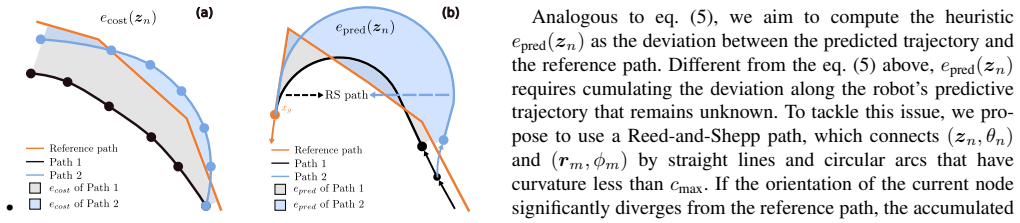
The central mechanism is the Path-Tracking Hybrid A* search with evaluation function $f(z_n)=\alpha\,e_{\mathrm{cost}}(z_n)+\beta\,e_{\mathrm{pred}}(z_n)+\gamma\,h(z_n)$, where $e_{\mathrm{cost}}$ accumulates $\mathrm{dis}(z_i,R)\|z_i-z_{i-1}\|$ over the generated trajectory as an area-like deviation measure, $e_{\mathrm{pred}}$ accumulates the same deviation along a Reeds-Shepp path from the current node to the goal, and $h$ sums traveled and predicted path lengths. The search uses motion primitives that are straight lines and circular arcs with curvature at most $\tan(\delta_m)/L$, so curvature constraints are satisfied by construction, while collision checks are performed on the full rectangular vehicle body. Complementing the planner is the hierarchical MPC: a quadratic-programming MPC linearized about the reference trajectory, whose collision constraints use half-plane separators obtained from GJK/EPA signed-distance computations, provides a warm start for a nonlinear MPC that enforces exact vehicle-footprint signed-distance constraints over a shorter horizon. This warm-starting is what lets the nonlinear optimization converge quickly enough for real-time use.
What would settle it
Introduce a lateral disturbance or a sharp reference turn that drives the tracking error outside the linearization neighborhood (for example, lateral error on the order of half the vehicle width) while the pipeline is running, and check whether the vehicle body crosses a field boundary or obstacle. A collision in such a test would falsify the claim that the hierarchical MPC provides full-body collision avoidance, because the linearized warm-start stage would have selected the boundary separator from the reference trajectory, not the actual vehicle state.
Extended reading notes
Core claim
The central claim, as the authors state it, is that making deviation from the reference path an explicit component of the Hybrid A* evaluation function—rather than a post-hoc smoothing objective—produces trajectories that satisfy strict curvature constraints by construction and remain close enough to the reference that a hierarchical MPC can track them reliably. The deviation cost accumulates the distance from each trajectory point to the reference polyline, weighted by segment length, so it approximates the area enclosed between the planned path and the furrow line; the heuristic does the same along a Reeds-Shepp path to the goal, which penalizes wrong headings. The controller then solves a linearized MPC with half-plane collision separators to initialize a nonlinear MPC with exact footprint signed-distance constraints, which the authors argue improves convergence with minimal accuracy loss. The reported simulation results—zero curvature-limit violations, 100% tracking success on 713 real-farm reference paths, and a 0.0366-second average control loop—support the claim that the framework is suitable for real-time cross-furrow operation.
Load-bearing premise
The collision-safety guarantee rests on the MPC's predicted states remaining close to the reference trajectory: the nearest field-boundary segment is selected using the reference state rather than the true predicted state, and the vehicle-corner inequality is linearized around the reference heading, so a sufficiently large tracking error could make the chosen half-plane separator the wrong one and permit a body collision that the constraint does not detect.
Editorial extensions
If this is right
- Because the planner's motion primitives are arcs and straight lines within the maximum steering angle, every smoothed path satisfies the vehicle's curvature limit by construction; the reported 0% violation rate is a direct consequence, not a separate tuning outcome.
- The linearized-to-nonlinear warm start brings the control computation to about 0.0366 seconds per step with small variance, which supports real-time tracking at the tested 2 m/s operating speed.
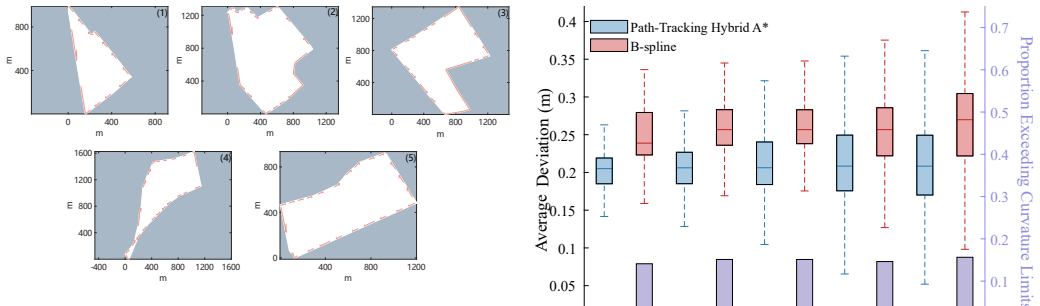
- Across 713 reference paths from five real farmlands, the full pipeline reached a 100% tracking success rate, while B-spline-smoothed and raw reference paths showed larger deviations and lower success; this supports using the framework for offline field-path smoothing before operations.
- The replanning extension preserves success rates above 97% with up to three vehicle-sized obstacles and mean replanning times under 0.8 seconds, indicating the same planner can serve as an online local replanner when unexpected obstacles appear.
Reading between the lines
- Because the deviation cost is symmetric in the lateral direction, the framework treats drift into the crop row and drift into the adjacent row as equally costly; a natural extension would weight deviation asymmetrically based on which side of the vehicle carries standing crop.
- The 100% success rate is a simulation result on recorded field geometry; a field trial with GPS noise, wheel slip, and uneven terrain would be the real test of whether errors stay inside the linearization neighborhood that the MPC's collision constraints assume.
- The pruning rule that stops searching once any target node exists trades optimality for speed; in dense obstacle configurations it could discard the only branch that eventually reaches a feasible path, which the declining success rate at three obstacles hints at.
Editorial analysis
A structured set of objections, weighed in public.
Referee Report
Summary. The paper proposes a two-stage planning-control framework for agricultural vehicles operating in cross-furrow scenarios. The first stage is a Path-Tracking Hybrid A* algorithm with deviation-aware cost and heuristic functions that generates curvature-bounded, full-body-collision-free trajectories closely following a reference polyline. The second stage is a hierarchical MPC, in which a linearized MPC with linearized collision constraints warm-starts a nonlinear MPC that enforces the exact signed-distance collision constraint. An online replanning extension with pruning handles unforeseen obstacles. The framework is evaluated in simulation on five real-world farm datasets with 713 reference paths, reporting lower average deviation than a B-spline baseline, 0% curvature violations, 100% tracking success, and high obstacle-avoidance success rates with computation times suitable for real-time use.
Significance. If the claims hold, the framework would be a practically useful, ready-to-deploy combination of search-based path smoothing and hierarchical MPC for agricultural path tracking, with a clear formulation of deviation-aware planning and a warm-start strategy that is likely to improve nonlinear MPC convergence. The paper provides a detailed algorithmic description, a large simulation study on real-world farm layouts, and explicit metrics. Strengths include the explicit minimization of path deviation along with curvature and body-collision constraints, the proposed heuristic based on Reed-Shepp paths, and the two-level MPC warm-start design. However, the load-bearing safety comparison relies on a baseline that does not enforce curvature constraints and on a linearized collision constraint whose validity depends on an unquantified small-error assumption; the main quantitative metric is also nearly identical to the planner's own cost, so part of the improvement over the B-spline baseline is by construction. These issues limit the strength of the reported superiority claims.
major comments (3)
- [Section IV-C, Eqs. (17)-(24)] The linearized collision-avoidance constraint (10c) is built by selecting the nearest boundary segment and linearizing sin/cos around the reference state x_{r,k+j}, not around the actual predicted state x_{k+j}. If the tracking error grows beyond the linearization neighborhood, the chosen half-plane separator may be the wrong one, so the linearized MPC could declare an unsafe state safe or be infeasible even when a safe trajectory exists. The nonlinear stage (25) uses the exact signed distance g(x_{k+j})>0 but is only warm-started from this possibly incorrect linear solution; the paper provides no convergence or robustness argument that the nonlinear solver can recover from a wrong-side or infeasible initialization. The reported 100% success on 713 paths is therefore an empirical observation, not a guarantee, and the paper supplies no worst-case deviation or minimum-clearance statistics. Please add a state-dependent constraint formulation, a theoretical bound on the tracking error that justifies the reference-based linearization, or a robust constraint-tightening scheme that makes the claim valid.
- [Section V, Eq. (26) and Fig. 6] The headline deviation metric E in Eq. (26) is exactly the normalized version of the cost function ecost minimized by the Path-Tracking Hybrid A* planner in Eq. (5). Consequently, the improvement of the proposed planner over the B-spline baseline in this metric is partially by construction: the planner directly optimizes the quantity that is later used for comparison. Moreover, in the MPC comparison of Section V-B, the B-spline baseline is not required to satisfy curvature constraints, and for baseline trajectories the MPC collision constraint (10c) is removed and the local nonlinear adjustment is skipped. These choices favor the proposed method and weaken the claim of 'superior performance in safety, path adherence, and real-time obstacle avoidance.' A fairer comparison would use a curvature-constrained and collision-aware baseline under identical MPC settings, or state explicitly that the comparison is against an unprepared baseline.
- [Section IV-C, Eq. (25)] The nonlinear MPC formulation in Eq. (25) lists the objective (25a) with constraints g(x_{k+j})>0 (25b) and the dynamics (25c), but does not include the control-limit constraints |a_{k+j}| ≤ a_m and |δ_{k+j}| ≤ δ_m that are enforced in the linearized MPC via Eqs. (10d)-(10e). Since the final control applied to the vehicle comes from the nonlinear stage, the overall framework does not formally guarantee that actuator limits are respected. Please add the control bounds to the nonlinear problem, or explicitly state that they are inherited from the linearized warm-start and justify that this is sufficient.
minor comments (6)
- [Eq. (9)] There is a stray period in the displayed equation: 'f (zn) = α · ecost(zn) + β · epred(zn). + γ · h(zn)' should not have the period before the plus sign.
- [Section IV-C, paragraph after Eq. (18)] The sentence is broken: 'Note that xk+j is obtained from eq. (18) using ˜xk and the control variable U k, and thus xk+j is an unknown priori. and the nearest boundary segment is estimated using the reference trajectory xr,k+j.' Please rephrase to clearly distinguish the known reference-based selection from the unknown predicted state.
- [Algorithm 1, line 10] The text says dist(zp, rm) is 'measured by the distance along the reference path between their projections' but the pseudocode simply uses dist(zp, rm); please define this distance explicitly in the notation or add a comment in the algorithm.
- [Eq. (8)] The first summation uses index i but the summand is written with z_j: 'h(zn) = sum_{i=1}^n ||zj − zj−1|| + ...'. This is a typographical inconsistency.
- [Section V-A, Fig. 5] The caption and text state that the lower bar chart shows only the B-spline proportion exceeding curvature limits, while the text claims the Path-Tracking Hybrid A* proportion is 0%. If the bar chart indeed omits the 0% category, that is fine, but the figure legend is ambiguous; please clarify.
- [Section V-B and V-C] The success-rate results are reported without any statistical dispersion or confidence intervals, and the paper does not state that code or data are available for reproducibility. Adding error bars and a short reproducibility statement would substantially strengthen the empirical claims.
Circularity Check
The path-adherence metric is the normalized planner objective, so part of the reported smoothing advantage is by construction; the MPC tracking and obstacle-avoidance results remain independent.
-
self definitional
[Section V-A Eq. (26) vs. Section IV-A1 Eq. (5)]
"E({xr,n}^T_{n=0}) = (Σ_{i=1}^T ||z_i − z_{i−1}||·dis(z_i, R)) / (Σ_{i=1}^T ||z_i − z_{i−1}||), (26), which is calculated by dividing the total deviation as defined in eq. (5) by the total trajectory length, representing the average deviation degree."
Eq. (26) is exactly the normalized version of the planner cost ecost in Eq. (5), which appears as the α-term of the evaluation function f in Eq. (9) that Path-Tracking Hybrid A* minimizes. The B-spline baseline is not designed to minimize this cumulative deviation objective. Therefore the Fig. 5 claim that the proposed planner 'outperforms the B-spline method in terms of the average deviation degree in all field scenes' is in part a direct restatement of the algorithm's own objective rather than an independent measurement. This does not affect the MPC tracking comparisons, which evaluate a separate closed-loop quantity.
full rationale
The only clear reduction is the smoothing metric: Eq. (26) is explicitly derived from Eq. (5), and Eq. (5) is what the planner minimizes. That makes the path-adherence improvement over B-spline partially self-definitional. The curvature-violation comparison is likewise a hard-constraint guarantee of the motion-primitive construction, acknowledged in the text ('motion primitives that inherently respect these limits'), so it is not an empirical prediction. The rest of the claimed contributions are independent: the hierarchical MPC tracking success (Fig. 7), the closed-loop deviations (Fig. 6), the replanning obstacle-avoidance statistics (Table I), and the computation-time measurements do not reduce to the planner cost and are evaluated against external baselines. The only self-citation, [46], supplies a standard signed-distance normal formula within the linearized collision constraint and is not load-bearing for the central claims; [43] is an external MPC reference. Thus the circularity burden is mild and localized.
Assumptions & free parameters
free parameters (5)
- α, β, γ in evaluation function (Eq. 9) =
not reported
- Q, W in MPC objective (Eqs. 12 and 25a) =
not reported
- Planning discretization parameters (Δt, vr, curvature levels, motion primitive length, d0, grid resolution) =
partially reported (Δt=0.5 s, vr=2 m/s, 5 curvature levels)
- Replanning parameters (detection range, FOV, inflation width, expansion margin) =
partially reported (range=15 m, FOV=90 degrees)
- Prediction horizons (N, N') =
N=20; N' unspecified
assumptions (5)
- domain assumption Farmland is a 2D polygon; reference paths are polylines; obstacles are convex polygons.
- domain assumption Vehicle is a front-steered bicycle model with no slip (Eq. 1), and motion primitives use constant-speed arc segments.
- ad hoc to paper In linearized MPC, the nearest boundary segment and the linearization angle are taken from the reference trajectory, not the actual predicted state.
- standard math GJK/EPA signed distance queries correctly compute convex collision geometry within the solver time step.
- ad hoc to paper A feasible trajectory exists in the discretized search and the MPC solvers always find it.
Cite this review
Pith. "Pith review of Path-Tracking Hybrid A* and Hierarchical MPC Framework for Autonomous Agricultural Vehicles." pith.science (2026). https://pith.science/paper/ISFW655S
@misc{pith2026241114086,
  author       = {Pith},
  title        = {Pith review of: Path-Tracking Hybrid A* and Hierarchical MPC Framework for Autonomous Agricultural Vehicles},
  year         = {2026},
  howpublished = {\url{https://pith.science/paper/ISFW655S}},
  note         = {Machine review of arXiv:2411.14086}
}
read the original abstract
We propose a Path-Tracking Hybrid A* planner coupled with a hierarchical Model Predictive Control (MPC) framework for path smoothing in agricultural vehicles. The goal is to minimize deviation from reference paths during cross-furrow operations, thereby optimizing operational efficiency, preventing crop and soil damage, while also enforcing curvature constraints and ensuring full-body collision avoidance. Our contributions are threefold: (1) We develop the Path-Tracking Hybrid A* algorithm to generate smooth trajectories that closely adhere to the reference trajectory, respect strict curvature constraints, and satisfy full-body collision avoidance. The adherence is achieved by designing novel cost and heuristic functions to minimize tracking errors under nonholonomic constraints. (2) We introduce an online replanning strategy as an extension that enables real-time avoidance of unforeseen obstacles, while leveraging pruning techniques to enhance computational efficiency. (3) We design a hierarchical MPC framework that ensures tight path adherence and real-time satisfaction of vehicle constraints, including nonholonomic dynamics and full-body collision avoidance. By using linearized MPC to warm-start the nonlinear solver, the framework improves the convergence of nonlinear optimization with minimal loss in accuracy. Simulations on real-world farm datasets demonstrate superior performance compared to baseline methods in safety, path adherence, computation speed, and real-time obstacle avoidance.
Figures

Figures from the paper (3 more)


Reference graph
Works this paper leans on
-
[1]
Applications of machine vision in agricultural robot navigation: A review,
T. Wang, B. Chen, Z. Zhang, H. Li, and M. Zhang, “Applications of machine vision in agricultural robot navigation: A review,” Computers and Electronics in Agriculture , vol. 198, p. 107085, 2022
work page 2022
-
[2]
Recent advancements in agriculture robots: Benefits and challenges,
C. Cheng, J. Fu, H. Su, and L. Ren, “Recent advancements in agriculture robots: Benefits and challenges,” Machines, vol. 11, no. 1, p. 48, 2023
work page 2023
-
[3]
A mobile robotic platform for crop moni- toring,
M. Bayati and R. Fotouhi, “A mobile robotic platform for crop moni- toring,” Advances in Robotics & Automation , vol. 7, no. 1, p. 1000186, 2018
work page 2018
-
[4]
Pes- ticide spraying robot for precision agriculture: A categorical literature review and future trends,
A. T. Meshram, A. V . Vanalkar, K. B. Kalambe, and A. M. Badar, “Pes- ticide spraying robot for precision agriculture: A categorical literature review and future trends,” Journal of Field Robotics , vol. 39, no. 2, pp. 153–171, 2022
2022
-
[5]
K. G. Fue, W. M. Porter, E. M. Barnes, and G. C. Rains, “An extensive review of mobile agricultural robotics for field operations: focus on cotton harvesting,” AgriEngineering, vol. 2, no. 1, 2020
work page 2020
-
[6]
Robot for weed species plant-specific man- agement,
O. Bawden, J. Kulk, R. Russell, C. McCool, A. English, F. Dayoub, C. Lehnert, and T. Perez, “Robot for weed species plant-specific man- agement,” Journal of Field Robotics , vol. 34, no. 6, pp. 1179–1199, 2017
work page 2017
-
[7]
Path planning aware of robot’s center of mass for steep slope vineyards,
L. Santos, F. Santos, J. Mendes, P. Costa, J. Lima, R. Reis, and P. Shinde, “Path planning aware of robot’s center of mass for steep slope vineyards,” Robotica, vol. 38, no. 4, pp. 684–698, 2020
work page 2020
-
[8]
The path planning of agricultural agv in potato ridge cultivation,
T. Mai, S. Shao, and Z. Yun, “The path planning of agricultural agv in potato ridge cultivation,” Ann. Adv. Agric. Sci , vol. 3, no. 2, 2019
work page 2019
Show all 46 references
-
[9]
Hybrid path planning methods for complete coverage in har- vesting operation scenarios,
N. Wang, Z. Jin, T. Wang, J. Xiao, Z. Zhang, H. Wang, M. Zhang, and H. Li, “Hybrid path planning methods for complete coverage in har- vesting operation scenarios,” Computers and Electronics in Agriculture , vol. 231, p. 109946, 2025
2025
-
[10]
Deep learning-based complete coverage path planning with re-joint and obstacle fusion paradigm,
T. Lei, C. Luo, G. E. Jan, and Z. Bi, “Deep learning-based complete coverage path planning with re-joint and obstacle fusion paradigm,” Frontiers in Robotics and AI , vol. 9, p. 843816, 2022
2022
-
[11]
A deep reinforcement learning-based multi-agent area coverage control for smart agriculture,
A. Din, M. Y . Ismail, B. Shah, M. Babar, F. Ali, and S. U. Baig, “A deep reinforcement learning-based multi-agent area coverage control for smart agriculture,” Computers and Electrical Engineering, vol. 101, p. 108089, 2022
2022
-
[12]
The agrirover: a reinvented mechatronic platform from space robotics for precision farming,
X.-T. Yan, A. Bianco, C. Niu, R. Palazzetti, G. Henry, Y . Li, W. Tubby, A. Kisdi, R. Irshad, S. Sanders, et al. , “The agrirover: a reinvented mechatronic platform from space robotics for precision farming,” Rein- venting Mechatronics: Developing Future Directions for Mechatr...
2020
-
[13]
An analytical continuous-curvature path- smoothing algorithm,
K. Yang and S. Sukkarieh, “An analytical continuous-curvature path- smoothing algorithm,” IEEE Transactions on Robotics , vol. 26, no. 3, pp. 561–568, 2010
2010
-
[14]
Collision free smooth path for mobile robots in cluttered environment using an economical clamped cubic b-spline,
I. Noreen, “Collision free smooth path for mobile robots in cluttered environment using an economical clamped cubic b-spline,” Symmetry, vol. 12, no. 9, p. 1567, 2020
2020
-
[15]
Optimal smooth paths based on clothoids for car-like vehicles in the presence of obstacles,
E. D. Lambert, R. Romano, and D. Watling, “Optimal smooth paths based on clothoids for car-like vehicles in the presence of obstacles,” International Journal of Control, Automation and Systems , vol. 19, pp. 2163–2182, 2021
2021
-
[16]
Optimal paths for a car that goes both forwards and backwards,
J. Reeds and L. Shepp, “Optimal paths for a car that goes both forwards and backwards,” Pacific journal of mathematics, vol. 145, no. 2, pp. 367– 393, 1990
1990
-
[17]
An improved pso algorithm for smooth path planning of mobile robots using continuous high-degree bezier curve,
B. Song, Z. Wang, and L. Zou, “An improved pso algorithm for smooth path planning of mobile robots using continuous high-degree bezier curve,” Applied soft computing , vol. 100, p. 106960, 2021
2021
-
[18]
Path optimization of agricultural robot based on immune ant colony: B- spline interpolation algorithm,
K. Feng, X. He, M. Wang, X. Chu, D. Wang, and D. Yue, “Path optimization of agricultural robot based on immune ant colony: B- spline interpolation algorithm,” Mathematical Problems in Engineering , vol. 2022, no. 1, p. 2585910, 2022
2022
-
[19]
Practical search techniques in path planning for autonomous driving,
D. Dolgov, S. Thrun, M. Montemerlo, and J. Diebel, “Practical search techniques in path planning for autonomous driving,” Ann Arbor , vol. 1001, no. 48105, pp. 18–80, 2008
2008
-
[20]
Guided hybrid a-star path planning algorithm for valet parking applications,
S. Sedighi, D.-V . Nguyen, and K.-D. Kuhnert, “Guided hybrid a-star path planning algorithm for valet parking applications,” in 2019 5th international conference on control, automation and robotics (ICCAR) , pp. 570–575, 2019
2019
-
[21]
Autonomous parking trajectory planning with tiny passages: A combination of multistage hybrid a- star algorithm and numerical optimal control,
W. Sheng, B. Li, and X. Zhong, “Autonomous parking trajectory planning with tiny passages: A combination of multistage hybrid a- star algorithm and numerical optimal control,” IEEE Access , vol. 9, pp. 102801–102810, 2021
2021
-
[22]
The navigation based on hybrid a star and teb algorithm implemented in obstacles avoidance,
H. Zheng, M. Dai, Z. Zhang, Z. Xia, G. Zhang, and F. Jia, “The navigation based on hybrid a star and teb algorithm implemented in obstacles avoidance,” in 2023 29th International Conference on Mechatronics and Machine Vision in Practice (M2VIP) , pp. 1–6, 2023
2023
-
[23]
Hybrid a-star path planning method based on hierarchical clustering and trichotomy,
T. Chang and G. Tian, “Hybrid a-star path planning method based on hierarchical clustering and trichotomy,”Applied Sciences, vol. 14, no. 13, p. 5582, 2024
2024
-
[24]
Improved hybrid a-star algorithm for path planning in autonomous parking system based on multi-stage dynamic optimization,
T. Meng, T. Yang, J. Huang, W. Jin, W. Zhang, Y . Jia, K. Wan, G. Xiao, D. Yang, and Z. Zhong, “Improved hybrid a-star algorithm for path planning in autonomous parking system based on multi-stage dynamic optimization,” International journal of automotive technology , vol. 24,...
2023
-
[25]
Path smoothing techniques in robot navigation: State-of-the-art, current and future challenges,
A. Ravankar, A. A. Ravankar, Y . Kobayashi, Y . Hoshino, and C.-C. Peng, “Path smoothing techniques in robot navigation: State-of-the-art, current and future challenges,” Sensors, vol. 18, no. 9, p. 3170, 2018
2018
-
[26]
On the runge example,
J. F. Epperson, “On the runge example,” The American Mathematical Monthly, vol. 94, no. 4, pp. 329–341, 1987
1987
-
[27]
A new approach based on bezier curves to solve path planning problems for mobile robots,
Z. Duraklı and V . Nabiyev, “A new approach based on bezier curves to solve path planning problems for mobile robots,” Journal of computa- tional science, vol. 58, p. 101540, 2022
2022
-
[28]
High-fidelity and curvature-continuous path smoothing with quadratic b´ezier curve,
X. Liu, H. Nie, D. Li, Y . He, and M. H. Ang, “High-fidelity and curvature-continuous path smoothing with quadratic b´ezier curve,” IEEE Transactions on Intelligent Vehicles, 2024
2024
-
[29]
Continuous path smoothing for car-like robots using b-spline curves,
M. Elbanhawi, M. Simic, and R. N. Jazar, “Continuous path smoothing for car-like robots using b-spline curves,” Journal of Intelligent & Robotic Systems, vol. 80, pp. 23–56, 2015
2015
-
[30]
Clothoid curve-based emergency-stopping path planning with adaptive potential field for autonomous vehicles,
P. Lin, E. Javanmardi, and M. Tsukada, “Clothoid curve-based emergency-stopping path planning with adaptive potential field for autonomous vehicles,” IEEE Transactions on Vehicular Technology , 2024
2024
-
[31]
On curves of minimal length with a constraint on average curvature, and with prescribed initial and terminal positions and tangents,
L. E. Dubins, “On curves of minimal length with a constraint on average curvature, and with prescribed initial and terminal positions and tangents,” American Journal of mathematics, vol. 79, no. 3, pp. 497–516, 1957
1957
-
[32]
Three-dimensional dubins-path-guided continuous curvature path smoothing,
S. Park, “Three-dimensional dubins-path-guided continuous curvature path smoothing,” Applied Sciences, vol. 12, no. 22, p. 11336, 2022
2022
-
[33]
A new approach to smooth path planning of mobile robot based on quartic bezier transition curve and improved pso algorithm,
L. Xu, M. Cao, and B. Song, “A new approach to smooth path planning of mobile robot based on quartic bezier transition curve and improved pso algorithm,” Neurocomputing, vol. 473, pp. 98–106, 2022
2022
-
[34]
A new approach to smooth path planning of ackerman mobile robot based on improved aco algorithm and b-spline curve,
F. Huo, S. Zhu, H. Dong, and W. Ren, “A new approach to smooth path planning of ackerman mobile robot based on improved aco algorithm and b-spline curve,” Robotics and Autonomous Systems, vol. 175, p. 104655, 2024
2024
-
[35]
Mobile robot motion planning by point to point based on modified ant colony optimization and voronoi diagram,
N. Habib, D. Purwanto, and A. Soeprijanto, “Mobile robot motion planning by point to point based on modified ant colony optimization and voronoi diagram,” in 2016 International Seminar on Intelligent Technology and Its Applications (ISITIA) , pp. 613–618, IEEE, 2016
2016
-
[36]
Path planning of mobile robot based on dynamic chaotic ant colony optimization algorithm,
X. Li, T. Huang, H. Chen, Y . Zhang, L. Xu, and Y . Liu, “Path planning of mobile robot based on dynamic chaotic ant colony optimization algorithm,” in 2022 IEEE 10th international conference on information, communication and networks (ICICN) , pp. 515–519, IEEE, 2022
2022
-
[37]
Improved biological neural network approach for path planning of differential drive agricultural robots with arbitrary shape,
Z. Zhao, S. Liu, J. Wei, and F. Qin, “Improved biological neural network approach for path planning of differential drive agricultural robots with arbitrary shape,” Computers and Electronics in Agriculture , vol. 216, p. 108525, 2024
2024
-
[38]
The intelligent path plan- ning system of agricultural robot via reinforcement learning,
J. Yang, J. Ni, Y . Li, J. Wen, and D. Chen, “The intelligent path plan- ning system of agricultural robot via reinforcement learning,” Sensors, vol. 22, no. 12, p. 4316, 2022
2022
-
[39]
Re- search progress of agricultural robot full coverage operation planning,
W. Ning, H. Yuxiao, W. Yaxuan, W. Tianhai, Z. Man, and L. Han, “Re- search progress of agricultural robot full coverage operation planning,” Nongye Jixie Xuebao/Transactions of the Chinese Society of Agricultural Machinery, 2022
2022
-
[40]
Collaborative path planning and task allocation for multiple agricul- tural machines,
N. Wang, X. Yang, T. Wang, J. Xiao, M. Zhang, H. Wang, and H. Li, “Collaborative path planning and task allocation for multiple agricul- tural machines,” Computers and Electronics in Agriculture , vol. 213, p. 108218, 2023
2023
-
[41]
Optimization of agricultural machinery allocation in heilongjiang reclamation area based on particle swarm optimization algorithm,
L. Liu, T. Chen, S. Gao, Y . Liu, S. Yang, et al. , “Optimization of agricultural machinery allocation in heilongjiang reclamation area based on particle swarm optimization algorithm,” Tehniˇcki vjesnik , vol. 28, no. 6, pp. 1885–1893, 2021
2021
-
[42]
Global path conflict detection algorithm of multiple agricultural machinery cooperation based on topographic map and time window,
R. Cao, Y . Guo, Z. Zhang, S. Li, M. Zhang, H. Li, and M. Li, “Global path conflict detection algorithm of multiple agricultural machinery cooperation based on topographic map and time window,” Computers and Electronics in Agriculture , vol. 208, p. 107773, 2023
2023
-
[43]
Mobile robot trajectory tracking using model predictive control,
F. K ¨unhe, J. Gomes, and W. Fetter, “Mobile robot trajectory tracking using model predictive control,” in II IEEE latin-american robotics symposium, vol. 51, p. 5, 2005
2005
-
[44]
A fast procedure for computing the distance between complex objects in three-dimensional space,
E. G. Gilbert, D. W. Johnson, and S. S. Keerthi, “A fast procedure for computing the distance between complex objects in three-dimensional space,” IEEE Journal on Robotics and Automation , vol. 4, no. 2, pp. 193–203, 1988
1988
-
[45]
Proximity queries and penetration depth compu- tation on 3d game objects,
G. Van Den Bergen, “Proximity queries and penetration depth compu- tation on 3d game objects,” in Game developers conference , vol. 170, p. 209, 2001
2001
-
[46]
Probabilistic visibility-aware trajectory planning for target tracking in cluttered environments,
H. Gao, W. Pengying, S. Yao, K. Zhou, M. Ji, H. Liu, and C. Liu, “Probabilistic visibility-aware trajectory planning for target tracking in cluttered environments,” in 2024 American Control Conference (ACC) , pp. 594–600, 2024
2024
Reviewed August 12, 2026 · model on record in the stance chip above.
Discussion (0). Continue with ORCID to comment.