REVIEW 4 major objections 5 minor 40 references
Channel Customization for Low-Complexity CSI Acquisition in Multi-RIS-Assisted MIMO Systems
T0 review · 4 major / 5 minor · reviewed 2026-08-12 · deepseek-v4-flash
Pith's one-line read The paper claims that tuning each RIS to its cascaded LoS paths makes the multi-RIS MIMO channel approximately sparse, reducing CSI acquisition to a few path-parameter estimates.
desk verdict A clean, useful engineering scheme for low-complexity multi-RIS CSI acquisition; the soft spot is real but fixable — the sparse-channel model (27) is justified only in expectation, while the estimators use it per realization. read the letter →
The pith
A machine-rendered reading of the paper's core claim, the machinery that carries it, and where it could break.
The reading
What carries the argument
The central mechanism is the channel-customization identity for the k-th RIS reflection vector, $\gamma_k = M_k \mathbf{a}_r(\Theta^{\mathrm{D}}_{rb,k,0}, \Phi^{\mathrm{D}}_{rb,k,0}) \odot \mathbf{a}_r^*(\Theta^{\mathrm{A}}_{ur,k,0}, \Phi^{\mathrm{A}}_{ur,k,0})$ in (26), where $\mathbf{a}_r(\cdot)$ is the RIS array response vector, together with the cascaded-gain expression $\xi_{k,l,v}$ in (25). This choice makes the gain sum collapse to a Dirichlet-like kernel that is $M_k$, the number of elements on the surface, times larger for the LoS-LoS cascade than for any cascade involving an NLoS path, so in expectation the matrix $\boldsymbol{\Xi}$ becomes nearly diagonal and $H \approx \mathbf{A}_{b,e} \boldsymbol{\Xi}_e \mathbf{A}_{u,e}^H$. The fast-varying reflection matrix $F = [\mathbf{f}_0, \ldots, \mathbf{f}_K]$ acts as a channel-separation mechanism: multiplying the received training blocks by $F^*$ isolates the direct and RIS-cascaded components, converting the multi-RIS estimation problem into $K+1$ independent subproblems.
What would settle it
Compute, over many channel realizations with a small RIS (for example 4 by 4 elements), Rician factor $\kappa^{\mathrm{ur}} = 0$ dB, and several strong NLoS paths, the ratio $\|H - \mathbf{A}_{b,e} \boldsymbol{\Xi}_e \mathbf{A}_{u,e}^H\|_F^2 / \|H\|_F^2$ after applying (26). If this ratio stays well above zero at high SNR and the downlink single-path estimator (45) shows a systematic bias that does not vanish with more pilots, the sparsification claim fails in that regime.
Extended reading notes
Core claim
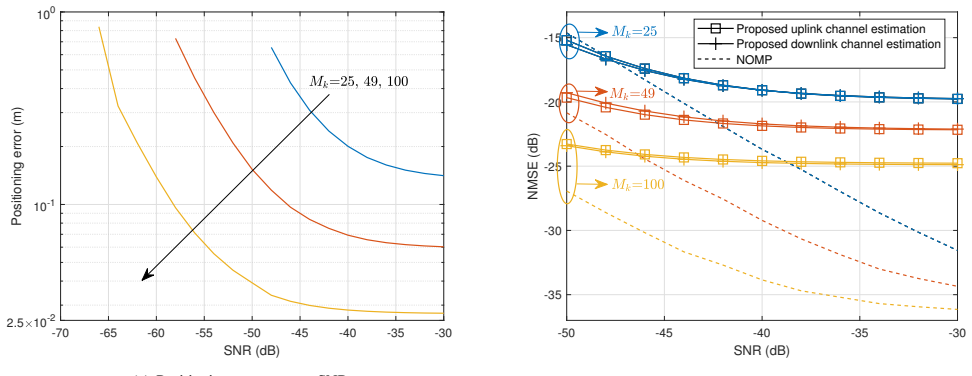
The central claim is that the RIS itself can simplify the channel estimation problem instead of being treated as an unknown to be estimated. When each RIS's phases are chosen as in (26) to coherently combine the LoS paths from the UE side and the BS side, the per-path cascaded gains $\xi_{k,l,v}$ become concentrated: in expectation, $E[|\xi_{k,0,0}|^2]$ dominates the other cascaded terms by factors that grow with the RIS size $M_k$ and the Rician factors, so the full reflection channel is well approximated by the LoS-only matrix (27). The paper then exploits this customization: a positioning-based joint LoS-path estimation algorithm detects the LoS angles by triangulating the UE from at least three RISs and matching NOMP-extracted angles against the geometric prediction, and in the downlink the UE only needs to detect the departure angle of one LoS path per RIS, with the pilot count reduced from $K_S N_u$ to $N_b$. The simulations show the reconstructed channel has a higher NMSE floor than full NOMP estimation, but the spectral efficiency achieved with the estimated CSI is close to the perfect-CSI result.
Load-bearing premise
The load-bearing premise is that the average-power dominance computed in Appendix A licenses replacing the instantaneous reflection channel by its LoS-only part; the paper does not bound the per-realization NLoS residual, so with small RISs or weak LoS the reconstructed channel carries an unquantified error floor.
Editorial extensions
If this is right
- If the approximation (27) holds, the uplink reflection channel can be reconstructed from the K LoS paths in the UE-RIS links, dropping the NOMP search complexity from roughly $K M \eta^3 (L^{\mathrm{ur}} N_u + L^{\mathrm{rb}} N_b)$ to $K M \eta^3 (N_u + N_b)$ in the best case.
- Downlink training overhead falls from $K_S N_u$ pilots to $N_b$ pilots, and the UE's estimation task becomes one single-path angular search per RIS.
- The RIS configuration (26) requires only the LoS departure angles in the UE-RIS channels, which are obtained from the positioning step, so no full instantaneous CSI is needed at the RIS.
- The method's complexity advantage over full NOMP grows with the number of NLoS paths, because those paths are never searched for, while the channel reconstruction error stays nearly flat as the path count increases.
- In the simulated mmWave scenario, the spectral efficiency obtained from the customized-channel estimate is close to that of perfect CSI despite the higher NMSE, because the dominant LoS paths carry most of the channel power.
Reading between the lines
- The paper leaves implicit that the same customization idea could be closed-loop: after the first downlink estimate, the UE's detected angles could be fed back to refine the RIS phases, progressively hardening the channel over a few rounds and lowering the residual NLoS power.
- The average-power justification suggests the scheme is strongest when each RIS has many elements and the UE-RIS links are strongly LoS-dominated; in the opposite regime, the LoS-only reconstruction has an irreducible per-realization residual, which the NMSE floor in the simulations already hints at.
- Because the positioning step needs at least three RISs with LoS visibility to the UE, applying the scheme to multi-UE or cell-free deployments would require each UE to be visible to at least three surfaces, or the LoS-identification step would need another source of angular reference.
- The complexity comparison depends on the NOMP baseline's grid oversampling factors; under a fixed accuracy target the downlink single-path search may need a finer grid, so the true savings are set by how many NOMP iterations the positioning-based match actually avoids.
Editorial analysis
A structured set of objections, weighed in public.
Referee Report
Summary. The paper proposes a joint CSI-acquisition and RIS-configuration scheme for multi-RIS-assisted MIMO systems. In the uplink, fast-varying RIS reflection phases across pilot symbols are used to separate channel components from different RISs and the direct link via the orthogonality of a DFT reflection matrix (Section III-A). The authors then propose a positioning-based algorithm that estimates only the LoS path parameters of each UE-RIS channel, uses those parameters to configure each RIS with the reflection vector in Eq. (26), and argues via Appendix A that the resulting cascaded reflection channel is approximately sparse, H ≈ A_{b,e} Ξ_e A_{u,e}^H in Eq. (27). This sparse model is then used to simplify downlink estimation to K independent single-path detection problems (Section IV-C). Numerical results in Section V evaluate parameter-extraction error, positioning error, channel-reconstruction NMSE, and spectral efficiency against a NOMP baseline.
Significance. If the sparse-channel approximation in Eq. (27) were reliable per channel realization, the proposed scheme would be a substantive contribution: it converts a high-dimensional multi-path channel estimation problem into a few single-path searches and reduces downlink pilot overhead, while preserving much of the achievable spectral efficiency. The channel separation step using F^T F^* = K_F I is clean and correctly derived, and Appendix A provides a careful average-power calculation for the cascaded path gains. The numerical study is reasonably extensive and the paper is generally well organized. However, the central theoretical claim—that average LoS power dominance licenses an instantaneous sparse approximation—is not established, and this gap is load-bearing for the downlink estimator and the channel reconstruction.
major comments (4)
- [Section IV-A, Eq. (27); Appendix A, Eqs. (63)-(64)]
- [Section IV-C, Eqs. (40)-(46)]
- [Section IV-B, Algorithm 1 and Eq. (29)]
- [Section IV-C, Eq. (40)]
minor comments (5)
- [Eq. (24)]
- [Notation, Section II]
- [Appendix A, Eq. (54)]
- [Section V-A, Fig. 6]
- [Section V-D, Fig. 12]
Circularity Check
No significant circularity; the sparse-channel approximation is derived from first principles in Appendix A, and no fitted input is renamed as a prediction.
full rationale
The paper's derivation chain is self-contained with respect to its central claim. Equation (26) defines the RIS reflection vector from LoS angle parameters, and Appendix A computes the expected power of each cascaded path, showing in (63)-(64) that for large M_k the LoS cascaded component dominates in expectation. Equation (27) is used as an approximation, not as an equality forced by definition; the residual H - A_b,e Ξ_e A_u,e^H is a modeling error that is evaluated by Monte Carlo simulations in Figs. 6 and 11-13. The downlink single-path estimator (42)-(45) does not fit a parameter to the downlink data and then call that fit a prediction; it estimates the LoS angle and gain from the customized channel model. Uplink LoS parameters are used to configure the RIS, and the downlink angles are re-estimated, so the downlink result is not statistically forced by the uplink fit. Self-citations [10], [13], and [40] concern prior channel-customization frameworks, but the present derivation does not rely on them as unverified premises: the array response decomposition in (27) is stated explicitly and the dominance claim is proven in Appendix A using the paper's own assumptions. The gap between the average-power statement in (63)-(64) and the instantaneous use of (27) is a correctness and statistical issue (the NLoS residual is not bounded per realization), not a circularity in the derivation chain.
Assumptions & free parameters
free parameters (3)
- Stopping threshold τ =
not specified
- Number of positioning RISs KL =
not specified (must be ≥ 3)
- Oversampling factors ηb, ηu, ηh,k, ηv,k =
not specified
assumptions (4)
- standard math The fast reflection matrix F is a DFT matrix satisfying F^T F^* = KF I (Section III-A, Eq. (13)).
- domain assumption Far-field planar wave propagation and geometric multipath model with known LoS angles for the fixed RIS-BS links (Section II-A, Eqs. (3)-(7)).
- domain assumption All RISs are perfectly synchronized with the BS via GNSS (footnote 1).
- ad hoc to paper The reflection channel can be replaced by the LoS-only term H ≈ A_{b,e} Ξ_e A_{u,e}^H in (27) because the expected power of the LoS cascaded path dominates for large M_k (Appendix A, Eqs. (63)-(64)).
Cite this review
Pith. "Pith review of Channel Customization for Low-Complexity CSI Acquisition in Multi-RIS-Assisted MIMO Systems." pith.science (2026). https://pith.science/paper/YUQCB5NP
@misc{pith2026241114088,
  author       = {Pith},
  title        = {Pith review of: Channel Customization for Low-Complexity CSI Acquisition in Multi-RIS-Assisted MIMO Systems},
  year         = {2026},
  howpublished = {\url{https://pith.science/paper/YUQCB5NP}},
  note         = {Machine review of arXiv:2411.14088}
}
read the original abstract
The deployment of multiple reconfigurable intelligent surfaces (RISs) enhances the propagation environment by improving channel quality, but it also complicates channel estimation. Following the conventional wireless communication system design, which involves full channel state information (CSI) acquisition followed by RIS configuration, can reduce transmission efficiency due to substantial pilot overhead and computational complexity. This study introduces an innovative approach that integrates CSI acquisition and RIS configuration, leveraging the channel-altering capabilities of the RIS to reduce both the overhead and complexity of CSI acquisition. The focus is on multi-RIS-assisted systems, featuring both direct and reflected propagation paths. By applying a fast-varying reflection sequence during RIS configuration for channel training, the complex problem of channel estimation is decomposed into simpler, independent tasks. These fast-varying reflections effectively isolate transmit signals from different paths, streamlining the CSI acquisition process for both uplink and downlink communications with reduced complexity. In uplink scenarios, a positioning-based algorithm derives partial CSI, informing the adjustment of RIS parameters to create a sparse reflection channel, enabling precise reconstruction of the uplink channel. Downlink communication benefits from this strategically tailored reflection channel, allowing effective CSI acquisition with fewer pilot signals. Simulation results highlight the proposed methodology's ability to accurately reconstruct the reflection channel with minimal impact on the normalized mean square error while simultaneously enhancing spectral efficiency.
Figures


Figures from the paper (10 more)




Reference graph
Works this paper leans on
-
[1]
Prospective multiple antenna technologies for beyond 5G,
J. Zhang, E. Bj ¨ornson, M. Matthaiou, D. W. K. Ng, H. Yang, and D. J. Love, “Prospective multiple antenna technologies for beyond 5G,” IEEE J. Sel. Areas Commun., vol. 38, no. 8, pp. 1637-1660, Aug. 2020
work page 2020
-
[2]
Deep joint source- channel coding for wireless image transmission,
E. Bourtsoulatze, D. Burth Kurka, and D. G ¨und¨uz, “Deep joint source- channel coding for wireless image transmission,” IEEE Trans. Cogn. Commun. Netw., vol. 5, no. 3, pp. 567-579, Sept. 2019
work page 2019
-
[3]
Joint transmit waveform and receive filter design for dual-function radar- communication systems,
C. G. Tsinos, A. Arora, S. Chatzinotas, and B. Ottersten, “Joint transmit waveform and receive filter design for dual-function radar- communication systems,” IEEE J. Sel. Topics Signal Process., vol. 15, no. 6, pp. 1378-1392, Nov. 2021
work page 2021
-
[4]
TDMA is optimal for all- unicast DoF region of TIM if and only if topology is chordal bipartite,
X. Yi, H. Sun, S. A. Jafar, and D. Gesbert, “TDMA is optimal for all- unicast DoF region of TIM if and only if topology is chordal bipartite,” IEEE Trans. Inf. Theory , vol. 64, no. 3, pp. 2065-2076, Mar. 2018
work page 2018
-
[5]
End-to-end performance of transmission systems with relays over Rayleigh-fading channels,
M. O. Hasna and M. . -S. Alouini, “End-to-end performance of transmission systems with relays over Rayleigh-fading channels,”IEEE Trans. Wireless Commun., vol. 2, no. 6, pp. 1126-1131, Nov. 2003
work page 2003
-
[6]
Coding metama- terials, digital metamaterials and programmable metamaterials,
T. J. Cui, M. Q. Qi, X. Wan, J. Zhao, and Q. Cheng, “Coding metama- terials, digital metamaterials and programmable metamaterials,” Light Sci. Appl., vol. 3, pp. 1–9, Oct. 2014
work page 2014
-
[7]
M. Di Renzo et al., “Smart radio environments empowered by recon- figurable AI meta-surfaces: An idea whose time has come,” EURASIP J. Wireless Commun. Netw., 2019. vol. 2019, no. 129, May 2019
work page 2019
-
[8]
Reconfigurable intelligent surfaces for energy efficiency in wireless communication,
C. Huang, A. Zappone, G. C. Alexandropoulos, M. Debbah, and C. Yuen, “Reconfigurable intelligent surfaces for energy efficiency in wireless communication,” IEEE Trans. Wireless Commun., vol. 18, no. 8, pp. 4157–4170, Aug. 2019
2019
Show all 40 references
-
[9]
Reconfig- urable intelligent surface assisted UA V communication: Joint trajectory design and passive beamforming,
S. Li, B. Duo, X. Yuan, Y . -C. Liang, and M. Di Renzo, “Reconfig- urable intelligent surface assisted UA V communication: Joint trajectory design and passive beamforming,” IEEE Wireless Commun. Lett. , vol. 9, no. 5, pp. 716-720, May 2020
2020
-
[10]
Multi-timescale channel customization for transmission design in RIS-assisted MIMO systems,
W. Chen, C.-K. Wen, X. Li, and S. Jin, “Multi-timescale channel customization for transmission design in RIS-assisted MIMO systems,” IEEE J. Sel. Aera Commun. , vol. 41, no. 8, Aug. 2023
2023
-
[11]
A joint precoding framework for wideband reconfigurable intelligent surface-aided cell-free network,
Z. Zhang and L. Dai, “A joint precoding framework for wideband reconfigurable intelligent surface-aided cell-free network,” IEEE Trans. Signal Process., vol. 69, pp. 4085-4101, 2021
2021
-
[12]
Refracting RIS aided hybrid satellite-terrestrial relay networks: Joint beamforming design and optimization,
Z. Lin et al. , “Refracting RIS aided hybrid satellite-terrestrial relay networks: Joint beamforming design and optimization,” IEEE Trans. Aerosp. Electron. Syst., vol. 58, no. 4, pp. 3717-3724, Aug. 2022
2022
-
[13]
Channel customization for joint Tx-RISs-Rx design in hybrid mmWave systems,
W. Chen, C.-K. Wen, X. Li, and S. Jin, “Channel customization for joint Tx-RISs-Rx design in hybrid mmWave systems,” IEEE Trans. Wireless Commun., vol. 22, no. 11, pp. 8304-8319, Nov. 2023
2023
-
[14]
Location aware- ness in beyond 5G networks via reconfigurable intelligent surfaces,
Z. Wang, Z. Liu, Y . Shen, A. Conti, and M. Z. Win, “Location aware- ness in beyond 5G networks via reconfigurable intelligent surfaces,” IEEE J. Sel. Areas Commun. , vol. 40, no. 7, pp. 2011-2025, Jul. 2022
2011
-
[15]
Cooperative reflection and synchronization design for distributed multiple-RIS communica- tions,
Y . Zhao, W. Xu, X. You, N. Wang, and H. Sun, “Cooperative reflection and synchronization design for distributed multiple-RIS communica- tions,” IEEE J. Sel. Topics Signal Process., vol. 16, no. 5, pp. 980–994, Aug. 2022
2022
-
[16]
MU-massive MIMO with multiple RISs: SINR maximization and asymptotic analysis,
S. Aghashahi, Z. Zeinalpour-Yazdi, A. Tadaion, M. B. Mashhadi, and A. Elzanaty, “MU-massive MIMO with multiple RISs: SINR maximization and asymptotic analysis,” IEEE Wireless Commun. Lett., vol. 12, no. 6, pp. 997-1001, Jun. 2023
2023
-
[17]
Perfor- mance of multi-RIS-aided cell-free massive MIMO: Do more RISs always help?,
B. Al-Nahhas, M. Obeed, A. Chaaban, and M. J. Hossain, “Perfor- mance of multi-RIS-aided cell-free massive MIMO: Do more RISs always help?,” IEEE Trans. Commun. , vol. 72, no. 7, pp. 4319-4332, Jul. 2024
2024
-
[18]
Channel estimation with reconfigurable intelligent surfaces—A general frame- work,
A. L. Swindlehurst, G. Zhou, R. Liu, C. Pan, and M. Li, “Channel estimation with reconfigurable intelligent surfaces—A general frame- work,” Proc. of the IEEE , vol. 110, no. 9, pp. 1312-1338, Sep. 2022
2022
-
[19]
Channel estimation for intelligent reflecting surface assisted multiuser communications: Framework, al- gorithms, and analysis,
Z. Wang, L. Liu, and S. Cui, “Channel estimation for intelligent reflecting surface assisted multiuser communications: Framework, al- gorithms, and analysis,” IEEE Trans. Wireless Commun. , vol. 19, no. 10, pp. 6607-6620, Oct. 2020
2020
-
[20]
Channel estimation for RIS- aided mmWave MIMO systems via atomic norm minimization,
J. He, H. Wymeersch, and M. Juntti, “Channel estimation for RIS- aided mmWave MIMO systems via atomic norm minimization,” IEEE Trans. Wireless Commun., vol. 20, no. 9, pp. 5786–5797, Sep. 2021
2021
-
[21]
Localization and channel reconstruction for extra large RIS-assisted massive MIMO systems,
Y . Han, S. Jin, C. -K. Wen, and T. Q. S. Quek, “Localization and channel reconstruction for extra large RIS-assisted massive MIMO systems,” IEEE J. Sel. Topics Signal Process., vol. 16, no. 5, pp. 1011- 1025, Aug. 2022
2022
-
[22]
Anchor-assisted channel estimation for intelligent reflecting surface aided multiuser communication,
X. Guan, Q. Wu, and R. Zhang, “Anchor-assisted channel estimation for intelligent reflecting surface aided multiuser communication,” IEEE Trans. Wireless Commun., vol. 21, no. 6, pp. 3764-3778, Jun. 2022
2022
-
[23]
Deep learning for super- resolution channel estimation in reconfigurable intelligent surface aided Ssystems,
W. Shen, Z. Qin, and A. Nallanathan, “Deep learning for super- resolution channel estimation in reconfigurable intelligent surface aided Ssystems,” IEEE Trans. Commun., vol. 71, no. 3, pp. 1491-1503, Mar. 2023
2023
-
[24]
Channel estimation for distributed intelligent reflecting surfaces assisted multi-user MISO systems,
H. Alwazani, Q.-U.-A. Nadeem, and A. Chaaban, “Channel estimation for distributed intelligent reflecting surfaces assisted multi-user MISO systems,” in Proc. IEEE Globecom Workshops , Dec. 2020,pp. 1–6
2020
-
[25]
Robust design for intelligent reflecting surfaces assisted MISO systems,
J. Zhang, Y . Zhang, C. Zhong, and Z. Zhang, “Robust design for intelligent reflecting surfaces assisted MISO systems,” IEEE Commun. Lett., vol. 24, no. 10, pp. 2353–2357, Oct. 2020
2020
-
[26]
Wireless communication via double IRS: Channel estimation and passive beamforming designs,
C. You, B. Zheng, and R. Zhang, “Wireless communication via double IRS: Channel estimation and passive beamforming designs,” IEEE Wireless Commun. Lett., vol. 10, no. 2, pp. 431-435, Feb. 2021
2021
-
[27]
Intel- ligent reflecting surface-assisted cognitive radio system,
J. Yuan, Y . -C. Liang, J. Joung, G. Feng, and E. G. Larsson, “Intel- ligent reflecting surface-assisted cognitive radio system,” IEEE Trans. Commun., vol. 69, no. 1, pp. 675-687, Jan. 2021
2021
-
[28]
Performance analysis for RIS-aided wireless systems with imperfect CSI,
P. Yang, L. Yang, and S. Wang, “Performance analysis for RIS-aided wireless systems with imperfect CSI,” IEEE Wireless Commun. Lett. , vol. 11, no. 3, pp. 588-592, Mar. 2022
2022
-
[29]
Is RIS-aided massive MIMO promising with ZF detectors and imperfect CSI?,
K. Zhi, C. Pan, G. Zhou, H. Ren, M. Elkashlan, and R. Schober, “Is RIS-aided massive MIMO promising with ZF detectors and imperfect CSI?,” IEEE J. Sel. Areas Commun. , vol. 40, no. 10, pp. 3010-3026, Oct. 2022
2022
-
[30]
Alternating minimization for wideband multiuser IRS-aided MIMO systems under imperfect CSI,
D. P ´erez-Ad´an, M. Joham, ´O. Fresnedo, J. P. Gonz ´alez-Coma, L. Castedo, and W. Utschick, “Alternating minimization for wideband multiuser IRS-aided MIMO systems under imperfect CSI,” IEEE Trans. Signal Process., vol. 72, pp. 99-114, 2024
2024
-
[31]
Precise GNSS time synchro- nization with experimental validation in vehicular networks,
K. F. Hasan, Y . Feng, and Y . -C. Tian, “Precise GNSS time synchro- nization with experimental validation in vehicular networks,” IEEE Trans. Netw. Serv. Manag., vol. 20, no. 3, pp. 3289-3301, Sept. 2023
2023
-
[32]
A statistical model for indoor multipath propagation,
A. A. M. Saleh and R. A. Valenzuela, “A statistical model for indoor multipath propagation,” IEEE J. Sel. Areas Commun. , vol. SAC-5, no. 2,pp. 128–137, Feb. 1987
1987
-
[33]
Y . S. Cho et al., MIMO-OFDM Wireless Communications with MAT- LAB. Singapore: John Wiley & Sons (Asia) Pte Ltd, 2010
2010
-
[34]
Multi-RIS discrete-phase en- coding for interpath-interference-free channel estimation,
K. Keykhosravi and H. Wymeersch, “Multi-RIS discrete-phase en- coding for interpath-interference-free channel estimation,” 2021, arXiv:2106.07065
2021 arXiv
-
[35]
Cascaded Channel Estimation for RIS Assisted mmWave MIMO Transmissions,
Y . Liu, S. Zhang, F. Gao, J. Tang, and O. A. Dobre, “Cascaded Channel Estimation for RIS Assisted mmWave MIMO Transmissions,” IEEE Wireless Commun. Lett., vol. 10, no. 9, pp. 2065-2069, Sept. 2021
2021
-
[36]
Conformal IRS-empowered MIMO-OFDM: channel estimation and environment mapping,
Y . Lin, S. Jin, M. Matthaiou, and X. You, “Conformal IRS-empowered MIMO-OFDM: channel estimation and environment mapping,” IEEE Trans. Commun., vol. 70, no. 7, pp. 4884-4899, Jul. 2022
2022
-
[37]
Newtonized or- thogonal matching pursuit: Frequency estimation over the continuum,
B. Mamandipoor, D. Ramasamy, and U. Madhow, “Newtonized or- thogonal matching pursuit: Frequency estimation over the continuum,” IEEE Trans. Signal Process. , vol. 64, no. 19, pp. 5066–5081, Oct. 2016
2016
-
[38]
Efficient multiband channel reconstruction and tracking for hybrid mmWave MIMO systems,
W. Chen, Y . Han, S. Jin, and H. Sun, “Efficient multiband channel reconstruction and tracking for hybrid mmWave MIMO systems,” IEEE Trans. Commun. , vol. 69, no. 12, pp. 8501-8517, Dec. 2021
2021
-
[39]
Gradshteyn and I
S. Gradshteyn and I. M. Ryzhik, Table of Integrals, Series, and Products, 6th ed. New York: Academic, 1994
1994
-
[40]
Channel customization for limited feedback in RIS-assisted FDD systems,
W. Chen, C.-K. Wen, X. Li, M. Matthaiou, and S. Jin,“Channel customization for limited feedback in RIS-assisted FDD systems,” IEEE Trans. Wireless Commun. , vol. 22, no. 7, Jul. 2023
2023
Reviewed August 12, 2026 · model on record in the stance chip above.
Discussion (0). Continue with ORCID to comment.