REVIEW 2 major objections 3 minor 1 cited by
Multi-terminal Strong Coordination subject to Secrecy Constraints
T0 review · 2 major / 3 minor · reviewed 2026-08-12 · deepseek-v4-flash
Pith's one-line read This paper proves an exact secure strong-coordination region for conditionally independent sources and a deterministic legitimate channel in a multiple-access wiretap setting.
desk verdict The inner and outer bounds are solid and the model is new, but the paper's headline tight characterization (Theorem 3) rests on a converse whose auxiliary variables do not satisfy the product-form distribution the theorem quantifies over. read the letter →
The pith
A machine-rendered reading of the paper's core claim, the machinery that carries it, and where it could break.
The reading
What carries the argument
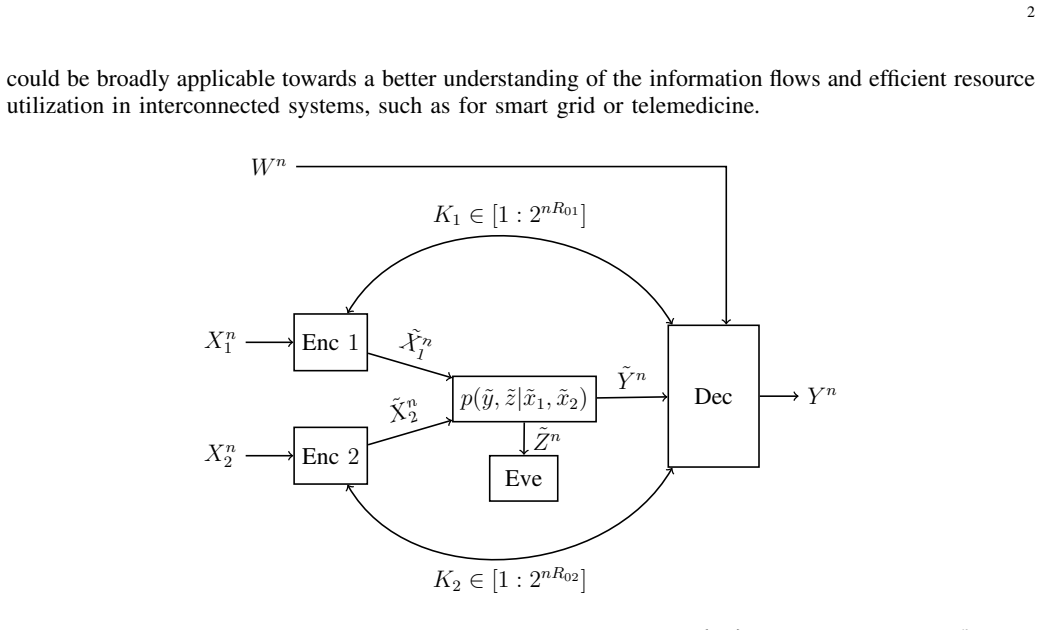
The argument is carried by two pairs of auxiliary random variables: $U_1$ and $U_2$ carry the source descriptions from Encoder 1 and Encoder 2 to the legitimate decoder, while $V_1$ and $V_2$ generate the wiretap code that hides the coordinated actions from the eavesdropper; $T$ is a time-sharing variable. Achievability is proved by random binning: the binning protocol is shown, via output-statistics-of-random-binning estimates and simultaneous decoding of correlated source descriptions, to induce almost the same joint distribution as a random-coding protocol, after which extra shared randomness is removed with a randomness-extraction lemma. The deterministic legitimate channel $\tilde Y = (f_1(\tilde X_1), f_2(\tilde X_2))$ is what makes the characterization tight: setting $V_1 = \tilde Y_1$ and $V_2 = \tilde Y_2$ collapses the general inner bound to three constraints, and with conditional independence the matching converse is obtained directly. Cardinality bounds on $U_1$, $U_2$, and $T$ are established by a perturbation argument so that the converse region is compact and continuous.
What would settle it
Compute or simulate the secure strong-coordination region for a two-transmitter MAC-WT with a non-deterministic legitimate channel and sources with $I(X_1;X_2|W)>0$: if any rate pair outside Theorem 3's region is achievable, or any pair inside is not, the claimed completeness fails. More narrowly, for the paper's Example 1 without cribbing, an attempt to achieve secure channel simulation with $R_{01}<1$, for instance $R_{01}=0.75$, would disprove Proposition 1.
Extended reading notes
Core claim
The paper's central discovery is Theorem 3: for conditionally independent sources ($I(X_1;X_2|W)=0$) and a legitimate channel of deterministic links $\tilde Y = (f_1(\tilde X_1), f_2(\tilde X_2))$, the secure strong-coordination region with unlimited second shared-randomness rate $R_{02}$ is exactly the set of $R_{01}$ satisfying $H(\tilde Y_1|T) \ge I(U_1;X_1|W,T)$, $H(\tilde Y_2|T) \ge I(U_2;X_2|W,T)$, and $R_{01} \ge I(U_1;X_1,Y|X_2,W,T) - H(\tilde Y_1|\tilde Z,T)$, for some auxiliary distribution whose marginal on $(X_1,X_2,W,Y)$ equals the target $q_{X_1X_2WY}$. The achievability side follows from the general inner bound by taking $V_1=\tilde Y_1$, $V_2=\tilde Y_2$, and a large $R_{02}$; the converse is proved directly rather than by specializing the general outer bound. This yields a matching inner-outer characterization for this multi-terminal noisy secure-coordination setting.
Load-bearing premise
The tight region collapses unless the sources are conditionally independent given the decoder side information and the legitimate channel outputs are deterministic functions of the two channel inputs; if either fails, only the non-matching inner and outer bounds remain.
Editorial extensions
If this is right
- For conditionally independent sources and deterministic legitimate links, the secure coordination region is exactly known: no gap remains between achievable and converse rates when $R_{02}$ is unlimited.
- The eavesdropper enters the single rate constraint only through the term $H(\tilde Y_1|\tilde Z,T)$, the residual entropy of the legitimate channel output given the wiretap observation; wiretap noise is thus priced explicitly in the shared-randomness rate.
- Encoder cribbing can strictly enlarge the achievable region: in the paper's binary example, cribbing lowers the required channel entropy from $2$ to $1.5$ bits and the required shared-randomness rate $R_{01}$ from $1$ to $0.5$ bits per symbol.
- The general inner and outer bounds (Theorems 1 and 2) still apply when the tight-case assumptions fail, so the paper supplies a fallback region for arbitrary correlated sources and noisy legitimate channels.
Reading between the lines
- Beyond the paper, the structure of the tight result suggests that the general multiple-access wiretap coordination problem will resist single-letter solutions unless further independence or structural assumptions are imposed, since distributed source coding with decoder side information is tight only under such conditions.
- The cribbing example indicates that one encoder's access to the other encoder's channel input can substitute for part of the shared randomness, so a cribbing link and a secret key may be traded off; the paper does not optimize this trade-off.
- A natural testable extension is to vary the eavesdropper's noise level in the paper's example: the penalty term $H(\tilde Y_1|\tilde Z,T)$ predicts that a noisier wiretap observation monotonically reduces the shared-randomness rate required for secure coordination.
Editorial analysis
A structured set of objections, weighed in public.
Referee Report
Summary. The paper studies strong coordination with secrecy over a discrete memoryless multiple-access wiretap channel (MAC-WT). Two encoders observe i.i.d. correlated sources (X1^n, X2^n) and share pairwise independent randomness (K1, K2) with the decoder; the decoder also observes side information W^n and the legitimate channel output Ytilde^n, and must emit Y^n so that (X1^n, X2^n, W^n, Y^n, Ztilde^n) is close in total variation to q_{X1X2WY}^{(n)} times p_{Ztilde^n}. The authors derive an inner bound (Theorem 1) and an outer bound (Theorem 2), a claimed complete characterization for conditionally independent sources given W and a deterministic legitimate channel with Ytilde = (f1(Xtilde1), f2(Xtilde2)) under unlimited R02 (Theorem 3), and an inner bound for non-causal cribbing at Encoder 1 (Theorem 4). Section V gives an example where cribbing improves the achievable rates. Proofs use OSRB, Slepian-Wolf decoding, the functional representation lemma, and perturbation cardinality bounds.
Significance. If the Theorem 3 characterization is correct, the paper contributes a tight multi-terminal secure strong-coordination result over a wiretap channel, a regime where matching inner and outer bounds are rare; the example and its Proposition 1 converse are also instructive. The general inner/outer bounds appear to follow standard and identifiable techniques, and I did not find obvious errors in the proofs of Theorems 1 and 2 or in Proposition 1. The value of the manuscript is, however, conditional on Theorem 3: the converse currently does not show that the auxiliary variables live in the product-form family (9) over which the theorem is quantified, and Theorem 4 lacks a complete proof. Neither issue is cosmetic.
major comments (2)
- [VIII, Eqs. (8)-(9) and (65)-(66)] The converse of Theorem 3 does not establish that its auxiliary variables satisfy the product-form p.m.f. on which the theorem's rate region is defined. The proof sets U1i = (K1, X_{1,i+1}^n, Ytilde_1^n, W_{~i}) and U2i = (K2, X_{2,i+1}^n, Ytilde_2^n), and then uses these in I(U1; X1|W,T), I(U2; X2|W,T), and I(U1; X1,Y|X2,W,T). Region (9) requires p(u1,u2|x1,x2,w,t) = p(u1|x1,t)p(u2|x2,t), equivalently U1 indep U2 given (X1,X2,W,T) together with the conditional-independence structure inherited from the sources. The constructed variables generally fail this: for example, take q with X1 = X2 = W, W uniform on {0,1}; then I(X1;X2|W)=0, but U1i contains W_{~i} and U2i contains X_{2,i+1}^n, so both contain W_{i+1},...,W_n and I(U1i;U2i|X1i,X2i,Wi) = Theta(n). Thus the derived single-letter inequalities may describe a point outside the region in Theorem 3. The passage from time-sharing averages over T to a product-form distribution is not a routine step here and is not provided. This gap affects the paper's headline characterization; Appendix B's cardinality bounds do not repair it, because they are derived starting from a p.m.f. already assumed to have the form (81)/(9).
- [IX, Theorem 4] The proof of Theorem 4 is an outline rather than a proof. After writing the joint distribution (67) and the two binning conditions (68)-(69), the text states that the Slepian-Wolf constraints, elimination of (F1,F2), strong coordination, and secrecy follow similarly to Theorem 1, and that Fourier-Motzkin elimination gives (10a)-(10h). Because cribbing changes the way Encoder 1 generates (U1,V1) and the channel input, the OSRB equivalence, the Slepian-Wolf rate conditions, and the secrecy analysis all need to be verified with the new conditional structure; this is not shown. As Section V's improvement claim relies on Theorem 4, the example currently inherits this missing support.
minor comments (3)
- [Definition 2] The paragraph after (1) says that strong secrecy holds 'provided that the total variation distance goes to zero exponentially in n', but Definition 2 only requires the limit in (1) to vanish; the definition and the surrounding text should be reconciled.
- [Definition 3] The notation R_{secrecy_noisy-coord, R02 -> infinity} denotes a projection with 'exists R02', not an actual limit; the notation may mislead a reader into thinking a limiting construction is being used.
- [Theorem 4 statement] In the p.m.f. (11), the roles of V1 and V2 in the cribbing scheme are less transparent than in Theorem 1; a short explanation of why the cribbing structure changes the wiretap-coding auxiliary variables in this way would improve readability.
Circularity Check
No significant circularity: the rate regions are derived from external theorems and explicit coding arguments; a possible converse gap about product-form auxiliaries is a correctness concern, not circularity.
full rationale
The derivation chain is self-contained rather than circular. Theorem 1's achievability is proved via the OSRB framework [29] with Slepian-Wolf decoding [30] and external randomness-extraction lemmas [31,32]; Theorem 2's converse uses the functional representation lemma [34] and standard single-letterization tools [7,16]; Theorem 3's converse is derived separately in Section VIII with cardinality bounds from the perturbation method [35]. No fitted parameter is renamed as a prediction, and no rate-region inequality is defined in terms of its own conclusion. The same authors' earlier works [12], [20], and [21] are cited as prior results, conference versions, or benchmarks, not as the load-bearing justification for the present characterization, so they do not constitute circularity. One non-circular concern is flagged per the review rule: in the converse proof of Theorem 3, the auxiliaries are U1i=(K1,X_{1,i+1}^n,\tilde Y_1^n,W_{\sim i}) and U2i=(K2,X_{2,i+1}^n,\tilde Y_2^n), while the stated region is quantified over p.m.f.s of the product form (9); the manuscript does not verify that this construction satisfies p(u1,u2|x1,x2,w,t)=p(u1|x1,t)p(u2|x2,t), and in general correlated W can make the constructed pair violate that structure. That is a potential correctness gap in the claimed tight characterization, but it is not a circular reduction of the theorem's conclusion to its inputs.
Assumptions & free parameters
assumptions (7)
- domain assumption Discrete memoryless multiple-access wiretap channel with finite alphabets and i.i.d. sources.
- domain assumption Pairwise shared randomness K1,K2 are uniform, independent of each other and of the sources.
- standard math OSRB theorem [29] guarantees equivalence of random binning and random coding protocols under the stated rate constraints.
- standard math Slepian-Wolf theorem [30] guarantees reliable recovery of source descriptions from bin indices and side information.
- standard math Functional representation lemma [34] permits randomized encoders to be written as deterministic functions of private randomness.
- domain assumption Conditional independence X1 independent of X2 given W and deterministic legitimate channel Y_tilde=(f1(X_tilde1),f2(X_tilde2)).
- domain assumption Cribbing model of [4, Situation 4]: Encoder 1 non-causally observes X_tilde2^n before encoding.
Cite this review
Pith. "Pith review of Multi-terminal Strong Coordination subject to Secrecy Constraints." pith.science (2026). https://pith.science/paper/AF46BXUZ
@misc{pith2026241114123,
  author       = {Pith},
  title        = {Pith review of: Multi-terminal Strong Coordination subject to Secrecy Constraints},
  year         = {2026},
  howpublished = {\url{https://pith.science/paper/AF46BXUZ}},
  note         = {Machine review of arXiv:2411.14123}
}
read the original abstract
A fundamental problem in decentralized networked systems is to coordinate actions of different agents so that they reach a state of agreement. In such applications, it is additionally desirable that the actions at various nodes may not be anticipated by malicious eavesdroppers. Motivated by this, we investigate the problem of secure multi-terminal strong coordination aided by a multiple-access wiretap channel. In this setup, independent and identically distributed copies of correlated sources are observed by two transmitters who encode the channel inputs to the MAC-WT. The legitimate receiver observing the channel output and side information correlated with the sources must produce approximately i.i.d. copies of an output variable jointly distributed with the sources. Furthermore, we demand that an external eavesdropper learns essentially nothin g about the sources and the simulated output sequence by observing its own MAC-WT output. This setting is aided by the presence of independent pairwise shared randomness between each encoder and the legitimate decoder, that is unavailable to the eavesdropper. We derive an achievable rate region based on a combination of coordination coding and wiretap coding, along with an outer bound. The inner bound is shown to be tight and a complete characterization is derived for the special case when the sources are conditionally independent given the decoder side information and the legitimate channel is composed of deterministic links. Further, we also analyze a more general scenario with possible encoder cooperation, where one of the encoders can non-causally crib from the other encoders input, for which an achievable rate region is proposed. We then explicitly compute the rate regions for an example both with and without cribbing between the encoders, and demonstrate that cribbing strictly improves upon the achievable rate region.
Figures

Forward citations
Cited by 1 Pith paper
-
Multi-terminal Strong Coordination over Noisy Channels with Encoder Co-operation
For strong coordination over a MAC, the paper derives an achievable shared-randomness region with cribbing encoders and a tight characterization without cribbing for deterministic links with conditionally independent sources.
Reference graph
Works this paper leans on
-
[1]
Common randomness in infor mation theory and cryptography. I. Secret sharing,
R. Ahlswede and I. Csisz´ ar, “Common randomness in infor mation theory and cryptography. I. Secret sharing,” IEEE Transactions on Information Theory , vol. 39, no. 4, pp. 1121–1132, 1993
work page 1993
-
[2]
Common randomness in information theory and crypto graphy. II. CR capacity,
——, “Common randomness in information theory and crypto graphy. II. CR capacity,” IEEE Transactions on Information Theory , vol. 44, no. 1, pp. 225–240, 1998
work page 1998
-
[3]
P . Cuff, H. Permuter, and T. Cover, “Coordination capaci ty,” IEEE Transactions on Information Theory , vol. 56, no. 9, pp. 4181–4206, 2010
work page 2010
-
[4]
The discrete memoryles s multiple-access channel with cribbing encoders,
F. Willems and E. V an der Meulen, “The discrete memoryles s multiple-access channel with cribbing encoders,” IEEE Transactions on Information Theory , vol. 31, no. 3, pp. 313–327, 1985
work page 1985
-
[5]
Entang lement-assisted capacity of a quantum channel and the rever se Shannon theorem,
C. Bennett, P . Shor, J. Smolin, and A. Thapliyal, “Entang lement-assisted capacity of a quantum channel and the rever se Shannon theorem,” IEEE Transactions on Information Theory , vol. 48, no. 10, pp. 2637–2655, 2002
work page 2002
-
[6]
The quantum reverse Shannon theorem and resource tradeoff s for simulating quantum channels,
C. Bennett, I. Devetak, A. Harrow, P . Shor, and A. Winter, “The quantum reverse Shannon theorem and resource tradeoff s for simulating quantum channels,” IEEE Transactions on Information Theory , vol. 60, no. 5, pp. 2926–2959, 2014
work page 2014
-
[7]
Distributed channel synthesis,
P . Cuff, “Distributed channel synthesis,” IEEE Transactions on Information Theory , vol. 59, no. 11, pp. 7071–7096, 2013
work page 2013
-
[8]
Channel simulation v ia interactive communications,
M. Yassaee, A. Gohari, and M. Aref, “Channel simulation v ia interactive communications,” IEEE Transactions on Information Theory , vol. 61, no. 6, pp. 2964–2982, 2015
work page 2015
Show all 37 references
-
[9]
Secure cascade channel synthes is,
S. Satpathy and P . Cuff, “Secure cascade channel synthes is,” IEEE Transactions on Information Theory , vol. 62, no. 11, pp. 6081–6094, 2016
2016
-
[10]
Strong coordina tion over multi-hop line networks using channel resolvabil ity codebooks,
B. V ellambi, J. Kliewer, and M. Bloch, “Strong coordina tion over multi-hop line networks using channel resolvabil ity codebooks,” IEEE Transactions on Information Theory , vol. 64, no. 2, pp. 1132–1162, 2017
2017
-
[11]
Strong coordination with side information,
V . Ramachandran, S. R. B. Pillai, and V . M. Prabhakaran, “Strong coordination with side information,” in 2020 IEEE International Symposium on Information Theory (ISIT) , 2020, pp. 1564–1569
2020
-
[12]
Multiple access channel simulation,
G. R. Kurri, V . Ramachandran, S. R. B. Pillai, and V . M. Pr abhakaran, “Multiple access channel simulation,” IEEE Transactions on Information Theory , vol. 68, no. 11, pp. 7575–7603, 2022
2022
-
[13]
Mu lti-terminal strong coordination with degraded source obs ervations,
V . Ramachandran, T. J. Oechtering, and M. Skoglund, “Mu lti-terminal strong coordination with degraded source obs ervations,” in 2024 IEEE Information Theory W orkshop (ITW) , 2024
2024
-
[14]
When is it possible to simulate a DMC channel from another?
F. Haddadpour, M. H. Yassaee, M. R. Aref, and A. Gohari, “ When is it possible to simulate a DMC channel from another?” i n IEEE Information Theory W orkshop, 2013, pp. 1–5
2013
-
[15]
Simulation of a channel with another channel,
F. Haddadpour, M. H. Yassaee, S. Beigi, A. Gohari, and M. R. Aref, “Simulation of a channel with another channel,” IEEE Transactions on Information Theory , vol. 63, no. 5, pp. 2659–2677, 2017
2017
-
[16]
Stron g coordination of signals and actions over noisy channels wi th two-sided state information,
G. Cervia, L. Luzzi, M. Le Treust, and M. R. Bloch, “Stron g coordination of signals and actions over noisy channels wi th two-sided state information,” IEEE Transactions on Information Theory , vol. 66, no. 8, pp. 4681–4708, 2020
2020
-
[17]
Secure channel simulation,
A. Gohari, M. H. Yassaee, and M. R. Aref, “Secure channel simulation,” in 2012 IEEE Information Theory W orkshop . IEEE, 2012, pp. 406–410
2012
-
[18]
Int eractive secure function computation,
D. Data, G. R. Kurri, J. Ravi, and V . M. Prabhakaran, “Int eractive secure function computation,” IEEE Transactions on Information Theory, vol. 66, no. 9, pp. 5492–5521, 2020
2020
-
[19]
Secure strong coo rdination,
G. Cervia, G. Bassi, and M. Skoglund, “Secure strong coo rdination,” in 2020 IEEE Conference on Communications and Network Security (CNS) . IEEE, 2020, pp. 1–6
2020
-
[20]
Mu lti-terminal strong coordination over noisy channels with secrecy constraints,
V . Ramachandran, T. J. Oechtering, and M. Skoglund, “Mu lti-terminal strong coordination over noisy channels with secrecy constraints,” in 2024 IEEE International Symposium on Information Theory (I SIT), 2024
2024
-
[21]
Multi-terminal strong coordination over noisele ss networks with secrecy constraints,
——, “Multi-terminal strong coordination over noisele ss networks with secrecy constraints,” in 2024 International Zurich Seminar on Information and Communication (IZS) . ETH Zurich Library, 2024
2024
-
[22]
Multiterminal source coding,
T. Berger, “Multiterminal source coding,” The information theory approach to communications , vol. 229, pp. 171–231, 1977
1977
-
[23]
Computing a function of correlated sources: A rate region,
M. Sefidgaran and A. Tchamkerten, “Computing a function of correlated sources: A rate region,” in IEEE International Symposium on Information Theory , 2011, pp. 1856–1860
2011
-
[24]
Distributed function computation over a rooted di rected tree,
——, “Distributed function computation over a rooted di rected tree,” IEEE Transactions on Information Theory , vol. 62, no. 12, pp. 7135–7152, 2016
2016
-
[25]
The Wyner-Ziv problem with multiple sourc es,
M. Gastpar, “The Wyner-Ziv problem with multiple sourc es,” IEEE Transactions on Information Theory , vol. 50, no. 11, pp. 2762–2768, 2004
2004
-
[26]
How to encode the modulo-two s um of binary sources (corresp.),
J. K¨ orner and K. Marton, “How to encode the modulo-two s um of binary sources (corresp.),” IEEE Transactions on Information Theory , vol. 25, no. 2, pp. 219–221, 1979
1979
-
[27]
On computing a functi on of correlated sources,
M. Sefidgaran and A. Tchamkerten, “On computing a functi on of correlated sources,” arXiv preprint arXiv:1107.5806 , 2011
2011 arXiv
-
[28]
Rate-distortion for correlate d sources with partially separated encoders,
A. Kaspi and T. Berger, “Rate-distortion for correlate d sources with partially separated encoders,” IEEE Transactions on Information Theory, vol. 28, no. 6, pp. 828–840, 1982
1982
-
[29]
Achievability proo f via output statistics of random binning,
M. Yassaee, M. Aref, and A. Gohari, “Achievability proo f via output statistics of random binning,” IEEE Transactions on Information Theory, vol. 60, no. 11, pp. 6760–6786, 2014
2014
-
[30]
Noiseless coding of correlated information sources,
D. Slepian and J. Wolf, “Noiseless coding of correlated information sources,” IEEE Transactions on information Theory , vol. 19, no. 4, pp. 471–480, 1973
1973
-
[31]
Joint channel intrinsic r andomness and channel resolvability,
A. J. Pierrot and M. R. Bloch, “Joint channel intrinsic r andomness and channel resolvability,” in 2013 IEEE Information Theory W orkshop (ITW). IEEE, 2013, pp. 1–5
2013
-
[32]
Coordination of autonomous devices over no isy channels: capacity results and coding techniques,
G. Cervia, “Coordination of autonomous devices over no isy channels: capacity results and coding techniques,” Ph. D. dissertation, Universit´ e de Cergy Pontoise, 2018
2018
-
[33]
T. M. Cover and J. A. Thomas, Elements of information theory . John Wiley & Sons, 2012
2012
-
[34]
El Gamal and Y .-H
A. El Gamal and Y .-H. Kim, Network information theory . Cambridge University Press, 2011. 27
2011
-
[35]
Evaluation of Marton’s inner bound for the general broadcast channel,
A. A. Gohari and V . Anantharam, “Evaluation of Marton’s inner bound for the general broadcast channel,” IEEE Transactions on Information Theory , vol. 58, no. 2, pp. 608–619, 2012
2012
-
[36]
Communication and state estimation over a state-dependen t Gaussian multiple-access channel,
V . Ramachandran, S. R. B. Pillai, and V . M. Prabhakaran, “Communication and state estimation over a state-dependen t Gaussian multiple-access channel,” in 2018 Twenty F ourth National Conference on Communications ( NCC), pp. 1–6
2018
-
[37]
Feedback-capacit y of degraded Gaussian vector BC using directed information and concave envelopes,
V . Ramachandran and S. R. B. Pillai, “Feedback-capacit y of degraded Gaussian vector BC using directed information and concave envelopes,” in 2017 Twenty-third National Conference on Communications ( NCC). IEEE, 2017, pp. 1–6
2017
Reviewed August 12, 2026 · model on record in the stance chip above.
Discussion (0). Continue with ORCID to comment.